QuickBooks usually works until the finance team needs answers it wasn't designed to provide. The close slows down because fund details live in spreadsheets, grant reporting depends on manual reconciliations, and board reports require finance staff to rebuild the same information from disconnected systems. Restricted and unrestricted resources become harder to monitor, while audit support turns into a search through old files, emails, and workarounds.
The right nonprofit fund accounting software should connect fund tracking, grant reporting, budgeting, controls, and decision-ready dashboards. It should also fit the organization's operating model, whether that means a church with a small finance team, a grant-funded nonprofit with complex awards, or a multi-entity organization managing programs across locations.
This comparison examines seven platforms based on the operational challenges they address, covering fund stewardship, grant workflows, multi-entity management, deployment options, organizational scale, integrations, reporting capabilities, pricing, and implementation requirements. Sage Intacct serves as the primary mid-market benchmark, while Lucentive assists leaders in evaluating suitability and planning an implementation without purchasing software independently.
Key Takeaways
- The right nonprofit fund accounting software depends on your organization’s operating model — a small church, a grant-funded nonprofit, and a multi-entity organization each need different capabilities.
- Sage Intacct is positioned as the strongest mid-market option for nonprofits that have outgrown QuickBooks, with a dimensional general ledger connecting fund, grant, program, location, and entity reporting.
- Smaller, centralized nonprofits may be better served by Aplos, which bundles accounting, giving, donor records, and events into one accessible system.
- Organizations already anchored to Blackbaud’s Raiser’s Edge NXT, or focused on restricted funds and endowments, may favor Blackbaud Financial Edge NXT.
- Under U.S. GAAP, nonprofit net assets are reported in two classes — with donor restrictions and without — and financial statements must show restricted and unrestricted amounts separately.
- No platform is the right answer purely on feature list; the implementation itself has to preserve historical grant data, protect the audit trail, and make reporting usable for people outside finance.
Table of Contents
- 1. Sage Intacct for Nonprofits
- 2. Blackbaud Financial Edge NXT
- 3. MIP Fund Accounting
- 4. Oracle NetSuite for Nonprofits
- 5. AccuFund Accounting Suite
- 6. Aplos
- 7. NonProfit+ built on Acumatica Cloud ERP
- Top 7 Nonprofit Fund Accounting Software Comparison
- Choose the Platform That Fits Your Operating Model
1. Sage Intacct for Nonprofits
Sage Intacct is the strongest starting point for a mid-market nonprofit that has outgrown QuickBooks and needs financial control without adopting an unnecessarily broad enterprise platform. Its cloud financials support organizations managing multiple funds, grants, programs, locations, and entities, with a dimensional structure that lets finance teams analyze transactions by the operational context behind them.
The key advantage is not just fund accounting. It's the ability to connect fund, grant, program, location, and entity reporting inside the general ledger. Native grant tracking and billing support compliance workflows, while dynamic allocations and nonprofit revenue recognition help finance teams manage costs and revenue more consistently. Sage Intacct Planning adds budgeting and planning capabilities, and AI assistants can support close activities and finance inquiries.
Practical rule: Configure the reporting model before you configure the screens. A clean dimensional design creates more value than a long list of enabled modules.
Sage Intacct also fits organizations that need stronger board and program visibility. Role-based reporting can give board members, executives, and program leaders access to the information relevant to their responsibilities without exposing every accounting detail. Open integrations support connections with CRM and HR systems, which helps reduce the gap between development, people operations, programs, and finance.
The trade-off is cost and configuration. Pricing is quote-based and can exceed entry-level tools for smaller organizations. Teams also need to make disciplined choices about dimensions, allocations, approvals, and reporting structures. That's where implementation guidance matters. Lucentive's Sage Intacct nonprofit services can help finance leaders translate operational requirements into a usable system design.
For organizations with multiple entities, growing grant complexity, and a need for real-time management reporting, Sage Intacct is the best overall benchmark.
Visit Sage Intacct for nonprofits
2. Blackbaud Financial Edge NXT
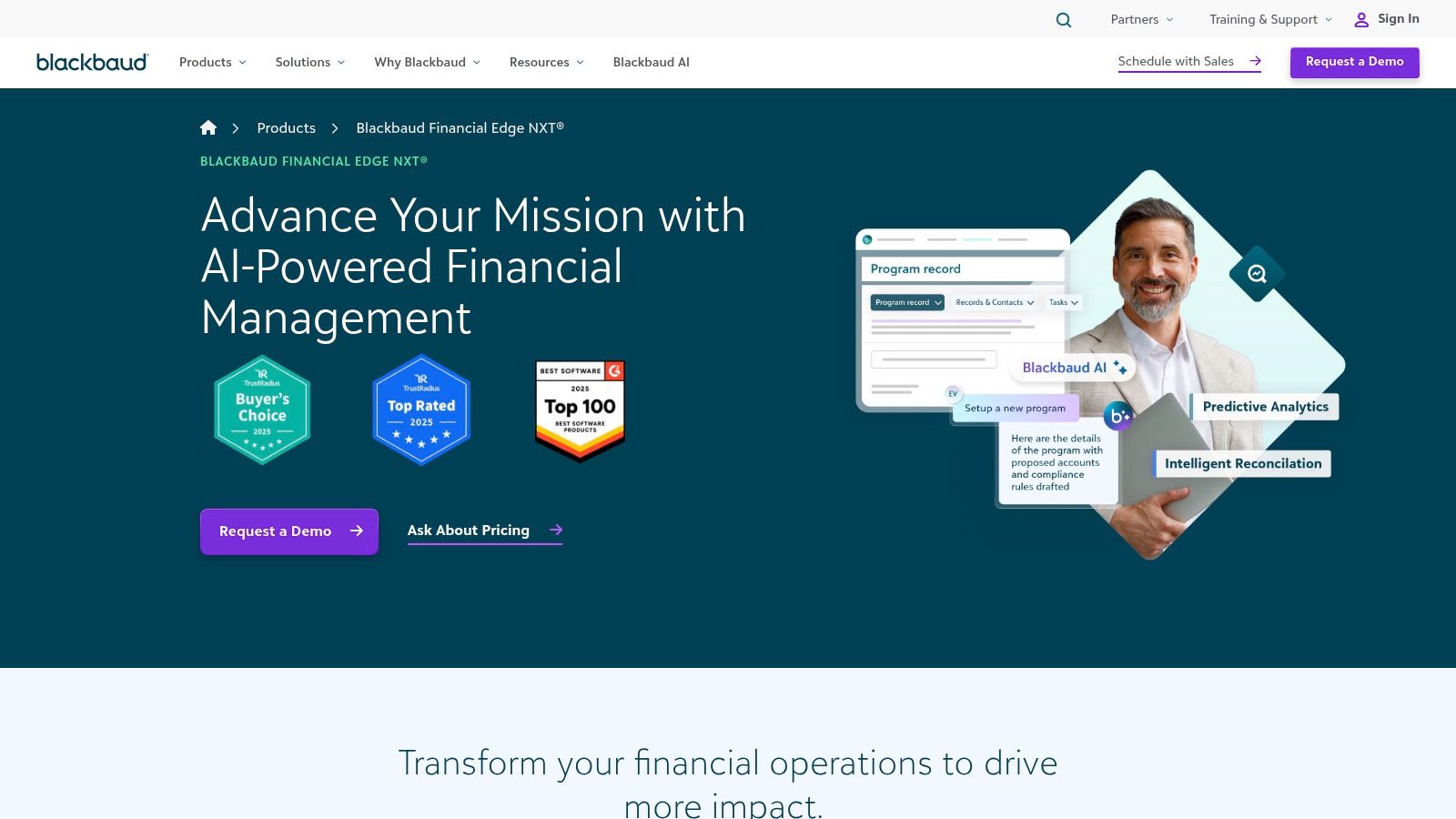
Blackbaud Financial Edge NXT makes the most sense when restricted-fund stewardship and development integration sit at the center of the finance operating model. It's designed for nonprofit organizations that need segmented accounting, subfund and endowment tracking, audit-ready controls, and close coordination between finance and fundraising.
Its chart of accounts and subfund accounting support detailed reporting for grants and endowments. AI-assisted reconciliation, invoice capture, and anomaly or spend controls can reduce manual review work, while nonprofit templates and dashboards give finance teams a starting point for common reporting needs. View-only access can also help stakeholders review financial information without becoming accounting-system users.
The platform's defining strength is its connection to the Blackbaud ecosystem. Organizations already using Raiser's Edge NXT can create a more direct relationship between donor activity and financial reporting. That can be valuable for development teams that need finance to confirm how gifts, restrictions, and program activity are being reflected.
The trade-off is ecosystem dependence. Financial Edge NXT is optimized for Blackbaud products, so organizations using a broader mix of CRM, grant, HR, or operational systems should test integration requirements early. Custom pricing and add-ons can also make the total investment harder to estimate from a basic product review.
Don't evaluate Financial Edge NXT only with the Controller. Bring development leadership into the process, then test whether the finance and fundraising workflows actually remove duplicate work.
For nonprofits whose priority is donor-restricted reporting and a Blackbaud-centered technology stack, Financial Edge NXT deserves serious consideration. For organizations seeking broader dimensional flexibility and multi-entity operating control, compare it closely with Sage Intacct. Lucentive's nonprofit accounting software guidance can help frame that comparison around reporting design and implementation risk.
Visit Blackbaud Financial Edge NXT
3. MIP Fund Accounting
MIP Fund Accounting is the practical choice for organizations that value deep fund accounting, broad reporting, and deployment flexibility over a modern consumer-style interface. It serves nonprofits, government organizations, and education institutions, with cloud SaaS, hosted, and on-premises options.
The product has a long history in nonprofit finance. MIP Fund Accounting launched in 1982, when Micro Information Products was founded in Austin, Texas to build a flexible fund accounting system for nonprofits. Its early DOS product combined basic accounting with financial statement production, accounts payable and receivable, and table-driven chart-of-accounts reporting designed to support grant schedules that didn't align with an organization's fiscal year. The product later evolved from DOS to Windows and then cloud SaaS, reflecting the category's movement from desktop tools to subscription platforms over multiple decades. This history of MIP Fund Accounting also highlights why grant compliance remains central to nonprofit finance.
MIP's multidimensional chart of accounts supports fund and grant reporting, while requisition and purchase order workflows can bring more control to spending before invoices arrive. Integrated payroll and HR options broaden the platform's reach, and FASB and GASB reporting support organizations with nonprofit, government, or education requirements.
Its weakness is user experience. The interface can feel traditional, and complex configurations often require partner assistance. Deployment flexibility is useful, but it also creates more decisions around hosting, upgrades, security, integrations, and ownership of technical administration.
A flexible deployment model isn't automatically a lower-risk model. Ask who owns upgrades, integrations, data validation, and user support after go-live.
MIP is a good fit when reporting breadth and deployment choice matter more than a smooth cloud experience. Build the implementation plan before signing, including data migration, chart-of-accounts redesign, training, and post-launch support. Lucentive's guidance on planning ERP implementation costs, time, and resources is relevant to that evaluation.
4. Oracle NetSuite for Nonprofits
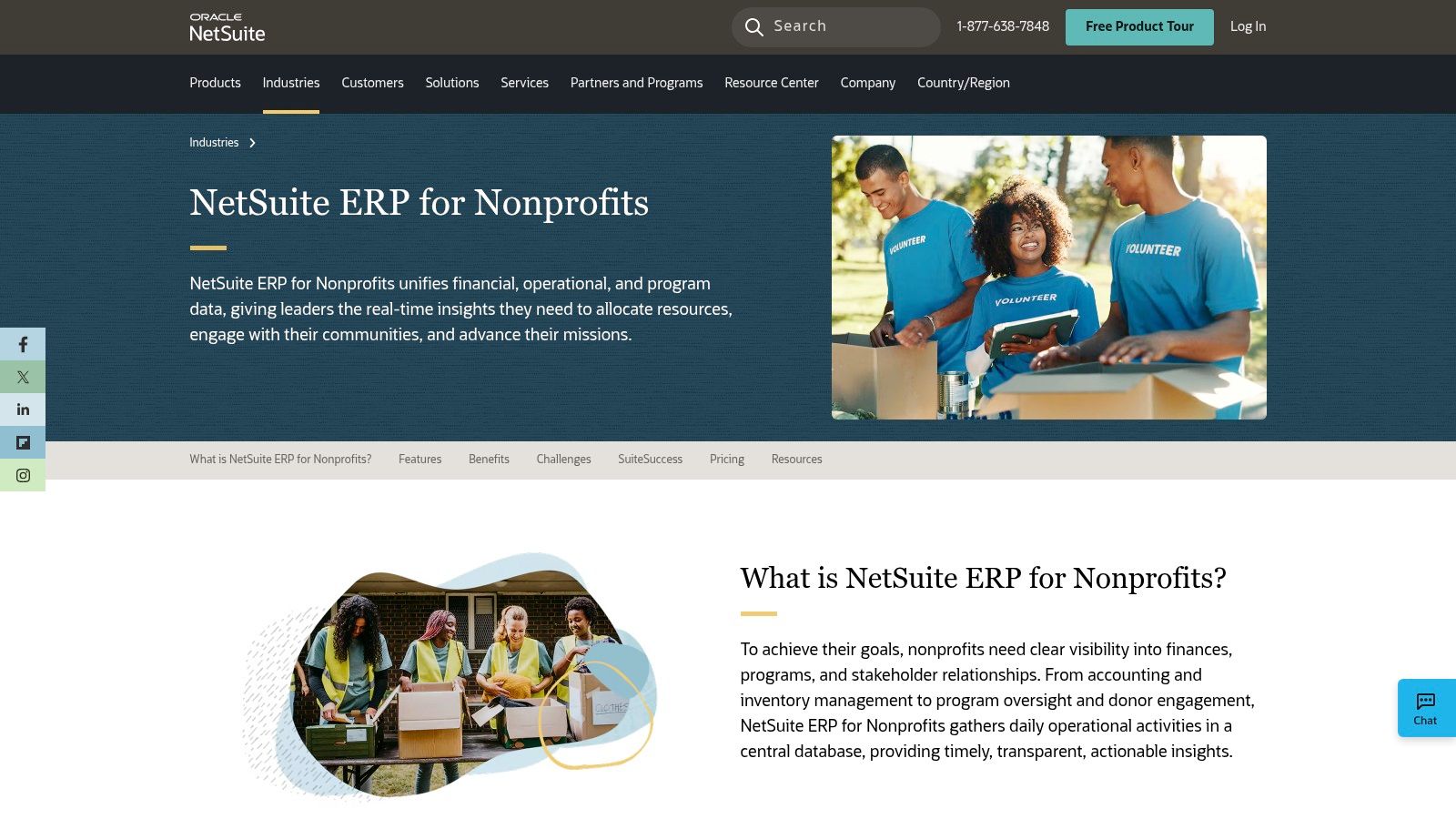
Oracle NetSuite is for nonprofit organizations that need a full cloud ERP for finance and operations, not just a stronger accounting system. Its nonprofit editions and Social Impact tiers package nonprofit data structures, roles, dashboards, and processes, while the broader platform supports procurement, inventory, and other operational functions.
Nonprofit editions include Donation, Starter, and Standard options, with prebuilt nonprofit roles and dashboards. Industry SuiteApps can extend the platform with nonprofit general ledger capabilities, grant and program tracking, and fundraising integrations. NetSuite's enterprise architecture is particularly relevant to organizations managing multiple subsidiaries, currencies, or complex consolidation requirements.
That breadth is both the reason to choose NetSuite and the reason to be cautious. A single platform can reduce the need to maintain separate finance and operational systems. It can also introduce a larger implementation footprint than a mid-market financial management platform. The team must define entities, dimensions, workflows, approval rules, integrations, and historical data requirements before configuration begins.
Pricing and implementation can be higher and longer than mid-market accounting systems. Success depends heavily on the implementation partner, because a technically correct deployment can still fail if program leaders, development teams, and finance users don't receive reports that match how the organization operates.
The question for a buyer is simple: does the organization need NetSuite's operational breadth now, or is it buying complexity for a future state that isn't yet funded?
NetSuite is a strong candidate for a large, complex, or globally operating nonprofit. It's less compelling for a finance team that primarily needs faster close, better fund visibility, and stronger grant reporting without a full operational ERP transformation. Review the difference between selecting a platform and selecting the team that will implement it, as discussed in Lucentive's comparison of ERP choices beyond QuickBooks.
Visit Oracle NetSuite for nonprofits
5. AccuFund Accounting Suite
AccuFund Accounting Suite is built for nonprofits and government organizations that need fund accounting depth with deployment choice. AccuFund Anywhere provides a cloud option, while on-premises deployment remains available for teams with specific infrastructure, control, or policy requirements.
The platform includes a nonprofit-specific general ledger, report writer, budgeting, and grant reporting. Requisitions and purchasing workflows can help organizations establish control before spending reaches accounts payable. Optional Endowment Management adds a path for organizations that need to manage endowment-related information alongside core accounting.
AccuFund's broad functional coverage makes it attractive for organizations that don't want to assemble every nonprofit requirement through separate products. Role-based access and distributed access support teams working across locations or departments, while modular options allow the system to expand with requirements.
The drawback is that the platform feels more traditional than newer cloud-first products. Third-party integrations are also fewer than those typically associated with the largest cloud ERP ecosystems. Public pricing is scarce, so a meaningful evaluation requires a demonstration tied to the organization's chart of accounts, grant structure, purchasing process, and reporting calendar.
Ask the vendor to demonstrate your month-end close, not a generic dashboard. You need to see how restricted funds, allocations, approvals, and audit support work together.
AccuFund is a sensible option for nonprofits and public-sector organizations that prioritize fund accounting requirements and deployment flexibility. It requires a more deliberate evaluation than a software review page can provide. The finance team should document which modules are essential, which are optional, and which external systems must exchange data before comparing total cost.
Visit AccuFund Accounting Suite
6. Aplos
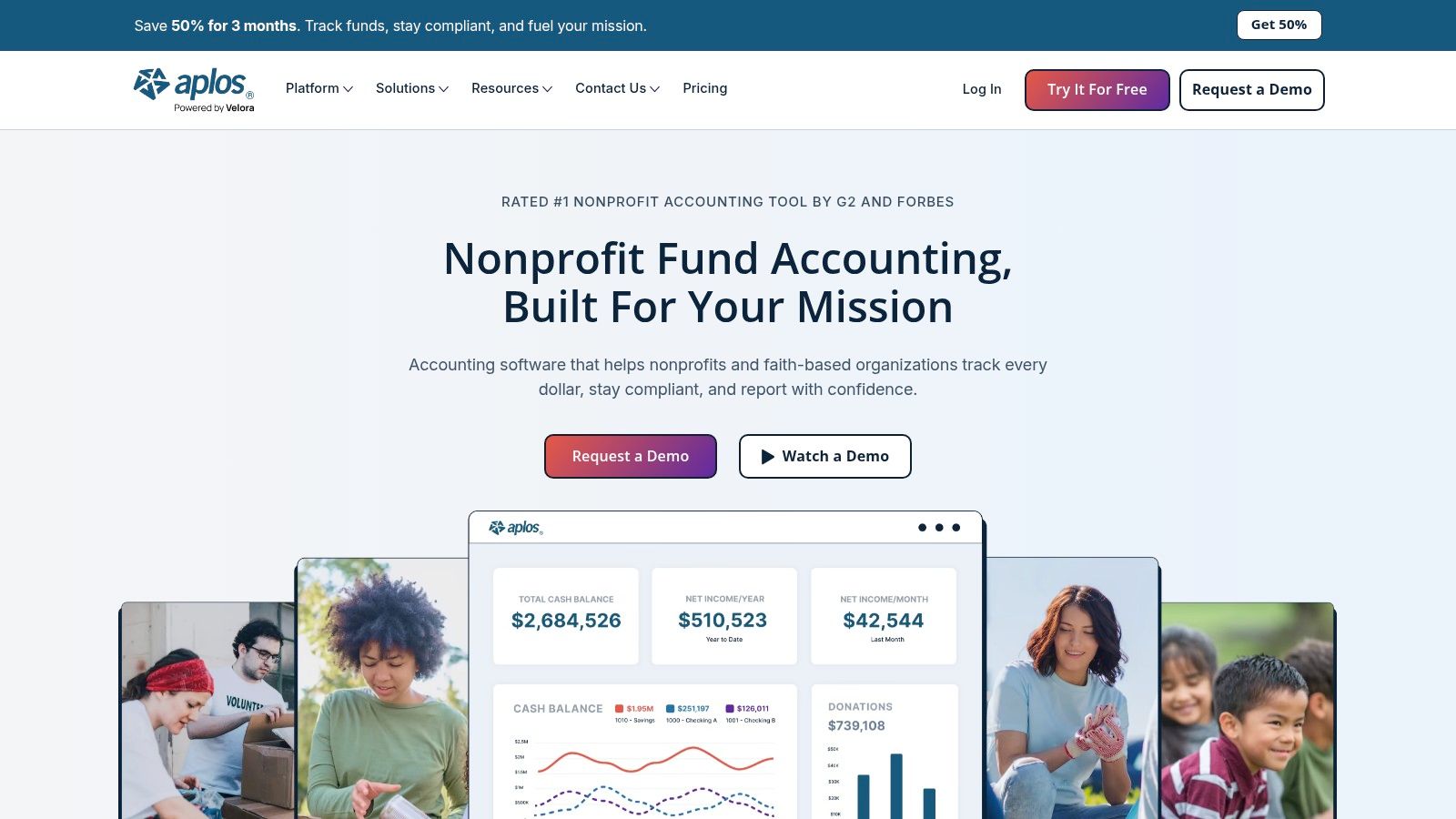
Aplos is the accessible option for small nonprofits and churches moving beyond general-purpose small-business accounting. It combines accounting with online giving, donor management, event registration, and basic website tools, which can be appealing when one small team handles finance and development.
Its true fund accounting model supports balance sheets and income statements by fund, along with accounts payable, accounts receivable, recurring transactions, and budgeting or reporting dimensions at higher tiers. Online giving, donor CRM, and event registration are integrated into the same product, reducing the need to connect several entry-level tools.
The adoption case is straightforward. A small organization can use published pricing to understand its starting point, train users on a nonprofit-first interface, and avoid building a large technology stack before the finance function is ready for one. That makes Aplos particularly relevant for churches, volunteer-supported organizations, and smaller nonprofits without a dedicated systems administrator.
The limits appear as operational complexity grows. Feature depth and scalability are below mid-market ERPs, and larger organizations may eventually need more advanced multi-entity control, dimensional reporting, integrations, approval workflows, or grant management. Moving later can also require another data migration, so leaders should consider the likely operating model rather than only the current budget.
Aplos is the right decision when speed of adoption and straightforward nonprofit functionality matter more than enterprise reporting depth. It isn't the right benchmark for a multi-entity nonprofit preparing for advanced board reporting, complex grants, or broad operational integration.
Before choosing it, define the next stage of finance maturity. If the organization expects to remain small and centralized, Aplos may fit well. If growth will add entities, programs, locations, or reporting obligations, evaluate the migration path before committing.
7. NonProfit+ built on Acumatica Cloud ERP
NonProfit+ is for organizations that want fund accounting embedded in a broader Acumatica ERP operating model. It adds unrestricted, restricted, endowment, and board fund management to Acumatica's financials, with self-balancing funds, encumbrances, grants, procurement, and workflow capabilities.
Self-balancing funds and due-to/due-from automation support organizations that need clearer separation between funds without relying on manual interfund calculations. Integrated requests, purchasing, budget controls, and encumbrance support can connect finance policy to operational spending. Optional modules such as purchasing, inventory, and fixed assets extend the system beyond the general ledger.
That ERP foundation is the main differentiator. NonProfit+ can suit an organization standardizing on Acumatica and looking for a platform that supports operational workflows alongside accounting. Its extensibility and workflow customization can also help organizations model processes that don't fit a basic nonprofit accounting package.
The trade-off is evaluation complexity. NonProfit+ is sourced and priced through partners, so the buyer isn't evaluating only a product. The buyer is evaluating the partner's nonprofit experience, Acumatica capabilities, implementation method, integration approach, and post-go-live support. The ecosystem is also smaller than the largest nonprofit finance platforms, which may affect recruiting, peer references, and available integrations.
Choose NonProfit+ when Acumatica is part of the operating strategy. Don't choose it solely because it can produce nonprofit financial statements.
This platform is a strong candidate for a growing organization that wants fund accounting and ERP operations in one environment. For a finance team seeking a more focused cloud financial management deployment, compare scope, timeline, reporting design, and partner capacity carefully. Lucentive's explanation of cloud-enabled versus cloud-native financial planning provides useful context for evaluating the underlying technology model.
Top 7 Nonprofit Fund Accounting Software Comparison
| Item | 🔄 Implementation complexity | ⚡ Resource requirements | 📊 Expected outcomes | Ideal use cases | ⭐ Key advantages | 💡 Tips |
|---|---|---|---|---|---|---|
| Sage Intacct for Nonprofits | Moderate–High; configurable dimensions & allocations (partner often recommended) | Moderate–High; licenses, integrations (CRM/HR), training | Strong stewardship, multi-entity consolidation, advanced dimensional reporting | Multi-entity or grant-heavy nonprofits scaling financial controls | Dimensional GL, native grant tracking, dynamic allocations, planning tools | Model dimensions up front; engage a partner for complex setups |
| Blackbaud Financial Edge NXT | Moderate; optimized workflows but tied to Blackbaud ecosystem | Moderate; works best with Raiser's Edge NXT; add-ons increase cost | Audit-ready controls, donor-restricted reporting, streamlined reconciliation | Nonprofits using Blackbaud fundraising or needing subfund/endowment tracking | Segmented chart of accounts, AI-assisted reconciliation, nonprofit templates | Evaluate total cost of ownership and vendor fit with fundraising systems |
| MIP Fund Accounting | Moderate; flexible deployments (cloud/hosted/on-prem) but can be complex | Moderate; deployment choice affects IT and staffing needs | Robust fund accounting, FASB/GASB-compliant reporting, deep report breadth | Government, education, and nonprofits needing traditional fund accounting | Flexible deployment, strong reporting, long sector track record | Expect a more traditional UI; plan for partner support on complex setups |
| Oracle NetSuite for Nonprofits | High; enterprise-grade implementation requiring skilled partner | High; higher licensing and implementation time/cost for multi-entity setups | Centralized ERP, global consolidation, cross-functional operations beyond finance | Large, multi-subsidiary nonprofits requiring full ERP capabilities | Single platform for finance/operations, enterprise consolidation, Social Impact tiers | Budget for longer implementations and experienced partners |
| AccuFund Accounting Suite | Moderate; configurable with a traditional interface | Moderate; fewer third‑party integrations; demo-based evaluation | Solid fund/government accounting with optional endowment and purchasing | Mid-sized nonprofits/governments needing comprehensive fund features | Depth in fund accounting, flexible deployment, add-on modules | Validate integration needs and request hands‑on demos for pricing clarity |
| Aplos | Low; quick to adopt with published pricing | Low; designed for small teams, includes donor tools | Fast adoption, basic true fund accounting, integrated giving/CRM | Small nonprofits and churches moving up from small-business systems | Clear pricing, combined accounting + donor/event tools, ease of use | Good starter system, plan migration if growth demands deeper features |
| NonProfit+ (Acumatica) | Moderate–High; partner-sourced implementation and configuration | Moderate–High; Acumatica licensing, partner services, module choices | Full ERP extensibility with deep fund accounting and encumbrance support | Organizations standardizing on Acumatica needing ERP-wide capabilities | Fund accounting on a modern ERP, workflow customization, procurement integration | Engage an Acumatica partner early; review community and support resources |
Choose the Platform That Fits Your Operating Model
The best nonprofit fund accounting software depends on the problem your finance team needs to solve first.
Smaller nonprofits and churches may prioritize accessible adoption, nonprofit-first terminology, and published pricing. Aplos can be a practical fit when the finance structure is centralized and the organization needs accounting, giving, donor records, and events in one approachable system. The decision should still include a view of future requirements, especially if the organization expects more programs, grants, locations, or entities.
Organizations focused on restricted funds, endowments, and development integration may favor Blackbaud Financial Edge NXT, particularly when Raiser's Edge NXT already anchors the technology stack. Government and education organizations may value MIP or AccuFund because of their reporting breadth, modularity, and deployment options. NonProfit+ deserves attention when Acumatica is already the preferred ERP foundation.
For mid-market nonprofits managing multiple entities, programs, grants, and increasingly detailed reporting demands, assess Sage Intacct against the full operating model. Its dimensional general ledger, grant tracking, allocations, planning, role-based reporting, and open integrations can support a finance function that needs more than separate fund ledgers and manually assembled reports. The platform also gives leaders a clearer path from accounting data to board, program, and executive decisions.
Sage Intacct is not automatically the right answer because it has the right feature list. The implementation must preserve historical grant data, protect the audit trail, define restricted-fund workflows, and make reporting usable for people outside finance. Under U.S. GAAP, nonprofit net assets are reported in two classes, with donor restrictions and without donor restrictions. Restrictions can be purpose-based or time-based, and when satisfied, the amount is reclassified from net assets with donor restrictions to net assets without donor restrictions. This GAAP overview of nonprofit fund accounting explains the accounting structure behind those decisions.
Financial statements must show restricted and unrestricted amounts separately. The Statement of Financial Position presents the two net asset classes, while the Statement of Activities reports revenues and changes in net assets by restriction category, as explained in this guide to GAAP for nonprofits. Restricted funds remain part of total net assets, but they aren't available for general use unless the donor's restriction allows it. Guidance on managing restricted funds makes the operational implication clear: balances must remain separate until the stated condition or time period has been met.
Evaluate the system and partner together. Compare total cost, implementation timeline, migration approach, integrations, controls, reporting design, training, support, and the partner's experience with organizations like yours. A platform that looks affordable can become expensive when finance staff must rebuild reports manually or correct a poorly designed data model. A more capable system can deliver faster time-to-value when the implementation team understands nonprofit accounting and operational realities.
Lucentive is a Sage Intacct National Premier Partner with mid-market, healthcare, and nonprofit experience. Schedule a 30-minute working session or custom Sage Intacct demo with the team to determine whether Sage Intacct fits your organization before you buy Intacct alone.
Lucentive helps finance leaders evaluate nonprofit fund accounting requirements, design Sage Intacct around funds, grants, programs, and entities, and plan an implementation that protects reporting continuity. Visit Lucentive to schedule a 30-minute working session and see whether a Sage Intacct approach fits your organization.
Summary
Choosing nonprofit fund accounting software isn’t really about finding the platform with the longest feature list — it’s about matching a system to how your organization actually operates. A small nonprofit with a centralized finance team has different needs than a multi-entity organization juggling grants across programs and locations. Sage Intacct stands out for mid-market nonprofits that have outgrown QuickBooks and need dimensional reporting across funds, grants, and entities, but Aplos, Blackbaud, MIP, AccuFund, NetSuite, and NonProfit+ each fit a different operating profile.
Whichever platform fits, the harder work is the implementation itself: preserving historical grant data, protecting the audit trail, and making the reporting usable for people outside finance.
FAQ
What is nonprofit fund accounting software?
Fund accounting software tracks money by the restrictions attached to it rather than treating every dollar the same way. Instead of one general ledger, it separates resources into funds tied to specific programs, grants, or donor restrictions, so a nonprofit can report what it has, where it can spend it, and prove compliance with donor intent.
What’s the difference between restricted and unrestricted net assets?
Restricted net assets carry donor-imposed conditions on how or when the money can be used, and those terms are legally enforceable. Unrestricted net assets have no donor-imposed stipulations, so the organization can direct them wherever they’re needed — operations, staffing, or programming. Under U.S. GAAP, both are reported as separate net asset classes on the financial statements.
Is Sage Intacct good for nonprofits?
Sage Intacct is a strong fit for mid-market nonprofits that have outgrown QuickBooks and need more than separate fund ledgers. Its dimensional general ledger connects fund, grant, program, location, and entity reporting, and native grant tracking, dynamic allocations, and role-based reporting support organizations managing multiple programs or entities at once.
What should a small nonprofit or church look for in accounting software?
Smaller organizations with a centralized finance team typically benefit most from accessible adoption, nonprofit-specific terminology, and transparent pricing. A platform like Aplos, which combines accounting, giving, donor records, and events in one system, can be a practical fit — though it’s worth weighing future growth in programs, grants, or locations before committing.
Do I need Sage Intacct if I already use QuickBooks?
Not necessarily right away. QuickBooks tends to work until the finance team needs answers it wasn’t built to provide — fund detail scattered across spreadsheets, manual grant reconciliations, or board reports assembled by hand from disconnected systems. Once those signs show up consistently, it’s worth evaluating a platform built around fund, grant, and entity-level reporting.