A healthcare finance team rarely starts looking for an ERP because someone wants a newer dashboard. The conversation usually begins after another late close, another unexplained variance, or another acquisition that exposes how many versions of the truth the organization is maintaining.
A multi-site specialty group may have separate AP processes across locations, invoices arriving through shared inboxes, and clinical-system data that finance can't reconcile without rebuilding spreadsheets. Add a new payer contract, a pending acquisition, or tighter lender scrutiny, and the accounting stack stops being an inconvenience. It becomes a control risk.
ERP in healthcare is a finance decision before it's an IT decision. The right platform can give leaders one financial view across entities, preserve an audit trail, and reduce the manual work that keeps experienced people focused on reconciliations instead of analysis. The wrong implementation can disrupt the close, frustrate clinicians, and leave the organization with an expensive system nobody trusts.
Table of Contents
- When Healthcare Finance Leaders Start Looking at ERP
- What ERP in Healthcare Means
- Core Modules and What They Actually Do
- How ERP Connects to EMR and Clinical Systems
- Compliance, Audit, and Data Governance Requirements
- ERP Use Cases for Clinics, Multi-Site Groups, and DSOs
- Why the Implementation Partner Matters More Than the Demo
- A CFO Checklist Before You Buy
- Summary
- FAQ: ERP in Healthcare
- What is ERP in healthcare?
- How is ERP different from an EMR or EHR?
- Why do healthcare organizations need an ERP?
- What ERP modules matter most for healthcare finance teams?
- Can ERP integrate with EMR and practice management systems?
- Is ERP implementation in healthcare mainly an IT project?
- What should CFOs evaluate before buying a healthcare ERP?
- How long does a healthcare ERP implementation take?
When Healthcare Finance Leaders Start Looking at ERP
The tipping point usually arrives. A Controller notices that one location posted charges differently from another. The CFO asks for profitability by service line, and the answer requires several exports from the EMR, practice management system, payroll platform, and bank. Nobody owns the final spreadsheet, but everyone depends on it.
That operating model can survive while the organization is small and stable. It becomes fragile when the group adds locations, legal entities, providers, or reimbursement arrangements. Disconnected billing and finance systems create room for missed charges, delayed postings, inconsistent payer mappings, and revenue that's difficult to trace from encounter to ledger.
Audit pressure exposes the same weakness from another angle. Manual journal entries, undocumented approvals, vendor changes, and spreadsheet-based reconciliations make it harder to prove who did what and why. Healthcare ERP platforms are expected to support digital audit trails across transactions, journal entries, approvals, and access activity, with role-based controls limiting sensitive financial data to authorized users, as described in Intuit's overview of ERP for healthcare.
Practical rule: If the CFO can't explain how a reported number moved from the clinical or billing system into the general ledger, the organization has a control problem, not merely a reporting problem.
The market confirms that this isn't a passing software trend. In U.S. non-federal acute care hospitals, EHR adoption grew from less than 10% in 2008 to 99% by 2018, showing how quickly healthcare organizations standardized digital core systems over a decade, according to Integrum Resources' healthcare ERP adoption analysis. ERP adoption itself rose from 18.8% of hospitals in 2008 to 38.4% ten years later, while roughly 60% of U.S. hospitals still lacked an ERP solution at that time, according to the same source.
For a mid-market group, the question isn't whether ERP sounds modern. It's whether the current finance process can support the next acquisition, audit, covenant review, or operating change without adding more spreadsheets and more key-person dependency. Leaders evaluating the nonprofit healthcare angle can also review why cloud accounting can be a smart choice for nonprofit healthcare.
What ERP in Healthcare Means
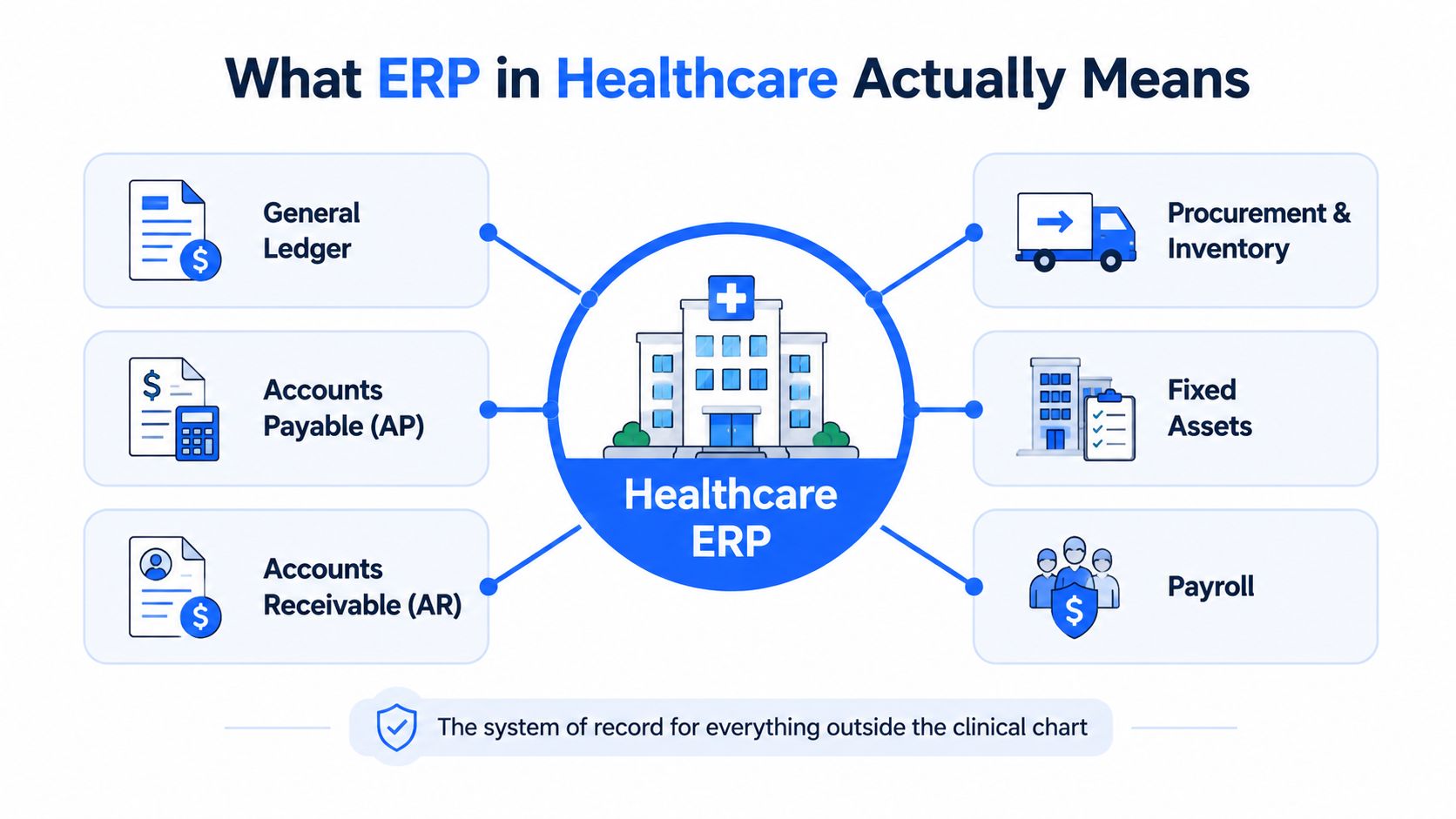
A healthcare ERP is the system of record for financial and operational activity outside the clinical chart. It typically manages the general ledger, accounts payable and receivable, procurement, inventory, fixed assets, payroll connections, entity structures, and management reporting. That scope makes ERP a control layer for finance, not another clinical application.
The EMR or EHR owns patients, encounters, clinical documentation, orders, diagnoses, and other care records. The ERP owns the dollars, vendors, employees, locations, assets, and legal entities behind those encounters. The systems must exchange data, but replacing one with the other is a category mistake.
Use this rule with your leadership team:
If the question starts with a patient or clinical note, it belongs in the EMR. If it starts with a dollar, vendor, location, employee, or legal entity, it belongs in the ERP.
The distinction matters because billing and clinical platforms often get pushed into accounting work they were not built to handle. A practice management system may calculate charges effectively, yet still lack entity consolidation, approval controls, dimensional reporting, and the audit structure a CFO needs.
A cloud ERP can centralize finance workflows while connecting with the systems that own clinical and revenue-cycle data. Configure shared definitions for entities, locations, vendors, departments, providers, payers, and accounts before integration. Otherwise, the interface only moves inconsistent data faster.
Market estimates show sustained investment in the category. One estimate placed healthcare ERP at USD 7.42 billion in 2023, with projected growth to USD 11.96 billion by 2030 at a 7.2% CAGR, according to Integrum Resources' market overview. Another projected growth from about USD 7.5 billion in 2023 to USD 15.7 billion by 2033, implying a 7.7% CAGR, and reported that finance and billing represented 30.4% of the market in 2023, according to ERP Today's healthcare ERP market coverage.
For finance leaders, the practical question is whether the ERP can protect the close, clarify ownership of data, and support growth without multiplying spreadsheet work. That standard matters more than the software demo.
Core Modules and What They Actually Do
Module selection should follow the bottleneck, not the vendor's demo script. A healthcare group doesn't need every feature a platform can display. It needs the capabilities that remove reconciliation work, improve control, and produce reporting leaders can act on.
Finance is the foundation
The general ledger should handle dimensions such as entity, location, department, provider, service line, and payer without forcing accountants to create a separate account for every reporting question. For groups operating across legal entities, native consolidation and intercompany processing are essential. Multi-entity systems should support consolidated financials, intercompany eliminations, real-time reporting, and a built-in audit trail, as outlined in LiveFlow's discussion of multi-entity healthcare accounting.
Accounts payable should replace the invoice-inbox pattern with controlled intake, coding, approval, and payment workflows. Accounts receivable should receive postings from the practice management or billing system and make it possible to reconcile activity to deposits, claims, contractual adjustments, and outstanding balances.
Supply chain needs financial discipline
Procurement and inventory matter most where spending is concentrated in pharmaceuticals, implants, medical supplies, equipment, and other high-value categories. The ERP should connect purchasing, vendor records, receiving, invoice matching, and financial posting. A large health system's experience, documented in Black Book Research's interoperability coverage, illustrates the value of standardizing a single procure-to-pay process, eliminating multiple item masters, reducing off-contract spending, improving discrepancy control, and supporting price negotiations and product recalls with historical data.
Fixed assets and lease accounting deserve their own design decisions. The system should support capitalization, depreciation, transfers, disposals, and lease accounting under ASC 842, with clear ownership between accounting and operations.
Reporting should answer management questions
Management reporting should let leaders analyze performance by payer, service line, location, provider, and department. Payroll integrations and credentialing tie-outs are also important, but don't assume every ERP offers deep workforce management. Native revenue cycle management is commonly oversold, and HR or payroll depth varies sharply by platform.
| Module | Finance Problem It Solves | Commonly Oversold As |
|---|---|---|
| General ledger and consolidation | Inconsistent entities, limited dimensions, manual consolidations | A complete revenue-cycle replacement |
| Accounts payable | Invoice bottlenecks, weak approvals, duplicate or late payments | A substitute for procurement policy |
| Accounts receivable interfaces | Disconnected billing postings and reconciliation gaps | A clinical billing system |
| Procurement and inventory | Poor purchasing visibility, excess stock, off-contract spend | A replacement for clinical inventory workflows |
| Fixed assets and leases | Incomplete asset registers and lease schedules | A universal facilities platform |
| Payroll and HR integrations | Manual payroll journal entries and staffing tie-outs | Full credentialing or workforce management |
| Reporting and dashboards | Slow analysis by entity, payer, location, or service line | A replacement for financial judgment |
A serious selection process maps each module to a named finance problem, an accountable owner, and a measurable decision outcome. If a module doesn't improve control or remove work your team performs, leave it out of phase one.
How ERP Connects to EMR and Clinical Systems
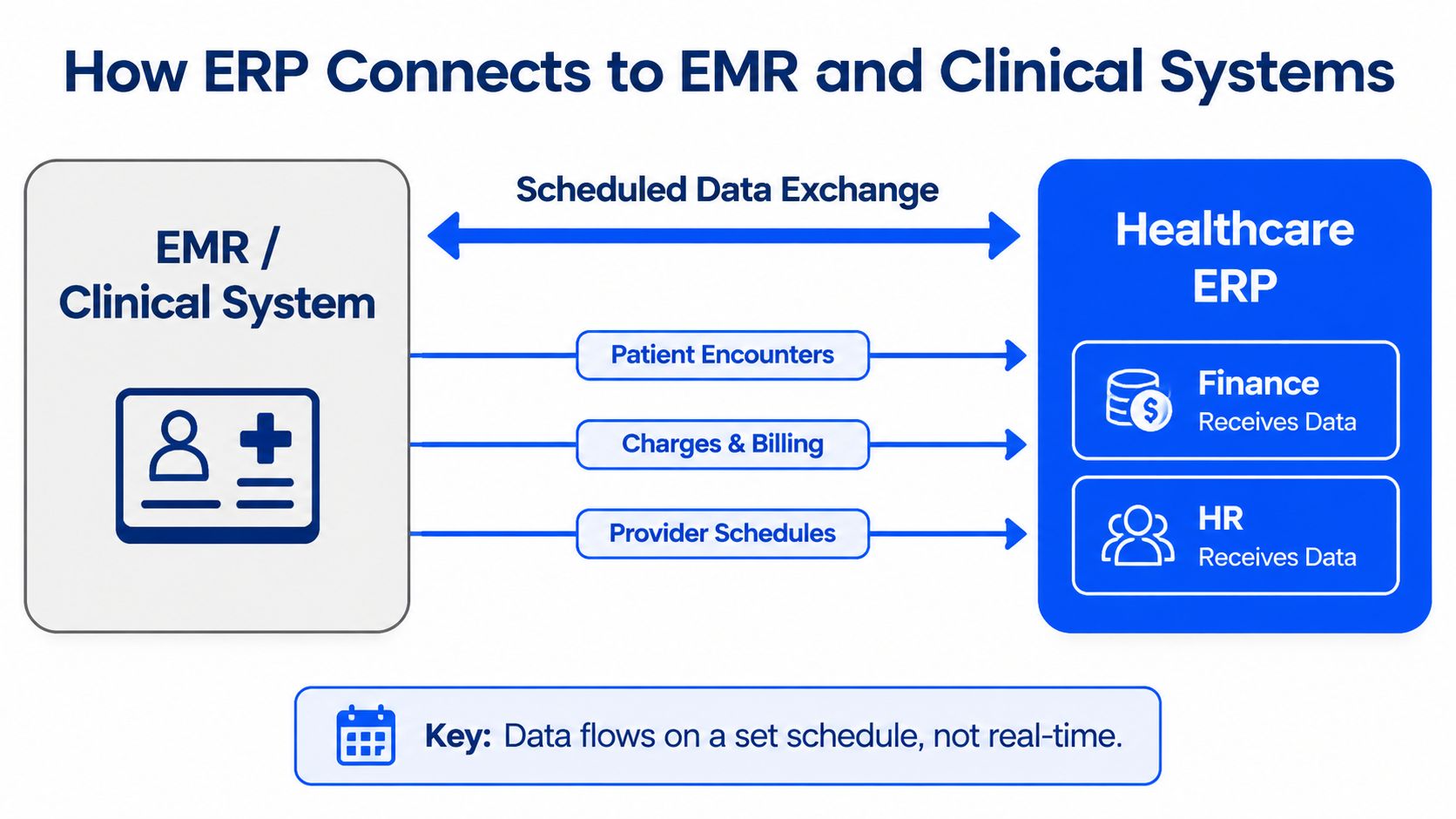
The ERP manages financial and operational data alongside the EMR, which handles clinical records. These systems exchange defined data on an agreed schedule, with ownership assigned for every field and exception. That boundary protects the close because clinical workflows remain in the EMR while finance controls accounting treatment and reconciliation.
A common design sends patient encounters, charges, billing activity, provider schedules, and related dimensions from the EMR or practice management system into the ERP. The ERP uses those records for billing postings, contract modeling, revenue recognition, reporting, and reconciliation. In the other direction, payroll information, vendor master updates, purchasing activity, supply replenishment, and approved financial structures may flow to connected operational systems.
Design the interface before signing
Healthcare interfaces commonly use HL7v2 feeds, FHIR APIs, flat files, or an integration engine for transformation and routing. Mid-market providers often need middleware because the EMR, practice management system, payroll platform, and ERP use different data models and update schedules.
Approve answers to these questions before contracting:
- Encounter ownership: Which system creates the encounter, and which confirms that it is financially complete?
- Charge timing: How are late charges handled after the accounting period appears closed?
- Payer mapping: Who owns payer definitions when contracts, plans, or billing rules change?
- Provider and location masters: Which system controls additions, edits, and deactivations?
- Exception handling: Where does a failed interface land, and who resolves it?
- Reconciliation: What report proves that source transactions agree with ERP postings?
Administrative failures create as much risk as technical failures. Payer mappings drift, providers are created twice, and locations follow inconsistent naming conventions. Finance can also send excessive clinical detail into the general ledger, producing an account structure the team cannot maintain.
Integration rule: Approve the data model, interface ownership, reconciliation process, and exception workflow before signing. Otherwise, the implementation starts with unresolved control decisions.
Finance should set the boundaries, test exception paths, and assign owners before the first production transfer. Lucentive's guidance on integrating a financing system with an electronic medical record offers relevant guidance for deciding which system owns each part of the process.
Compliance, Audit, and Data Governance Requirements
Healthcare ERP control design has two overlapping objectives. The first protects sensitive patient and employee information. The second protects the integrity of financial reporting. A platform can support both, but configuration and governance determine whether those controls work in practice.
HIPAA, applicable state privacy requirements, and business associate agreements shape how protected health information is stored, transmitted, and accessed. Many organizations minimize exposure by keeping detailed PHI in the EMR and sending only the financial or operational fields the ERP needs. Restricted fields, masked views, role-based access, and controlled interfaces can reduce unnecessary exposure.
Financial controls apply even when the organization isn't publicly traded. Larger groups may face SOX-style expectations, while private organizations often adopt comparable discipline to satisfy lenders, auditors, boards, and acquisition partners. The ERP should record approvals, changes, journal entries, access activity, and period status in a way an auditor can follow.
Governance needs named owners
The chart of accounts is not just an accounting artifact. It determines how management sees profitability, how entities consolidate, how service lines compare, and how acquisitions fit into the reporting model. The approval matrix is equally important. Someone must own vendor creation, contract edits, master-data changes, manual journal entries, and period reopening.
A finance implementation roadmap from Wiss stresses named master-data owners, formal reconciliations, and a parallel close before cutover. That is the standard to use. Moving records into a new system without proving that the balances reconcile only transfers uncertainty into a newer interface.
| Control Area | Requirement | Where It Lives in the ERP |
|---|---|---|
| Access control | Role-based access and least-privilege permissions | User roles, permissions, and sensitive-field restrictions |
| Segregation of duties | Separate invoice approval, payment, cash posting, and reconciliation responsibilities | Workflow rules and role design |
| Journal governance | Documented preparation, approval, posting, and reversal procedures | Journal workflows and audit history |
| Vendor controls | Controlled creation and modification of vendor records | Vendor master permissions and change logs |
| Chart of accounts | Named ownership for account, entity, location, and dimension structures | Master-data governance |
| Audit trail | Traceable activity across transactions, approvals, and access | System audit logs |
| Close controls | Period locks, reconciliations, and documented exception handling | Close checklist, period controls, and reporting |
Compliance isn't won by checking a box in a vendor questionnaire. It's won through a workable chart of accounts, enforceable permissions, documented ownership, and evidence that the close process operates as designed. Sage Intacct guidance on HIPAA compliance and related controls can help frame the technology discussion, but your policies still determine the outcome.
ERP Use Cases for Clinics, Multi-Site Groups, and DSOs
The right ERP scope depends on operating complexity. A single clinic and a specialty roll-up may use the same product category, but they shouldn't buy the same implementation.
| Organization Type | Primary Finance Pain | ERP Modules That Matter | What Is Usually Overbought |
|---|---|---|---|
| Single clinic | Manual bookkeeping, limited AP control, basic reporting gaps | General ledger, AP, bank connectivity, reporting, payroll integration | Complex consolidation and deep inventory |
| Multi-site medical group | Entity consolidations, location visibility, shared-services allocation | Multi-entity GL, AP automation, intercompany processing, dimensions, reporting, integrations | Broad HR functionality without a clear owner |
| DSO or specialty group | Acquisition integration, provider compensation, standardized reporting | Multi-entity consolidation, dimensional reporting, provider and location structures, AP, fixed assets, integration framework | Full clinical or revenue-cycle replacement |
Single clinics should protect simplicity
A smaller clinic often needs a reliable general ledger, controlled payables, payroll integration, and reporting that answers basic questions about location and service line performance. Adding complex workflows that the team won't operate creates administrative drag without improving control.
Multi-site groups need a common financial language
A multi-site organization needs more than separate books rolled into a spreadsheet. It needs consistent entity structures, intercompany eliminations, shared-service allocations, and reporting by location, payer mix, provider, or service line. The goal is not centralization for its own sake. It's the ability to compare performance without debating whether each location classified activity differently.
Organizations evaluating this model can review the benefits of consolidating and automating finances for multi-entity organizations.
DSOs and specialty roll-ups need acquisition discipline
A DSO or specialty group must absorb new practices without rebuilding its entire chart of accounts. Provider onboarding, production-based compensation, location setup, intercompany activity, and acquisition reporting need a repeatable design. The ERP should make the next acquisition easier to integrate, not force finance to recreate the same spreadsheet architecture every time.
The common mistake is under-buying because the current finance team is coping today. The opposite mistake is buying enterprise complexity that the organization can't govern. Choose the smallest scope that supports the operating model and the next credible stage of growth.
Why the Implementation Partner Matters More Than the Demo
Implementation discipline determines whether an ERP improves execution or becomes another system the finance team works around. A configurational study of 86 hospitals found that 26 hospitals, or 30.2%, achieved high ERP adherence improvement, while 40, or 46.5%, improved moderately, and 20, or 23.3%, saw no improvement, according to the study published through DOAJ. The study identified readiness to change, staff buy-in, and sufficient workload and time during rollout as factors in successful implementation.
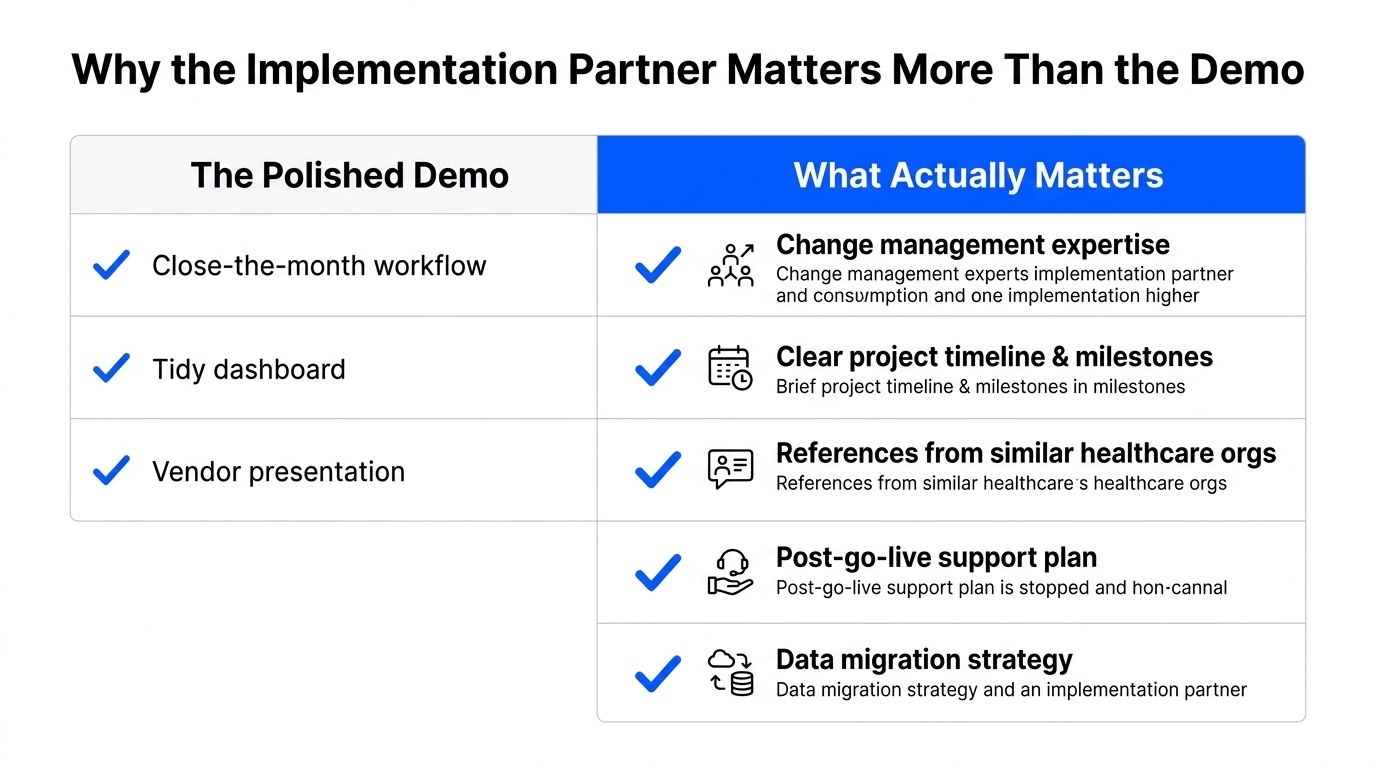
A polished demonstration says little about delivery quality. The partner must convert the proposed workflows into your entities, locations, interfaces, accounting policies, approval rules, and close calendar. That work determines whether users adopt the system and whether finance can maintain control during the transition.
Vet the partner, not just the platform
Request live references from organizations with a similar delivery model. The partner should understand entity consolidation, payer and provider dimensions, clinical-system interfaces, audit requirements, and the operational consequences of a poor cutover. Ask what went wrong on comparable projects and how the team corrected it.
Protecting the close requires named responsibilities and tested procedures. The partner should define data ownership, migration checkpoints, reconciliation steps, parallel-close expectations, user acceptance criteria, and escalation paths. Confirm who remains accountable after go-live, including support for interface failures, reporting defects, and unresolved master-data issues.
A cloud SaaS rollout for a mid-market hospital network typically takes 9 to 14 months for phased core modules, while enterprise deployments across 10 or more hospitals can take 18 to 36 months, according to MarketIntelo's healthcare ERP market coverage. Use these ranges for planning context, not as promises. Scope, interfaces, decision speed, data quality, and staffing can shift the schedule substantially. Planning the costs, time, and resources for an ERP implementation gives finance leaders a practical structure for assessing those requirements.
Before signing, ask:
- Who owns the chart of accounts and master data?
- How will the team protect the month-end close during migration?
- What happens when an interface fails during a reporting period?
- Who provides post-go-live support after the initial warranty?
- Which project decisions require our executive involvement?
- How are scope changes priced, approved, and documented?
Lucentive is a Sage Intacct National Premier Partner with mid-market, healthcare, and nonprofit experience. For a finance leader evaluating Sage Intacct, assess whether the implementation approach fits the organization's close calendar, data maturity, and operating model.
A CFO Checklist Before You Buy
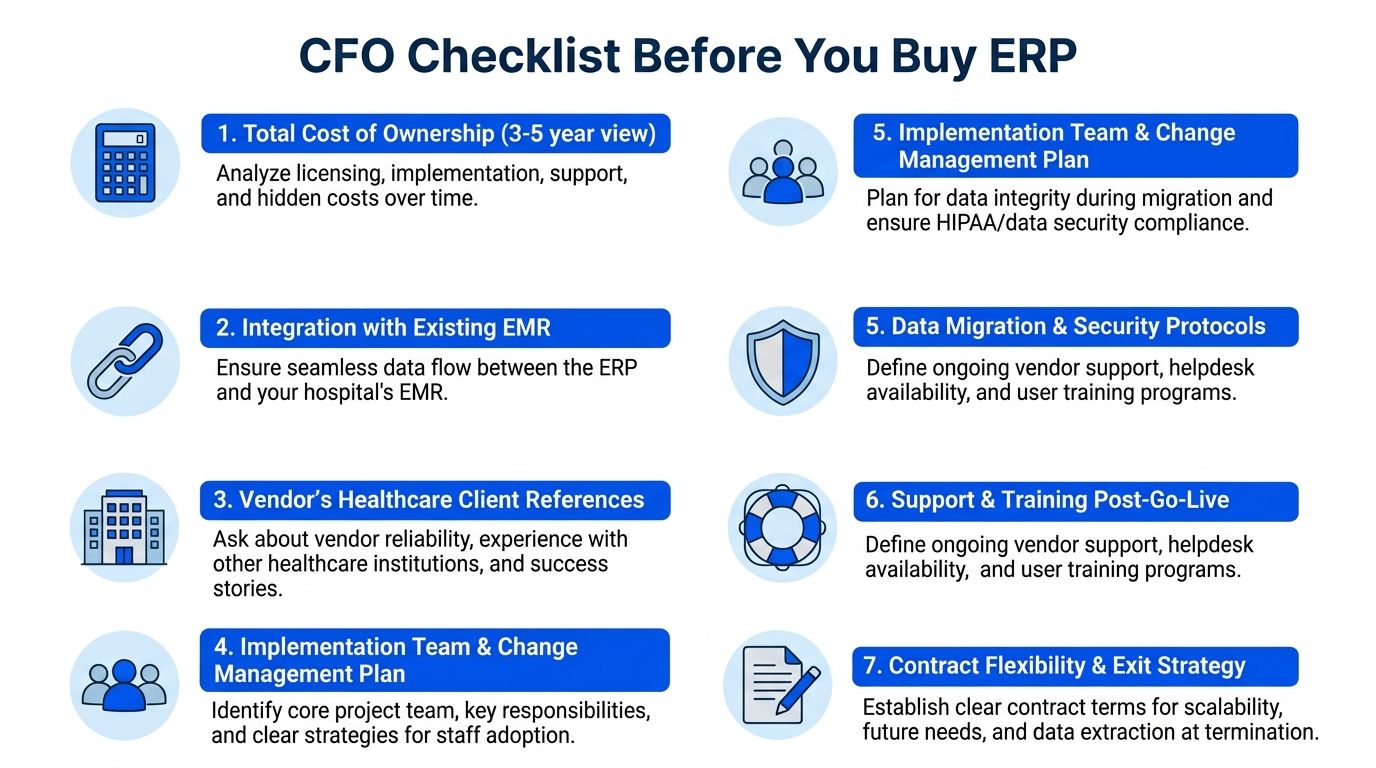
An ERP decision should give your finance team testable answers about scope, risk, and the close.
- Define the outcome: Tie the project to a finance result, such as a shorter close, stronger reconciliation, clearer AR visibility, or more reliable reporting. “Modernization” is not a business case.
- Set phase-one boundaries: Limit the initial scope to workflows the team can document, test, train, and own.
- Match the delivery model: A clinic, multi-site group, and DSO require different dimensions, integrations, and consolidation structures.
- Assign data owners: Name accountable owners for the chart of accounts, entities, locations, vendors, providers, payers, and reporting definitions.
- Document privacy boundaries: Specify which clinical or protected information enters the ERP, how access is restricted, and who reviews exceptions.
- Protect the close: Require migration reconciliations, parallel-close expectations, cutover criteria, and a fallback process.
- Test the partner: Confirm staffing, healthcare references, escalation paths, training responsibilities, and post-go-live support in writing.
Summary
ERP in healthcare works best when finance leads the evaluation. For CFOs and controllers, the priority is not a better demo. It is a stronger close, clearer ownership of data, better reconciliation between clinical and financial systems, and reporting that supports growth.
The right ERP helps healthcare organizations standardize multi-entity accounting, tighten AP controls, improve audit readiness, and connect operational data to the general ledger without multiplying spreadsheets. The wrong scope or implementation partner can create disruption, weak adoption, and new control gaps.
For most healthcare finance leaders, the practical goal is simple. Choose an ERP scope that fits the operating model today, supports the next stage of growth, and protects the close during implementation.
FAQ: ERP in Healthcare
What is ERP in healthcare?
ERP in healthcare is a financial and operational system used to manage general ledger, accounts payable, procurement, inventory, reporting, fixed assets, and related business processes outside the clinical record.
How is ERP different from an EMR or EHR?
An EMR or EHR manages patient charts, encounters, diagnoses, and clinical documentation. An ERP manages financial, vendor, entity, employee, and operational data. The systems integrate, but they serve different purposes.
Why do healthcare organizations need an ERP?
Healthcare organizations often need an ERP when they outgrow spreadsheets, manual reconciliations, disconnected AP processes, or separate systems across locations and entities. ERP helps create one financial view and stronger controls.
What ERP modules matter most for healthcare finance teams?
The most important modules usually include the general ledger, multi-entity consolidation, accounts payable, procurement, reporting, fixed assets, and integrations with payroll, billing, and practice management systems.
Can ERP integrate with EMR and practice management systems?
Yes. Healthcare ERP platforms can integrate with EMR, EHR, and practice management systems through APIs, HL7 feeds, flat files, or middleware. The key is defining data ownership, mappings, reconciliation rules, and exception handling before go-live.
Is ERP implementation in healthcare mainly an IT project?
No. ERP in healthcare is primarily a finance and operations project with technical dependencies. Finance should define reporting requirements, controls, data ownership, and close protections before implementation begins.
What should CFOs evaluate before buying a healthcare ERP?
CFOs should evaluate entity structure, reporting requirements, audit controls, implementation scope, partner experience, EMR integration design, ownership of master data, and how the rollout will protect the month-end close.
How long does a healthcare ERP implementation take?
Implementation timelines vary by scope, interfaces, data quality, and decision speed. Mid-market phased rollouts may take months, while larger multi-hospital deployments can take much longer.
For mid-market healthcare leaders, the most effective next step is a working session that maps the current close, entity structure, EMR interfaces, reporting requirements, and implementation capacity to a practical Sage Intacct scope.
Lucentive helps healthcare and mid-market finance teams evaluate, implement, and integrate Sage Intacct around operating requirements, including multi-entity reporting, audit controls, close protection, and EMR-related data flows. Schedule a 30-minute working session with the Lucentive team through Lucentive to assess fit, sequence the rollout, and decide whether Sage Intacct is appropriate before buying software alone.