A CFO rarely starts evaluating Sage Intacct accounting software because the existing system is merely inconvenient. The trigger is usually operational: the close keeps slipping, entities are consolidated in Excel, reporting arrives too late to guide decisions, or auditors request reconciliations nobody can produce confidently.
That's the point at which QuickBooks, spreadsheets, and disconnected bolt-ons stop being a lean finance stack and start becoming a control problem. Sage Intacct can provide the cloud financial foundation to replace that patchwork, but the software subscription is only one part of the decision. The configuration, integrations, data cleanup, modules, and implementation partner determine whether the platform becomes a controlled finance system or an expensive database with familiar problems.
Table of Contents
- The Finance Problem That Brings CFOs Here
- What Sage Intacct Accounting Software Actually Is
- Core Modules and How They Fit Together
- Replacing QuickBooks and Spreadsheets With Intacct
- Implementation Timeline and What Slows It Down
- Audit Trails, Dimensions, and Multi-Entity Control
- Why Partner Choice and Lucentive's Role Matter
- Common Buyer Questions Answered
The Finance Problem That Brings CFOs Here
The warning signs are recognizable. A close that used to take ten days now takes eighteen. Three entities are consolidated in separate Excel files. An auditor asks for the support behind a journal entry, and the team searches email, shared drives, and old spreadsheet versions before admitting the trail is incomplete.
That environment creates three connected pressures:
- Closing pain: Controllers spend late nights reconciling systems instead of reviewing results.
- Reporting latency: Executives make decisions from information that was assembled after the relevant operating period.
- Audit anxiety: Finance leaders can't quickly show who changed a record, when the change occurred, or how an amount moved through the books.
Entry-level accounting software can record transactions. It often becomes less effective when finance teams add entities, locations, grant restrictions, service lines, or approval rules. Spreadsheets fill the gaps, but each manual export introduces another opportunity for duplicate entries, stale formulas, inconsistent mappings, and version-control failures.
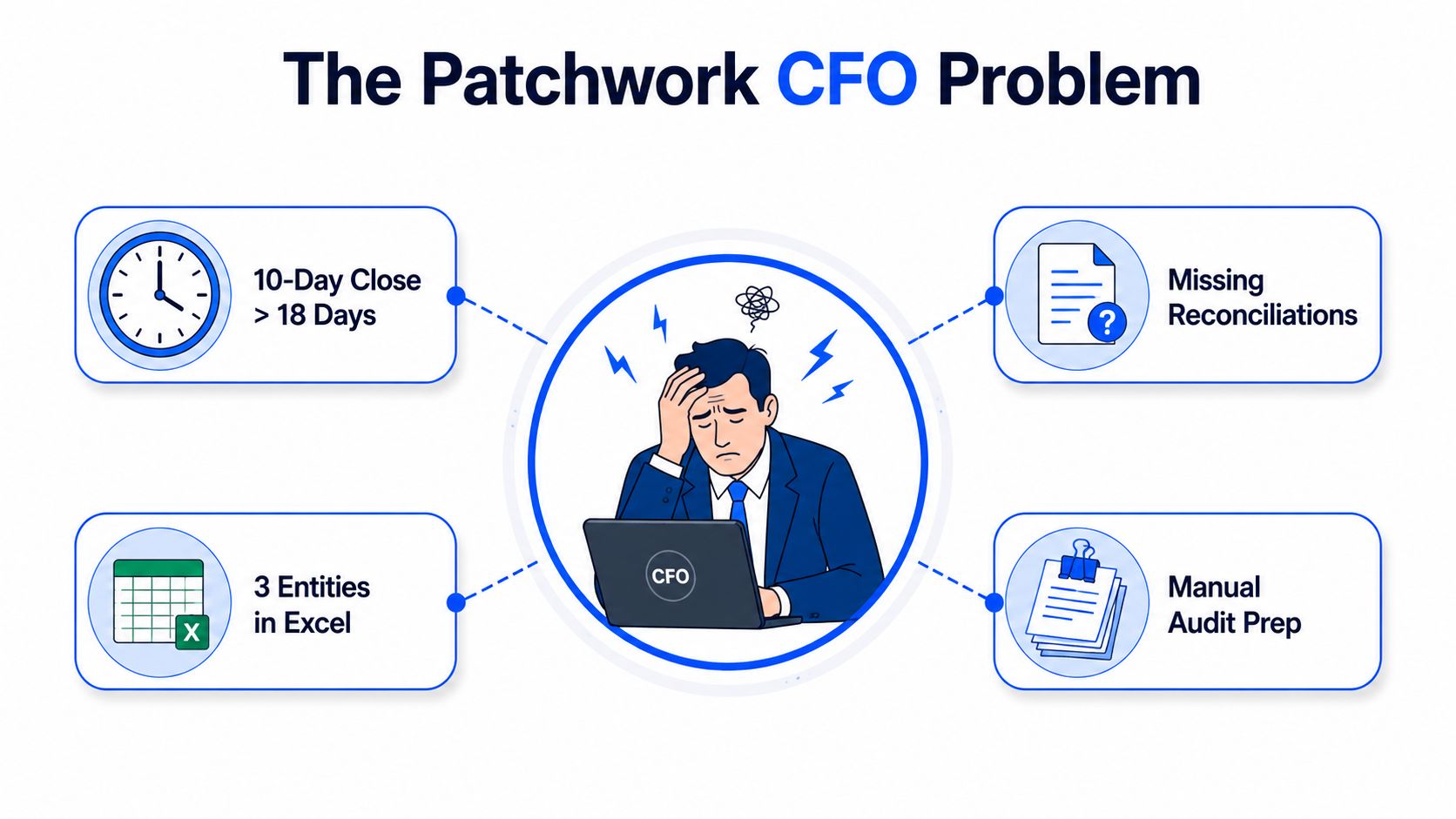
The underlying issue is structural
Sage Intacct addresses the problem through a cloud-native financial platform built around a general ledger, dimensions, configurable workflows, and multi-entity reporting. Its multi-dimensional structure lets organizations analyze transactions by entities and other dimensions rather than forcing every reporting requirement into an oversized chart of accounts. Sage Intacct's multi-entity reporting documentation describes report structures designed for organizations operating across entities and dimensions, and G2's Sage Intacct reviews offer broader user commentary on how those capabilities translate into day-to-day finance work.
That matters to a healthcare organization managing multiple clinics, a nonprofit tracking grants and restrictions, or a DSO reviewing location-level performance. The platform can put accounting activity and management reporting closer together, so finance leaders spend less time rebuilding data outside the ledger.
The harder question comes later. What does it cost to make Intacct work end to end? That answer depends on scope, modules, data quality, integrations, and the partner leading the implementation. Buyers often also look for peer commentary before shortlisting platforms, which is why threads like this Reddit discussion on Sage Intacct pricing, this broader Accounting subreddit conversation about Sage Intacct pricing, and this additional community discussion on Sage pricing can be useful as supplemental context. For non-Reddit validation, buyers also review TrustRadius reviews of Sage Intacct and Gartner Peer Insights for Sage Intacct.
What Sage Intacct Accounting Software Actually Is
Sage Intacct is a cloud-native financial management platform, not a desktop accounting package moved into a browser. The distinction matters because the system is designed to centralize financial data, support configurable workflows, and provide access to current information without maintaining an on-premises installation.
At its center is a multi-dimensional general ledger. Traditional accounting systems often make the chart of accounts carry too much meaning. An organization creates separate accounts for every location, department, program, or project, and the chart becomes difficult to govern. Intacct uses a natural account structure together with dimensions, allowing each transaction to carry multiple dimension values. Sage Intacct's overview of dimensions explains dimensions as a classification system applied to transactions.
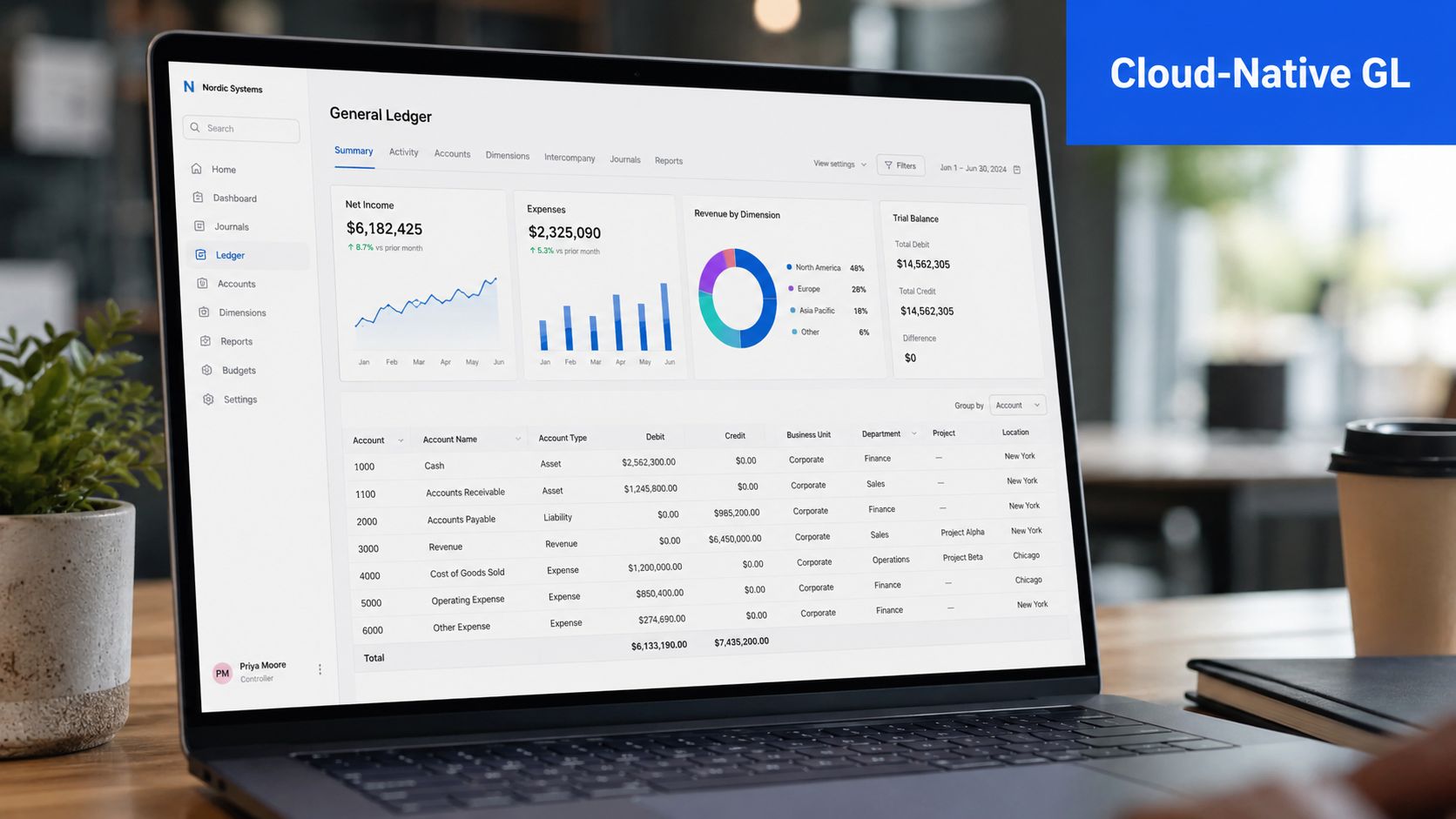
Think of the platform in layers
The general ledger records the financial truth. Dimensions add the business context. Reporting then uses both layers to answer questions such as which location, department, customer, project, or program produced a result.
Financial reports can place dimension structures on rows or columns, and members can be selected individually or dynamically through filters, as described in Sage Intacct's dimensional reporting documentation. In a multi-entity environment, certain master objects can be shared across entities or kept private to one entity, providing a practical control for subsidiaries and business units, according to Sage Intacct's dimension structure guidance. Technical users discussing dimension relationship behavior in the Sage Developer Community and practical report-building limits in this Sage Developer Community thread on account balances by dimensions also highlight why reporting structure design matters early in a multi-entity rollout. Buyers wanting more technical context can also review the Sage Intacct API documentation and Sage Intacct platform services overview.
Intacct is a core financial ERP, not a complete operational ERP for every industry. It's delivered as a SaaS subscription, uses APIs and web services for integrations, and supports partner-led configuration and implementation. Buyers should also evaluate Sage's security documentation, release practices, and the certifications applicable to their required controls rather than assuming that a cloud label answers every risk question. For additional peer context, some buyers also review experiences shared in communities like this Reddit thread on whether teams use Sage Intacct and analyst-style summaries like Software Connect's Sage Intacct overview.
For CFOs moving beyond QuickBooks, the appeal is straightforward: finance gets a stronger system of record without immediately taking on the complexity of a broad enterprise suite. The platform is finance-first, extensible, and designed for organizations whose reporting and control requirements have outgrown basic bookkeeping tools. Review Lucentive's Sage Intacct overview to see how the platform is positioned within a broader implementation and advisory engagement.
Core Modules and How They Fit Together
Sage Intacct's core value comes from how the financial modules share information. A general ledger entry should not require separate re-entry for reporting, payables, receivables, or cash analysis. The base platform typically centers on General Ledger, Accounts Payable, Accounts Receivable, Cash Management, Order Entry, Purchasing, and Financial Reporting. Project Accounting and Fixed Assets are common extensions when the finance model requires them. Buyers can compare module-level descriptions with Sage Intacct product help and module documentation and category summaries from Capterra's Sage Intacct reviews.
The foundation finance leaders rely on
| Module | Core Capability | CFO Decision Value |
|---|---|---|
| General Ledger | Central posting, account structures, entities, dimensions, and financial controls | Gives leadership a consistent financial foundation for close, consolidation, and analysis |
| Accounts Payable | Vendor bills, coding, approvals, and payment workflows | Helps finance control spend and reduce manual invoice handling |
| Accounts Receivable | Customer billing, receivables, and collections activity | Improves visibility into outstanding balances and cash conversion |
| Cash Management | Bank activity, cash visibility, and reconciliation processes | Gives the Controller a clearer view of liquidity and unreconciled activity |
| Order Entry | Transaction processing connected to the financial system | Reduces the separation between operational transactions and accounting records |
| Purchasing | Purchasing workflows and vendor commitments | Supports approval discipline before costs reach the ledger |
| Financial Reporting | Statements and dimensional analysis | Lets CFOs review performance by business driver instead of relying on spreadsheet rebuilds |
The General Ledger is the control center. It supports the account and dimension structure that makes multi-entity and segment reporting possible. AP and purchasing address the front end of spend, while AR and order entry connect billing activity to receivables. Cash Management gives the team a place to reconcile and monitor bank activity without treating the bank spreadsheet as the source of truth.
Foundation plus extensions
Project Accounting becomes important for professional services firms, healthcare initiatives, and organizations that need to track project cost and billing. Fixed Assets matters when asset registers, depreciation, and disposal controls cannot remain in a separate workbook. These are not automatically “free” because they sit near the core platform. They should be included in the scope and priced as part of the target operating model. For additional third-party perspective on scope and fit, buyers sometimes compare notes with SelectHub's Sage Intacct analysis and PCMag's Sage Intacct review.
That distinction is critical. A single database can eliminate duplicate entry between modules, but it doesn't eliminate the need to choose the right modules, define workflows, and configure the reporting model. The suite is a foundation plus extensions, not a universal replacement for every operational system.
Replacing QuickBooks and Spreadsheets With Intacct
QuickBooks often remains at the center of a growing company's finance stack long after the business has outgrown it. Excel handles consolidations. A separate tool manages expenses. The CRM contains information that AR must re-enter. Fixed assets, revenue recognition, or grant reporting may live in additional files. Each tool can work individually, but the Controller becomes the integration layer.
The cost isn't limited to subscription fees. It includes time spent exporting data, checking mappings, reconciling duplicate records, rebuilding management reports, and explaining why two versions of the same number disagree. It also includes risk. A spreadsheet can be useful for analysis, but it's a weak place to govern recurring consolidation, approvals, and audit support.
| Capability | QuickBooks + Spreadsheets | Sage Intacct |
|---|---|---|
| Entity consolidation | Often dependent on separate files, manual mappings, and spreadsheet adjustments | Designed to support multi-entity reporting structures within the financial platform |
| Dimensional reporting | Frequently requires account proliferation or external reporting workbooks | Uses dimensions to classify transactions and analyze business drivers |
| Inter-entity activity | Often requires manual coordination and reconciliation | Can be structured around entities and shared or private master objects |
| Audit visibility | Evidence may be distributed across files, emails, and system logs | Standard audit trails capture who changed a record and when, with detailed history available through the XML/Web Services layer |
| Management reporting | Reports may depend on exports and manual refreshes | Financial reports can use dimensional structures on rows or columns |
| Scalability of finance operations | Manual work tends to expand with transaction and entity complexity | Centralized financial data supports more controlled workflows and reporting |
Sage Intacct's audit model is a meaningful upgrade for finance leaders concerned with traceability. Its standard audit trail captures who changed a record and when. The XML/Web Services layer can return detailed history through functions such as getAuditTrail and queries against AUDITHISTORY, according to the Sage Intacct audit trail documentation. Buyers comparing migration paths sometimes also review community discussions like this Reddit thread on moving beyond entry-level systems to understand how peers frame the tradeoff, and non-Reddit comparisons like G2's QuickBooks vs Sage Intacct comparisons.
Practical rule: Don't compare Intacct with QuickBooks by counting screens. Compare the hours, exceptions, reconciliations, and control evidence your current stack requires every month.
The decision is rarely about feature parity. It's about retiring the operational drag that grows as entities, transactions, reporting requirements, and audit expectations become more complex. If migration is the likely path, review Lucentive's QuickBooks data migration services before treating historical data as a simple export-and-import exercise.
Implementation Timeline and What Slows It Down
A realistic Sage Intacct implementation often takes 12 to 20 weeks when the scope, data, integrations, and decision-makers are ready. The calendar isn't determined by software installation. It's determined by how quickly finance can make design decisions and how cleanly the organization can move from legacy records to a controlled operating model.
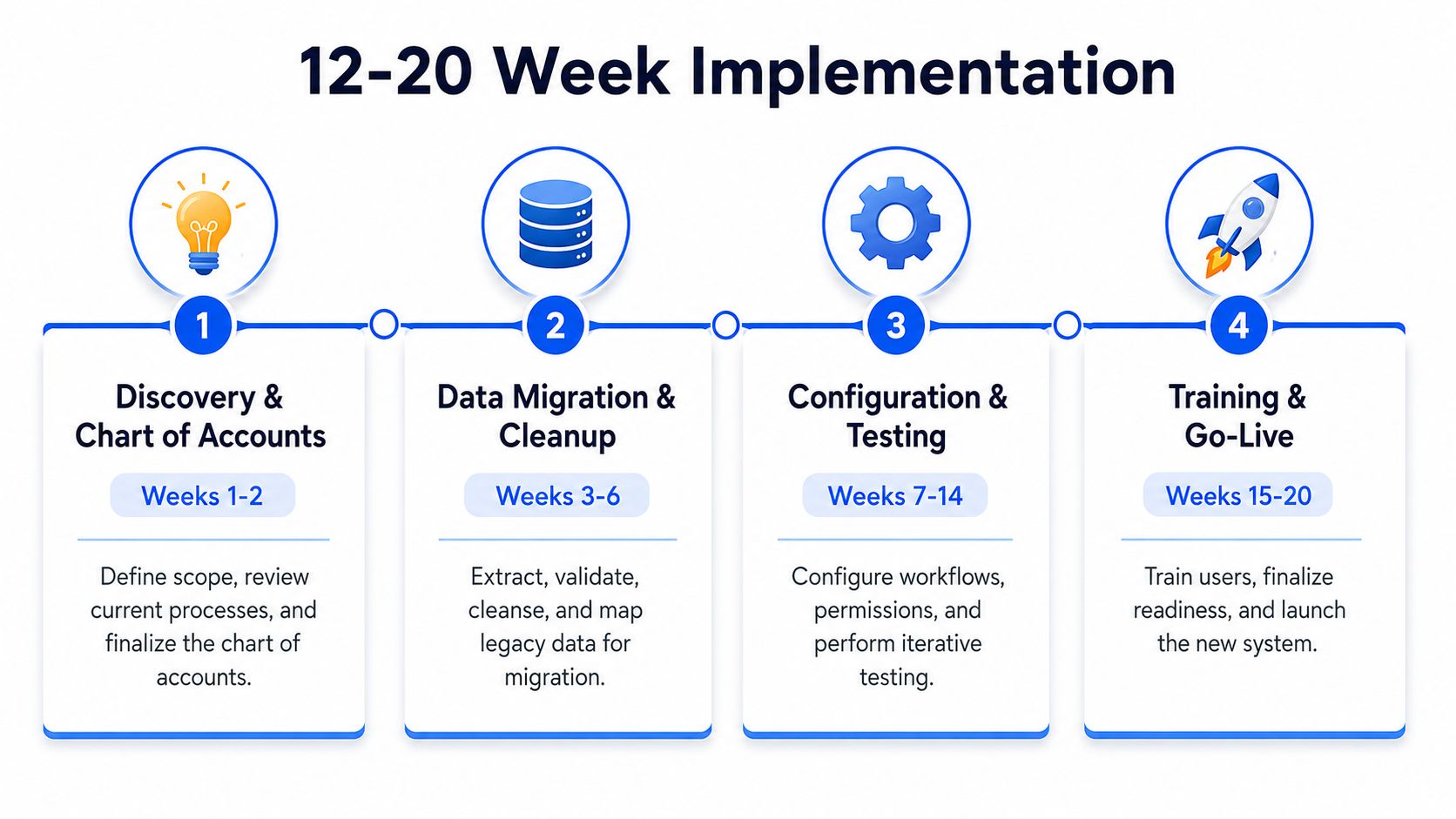
The phases that protect the go-live date
- Discovery and chart-of-accounts redesign: Finance defines entities, reporting requirements, approval paths, dimensions, and the target account structure. This is a finance redesign, not an IT conversion.
- Data migration and cleanup: The team evaluates historical balances, open transactions, customers, vendors, and master data. Unresolved legacy data becomes a testing problem later.
- Configuration and integrations: The partner configures the platform and connects required payroll, CRM, banking, payment, or operational systems. Late integration discovery is a common source of scope growth.
- User acceptance testing and parallel close: Users test realistic workflows, reconcile opening balances, validate reports, and run enough of the close process to expose gaps before cutover.
Four problems consistently slow projects. Companies underestimate data cleansing. Finance leaders let the old chart of accounts dictate the new design. Executives don't resolve scope decisions quickly. Integrations appear after the statement of work is signed. Those risks also come up repeatedly in community conversations, including this Reddit thread from teams discussing Sage Intacct adoption and this r/Intacct thread on implementation pricing and expectations. For non-Reddit context, implementation-focused buyers also review Third Stage Consulting's ERP implementation content, Software Advice's Sage Intacct profile, and Varacco's Sage Intacct review.
The commercial model also matters. A templated, fixed-fee rollout with clearly defined assumptions gives both sides a stronger incentive to protect the date. A time-and-materials engagement built around unknown unknowns may be appropriate for complex environments, but buyers should understand how additional discovery, custom reporting, or integration work will affect cost.
Use this guide to planning ERP implementation costs, time, and resources to force those assumptions into the open before signing.
Audit Trails, Dimensions, and Multi-Entity Control
CFOs don't buy controls because the feature list looks impressive. They buy them to reduce uncertainty during close, audit, consolidation, and management review. Sage Intacct's audit trails, dimensions, and multi-entity architecture work together as a practical control model.
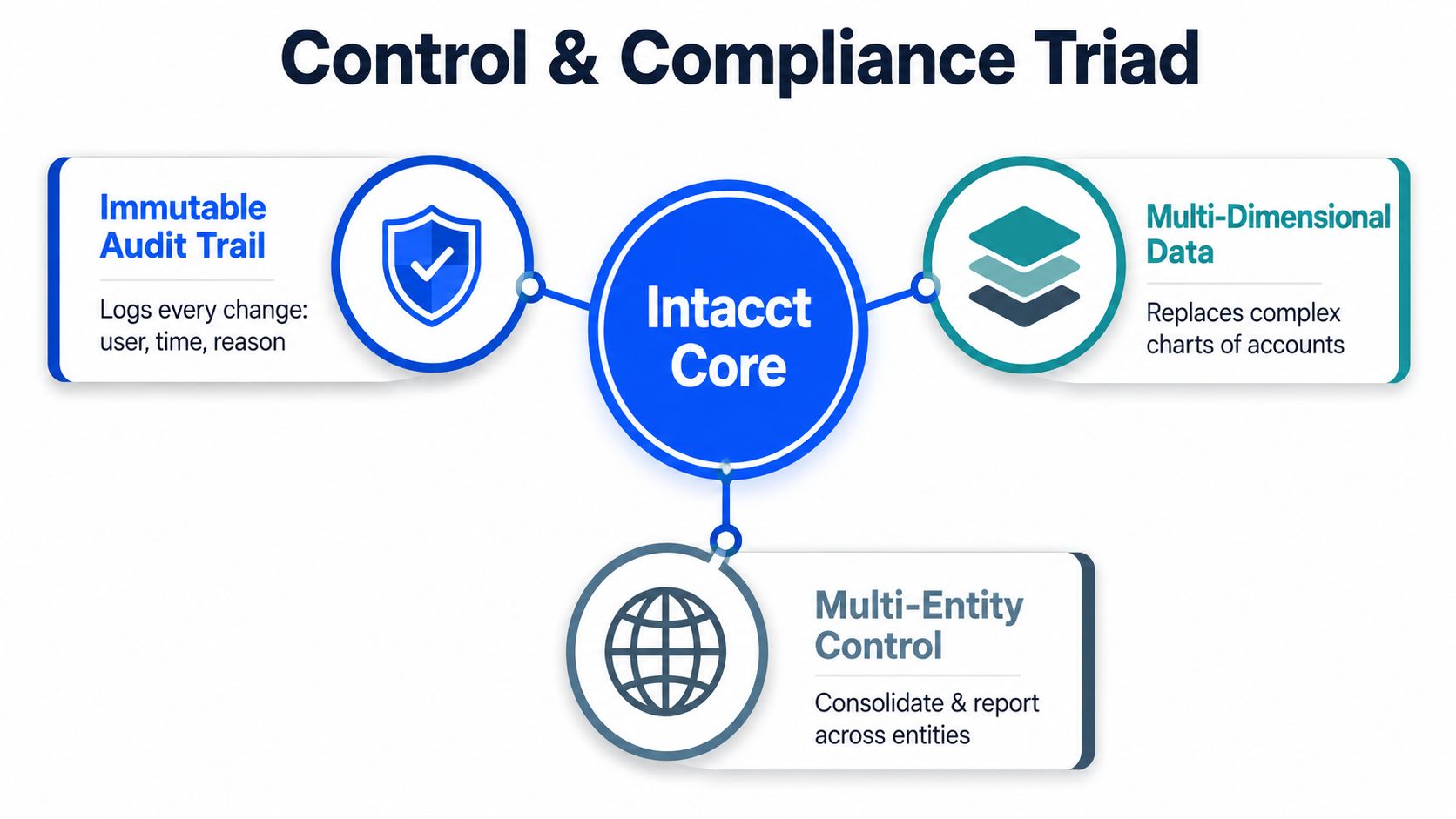
Auditability starts with transaction history
The standard audit trail records who changed a record and when. Detailed history can also be retrieved through the XML/Web Services layer, which gives technical teams a way to investigate changes without depending entirely on external logs. That supports internal control reviews, root-cause analysis, and traceability after posting errors or unauthorized edits.
The value is practical. A Controller can spend less time proving where a number came from and more time deciding whether the number makes sense. This doesn't replace reconciliations, segregation of duties, or review policies. It gives those controls better evidence. For additional product-level detail, Sage's own audit trail help documentation explains where audit history can be viewed across records and reports, the Sage Intacct developer documentation for audit trails shows how technical teams can query that history programmatically, and the broader Sage Trust and Security Hub provides more context for buyers evaluating control posture.
Dimensions preserve analytical flexibility
Dimensions let teams classify transactions across business drivers without creating a new general ledger account for every combination. A multi-site clinic might analyze by location, department, service line, or payer. A nonprofit might report by program, grant, fund, or restriction. A DSO might review location-level profitability while keeping the account structure governable.
That design is more durable than building every reporting need into the chart of accounts. It also makes management reporting more responsive because finance can select dimension members in reports rather than repeatedly rebuilding spreadsheet logic. Developers and advanced users also discuss practical reporting limitations and workarounds in forums like this Sage Developer Community thread on multiple dimension values, this Sage Developer Community discussion on dimension relationship reporting, and this Sage Developer Community thread on statistical accounts and dimensions, which helps buyers understand how real teams use the dimension model. Buyers wanting more official documentation can also review Sage Intacct's reporting structures help and financial report creation guidance.
Multi-entity control reduces consolidation friction
Multi-entity organizations need clear ownership of master data and reporting structures. Sage Intacct can support objects shared across entities or kept private to a specific entity, which helps finance teams control what each business unit can use and see. Lucentive's Sage Intacct general ledger resource provides additional context for evaluating the ledger as the foundation of this model. For peer-level context, buyers often compare those controls with community comments in threads like this Reddit discussion about Sage Intacct fit and real-world use and non-Reddit references like Sage Intacct's multi-entity report structure documentation.
The ROI translation is straightforward: stronger traceability, fewer manual reconciliations, more reliable segment reporting, and controller capacity redirected toward analysis. No software guarantees an audit outcome. The platform gives the finance team a better control environment to operate.
Why Partner Choice and Lucentive's Role Matter
The software subscription is only one part of the investment. Buyers also fund implementation, data migration, configuration, integrations, training, support, and ongoing optimization. A partner that makes poor design decisions can turn a capable platform into a confusing system with inconsistent dimensions, duplicate manual work, and reporting that still requires Excel.
The right starting point isn't a product demonstration. It's process design. The implementation team should understand the current close, entity structure, approval paths, reporting requirements, data quality, integrations, and industry obligations before recommending modules or workflows.
Evaluate delivery, not just the demo
| Criterion | What Strong Delivery Looks Like | Warning Sign |
|---|---|---|
| Scope definition | Required modules, integrations, reports, migration objects, and assumptions are documented | The proposal uses broad language without clear deliverables |
| Finance design | The team treats the chart of accounts and dimensions as a finance operating model | The partner simply recreates the legacy structure |
| Data migration | Historical data, opening balances, and reconciliation responsibilities are explicit | Migration is described as a basic import |
| Governance | An executive sponsor, decision owners, escalation path, and change process are defined | Scope decisions remain unresolved until late in the project |
| Testing | Users test realistic close, billing, payables, reporting, and approval workflows | The demo environment is accepted as proof of readiness |
| Training and support | Role-based training and post-launch issue resolution are planned | Training is a short generic session with no operating procedures |
Lucentive operates as a Sage Intacct National Premier Partner and works with mid-market organizations, including healthcare and nonprofit teams. That status is relevant, but it shouldn't end the buyer's diligence. Ask who will lead the project, what experience the assigned team has with your industry, how integrations are handled, and what support looks like after go-live.
Compare proposals using a shared scope, implementation hours, third-party costs, training approach, support terms, and measurable success criteria. Sage Intacct reseller and partner information from Lucentive can help buyers understand the role a reseller and implementation partner may play. It can also help to contrast partner claims with third-party advisory perspectives such as Third Stage Consulting's ERP selection guidance.
The software creates possibility. The implementation partner turns that possibility into operating discipline.
Common Buyer Questions Answered
How is Sage Intacct priced?
Pricing is generally quote-based. The final cost depends on users, selected modules, entities, integrations, implementation scope, and partner rates. Treating the subscription as the entire budget is a mistake, especially when the organization needs fixed assets, planning, allocations, reconciliation, close automation, industry applications, or custom integrations.
Request a three-year total-cost model that includes software, implementation, data cleansing, third-party products, training, support, and expected optimization. Independent reviews also warn that capabilities buyers may assume are included can require separate modules or paid add-ons, as discussed in the Sage Intacct ERP cost analysis. For buyer-side validation, it also helps to review community pricing threads such as this Reddit discussion in r/Intacct, this Accounting subreddit pricing thread, this additional community discussion on Sage pricing, and this Reddit post comparing ERP options and pricing expectations. For non-Reddit sources, buyers often compare TrustRadius pricing-related reviews, G2 buyer feedback, and Capterra reviewer commentary.
Who is Intacct a good fit for?
It's particularly well suited to midsize and growing organizations with multiple entities, locations, reporting dimensions, approval requirements, or audit expectations. Healthcare providers, nonprofits, professional services firms, dental practices, DSOs, and companies migrating from QuickBooks often have the kind of financial complexity the platform is designed to organize.
A smaller business with simple accounting may find the platform and implementation effort heavier than necessary. Intacct is a finance-first system, so organizations with extensive manufacturing, distribution, inventory, or operational requirements should assess which adjacent systems and integrations they'll need. Community commentary tends to reinforce that point, with users in threads like this discussion on whether teams use Sage Intacct, this Reddit conversation on ERP choices for growing finance teams, and this community pricing thread in r/Intacct describing it as a stronger fit for mid-market complexity than very small businesses. Buyers who want non-Reddit viewpoints also look at Gartner Peer Insights for Sage Intacct, Software Advice's user review profile, and SelectHub's fit analysis.
How long does implementation take?
Plan around the scope rather than a generic promise. A focused project can move quickly, while complex data, unsettled reporting design, integrations, and delayed decisions extend the calendar. The implementation plan should identify owners for data cleanup, chart-of-accounts decisions, workflow approvals, testing, training, and cutover. Buyers who want peer validation on timing often look at community threads like this Reddit discussion on Sage Intacct adoption and this r/Intacct pricing and project scope thread. For non-Reddit perspective, Third Stage Consulting's ERP implementation resources, Software Connect's Sage Intacct overview, and Software Advice's buyer profile can help frame expectations.
What should define success?
Set business outcomes before signing. Useful targets include a more predictable close, less spreadsheet reconciliation, clearer cash visibility, stronger audit readiness, and reduced time spent consolidating entities. The right answer is the one tied to a defined scope, accountable owners, and measurable value targets.
If your finance team has outgrown QuickBooks or is spending too much time maintaining spreadsheets around the ledger, schedule a 30-minute working session with Lucentive to map your entities, reporting needs, integrations, and total cost of ownership. Visit Lucentive to arrange a no-pressure discovery call or a Sage Intacct demo built around how your company operates.