Your controller is ready to close, except the euro supplier invoice, the Canadian subsidiary balance, and the grant received in pounds still need separate spreadsheet adjustments. Someone knows which rates were used, but the support isn't attached to the entries. If you've outgrown QuickBooks, that's the problem to solve with Sage Intacct and the right implementation partner: a faster close, clearer entity-level reporting, and an audit trail your team doesn't have to reconstruct.
Table of Contents
- Why Multi-Currency Problems Show Up at Month-End
- Core Concepts Behind Multi-Currency Books
- Must-Have Features to Require in Accounting Software
- Implementation Checklist and Pitfalls to Avoid
- Software Alone Versus a Partner-Led Implementation
- Summary
- Frequently Asked Questions
Why Multi-Currency Problems Show Up at Month-End
Rates move every business day. Your close cannot.
That gap is why multi-currency issues surface when the trial balance is due. During the month, a foreign invoice can look complete: document attached, amount entered, payment scheduled. At month-end, the questions turn evidentiary. Which rate was used at recognition? Which rate settled the payment? Who approved the revaluation entry, and where is the support?

Currency volume is mainstream. The Bank for International Settlements reported daily over-the-counter foreign-exchange trading of US$7.5 trillion in April 2022, up 14% from US$6.6 trillion in April 2019. You do not need bank-scale volume to inherit the same discipline. One overseas subsidiary, one euro supplier, or one restricted grant in pounds is enough.
Treat the close as an evidence test first; conversion is only the input. Accounting software should own the transaction currency, rate source, posting date, revaluation or translation entry, approver, and attached support. Treasury tools should own exposure decisions such as netting or hedging. Bank platforms should prove settlement. An implementation partner should design entity settings, rate policy, migrated balances, and the tests that prove them.
Audit the handoffs with three questions:
- Capture: Does the invoice keep currency, amount, source document, and accounting date together? BankStatementWizard's guidance on reducing accounting data entry errors is a useful check when manual handoffs creep back in.
- Control: Can a reviewer see the selected rate, adjustment journal, and approval without asking the preparer to rebuild the logic?
- Consolidation: Does your financial consolidation software match the entity structure and eliminations you run?
Practical rule: If the explanation for a balance lives only in someone's inbox, the accounting process isn't finished.
Demand a trail that stands without narration: source document, rate, journal, approval, settlement, and consolidated result. That is what lets cash, payables, and FX remain explainable after the meeting ends.
Core Concepts Behind Multi-Currency Books
Functional and Transaction Currency Explained
Every legal entity keeps its books in one currency, even when invoices and bills arrive in several others. That bookkeeping currency is its functional currency, the currency of its primary economic environment. The currency printed on a supplier bill or customer invoice is the transaction currency. The group's presentation currency is the one used in its consolidated financial statements.
Each term does a different job, and confusing them produces journals nobody can explain later. Under IAS 21's requirements for functional currency and initial recognition, a foreign-currency transaction is initially recorded in the entity's functional currency using the spot exchange rate at the transaction date.
The concept map below shows how the three terms relate.
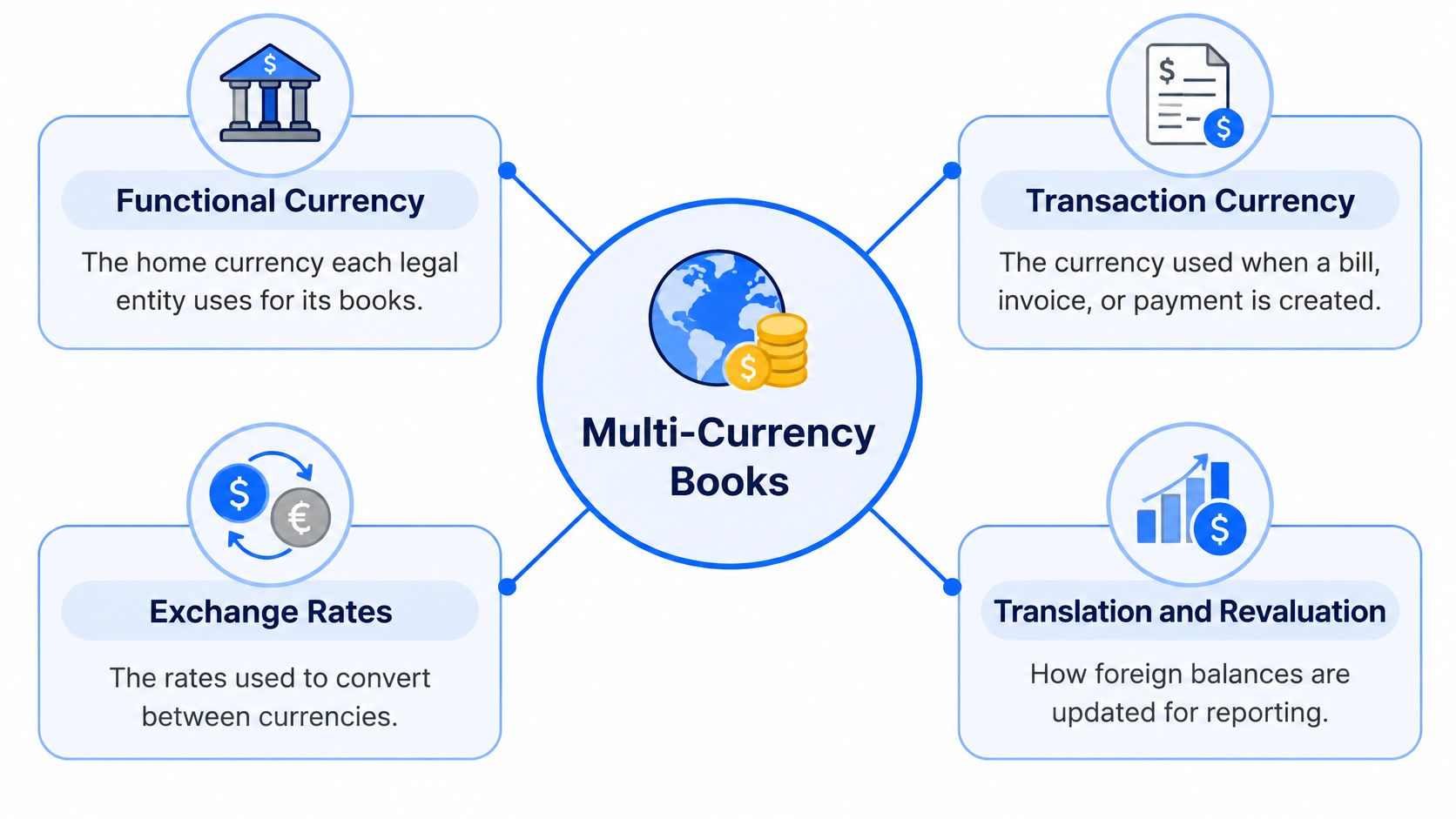
A Canadian subsidiary doesn't automatically use the parent's currency as its functional currency. Make that determination from the entity's economic environment, then configure the system accordingly. For teams reporting under US GAAP, Deloitte's ASC 830 functional-currency guidance offers a corresponding reference. Don't let a convenient reporting preference become an accounting policy.
Revaluation and Translation in Plain Terms
During close, revaluation updates foreign-currency monetary balances to the closing rate. Open receivables, payables, loans, and foreign-currency cash can therefore produce unrealized exchange gains or losses before settlement.
Draw the ownership lines early. Revaluation belongs in the ledger. Rate sourcing, hedging, and fund movements can sit in a treasury tool or bank platform. What the accounting system must keep is the evidence: which rate was applied, when it took effect, and who approved it.
Some balances stay at historical rates. PwC's explanation of monetary and non-monetary foreign-currency items distinguishes closing-rate treatment for monetary items from transaction-date treatment for non-monetary items measured at historical cost. Non-monetary items measured at fair value use the rate applicable when fair value was measured.
| Accounting job | What the finance team is doing |
|---|---|
| Initial recognition | Recording a foreign transaction in functional currency |
| Period-end revaluation | Updating eligible monetary balances for closing rates |
| Translation | Converting an entity's statements into the group's presentation currency |
Translation happens at consolidation. For foreign operations covered by the relevant IAS 21 requirements, assets and liabilities use closing rates, income and expenses use transaction-date rates, and the resulting translation differences go to other income.
Keep those translation differences separate from transaction-level exchange gains and losses. The detailed IAS 21 guidance on recognition and exchange differences provides the accounting basis, including exceptions to the general profit-or-loss treatment.
A short walkthrough of the same terminology:
How AR, AP, and Intercompany Balances Move
Follow a customer invoice through its lifecycle. Record it, reassess the open monetary balance at each reporting date, then reconcile settlement and the related exchange difference. AP follows the same control logic from the payable side.
Billing events deserve attention before the currency calculation starts. For subscription businesses, map the operational events that feed receivables first; Creem's guide to handling mid-cycle upgrades and failed renewals covers the billing side of that work.
Intercompany activity carries a stricter requirement: the counterparties must agree on the underlying transaction before consolidation. Align document references, transaction currencies, dates, and settlement status when designing intercompany transaction processes. Software can flag a mismatch. Agreeing the underlying entry stays with the two teams that booked it.
Don't assume different functional-currency balances automatically indicate an error. Investigate whether the difference reflects legitimate currency treatment or mismatched source entries. Deloitte's overview of foreign-currency transactions under ASC 830 is a useful reference when documenting the distinction for US GAAP reporting.
Must-Have Features to Require in Accounting Software
Skip the opening question about how many currencies the platform supports. Hand the presenter a foreign-currency invoice instead, ask them to run its period-end treatment, and trace the journal that comes out back to the source document. One transaction tells you more than a feature checklist ever will.
Two things must survive that trace. The original amount stays on record next to the functional-currency value, the rate applied, and the rate date. Revaluation writes an adjustment a reviewer can explain, with the entry history intact behind it.
Keep the scope honest while you're at it. Conversion is the easy part; the ledger's job is evidence. Hedging decisions, exposure monitoring, and bank-side rate execution belong to treasury tools and your banking platform. Asking the GL to do treasury work is how teams end up resenting software they overpaid for.
Rate and Evidence Controls to Verify in a Demo
| Control to verify | Why it protects the close and audit trail |
|---|---|
| Original and functional-currency values | Lets reviewers follow the conversion without rebuilding it |
| Rate source, currency pair, and effective date | Shows exactly which rate supported the entry |
| Separate spot, average, and closing rate types | Prevents an inappropriate rate from becoming a universal default |
| Monetary-item classification | Keeps historical-cost balances out of blanket revaluation |
| Effective-dated rate overrides | Preserves the reason and period for an approved exception |
| Approval history and supporting evidence | Identifies who authorized the rate and what they reviewed |
| Separate translation-adjustment tracking | Makes consolidated movements distinguishable from transaction-level FX |
| Entity-to-group drill-down | Helps the controller reconcile group statements to entity records |
Rate types are where shortcuts hide. The IAS 21 requirements for translating foreign operations distinguish closing-rate translation of assets and liabilities from transaction-date translation of income and expenses. A single period-end rate applied across every statement line fails that test.
For a concrete product check, review Sage Intacct's exchange-rate documentation and its overview of exchange rate types before the demo. Ask the presenter to show the rate type, effective date, and any approved override for your transaction, then trace the resulting journal.
When a vendor proposes average rates, ask who decides they're appropriate and on what basis. For a product-specific follow-up, Sage Intacct's global consolidation book documentation describes reporting-currency settings and translation methods. A dropdown option proves nothing about whether the rate represents the transactions it converts.
Test the Exception, Not Just the Happy Path
Run two scenarios in every demo: a clean transaction, then an approved rate override. The presenter should show what the preparer can edit, what requires controller sign-off, and what a reviewer can still see afterward. If the exception erases its own audit trail, walk away.
A good demo ends with reconciled statements and the evidence behind them, not a converted invoice on a screen.
For financial-services entities, the Sage Intacct evaluation for financial-services organizations is a useful frame for the reporting and control requirements your structure will demand. Keep acceptance criteria tied to your own books, not the vendor's reference setup.
Apply the same discipline to the purchase itself. Rally's resources to track software and cloud spending help you see what you're committing across software and related services before you sign.
Define ROI as work removed and controls strengthened. Spreadsheet exceptions, reconciliation hours, evidence preparation for auditors, recurring administration: put all of it in the business case. Reject any return claim that amounts to a faster close with nothing behind it.
Implementation Checklist and Pitfalls to Avoid
A rate feed can be perfectly reliable and still wrong for your books. Consistency is not evidence, and a converted number is not support unless someone can explain where the rate came from, why it was allowed, and who approved the exception.
The IAS 21 exchangeability amendments, effective for annual reporting periods beginning on or after 1 January 2025, raise the bar on judgment: assess whether exchange is available, estimate a spot rate when it is not, and disclose the methodology, assumptions, and financial effects. A documented estimate can be safer than an automatic rate nobody can defend.
Establish Policy Before Configuration
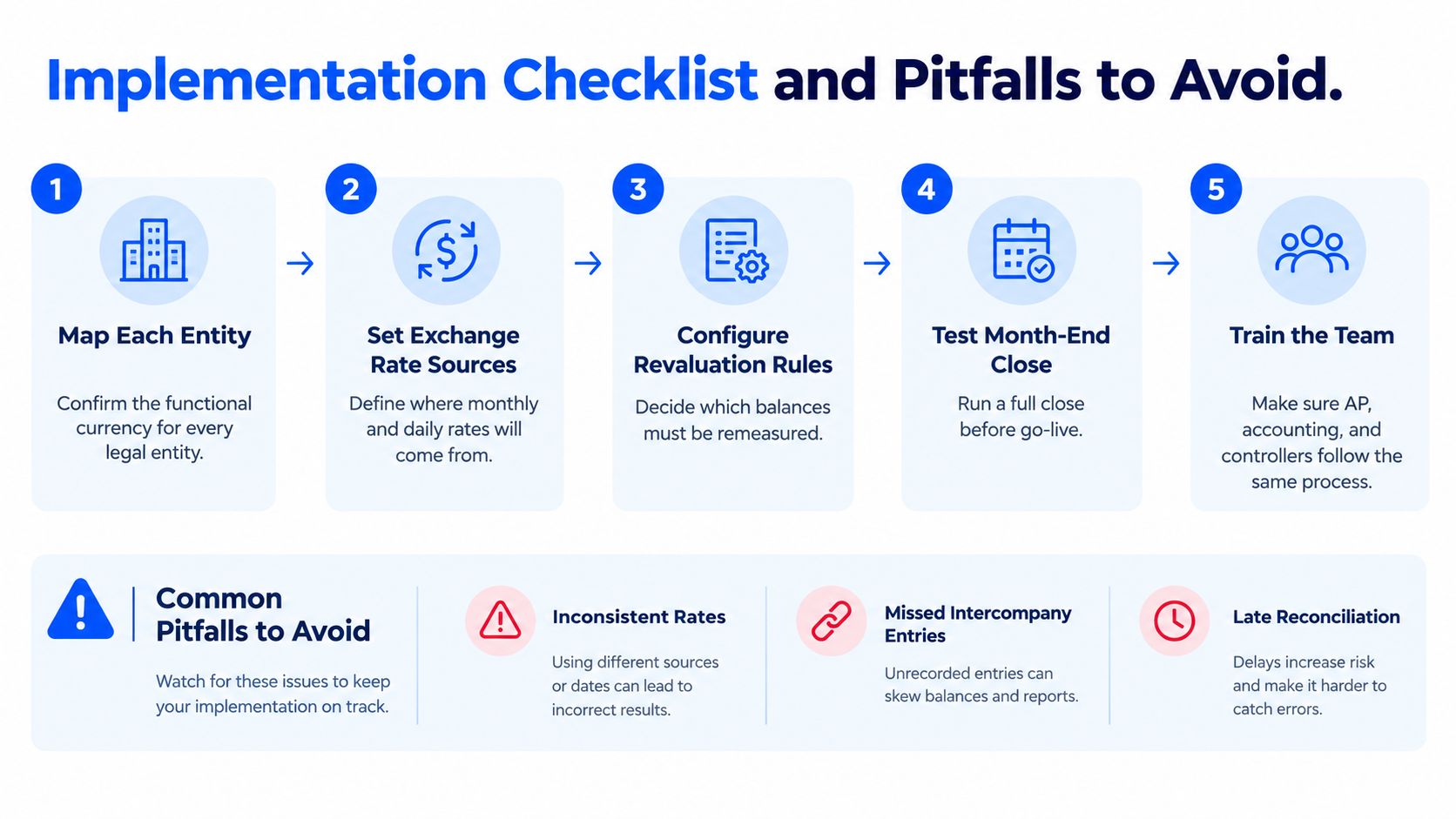
- Map each entity. Confirm its functional currency and document the rationale. Identify the presentation currencies needed for group reporting. Check Sage Intacct's multicurrency setup documentation when specifying transaction-currency requirements, and verify entity base-currency requirements separately.
- Assign rate sources. Define the source for each currency pair, the applicable rate types, and the owner responsible for investigating missing or questionable rates.
- Document exchangeability judgments. Separate routine settlement delay from a real restriction, and retain the evidence behind any estimated rate.
- Set approval authority. Name who proposes an exception, who approves it, and where the methodology and disclosure support will live.
The controller should own this policy. Whoever uploads the rate file should not be deciding accounting treatment by default.
Prove the Boundary Before Go-Live
Let the ERP own recorded calculations, consolidation, and retained support. Keep conversion pricing, payment execution, and settlement detail with the bank or payment provider unless the ledger can capture them with evidence.
- Configure eligible balances. Test monetary and non-monetary classifications instead of revaluing everything.
- Rehearse a closed period. Compare system outputs with reviewed balances and explain differences before accepting the configuration. Use documented application-control objectives to check that inputs, processing, and outputs remain accurate, complete, and traceable.
- Reconcile intercompany activity. Clear missing counterpart entries and timing differences before consolidated reports are trusted.
- Train the close team. AP, accounting, and controllers should run the actual approval and evidence-retrieval path, not a demo path.
Go-live gate: The close team should be able to explain an adjustment without asking the implementation consultant to reconstruct it.
Put incomplete source data, unsupported automatic rates, and late reconciliations in the risk register. Do not add a hedging program just because foreign-currency transactions exist.
Use an ERP readiness assessment checklist to assign owners and dependencies before setting the deployment calendar. Time-to-value comes from making accounting decisions early, not from loading opening balances quickly.
Software Alone Versus a Partner-Led Implementation
A software license gives you access to functionality. It doesn't decide your functional currencies, design the intercompany structure, approve your rate policy, or determine what the board needs to see.
Buying an ERP and buying an implementation are two separate decisions. The platform must support the required accounting. The implementation must make that accounting workable for your team.
Keep Accounting and Treasury Responsibilities Separate
The distinction matters beyond the close. OFX's UK SME finance research surveyed 150 finance leaders in April 2025 and identified interest in multi-currency accounts, FX fees and rates, and hedging or forward contracts.
Those needs are connected. They don't all belong in the general ledger.
| Layer | Recommended process ownership |
|---|---|
| Operational currency management | Finance operations with banks and payment providers for payments, settlement, fees, and cash access |
| Financial-reporting translation | Accounting team using the ERP for controlled calculations, consolidation, and supporting records |
| Risk management | Treasury or designated finance leadership for exposure policy, forecasts, and hedging decisions |
A correctly recorded accounting gain tells you nothing about whether the company obtained a good conversion rate. A favorable payment rate tells you nothing about whether the statements received the right accounting treatment. Hold each layer to its own standard of evidence.
Hedging earns its own decision, gated on forecast quality, approval authority, documentation requirements, and hedge-accounting complexity.
Buy a Design Your Team Can Operate
Among implementation options, Lucentive is a Sage Intacct National Premier Partner and Value Added Reseller serving mid-market, healthcare, and nonprofit organizations. Its team includes CPAs, training specialists, developers, and engineers with long-standing ERP delivery experience.
A good engagement starts from how your organization bills, receives funding, pays suppliers, manages entities, and closes its books. A pre-packaged configuration skips that work, and the gaps surface at your first real close.
When evaluating a Sage Intacct consulting engagement, ask for named deliverables rather than estimated hours. Hours are easy to sell and hard to audit. Specifics to require:
- Accounting design: Entity structure, rate governance, intercompany rules, and reporting responsibilities.
- Acceptance evidence: A rehearsed close with reconciled outputs and documented exceptions.
- Operational handover: Training, process ownership, and a support path your controller understands. If the ERP is hosted, include provider-control review in the handover; the AICPA's SOC resources explain the reports available for evaluating service-organization controls.
For CEOs and CFOs approving the investment, these deliverables make the scope easier to challenge and the outcome easier to evaluate. A short working session should establish whether Sage Intacct fits your entities, currencies, and close calendar before you commit to a broader project.
Summary
Multi-currency accounting is a control and evidence problem, not just a conversion feature. Functional currency, transaction currency, revaluation, and translation serve different purposes, and your software must preserve those distinctions. Require traceable rates, retained transaction history, approved exceptions, and reconciled consolidation outputs. Establish policy before configuration, test a closed period, and keep accounting responsibilities separate from payments and treasury risk management. For organizations moving beyond QuickBooks, Sage Intacct deserves an evaluation built around their actual books. A partner-led working session can clarify the design and implementation responsibilities before purchase.
Frequently Asked Questions
Do We Need Multi-Currency Accounting if We Only Bill a Few Foreign Customers?
Yes, but transaction volume doesn't settle the tooling question. Control gaps do. Even a handful of foreign-currency receivables requires correct initial recognition, reporting-date remeasurement, and settlement reconciliation. Check whether your current process retains the rate evidence and journal trail an auditor would request. If it does and you have no consolidation layer, your existing setup may still be adequate. If entities are stacking up, the workload has likely outgrown it already.
What Is the Difference Between Revaluation and Translation?
Revaluation remeasures open monetary balances inside one entity's functional-currency books, with differences typically hitting income. Translation converts an entire entity's statements into the group's presentation currency for consolidation, routing exchange differences through equity. Different mechanics, different outputs, different audit questions. When a vendor says the system "handles currencies," ask for separate demonstrations of both processes, including the journals and rate records behind each one.
Should Accounting Software Decide Whether We Hedge Currency Risk?
No. The ledger's job is reliable balances and clean reporting. Hedging is a treasury policy decision that turns on forecast quality, governance appetite, documentation discipline, and whether hedge accounting justifies its complexity. One caution worth repeating: a reported FX gain or loss tells you what the exchange rate did, not whether the company absorbed an avoidable conversion cost. Keep the reporting conversation separate from the exposure management one, and assign each to the right owner.
When Should We Bring in a Partner Before Buying Sage Intacct?
Earlier than most finance teams expect. Engage a partner while requirements are still open, before licensing and configuration decisions lock in design choices you will live with for years. The work to resolve up front covers entity currencies, rate sources, approval rules, intercompany handling, and close testing. Have the partner walk through your real transactions and reporting outputs rather than a scripted demo. That exercise exposes implementation effort, internal responsibilities, and acceptance criteria far better than any feature checklist.
Lucentive provides Sage Intacct advisory and implementation services for finance teams connecting multi-currency accounting policy with a workable close process. To assess fit before you buy, bring your entity structure, currency exceptions, and close calendar to a 30-minute working session with our team.