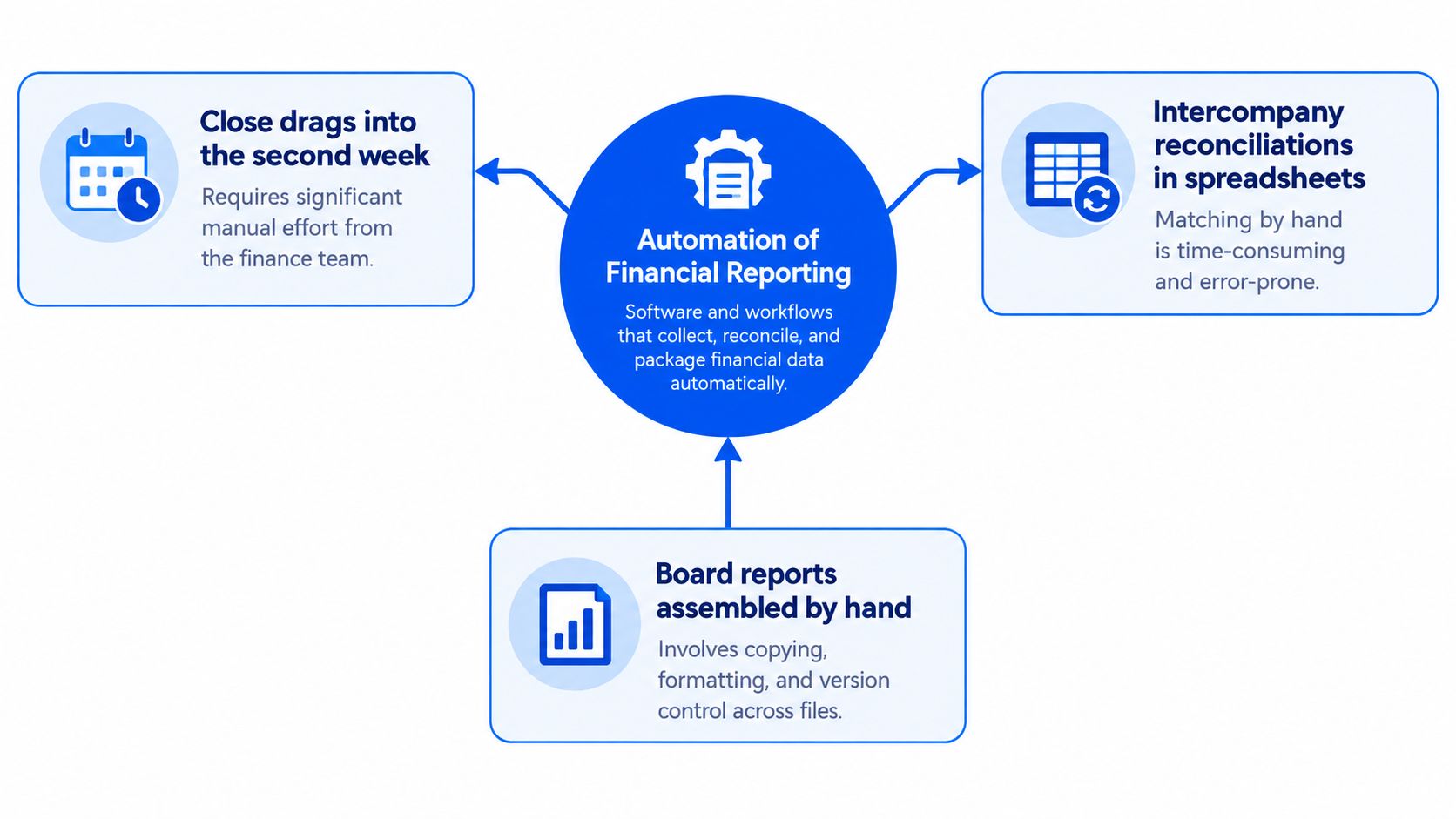
Automation of financial reporting is the use of software and structured, machine-readable data to collect, validate, consolidate, and distribute financial reports with minimal manual work. It matters when your close stretches into the second week while your Controller chases intercompany differences and your CFO waits for a board package assembled by hand.
If you've outgrown QuickBooks, the question isn't whether another reporting tool can produce a better-looking statement. It's whether a cloud ERP such as Sage Intacct, implemented around your actual workflows, can give you faster reporting, multi-entity control, and evidence you can defend during an audit.
Table of Contents
- What Automation of Financial Reporting Actually Means
- The Business Case for Financial Reporting Automation
- Key Components and Integration Points
- A Phased Implementation Roadmap
- Controls, Compliance, and Common Challenges
- How Reporting Automation Works in Practice
- Summary
- Frequently Asked Questions
What Automation of Financial Reporting Actually Means
The familiar setup looks automated until someone follows a number from its source to the board report. Transactions enter an accounting system, but staff export balances, repair account mappings, reconcile entities in spreadsheets, and paste results into presentation templates. Software handles individual tasks while people still connect the process.
Automation is a spectrum, not a switch. A scheduled report is useful, but it doesn't make the underlying close automated if the balances depend on undocumented adjustments in someone's workbook.
Follow the process rather than the presentation
Start with the record-to-report process flow. Identify where a transaction enters, who validates it, how it reaches consolidation, and what happens before someone distributes the report.
Classify the handoffs accurately.
- System-controlled work runs against defined rules and retains evidence of completion.
- Assisted work uses software but still requires someone to review, upload, or approve the result.
- Manual bridges depend on exports, spreadsheet formulas, copied values, or personal knowledge.
That distinction matters more than how polished the final dashboard looks. A report can refresh automatically while still relying on a fragile upstream reconciliation.
Structured data came before AI
Financial-reporting automation didn't begin with generative AI. XBRL, or eXtensible Business Reporting Language, made financial information machine-readable through standardized tags; the SEC established a voluntary filing program in 2005 and adopted mandatory reporting rules with phased implementation in 2009, as documented in the review of XBRL research.
The practical lesson isn't that every mid-market company needs a public-company filing architecture. It's that software needs consistent definitions before it can reliably compare, validate, or aggregate financial information. The SEC's Company Facts data illustrates the payoff: tagged filing information can be accessed as structured data rather than extracted manually from individual reports.
Cyndra's resource on implementing AI-driven financial reporting offers a separate perspective for teams exploring AI. Treat that evaluation as distinct from the foundational work of standardizing accounts, approvals, and data movement.
Practical rule: If nobody can explain how a reported balance was assembled without opening a personal spreadsheet, the process still depends on a manual bridge.
A sensible target isn't a close without people. It's a close where people spend their time resolving exceptions and exercising judgment rather than carrying data between systems.
The Business Case for Financial Reporting Automation
A CFO should challenge any business case built entirely on hours saved. Someone still has to review exceptions, maintain integrations, approve accounting decisions, and administer the system. The defensible question is whether the organization can produce reliable information sooner with less repetitive handling.
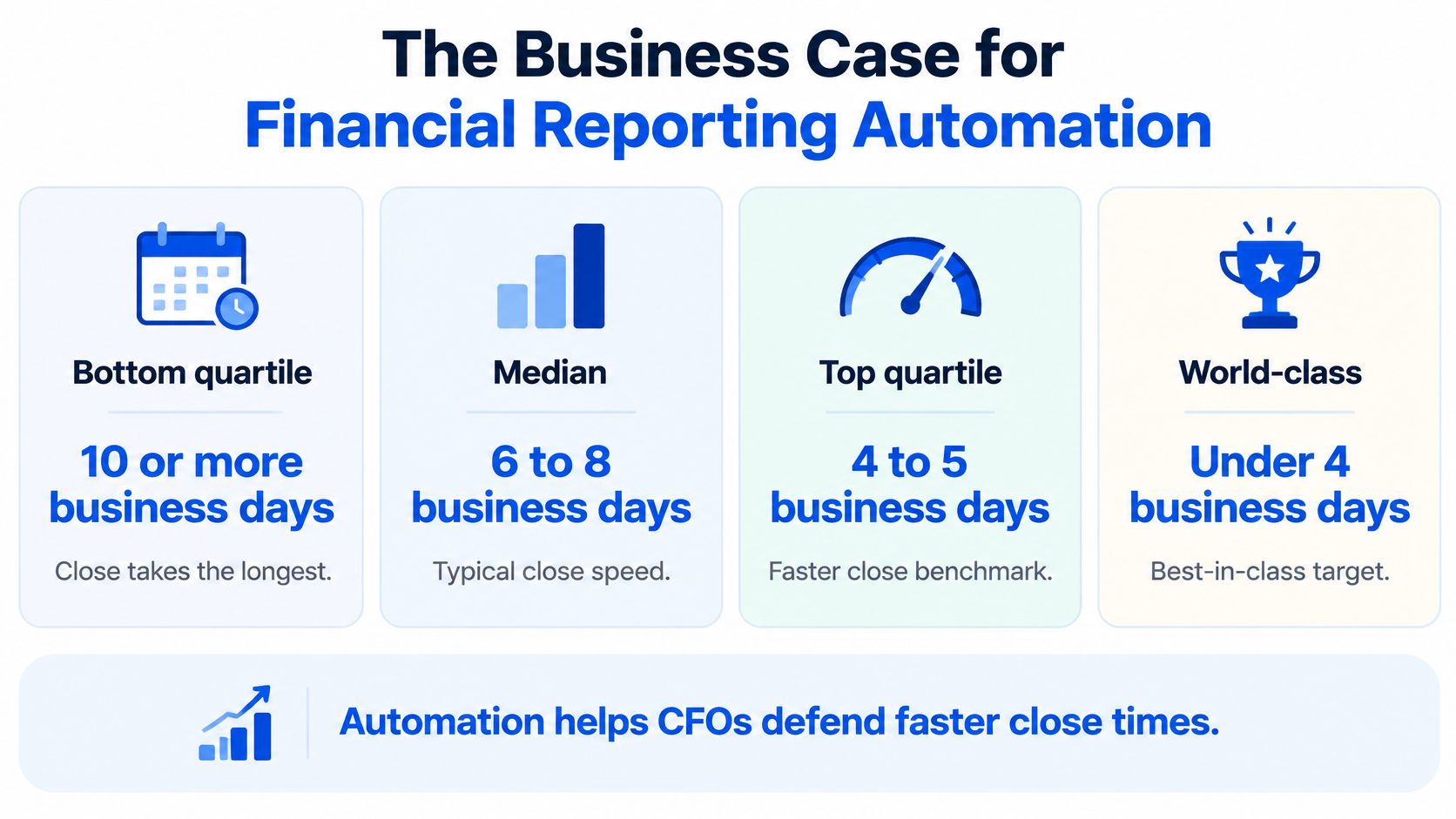
Close benchmarks provide context, not a promise. An APQC benchmark summary covering close performance places bottom-quartile organizations at 10 or more business days, median organizations at 6 to 8, top-quartile organizations at 4 to 5, and world-class organizations at 1 to 3; the same secondary summary reports that organizations automating reporting and reconciliation close three times faster and redirect approximately 40% of staff time toward analysis and advisory work.
Separate association from a savings commitment
Stronger evidence for the operating model comes from ISG's close-cycle benchmark research: 88% of organizations automating substantially all of the close finished within six business days, compared with 59% automating some activities and 40% automating little or none.
That association supports evaluating the whole process rather than buying isolated task automation. It doesn't establish what your company will achieve, because your starting point includes your entity structure, data quality, accounting complexity, and team capacity.
For investment approval, distinguish capacity released from cash savings realized. Time redirected toward forecasting can be valuable without reducing payroll. Don't count that same time as both a staffing reduction and additional analytical capacity.
Baseline what the investment must improve
Agree on definitions before implementation. Otherwise, the project team may celebrate a faster ledger close while the CFO still waits for usable management reporting.
| Measure | What finance should establish |
|---|---|
| Days to close | Start and finish points, including management-report readiness |
| Manual intervention | Which transactions require human repair or re-entry |
| Unreconciled-item aging | How long unresolved differences remain outstanding |
| Post-close adjustments | Frequency, cause, and materiality |
| Exception-resolution time | Time from detection to approved resolution |
| Audit requests | Effort needed to retrieve supporting evidence |
| Forecast variance | Whether earlier actuals support better planning |
Build the cost side just as carefully. Include implementation, integration maintenance, internal participation, training, and ongoing ownership. A workflow that saves preparation time but creates an unmanageable exception queue may relocate the workload.
The return should be expressed in operating terms: earlier visibility into location performance, more time to investigate variances, and less dependence on a few employees' spreadsheet knowledge. Those are outcomes a CEO can evaluate alongside the software spend.
Key Components and Integration Points
A reporting architecture should explain how a number travels, not just which applications the company owns. For a Sage Intacct evaluation, ask the implementation team to trace a representative transaction through the proposed design before discussing dashboard layouts.
The working layers are source systems, governed mappings, processing workflows, and report outputs. Each needs an owner and a clear boundary.
Connect the source systems deliberately
In healthcare, the source inventory may include the EMR, clinical billing, payroll, purchasing, and the general ledger. A nonprofit may need fund accounting, grant administration, donor records, and expense systems. Multi-entity businesses must also account for transactions originating in separate operating companies.
Don't assume every source should post every detail to the ledger. Decide what finance needs for accounting, what operating teams need for analysis, and where supporting detail should remain accessible.
- EMR and clinical integrations should specify the accounting event, posting period, location, and treatment of corrections.
- Fund and grant integrations need consistent identifiers and a clear distinction between accounting classifications and operational grant records.
- Payroll, billing, and AP/AR connections should define balancing totals, rejected records, and the person responsible for resolving failures.
- Intercompany interfaces need agreement on counterparties and timing before consolidation begins.
Use the Sage Intacct API integration discussion to frame technical discovery around these interfaces. Sage Intacct's developer API documentation can help technical teams verify available objects and integration options. Connectivity is only part of the specification; reconciliation and recovery belong in the design too.
Govern the reporting definitions
The mapping layer translates source accounts and identifiers into reporting definitions. Maintain a controlled chart-of-accounts crosswalk, version changes, validate required dimensions, and assign unmapped values to an accountable reviewer.
Dimensional reporting means organizing results by attributes such as entity, location, department, fund, grant, or project rather than reconstructing every view in a separate workbook. Sage Intacct's dimensions documentation shows how these classifications appear in transactions and reports. Agree on those definitions before migration. A location label that means different things across systems won't become consistent because an integration runs more often.
Faster data movement is useful only when finance agrees on what the data means.
After mapping, configure recurring journals, reconciliations, intercompany eliminations, and consolidation. Sage Intacct's consolidation API documentation is a useful technical reference when scoping entity-level consolidation workflows. Keep processing rules separate from presentation choices so a board-report redesign doesn't require rebuilding accounting logic.
Finally, define the outputs: executive dashboards, management statements, board packages, and applicable statutory reports. Each should have an intended audience, refresh expectation, and approval status.
Real-time visibility isn't the same as finalized accounting. A dashboard can show current posted activity while estimates or period-end reviews remain incomplete. Label that distinction clearly so executives don't mistake an available balance for an approved result.
A Phased Implementation Roadmap
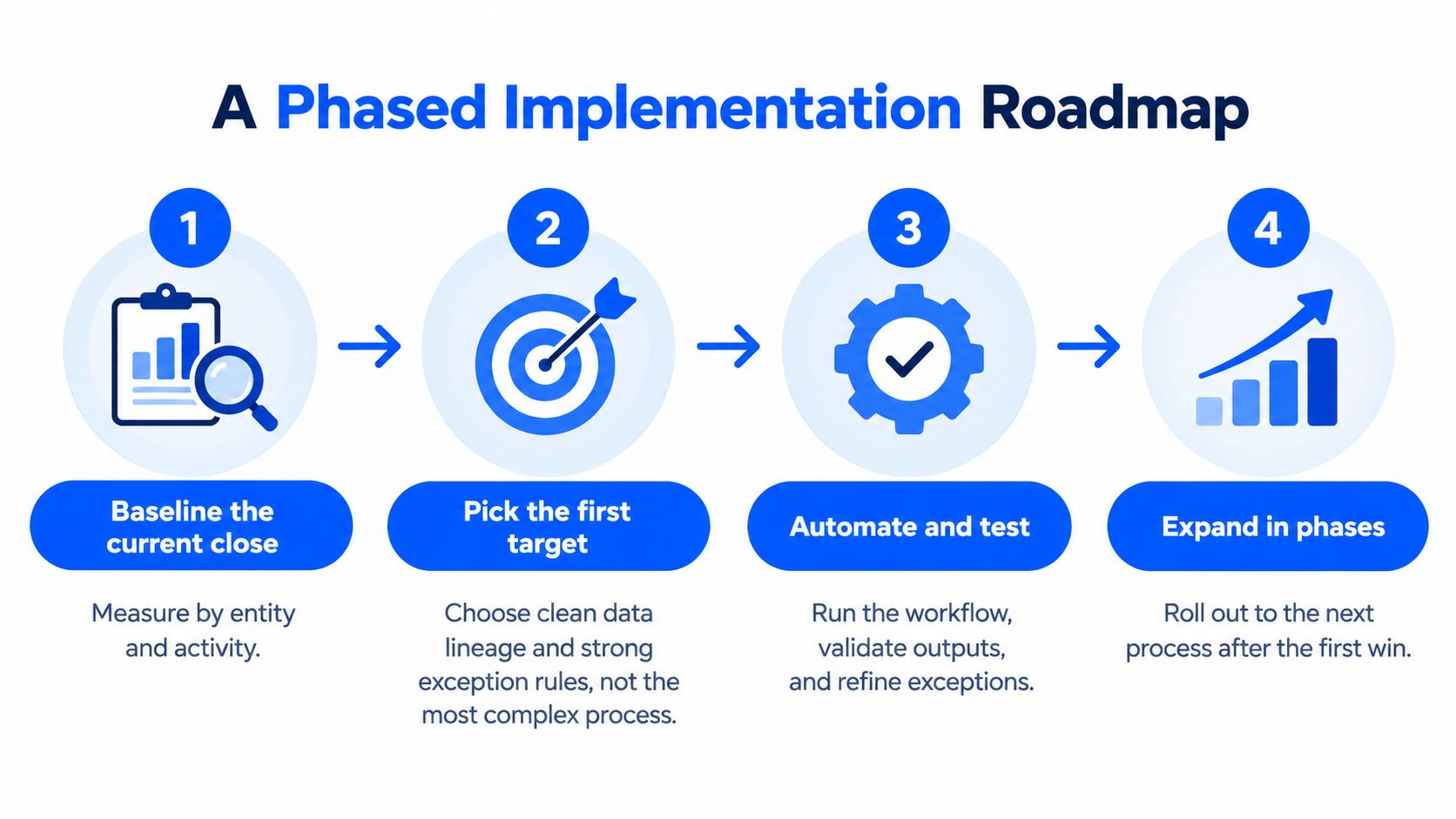
The first automation target shouldn't automatically be the task consuming the most hours. A painful process with inconsistent inputs and unclear accounting rules can be a poor pilot. Start where finance can demonstrate clean lineage, predictable rules, and a manageable exception path.
Team capacity deserves equal attention. In the Airbase Annual Benchmark Survey, 38% of respondents said their teams spent more than one-quarter of their time on manual tasks, and 11% said manual work consumed more than half. Don't schedule transformation work as though the close team has spare capacity.
Establish the baseline and choose a bounded pilot
Document the current close by entity and activity. Record dependencies, owners, required evidence, and the manual interventions identified in the business case. Include the work after the ledger closes, particularly consolidation adjustments and management-report preparation.
Then select a bounded workflow. Recurring journals, rule-based matching, account reconciliations, and close checklists are candidates when their rules are stable. An unresolved revenue-recognition policy isn't a software configuration problem.
Set acceptance criteria before building:
- Completeness means expected records arrive and reconcile to agreed control totals.
- Exception handling means rejected or conflicting items reach a named owner.
- Accounting approval means estimates and material judgments remain with authorized reviewers.
- Operational readiness means staff can run, troubleshoot, and recover the workflow without relying entirely on the project team.
Test the operating model before expanding
Compare automated output with approved accounting expectations. Include corrections, missing dimensions, duplicate submissions, period changes, and interface failures in testing. A clean demonstration using ideal data doesn't establish readiness for month-end.
Train preparers and reviewers differently. Preparers need to understand failures and recovery; reviewers need to understand evidence and approval boundaries. Assign an internal process owner who remains accountable after the implementation team leaves.
The phases of ERP implementation provide a useful planning reference for coordinating this work with broader system deployment. Expand into consolidation, intercompany processing, and management reporting only when the preceding workflow is stable enough to support them.
Implementation checkpoint: Don't approve a workflow merely because it runs. Approve it when finance can explain its output, resolve its exceptions, and operate it consistently.
Buying software alone leaves these design decisions with your team. An internal ERP group, an independent implementation firm, or a specialist partner can support the work, but responsibilities should be explicit.
Lucentive is a Sage Intacct National Premier Partner with deep mid-market, healthcare, and nonprofit experience, implementing and optimizing the platform around financial and operational reporting needs. Evaluate that advisory role through practical questions about mappings, migration, controls, training, and post-launch ownership, not just a feature demonstration.
Controls, Compliance, and Common Challenges
Automation without an audit trail reduces visible labor while increasing review risk. A reconciliation marked complete is weak evidence if nobody can reproduce the matching logic or explain how the exceptions were cleared. In my experience, month-end automation fails first when the report runs, the workflow finishes, and the reasoning behind it lives in a consultant's notebook or nowhere at all.
Partial automation is the norm. Interfaces drop records, a handful of accounts never match cleanly, and someone still keys the entries that fall outside the rules. Design controls around those exceptions, because that is where errors and audit questions concentrate.
AI raises the stakes further. A KPMG report on AI in audit and financial-reporting governance identifies accuracy, cybersecurity, and data organization among the governance concerns finance and audit leaders raise about AI in reporting, and discusses SEC staff expectations around documented model design, appropriate governance expertise, and evaluation within internal control over financial reporting.
Specify the evidence before configuration
Ask a direct question during design: What must an auditor or reviewer receive to reproduce, challenge, and approve this result? Write the answer into the workflow specification. COSO's internal-control framework offers a useful reference for designing and monitoring controls around the process. A control binder assembled after go-live rarely matches what the system did during close.
| Control requirement | Evidence to retain |
|---|---|
| Ownership and approval thresholds | Responsible preparer, reviewer, and escalation authority |
| Exception control | Original issue, investigation, resolution, and approval |
| Source-to-report lineage | Source reference, transformation, posting, and report destination |
| Change management | Mapping, rule, or model changes with authorization |
| Access rights | Permissions appropriate to preparation, administration, and approval |
| Fallback procedures | Recovery steps when an interface or automated decision fails |
For a clinic, access design should account for the data entering from clinical systems. For a nonprofit, review boundaries must reflect restricted funds and grant requirements. For a multi-entity group, intercompany eliminations need visible lineage on both sides of the entry, since an adjustment that clears in one entity can strand an out-of-balance in another. A generic approval template will not catch those differences. When an outsourced service affects financial reporting, review its relevant controls and your own responsibilities; the AICPA's SOC 1 guide explains how these reports support that assessment.
Separate fixed rules from generated output
Deterministic automation follows specified logic: balancing totals, testing required fields, matching defined attributes. Finance can validate the rule and test whether the system applies it consistently, and an auditor can re-perform it.
Generative AI produces output that has to be judged, which changes the control. Document prompts or configurations, sample results, preserve relevant model-change records, and require explicit human sign-off for consequential reporting output. The NIST Generative AI Profile offers a framework for assigning oversight roles and assessing risks throughout deployment. Its companion, the NIST AI Risk Management Framework, organizes AI risk management around governance, mapping, measurement, and management. Use these resources to inform AI oversight, not as substitutes for accounting controls or audit standards. A plausible classification or explanation is not evidence that it is correct.
Governance also changes implementation economics. Research on financial-reporting automation, including a peer-reviewed study of financial-reporting automation, has examined its associations with internal-control quality, audit fees, and audit-committee activity. The practical lesson holds regardless of where any single study lands: do not assume an immediate reduction in audit effort. Budget for transition review, process documentation, and evidence validation, and expect the audit team's questions to shift toward the automated rules themselves before effort declines.
Use an ERP post-implementation review checklist to revisit the design after staff have operated it through real reporting cycles, since exceptions that never appeared in testing tend to surface in the second or third close. Software alone is not a control environment. Finance still owns the rules, the exceptions, and the approvals.
How Reporting Automation Works in Practice
Manual work is a concrete starting point, not an abstract technology problem. In a survey of 700 finance and business leaders, 40% of organizations managed up to half their financial data manually and 26% handled most of it manually; the largest monthly time drains were interentity reconciliations at 31%, month-end close at 26%, and audit and compliance reporting at 20%.
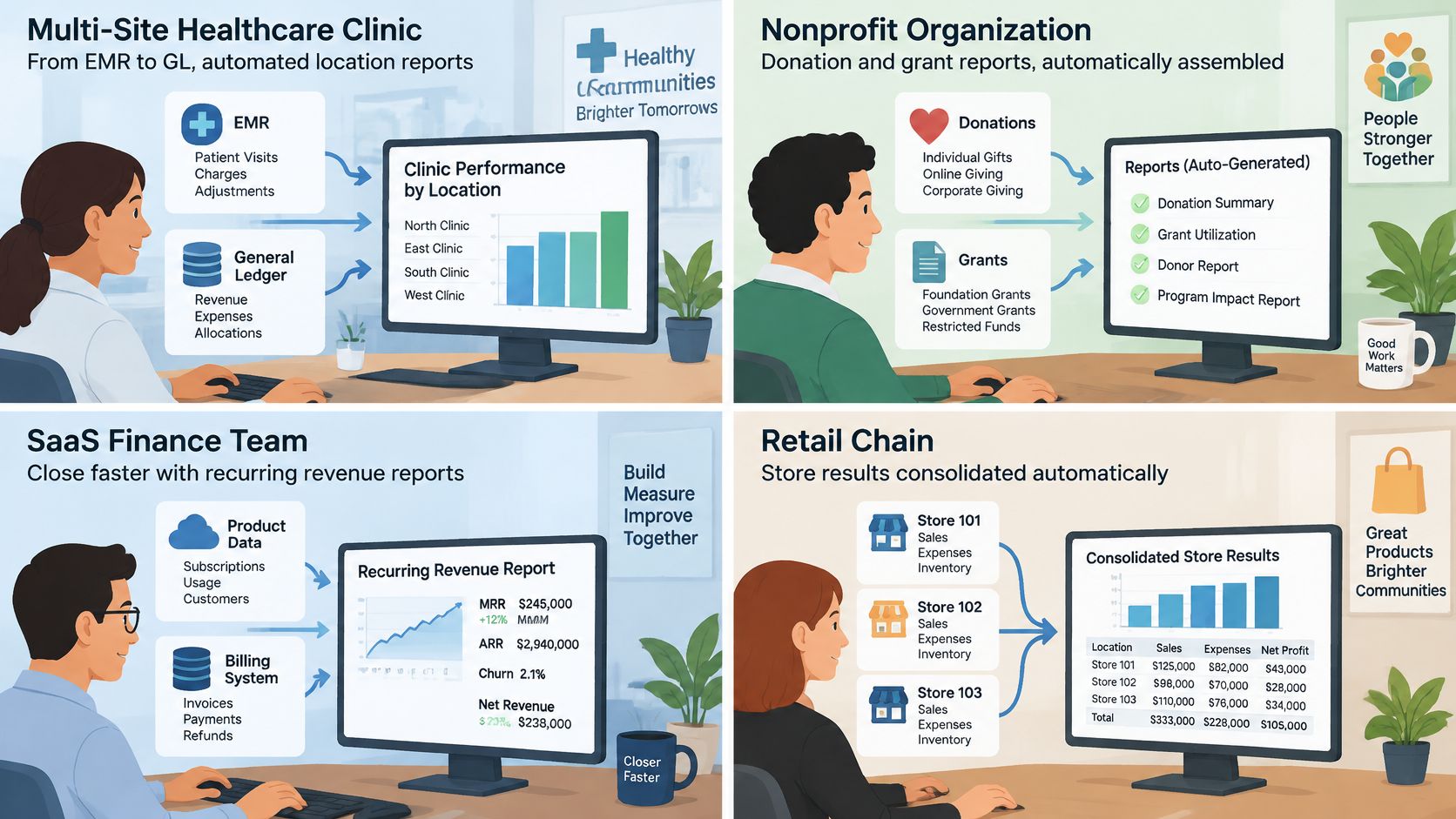
The following are illustrative workflow designs, not customer case studies or measured results. Each pairs a recognizable problem with an outcome to test during implementation.
A multi-site clinic reconciling EMR activity
A clinic's Controller receives separate clinical-system exports and rebuilds location reporting each month. The proposed workflow routes approved EMR-derived accounting data into the ledger with location identifiers, reconciles batch totals, and holds rejected records for review.
The intended outcome is earlier location-level visibility without losing the connection to source activity. Measure manual intervention and exception aging, not merely whether the interface completed successfully. Keep clinical detail outside the accounting feed unless there's a defined reporting need.
A nonprofit preparing fund and donor reports
A nonprofit's finance team repeatedly recasts ledger balances for grant managers, donors, and the board. The proposed design uses agreed fund and grant dimensions, controlled classifications, and saved reporting structures rather than separate reconciliation workbooks.
The outcome to test is consistent reporting from approved accounting data with traceable adjustments. Restricted-fund interpretation and unusual grant conditions still require human review; FASB's guidance on nonprofit financial statements provides useful context for distinguishing net assets with and without donor restrictions. Measure report-preparation effort alongside post-close corrections so speed doesn't conceal classification problems.
A DSO integrating acquired practices
A dental service organization receives practice-level balances under inconsistent account structures. The proposed workflow maps each practice to a governed chart of accounts, identifies intercompany counterparties, and applies reviewed elimination rules.
The target is consolidated reporting with explainable entity-level detail. Test mapping completeness before assessing consolidation speed, and track unresolved intercompany differences. Acquiring another practice shouldn't require finance to rebuild the reporting model from scratch.
A growing business moving beyond QuickBooks
A CFO can no longer answer department or project questions without assembling spreadsheet consolidations. The proposed Sage Intacct design uses agreed dimensions and dashboards and reporting tied to posted financial data, with clear distinctions between current activity and approved period-end results.
Nexist's guide to automate reporting for your SME offers another resource for scoping the reporting problem. Before selecting a platform or partner, bring representative statements, a troublesome reconciliation, and an executive reporting question to the evaluation. Those materials make a focused demonstration more useful than a tour of standard screens.
Summary
Automation of financial reporting replaces repetitive data handling with structured workflows, but it remains a spectrum rather than an all-or-nothing transformation. Close benchmarks support a business case around speed and analytical capacity, not guaranteed savings. Reliable execution depends on connected source systems, governed mappings, phased implementation, and clear ownership. Audit evidence and exception controls matter as much as report delivery. Healthcare, nonprofit, DSO, and growing-business workflows require different integration and review decisions. Choosing implementation support deserves the same attention as choosing software, because the operating design determines how finance will use it.
Frequently Asked Questions
What should we automate first in the reporting process?
Start with a bounded process that has clean source-to-report lineage, stable rules, and a clear exception owner. Recurring journals, matching, reconciliations, and close checklists can be suitable candidates. Don't choose solely by hours consumed. Establish completeness, accounting approval, and recovery criteria before expanding into consolidation or more complex management reporting.
Will automation replace our accounting staff?
The operating model described here redirects repetitive preparation toward exception resolution, review, forecasting, and decision support. It still requires people to approve estimates, interpret unusual transactions, maintain controls, and own the process. Treat capacity released as distinct from payroll savings. A credible investment case shouldn't count the same time as both additional analytical capacity and a staffing reduction.
How do we know whether automation is improving reporting?
Compare performance against the baseline established before implementation. Track days to close, manual intervention, unreconciled-item aging, post-close adjustments, exception-resolution time, audit requests, and forecast variance. Check whether management reports are usable sooner, not just whether the ledger closes earlier. Include integration maintenance and review effort so the assessment captures work shifted elsewhere in the process.
Can a small nonprofit or single-specialty clinic benefit?
Evaluate the reporting problem rather than organization size alone. A nonprofit may need consistent fund and grant reporting, while a clinic may need controlled EMR-to-ledger data movement and location visibility. A phased approach can address those specific needs while retaining human review. Assess implementation effort, ongoing ownership, and reporting requirements before committing to a broader ERP scope.
Lucentive offers Sage Intacct implementation and optimization focused on the workflows, integrations, and controls behind reliable financial reporting. Visit Lucentive to schedule a 30-minute working session or customized demo, bringing your close checklist and a representative reporting problem so your team can assess fit before choosing a partner or buying software alone.