A controller at a multi-location clinic group can spend every month-end rebuilding deferred-revenue schedules in spreadsheets. A nonprofit on QuickBooks may have contract amendments, milestone billing, and several entities spread across disconnected files. The close gets slower, exceptions multiply, and the audit trail depends on whoever remembers why a schedule changed.
That problem is bigger than compliance. ASC 606 follows five steps, from identifying the customer contract through recognizing revenue as performance obligations are satisfied, so the system must preserve contract data, allocation logic, schedules, and evidence for each recognition event as outlined in SEC-filed ASC 606 guidance. The best revenue recognition software depends on where it sits relative to your general ledger, the contracts you manage, and the team responsible for operating it.
Table of Contents
- 1. Sage Intacct Contracts Revenue Management
- 2. Oracle NetSuite Revenue Management
- 3. Zuora Revenue (formerly RevPro)
- 4. SOFTRAX Revenue Management System
- 5. Chargebee RevRec
- 6. Maxio Revenue Recognition
- 7. Stripe Revenue Recognition
- Top 7 Revenue Recognition Software Comparison
- Choosing Your Revenue Recognition Path Before You Buy
- Summary
- Frequently Asked Questions
- What is the best revenue recognition software for a mid-market company leaving QuickBooks?
- Should revenue recognition software sit inside the ERP?
- Can revenue software handle contract modifications?
- What should a healthcare or dental organization test?
- Is a standalone revenue engine better than an ERP module?
- Does revenue recognition software remove accounting judgment?
- What should a proof of concept include?
- Why does the implementation partner matter?
1. Sage Intacct Contracts Revenue Management
Best for finance teams standardizing on Sage Intacct.
Sage Intacct Contracts is the strongest fit when your general ledger, entities, reporting dimensions, and revenue workflows should live in one cloud ERP. It provides ASC 606 and IFRS 15 support through configurable templates, schedules, and event-based triggers. It also supports straight-line, daily-rate, event-based, and evergreen recognition for organizations with recurring services, project work, or milestone-driven arrangements.
The important distinction is its position as a native ERP module, not a separate subledger that must reconcile back into Sage Intacct. Contract accounting can map unbilled accounts receivable, deferred revenue, and recognized revenue directly to the general ledger. That reduces integration points and gives auditors a clearer path from contract record to journal entry, which aligns with the emphasis on contract traceability and internal control in AICPA revenue recognition guidance.
Practical rule: If Sage Intacct will remain your system of record, test native contract accounting before adding an external revenue engine.
Healthcare and dental organizations can use event-driven schedules for services tied to milestones. Nonprofits can also evaluate workflows that support contract assets, acquisition-cost amortization, and nonprofit accounting requirements under ASC 958. The fit is especially strong for multi-entity teams moving beyond QuickBooks and looking for dashboards, dimensions, and close controls in the same environment.
Pricing is quote-based, and the module requires a Sage Intacct subscription. Advanced event-based methods may also have template constraints, so your proof of concept should use real amendments, bundled services, and milestone billing. Review the Sage Intacct revenue management platform and compare the Sage Intacct and Salesforce integration approach before deciding how contracts and source systems will connect.
2. Oracle NetSuite Revenue Management
Best for companies adopting NetSuite as their ERP.
NetSuite Revenue Management belongs in the ERP-native category. It makes sense when the company has already chosen NetSuite or is prepared to standardize financials, subscription billing, and revenue accounting there. It isn't a practical standalone revenue engine for a finance team that wants to keep a different general ledger.
The module handles complex arrangements involving bundles, services, subscriptions, and usage-based charges. Its allocation capabilities include standalone selling price calculations and policy-based revenue plans. That matters when one customer order contains several deliverables with different recognition patterns. The system can automate scheduling and unbilled-revenue handling while keeping the accounting relationship inside NetSuite. Those allocation issues are central to ASC 606, especially when contracts bundle multiple promises, as discussed in PwC's revenue recognition guide. Buyers that want independent market feedback can also compare user commentary on G2's NetSuite page.
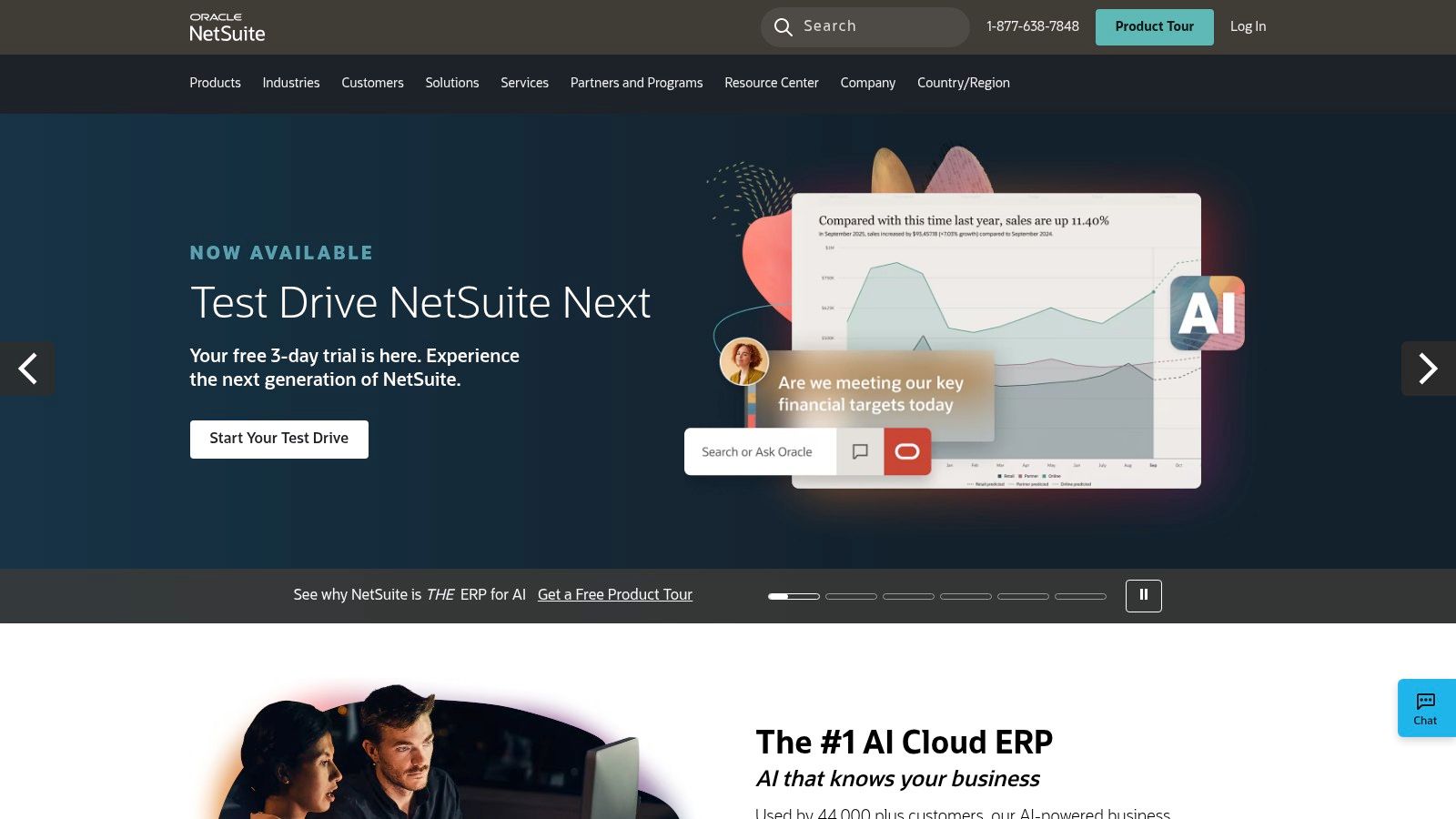
The trade-off is implementation scope. NetSuite Revenue Management is most effective when the broader company architecture already points toward NetSuite. A smaller finance team moving off QuickBooks may gain deep integration, but it may also inherit a larger ERP transition than the revenue problem requires.
Where NetSuite earns its place
NetSuite is a strong candidate for a growing mid-market company with multiple entities, complex bundles, and a need for integrated subscription billing. It is less attractive when the general ledger is already settled elsewhere and the buyer only needs contract-level revenue schedules.
Finance leaders comparing platforms should evaluate data ownership, allocation rules, amendment handling, and the effort required to reconcile billing to the ledger. Lucentive's Sage Intacct versus NetSuite comparison can help frame that ERP decision. Review the NetSuite Revenue Management product with your actual contract files, not a generic demonstration.
3. Zuora Revenue (formerly RevPro)
Best for enterprise subscription and high-complexity contract environments.
Month-end gets messy fast when billing sits in one system, the CRM in another, and the general ledger somewhere else. Zuora Revenue is built for that setup. It is an add-on subledger, not a native ERP module, and that distinction matters. A team moving off QuickBooks should expect more integration work and more implementation ownership than with an ERP-native option, but also far more control over contract-level revenue rules.
Zuora Revenue fits companies that need a dedicated engine for ASC 606 and IFRS 15 across bundles, usage, services, amendments, and multiple books. It is strongest when finance needs detailed standalone selling price analysis, contract modification handling, and delivery-based recognition that does not fit a basic invoice-driven schedule. That can be a strong match for subscription businesses, healthcare technology firms, DSOs with layered service arrangements, and nonprofit groups with complex funding terms if the organization already runs a mixed systems stack.
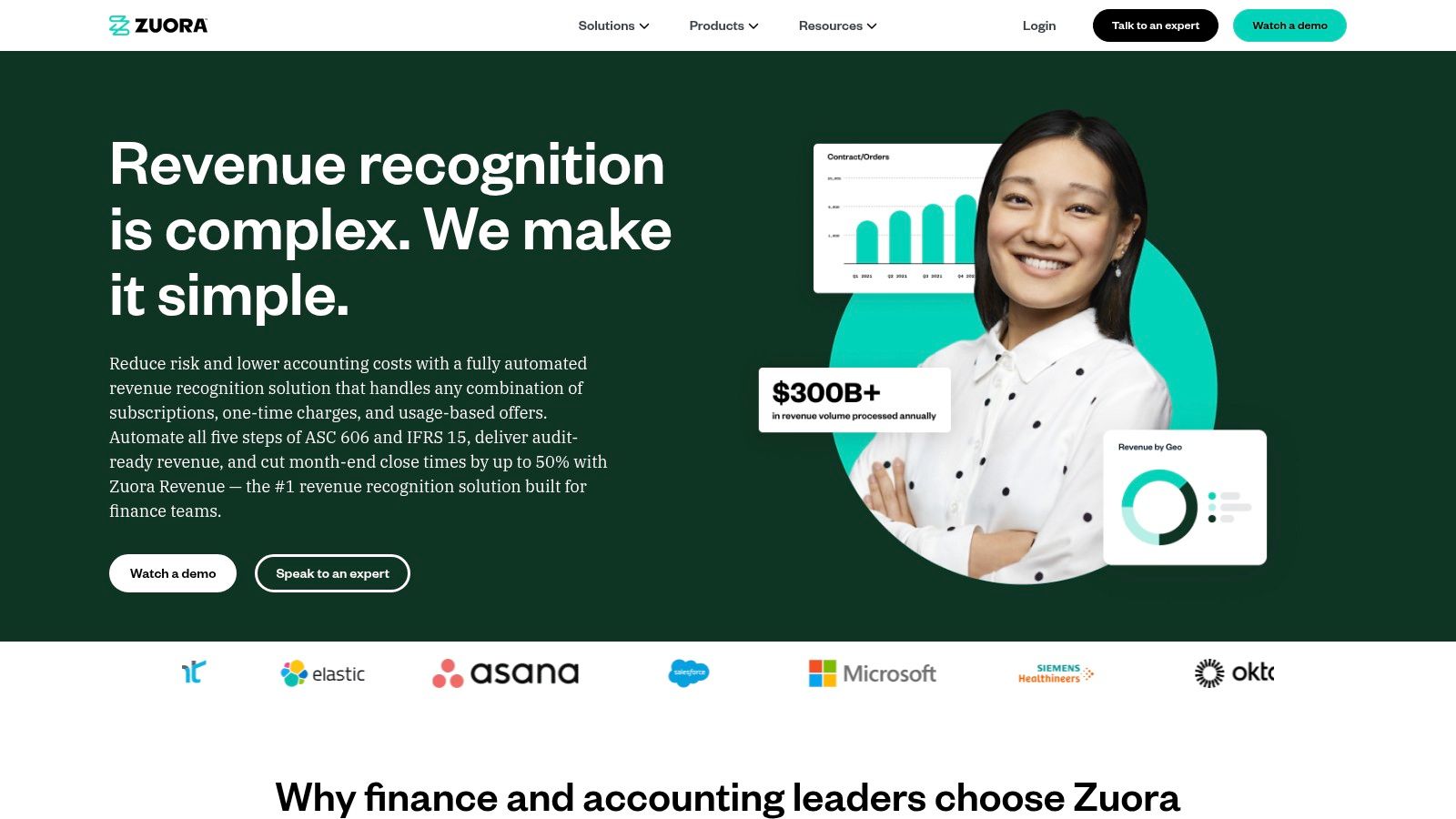
The trade-off is clear. Your team owns integrations, source-data quality, policy setup, and the reconciliation from subledger to general ledger. The software can automate schedules and reduce manual overrides. It cannot make accounting judgments for you. Questions around distinct performance obligations, standalone selling prices, variable consideration, and principal-versus-agent treatment still need documented policy and approval, as Deloitte notes in its revenue-recognition guidance. Teams that want third-party buyer feedback can also review Gartner's Zuora vendor profile.
Zuora Revenue is priced by quote, with no public list price. Buy it when contract complexity is the main problem. Skip it if you mainly want revenue schedules inside an ERP-centered close. If Sage Intacct is your likely ledger home, review the Sage Intacct API for integration planning before adding a separate engine. Start with the Zuora Revenue product page.
4. SOFTRAX Revenue Management System
Best for complex billing and revenue recognition in healthcare and B2B services.
SOFTRAX RMS combines billing and revenue recognition in one enterprise-leaning platform. That makes it different from a focused add-on that receives billing data from another system. Its policy-driven engine supports performance-obligation modeling, allocations, continuous accounting, and detailed general-ledger posting patterns.
The product supports subscription, consumption, milestone, and multi-element arrangements. It also supports multi-currency and multi-book accounting, which matters for organizations with several legal entities, reporting bases, or operating locations. Healthcare service contracts and B2B platform agreements often need more than a simple monthly schedule. They may include usage inputs, delivery milestones, credits, amendments, and changes to estimated selling prices. Those fact patterns often increase disclosure and judgment requirements under Topic 606, as outlined in KPMG's revenue issues and solutions guidance.
The integrated architecture can reduce reconciliation risk because billing and recognition share a controlled environment. It also creates a larger implementation responsibility. Your team needs defined revenue policies, reliable source data, and clear ownership for exceptions. A platform this capable won't fix contracts that lack enforceable terms or approval records.
What to test before signing
Use a mixed contract that includes recurring services, implementation work, usage charges, a discount, a milestone, and an amendment. Ask the vendor to show:
- Modification treatment: How does the system distinguish a separate contract from a change to an existing obligation?
- Audit evidence: Can an auditor trace the result from source document through allocation, schedule, and journal entry?
- Entity reporting: Can finance reconcile each entity while producing consolidated views?
- Exception control: Who reviews failed inputs, unusual changes, and manual overrides?
SOFTRAX pricing is quote-based, and implementation effort can exceed that of lighter tools. It makes sense when billing complexity and revenue complexity are inseparable. Review the SOFTRAX Revenue Management System with the contracts your healthcare, services, or multi-entity team manages.
5. Chargebee RevRec
Best for SaaS and subscription businesses that need a flexible revenue subledger.
Chargebee RevRec sits outside the general ledger as a dedicated revenue subledger. It stores contracts, applies revenue rules, calculates schedules, and posts journal entries to connected ERPs. That structure suits SaaS companies that change plans, pricing, usage tiers, credits, and overage terms more often than a traditional services organization.
The product supports ASC 606 and IFRS 15, bundle allocation, variable consideration, usage-based recognition, and standalone selling price handling. Its drill-down reporting connects accounting outputs to orders and periods, which helps controllers explain deferred balances during close and audit preparation. That visibility is useful because variable consideration and usage-driven contracts can create timing complexity that finance teams must document carefully, as explained in EY's revenue recognition publication. Buyers can also benchmark operator sentiment on G2's Chargebee page.
Prebuilt integrations include Stripe, NetSuite, Sage Intacct, QuickBooks, and Xero, with APIs available for other source systems. That breadth is useful for a company moving beyond QuickBooks without replacing every billing process at once. It also means integration quality needs careful testing. Chargebee RevRec works best when Chargebee Billing or Stripe already carries the transaction detail. A non-Chargebee stack may require more mapping and exception handling.
The mid-market trade-off
Chargebee can shorten the path from contract event to revenue schedule for a SaaS finance team. It isn't automatically the right choice for a nonprofit, clinic group, or professional services firm whose main need is a controlled ERP close rather than subscription monetization.
Pricing is quote-based, and RevRec is an add-on. Test amendments, credits, overages, refunds, and journal-entry posting into the intended general ledger. For a broader finance architecture, compare the Sage Intacct subscription and SaaS capabilities with the Chargebee RevRec product.
6. Maxio Revenue Recognition
Best for mid-market B2B SaaS teams that want billing and revenue in the same system.
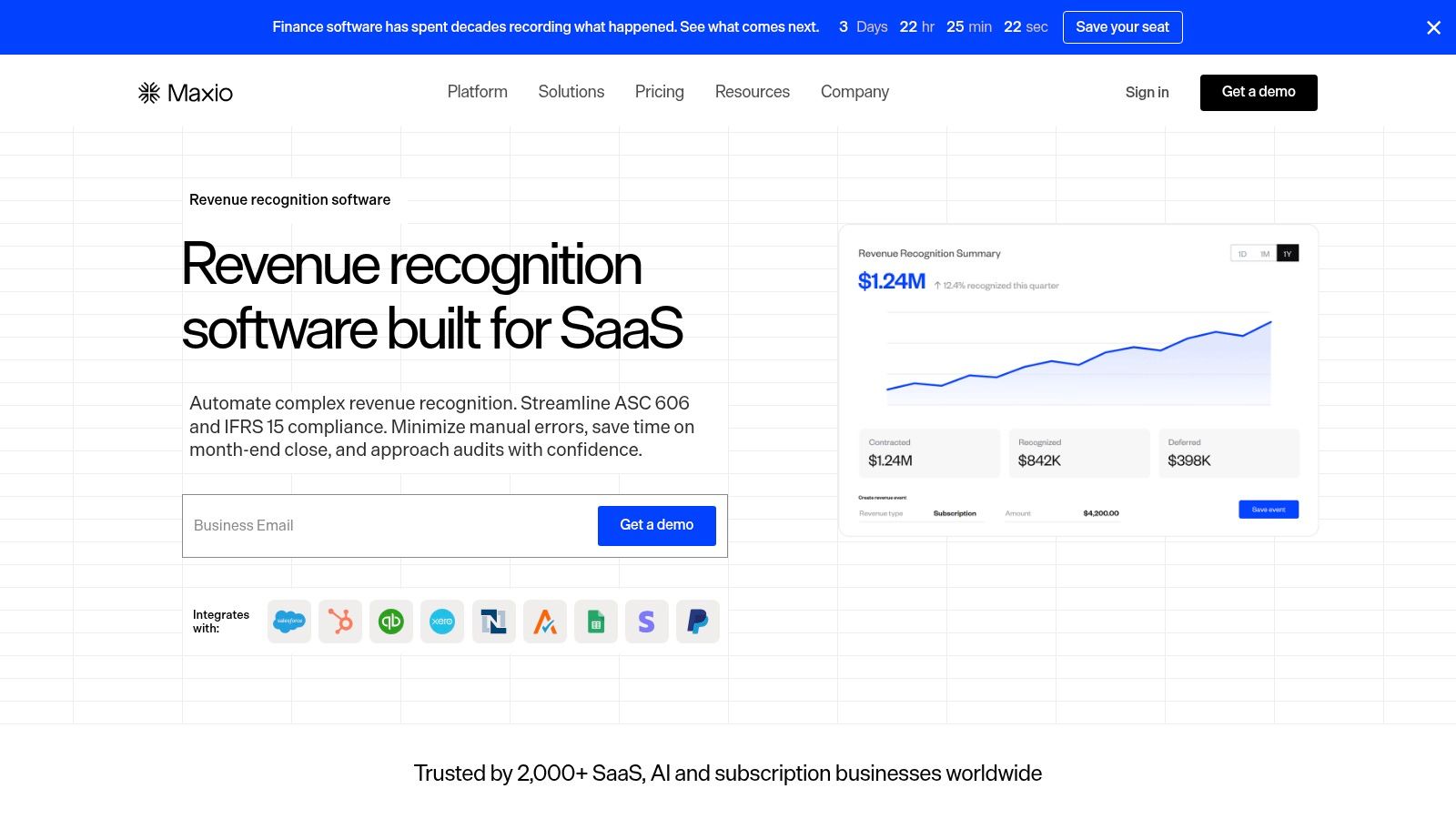
Month-end gets messy fast when billing lives in one tool, revenue schedules in another, and the general ledger in QuickBooks. Maxio appeals to teams in that spot because it sits upstream of the ledger and handles more than revenue recognition. It combines CPQ, billing, collections, analytics, and revenue features in one quote-to-cash platform. For a SaaS company moving off spreadsheets, that can reduce handoffs and give finance one operating model from contract through journal entry.
That position matters. Maxio is not an ERP-native revenue module. It is closer to an operating platform with revenue capabilities attached. For a mid-market SaaS finance team, that can be a good trade if billing, amendments, and customer balances are part of the problem. For healthcare groups, nonprofits, DSOs, or other buyers that need the ERP close to stay at the center, the fit is narrower.
The product supports subscriptions, one-time charges, and usage-based pricing. It also provides transaction-level records, revenue waterfalls, and audit support. Those are practical strengths for controllers who need to explain deferred revenue, trace changes, and tie outputs back to source activity during close. Finance teams that want broader market feedback can also review G2's Maxio page.
The limit is scope. If your billing process already works and the only pain point is ASC 606 automation, Maxio may be more system than you need. Teams with unusual allocation policies, highly bespoke arrangements, or heavier multi-book requirements should pressure-test that boundary before buying.
Don't buy a quote-to-cash platform to solve a schedule problem unless billing, collections, and monetization also need to change.
Pricing is quote-based. Run a proof of concept with upgrades, cancellations, discounts, usage charges, and a mid-term amendment. Then inspect the journal entries and the exception handling.
Review Maxio Revenue Recognition. If you are comparing a quote-to-cash platform with an ERP-centered design, Lucentive's overview of subscription and SaaS finance is a useful frame for the decision.
7. Stripe Revenue Recognition
Best for organizations that run their monetization through Stripe.
Stripe Revenue Recognition is the most direct choice for a Stripe-first business. It sits in the Stripe ecosystem, uses Stripe Billing and Invoicing data natively, and provides a centralized revenue subledger with journal entries, waterfalls, accounts-receivable aging, and trial-balance reporting.
The product supports subscriptions, upgrades, downgrades, refunds, usage, and hybrid pricing models. That makes it useful for digital businesses that already capture customer activity and billing events in Stripe. Native integration can reduce the work required to move invoice and contract data into revenue schedules. Finance teams that want peer reviews can compare G2's Stripe Billing page alongside Stripe's own documentation.
The boundary appears when Stripe isn't the full source of truth. Non-Stripe transactions can be imported by CSV, but large or varied external data sets may add workflow steps. A healthcare organization, nonprofit, or multi-site clinic may need to coordinate EMR, practice-management, grant, billing, and ERP data. Stripe Revenue Recognition won't eliminate that architecture work.
When Stripe is the right center
Choose Stripe Revenue Recognition when the commercial events already occur in Stripe and the finance team wants fast access to automated reports. Choose an ERP-native module when the general ledger, entities, dimensions, and operational accounting should remain centralized. Choose an add-on subledger when several source systems feed a complex revenue policy.
Pricing has shifted toward subscription-based models, and exact amounts vary, so confirm current terms directly with Stripe Revenue Recognition. Finance leaders evaluating SaaS accounting can also review Lucentive's best accounting software for SaaS businesses before deciding whether a Stripe-centered architecture is sufficient.
Top 7 Revenue Recognition Software Comparison
| Solution | Implementation complexity 🔄 | Resource requirements ⚡ | Expected outcomes ⭐📊 | Ideal use cases 💡 | Key advantages |
|---|---|---|---|---|---|
| Sage Intacct Contracts (Revenue Management) | 🔄 Medium, native module, configuration + Intacct subscription | ⚡ Moderate, Intacct subscription + Contracts module, finance/IT setup | ⭐📊 Audit-ready ASC 606 subledger; granular GL mapping and contract state separation | 💡 Organizations standardizing on Sage Intacct; nonprofits; milestone-driven services | Native Intacct integration, strong nonprofit/service workflows, event-based recognition |
| Oracle NetSuite Revenue Management | 🔄 Medium-High, smoother if on NetSuite ERP; sizable when standalone | ⚡ High, requires NetSuite ERP and implementation resources | ⭐📊 Robust SSP/ allocation and integrated automated revenue plans | 💡 Midmarket companies adopting NetSuite ERP for end-to-end financials | Deep NetSuite integration; powerful SSP and allocation capabilities |
| Zuora Revenue (RevPro) | 🔄 High, enterprise-grade implementation and configuration | ⚡ High, enterprise TCO, cross-system integrations and specialist resources | ⭐📊 Enterprise-level ASC 606 automation, forecasting, multi-book and disclosure support | 💡 Large subscription/SaaS, healthcare-tech, and services at scale with complex contracts | Market-leading depth for complex contracts; strong SSP analytics and auditability |
| SOFTRAX Revenue Management System (RMS) | 🔄 High, policy-driven setup for complex billing and accounting | ⚡ High, multi-entity/multi-currency needs, heavy configuration effort | ⭐📊 Single-platform billing + rev rec with real-time analytics and full audit trail | 💡 Complex multi-entity healthcare, B2B platforms, organizations needing transparent evidence | Policy-driven engine, multi-book/multi-currency support, robust GL posting patterns |
| Chargebee RevRec | 🔄 Low-Medium, fast setup, especially with Chargebee Billing | ⚡ Moderate, add-on pricing; best with Chargebee/Stripe stacks and APIs | ⭐📊 Quick time-to-value; audit trail, supports amendments/overages | 💡 SaaS companies iterating pricing frequently or using Chargebee/Stripe | Fast deployment, prebuilt integrations, good support for usage/amendments |
| Maxio Revenue Recognition | 🔄 Low-Medium, streamlined for midmarket SaaS workflows | ⚡ Moderate, part of broader quote-to-cash with midmarket resource needs | ⭐📊 Transaction-level exports, revenue waterfalls, simplified close for SaaS teams | 💡 B2B SaaS teams moving from spreadsheets/QuickBooks seeking integrated stack | Combines monetization and rev rec without enterprise complexity |
| Stripe Revenue Recognition | 🔄 Low, rapid for Stripe-first stacks; moderate if importing non-Stripe data | ⚡ Low-Moderate, works best natively with Stripe Billing/Invoicing | ⭐📊 Centralized subledger and same-day accounting reports to speed close | 💡 Stripe-centric businesses that process most transactions via Stripe | Native Stripe integration, fast deployment, centralized revenue subledger |
Choosing Your Revenue Recognition Path Before You Buy
Start with the general ledger. Decide whether your organization will keep Sage Intacct, adopt NetSuite, retain QuickBooks temporarily, or operate a broader ERP and billing stack. Revenue software that sits inside the ledger usually reduces integration effort. An add-on subledger provides more flexibility but creates reconciliation and data-ownership responsibilities. A standalone engine can handle complex policy requirements, but it demands stronger implementation discipline.
Next, map your contracts. List recurring services, implementation fees, usage charges, milestones, discounts, refunds, renewals, cancellations, amendments, and bundled arrangements. Include every entity, currency, fund, location, and reporting dimension that finance must close. The system should handle your real contract population, not just the clean example used in a sales demo.
Then test judgment, not just automation. ASC 606 and IFRS 15 still require finance teams to determine distinct performance obligations, estimate standalone selling prices, constrain variable consideration, and assess principal-versus-agent conclusions. Revenue software should preserve approvals, source documents, policy versions, exceptions, and the link from contract to general-ledger posting. Deloitte's guidance emphasizes that these judgments create both implementation and ongoing costs in its discussion of revenue recognition. For the core framework itself, it can also help to review the FASB ASC 606 overview and the IFRS 15 summary from IFRS Foundation.
A practical proof of concept should include an amendment, a concession, a bundled service, a usage component, and a cancellation. Review deferred-revenue rollforwards, disclosures, journal entries, reconciliation reports, and the handling of remaining performance obligations. ASC 606 disclosures can include disaggregated revenue, contract assets and liabilities, significant judgments, and remaining obligations as described in SEC filings. If your policy uses the one-year practical expedient, verify that the software consistently excludes eligible contracts and separates those amounts in reporting as described in SEC-filed accounting policies.
Software alone won't define your policies, clean your source data, or train your close team. The right partner configures the platform, maps integrations, validates schedules, and helps finance own the process after go-live. For a mid-market organization leaving QuickBooks, that implementation relationship often matters as much as the feature list.
Summary
The best revenue recognition software depends on the general ledger, contract complexity, and team operating the process. Sage Intacct Contracts fits organizations standardizing on Sage Intacct and wanting native contract accounting. NetSuite suits companies adopting NetSuite as their ERP. Zuora Revenue, SOFTRAX, and Chargebee RevRec provide add-on subledger depth for complex contracts and distributed systems. Maxio combines SaaS billing with revenue workflows, while Stripe Revenue Recognition fits Stripe-first businesses. Buyers should test amendments, bundles, usage, disclosures, reconciliation, and audit evidence before comparing quotes.
Frequently Asked Questions
What is the best revenue recognition software for a mid-market company leaving QuickBooks?
Sage Intacct Contracts is the clearest fit when the company is moving to Sage Intacct and wants revenue accounting inside the ERP. Maxio can fit B2B SaaS teams that also need billing and collections. Chargebee RevRec works as a subledger when subscription data comes from Chargebee, Stripe, or other systems. The decision should follow the general ledger and contract types, not the longest feature list.
Should revenue recognition software sit inside the ERP?
An ERP-native module usually reduces integration and reconciliation work because contract accounting and general-ledger posting share the same environment. That makes Sage Intacct Contracts or NetSuite Revenue Management attractive when the ERP decision is already made. An add-on subledger may be better when billing, CRM, and operational systems are distributed. The trade-off is more data ownership and reconciliation work.
Can revenue software handle contract modifications?
It can apply configured modification rules, but finance still needs to determine the accounting treatment. ASC 606 treats a modification as a separate contract only when the additional goods or services are distinct and the price reflects standalone selling price according to BDO's Topic 606 guidance. During testing, require the system to retain approvals, revised prices, allocation logic, and the resulting schedule.
What should a healthcare or dental organization test?
Test milestone billing, recurring services, usage inputs, bundled arrangements, refunds, amendments, and multiple entities. The system should show contract assets, deferred revenue, unbilled balances, recognition events, and journal entries with a traceable audit history. Sage Intacct Contracts and SOFTRAX are strong candidates for this evaluation because both can support event-driven or complex service arrangements, but the final choice should reflect your ERP architecture. For healthcare-specific accounting context, the HFMA resource library is also a useful reference point during requirements gathering.
Is a standalone revenue engine better than an ERP module?
Not by default. A standalone engine can support complex contracts across multiple billing, CRM, and ERP systems. An ERP module can reduce integration effort and keep accounting closer to the general ledger. The better choice depends on whether your organization needs flexibility across a hybrid stack or wants one controlled financial system. Implementation capacity and reconciliation ownership should be part of the decision.
Does revenue recognition software remove accounting judgment?
No. Teams still need documented policies for performance obligations, standalone selling prices, variable consideration, contract modifications, and principal-versus-agent conclusions. Software can apply approved rules, preserve evidence, automate schedules, and support disclosures. It can't decide whether an obligation is distinct or whether a contract conclusion is appropriate without finance and accounting review.
What should a proof of concept include?
Use a mixed contract with implementation fees, recurring services, usage charges, a discount, a milestone, and an amendment. Add a cancellation or credit and test more than one entity if that reflects your business. Review exception rates, manual journal entries, deferred-revenue rollforwards, reconciliation effort, disclosure reports, and the audit trail from source transaction to general-ledger posting.
Why does the implementation partner matter?
Revenue software needs configured policies, clean source data, mapped integrations, tested schedules, and trained owners. A partner helps connect those pieces and establishes a repeatable close process. Lucentive supports Sage Intacct for mid-market, healthcare, and nonprofit organizations, so a working session can test whether the ERP, revenue module, and implementation approach fit before you buy software alone.
Lucentive helps finance leaders evaluate Sage Intacct, configure revenue workflows, connect source systems, and build a controlled close process for complex contracts. Schedule a personalized conversation through Lucentive to test fit for your organization before selecting a revenue tool or buying Sage Intacct alone.