The close is late again. Approvals are sitting in email, employees are submitting expenses without receipts, and nobody has a reliable view of committed spend across entities, clinics, or locations. By the time finance finds the problem, the money is already committed and the audit trail is incomplete.
That's when spend visibility becomes an operating risk, not just an accounting inconvenience. The best spend management software depends on your finance operating model, current AP tools, Sage Intacct plans, and the implementation capacity behind the purchase. A card program may solve employee spending while leaving purchase orders, supplier invoices, and nonprofit fund reporting untouched.
The comparison below looks at approvals, purchase orders, expenses, vendor management, integrations, pricing approach, use cases, and complexity. It's designed for CFOs, Controllers, CEOs, and VP Finance leaders moving beyond QuickBooks or building a more controlled cloud ERP environment.
Lucentive, a Sage Intacct National Premier Partner, works with mid-market, healthcare, nonprofit, and general business organizations. A short working session can help you test the operating fit between Sage Intacct, a spend platform, and your internal team before you buy software alone.
Table of Contents
- 1. Ramp
- 2. Airbase
- 3. BILL Spend & Expense
- 4. Procurify
- 5. Coupa
- 6. SAP Concur Expense and Invoice
- 7. Navan Expense
- 8. Emburse Spend
- 9. Teampay by Paystand
- 10. Expensify
- Top 10 Spend Management Software Comparison
- Choose the Platform and the Implementation Path
- Summary
- Frequently Asked Questions
- Is spend management software the same as procurement software?
- Which platform is best for a company moving beyond QuickBooks?
- What should we test in a Sage Intacct integration?
- Is a card-first platform enough for multi-site clinics or DSOs?
- When should we use an implementation partner?
- How should finance compare pricing?
1. Ramp
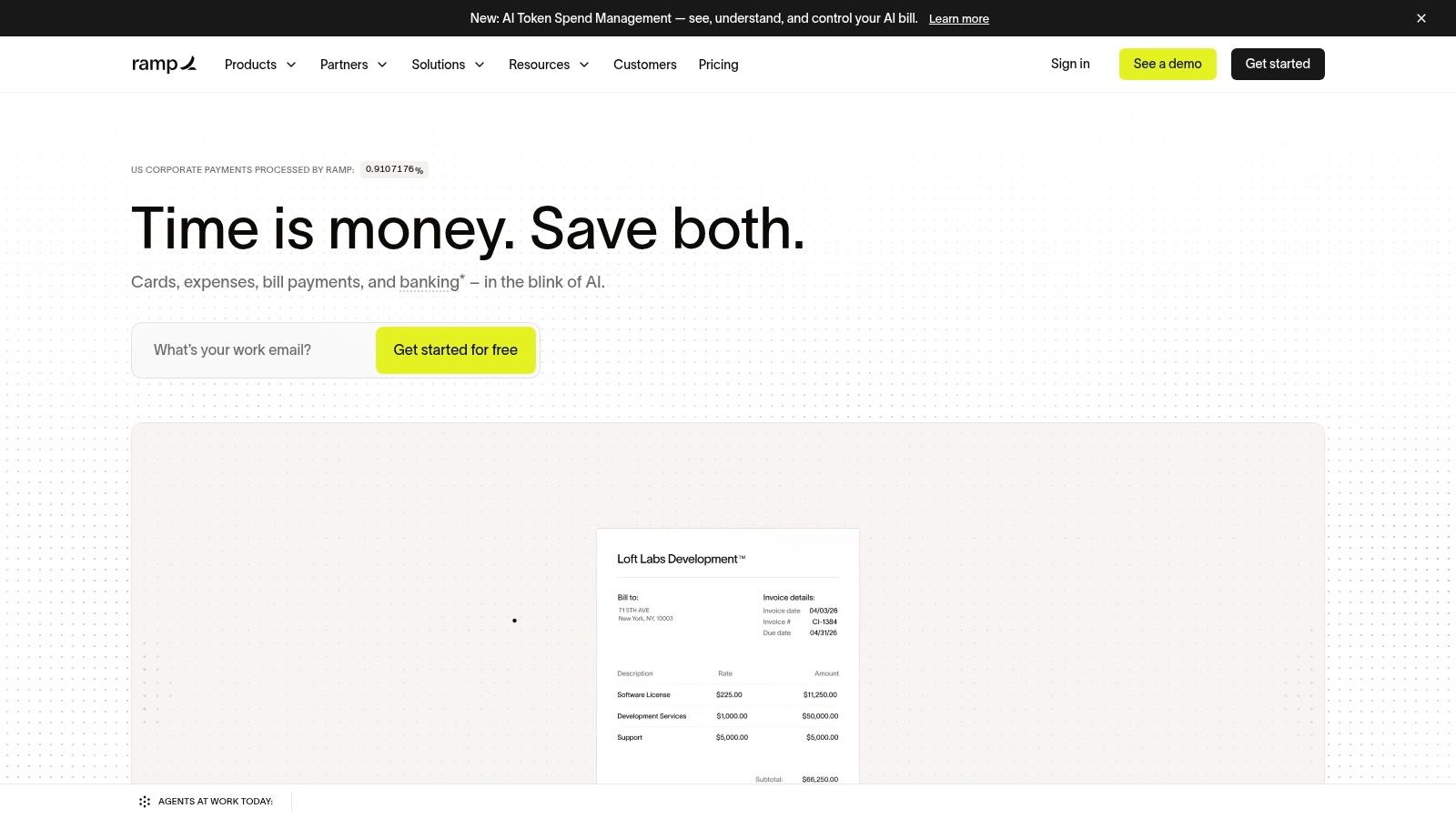
Ramp combines corporate cards, expense management, bill pay, and procurement workflows in one finance automation platform. It's a strong starting point for a mid-market company whose immediate problem is uncontrolled card spend, slow receipt collection, or manual transaction coding.
The platform supports physical and virtual cards with real-time controls, automated receipt collection, AP automation, bill pay, vendor pricing intelligence, and renewal tracking. Its Sage Intacct connection is a meaningful advantage because teams can sync transactions into Intacct's Cash Management area and support multi-entity accounting workflows without relying entirely on spreadsheets or manual exports.
Where Ramp fits
Ramp works best when finance wants preventive controls at the moment an employee requests or makes a purchase. Rules can reduce exception handling, while automated coding helps the accounting team prepare transactions for review and reconciliation. That's useful for distributed professional services firms, healthcare operators with decentralized purchasing, and businesses trying to reduce informal buying.
It can also support a more disciplined purchasing process when paired with formal requisitions and purchase orders. Teams comparing workflows may also want a broader view of procure-to-pay processes alongside Lucentive's guidance on purchase order system benefits, especially to understand why visibility at the commitment stage matters before an invoice reaches AP.
Trade-offs to examine
Ramp's pricing has evolved, and the Plus tier adds a platform fee. Some bill-pay transactions may also carry fees, so the business case should include payment volume and the expected mix of card and AP usage.
Practical rule: Don't evaluate Ramp only on card controls. Map how approved spend becomes a Sage Intacct posting, how exceptions are handled, and who owns reconciliation after implementation.
Ramp is compelling for automation depth and documented Sage Intacct integration. It's less convincing if your primary need is complex fund accounting, contract lifecycle management, or deep procure-to-pay governance rather than card-led control.
2. Airbase
Airbase takes a broader intake-to-pay approach, combining corporate cards, employee expenses, procurement, accounts payable, and vendor management. That breadth makes it a better candidate than a card-first tool for organizations that need formal approvals before money is committed.
Its guided spend intake can direct employees to the right request type, approval path, budget owner, and accounting dimensions. Corporate cards and reimbursements can operate under policy controls, while AP workflows support invoice automation and three-way matching. The maintained Sage Intacct connector is designed to support dimensions and entities, which matters for multi-site clinics, nonprofit programs, and services businesses with separate reporting requirements.
Governance over convenience
Airbase is most attractive when auditability and approval governance matter as much as employee experience. A healthcare organization can create stronger controls around department purchases. A nonprofit can connect requests to the appropriate program, grant, or fund structure. A professional services firm can route project-related spend to the right manager before it becomes an unplanned cost.
The full-suite model also reduces the need to connect separate card, expense, purchasing, and AP products. That can simplify ownership, but only if the implementation team agrees on master data, approval rules, and posting logic before configuration begins.
The cost of buying breadth
Pricing is quote-based and can be higher than card-centric alternatives for smaller teams. Very small organizations may also find the suite broader than they need, particularly if their main problem is receipt capture and reimbursement.
Airbase deserves serious consideration when the business wants one controlled spend process rather than several disconnected tools. It requires more deliberate scoping than a lightweight expense application, and that complexity should be treated as an implementation decision, not hidden until contracting.
3. BILL Spend & Expense
BILL Spend & Expense, formerly associated with Divvy by BILL, combines budgets, corporate cards, and expense management within BILL's broader payables and receivables ecosystem. It's particularly relevant for organizations already using BILL for AP and looking to extend controls into employee and department spending.
The product supports budget-based physical and virtual cards, real-time spend tracking, receipt capture, and transaction syncing to the Sage Intacct credit card module. Departments or projects can receive defined budgets, giving finance a clearer view of planned and actual card activity than a conventional month-end expense report.
When the ecosystem matters
BILL Spend & Expense makes the most sense when the organization wants to standardize on BILL for payables and add card-led controls without introducing another major finance platform. The familiar ecosystem can support faster adoption, particularly for smaller finance teams replacing spreadsheets or informal card processes.
That convenience has limits. Procurement depth is lighter than what you'll typically find in a dedicated procure-to-pay suite. If the company needs purchase requisitions, supplier onboarding, contract controls, receiving, and invoice matching as one governed process, a card and budget tool may not go far enough.
Confirm the commercial model
Pricing and terms may be connected to card interchange and AP payment fees. Finance teams evaluating card economics may want a baseline understanding of interchange fees before comparing only a subscription line item against the current payment mix.
Strong AP workflows still require clean invoice coding, consistent approval ownership, and clear exception handling. Lucentive's accounts payable invoice processing best practices are useful context when deciding whether BILL Spend & Expense solves the whole process or only the employee-spend portion.
Choose it when existing BILL adoption is a strategic advantage. Look elsewhere when purchasing governance and supplier controls are the central problem.
4. Procurify
Procurify is built around mid-market procure-to-pay workflows, then adds corporate cards, expenses, and AP automation. That orientation makes it a strong option for companies where the problem starts with unapproved purchasing rather than missing receipts.
Employees can submit guided purchase requests, managers can approve against budgets, and finance can connect invoice-to-bill activity with Sage Intacct. Its multi-entity integration is relevant for multi-location healthcare organizations, nonprofit networks, DSOs, and companies that need consistent controls without adopting an enterprise procurement suite.

A better fit for purchase-led organizations
Procurify's strength is the point before the purchase. A clinic can route a supply request to the right location and budget owner. A nonprofit can require program approval before funds are committed. A DSO can create more consistent purchasing rules across practices instead of allowing each site to develop its own process.
The platform also offers packaging flexibility. Organizations can add AP, cards, or contracts as their operating model requires, rather than buying every module on day one.
Change management is part of the product decision
Procurement projects require behavior change. Employees must stop emailing requests, managers must approve inside the system, and finance must maintain vendor and accounting data. If leadership won't enforce the new process, even a capable tool will become another place for exceptions to accumulate.
Lucentive's guidance on the online purchase requisition approval process illustrates the operating discipline required before configuration begins.
Procurify is a strong candidate when purchasing control and committed-spend visibility matter more than travel or card rewards. Pricing is quote-based and requires careful scoping, particularly across multiple entities and locations.
5. Coupa
Coupa is an enterprise-grade Business Spend Management suite covering sourcing, procurement, invoicing, payments, travel and expense. It belongs on a shortlist when the organization needs broad source-to-pay governance, supplier risk controls, contract lifecycle management, and mature analytics.
The platform can support a unified control environment for sourcing, supplier interactions, purchase orders, invoices, payments, and employee expenses. Connector options can sync master and transactional data with Sage Intacct, but the integration design deserves close technical review. The question isn't only whether data can move. It's whether dimensions, vendors, statuses, approvals, and posting rules move in a way the accounting team can reconcile.
Scale creates both value and friction
Coupa's breadth is useful for complex organizations with multiple buying channels and demanding compliance requirements. A large healthcare or services organization may benefit from structured supplier governance and contract visibility. A mature procurement function may also value the partner ecosystem and marketplace capabilities.
The same breadth can overwhelm a mid-market finance team. Pricing is quote-based and typically expensive compared with card-led or lighter procurement products. Configuration, data preparation, integration, training, and adoption can become a significant program rather than a software rollout.
Coupa is rarely the right answer because it has the longest feature list. It's right when the organization has the process ownership and implementation capacity to use that breadth.
Before selecting it, define supplier ownership and master-data standards. Standard data governance principles from DAMA International pair well with Lucentive's vendor master data management best practices when evaluating whether the organization is ready for a suite of this scope.
Coupa is compelling for scale and governance. It's excessive when the business needs only card controls, basic expenses, or a straightforward Sage Intacct connection.
6. SAP Concur Expense and Invoice
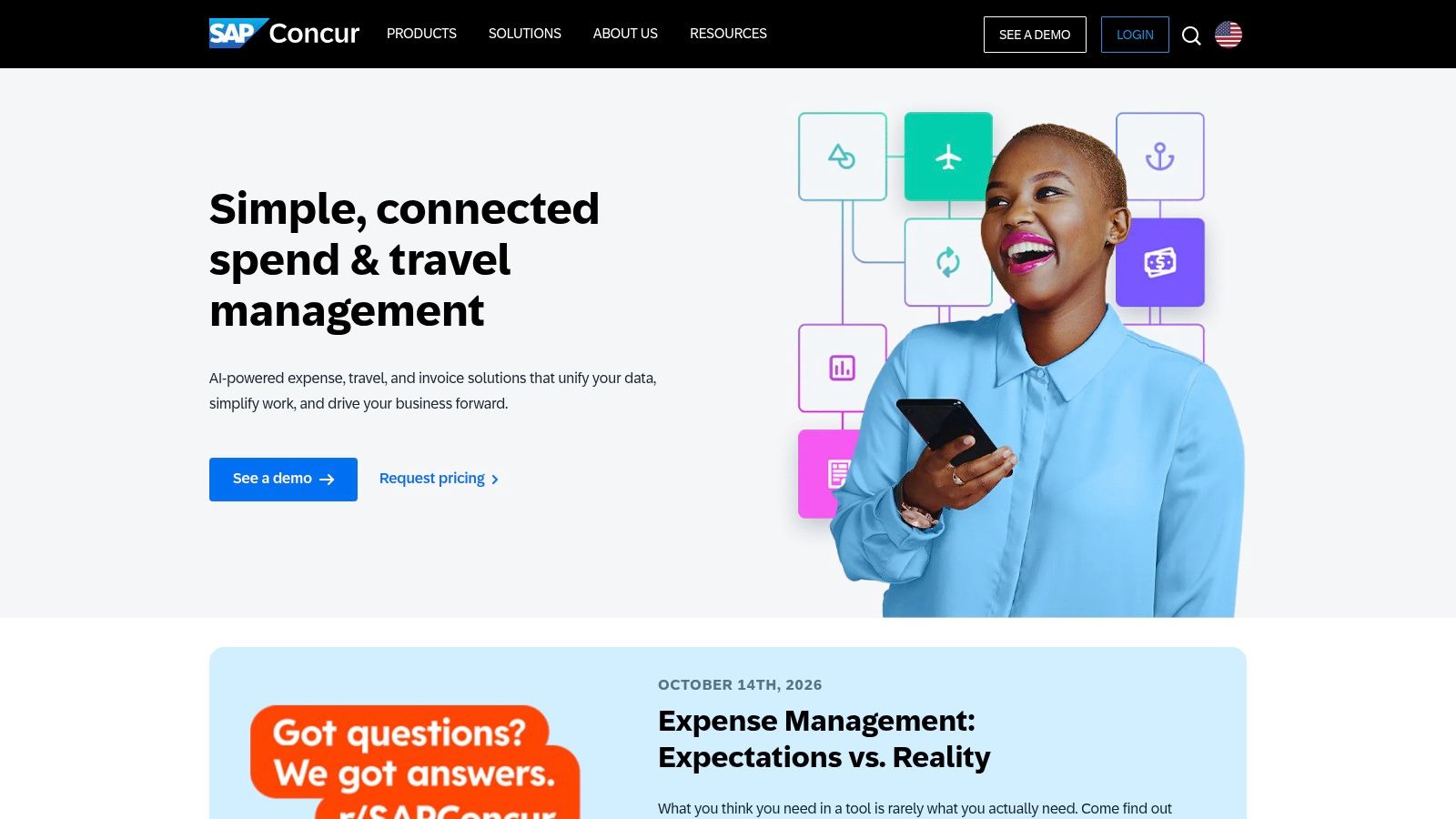
SAP Concur is a strong fit for organizations where travel and employee expenses represent a meaningful operational burden. Its expense, travel, and invoice products support mobile receipt imaging, OCR-based capture, policy controls, travel booking integrations, and AP automation.
The packaged Sage Intacct connector can support lists, vendors, and postings with near real-time data movement. That makes Concur relevant for field-heavy organizations, consulting firms, healthcare groups with traveling staff, and companies that need a mature mobile experience for employees submitting expenses away from the office.
Travel is the deciding use case
Concur's advantage is the connection between travel booking, travel policy, expense capture, and invoice workflows. Employees can book through governed channels, capture receipts on mobile, and submit expenses without waiting until they return to the office. Finance gets a more consistent process for reviewing and posting travel-related spend.
That doesn't make it a universal procurement platform. Companies needing deep purchase requisition workflows, supplier sourcing, contract controls, or committed-spend management may need additional tools or a different primary platform.
Integration scope matters
Pricing is quote-based, and additional integration packs may be required depending on the selected scope. Confirm which connector capabilities are included, who owns maintenance, and how failed postings are resolved.
Concur can deliver value where travel compliance and mobile adoption are central. It may introduce unnecessary cost and complexity for a business that only needs simple reimbursement workflows.
Lucentive's Sage Intacct accounts payable support can help finance leaders compare Concur Invoice with the AP capabilities they already have or plan to implement in Intacct.
7. Navan Expense
Navan Expense, formerly TripActions, combines travel, corporate cards, and expense management with a strong traveler-oriented user experience. It's a natural candidate for travel-intensive organizations that want booking, policy enforcement, card activity, and expense reporting in a more unified program.
The platform supports corporate cards, automated expense workflows, integrated travel booking, policy and rate controls, real-time spend visibility, and automated coding. Its Sage Intacct integration is listed in the Sage Intacct Marketplace and is intended to support accurate expense posting.
Adoption can be the main ROI driver
Employees are more likely to comply with a travel and expense process that works well on the road. Receipt capture, booking controls, and automated report creation can reduce the finance team's need to chase incomplete submissions. For a consulting firm, multi-site provider, or field-based organization, that user experience can matter more than a long list of procurement modules.
Navan's focus is also its limitation. It's card-first and travel-centered, with less procurement depth than a full procure-to-pay platform. Supplier invoices, purchase requisitions, contract approvals, and receiving may remain in another system.
Pricing is quote-based and may be bundled with the travel program scope. Evaluate the travel economics and accounting integration together. A compelling traveler experience doesn't compensate for unclear posting rules or manual reconciliation after transactions reach Sage Intacct.
Navan makes sense when travel is a major category and employees need a simple, mobile operating model. It's not the first choice for a nonprofit seeking fund accounting controls or a DSO standardizing supplier purchasing across practices.
8. Emburse Spend
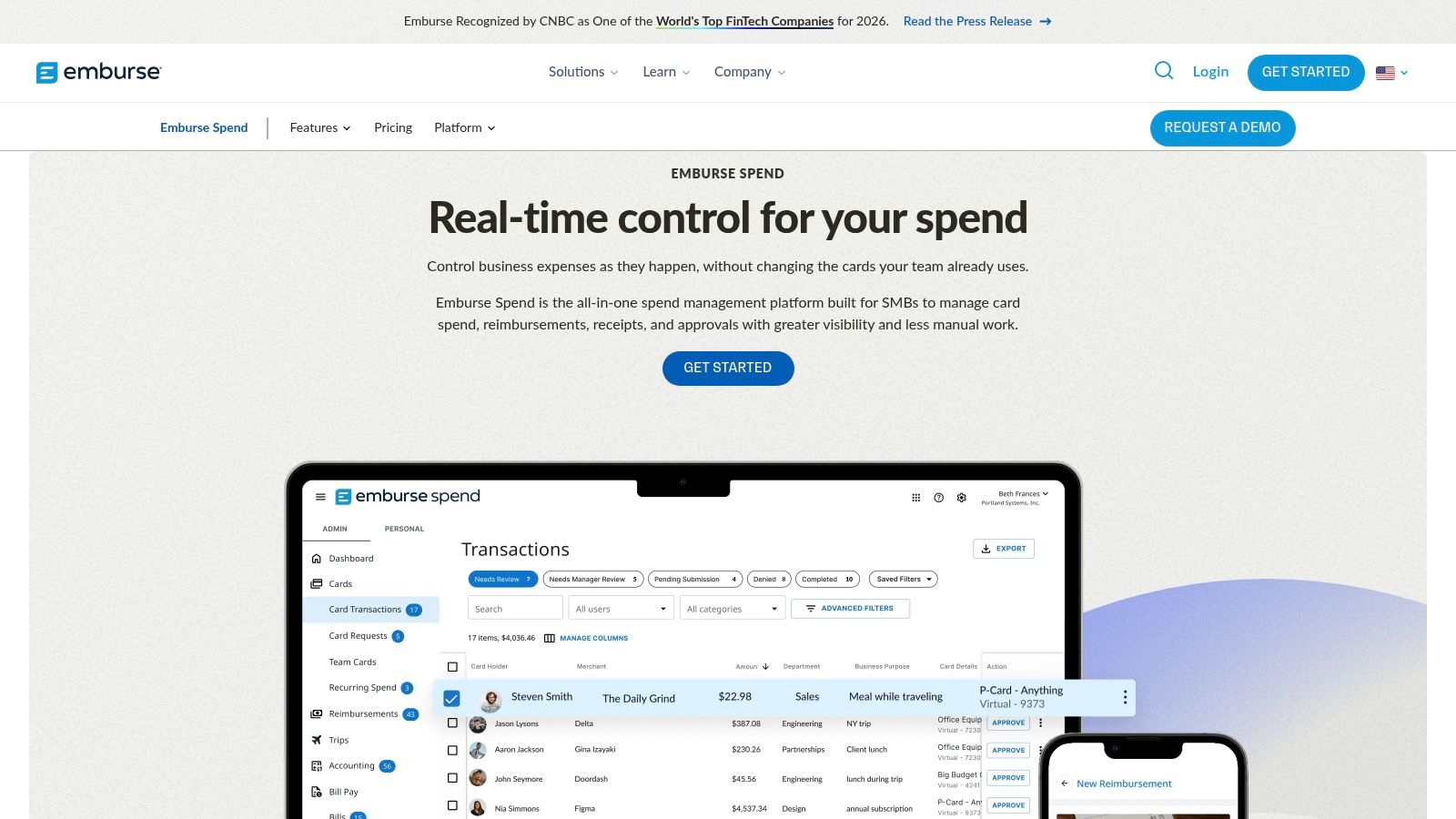
Emburse Spend provides corporate cards, reimbursements, approvals, policy enforcement, and mobile receipt capture. It sits within the broader Emburse family, which includes products such as Chrome River and Certify, giving organizations room to consider adjacent expense and travel requirements.
The platform supports automated coding, configurable workflows, and ERP connectors, including a Sage Intacct connector. That flexibility can help regulated organizations or finance teams whose approval paths vary by department, entity, project, location, or spend category.
Configuration is a benefit only if it stays governable
A configurable workflow can support nonprofit departments, healthcare locations, and professional services projects without forcing every transaction through one generic approval chain. It can also help finance build stronger controls around reimbursements and corporate cards.
The risk is unnecessary variation. If each department requests its own fields, policies, or approval route, the platform can become difficult to maintain. Finance should define the minimum common process before configuring exceptions.
Scope the Emburse portfolio carefully
Multiple Emburse products and connector options mean buyers need to identify the exact SKU, workflow, and integration package they're purchasing. Pricing is quote-based, and connector costs may be packaged separately.
Emburse Spend is a credible choice for organizations that value mature integrations and configurable expense controls. It's less attractive when the buyer wants a single, simple product with minimal scoping. The implementation partner should help translate policy requirements into a maintainable configuration rather than reproducing every existing exception.
9. Teampay by Paystand
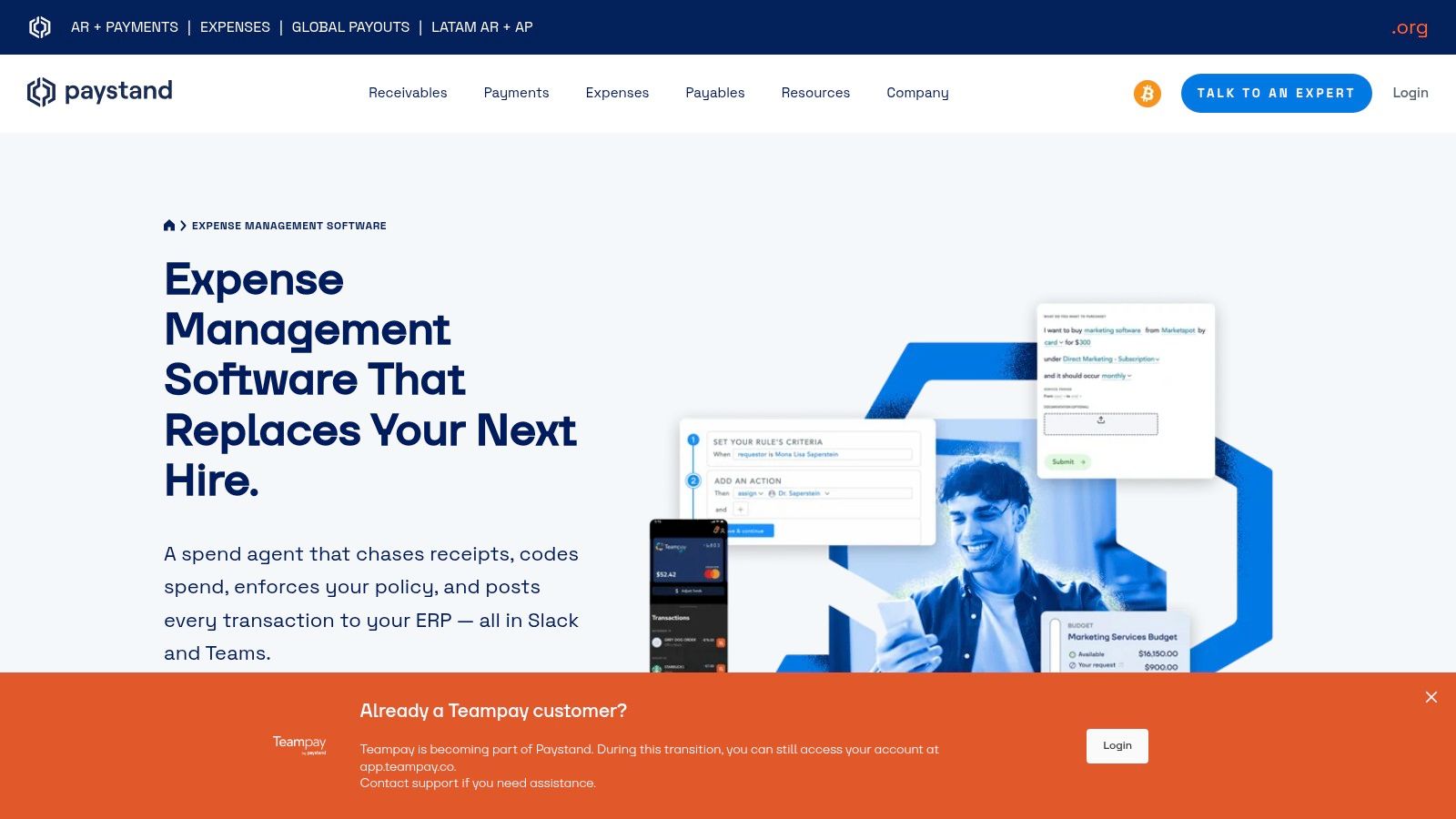
Teampay by Paystand focuses on distributed purchasing and proactive spend controls. It supports virtual cards, request and approval flows, expense capture, reimbursements, analytics, and accounting integrations including Sage Intacct.
Its defining strength is the request-driven experience. Employees can ask for what they need, managers can approve at the point of purchase, and finance can apply merchant, category, and policy guardrails before the transaction becomes an accounting problem.
Useful for decentralized operations
Teampay can help organizations with multiple locations that struggle to control local purchasing. A clinic manager may need a fast way to request supplies without bypassing policy. A nonprofit program director may need approval before using a restricted budget. A professional services team may need project-specific controls before issuing a card.
The platform's guided-purchase experience addresses a common failure in spend programs: employees know the policy exists but don't know which process to follow. Making the request path easier can reduce off-system approvals and give finance earlier visibility.
Know what remains outside the platform
Teampay is more focused on purchase and expense workflows than full procurement or contract lifecycle management. Supplier sourcing, complex contract governance, and end-to-end procure-to-pay processes may require adjacent systems.
Pricing is quote-based, and enterprise features can affect total cost. Validate how Teampay handles Sage Intacct dimensions, entity assignment, coding changes, rejected transactions, and reconciliation ownership.
It's a strong fit for proactive approval governance across distributed teams. It's less suitable as the only procurement system for a complex organization with extensive supplier, contract, and invoice requirements.
10. Expensify
Expensify is a longstanding expense management platform with receipt capture, SmartScan OCR, mobile workflows, corporate cards, reimbursements, policy rules, and automated report creation. Its maintained Sage Intacct connector makes it a practical option for smaller teams replacing spreadsheets or QuickBooks-centric expense processes.
The user experience is straightforward, which can support a quick rollout. Employees can submit receipts from mobile, finance can review reports, and approved transactions can sync into Sage Intacct for coding and posting.
The case for simplicity
Expensify is well suited to professional services firms, small organizations, and teams whose main pain is manual expense reporting. It can provide a cleaner process without forcing the business to adopt a full procurement suite.
That simplicity comes from narrower scope. Expensify isn't a full procure-to-pay platform and has limited procurement and contracting capabilities. It won't replace purchase requisitions, receiving, supplier lifecycle management, or complex committed-spend controls where those processes are central to the finance model.
Enterprise Control features are quoted rather than publicly priced, so buyers should confirm what's included in the selected plan. The Sage Intacct connector also deserves a practical test with real dimensions, entities, project coding, and exception scenarios.
Expensify is a sensible first step when ease of use and quick adoption matter most. If the organization has outgrown QuickBooks because of multi-entity reporting, fund accounting, or broader operational controls, it may be better viewed as an expense component within a larger Sage Intacct strategy.
Top 10 Spend Management Software Comparison
| Product | ✨ Key features | 🏆 Sage Intacct fit / Unique strength | ★ UX / Quality | 👥 Best fit | 💰 Pricing / Value |
|---|---|---|---|---|---|
| Ramp | Corporate cards, AP automation, procurement rules, vendor price intel | Deep, well-documented Intacct sync & auto-coding | ★★★★ | Mid-market finance teams; multi-entity US orgs | 💰 Card-first; Plus has platform fee; some bill-pay fees |
| Airbase | Full spend suite: cards, procurement, approvals, AP | Robust, maintained multi-entity Intacct connector & audit trail | ★★★★ | Audit-heavy orgs (healthcare, nonprofit, services) | 💰 Quote-based; can be higher for smaller teams |
| BILL Spend & Expense (Divvy by BILL) | Budgeted virtual/physical cards, real-time tracking, AP/AR consolidation | Native Intacct integration for cards & expenses | ★★★★ | Teams standardizing on BILL for AP; card-first adopters | 💰 Card-centric pricing; interchange & AP payment fees possible |
| Procurify | Procure-to-pay with guided purchase, budget controls, AP sync | Enhanced multi-entity Intacct integration for multi-location orgs | ★★★★ | Mid-market orgs needing procurement depth (healthcare/nonprofit) | 💰 Quote-based; modular packaging (add AP/cards/contracts) |
| Coupa | Source-to-pay, contracts, supplier risk, analytics & AI | Enterprise-grade controls; connector options for Intacct | ★★★★ | Large, complex organizations needing end-to-end controls | 💰 Quote-based; typically expensive |
| SAP Concur (Expense, Invoice) | OCR receipt capture, travel booking, Concur Invoice payables | Proven T&E strength with packaged Intacct connector | ★★★★ | Travel-intensive organizations & field-heavy teams | 💰 Quote-based; may require additional integration packs |
| Navan Expense (formerly TripActions) | Travel booking + corporate cards + automated expense workflows | Traveler-first UX; listed in Sage Intacct Marketplace | ★★★★ | Travel-heavy teams seeking unified T&E program | 💰 Quote-based; often bundled with travel program pricing |
| Emburse Spend | Configurable expense workflows, mobile capture, scalable suite | Mature Intacct integrations and implementation playbooks | ★★★★ | Regulated industries needing flexible configurations | 💰 Quote-based; multiple SKUs require scoping |
| Teampay by Paystand | Request/approve flows, virtual cards, merchant/category controls | Strong pre-approval/guided-purchase UX with Intacct integration | ★★★★ | Decentralized teams wanting request-driven spend controls | 💰 Quote-based; enterprise features can raise cost |
| Expensify | SmartScan OCR, Expensify Card, quick expense reports | Simple, maintained Intacct connector for fast rollout | ★★★★ | SMBs and services firms replacing spreadsheets/QuickBooks | 💰 Cost-effective for small teams; enterprise Control quoted |
Choose the Platform and the Implementation Path
Selecting the best spend management software starts with the operating model, not the demo. Document how employees request purchases, how managers approve them, how purchase orders are created, how goods are received, how invoices are matched, how expenses are reimbursed, and how vendors are maintained. Then identify the entity, location, department, fund, grant, project, and reporting dimensions that finance must preserve in Sage Intacct.
Separate the problem into categories. A card-first platform may be enough when uncontrolled employee spend and missing receipts are the primary issues. A procure-to-pay product is more appropriate when the business needs purchase requisitions, purchase orders, receiving, invoice matching, and visibility into committed spend. A travel-led product makes sense when booking policy and field expense adoption drive the largest risk.
The integration review should be specific. Confirm how the selected platform handles Sage Intacct entities, dimensions, vendors, accounts, posting dates, approval statuses, failed imports, credit card transactions, reimbursements, and reconciliation. Ask to see the exception process, not only the successful transaction path.
Validate the total cost
Pricing rarely stops at the subscription. Review platform fees, connector costs, card terms, payment fees, implementation services, training, data cleanup, and the internal time required from accounting, operations, IT, and department leaders. BILL's payment model, Ramp's platform and bill-pay considerations, quote-based suite pricing, and enterprise connector packages all illustrate why a proposal needs to be evaluated as a complete operating cost.
Implementation readiness matters just as much as product capability. Independent AP research found that many organizations still rely heavily on manual work, while only a small share report fully automated invoice-to-payment processes without manual touchpoints. That gap is why a feature checklist can produce a disappointing business case. A platform may automate capture while leaving coding, approval exceptions, vendor cleanup, and reconciliation with finance.
Know when a partner is warranted
Software alone may be sufficient for a small team with one entity, uncomplicated approvals, and limited purchasing complexity. A Sage Intacct implementation partner becomes more valuable when the company is migrating from QuickBooks, redesigning its chart of accounts, supporting nonprofit fund accounting, operating multi-site clinics, managing DSO locations, or requiring audit-sensitive controls.
QuickBooks can become a ceiling for growing organizations that need true cloud ERP capabilities, multi-entity consolidation, and broader operational reporting. Finance teams evaluating that transition often compare ERP capabilities more broadly before selecting a platform. An independent analysis describes QuickBooks Enterprise as desktop-first, with limitations around true multi-entity consolidation and larger concurrent-user environments. Moving to Sage Intacct without redesigning the surrounding workflows can just transfer old process problems into a newer system.
Lucentive works as a Sage Intacct National Premier Partner with experience across mid-market organizations, healthcare, nonprofits, DSOs, and general business. The value of that relationship isn't just software configuration. It's aligning purchasing, AP, dimensions, approvals, reporting, training, and ownership so the system reflects how the company operates.
Before selecting a platform or buying Intacct alone, schedule a 30-minute working session with Lucentive. Bring your current approval map, entity structure, AP pain points, and intended Sage Intacct timeline. The discussion should help you determine whether a card platform, a procure-to-pay tool, Sage Intacct purchasing and AP capabilities, or a coordinated combination is the right fit.
Summary
The best spend management software depends on the problem finance needs to solve. Ramp, BILL Spend & Expense, Navan, Emburse Spend, Teampay, and Expensify are strongest when cards, expenses, travel, and employee adoption lead the project. Airbase, Procurify, and Coupa provide broader purchasing and AP governance, with different levels of complexity. SAP Concur is particularly relevant to travel and invoice workflows. Buyers should validate Sage Intacct integration, approval ownership, dimensions, vendor data, pricing, connector costs, payment fees, and implementation capacity before selecting a platform.
Frequently Asked Questions
Is spend management software the same as procurement software?
No. Spend management is broader and can include corporate cards, employee expenses, reimbursements, accounts payable, purchasing, approvals, vendor management, and reporting. Procurement software typically focuses more directly on requisitions, purchase orders, sourcing, contracts, receiving, and invoice matching. A company may need only expense controls, but a business with distributed purchasing or significant supplier spend usually needs to evaluate the full procure-to-pay process.
Which platform is best for a company moving beyond QuickBooks?
There isn't one universal choice. Expensify or BILL Spend & Expense may suit a smaller organization focused on expenses and card controls. Procurify or Airbase may be better when purchasing governance and AP are central. Coupa offers broader enterprise functionality, while Sage Intacct provides the ERP foundation. The right answer depends on entities, dimensions, nonprofit or healthcare requirements, approval complexity, and implementation readiness.
What should we test in a Sage Intacct integration?
Test entities, dimensions, vendors, accounts, posting dates, credit card transactions, reimbursements, approval statuses, failed imports, and reconciliation. Don't stop at a successful demo transaction. Ask how the platform handles coding changes, rejected invoices, duplicate records, missing data, and exceptions. The integration should support the accounting team's actual close and audit processes, not just move clean transactions between systems.
Is a card-first platform enough for multi-site clinics or DSOs?
It may not be. Card controls can help limit employee and location-level spending, but multi-site clinics and DSOs may also need requisitions, purchase orders, receiving, vendor controls, invoice matching, and committed-spend visibility. A platform such as Ramp, Navan, or Expensify may address a specific employee-spend problem, while Procurify, Airbase, Sage Intacct purchasing, or a coordinated solution may better support the broader operating model.
When should we use an implementation partner?
A partner is especially useful when the organization is migrating from QuickBooks, supporting nonprofit fund accounting, managing multiple entities or locations, operating healthcare or DSO workflows, or requiring audit-sensitive approvals. The partner can help design dimensions, approval rules, AP workflows, integrations, training, and rollout ownership. Software may be sufficient for a simple environment, but complex changes usually require more than product configuration.
How should finance compare pricing?
Compare the complete cost of ownership, not only the subscription. Include platform fees, connector packages, implementation, training, card terms, payment fees, internal staff time, data cleanup, and ongoing administration. Quote-based products and card-led platforms may use different commercial models, so finance should map pricing to transaction volume, users, entities, AP activity, and the actual operating scope before approving a purchase.
Lucentive helps finance leaders connect Sage Intacct with purchasing, AP automation, approvals, reporting, and the spend controls their organizations need. Schedule a focused discovery conversation or customized Sage Intacct demo through Lucentive to assess fit before selecting a platform or buying Intacct alone.