It's Friday evening during close week. Your Controller is rebuilding cost of goods sold in a spreadsheet, production hasn't finished reporting labor, and the inventory balance won't tie to the ledger. Monday's leadership meeting is approaching, but nobody can confidently explain which products made money.
That's the problem cost accounting software for manufacturing needs to solve. A better-looking dashboard isn't enough. You need defensible margins, a repeatable close, and clear ownership of the records behind both.
Table of Contents
- The Close-Week Pain That Drives the Search
- Manufacturing Costing Methods Explained Without the Jargon
- Seven Capabilities a Real Manufacturing Cost System Must Have
- Software Alone Versus a Real Implementation Partner
- A Five-Phase Implementation Roadmap for Manufacturers
- The Master Data and Reconciliation Pitfalls That Ruin Margins
- A Practical Evaluation Checklist and Next Step
- Summary
- Frequently Asked Questions
The Close-Week Pain That Drives the Search
Consider a hypothetical manufacturer that has outgrown QuickBooks. Purchasing records material receipts, the warehouse tracks quantities separately, and supervisors submit production adjustments after accounting has started closing.
The Controller can make the accounts balance by posting adjustments. What they can't easily establish is whether the resulting margin reflects actual production economics or the latest spreadsheet correction.
Recognize the real buying trigger
The problem isn't missing job-costing functionality. It's that nobody owns the complete path from a material issue to a finished-goods balance and, eventually, cost of goods sold.
A replacement system needs to answer practical questions:
- Timing: Which production transactions haven't reached accounting?
- Ownership: Who resolves a disagreement between warehouse quantities and production records?
- Evidence: Can finance trace a product's reported cost back to approved inputs?
- Exceptions: Which adjustments require review before the period closes?
Practical rule: Don't buy a new system merely to reproduce your existing reconciliation spreadsheet inside a more expensive application.
Define the outcome before the shortlist
For a discrete manufacturer, start with the relationship between operational execution and financial reporting. Use this discrete manufacturing ERP resource to frame the scope, then document where your current process breaks.
The target should be specific: accounting reviews production costs instead of reconstructing them, operations owns missing transactions, and leadership receives margins finance can explain.
If Sage Intacct is on your shortlist, evaluate the complete proposed solution, including the production systems and integrations surrounding it. Don't assume that selecting a financial platform automatically settles manufacturing execution, inventory ownership, or costing design. Require the seller to show where each responsibility lives.
Manufacturing Costing Methods Explained Without the Jargon
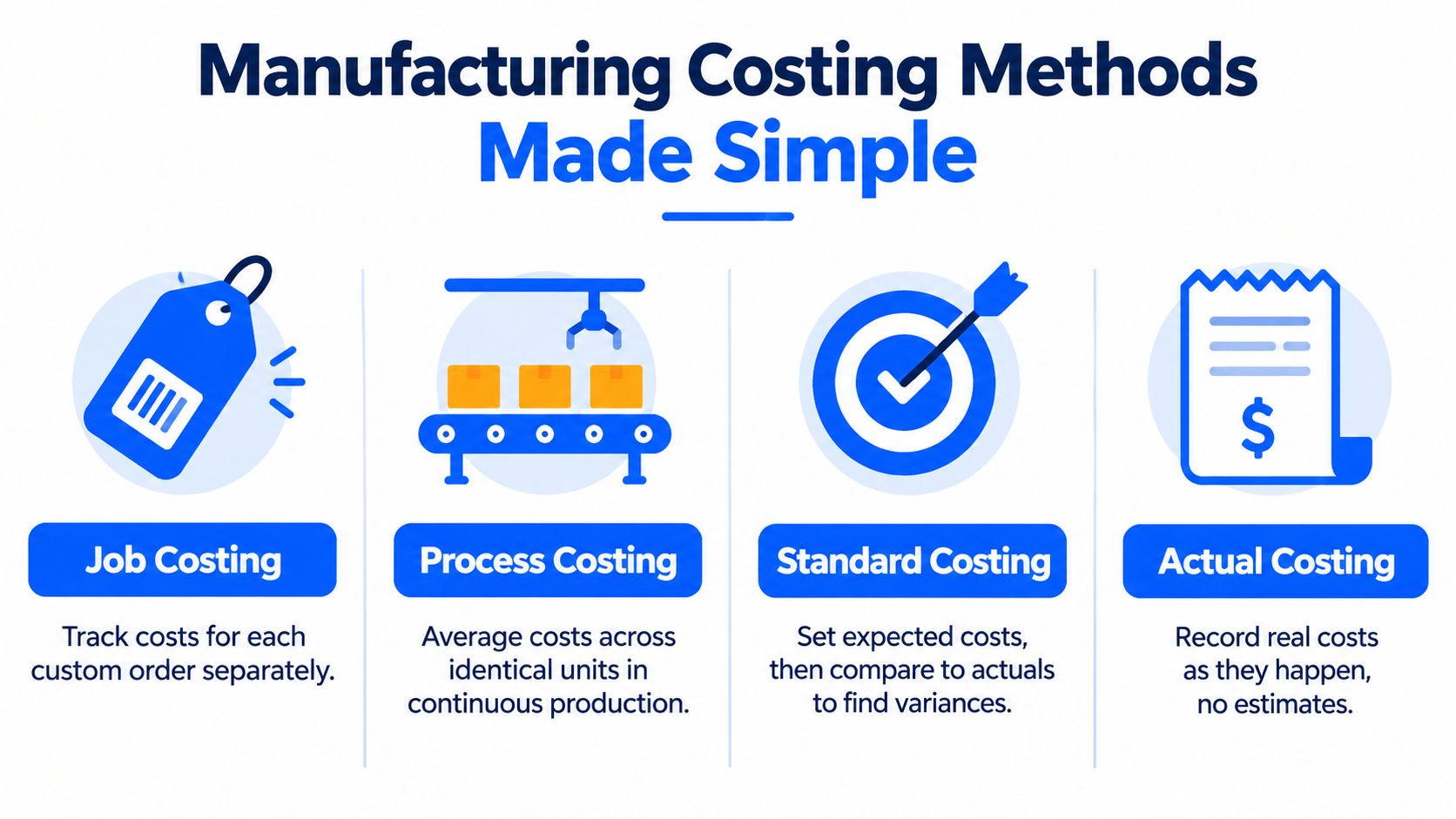
Job costing and process costing describe how you collect costs. Standard costing and actual costing describe how you measure them. They aren't necessarily competing alternatives. A custom manufacturer, for example, can collect costs by job while comparing actual consumption against standards.
Match the method to production
Match Your Production Model to the Right Costing Method
| Production Model | Best-Fit Method | Why It Fits |
|---|---|---|
| Custom-engineered equipment | Job costing | Keeps each order's materials, labor, and overhead together |
| Food and beverage production run | Process costing | Averages production costs across comparable output |
| Repetitive make-to-stock discrete production | Standard costing | Establishes expected costs and highlights deviations |
| Contract manufacturing with order-specific consumption | Actual costing within jobs | Measures recorded inputs against the customer order |
With job costing, a custom machine's cost follows its work order. Close review focuses on incomplete jobs and whether their accumulated costs belong in work in process.
With process costing, a beverage run's costs are spread across its output. Finance must understand completed production and unfinished quantities before accepting the period-end valuation.
Standard costing compares expected material, labor, and overhead with recorded results. Under IAS 2's standard-cost guidance, standard costs should approximate actual cost and be reviewed regularly. Actual costing uses recorded costs, but it still requires allocation policies, complete transactions, and a reliable cutoff.
Keep reporting costs separate from decision views
Under U.S. GAAP and IAS 2, inventory cost includes direct materials, direct labor, and production overhead, with fixed overhead commonly allocated using normal rather than actual production capacity, as reflected in the inventory-cost principles summarized with IAS 2. FASB's guidance on inventory costs also addresses fixed-overhead allocation based on normal production capacity. Allocation policy is therefore a financial-reporting decision, not a default setting to leave with the implementation consultant.
For management, a contribution-margin view can answer a different question: what changes economically if you accept an order or alter production? Keep that view separate from absorption costing, then reconcile the difference rather than declaring either view universally superior.
If products consume support activities differently, use HireAccountants' ABC guide as a discussion resource. Also distinguish production-cost collection from inventory valuation when reviewing inventory costing methods. A vendor should explain both without mixing them together.
Seven Capabilities a Real Manufacturing Cost System Must Have
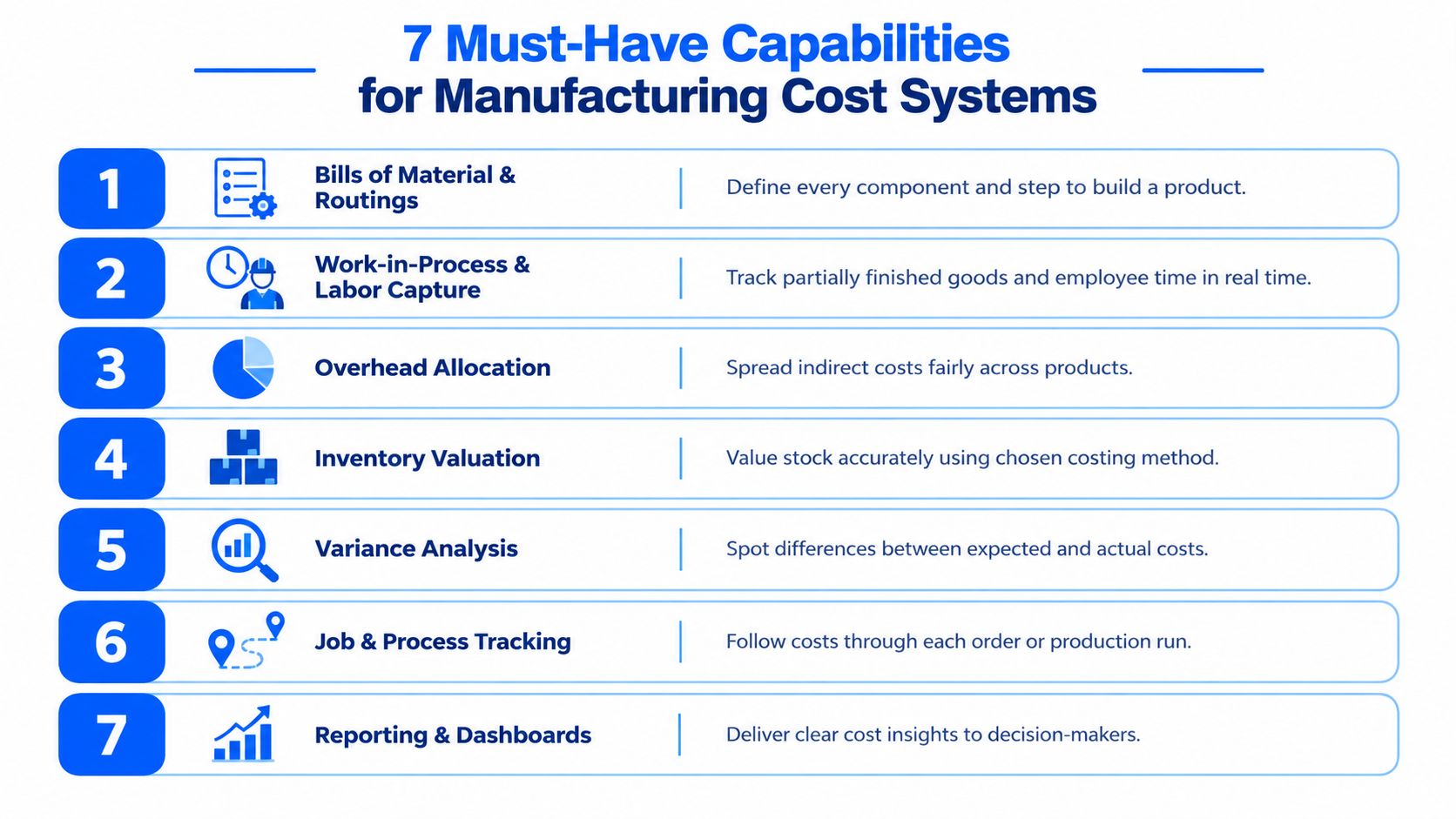
Judge capabilities by the decisions they support and the exceptions they expose. A feature earns its place when your team can use it to defend a balance, explain a variance, or make a better operating decision.
NIST's Manufacturing Cost Guide draws on an Annual Survey of Manufactures covering roughly 50,000 establishments, with categories mapping to materials, labor, overhead, inventories, and economic output. That breadth is a useful reminder: manufacturing costing isn't just purchasing data with a markup.
Require evidence across the operating cycle
- Bills of material and routings: Demonstrate component revisions, production steps, and effective dates. These support pricing and make-or-buy analysis. Without revision control, finance can't tell whether a margin reflects the current build.
- Work-in-process and labor capture: Show an unfinished order with material issues and recorded labor. Missing activity leaves finance guessing about completion and conversion costs.
- Overhead allocation with controlled rules: Show allocation bases, rate approvals, and treatment of changing utilization. A fixed percentage that nobody can explain isn't a cost model.
- Lot and serial tracking: Trace an item's production history and associated cost records. NIST's digital-thread work describes the value of connecting information across manufacturing systems. Without traceability, investigating a specific rework event or inventory exception becomes harder.
- Variance reporting: Separate material price and usage from labor rate, efficiency, overhead spending, and volume effects. A single unfavorable balance doesn't tell operations what to fix.
Test the financial boundary
Multi-entity and multi-currency consolidation must preserve useful plant and entity detail while supporting group reporting. Ask the vendor to distinguish an operating variance from a currency effect or intercompany issue. Otherwise, leadership may compare margins that don't share the same basis.
Audit-ready subledger-to-general-ledger reconciliation is the final requirement. Ask for the transaction behind a difference, its approval history, and the unresolved exception report. A balanced summary isn't proof that individual transactions are right.
The strongest demo isn't the cleanest dashboard. It's the clearest explanation of a transaction that went wrong.
Choose manufacturing KPIs for the ERP implementation around these workflows. Reject a demonstration that substitutes attractive charts for evidence that users can investigate and resolve the underlying problem.
Software Alone Versus a Real Implementation Partner
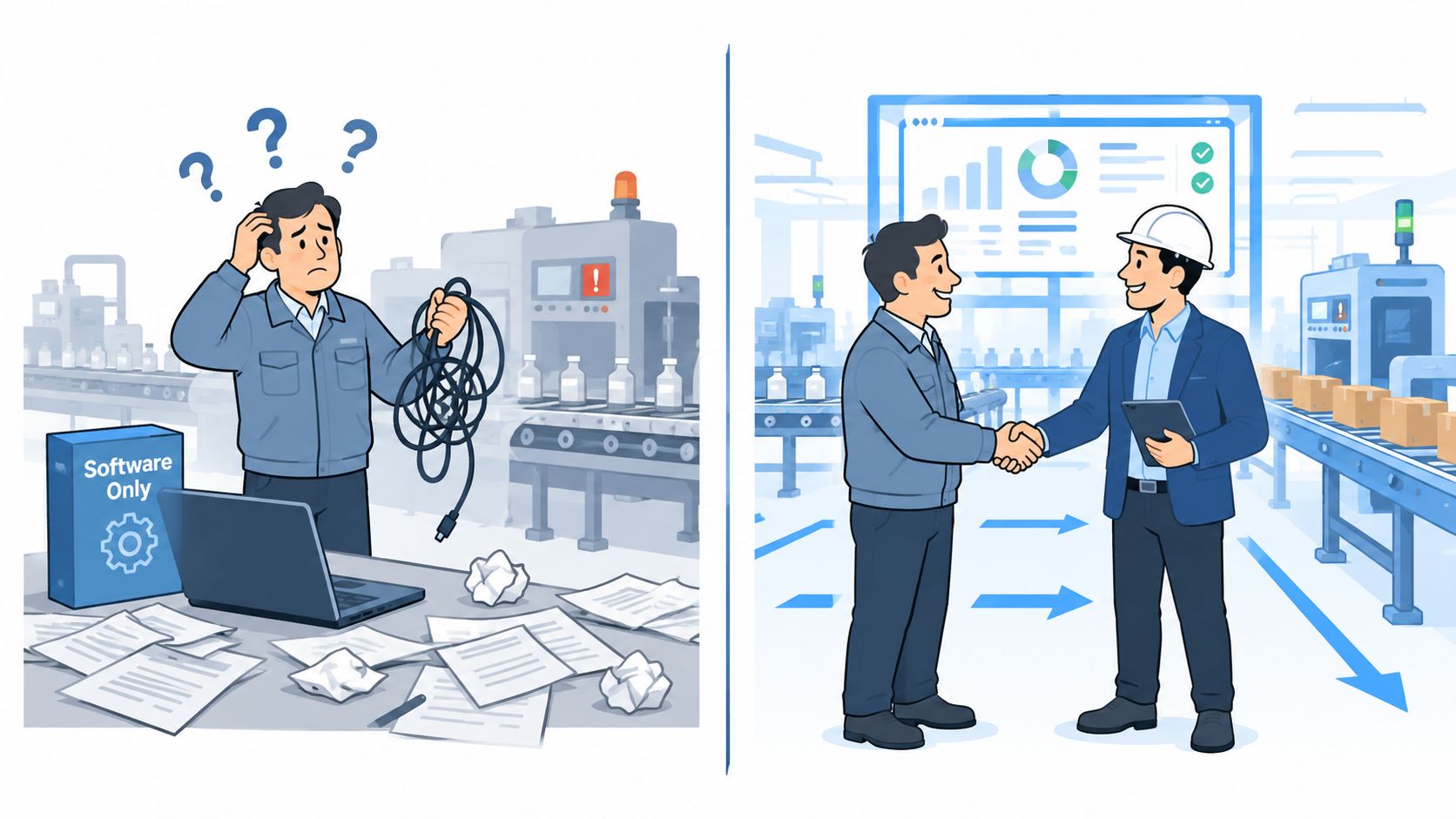
A software-only purchase isn't necessarily cheaper. It transfers more design, coordination, testing, and training responsibility to your employees. That can work, but only when you've deliberately staffed those responsibilities.
Implementation research reports that organizations may spend three to seven times more on ERP installation and operation than on software licenses, while resistance to change and inadequate training recur as implementation problems. That's a broad budgeting warning, not a forecast for your project, according to the ERP implementation literature.
Compare who actually does the work
| Responsibility | Software-only purchase | Partner-led implementation |
|---|---|---|
| Cost-model design | Internal finance and operations must lead | Advisor facilitates design and documents decisions |
| Data remediation | Internal teams identify and resolve defects | Partner helps define checks, ownership, and remediation scope |
| Integration testing | Buyer coordinates system boundaries | Partner should coordinate end-to-end acceptance |
| User readiness | Buyer develops training and procedures | Partner should provide role-based training and handover |
| Close support | Internal team builds controls | Partner should help establish reviewable close procedures |
The right-hand column describes responsibilities to contract for, not benefits every partner automatically delivers. A partner's title doesn't replace a statement of work.
Buy accountable delivery
For a Sage Intacct proposal, require a solution map identifying native functionality, manufacturing applications, interfaces, and any customization. Then ask who owns a defect that crosses those boundaries.
A serious partner should challenge the cost model before configuration begins. They should also identify which tasks require your Controller, plant manager, warehouse lead, and executive sponsor.
Ask for deliverables you can inspect: a design document, data-acceptance rules, test scripts, training materials, and a post-go-live escalation process. An implementation proposal that lists only meetings and configuration hours is incomplete.
Keep internal accountability. A consultant can facilitate decisions, but your finance and operations leaders must approve policies and own the resulting records. Buy expertise and execution support, not the illusion that accountability can be outsourced.
A Five-Phase Implementation Roadmap for Manufacturers
Release scope only when the preceding acceptance gate has been met. A calendar milestone isn't evidence that your cost model works.
Published ERP studies report failure estimates ranging from 67% to 90%, but definitions include missed benefits, schedule overruns, budget overruns, and poor adoption. The manufacturing ERP implementation research identifies management commitment, training, system suitability, and planning as important success factors. Don't treat that range as your project's probability of failure.
Establish the model before automating it
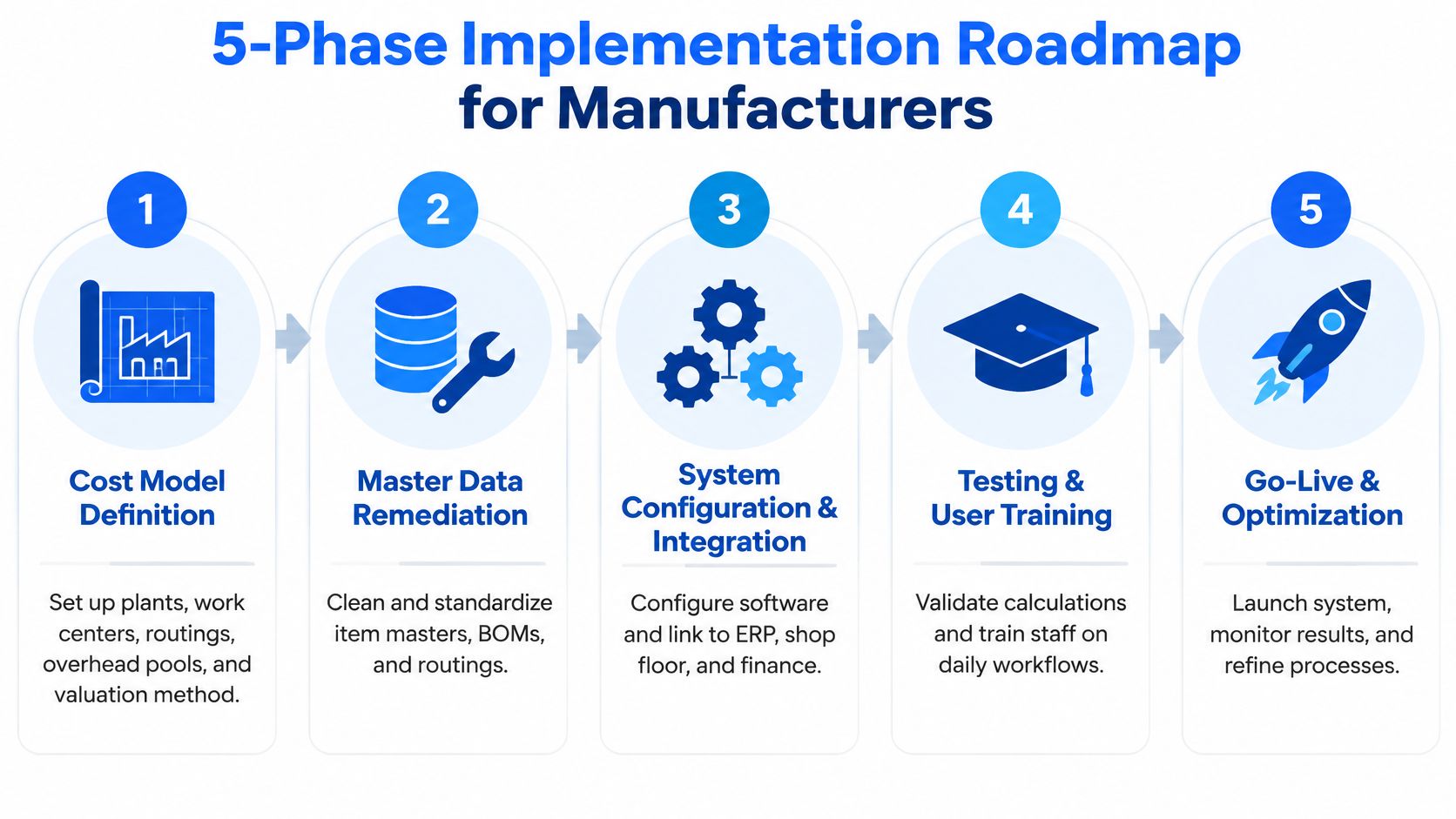
Phase one establishes the cost model. Document plants, work centers, products, routings, labor classes, overhead pools, and valuation methods. For a broader reference on manufacturing cost categories, consult NIST's Manufacturing Cost Guide Version 2.0 primer. Its industry-level estimates provide context, not a substitute for your plant's transaction-level cost records. Finance and operations must agree on the accounting treatment before consultants translate it into configuration.
The design approval gate requires signed policies and worked examples showing how representative transactions should flow.
Phase two remediates master data. Clean bills of material, routings, labor standards, work-center rates, and inventory masters. Resolve duplicates and inconsistent units rather than importing them and promising to fix them later.
The data readiness gate requires reconciled opening records, assigned owners, and approved exceptions.
Phase three configures costing and integration. Establish standard, actual, or hybrid costing and explicit variance categories. Test material price, material usage, labor rate, labor efficiency, overhead spending, and production volume separately.
The calculation gate requires expected results to match independently reviewed calculations, including exception transactions.
Prove the close before expanding
Phase four pilots a plant or product family. Run parallel comparisons against the legacy ledger and train users on the transactions they perform. Include make-to-stock, make-to-order, subcontracted, and rework scenarios where applicable.
The pilot acceptance gate requires explainable differences and correct representative transactions. Don't waive unresolved costing defects because the standard demonstration passed.
Phase five establishes the operating close. Require subledger reconciliation and root-cause review of material and conversion variances. Define escalation responsibilities before the implementation team steps back.
The operational acceptance gate requires finance to execute the documented close and retain review evidence.
- Budget for readiness: Include internal backfill, remediation, interfaces, testing, and training.
- Prioritize time-to-value: Release useful, accepted scope rather than pursuing an unnecessarily broad launch.
- Protect ownership: Keep data stewardship active after go-live.
Use a broader ERP implementation phase framework to coordinate technical activities around these finance approval gates.
The Master Data and Reconciliation Pitfalls That Ruin Margins
Treat ungoverned master data as a primary implementation risk, not administrative cleanup. Another costing feature won't resolve conflicting quantities, mismatched units, or labor that arrives after the reporting cutoff.
Deloitte's 2025 profitability research identified a complex, disparate systems environment as the leading barrier to meaningful cost data at 15%, while availability or timeliness at 21% and accurate, reliable information at 20% were leading challenges in using cost data for decisions, according to its profitability and cost-data findings.
Assign owners before resolving exceptions
Give these responsibilities to named people, not departments:
- Quantity owner: Resolves receipt, issue, transfer, and count differences across warehouse and production records.
- Labor owner: Approves time capture, labor classifications, calendars, and late submissions.
- Material owner: Maintains purchasing-cost inputs, units of measure, and landed-cost treatment.
- Cost owner: Governs rollups, overhead policies, effective dates, and financial reconciliation.
One person may hold multiple responsibilities. What matters is that each disputed field has an authoritative source and an escalation route.
ERP, warehouse-management, and shop-floor records can diverge when systems use different cutoffs, transaction statuses, or conversion rules. Resolve those causes at the transaction level. Don't force agreement by overwriting a summary balance.
Control boundary: A spreadsheet can support analysis. It mustn't become an unapproved alternative ledger.
Make synchronization visible
For cutover validation, compare at least three periods of legacy inventory, cost of goods sold, work-in-process, rollups, and variance explanations at transaction level. Prohibit uncontrolled spreadsheet overrides and require approval for changes to rates, yield assumptions, scrap treatment, and allocation bases.
Monitor close duration, unexplained variance percentage, inventory-adjustment frequency, and production orders closed without manual intervention. These indicators help finance distinguish useful automation from faster processing of unreliable inputs.
Menza's framework for e-commerce data management offers an adjacent-industry resource for thinking about ownership and governance. Apply that discipline to manufacturing records, and make data quality assurance for confident decisions part of operating management rather than a temporary migration task.
A Practical Evaluation Checklist and Next Step
Bring your own transactions to vendor demonstrations. A seller's sample company shows whether the presenter knows the software. Your unfinished orders, revised bills of material, and disputed receipts show whether the proposed solution fits your business.
Mark each requirement demonstrated, conditional, or unproven. Conditional items need a named application, accountable owner, delivery commitment, and acceptance test before you sign.
Use an evidence-based scorecard
| Capability | Evidence to require |
|---|---|
| Bills of material and routings | A controlled revision flows into a cost calculation |
| Work in process and labor | An incomplete order retains explainable accumulated cost |
| Overhead allocation | Approved rules handle utilization changes transparently |
| Lot and serial tracking | A production exception can be traced to affected records |
| Variance reporting | Users can distinguish causes and drill into transactions |
| Multi-entity and currency | Group reporting preserves meaningful operating detail |
| Subledger reconciliation | Users identify, assign, and resolve a transaction-level difference |
Keep control evidence in the evaluation. COSO's internal-control framework supports authorizations, approvals, verifications, reconciliations, and monitoring. Consult COSO's framework guidance when defining how those controls fit your reporting and operating risks. Applied to manufacturing, that means demonstrating standard-cost approvals, inventory-adjustment reviews, variance investigation, subledger reconciliation, and obsolete-inventory monitoring.
For IFRS reporting, IAS 2 requires inventory at the lower of cost and net realizable value. NRV is estimated selling price less expected completion and selling costs, so require an auditable item-level review for damaged or obsolete stock and changing recoverability, consistent with the IAS 2 measurement requirements.
Interview the partner as carefully as the vendor
Assess the people assigned to delivery, not just the firm's presentation:
- Cost-model design: Ask them to explain a disputed allocation and how they'd document the decision.
- Mid-market delivery: Request relevant references and clarify the internal staffing they expect from you.
- Healthcare and multi-entity depth: Where relevant to your group, test whether the team understands cross-entity reporting and differing operating systems.
- Training program: Review role-based exercises for operators, supervisors, and accounting staff.
- Post-go-live governance: Require escalation ownership, close support boundaries, and a documented handover.
For businesses with project-like production, AmbitionCFO's construction software guide provides an adjacent comparison resource. Use it to sharpen job-level questions, not as a substitute for manufacturing-specific transaction tests.
Frame ROI around close duration, unexplained variance percentage, and inventory-adjustment frequency. Establish your baseline, agree how improvements will be measured, and include internal effort in the investment case. Don't manufacture a savings estimate to justify a preferred platform.
Before selecting Sage Intacct, require the proposed delivery team to pressure-test the full manufacturing architecture and rollout. A fit discussion should expose exclusions and ownership gaps before the contract does.
Summary
Manufacturing costing becomes a finance problem when production records can't support the close. Choose methods that fit your production model, require evidence across the essential capabilities, and evaluate implementation responsibility alongside software functionality. A controlled rollout needs approved designs, clean master data, representative testing, and an operating close that finance can execute. Keep ownership and reconciliation central to the decision. The objective isn't more costing functionality for its own sake. It's a system and delivery approach that let your team explain inventory, investigate variances, and defend reported margins.
Frequently Asked Questions
How should manufacturing inventory be valued under IFRS?
IAS 2 requires inventory to be measured at the lower of cost and net realizable value. Cost includes purchase costs, direct labor, production overhead, and other qualifying expenditures needed to bring inventory to its current location and condition. NRV reflects expected selling proceeds after completion and selling costs. Your evaluation should therefore include item-level valuation support, recoverability review, and an auditable process for recording necessary write-downs.
Do ERP failure rates mean we should delay replacing our system?
The research discussed earlier uses different definitions of failure, including missed benefits, overruns, and poor adoption. It doesn't establish the likelihood that your specific project will fail. Use it to strengthen project governance rather than avoid a necessary decision. Require management sponsorship, suitable software, explicit acceptance gates, and role-based training. A capable partner helps organize those responsibilities, but your leadership team still owns policies and approvals.
How do we reconcile ERP, warehouse, and shop-floor systems?
Assign an authoritative source and named owner for quantity, labor, material, and cost records. Define transaction cutoffs, units, statuses, and exception routing before relying on synchronized reporting. When records disagree, investigate the underlying receipts, issues, transfers, and production activity instead of overwriting totals. Finance should receive unresolved exceptions with accountable owners, while approved corrections retain enough evidence to explain what changed and why.
Should we use absorption costing or contribution-margin reporting?
Use each for the question it answers. Absorption costing supports inventory and financial reporting by including manufacturing overhead under the applicable accounting policy. Contribution-margin views support management decisions about orders and production economics. Don't force either view to serve every purpose. Require a transparent reconciliation between them so leadership can distinguish product economics from allocation effects and understand why the reported margins differ.
Lucentive is a Sage Intacct National Premier Partner with deep mid-market, healthcare, and nonprofit experience, offering advisory and implementation support to evaluate the platform alongside your costing model, integrations, and close controls. Visit Lucentive to schedule a 30-minute working session or custom Sage Intacct demo, bring a troublesome production transaction and your shortlist, and pressure-test fit before you commit.