Donor-advised funds held an estimated $251.52 billion in charitable assets at the end of 2023, set against roughly $1.48 trillion inside private foundations. DAF assets were 16.98% of that foundation base, yet they still sent an estimated $54.77 billion to qualified charities, a payout near 24%. The average private-foundation payout was 8.7% in 2024, and the DAF rate has stayed at or above 20% in every year the National Philanthropic Trust DAF report tracks. A smaller pool is moving money faster.
If you sign off on a family gift or you book the checks that arrive at a nonprofit, that gap is the whole problem. You're choosing how much control, cost, and IRS work you want to own, and whether the revenue on the other side is something a controller can forecast.
Table of Contents
- Choosing Between a Donor-Advised Fund and a Private Foundation
- How Donor-Advised Funds and Private Foundations Work
- Tax Deductions, Payout Rules, and Compliance Compared
- Setup Costs, Governance, and Administrative Burden
- When to Choose a Donor-Advised Fund or a Private Foundation
- Summary
- Frequently Asked Questions
Choosing Between a Donor-Advised Fund and a Private Foundation
A donor I sat with last spring had a liquidity event and a two-week window before year-end. His attorney wanted a private foundation with the family name on the door. His controller wanted nothing that added a board, a Form 990-PF, and a self-dealing file to an already late close. Both were right about a piece of it. They were arguing past the actual choice, which is ownership of the work, not the cause.
A donor advised fund versus private foundation decision is a control-versus-administration trade with tax math attached. The account that pays out faster is not automatically the better institution. The entity you control is not automatically worth the compliance staff it demands.
What follows is a criteria pass in a fixed order: legal structure, deduction ceilings, payout rules, excise tax, filings, then the ongoing workload. After that, situational calls, including the view most comparisons skip. Nonprofit finance teams have to record, restrict, and forecast this money, not just celebrate the deposit.
Treat the vehicle as part of the estate file, not a December scramble. Counsel who already map charitable giving strategies for estate planning will tell you the same thing a CFO should: model the deduction, the payout cadence, and who still has to sign the return after you're gone.
Practical rule: If nobody on your team can name who owns the assets, who approves the grant, and who files, you aren't ready to fund either vehicle.
On the receiving side, a DAF check is not a pledge you control. Sponsor policy can slow it, split it, or restrict it. Controllers who book it like unrestricted annual fund revenue will miss a forecast the first time a donor goes quiet.
How Donor-Advised Funds and Private Foundations Work
Every later difference is a consequence of who holds title. The IRS requirements for donor-advised funds start with sponsor ownership and control; the IRS overview of private foundations covers the separate entity's obligations. Get that wrong and the tax talk is noise.
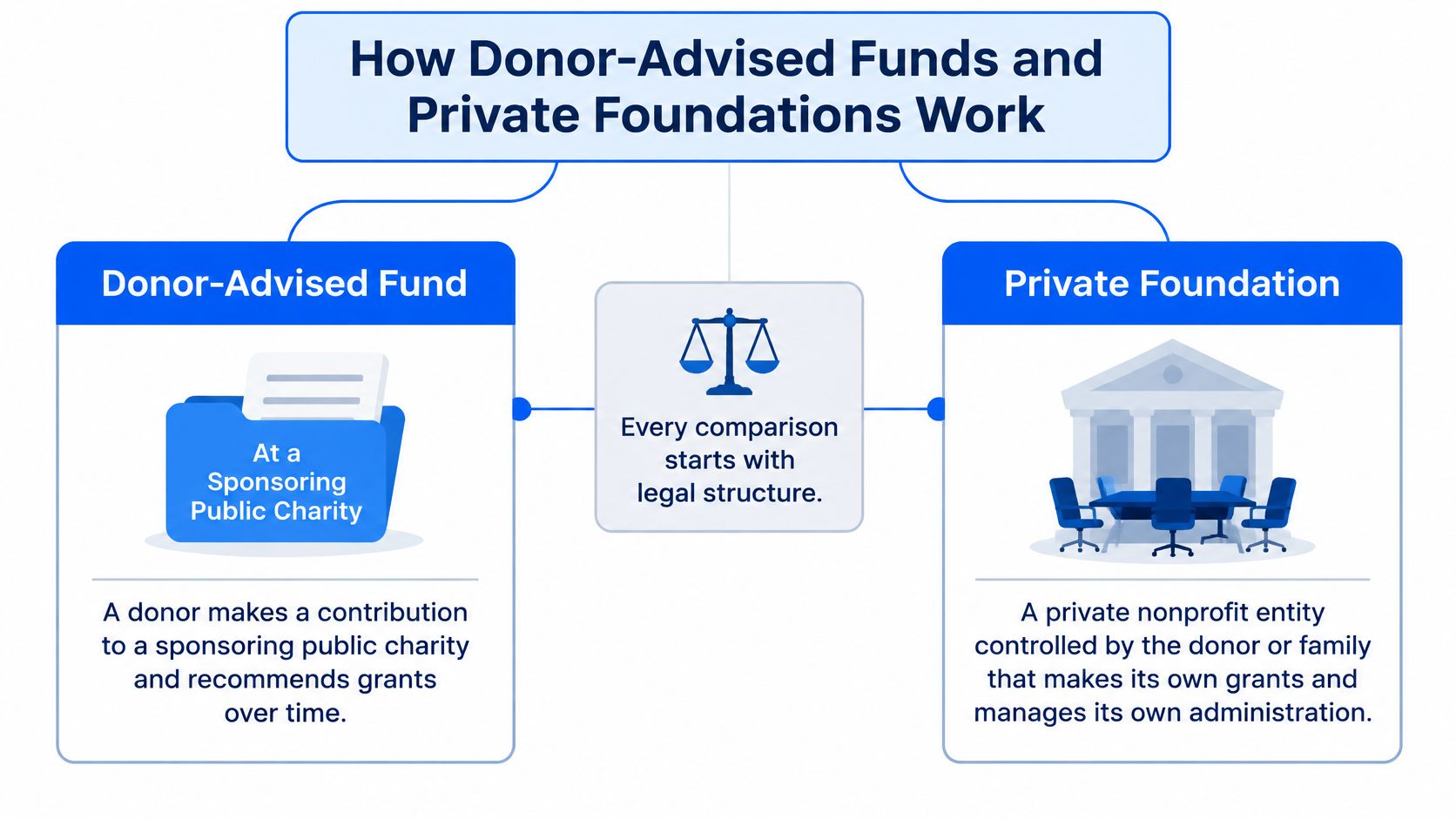
The sponsor owns the DAF
A donor-advised fund is a fund or account owned and controlled by a sponsoring organization, separately identified by reference to the donor's contributions. The donor, or a person the donor names, holds advisory privileges over investments or distributions. The sponsor cannot be a private foundation. IRS explanation of that structure is blunt: the donor contributes, claims the deduction, recommends grants to eligible charities, and the sponsor makes the final call. See the IRS description of donor-advised funds and its overview of DAF rules. For the deduction, the donor generally also needs a written acknowledgment from the sponsor confirming its exclusive legal control of the contribution.
In practice that means three people, not one.
- The donor writes an irrevocable check or transfers stock, then recommends.
- The sponsor titles the assets, invests under its policy, vets the grantee, and signs the grant.
- The IRS looks to the sponsor as the legal owner, not to the family that funded the account.
You don't operate a standalone nonprofit to do this. You also don't get to overrule the sponsor when a recommendation fails its eligibility screen.
The foundation is its own charity
A private foundation is a separate charitable entity, usually run by its creators, family, or a small donor group. Directors or trustees hold the investments, approve the grants, hire or don't hire staff, and answer for the filings. The IRS private-foundation overview outlines the rules that come with operating the entity. There is no outside charity sitting between the family and the check.
That is why deduction limits, payout statutes, and the compliance stack aren't lifestyle preferences. They follow title. Advisory input is not legal direction. Board control is not a light admin task.
Nonprofits on the receiving end should mirror that split in the books. A grant recommended from a DAF is the sponsor's distribution, often with the sponsor's name on the advice letter. Fund-level tracking, not a single "donations" bucket, is what keeps restrictions straight. Teams that have outgrown a flat QuickBooks file usually need real fund accounting for nonprofit organizations before those gifts get commingled with unrestricted cash.
Tax Deductions, Payout Rules, and Compliance Compared
Run the four tests in the same order every time. Deduction ceiling, payout duty, excise tax, then the return you have to file. The table at the end only confirms the math.
Deduction ceilings
Federal limits generally favor the DAF because the gift is to a public charity. For individuals who itemize, IRS guidance on charitable contribution deductions generally puts the ceiling for cash gifts to qualifying public charities, including DAF sponsors, at 60% of adjusted gross income, versus generally 30% for gifts to private foundations. For appreciated property, the general caps are 30% of AGI for public charities and 20% for private foundations. Limits and valuation rules depend on the asset, recipient, tax year, and the rest of the return; IRS Publication 526 explains the contribution limits and substantiation requirements. Model a concentrated stock block or closely held interest before it moves. The CRS summary of charitable contribution limits provides background, but use current IRS guidance for the year of the gift.
Families weighing a large noncash gift should also read practical charitable giving guidance for Texas families before they lock the entity. The deduction you can't use this year is not a strategy. It's a carryforward you may never fully absorb.
Payout, excise tax, and what gets taxed
Private foundations live under a minimum-distribution regime DAFs don't have. The distributable amount is built largely on a 5% minimum investment return on noncharitable-use assets, reduced by specified items such as acquisition indebtedness and certain taxes. Miss it and excise tax follows, with further penalties in willful or flagrant cases. The IRS lays that out under minimum investment return. DAF assets can stay invested with no matching federal annual payout. That flexibility is real. It is also how an account goes quiet unless the donor writes a grant policy the sponsor didn't require.
Foundations generally pay an excise tax on net investment income. The current Form 990-PF instructions specify a 1.39% rate for most domestic private foundations; the older 2% rate and possible 1% reduction no longer apply. The tax appears on the foundation's Form 990-PF. DAFs are not subject to that private-foundation investment-income tax. For background on the wider rule set, including minimum distributions and self-dealing limits, see the IRS private-foundation terms and concepts glossary.
DAFs aren't tax-free in every direction. The modern split was written into federal law in 2006. Section 4966 imposes excise tax on taxable distributions, including grants to individuals or for noncharitable purposes, generally for tax years beginning after August 17, 2006. IRS Notice 2006-109 is the notice that walks through that framework. Foundations, by contrast, can make certain grants to individuals or for programs a sponsor will refuse, but only inside extra expenditure rules. For example, IRS rules for certain grants to individuals and expenditure responsibility for certain grants impose conditions a foundation must check before it pays. That is a capability, not a free pass.
Filing follows the entity. The foundation files its own Form 990-PF, keeps investment and grant records, and maintains the board file. The IRS instructions for Form 990-PF show where foundations report grants, qualifying distributions, and investment-income tax. Its return is generally open to public inspection. The DAF donor does not file an entity return for the account. The sponsor handles its own reporting.
Map both vehicles to a real chart of accounts for nonprofits before the first grant hits, or the deduction story and the books will never match.
| Criterion | Donor-Advised Fund | Private Foundation |
|---|---|---|
| Cash gift deduction (general) | Up to 60% of AGI | Up to 30% of AGI |
| Appreciated property (general) | Up to 30% of AGI | Up to 20% of AGI |
| Federal annual payout | None | Generally based on 5% of noncharitable-use assets, subject to adjustments |
| Excise tax on net investment income | Not subject to the private-foundation tax | Generally 1.39% |
| Who directs the grant | Donor recommends, sponsor decides | Foundation managers decide |
| Who files for the vehicle | Sponsoring charity | The foundation itself |
Setup Costs, Governance, and Administrative Burden
Tax ceilings don't tell you who stays late in March. This is the workload test, and it's where most foundations get expensive in ways a fee schedule never shows.
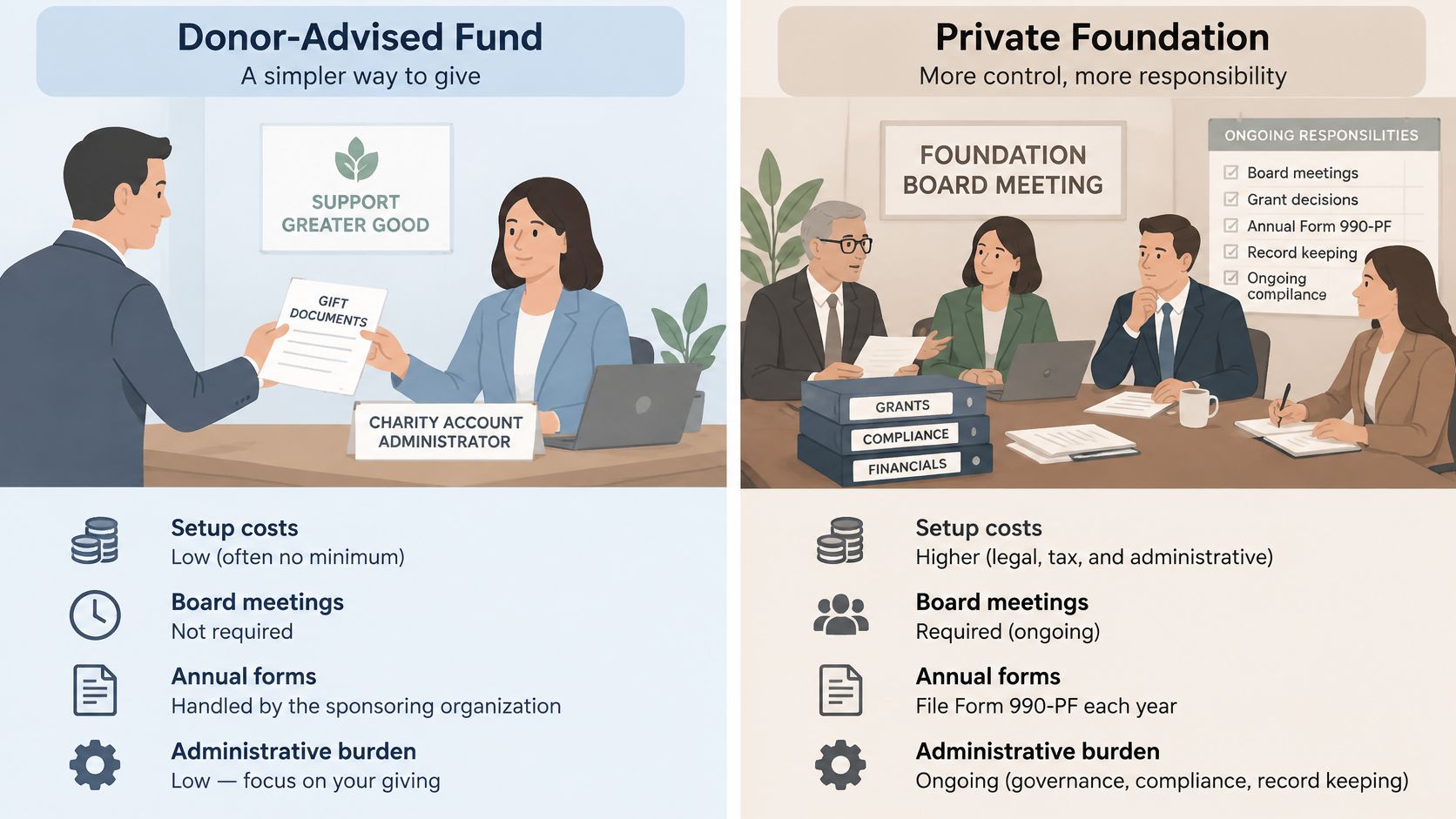
A foundation is a company that happens to be charitable. You form the entity, seat a board or trustees, open accounts, and then keep the machine running. Recurring work is accounting, the annual return, grant due diligence, and standing controls. Those controls exist because IRS private-foundation rules address self-dealing, excess business holdings, jeopardizing investments, and taxable expenditures, plus the yearly excise-tax computation. The National Philanthropic Trust's 2024 DAF report draws the operational line cleanly. The foundation can employ staff, run programs, and carry a public identity. It pays for that with governance.
A DAF pushes investment administration, grant processing, and regulatory oversight onto the sponsor. You pay sponsor fees instead of standing up a back office. You do not escape review. Sponsor grant-eligibility screens are a control, and a recommendation is not an order. Read the policy before you contribute, not after a grant is declined.
Where the cost actually sits
Skip fake precision on basis points. Price the ownership.
- Startup. Foundation formation means counsel, organizing documents, and exemption work. A DAF is an application and a contribution to a sponsor that already exists.
- Recurring cash. Foundations buy accounting, legal review, and often staff. DAFs buy a sponsor fee and whatever investment cost the platform charges.
- Board and family time. Foundations need minutes, investment oversight, and a grant committee that meets. DAF time is recommendation letters and a periodic look at the balance.
- Where risk lives. On a foundation, a bad transaction is your excise-tax problem. On a DAF, the sponsor holds title and the compliance file, and can say no.
If the only person who understands the foundation's books is an outside CPA you call in April, you don't have a philanthropic institution. You have an annual fire drill.
Grantees feel this too. Foundation awards often arrive with a reporting calendar and a restriction schedule a DAF gift may not spell out the same way. Keep a grant report sample in the file so program staff and accounting describe the same award. That's how you avoid booking a restricted gift as free cash.
When to Choose a Donor-Advised Fund or a Private Foundation
Pick the vehicle for the job in front of you. Don't pick it because a peer used it.
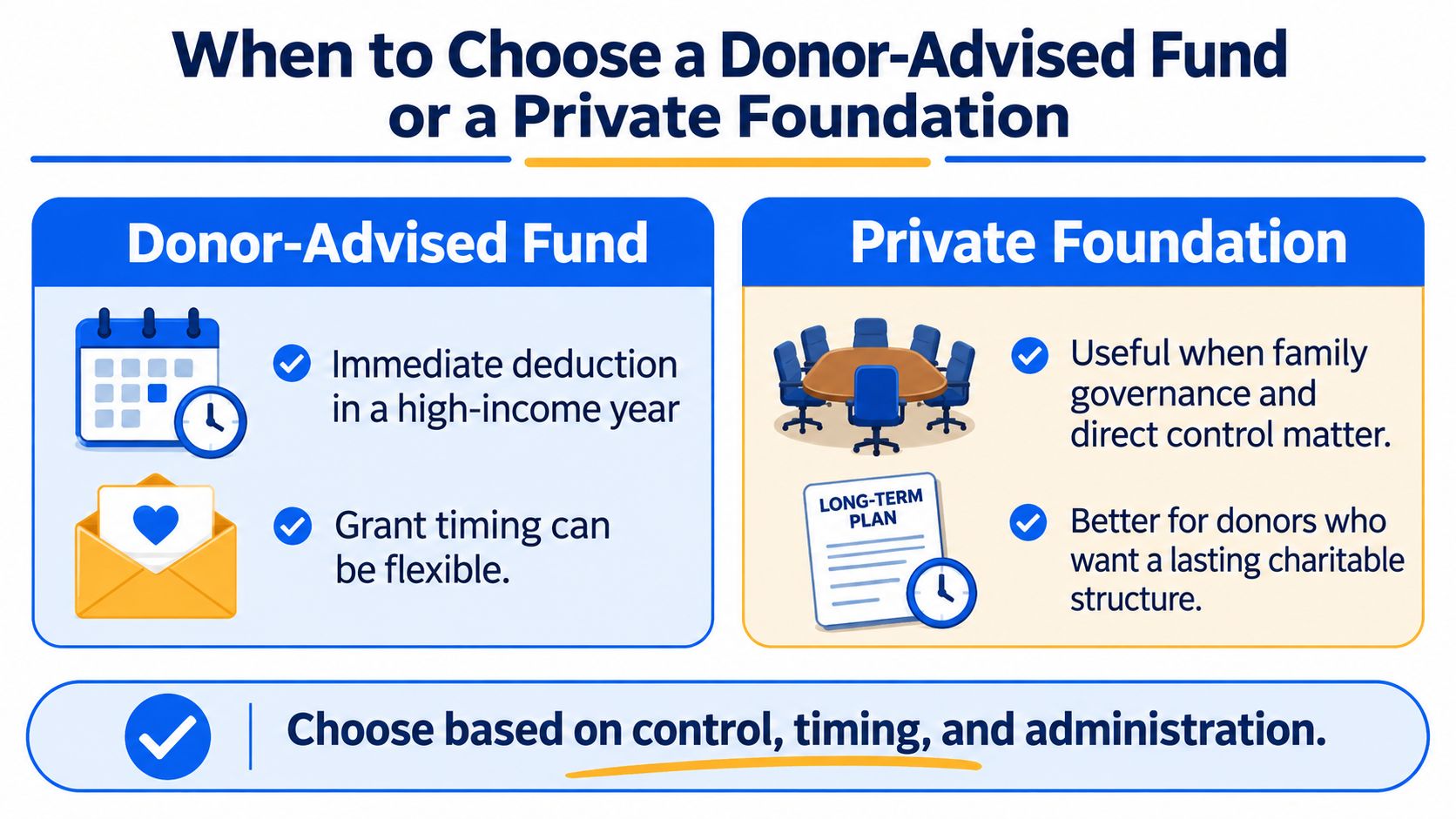
Use a DAF when speed and overhead dominate
Choose the DAF when the donor wants the deduction in a high-income year, wants to recommend grants later, and doesn't want a second set of books. Anonymity is available in a way a foundation's public return is not. Timing sits with the donor's policy, not a federal minimum. That is the right call for a liquidity year, a bunch of appreciated shares, or a family that will not staff a board.
It is the wrong call if you need to pay a scholarship to a named student, hire program staff inside the charity, or hold an investment menu the sponsor bans. Advisory privileges stop where sponsor policy stops.
Use a foundation when control is the point
Choose the foundation when the family wants to vote the grants, set the investment policy, employ people, and run programs under its own name across generations. The heavier file is the price of that control. If no one will serve as trustee in year ten, don't form it in year one.
A combined setup is legitimate. Some families keep the foundation for governance and staffed work, and use a DAF for grants they want processed quickly or without their name on the letter. The point is a written split of duties, not two accounts nobody reconciles.
A high payout is not the same as impact
Sector figures circulated in 2025 put the field near 3.5 million DAF accounts, $326 billion in assets, $65 billion in grants, and a payout above 25%. Those totals, noted in a review of DAF rules and contribution limits, show busy grantmaking without a statutory floor. They do not measure grant quality, whether the gift was additional, whether it was unrestricted, or whether it sat with one favored charity. Congressional Research Service analysis, cited in that same discussion, confirms assets can accumulate without the foundation minimum. Sponsors report in aggregate. Outsiders can't see dormant accounts, successor rules, or a single fund's cadence.
Can a high aggregate payout sit next to long-term accumulation and thin account-level transparency? Yes. The totals don't stop that.
Nonprofit CFOs should stop treating DAF revenue as a renewable annuity. Track cadence, restrictions, multi-year commitments, and what you could deploy in an emergency. Family principals should ask the same questions of their own advisor. Family office reporting requirements get sharper once charitable accounts sit beside operating entities.
Before you fund anything, answer four questions. Who must approve each grant? What must go out this year, by law or by your own policy? Which gifts can this vehicle not make? Who closes the books and survives an audit? If the answers point at a sponsor, use the DAF. If they point at a board you will run, use the foundation.
Finance teams staring at that reporting mess shouldn't buy software in a vacuum and hope the chart of accounts sorts itself out. Schedule a 30-minute working session with Lucentive, a Sage Intacct National Premier Partner with deep mid-market and nonprofit experience, and look at fit before you pick a partner or license Intacct on your own. Cleaner fund accounting is what makes either vehicle survivable at close.
Summary
A donor-advised fund is an account the sponsoring charity owns. The donor keeps advisory privileges, faces higher AGI deduction limits, has no federal annual payout mandate, and skips entity-level administration. A private foundation is a separate charity the family or its trustees govern. That control comes with a 5% distribution requirement, an excise tax on net investment income, and a much heavier compliance file. The trade is control versus administrative burden. Nonprofits that receive DAF grants should track restrictions and grant cadence instead of treating the checks as steady unrestricted income.
Frequently Asked Questions
Does a donor-advised fund have a required annual payout?
No federal rule forces a DAF to distribute a set percentage each year. A private foundation generally must make qualifying distributions tied to a 5% minimum investment return on its noncharitable-use assets, and missing that amount can trigger excise tax. DAF balances can stay invested. That timing room is useful only if the donor sets a grant policy. Aggregate payout rates can look high while individual accounts sit still, which is why the absence of a floor matters more than the sector average.
Who legally controls assets once they go into a DAF?
The sponsoring public charity does. The contribution is irrevocable. The donor claims the deduction and may recommend investments and grants, but those are advisory privileges, not title and not a veto. The sponsor approves or declines the grant and cannot itself be a private foundation. A private foundation flips that picture. Its directors or trustees hold the entity and sign the grants, and they accept the filings and prohibited-transaction rules that come with that control.
How do cash and appreciated-property deduction limits differ?
Gifts to a DAF are gifts to a public charity, so the general ceilings are higher. Cash is generally deductible up to 50% of adjusted gross income through a DAF sponsor, versus 30% for a gift to a private foundation. Appreciated property is generally capped at 30% of AGI for the public-charity route and 20% for a foundation. Asset type and the rest of the return can change the usable number. Model a concentrated stock position or business interest before you contribute it.
Do private foundations pay tax on investment income?
Yes. Foundations generally pay an excise tax on net investment income. IRS materials describe a 2% rate, with a possible reduction to 1% when the foundation meets the distribution-growth test. DAFs are not subject to that private-foundation investment-income tax. Foundations also carry minimum-distribution duties and limits on transactions such as self-dealing. Separately, taxable DAF distributions, including grants to individuals or for noncharitable purposes, can trigger excise tax under Section 4966.
Which grants can a foundation make that a DAF sponsor often will not?
Foundations can employ staff, operate programs, and make certain grants to individuals or for purposes a sponsor's DAF rules treat as off limits, provided the extra private-foundation expenditure rules are met. A DAF recommendation that sends money to an individual, or that isn't for a charitable purpose, sits in the taxable-distribution category the sponsor is built to avoid. International grants and similar edge cases follow the same pattern. The foundation can sometimes do them, with more procedure, and the sponsor may decline. Read the sponsor's eligibility list before you fund the account.
Controllers comparing systems for that grant file should look at fund accounting software against the restrictions they already struggle to report, not against a feature grid.
Lucentive implements Sage Intacct for nonprofit and mid-market finance teams that need multi-entity control, a faster close, and an audit trail that can separate DAF grants from foundation awards. Software alone doesn't fix a chart of accounts that hides restrictions. A working session with an implementation partner does. Visit Lucentive to schedule a 30-minute working session and see whether Sage Intacct fits the way your team already tracks funds.