Your ERP went live on schedule, but month-end still depends on spreadsheets, managers can't trust the dashboards, and every new entity adds another reconciliation headache. That isn't a software problem alone. It's an adoption problem, and it can turn a sound Sage Intacct investment into an expensive system people work around.
ERP change management is the operating discipline that moves employees from old habits to reliable, repeatable workflows. Research summarized by ERP Research's ERP adoption guidance shows that projects with excellent change management are 6x more likely to meet their objectives than projects with poor change management. For CFOs, Controllers, CEOs, and VP Finance leaders, the implication is direct: the business case depends on what people do after go-live, not whether the implementation team successfully switches the system on.
Executive Summary
If you want an ERP change management plan that works, focus on six practical controls:
- Visible executive sponsorship: Current ERP transformation guidance consistently points to strong sponsorship and decision clarity as essential for adoption and scope control, including Prosci's ERP transformation guidance and finance ERP governance recommendations from Umbrex.
- Clear governance: High-performing ERP programs define steering cadence, escalation rules, and process ownership before configuration starts. Finance-focused governance models commonly include executive steering, process leadership, design authority, and PMO delivery control, as outlined by Umbrex and SysgenPro.
- Role-based training: Search results repeatedly emphasize that training should mirror future-state workflows and approval responsibilities, not just software navigation, as noted by Prosci and implementation checklist guidance from CFO Shortlist.
- Go-live readiness checks: The most useful readiness tests include signed-off critical scenarios, validated reconciliations, completed training coverage, cutover rehearsals, and staffed hypercare support, based on SysgenPro's finance ERP governance guidance.
- Behavior-based adoption metrics: After launch, measure task completion, cycle times, ticket trends, and data quality, not just attendance or logins. This theme appears across ERP and finance system implementation guidance, including CFO Shortlist and Afternoons with ACES.
- Post-go-live reinforcement: The highest-risk period is often the first 30 to 90 days after launch, when local workarounds return unless managers, super users, and process owners keep coaching the new workflow.
Table of Contents
- Executive Summary
- What Actually Goes Wrong During ERP Go-Lives
- Mapping Stakeholders Before You Touch Software
- Building a Communication Rhythm People Actually Read
- Defining What Adoption Looks Like After Launch
- Designing Role-Based Training and a 30-60-90 Reinforcement Plan
- Why the Implementation Partner Matters More Than the Software
- A Practical ERP Change Management Checklist and Next Step
- ERP Change Management FAQ
- What is ERP change management?
- Why does ERP change management matter so much after go-live?
- Who should own ERP change management?
- What are the most important ERP change management activities before go-live?
- How do you measure ERP adoption?
- What should ERP training include?
- How long should ERP change management continue after launch?
- What are the biggest ERP change management mistakes?
What Actually Goes Wrong During ERP Go-Lives
A multi-entity distributor recently cut over to its new ERP on schedule. The first close looked promising. Within six weeks, finance was reconciling in Excel again, warehouse leads were ignoring system replenishment recommendations, and the executive sponsor was privately asking whether the project had failed.
The system hadn't failed technically. The organization had failed to define what adoption meant after launch.
The sponsor had treated go-live as the finish line. Training had arrived as one large wave before cutover, with little support for employees who encountered unfamiliar exceptions in real transactions. The project team had never agreed on role-level adoption measures, so leadership had no early warning when work moved back into spreadsheets. The governance committee dissolved after deployment, leaving nobody with clear authority to resolve process disputes or fund targeted reinforcement.
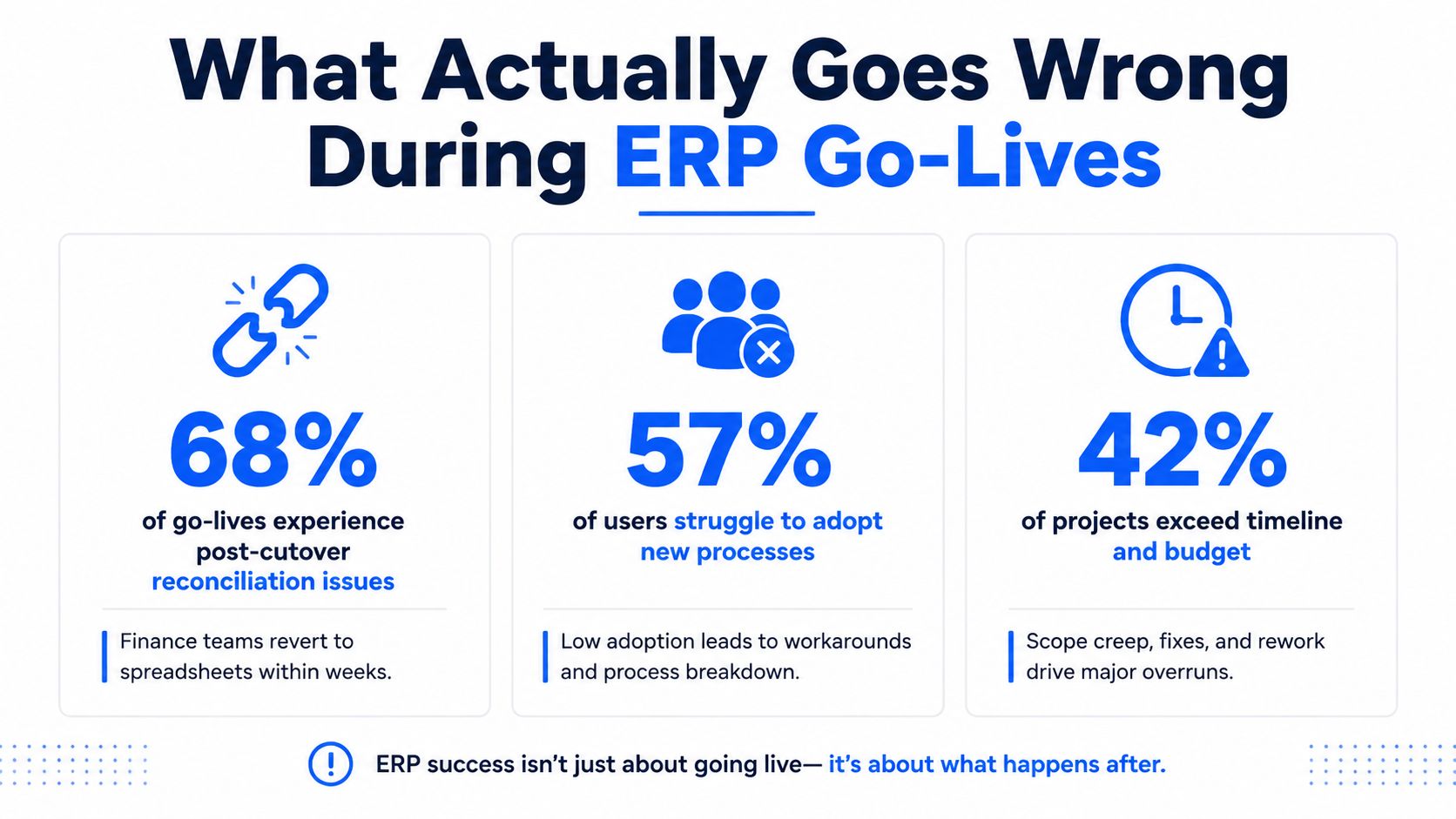
The visible symptoms start earlier
Each failure pattern points to a decision that was never made:
- Role clarity gaps: Employees don't know who owns approvals, master data, exception handling, or intercompany corrections in the future-state process.
- Weak feedback loops: Frontline concerns travel through informal conversations instead of a named channel reviewed by people who can act.
- No post-cutover measurement: Leadership counts attendance or logins instead of checking whether invoices, journals, purchase orders, and reports are being completed in the ERP.
- Sponsor disengagement: Executives communicate the reason for change before launch, then stop reinforcing it when operational pressure rises.
- Governance collapse: The steering group resolves design questions during implementation but has no mandate after go-live.
This is why an ERP rollout can meet its technical milestone while missing its business case. Planning the costs, time, and resources for an ERP implementation must include the people, decisions, coaching, and measurement required after cutover.
Prosci-referenced reporting shows that projects with excellent change management are about 6 times more likely to meet objectives than projects with poor change management, as summarized by ERP Lite's ERP change management analysis. The practical lesson is simple. Treat change as a measurable operating program, with owners and review rhythms that continue after the project team leaves.
Mapping Stakeholders Before You Touch Software
Configuration shouldn't begin until leadership knows who owns the change. A stakeholder map makes that ownership visible, then turns participation into documented deliverables rather than a calendar full of meetings.
Start with the executive sponsor. This person needs a written charter that explains why the organization is changing, what business outcomes matter, what the sponsor will communicate publicly, and which decisions cannot wait for consensus. Require the sponsor to review a public scorecard covering readiness, major risks, unresolved decisions, and adoption measures.
The steering committee needs more than senior titles. Give it a meeting cadence, decision rights, escalation rules, and a named chair. A written RACI should identify who recommends, approves, executes, and is consulted when scope, process design, data, or adoption risks surface.
Put process ownership close to the work
Process owners should own measurable outcomes, not merely attend workshops. The Controller might own close discipline and journal approval behavior. An operations leader might own purchasing and inventory adherence. A clinic administrator, nonprofit finance director, or DSO operations leader may own the consistency of workflows across locations.
Choose super users for credibility, not tenure. The person who understands how work happens on the floor often makes a stronger coach than the person with the longest title or service history. Give each super user a defined area, escalation path, and time allocation.
End users need structured input sessions organized around real tasks. Ask where work breaks today, which exceptions matter, and what would make the future process impractical. Review the feedback channel weekly, publish decisions, and tell employees which concerns will be addressed later.
| Stakeholder Tier | Change Responsibility | Pre-Go-Live Deliverable |
|---|---|---|
| Executive sponsor | Set direction, communicate the reason, remove barriers | Sponsor charter and public scorecard |
| Steering committee | Make timely decisions and control scope | RACI, decision log, and meeting cadence |
| Process owners | Own future-state workflows and outcomes | Approved process maps and KPI definitions |
| Super users | Coach peers and surface resistance | Nomination criteria, coverage plan, and office-hour schedule |
| End users | Validate usability and identify workflow risk | Structured feedback record and user readiness input |
This alignment work is especially important when finance teams are moving beyond QuickBooks, healthcare organizations are connecting financial workflows to EMR operations, or nonprofits are standardizing fund and grant reporting. Blending technology with talent to build the ultimate finance team captures the broader principle. Systems improve finance only when responsibilities, skills, and decision ownership improve with them.
Building a Communication Rhythm People Actually Read
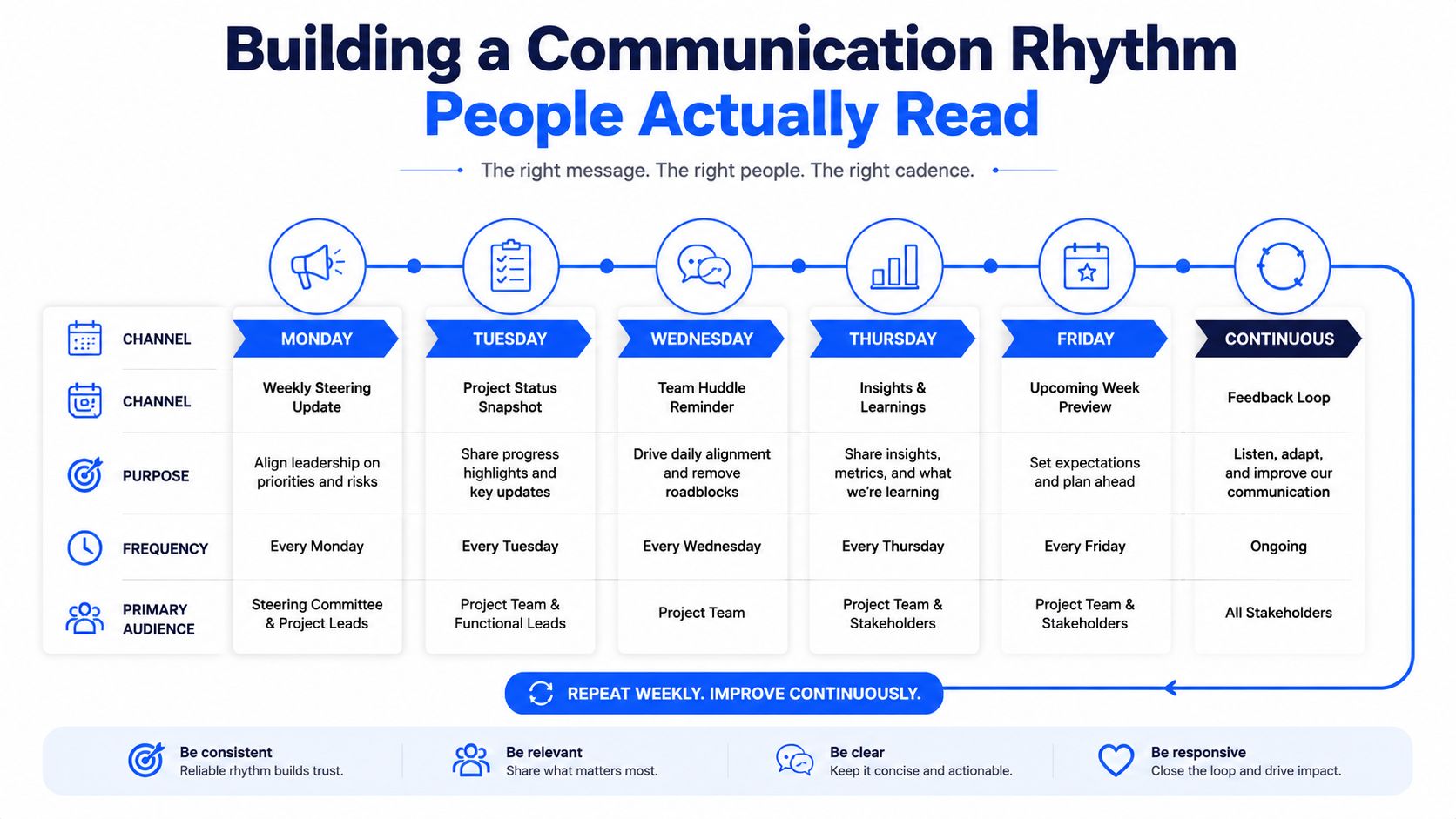
A communication plan fails when it becomes a collection of announcements. People need a predictable rhythm that tells them what changed, why it matters, what they must do, and where unresolved issues stand.
Use different channels for different decisions. A steering update shouldn't read like an end-user newsletter, and a process-owner briefing shouldn't bury design trade-offs in corporate language.
- Weekly steering update: Send a concise status note with decisions needed, current risks, upcoming milestones, and owners. The sponsor should see what requires executive action, not just a green status report.
- Biweekly process-owner briefing: Focus on design choices and their operational consequences. Explain which standard workflow the team selected, what exception it won't support, and how the business will handle that exception.
- Super-user huddle: Keep the conversation short and practical. Ask what employees are resisting, which job aids are unclear, and which transaction is creating repeat questions.
- Monthly all-user newsletter: Use plain language. Explain what is changing, why the company selected the change, what employees should practice, and where they can get help.
Write messages that answer the real question
A sponsor note might say: “We're moving to a common financial process because our current reporting requires too much manual reconciliation across entities. Leaders will review the same definitions and dashboards, and we'll publish the decisions that affect your daily work.”
A process-owner update should be more specific: “We selected approval routing inside the ERP instead of email approval. That gives finance a visible record of decisions, but it means managers must review requests in the system before purchasing can proceed.”
A frontline message should acknowledge friction: “The location-transfer workflow is creating duplicate entry for some teams. The project team is testing a revised form and will address the issue in the next support review.”
Repetition builds trust when the message stays consistent and the details become more useful. Silence after go-live sends a different message. Employees conclude that leadership has moved on, so local workarounds become acceptable.
For teams that need structured collaboration across finance, operations, and implementation workstreams, Sage Intacct Collaborate can support the shared communication and issue-resolution discipline around the ERP program. The tool matters less than the operating rule: every concern needs an owner, a status, and a response.
Defining What Adoption Looks Like After Launch
Login counts tell you who showed up. They do not show whether invoices were coded, journals approved, or intercompany activity processed through the standard workflow. Define adoption as task completion inside the ERP, using the workflows and controls the organization approved.
Finance teams should code and post invoices in the system, route journals through configured approvals, and process intercompany activity consistently. Operations teams should reconcile inventory adjustments promptly and convert purchase requests into purchase orders through the intended workflow. Executives should rely on governed reporting data, with clear ownership for investigating exceptions.
Build a dashboard around behavior
Start with three KPIs that connect user behavior to operating work:
- Days to close the books: Measure the close calendar from its defined starting event through final approval. Identify whether delays come from system use, unclear ownership, or poor upstream transaction quality.
- P2P transactions processed inside the ERP: Count transactions completed without offline workarounds. Segment results by entity, department, and transaction type so a strong total does not conceal a weak location.
- Requisition-to-PO cycle time: Measure the interval between an approved requisition and its purchase order. Investigate approval routing, incomplete requests, and employees bypassing the process.
| Role | KPI | Target by Day 90 | Source / Measurement |
|---|---|---|---|
| Controller | Days to close the books | Defined by the approved close calendar | Close checklist, journal status, and final approval timestamp |
| AP and procurement | P2P transactions processed inside the ERP | Standard workflow used consistently across in-scope entities | ERP transaction reports, exception log, and offline-workaround review |
| Department managers | Requisition-to-PO cycle time | Measured against the future-state purchasing process | Requisition and PO timestamps, segmented by entity and department |
Review the traffic-light dashboard weekly during the first 90 days, then monthly after stabilization. A red indicator requires a specific response, such as role-based refresher training, a workflow correction, or a manager conversation. Do not turn every red metric into an all-hands email.
Use the manufacturing KPI guidance for ERP implementations to connect system activity with operating decisions. Adoption provides an early signal of ROI. As behavior declines, reporting quality, control strength, and value realization decline with it. Assign an owner to every metric and review the trend during the governance meeting, so adoption remains managed after cutover rather than becoming a one-time launch check.
Designing Role-Based Training and a 30-60-90 Reinforcement Plan
Training for a software demo produces temporary familiarity. Training for daily work produces usable capability. Build learning paths around the transactions people perform, the exceptions they encounter, and the decisions they must make without calling the project team.
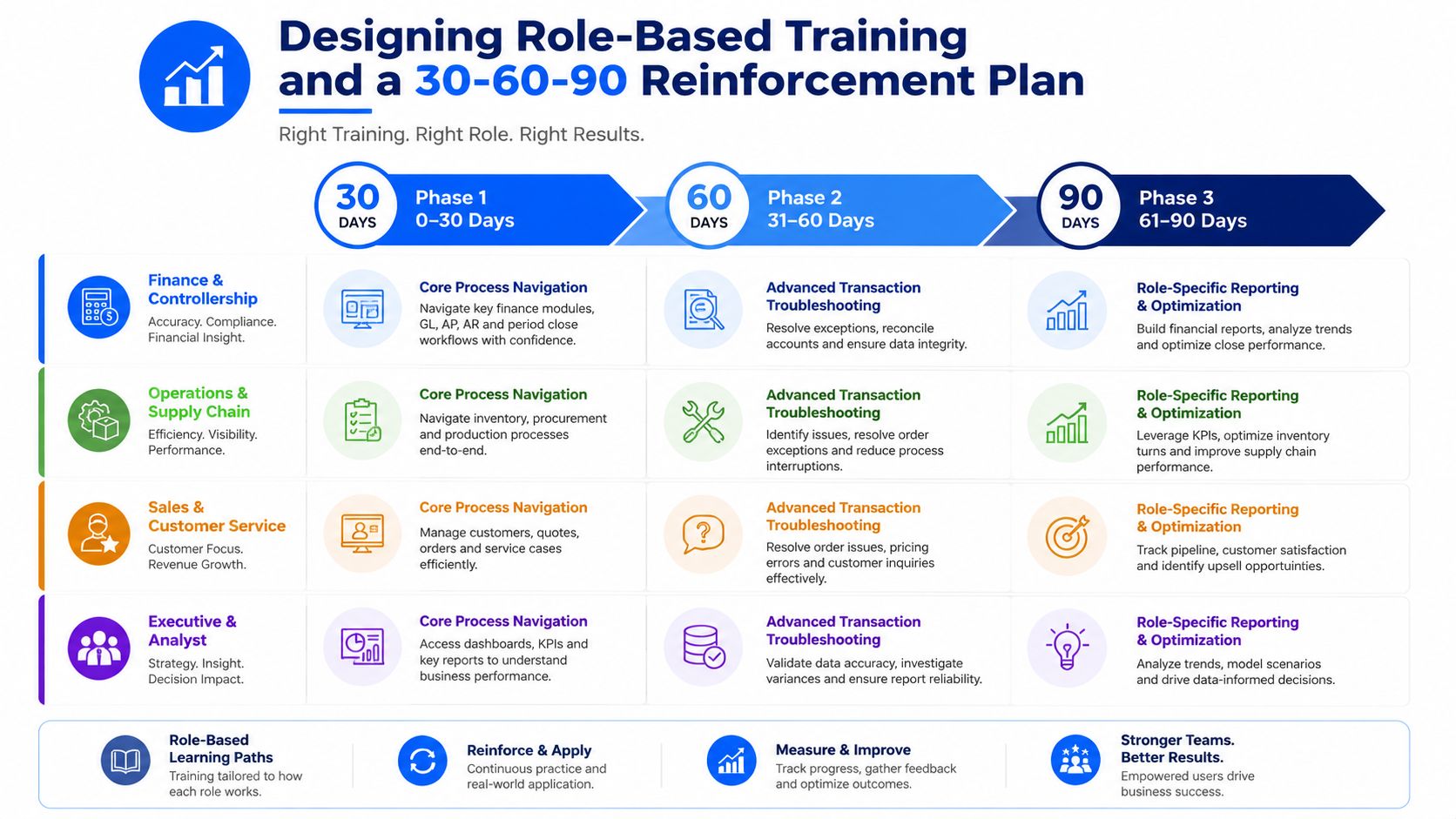
Group users into four cohorts:
- Finance and controllership: Cover chart-of-accounts behavior, intercompany billing, journal preparation and approval, close tasks, and management reporting.
- Operations and supply chain: Practice purchase requests, three-way match, receiving, warehouse transfers, inventory adjustments, and exception resolution.
- Sales and customer service: Use customer records, order-to-cash handoffs, billing triggers, credits, and the information service teams need to answer customer questions.
- Executive and analyst roles: Focus on dashboards, dimensional reporting, drill-downs, variance analysis, and the difference between a useful alert and an ungoverned spreadsheet.
Each cohort should work through realistic scenarios. A multi-entity finance team should practice an intercompany transaction from initiation through approval and elimination or reconciliation. A clinic should test how operational activity reaches finance. A nonprofit should validate fund, grant, and restricted-program reporting from live process data.
Make reinforcement part of the operating model
Use a super-user coaching model in which each functional area has two trained super users. They should hold office hours during weeks one through four, then run weekly floor walks for 90 days. Their job isn't to become an unofficial help desk. It's to identify repeated confusion, coach the correct process, and escalate defects or policy questions.
Days 1 through 30 should prioritize confidence and rapid correction:
- Super users hold daily office hours.
- The steering committee reviews adoption measures weekly.
- Quick-reference job aids are revised based on actual ticket patterns.
- Managers reinforce the required workflow during team meetings.
Days 31 through 60 should move beyond navigation:
- Training covers advanced scenarios and exception handling.
- Targeted refreshers address gaps identified in the dashboard.
- Process owners review whether the configured workflow matches the approved policy.
- Super users document recurring questions that indicate a design or competency problem.
Days 61 through 90 should transfer ownership:
- Process owners take responsibility for ongoing enablement.
- Certification paths are introduced for roles with recurring control or reporting responsibilities.
- Quarterly reinforcement sessions are scheduled.
- The project team reduces its involvement only after the adoption measures support that decision.
Training dollars are accountable when they improve task completion, process adherence, and reporting quality. Seat time alone proves that people attended. It doesn't prove that the organization changed how it works.
Why the Implementation Partner Matters More Than the Software
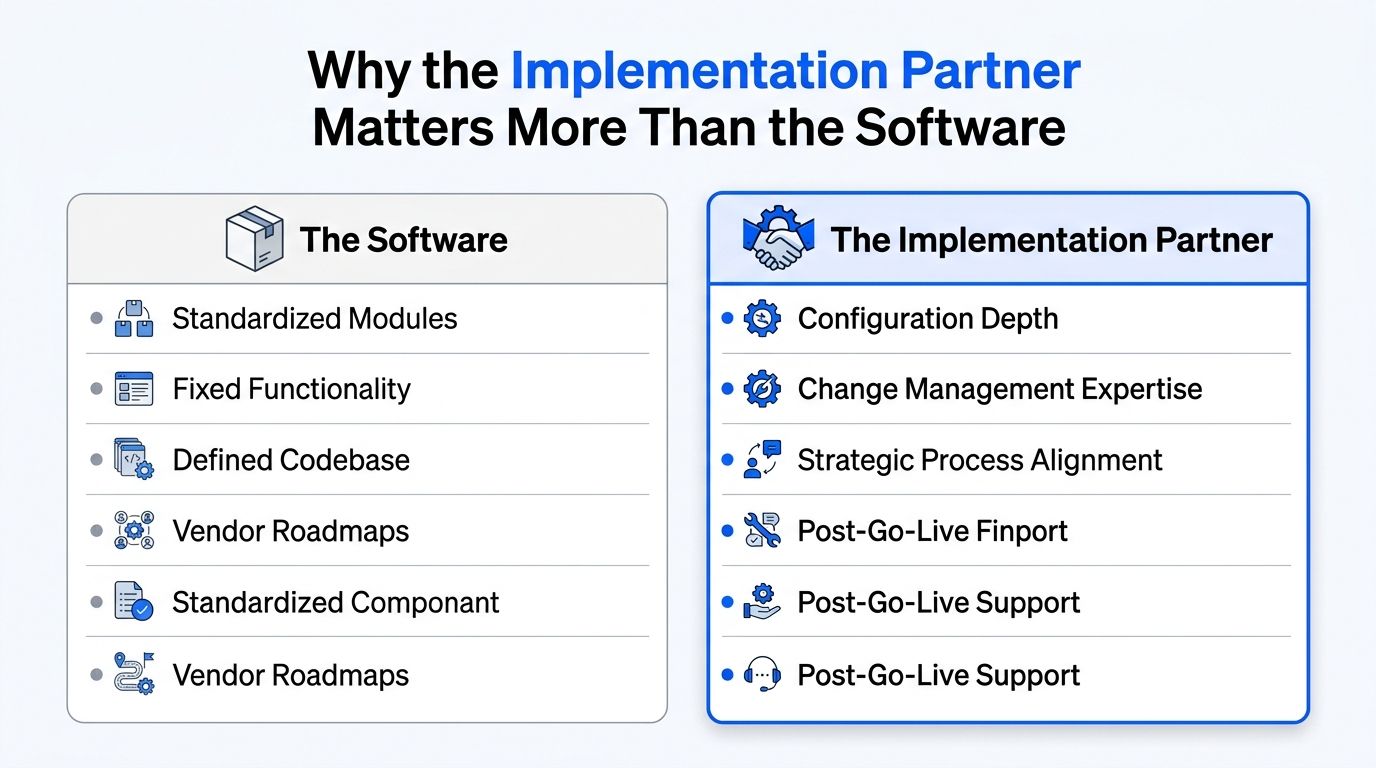
The software is the easier decision. The implementation partner determines whether discovery finds the true problems, configuration reflects the approved process, testing exposes operational risk, and post-go-live support changes behavior.
A software-only purchase can leave the customer running the implementation with back-office employees who already have full workloads. A partner-led program gives the work named accountability through an engagement manager, functional consultants, technical architects, and change specialists. That structure doesn't eliminate risk, but it makes ownership visible when decisions become difficult.
Industry guidance says roughly 75% of ERP implementation failures trace to the wrong implementation team rather than the software itself, as reported in this guide to evaluating an ERP implementation partner. The number matters because partner selection is often treated as a procurement exercise, even though the people assigned to the project shape the operating result.
Evaluate the team that will actually show up
Before signing, ask for:
- The named project manager: Don't accept a promise that the firm will assign someone later.
- Comparable references: Speak with organizations of similar size, entity complexity, and industry demands.
- The written change methodology: Look for stakeholder alignment, adoption measurement, role-based training, and post-go-live reinforcement.
- The reinforcement commitment: Confirm who supports the 30/60/90 plan, how issues are prioritized, and when ownership transfers to the client.
- The scope-control process: Ask who approves a change, how its effect on time and cost is documented, and what happens when business leaders disagree.
A partner guide from Dintec's mid-market SAP implementation recommendations emphasizes written scope-change processes, named decision authority, steering cadence, and a published training plan tied to go-live dates. Those are not administrative extras. They are controls against scope drift and adoption risk.
Lucentive is a Sage Intacct National Premier Partner with experience serving mid-market organizations, healthcare providers, and nonprofits. Its ERP program management approach addresses execution, launch, and the ongoing evaluation of how a business adopts its new system.
The cheapest quote rarely represents the lowest-risk choice. Weak partner performance often becomes visible only after go-live, when the SOW has been signed and the internal team is already carrying the operational burden.
A Practical ERP Change Management Checklist and Next Step
A steering committee should be able to audit change readiness without rereading a project plan. Use this checklist as a working control document and require evidence for every completed item.
- Sponsor charter: Done means the sponsor has approved the business reason, future-state outcomes, communication responsibilities, escalation authority, and scorecard.
- Stakeholder map: Done means every sponsor, committee member, process owner, super user, and end-user group has a named responsibility and participation measure.
- Decision governance: Done means the RACI, decision log, scope-change process, and escalation path are active before configuration begins.
- Communication rhythm: Done means the weekly steering update, biweekly process-owner briefing, super-user huddle, and monthly user communication have owners and sample messages.
- Adoption KPIs: Done means the dashboard measures actual workflow behavior, including close progress, in-system P2P activity, and requisition-to-PO cycle time.
- Super-user coverage: Done means each functional area has two trained super users, scheduled office hours, floor walks, and a clear route for unresolved issues.
- 30/60/90 reinforcement: Done means the team has defined early support, targeted skill reinforcement, ownership transfer, and the continuing training cadence.
- Risk escalation: Done means declining adoption produces a targeted action, an owner, a due date, and a follow-up review rather than general reminders.
- Audit-ready controls: Done means approvals and rejections are retained with the reason for each rejection. That requirement supports cleaner oversight in multi-entity finance, as described in this guidance on financial consolidation audit trails.
For a CFO or Controller, this checklist converts ERP change management from a soft project category into an operating discipline. It also exposes the difference between software alone and a partner accountable for adoption, controls, and time-to-value.
If you're considering Sage Intacct, the right next question isn't which feature list looks longest. It's whether the proposed design fits your entity footprint, reporting needs, team capacity, and ability to reinforce new workflows after launch. A short working session can pressure-test those risks before you commit to a platform, partner, or timeline.
ERP Change Management FAQ
What is ERP change management?
ERP change management is the structured work of helping people adopt new processes, controls, and system behaviors before, during, and after go-live. In practice, that means stakeholder alignment, governance, communication, training, readiness checks, and reinforcement after launch.
Why does ERP change management matter so much after go-live?
Because go-live is only the technical milestone. Business value appears only when teams complete real work inside the ERP instead of reverting to spreadsheets, email approvals, and side processes. Current ERP transformation guidance continues to emphasize sponsorship, manager reinforcement, and post-launch support as major drivers of value realization, including Prosci's ERP transformation guidance.
Who should own ERP change management?
The executive sponsor owns business alignment and visible reinforcement. Process owners own workflow adoption and outcomes. Super users support peer coaching. The steering committee owns cross-functional decisions, escalation, and scope control. Finance ERP governance guidance from Umbrex and SysgenPro supports this layered model.
What are the most important ERP change management activities before go-live?
The highest-value activities usually include stakeholder mapping, sponsor alignment, RACI definition, role-based training design, scenario testing, cutover communication, adoption KPI setup, and hypercare planning. Go-live readiness guidance also stresses signed-off critical scenarios, reconciliations, training completion, and staffed support coverage, as described by SysgenPro.
How do you measure ERP adoption?
Start with behavior, not attendance. Good measures include close cycle time, in-system transaction completion, approval routing compliance, exception rates, support ticket trends, and data quality. Finance implementation checklists and change guidance from CFO Shortlist and Afternoons with ACES both point toward tracking operational usage and outcome measures instead of basic login counts.
What should ERP training include?
ERP training should reflect the user's actual role, decisions, exceptions, and approvals. That means finance users practice close and intercompany scenarios, operations users practice purchasing and inventory workflows, and executives practice dashboard review and exception follow-up. Broad ERP change guidance also supports role-based learning over generic feature demos, including Prosci.
How long should ERP change management continue after launch?
At minimum, most organizations need a structured 30/60/90-day reinforcement period. The first phase focuses on rapid support and confidence, the second on exception handling and workflow correction, and the third on transferring ownership to managers and process owners. The exact timeline varies, but post-go-live reinforcement should continue until adoption metrics stabilize.
What are the biggest ERP change management mistakes?
The most common mistakes are weak sponsorship, unclear ownership, poor manager engagement, one-time training, vague go-live communications, and no adoption measurement after launch. Search patterns and implementation guidance consistently point to these issues as the main reasons users fall back to offline workarounds.
Lucentive helps mid-market finance leaders plan and implement Sage Intacct with practical ERP program management, role-based adoption planning, and post-go-live reinforcement for healthcare, nonprofit, and general business environments. Visit Lucentive to schedule a 30-minute working session with the team and review your timeline, entity structure, and change risk without turning the conversation into a feature pitch.