Your close is late, your consolidated numbers require spreadsheet surgery, and your leadership team is making decisions from financial data that was complete weeks ago. That's the point at which QuickBooks and disconnected tools stop being inexpensive and start becoming expensive operational constraints.
Cloud ERP benefits matter because they change how finance operates. A properly implemented system such as Sage Intacct can give a mid-market company centralized financial data, multi-entity control, real-time reporting, and a cleaner audit trail. The software matters, but the implementation decisions determine whether those capabilities become working processes or another underused system.
Table of Contents
- When It Is Time to Outgrow Your Current System
- Quantifying the Financial Impact and ROI
- Improving Security, Compliance, and Agility
- Streamlining Close Cycles and Multi-Entity Reporting
- Navigating Implementation Challenges Wisely
- Industry-Specific Considerations and Needs
- Choosing the Right Partner for Your Transition
- Summary
- Frequently Asked Questions
- What are the main ERP cloud benefits for a mid-market company?
- When should a company move beyond QuickBooks?
- Does cloud ERP automatically improve efficiency?
- How does cloud ERP support a faster close?
- What should a CFO include in the ERP ROI model?
- Is cloud ERP secure enough for sensitive financial data?
- Why does the implementation partner matter?
When It Is Time to Outgrow Your Current System
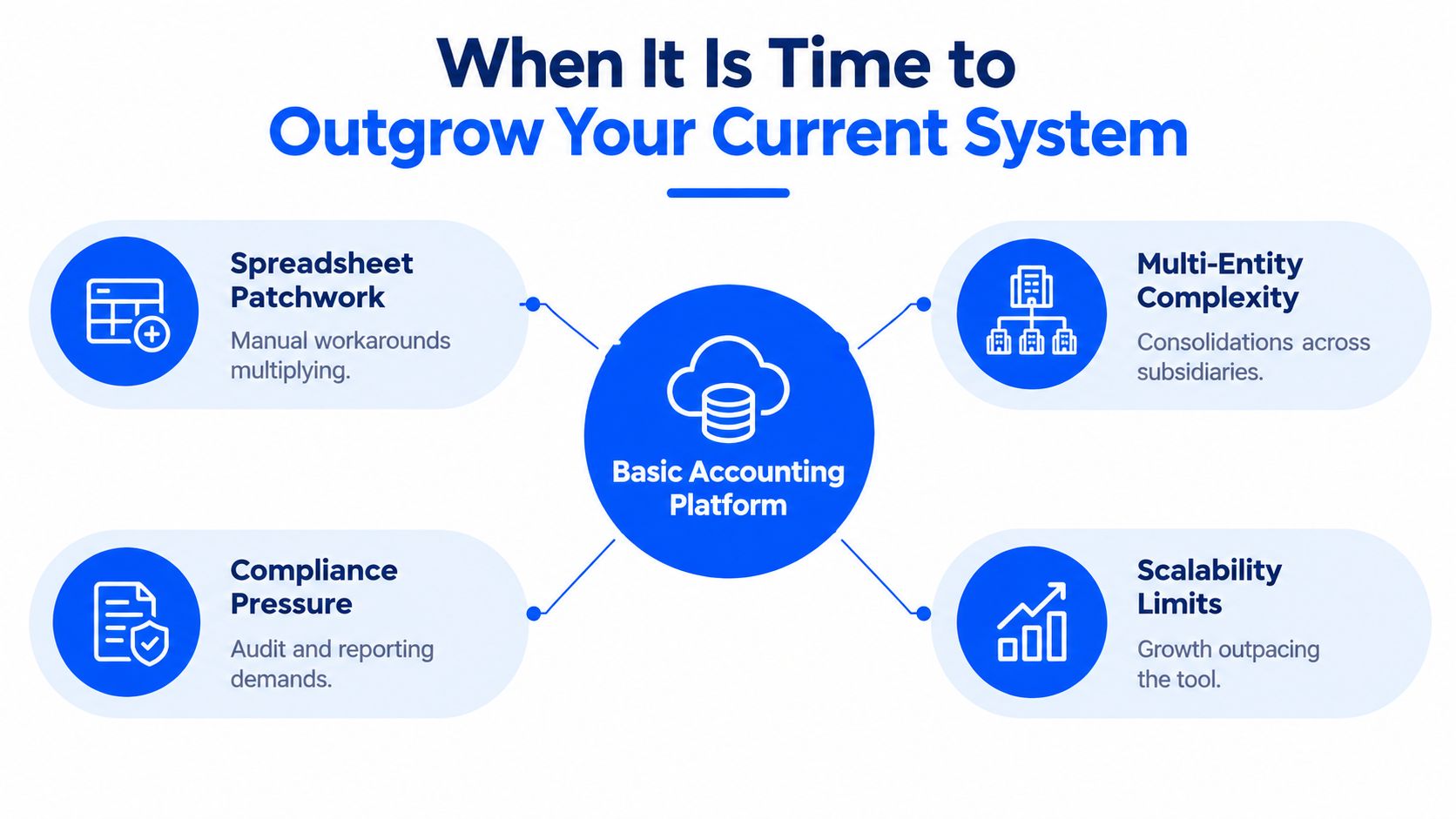
The warning signs usually appear before the software gets replaced. Your Controller asks for reports that require several exports. Someone maintains a consolidation workbook nobody else fully understands. A new location or subsidiary adds another set of accounts, currencies, approvals, and reporting rules. The close stretches, and leadership waits for answers while finance checks whether the numbers agree.
A basic accounting platform can serve a smaller organization well. It becomes a poor foundation when the business adds entities, revenue streams, locations, grant requirements, project accounting, or more demanding controls. QuickBooks Enterprise has a 30-user cap, while Premier supports five concurrent users. QuickBooks Enterprise also has a total limit of 14,500 master records across categories such as employees, customers, vendors, and units of measure, according to RSM's analysis of QuickBooks limitations. Intuit's own comparison materials also outline differences in user access and product fit across QuickBooks tiers on the QuickBooks Desktop product comparison page.
The operational symptoms
Watch for these patterns:
- Spreadsheet patchwork: Finance copies data between reports because the system can't produce the required view directly.
- Multi-entity complexity: Each subsidiary maintains local processes, and consolidation depends on manual intervention.
- Compliance pressure: Auditors request transaction support, approvals, and reconciliations that live in email or separate files.
- Scalability limits: Growth adds users, records, locations, and reporting requirements faster than the accounting platform can absorb them.
The issue isn't just that the current tool lacks features. The deeper problem is that finance can't reliably answer basic executive questions without assembling the answer manually. That weakens forecasting, slows decisions, and makes every new entity more disruptive than it should be. The AICPA's guidance on internal control and financial reporting is a useful reminder that reporting quality depends on process discipline as much as software capability.
What cloud ERP changes
Cloud ERP is hosted on remote infrastructure and accessed through the internet rather than maintained on your own servers. The provider manages the underlying environment, updates, and much of the infrastructure burden. Your team still owns the business decisions, controls, and data governance, but it no longer has to manage routine server maintenance and upgrade logistics.
For a CFO, the important shift is operational. Finance, project activity, and related business information can be organized around a shared system instead of separate local databases and workbooks. Users can access the system remotely, and growing organizations can add structure without rebuilding the accounting foundation each time they expand. For a broader market view, Oracle's cloud ERP overview and Microsoft's ERP guide provide useful definitions and examples of how ERP platforms centralize data across functions.
Read Sage Intacct versus QuickBooks as a practical comparison, then judge the decision against your close process, entity structure, reporting needs, and control environment. The right question isn't whether your current system still opens and posts transactions. It's whether it gives leadership the clarity required to run the company.
Quantifying the Financial Impact and ROI
The financial case for cloud ERP starts with total cost of ownership, not the subscription invoice. On-premise systems carry infrastructure, maintenance, patching, hardware refresh, and upgrade responsibilities. Cloud delivery shifts more of that burden into a recurring operating model, which can make costs easier to plan and reduce dependence on internal technical resources.
An independent synthesis reports 30% to 60% lower TCO over five to ten years, with ROI commonly above 200% and payback in roughly 12 to 18 months, as summarized by Rand Group's cloud ERP cost analysis. A separate analysis in the same source reports 4.01 times higher ROI, 21% lower overall IT spending, and 16% lower IT cost per user compared with on-premise ERP. Broader finance transformation research from Deloitte Insights can also help CFOs frame ERP ROI in terms of process efficiency, control maturity, and decision support rather than software cost alone.
Those figures aren't a reason to approve a project blindly. They're a reason to build a disciplined business case around your own costs.
| Cost Factor | Legacy On-Premise ERP | Modern Cloud ERP |
|---|---|---|
| Infrastructure | Company-owned servers and related maintenance | Provider-managed infrastructure |
| Upgrades | Planned projects with internal coordination | Vendor-managed upgrade cycles |
| IT dependency | Internal resources handle more upkeep and recovery work | Internal teams focus more on governance and business priorities |
| Scaling | Additional infrastructure and configuration may be required | Users, entities, and capabilities can be expanded within the platform |
| Budget profile | Larger periodic capital requirements can appear | More predictable recurring operating expense |
The strongest ROI case usually combines avoided infrastructure costs with finance capacity released from manual work. That may include fewer reconciliation workarounds, less time preparing recurring reports, and faster access to information for forecasting and management review.
A CFO should also test the less comfortable assumptions. Vendor fees, integrations, implementation services, data cleanup, change management, and future module requirements all belong in the model. The CFO's role in digital transformation is to connect the technology decision to cash, risk, operating capacity, and measurable business priorities, not to accept a generic savings claim. For teams building a more formal business case, the Gartner CFO and finance executive resource center is also worth reviewing.
Improving Security, Compliance, and Agility
Keeping financial data on local servers can feel safer because the infrastructure is visible. Visibility, however, isn't the same as resilience. A mid-market company may struggle to match the continuous monitoring, patch discipline, backup practices, and access governance available through a mature cloud environment.
Cloud ERP can improve continuity through managed availability, automated patching, backup, and replication patterns. The practical benefit is fewer single points of failure and a more centralized approach to access and updates. Remote users and multi-location teams can work from the same controlled environment rather than relying on fragmented local systems.
A security evaluation grounded in NIST CSF 2.0 and ISO/IEC 27001:2022 assessed 11 cloud-based and hybrid ERP platforms, showing that cloud ERP environments can be evaluated against formal security controls. The Unit4 technical whitepaper also discusses availability, data accessibility, backup, and disaster recovery considerations. Finance and IT leaders can also review the primary sources for NIST's Cybersecurity Framework 2.0 and the ISO/IEC 27001 information security standard overview when evaluating vendor claims.
Practical rule: Treat security as a control design issue, not a hosting preference. Ask who owns patches, backups, recovery testing, identity governance, and evidence collection.
Agility matters alongside protection. A finance team that can access current data during an outage, support remote users, and apply standardized updates has more operating flexibility than one dependent on a local server and manual recovery steps. That doesn't eliminate risk. It gives the organization a more structured way to manage it.
Streamlining Close Cycles and Multi-Entity Reporting
A slow close usually isn't caused by one bad task. It's caused by handoffs. Each entity sends files, finance checks mappings, intercompany balances are investigated, and someone maintains a separate schedule to explain what remains unresolved. Cloud ERP improves the close by putting those activities into a controlled, connected workflow.
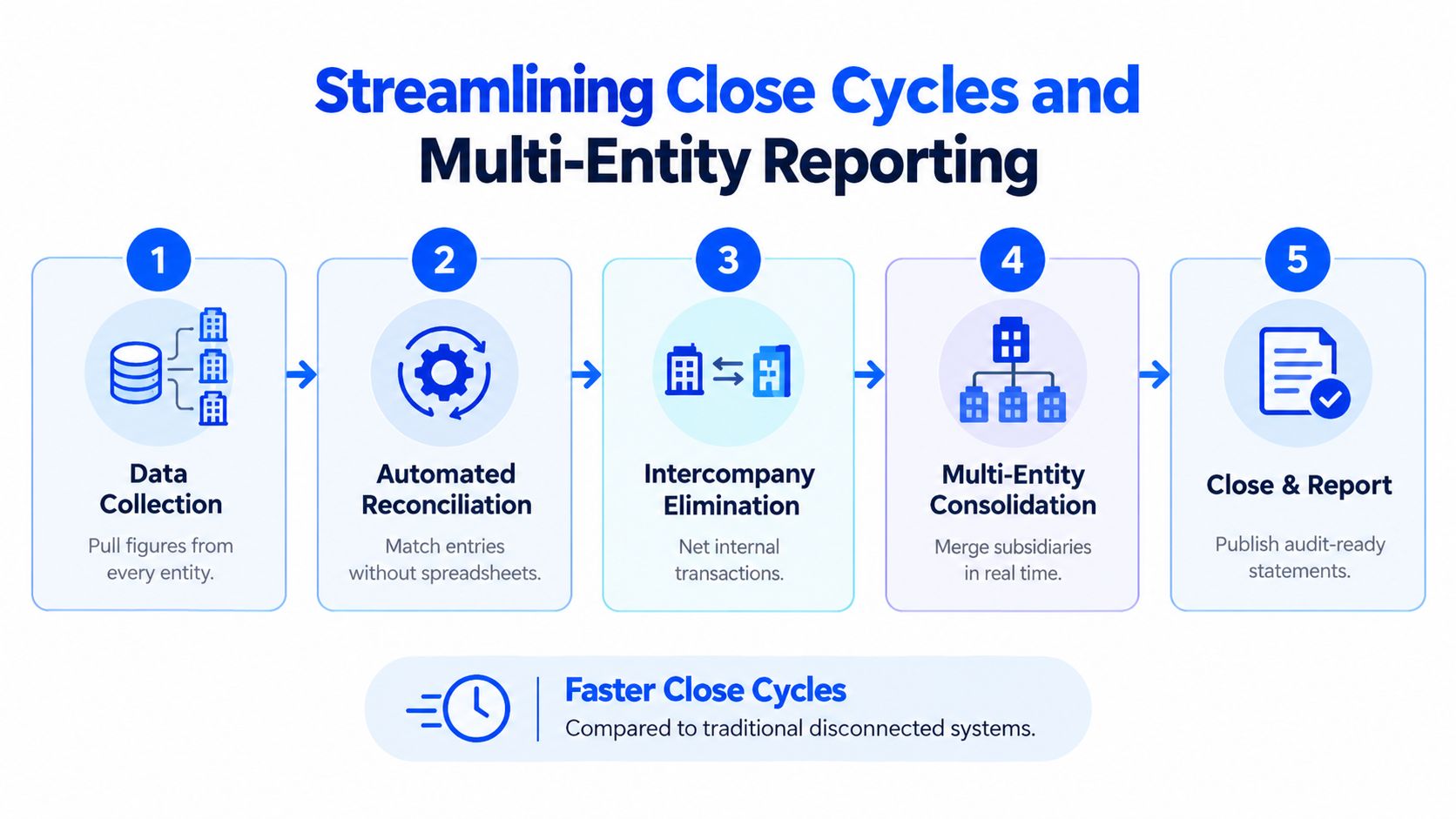
Start with data collection. Each entity should submit figures through the same financial structure, with consistent dimensions and ownership. Next, use automated reconciliation to match entries and identify exceptions rather than asking staff to compare spreadsheets line by line. The Corporate Finance Institute's close process overview is a helpful primer for teams documenting where their current month-end process breaks down.
Five controls that remove close friction
- Collect data from every entity through a consistent structure.
- Reconcile automatically where rules can match transactions and flag exceptions.
- Eliminate intercompany activity so internal transactions don't inflate consolidated results.
- Consolidate subsidiaries with workflows that convert currencies and combine entity data.
- Close and report using statements supported by transaction history, approvals, and reconciliation evidence.
Modern ERP finance modules create audit trails that document transaction histories, approvals, and user actions. Multi-entity workflows can automatically convert currencies and consolidate subsidiary data, helping finance produce consolidated statements and support compliance with international standards, as described in guidance on ERP finance modules. For technical accounting teams, the IFRS consolidation guidance overview from IFRS can also inform how subsidiary reporting and control concepts should be handled.
The close also needs visible ownership. An audit-ready process should show what remains unreconciled, who owns it, and how long it has been open. Each reconciliation and adjustment should carry the preparer, approver, and supporting evidence, so auditors aren't forced to chase email threads and spreadsheets. That operating discipline, supported by a system such as Sage Intacct, is what turns better reporting into better control.
See how multi-entity accounting can support the reporting structure your organization needs.
Navigating Implementation Challenges Wisely
Cloud ERP doesn't fix weak processes automatically. It gives you a platform on which to redesign them. If you migrate poor data, unclear ownership, and inconsistent approval rules without making decisions, you'll reproduce the same problems in a newer interface.
The implementation evidence is clear enough to challenge simplistic ROI promises. In Panorama Consulting's 2026 ERP survey, 77.4% of companies said they achieved the expected benefit of removing silos. That's a strong result, but it also means a meaningful group didn't reach that expectation. The same report indicates that productivity and efficiency were the benefits most often realized to the expected extent, not benefits achieved universally. The findings are summarized in ERP software statistics and survey coverage. Additional implementation perspective from Panorama Consulting's ERP research and reports can help teams benchmark timelines, change management challenges, and adoption risks.
Build the project around operating decisions
- Clean the data before migration: Decide which records, dimensions, vendors, customers, and historical transactions deserve a place in the new system.
- Redesign the close: Define owners, approval paths, reconciliation rules, and exception handling before configuring workflows.
- Make adoption measurable: Give Controllers and staff role-specific training, then monitor whether teams use the intended process.
- Protect the business case: Track the baseline close effort, reporting delays, manual work, and control issues so post-launch reviews have something real to compare.
Sage Intacct can support healthcare, nonprofit, professional services, and growing business workflows, but configuration still requires judgment. Lucentive's 11 phases of ERP implementation provide a useful framework for sequencing discovery, design, data, testing, training, and launch.
The partner matters because implementation is organizational change. Software alone can centralize information. It can't decide which processes to standardize, which exceptions to preserve, or how to make users trust the new workflow.
Industry-Specific Considerations and Needs
A generic chart of accounts won't solve an industry-specific reporting problem. Healthcare organizations may need financial workflows that connect with EMR-related operations. Nonprofits and faith-based organizations need fund accounting and grant reporting that preserve donor and program accountability. Dental practices and DSOs often need finance processes aligned with practice-level activity, shared services, and growth across locations.
The selection criteria should start with the operating model, not a feature checklist.
Healthcare and multi-site clinics
Finance leaders should map how clinical, operational, and financial data moves between systems. Integration with EMR systems can reduce duplicate entry and help finance connect revenue and expense reporting to the organization's actual service structure. The question is whether the ERP can support the required dimensions, approvals, reporting, and integrations without forcing finance to maintain parallel spreadsheets. For healthcare finance teams, HFMA resources can help frame operational and reporting priorities in provider organizations.
Nonprofits and faith-based organizations
Fund accounting and grant tracking are central controls, not optional add-ons. The system should help separate restricted and unrestricted activity, show spending against the appropriate purpose, and produce reports that support board, donor, and grant requirements. Data structure matters as much as the report layout. The National Council of Nonprofits provides practical context on compliance, governance, and financial oversight expectations in the sector.
Dental practices and DSOs
A growing dental organization needs visibility across practices, entities, and shared functions. Finance leaders should test how the ERP handles intercompany activity, location-level reporting, centralized purchasing, and consolidated management views. A system that works for one practice may become difficult to govern as the organization adds entities.
An experienced implementation team earns its role here. The partner should understand the workflows behind the reports, identify integration risks early, and configure Sage Intacct around how your organization operates. Lucentive is a Sage Intacct National Premier Partner with experience serving mid-market organizations, healthcare providers, and nonprofits. That experience is relevant when the project depends on industry-specific dimensions, controls, and reporting rather than generic accounting setup.
Choosing the Right Partner for Your Transition
Buying Sage Intacct is a software decision. Implementing it is a finance transformation decision. The difference shows up in the chart of accounts, entity structure, integrations, approval workflows, reports, migration rules, and user adoption plan.
A capable partner should begin with discovery rather than a product tour. Ask them to document your current close, identify manual workarounds, map intercompany activity, and clarify what leadership expects to see in dashboards. The partner should also explain which requirements belong in standard configuration, which need integration, and which should be redesigned instead of carried forward.
Evaluate the working relationship
Look for evidence of practical judgment in four areas:
- Industry understanding: Can the team discuss fund accounting, EMR integration, project accounting, or multi-site controls in operational terms?
- Implementation discipline: Do they use a defined sequence for discovery, design, data, testing, training, and launch?
- Financial focus: Can they connect configuration choices to close effort, reporting reliability, audit support, and risk?
- Post-launch ownership: Will they help your team stabilize processes after go-live rather than treating launch as the finish line?
The software can centralize finance, support multi-entity consolidation, and produce stronger audit evidence. The partner determines whether those capabilities match your policies and people. That's why you should compare Sage Intacct reseller and implementation support, not just license pricing. Independent partner evaluation frameworks from firms like G2 can also help buyers compare software ecosystems and market feedback.
Lucentive brings advisory and implementation support to Sage Intacct projects for growing organizations. A good first conversation should test fit, surface risks, and clarify the operating outcomes you need before anyone pushes you toward a purchase.
Summary
Cloud ERP gives mid-market finance teams a stronger foundation when basic accounting tools create spreadsheet workarounds, slow closes, weak visibility, or multi-entity complexity. The model can reduce infrastructure responsibility, support centralized controls, improve audit trails, and simplify subsidiary consolidation. The financial case should include total cost of ownership, implementation effort, data quality, adoption, and long-term operating costs. Sage Intacct can support healthcare, nonprofit, dental, professional services, and general business requirements, but software alone won't deliver the result. The right implementation partner connects configuration to your processes, controls, and leadership priorities.
Frequently Asked Questions
What are the main ERP cloud benefits for a mid-market company?
The main benefits are centralized financial data, easier multi-entity reporting, stronger audit trails, remote accessibility, managed updates, and less dependence on local infrastructure. Cloud ERP can also support scaling across locations and entities. The value comes from better operating control, not from moving software to a different hosting environment. Finance leaders should connect each benefit to a measurable business problem such as close delays, manual consolidation, or unreliable management reporting.
When should a company move beyond QuickBooks?
Move when the business has outgrown its users, records, entities, reporting needs, or controls. QuickBooks Enterprise has a 30-user cap and a 14,500 master-record limit, while Premier supports five concurrent users. Spreadsheet-based consolidations, slow closes, manual reconciliations, and audit requests that depend on email are also strong signals that the accounting platform is no longer a suitable foundation.
Does cloud ERP automatically improve efficiency?
No. Cloud ERP can improve visibility and cross-functional alignment, but efficiency depends on clean data, redesigned processes, and disciplined adoption. Panorama Consulting's 2026 survey found that 77.4% of companies achieved the expected benefit of removing silos, which also shows that not every organization realizes every expected gain. The implementation must address ownership, workflows, training, and exceptions.
How does cloud ERP support a faster close?
It can centralize data collection, automate reconciliation rules, manage intercompany eliminations, convert currencies, and consolidate subsidiary data. It can also preserve transaction histories, approvals, and user actions in an audit trail. A stronger close process shows unreconciled items, owners, aging, preparers, approvers, and supporting evidence. Those controls reduce the manual investigation that commonly extends month-end reporting.
What should a CFO include in the ERP ROI model?
Include subscription and implementation costs, data cleanup, integrations, training, change management, and ongoing operating expenses. Also model the current cost of infrastructure, upgrades, manual reconciliations, reporting preparation, audit support, and delayed decisions. Independent analyses report 30% to 60% lower TCO over five to ten years and commonly above 200% ROI, but your approval should rely on an organization-specific baseline and clear assumptions.
Is cloud ERP secure enough for sensitive financial data?
Security depends on the platform's controls, configuration, governance, and user behavior. Cloud ERP can provide managed availability, automated patching, backup, replication, and centralized access governance. A security evaluation grounded in NIST CSF 2.0 and ISO/IEC 27001:2022 assessed 11 cloud-based and hybrid ERP platforms. Buyers should ask how the provider handles access, recovery, monitoring, updates, and evidence.
Why does the implementation partner matter?
The partner translates your operating model into system configuration. That includes entity structure, dimensions, approvals, integrations, migration rules, reports, testing, and training. Software alone won't clean your data or decide which spreadsheet workarounds should disappear. A partner with mid-market, healthcare, and nonprofit experience can identify industry-specific requirements and help connect Sage Intacct to the financial and operational outcomes executives expect.
Lucentive offers advisory, implementation, and Sage Intacct support tailored to mid-market organizations evaluating cloud ERP benefits. Schedule a 30-minute working session or a demo built around your needs through Lucentive to test the fit for your entities, close process, reporting needs, and industry.