A treasurer at a growing church can watch a missions deposit, a building pledge, payroll, utilities, and a youth retreat all move through the same checking account. The bank balance looks healthy, but nobody can answer how much is available for operations without rebuilding the answer in a spreadsheet.
That's the operating problem fund accounting for churches solves. It treats every dollar as money with a purpose, records that purpose when the gift arrives, and gives pastors, treasurers, and boards a usable view of what they can spend. A modern cloud ERP such as Sage Intacct can support that discipline, but software alone won't fix an unclear chart of accounts or weak approvals. The implementation partner matters just as much as the platform.
Table of Contents
- Why Church Accounting Breaks Down Without Funds
- The Core Principles of Fund Accounting
- Restricted, Unrestricted, and Designated Funds Explained
- Designing a Chart of Accounts That Fits a Church
- Daily Controls That Protect Restricted Dollars
- Choosing Fund Accounting Software the Right Way
- Your 90-Day Implementation Checklist
- Summary
- Frequently Asked Questions
- How should a church report restricted funds to donors?
- What do auditors look for first in church books?
- Can a church use one bank account for multiple funds?
- How is a board-designated fund different from a donor-restricted fund?
- What should a church include in its chart of accounts?
- How should a church evaluate fund accounting software?
Why Church Accounting Breaks Down Without Funds
Generic small-business accounting assumes that management mainly needs to understand revenue, expenses, cash, and profitability. Churches have a different accountability problem. A single bank account may hold operating offerings, building gifts, missions support, and benevolence money, yet those balances don't have the same spending permissions. For a broader overview of nonprofit financial accountability, the National Council of Nonprofits offers useful governance and reporting resources.
Without fund-level records, the finance team starts reconstructing history after the fact. A donor asks what happened to a building gift, and the answer depends on exported transactions, spreadsheet tabs, email messages, and someone's memory of how the deposit was coded. That isn't a control system. It's an investigation.
The risk also reaches the pastor and board. Total cash can create false confidence when much of that cash is reserved for a defined purpose. Leaders may approve an operating commitment based on money that isn't available for general ministry, then discover the shortfall during reconciliation.
Practical rule: A fund assignment must happen when the gift is received, not when someone prepares the monthly report.
The cost of treating dollars as interchangeable
Quiet commingling usually starts with a reasonable shortcut. A volunteer posts all deposits to one revenue account. A bookkeeper uses a general expense account because the invoice doesn't identify the ministry. A transfer covers a short-term gap, but nobody documents which fund provided the cash or when it will be restored.
Each shortcut weakens the audit trail. It also makes donor communication harder because the church can't quickly connect a contribution to the related activity. Guidance on church accounting basics and donor restrictions emphasizes that gifts should be recorded according to donor intent and tracked separately from receipt through expenditure. Churches reviewing internal controls may also find the ECFA standards and resources helpful when shaping stewardship and accountability practices.
Fund accounting is a spending control
The strongest churches don't treat fund accounting as a report prepared after money leaves the account. They use it to challenge a proposed payment before approval. If a building invoice is coded to the operating fund, the error should be visible before the check or ACH is released.
That changes board meetings, too. Instead of debating whether a total checking balance is “enough,” leaders can review unrestricted availability, restricted commitments, current activity, and remaining balances by purpose. The system turns stewardship from a retrospective explanation into a daily operating discipline. For churches refining finance committee oversight, BoardSource also provides nonprofit board governance resources.
The Core Principles of Fund Accounting
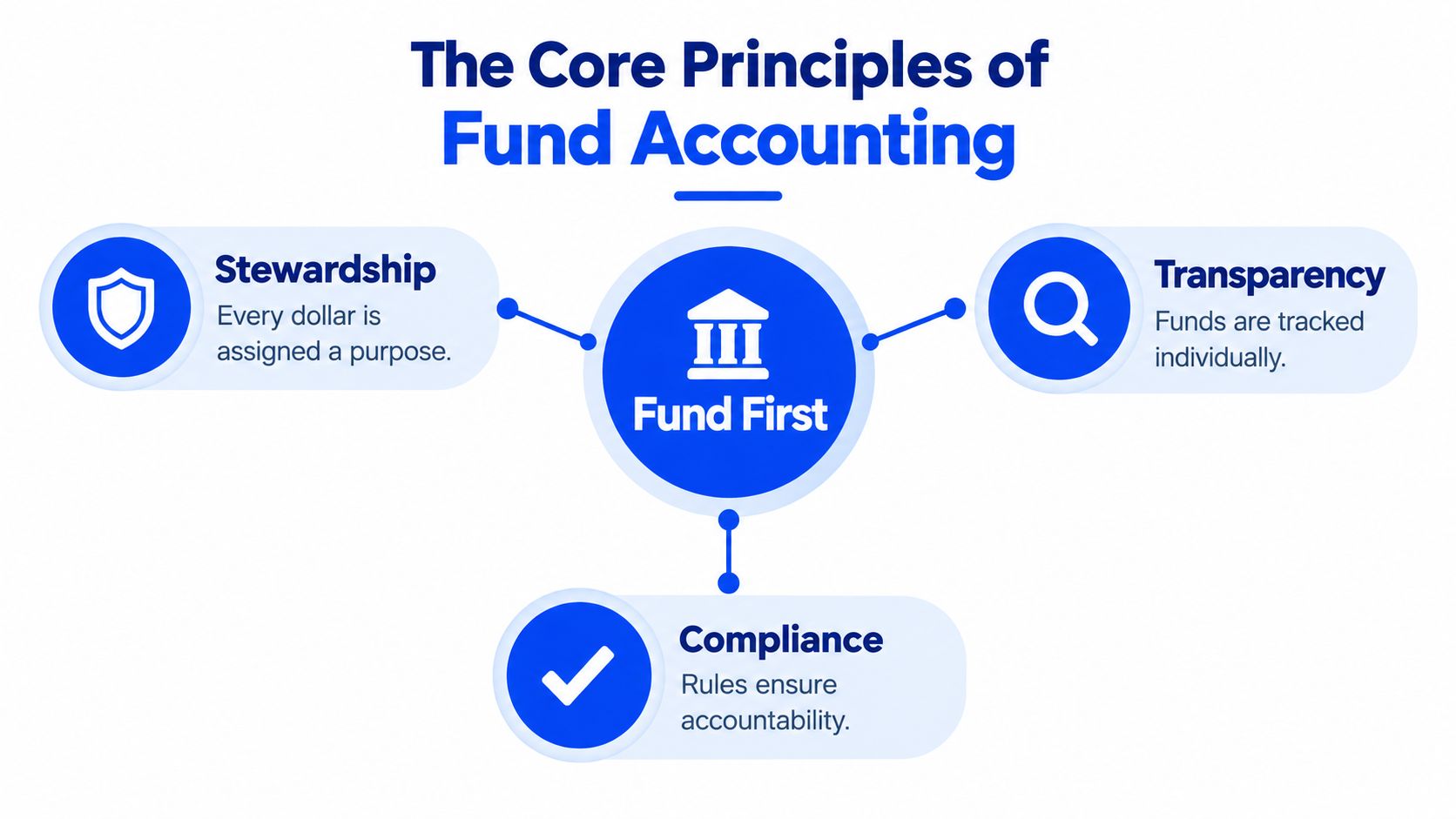
Think of church funds as labeled envelopes inside one larger checking account. The cash may sit together at the bank, but each envelope has a purpose, a balance, and rules for use. The accounting system creates the separation in the records and should preserve it through deposits, expenses, transfers, and reporting.
Assign purpose before spending
Every gift needs a fund assignment at receipt. If the donor gives to missions, the contribution belongs in the missions fund. If the gift has no donor restriction, it can enter the unrestricted operating fund. The key decision happens before anyone spends the money.
A fund also needs its own beginning balance, inflows, outflows, and ending balance. Transfers between funds must be recorded as transfers, not hidden through a broad journal entry or an unexplained sweep. The Episcopal Church's business methods manual emphasizes fund-level reconciliation, coverage of restricted and property funds, and segregation of duties. Additional practical controls are also covered in the Church Law & Tax finance guidance library.
Let restrictions follow the dollar
A donor restriction doesn't disappear because the calendar changes, the treasurer leaves, or the church migrates software. The original purpose must remain visible until the related spending occurs and the restriction is released under the applicable reporting process.
That requires a chart of accounts and transaction workflow that carry both the natural account and the fund. A youth expense should identify the expense type and the fund supporting it. Leadership then sees the organization-wide result while retaining the ability to drill into the source fund.
Under nonprofit GAAP, ASC 958 uses two net-asset classes, net assets without donor restrictions and net assets with donor restrictions. The distinction is not optional for churches reporting under that framework, as explained in this nonprofit accounting standards overview. Churches that want primary source material can also review the FASB accounting standards updates page.
Report fund-first, organization-second
A board needs consolidated information, but consolidation shouldn't erase the underlying funds. The right design lets leadership view total activity, then inspect the building campaign, missions, benevolence, or operating fund behind the total.
That structure supports accountability and decision-making at the same time. It tells leaders what the church did financially and what each purpose can support next. Churches benchmarking presentation and disclosure practices may also consult the AICPA nonprofit resources.
Restricted, Unrestricted, and Designated Funds Explained
The most important distinction is who created the limitation. Donor-restricted funds carry the donor's stated purpose. Unrestricted funds give leadership broader discretion within approved ministry and operating decisions. Board-designated funds reflect internal management intent rather than a donor-imposed restriction.
That difference affects approvals, reporting, and year-end review. A board can generally change an internal designation through a formal decision, while a donor restriction must be honored according to the gift terms. Calling every internal reserve “restricted” creates confusion in both management reporting and external financial statements.
Three categories in practice
An unrestricted general offering can support salaries, utilities, administration, or routine ministry expenses. A donor's building campaign gift belongs in a building fund, and a gift for rent assistance belongs in benevolence. A board-designated technology reserve may be tracked separately for visibility, but its status differs from a donor-restricted contribution.
The safest approach is to document each fund's purpose, source, approval authority, and release conditions. Don't let informal labels such as “designated” or “special fund” replace a clear policy. Churches working through gift acceptance and donor intent issues can reference the Council for Nonprofit Excellence resources for broader nonprofit policy ideas.
| Fund Type | Who Controls the Use | Can the Board Redirect? | Example |
|---|---|---|---|
| Unrestricted | Church leadership within approved policies and budgets | Generally yes | General operating offerings |
| Donor-restricted | The donor's communicated purpose governs use | Not simply by board preference | Building campaign or benevolence gift |
| Board-designated | The board or leadership sets the internal purpose | Generally, through formal board action | Technology reserve or future pastoral search reserve |
A building gift spent on payroll is not made acceptable because payroll is important. The transaction must follow the gift's purpose, and the accounting records need to show the related fund activity and release. For a deeper discussion of fund accounting for nonprofit organizations, focus on the distinction between donor restrictions and internal designations before configuring the system.
Use fund balances to guide decisions
A bank balance answers how much cash is in the account. A fund report answers which portion belongs to each purpose. That second answer is what the pastor, treasurer, and board need before approving a new commitment.
The external reporting model has also evolved. FASB issued FAS 116 and FAS 117 in 1993, and ASU 2016-14 became effective for fiscal years beginning after December 15, 2017, reducing the older three-class net-asset presentation to two classes, as described in this FASB fund accounting guidance. Many churches still use internal funds while presenting external reports using the modern net-asset structure. For more context on implementing ASU 2016-14, see the National Council of Nonprofits overview of nonprofit financial reporting changes.
Designing a Chart of Accounts That Fits a Church
The chart of accounts is the load-bearing structure of fund accounting. If it's too broad, reports hide the ministry story. If it's too fragmented, volunteers miscode transactions and the close becomes a cleanup exercise.
Start with a consistent account architecture. A church might use account families for assets, liabilities, net assets, revenue, and expenses, then add a separate fund or dimension segment to identify purpose. The exact numbering convention matters less than consistent use and clear documentation. For general accounting structure ideas, the IRS Tax Exempt Organization resources can help churches understand recordkeeping expectations.
Build around how the church operates
Create natural account families that reflect real decisions:
- Ministry compensation: Pastoral, worship, children's, youth, and administrative salaries.
- Facilities: Utilities, repairs, maintenance, insurance, and property costs.
- Outreach and missions: Local outreach, missionary support, and trip expenses.
- Benevolence: Assistance payments and related program costs.
- Capital and debt: Building improvements, equipment, loan payments, and capital project costs.
Keep account names understandable to the people posting transactions. Retire obsolete accounts instead of allowing them to remain available indefinitely. Resist unnecessary sub-account layers. A smaller, disciplined structure is more reliable than a complex one nobody follows.
Design for growth before it arrives
Multi-site churches should establish intercompany and due-to/due-from accounts early. The same principle applies to shared costs. Decide how the church will allocate facility, administrative, or insurance costs before the need becomes urgent.
A fund should identify purpose. A department or location should identify organizational responsibility. A project tag may identify a temporary initiative. Those dimensions shouldn't be confused, or the chart will multiply every time a ministry launches an event.
| Range | Account Family | Examples |
|---|---|---|
| 1000s | Assets | Cash, receivables, equipment, property |
| 2000s | Liabilities | Payables, loans, accrued obligations |
| 3000s | Net assets | Net assets with or without donor restrictions |
| 4000s | Revenue | General giving, building gifts, missions gifts |
| 5000s | Expenses | Compensation, facilities, ministry, benevolence |
This nonprofit chart of accounts guide is useful when testing whether account families support fund reporting without creating unnecessary complexity. The final design should answer a board question without requiring a spreadsheet reconstruction. Churches planning for complex entity structures may also review Clergy Financial Resources on church accounting practices.
Daily Controls That Protect Restricted Dollars
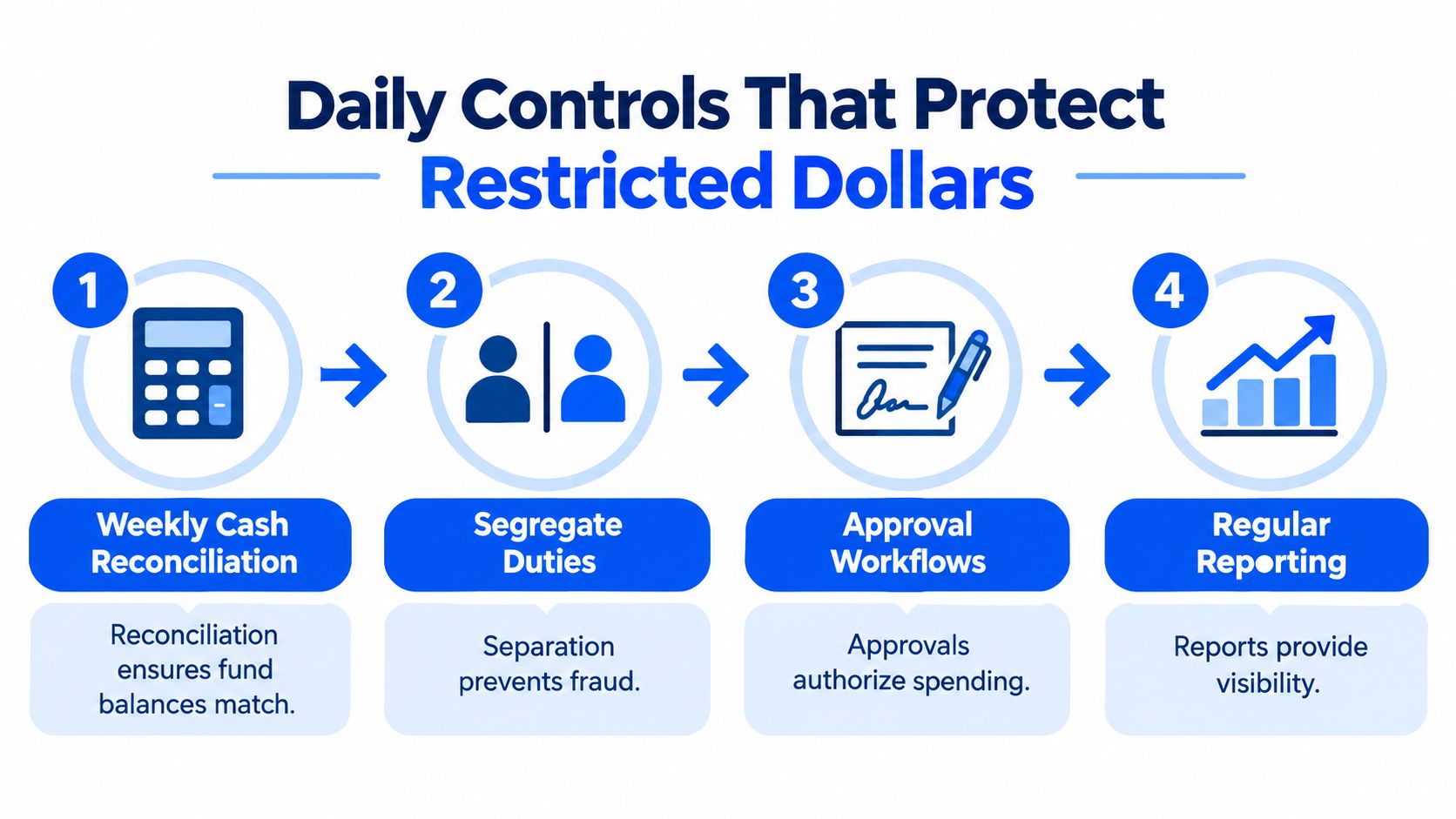
Fund accounting fails when the books are accurate only after month-end. Controls must operate at the point of receipt, approval, payment, and reconciliation. The finance leader's job is to make the correct action easier than the incorrect one.
Begin with the offering process. The people who count cash shouldn't be the only people who prepare the deposit, post the contribution, and reconcile the bank activity. Smaller churches may use volunteers, but they still need separate roles and documented review. For practical fraud prevention and controls, the Association of Certified Fraud Examiners provides relevant guidance on internal control design.
Put approvals in front of payment
Accounts payable should require the expense account and fund code at entry. An invoice for a missions trip shouldn't reach payment approval with only a vendor name and total amount. Reviewers need to know which purpose is funding it and whether that fund has enough available balance.
Use approval thresholds that fit the church's policy, with additional approval for larger or unusual purchases. Purchase order discipline can help finance teams connect authorization, receiving, and payment. The purchase order system guidance offers a useful framework for preventing unsupported spending. Churches formalizing disbursement controls may also find Church Law & Tax guidance on internal controls useful.
Reconcile by fund, not just by bank
A bank reconciliation confirms the cash account. A fund reconciliation confirms that the accounting records still preserve each purpose. Review restricted, designated, operating, property, and endowment activity against the general ledger and supporting schedules.
Use a dashboard that shows each campaign's opening balance, contributions, spending, transfers, and remaining balance. The dashboard should serve the board and the finance team, not replace source documentation.
Control that matters: If a payment can be approved without a fund code, the process still allows cross-fund spending.
Monthly bank and credit card reconciliations should be completed promptly after close. Review unusual journal entries, unresolved receipts, uncleared transfers, and negative or unexpectedly depleted fund balances. These checks catch errors while the people involved still remember the transaction. For broader month-end control checklists, nonprofit finance teams often consult the AICPA not-for-profit resources.
Choosing Fund Accounting Software the Right Way
The right question isn't “Which platform has the longest feature list?” It's “Can our team enforce fund rules every day and produce credible reports without manual reconstruction?”
A church has likely outgrown spreadsheets or entry-level accounting when the close consumes too much staff time, restricted balances can't be trusted, or a board question requires a custom workbook. QuickBooks Online can work for a small church with disciplined tagging and manual controls, but workarounds become fragile as funds, ministries, sites, and reporting demands multiply. Teams comparing accounting workflows may also want to review TechSoup's nonprofit technology resources.
Compare the operating fit
Sage Intacct, Aplos, Shelby, and ACS may suit different church environments. Evaluate native fund or dimension tracking, contribution and pledge workflows, giving-platform integration, role-based permissions, approval controls, bank reconciliation, and fund-level dashboards. For multi-site churches, ask how the platform handles intercompany activity and real-time consolidation.
| Platform | Best Fit | Fund Tracking | Typical Cost |
|---|---|---|---|
| Sage Intacct | Growing or multi-site churches needing cloud ERP controls | Dimensions, fund reporting, consolidation workflows | Varies by configuration and implementation scope |
| Aplos | Churches seeking purpose-built nonprofit and giving workflows | Fund and contribution tracking | Varies by plan and services |
| Shelby | Churches needing church administration and accounting workflows | Church-oriented fund structures | Varies by configuration |
| ACS | Churches combining ministry administration with financial processes | Fund and contribution tracking | Varies by configuration |
| QuickBooks Online | Smaller churches with simpler operations and disciplined processes | Classes, tags, and manual reporting | Varies by plan and setup |
These are fit categories, not rankings. A church fund accounting software comparison should be the start of a requirements review, not a substitute for one. Churches gathering product requirements can also use the NTEN nonprofit technology planning resources to structure evaluation criteria.
Buy implementation judgment, not just licenses
Software won't decide whether a board reserve is donor-restricted. It won't clean an inconsistent chart of accounts by itself. It won't determine how to migrate an old fund balance or train offering counters to capture donor intent correctly.
That's why the partner relationship matters. Lucentive is a Sage Intacct National Premier Partner with experience across mid-market, healthcare, and nonprofit organizations. Its Sage Intacct work includes fund accounting and real-time reporting for multiple funds, grants, and donors.
For a church, the evaluation should focus on time-to-value, risk reduction, reporting quality, and adoption. Ask the implementation team to show how a restricted gift enters the system, how an expense is approved against the fund, how a transfer is documented, and how the board sees the result. Churches that want additional governance benchmarks can also review resources from the National Council of Nonprofits, ECFA, and the FASB accounting standards updates page.
Your 90-Day Implementation Checklist
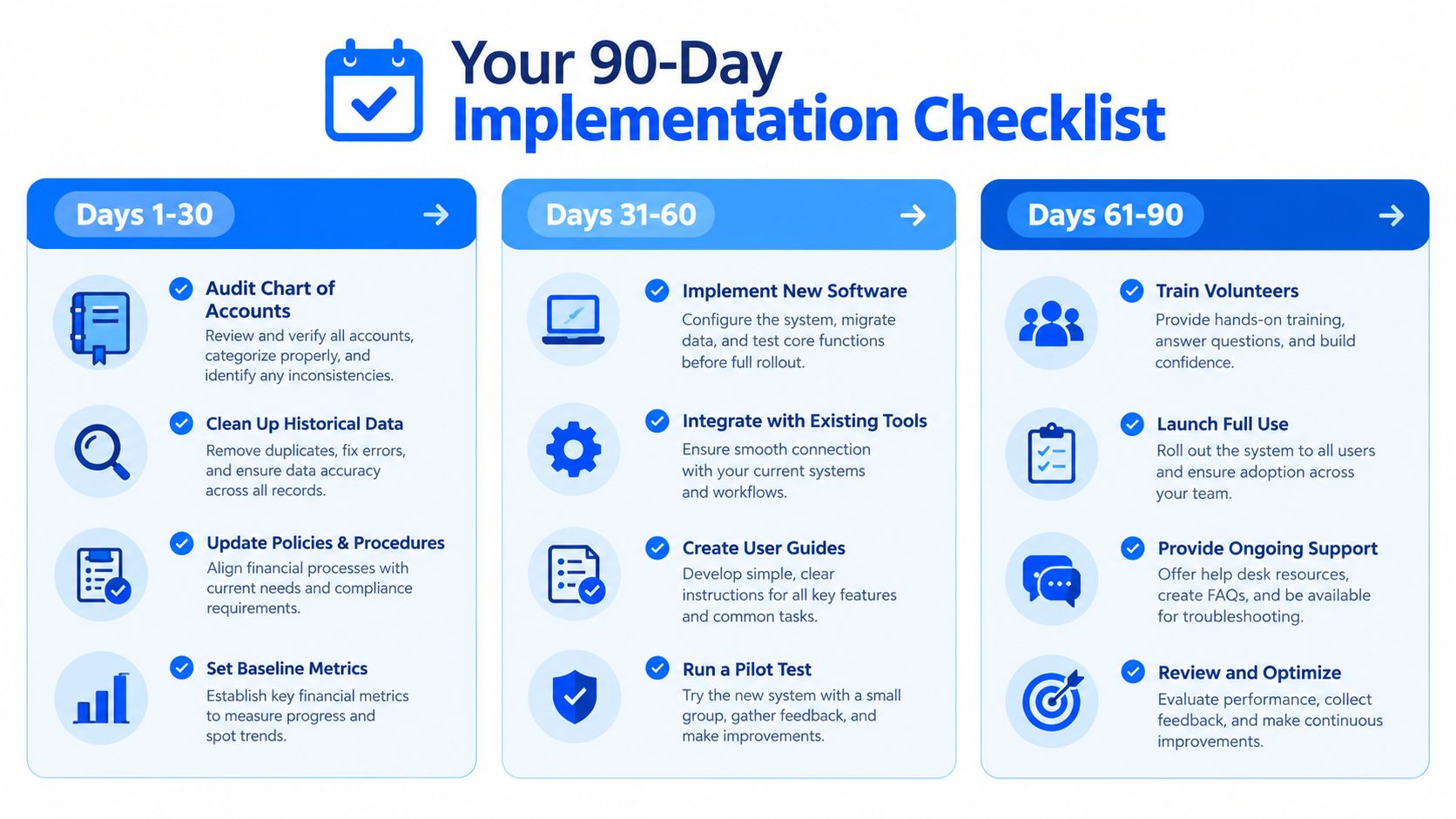
A fund accounting reset needs named deliverables, not a vague promise to “clean up the books.” The following sequence gives a treasurer, Controller, or finance chair a practical operating plan for a quarter.
Days 1 through 30
Start with discovery, not configuration. Review the current chart of accounts, bank accounts, donor records, contribution reports, open pledges, grants, and fund schedules.
Deliver these outputs:
- Reconciliation memo: Document differences between bank activity, the general ledger, donor records, and existing fund schedules.
- Fund register: List every active, inactive, restricted, and board-designated fund, including purpose and approval authority.
- Reporting gap list: Record the questions leadership can't answer quickly today.
- Control map: Identify who counts, deposits, posts, approves, pays, and reconciles.
FASB's nonprofit reporting model uses two net-asset classes, but internal fund tracking still needs enough detail to preserve donor purpose and management visibility. That distinction should guide the cleanup rather than forcing every internal reporting need into a single equity line. For preparation ideas, the National Council of Nonprofits audit resources can help frame documentation expectations.
Days 31 through 60
Redesign the chart of accounts and fund structure. Keep account families natural and fund segments purposeful. Document each fund's name, source, permitted spending, transfer rules, and release approach.
Then map every active pledge, gift, grant, and campaign balance to the correct fund. Produce a mapped donation report that ties donor communication to the accounting structure. If the mapping can't be explained to a board member, it isn't ready.
This is also the right time to approve policies for new funds, board designations, transfers, disbursement approvals, receipts, and monthly reconciliation. Written policies reduce dependence on one treasurer or bookkeeper. Churches drafting these policies may find Blue Avocado's nonprofit policy resources useful for examples and governance language.
Days 61 through 90
Configure the selected system, migrate historical data, and validate opening balances. Run parallel reports for a month so the old and new structures can be compared before the final cutover.
Train staff, volunteers, counters, approvers, and board reviewers on the parts they use. Demonstrate how a donation is assigned, how an invoice receives a fund code, how a transfer appears, and how a dashboard answers fund-balance questions.
Finish with a board dashboard sample and a signed go-live checklist. A nonprofit-experienced implementation team can help pressure-test the design before launch. Review Sage Intacct implementation services with that specific objective, not just to configure software. For project rollout discipline, the Project Management Institute offers general implementation planning frameworks that many finance teams adapt.
Summary
Fund accounting for churches is an active control discipline, not a report prepared after spending occurs. Assign each gift to its purpose at receipt, maintain fund-level balances, distinguish donor restrictions from board designations, and use a chart of accounts that supports natural accounts, funds, departments, and locations. Reconciliation, segregation of duties, approvals, and dashboards protect restricted dollars in daily operations. For churches that want to benchmark controls against broader nonprofit guidance, resources from the National Council of Nonprofits, ECFA, and the FASB accounting standards updates page can help frame policy and reporting decisions. A cloud platform such as Sage Intacct can improve visibility, but the chart design, policies, migration, training, and implementation partner determine whether the system works in practice.
Frequently Asked Questions
How should a church report restricted funds to donors?
A church should provide clear fund-level information tied to the donor's stated purpose and the related activity. Reports should show contributions, spending, and remaining balances without exposing unnecessary private details or promising commitments beyond the documented fund purpose. The accounting records should preserve the restriction from receipt through expenditure and reflect the appropriate release when spending occurs.
What do auditors look for first in church books?
Auditors will care about whether the records support donor restrictions, fund balances, bank activity, approvals, and the audit trail. They'll also examine whether custody, recording, approval, and reconciliation are separated appropriately. Restricted, endowment, property, and operating funds should be included in the reconciliation and review process, even when the cash sits in one bank account.
Can a church use one bank account for multiple funds?
Yes. Physical bank separation isn't required for internal fund tracking. The accounting records must still show each fund's beginning balance, inflows, outflows, transfers, and ending balance. Bank reconciliation confirms total cash, while fund-level reconciliation confirms that the cash is attributed to the correct purposes and that restricted balances haven't been used to subsidize operations.
How is a board-designated fund different from a donor-restricted fund?
A donor-restricted fund exists because the donor communicated a specific purpose. A board-designated fund exists because church leadership voluntarily set money aside for management purposes. The board generally has authority to change its own designation through formal action, while it cannot redirect a donor-restricted gift because another ministry need has emerged.
What should a church include in its chart of accounts?
The chart should include clear account families for assets, liabilities, net assets, revenue, and expenses, alongside a fund segment that identifies purpose. Common expense families include compensation, facilities, missions, benevolence, children's ministry, and debt service. Keep naming consistent, retire obsolete accounts, and establish intercompany or due-to/due-from accounts if the church operates across sites.
How should a church evaluate fund accounting software?
Evaluate whether the platform supports native fund or dimension tracking, contribution and pledge workflows, giving integration, approval controls, role permissions, reconciliations, dashboards, and multi-site activity. Then evaluate the implementation partner. The partner should be able to explain migration, fund design, training, reporting, and control workflows, because software alone won't resolve unclear policies or unreliable source data.
Lucentive helps churches assess fund structures, redesign charts of accounts, and implement Sage Intacct for clearer fund-level reporting and operating control. Schedule a 30-minute working session or a Sage Intacct demo with the team through Lucentive to pressure-test your approach before you buy software or choose an implementation partner.