You're reviewing the final close package when a grant schedule stops tying to the general ledger. The correction balances, but it moved the expense into operations and left the restricted fund untouched. Your team now has to rebuild the allocation, explain the variance, and reconsider whether the board's cash report shows money it can spend.
For finance leaders who've outgrown QuickBooks, a Sage Intacct implementation needs to prove its value here: fewer corrections at close, visibility by fund, and an approval trail that connects each posting to its purpose. The starting point isn't automation. It's designing fund accounting journal entries that your team can defend.
Table of Contents
- Why Fund Accounting Entries Break at Close
- The Anatomy of a Fund-Based Journal Entry
- Recording Contributions, Pledges, and Grant Awards
- Interfund Transfers, Allocations, and Shared Costs
- Depreciation, Capital Outlays, and Correcting Entries
- Why Restricted Cash Is Not the Same as Available Cash
- Building a Close Checklist and Letting the System Enforce It
- Summary
- Frequently Asked Questions
Why Fund Accounting Entries Break at Close
Consider a controller reviewing a manual payroll correction before posting. The natural account is right, the entry balances, and the explanation sounds reasonable. But the preparer copied the operating fund from last month's template instead of assigning the expense to the benefiting grant.
That's an illustrative scenario, not a client case study. It captures the practical problem: a balanced journal isn't necessarily a correct journal. A fund error can leave organization-wide totals looking reasonable while the grant report, restriction schedule, and fund-level results disagree.

Balance is only the starting control
Fund accounting uses a balanced, fund-specific double-entry structure, with transactions assigned to a fund, department, and account. Princeton's journal guidance requires at least two lines, normally a debit and credit, with additional lines when multiple accounts or chartstrings are affected. For teams formalizing close controls, the AICPA overview of internal control is also a useful reference point.
The reviewer also needs to answer:
- Ownership: Which fund received the resource or benefited from the expenditure?
- Authority: What donor agreement, grant term, or administrative decision permits the posting?
- Reporting: Will the entry appear consistently in the ledger and supporting schedules?
Where templates fall short
A copied template can preserve yesterday's coding while hiding today's business reason. An unexplained adjustment can fix a report without resolving the underlying classification. Both approaches leave the next reviewer reconstructing what happened.
Practical rule: Review the fund and restriction before reviewing the arithmetic. A correct account in the wrong fund is still a wrong entry.
The close should confirm decisions already documented at entry, not become the place where staff first determine which resources they were authorized to use.
The Anatomy of a Fund-Based Journal Entry
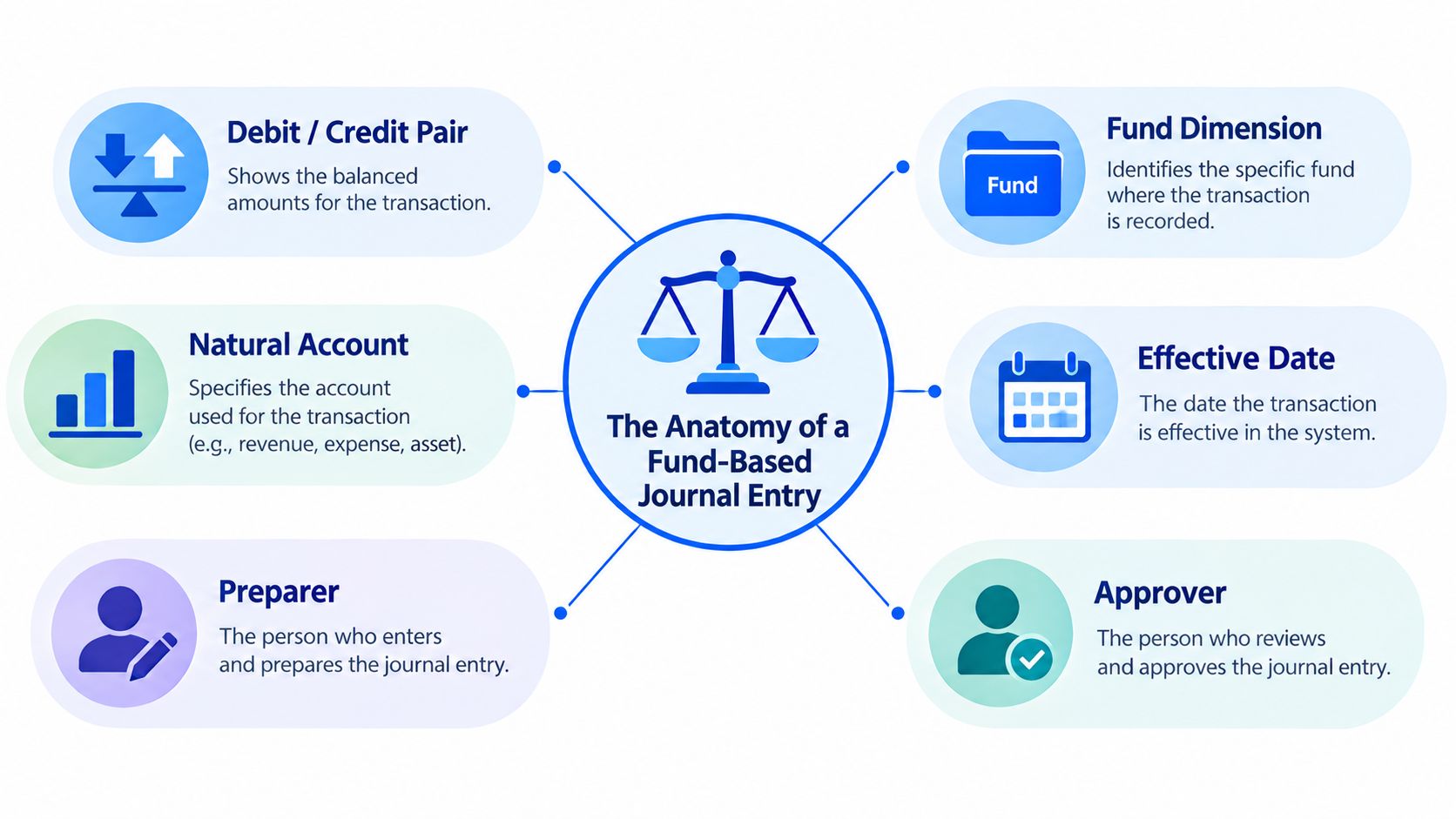
A fund dimension identifies the pool of resources affected. The natural account identifies the economic activity. Keep those questions separate: what happened, and whose resources did it affect?
The effective date determines the reporting period. The preparer explains the transaction, while an independent approver challenges its coding and authorization. Supporting documents connect those decisions to evidence.
Build the entry from the business reason
The manual-entry methodology for fund accounting has four parts: define the business reason; identify the fund, grant, natural account, and period; prepare balanced lines with support; and obtain independent approval before posting. A parallel concept appears in the Corporate Finance Institute's explanation of journal entries, which reinforces why business purpose and account selection have to be considered together.
For a restricted contribution, the difference between a usable entry and a misleading one is visible in the coding:
| Entry component | Properly identified | Quietly misclassified |
|---|---|---|
| Cash debit | Carries the applicable fund identity | Defaults to operations |
| Contribution credit | Reflects the donor restriction | Uses unrestricted revenue |
| Documentation | Links to the donor agreement | Says only “deposit” |
| Approval | Confirms purpose and classification | Checks balance alone |
Keep the chart usable
Don't create a new natural account for every reporting question. Decide which distinctions belong in funds, grants, departments, or locations, then document the permitted combinations. A nonprofit chart-of-accounts framework provides a useful starting point for that design discussion. If you want a second viewpoint, the National Council of Nonprofits overview of financial management is helpful for linking chart design to accountability and reporting.
For teams reviewing their nonprofit accounting practices, compliance help from Bookkeeping and Accounting of Florida Inc. is another resource to consider alongside their accounting advisors.
Maintain an entry log with the preparer, approver, date, rationale, supporting documents, restriction reference, and recurring status. Don't let the person who prepares a manual correction also become its only approver.
The trade-off is deliberate: requiring complete coding adds discipline during preparation, but avoids asking the controller to infer intent after posting.
Recording Contributions, Pledges, and Grant Awards
Start with the agreement, not the deposit. A donor restriction and a contribution condition aren't interchangeable. The distinction determines whether the credit belongs in revenue or a liability.
The visual below outlines the lifecycle, but its stages aren't a universal accounting sequence. Unconditional restricted contributions don't automatically pass through deferred revenue, and overcoming a condition isn't the same event as satisfying a donor restriction.
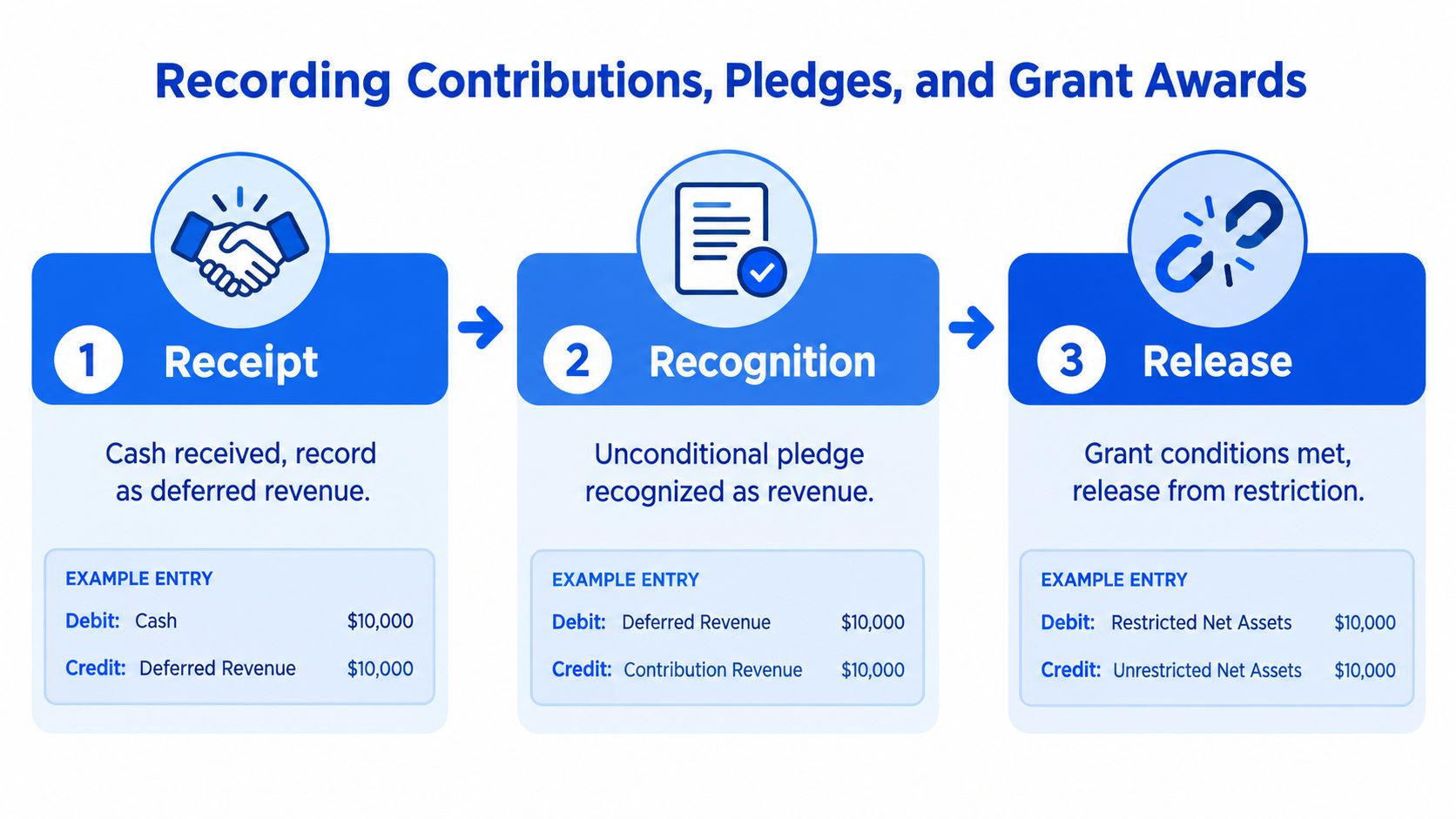
Unconditional restricted contributions
The restricted-contribution entry guidance describes receipt recognition and the subsequent release reclassification. For another plain-English overview, CFI's discussion of deferred revenue can help teams contrast liability treatment with immediate revenue recognition, even though donor-restricted gifts require a separate nonprofit analysis.
| Event | Debit | Credit | Required support |
|---|---|---|---|
| Cash contribution | Cash | Contribution Revenue with Donor Restrictions | Donor agreement and receipt |
| Unconditional pledge | Contributions Receivable | Contribution Revenue with Donor Restrictions | Documented unconditional promise |
| Restriction satisfied | Net Assets With Donor Restrictions | Net Assets Without Donor Restrictions | Qualifying expenditure or time evidence |
Account names can vary by system, particularly for release presentation. The reviewer should confirm that the configured accounts produce the intended reclassification rather than additional contribution revenue.
Time restrictions and conditional cash
The nonprofit contribution example recognizes a $60,000 unconditional, time-restricted grant in the first year and releases $20,000 annually over three years. For that example, debit Grants Receivable and credit restricted contribution revenue for the award, then use the release accounts for each qualifying annual amount.
For conditional cash received before the performance barrier is overcome, debit Cash and credit Refundable Advance or the appropriate liability account. Once the barrier is overcome, the liability can be cleared into contribution revenue with the appropriate restriction classification. The National Council of Nonprofits guide to restricted and unrestricted funding is also useful when training non-accounting leaders on why those distinctions matter operationally.
Don't automatically record a conditional promise as a receivable merely because an award letter exists. Document the recognition conclusion separately from the cash receipt.
Tie recognition to the grant schedule
Keep the agreement, recognition assessment, receipt evidence, and release support together. A grant report sample can help frame the schedule your ledger needs to support. For organizations building stronger grant files, Candid's grants management resources offer practical context around award tracking and reporting support.
For pledges receivable, include collectibility in the review rather than treating the original award amount as unquestionable. Any allowance assessment needs documented support; an unsupported plug won't improve the close.
Interfund Transfers, Allocations, and Shared Costs
Before moving money, decide what the movement represents. A permanent transfer, a repayable advance, and an expense allocation require different accounting logic. Calling all of them a “sweep” removes information the CFO needs.
The University of Texas System's current-funds training illustrates a $4,975 nonmandatory transfer from Educational and General Funds to Designated Funds and a $100,000 advance from Designated Funds to Unexpended Plant Funds. The patterns below follow those examples. For another overview of allocation mechanics, Investopedia's cost allocation definition gives finance and operations teams a common starting vocabulary.
Common Interfund Entry Patterns
| Scenario | Sending Fund Entry | Receiving Fund Entry |
|---|---|---|
| Nonmandatory transfer | Educational and General Funds: debit Interfund Transfer; credit Cash | Designated Funds: debit Cash; credit Interfund Transfer |
| Repayable internal advance | Designated Funds: debit Due From Unexpended Plant Funds; credit Cash | Unexpended Plant Funds: debit Cash; credit Due To Designated Funds |
Apply the cited amount equally to each debit and credit in its respective example. The transfer remains identifiable as internal financing, while the advance creates reciprocal balances rather than an increase in net position.
An internal advance isn't operating revenue. Preserve the repayment obligation instead of making the receiving fund look better funded than it is.
Allocate costs without inventing authority
For shared payroll or indirect costs, establish the approved allocation basis before preparing the journal. The support should explain the benefiting programs, eligible costs, reporting period, and grant terms.
- Expense reallocation: Debit the appropriate expense in the benefiting fund and credit the original expense allocation, with balancing or clearing lines as needed.
- Restriction release: Release only the eligible amount supported by the agreement and the remaining restricted balance.
- Excess allocation: Identify another authorized funding source for the unsupported portion. Don't force a release beyond the available restriction balance.
A cost allocation and a restriction release are separate decisions. Combining them without review can conceal an ineligible charge. The U.S. Department of Labor indirect cost rate guide is another practical reference when teams need a documented basis for shared-cost treatment.
Also distinguish fund movements from legal-entity transactions. A review of intercompany transactions and elimination is useful when the same close includes both. Fund-level accountability and entity-level consolidation shouldn't be treated as interchangeable workflows.
Depreciation, Capital Outlays, and Correcting Entries
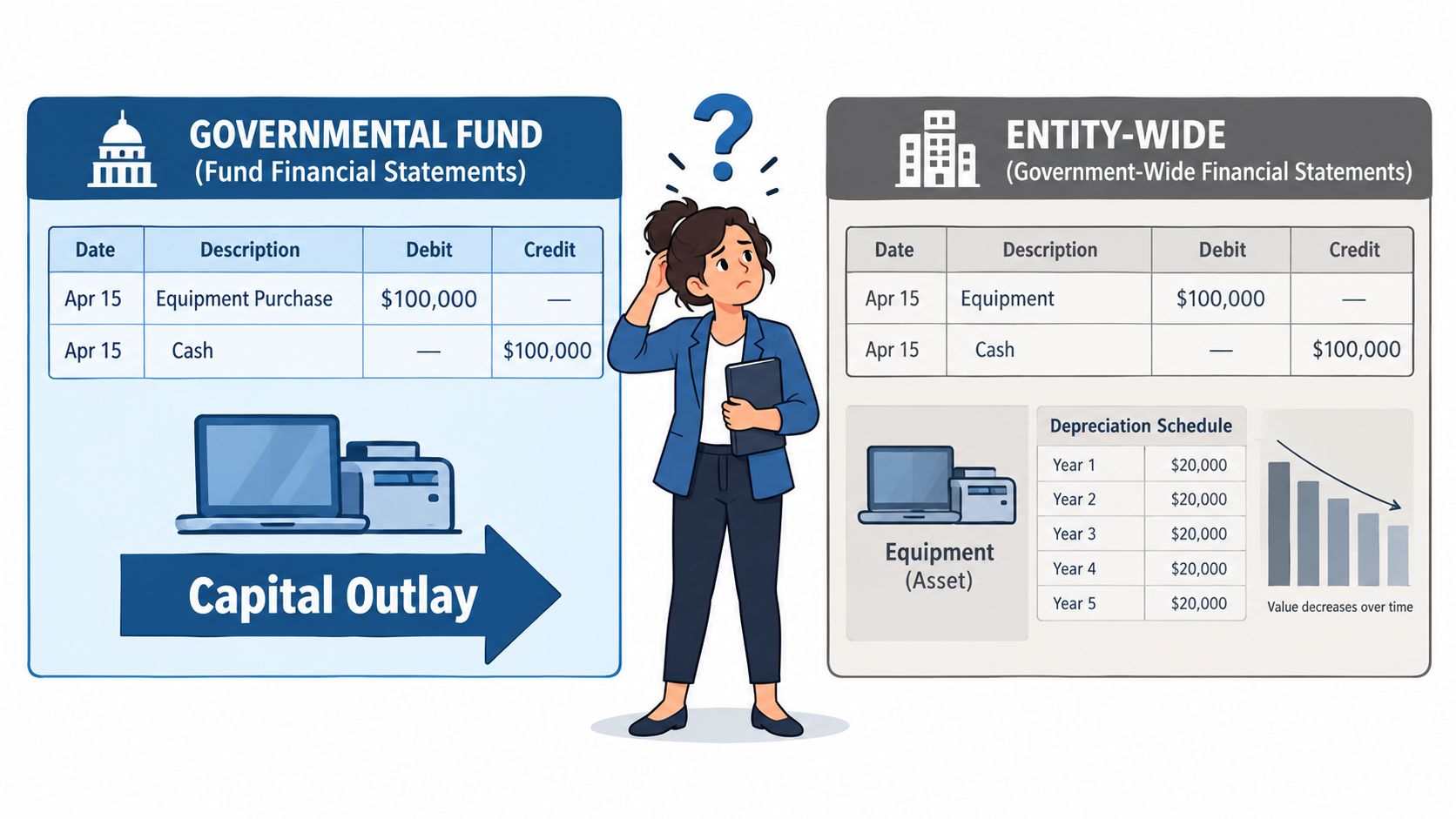
A capital-purchase template can be correct for one reporting basis and wrong for another. Governmental fund reporting isn't ordinary entity-wide accrual reporting.
Under GASB 34, Texas governmental-fund guidance explains that capital assets and long-term liabilities are generally reported in government-wide statements rather than governmental fund operating statements. A purchase using current financial resources is recorded as a capital-outlay expenditure in the governmental fund. The GASB standards overview is also a useful anchor for teams validating public-sector treatment.
Separate the reporting layers
| Reporting layer | Illustrative accounting treatment | Review evidence |
|---|---|---|
| Governmental fund purchase | Debit Capital-Outlay Expenditure; credit Cash or payable | Invoice, authorization, fund coding |
| Government-wide conversion | Recognize the capital asset and adjust the fund-level expenditure treatment | Conversion worksheet and asset record |
| Government-wide depreciation | Debit Depreciation Expense; credit Accumulated Depreciation | Supported depreciation schedule |
These governmental treatments shouldn't be copied into nonprofit accrual books merely because both organizations use funds. Teams considering fixed-asset management beyond QuickBooks should first establish which reporting layers their implementation must support.
Correct errors without hiding the original decision
For a misposted interfund transfer, reverse the erroneous lines and prepare the properly coded replacement. Link both entries to the original journal so the reviewer can follow the correction without interpreting it as new financing activity.
- Preparer: Documents the error, affected funds, period, and proposed treatment.
- Approver: Confirms that the correction fixes classification without adding unsupported activity.
- Close reviewer: Checks the corrected ledger against the transfer or grant schedule and verifies any planned reversal.
Prior-period adjustments deserve an explicit reporting assessment, not an automatic current-month posting. Similarly, reversing an accrual requires checking that the replacement transaction arrived. The Corporate Finance Institute explanation of reversing entries can be a useful refresher for teams documenting why a reversal was scheduled.
Governmental revenue timing needs its own review. Texas modified-accrual guidance requires revenue to be measurable and available, defining availability as financing expenditures payable within 60 days. Don't substitute nonprofit conditional-contribution logic for that governmental assessment.
Why Restricted Cash Is Not the Same as Available Cash
A board can receive an accurate bank balance and still make a poor spending decision. Restricted cash may be present without being available for general payroll, rent, or vendor payments.
The restricted-funds accounting discussion highlights the distinction: a restricted contribution can increase cash and net assets with donor restrictions while leaving unrestricted operating liquidity unchanged. This matters when programs share bank accounts or operate across grant periods. For board-level communication, the National Council of Nonprofits financial responsibilities guidance is a useful companion resource.
Reconcile cash and restrictions separately
Use separate schedules rather than one rollforward that mixes accounting classifications with bank movements.
| Schedule | Month-end bridge |
|---|---|
| Bank cash | Opening cash plus cash receipts, less cash payments, adjusted for bank transfers |
| Restricted net assets | Opening restricted balance plus restricted contribution recognition, less supported releases, adjusted for documented corrections |
| Operating cash availability | Total cash less identified restricted or otherwise unavailable cash, with commitments assessed separately |
A release isn't a cash receipt or payment. Don't subtract both a qualifying expenditure and its corresponding release from the same restricted-net-asset rollforward without checking how expenses and releases are presented. That can count the same activity twice.
More cash in the bank doesn't necessarily mean more room to spend. Show the restriction layer before asking the board to approve operating commitments.
Review the unresolved differences
Match each restriction schedule to its supporting receipts, qualifying activity, and ledger classification. Then identify which portion of the bank balance remains unavailable for general operations.
- Receivables: Separate recognized contributions that haven't been collected.
- Conditional advances: Identify cash still associated with an unmet performance barrier.
- Commingled balances: Preserve the fund-level allocation even when cash sits in a shared account.
For healthcare providers and nonprofits managing multiple programs, this bridge is more useful than a dashboard showing total cash alone. The CEO needs a spending decision, not merely a reconciled bank figure.
Building a Close Checklist and Letting the System Enforce It
The strongest close checklist tests whether the entries tell a consistent story across the ledger, grant reports, payroll, donor records, and cash schedules. It doesn't just confirm that journals posted.
Use the fund-dimension workflow guidance as a design principle: capture fund and grant information where transactions originate. Waiting until month-end to add those dimensions turns routine accounting into retrospective research. For a broader controls lens, the AICPA resources on audit and assurance can help teams frame documentation expectations.
Assign a review owner to each reconciliation
Build the checklist around evidence and exceptions:
- Fund rollforward: Tie opening balances, additions, expenditures, releases, transfers, and closing balances to the general ledger.
- Contribution review: Match recognition and release decisions to agreements and supporting schedules.
- Shared costs: Reconcile payroll and indirect-cost allocations to approved bases and grant reports.
- Internal movements: Match transfer counterparts and reciprocal due-to and due-from balances.
- Capital activity: Reconcile asset schedules and any government-wide conversion worksheets.
- Manual adjustments: Check approval, supporting documents, period selection, and required reversals.
- Liquidity: Reconcile the cash-availability bridge before distributing management reports.
Record who prepared each reconciliation, who reviewed it, and what remains unresolved. An unchecked box isn't the only concern. A checked box without evidence is just as weak.
If a release exceeded the supported amount, reverse the excess reclassification: debit Net Assets Without Donor Restrictions and credit Net Assets With Donor Restrictions, using the system-equivalent accounts where applicable. Then correct the supporting schedule and document why the original approval failed.
Make configuration a control decision
For teams evaluating Sage Intacct, the implementation conversation should start with transaction rules. Which dimensions must be populated? Which fund-and-grant combinations are allowed? Who approves manual journals, and how are exceptions routed?
Treat these as configuration requirements to demonstrate, not assumptions about software purchased. Ask the implementation team to show an incomplete entry, an unauthorized combination, a cross-fund allocation, and a correction. Confirm what standard configuration handles and where additional workflow design is required.
The reporting test matters just as much. A dashboard should let the CFO distinguish restrictions, advances, internal balances, and operating cash availability. A faster refresh doesn't improve a poorly defined measure.
For a broader view of evaluation criteria, Everglow Prosperity's resource to find NFP accounting software can support the selection discussion. Translate any software shortlist into your actual accounting requirements before comparing demonstrations.
Software alone doesn't settle accounting policy
Lucentive is a Sage Intacct National Premier Partner with mid-market, healthcare, and nonprofit experience, offering advisory and implementation support alongside other software and partner options. Its role in this process is to connect fund, grant, entity, department, and location design with workflows and reporting requirements.
The distinction for a CFO approving the investment is practical. Buying software provides a platform; implementing it well requires agreement on policy, responsibility, migration, and acceptance testing.
Use your record-to-report process flow to identify where staff currently rekey information, repair coding, or reconstruct approvals. Prioritize those points when defining the implementation scope.
ROI should be evaluated against your baseline, including correction work, reconciliation effort, and reporting delays. Time-to-value depends on delivering a usable control model, not reproducing every spreadsheet inside a new system.
Summary
Fund accounting journal entries need more than matching debits and credits. Reliable entries carry the correct fund identity, documented purpose, supporting evidence, and independent approval. Contributions require separate recognition and release decisions, while transfers and advances need explicit counterpart entries. Governmental capital accounting must distinguish fund statements from government-wide reporting. At close, reconcile fund activity and cash availability separately. A cloud ERP implementation should translate these policies into required coding, approval workflows, and exception review rather than move existing correction work into new software.
Frequently Asked Questions
When should a contribution be recorded as a liability instead of restricted revenue?
Conditional cash received before the performance barrier is overcome generally belongs in a refundable advance or appropriate liability account. An unconditional contribution with a donor restriction belongs in contribution revenue with donor restrictions. The agreement drives that distinction, not the presence of cash or the award's label. Keep the recognition assessment with the entry so the approver can verify why the credit was selected.
How should we treat a conditional grant or pledge?
Review the performance barrier before recognizing contribution revenue. For conditional cash already received, use the liability treatment described above until the barrier is overcome, then apply the appropriate revenue and restriction classification. Don't automatically record a conditional promise as a receivable because an award letter exists. Receipt, recognition, and satisfaction of a donor restriction are separate accounting decisions that need separate support.
How do we reverse a release that exceeded the restricted balance?
Reverse the excess reclassification by debiting Net Assets Without Donor Restrictions and crediting Net Assets With Donor Restrictions, or the equivalent release accounts in your system. Link the correction to the original entry and amend the restriction schedule. The reviewer should confirm the supported release amount and investigate the coding or approval failure. Don't use another fund's resources to conceal the excess.
Why does a governmental capital purchase post as an expenditure?
Governmental fund statements focus on current financial resources rather than the organization's full economic resources. Consequently, a capital purchase using those resources is recorded as capital-outlay expenditure at the governmental fund level. Capital-asset recognition and depreciation belong in the appropriate government-wide reporting layer. This treatment should not be copied into nonprofit accrual accounting because the nonprofit also tracks resources by fund.
Lucentive offers Sage Intacct advisory and implementation support to help translate fund-accounting policies into dimensions, approvals, and reporting workflows. Visit Lucentive to book a short, no-pressure discovery call or demo, and bring a troublesome journal, grant reconciliation, and cash report so the discussion can focus on fit for your organization.