The controller is in an audit meeting explaining why a vendor has been paid for months without a signed agreement on file. At the same time, a clinic manager is waiting for a new EMR vendor that finance hasn't activated, while accounts payable is sorting through late insurance certificates, duplicate records, and banking details buried in email.
That isn't a procurement inconvenience. It is a finance control failure. The onboarding vendor process determines when a supplier can be purchased from, paid, connected to systems, and included accurately in reporting. When the process is weak, the month-end close inherits the mess.
For CFOs, Controllers, and CEOs who have outgrown QuickBooks or are evaluating a real cloud ERP, the right question isn't how quickly a vendor can be entered. It's whether the vendor master, approval evidence, payment setup, and access controls will support a faster close and a defensible audit trail. Sage Intacct can provide the financial structure, but the implementation design and operating discipline determine whether that structure works.
Table of Contents
- What a Sloppy Vendor Setup Costs Finance
- Set the Policy, Roles, and Risk Tiers First
- Documentation and Screening by Risk Tier
- Setting Up the Vendor in Your ERP and Payment Flow
- Data, Security, and EMR Vendor Checks
- Monitoring After Approval, Not Just Activating
- Timelines, Owners, and KPIs That Actually Matter
- Summary
- Frequently Asked Questions
What a Sloppy Vendor Setup Costs Finance
A vendor record created from an email thread rarely carries enough information to support finance after the purchase begins. The legal entity may be incomplete, the remit-to address may be wrong, tax documents may be missing, and no one may know whether IT or legal reviewed the relationship. Six months later, the Controller is reconstructing decisions instead of reviewing results.
The fallout shows up fast. Duplicate vendor records distort spend reporting. Incorrect payment terms create avoidable follow-up. Missing insurance evidence creates audit exposure. A vendor activated before contract signature may receive access or payment authority before the company has enforceable terms.
A 2021 HICX survey of 100 senior procurement professionals at companies with annual revenue of at least $1 billion found that 63% reported average onboarding times of 15 to 28 days, while 31% reported 29 to 60 days. Only 4% completed onboarding within 8 to 14 days. These findings are reported in the HICX vendor onboarding cycle-time benchmark. The practical lesson is simple. Onboarding is a multi-week operating workflow. The ERP entry is only the final step.
Finance principle: A vendor is ready when the required evidence, approvals, contract, payment details, and access decisions are complete. A name in the ERP does not prove control.
The operating outcome that matters
A clean vendor master supports more than purchasing. It gives the accounting team reliable data for accruals, reconciliations, payment runs, expense classification, and management reporting. It also gives an auditor a traceable answer to four basic questions, who requested the vendor, what checks were performed, who approved it, and when it became active.
Teams building a formal process can use Doczen on vendor onboarding compliance as a practical reference for documentation, ownership, and control design. Finance should collect the evidence that matches the vendor's exposure, then store it where it can be retrieved during close or audit work.
Cash planning should reflect onboarding dependencies too. A rolling cash flow forecast is more accurate when upcoming vendor commitments, payment terms, implementation milestones, and approval delays are visible instead of trapped in inboxes.
The working sequence is straightforward. Set policy and ownership, classify risk, collect and verify evidence, configure the ERP and payment flow, review data and system access, monitor the relationship, and measure the effect on close performance. That sequence replaces informal email coordination with a process finance can run and improve.
Set the Policy, Roles, and Risk Tiers First
Don't start by designing a long vendor form. Start by deciding who can approve what, which evidence each vendor needs, and who owns a stalled request.
A usable policy should define the scope of onboarding, the process owner, the approval authority for each risk tier, required documents, escalation paths, and the conditions that block activation. The process owner is usually someone in accounts payable or finance operations. That person owns the queue, follows up on missing information, and reports aging. A risk reviewer may be the Controller, compliance lead, IT, or information security, depending on the vendor. A business sponsor remains accountable for why the company needs the vendor and whether the spend is appropriate.
A practical three-tier model
Tier 1 should cover low-risk suppliers such as office supplies, routine subscriptions, or vendors with no sensitive data or system access. Finance can validate tax, banking, and basic legitimacy information through a short path.
Tier 2 should cover services and facilities vendors with operational impact, material spend, or contractual dependencies. These vendors need finance review, a signed agreement, insurance evidence where applicable, and documented business approval.
Tier 3 should cover vendors that handle sensitive data, access regulated systems, influence payment activity, or support critical operations. These relationships require security and privacy review, legal involvement, controlled access provisioning, and documented acceptance of any remaining risk.
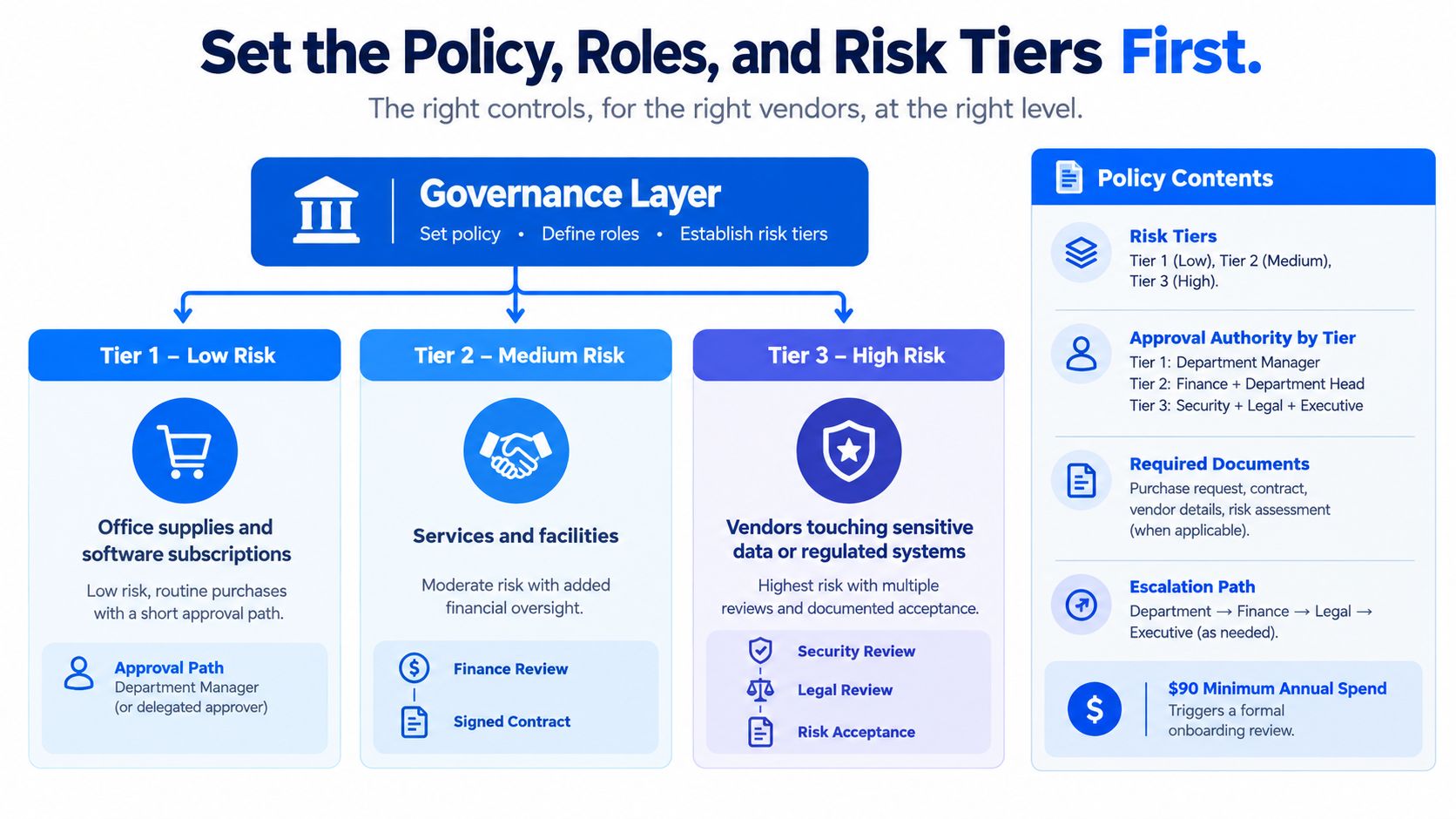
The tier should follow exposure, not the department requesting the vendor. A janitorial company with no system access may remain low risk even if it serves several locations. A small SaaS provider may require enhanced review if it connects to an EMR or stores employee information.
KPMG's global third-party-risk survey collected responses from 851 senior leaders across 16 countries. It found that risk-management involvement, information-security review time, third-party background checks, and system-access provisioning were the main factors influencing onboarding duration, supporting a tiered model rather than one uniform checklist. The findings are available in the KPMG global third-party-risk survey.
For purchase requests, connect the policy to an approval workflow rather than relying on email. A defined online purchase requisition approval process can capture the sponsor, business need, budget owner, risk indicators, and required reviewers before AP creates a vendor record.
Documentation and Screening by Risk Tier
The intake form should gather enough information to identify the entity, understand the exposure, and prevent a duplicate record. At minimum, capture the legal entity name, tax identifier, ownership, services provided, geographic exposure, data-access requirements, insurance information, banking details, and internal business owner.
Finance should screen the request against the existing vendor master before requesting payment information. Match legal name, tax identifier, remit-to details, and bank information where available. A legitimate vendor can still create a duplicate if the same company appears under a shortened name, a parent entity, or a location-specific record.
Evidence should match the exposure
Sanctions and watchlist screening, basic legitimacy review, and document validation belong in the standard path. The depth changes with risk. A low-risk office supplier doesn't need the same security questionnaire as an EMR integration provider. A critical technology vendor shouldn't receive access because a business sponsor marked a form complete.
A 2025 survey of 1,062 cybersecurity professionals found that 49% of organizations assessed supplier cybersecurity during initial evaluation or onboarding, while 28% had experienced a cybersecurity incident originating from a third-party vendor or supplier during the previous two years. Those findings are reported in the ISC2 supply-chain risk survey. The implication for finance is clear: cybersecurity review must be triggered by the vendor's access and data profile, not added after activation.
| Risk Tier | Examples | Core Documents | Screening Steps | Approval Level |
|---|---|---|---|---|
| Tier 1 | Office supplies, routine subscriptions, low-access services | Tax documentation, banking details, basic business information, insurance when applicable | Duplicate check, sanctions and watchlist screening, legitimacy review | Business sponsor and finance operations |
| Tier 2 | Facilities, professional services, operational vendors | Tier 1 evidence, signed contract, insurance evidence, service details, ownership information | Enhanced legitimacy review, reference checks where appropriate, contract and payment review | Business sponsor, finance, and designated reviewer |
| Tier 3 | EMR vendors, payroll providers, data processors, regulated-system providers | Tier 2 evidence, security and privacy questionnaire, relevant assurance report, data-handling terms, subcontractor information, access plan | Security review, privacy and legal review, background checks where relevant, documented residual-risk decision | Business sponsor, finance, legal, IT or security, and designated executive authority |
Keep the evidence in a central vendor record. The file should show what was requested, what was received, when it was verified, who approved it, and when the evidence expires. vendor master data management best practices become more than a data-cleanup exercise. The master record becomes the control point connecting procurement, AP, reporting, and audit support.
Setting Up the Vendor in Your ERP and Payment Flow
The ERP record is the point where an approved relationship becomes usable by finance. In Sage Intacct, a payment-ready vendor record should reflect the legal entity and the accounting treatment, not just the vendor's display name.
Configure the legal name, tax identifier, remit-to address, payment terms, currency, default expense account, class or department dimensions, and 1099 reporting status where applicable. Assigning the right dimensions at setup reduces reclassification work later and helps management reporting reflect the actual department, location, program, or entity receiving the service.
Build payment controls into activation
The approval workflow should distinguish the person requesting a vendor from the person approving the vendor and payment setup. Use approval routing that reflects spend thresholds and risk tier. A requester shouldn't approve their own vendor, and a bank-account change shouldn't be accepted solely because it arrived in an email from a familiar contact.
Verify bank changes through an independent callback using a trusted contact method already on file. Don't use the phone number included in the change request. If the signed contract, tax records, or required approvals are missing, the vendor should remain inactive or restricted from payment.
Control rule: Contract signature, approval evidence, and verified banking should precede payment activation. System access should follow the same gate.
APQC-based benchmarking across more than 3,000 companies reports a median supplier setup time of approximately 3 calendar days, but that metric measures system setup rather than the full compliance and contracting journey finance teams own. The distinction is explained in the APQC-based supplier onboarding metrics discussion. Creating a vendor in Sage Intacct quickly doesn't mean the relationship is ready if legal, security, insurance, or access controls remain incomplete.
The finance team should define a clear activation state. For example, a record can be pending evidence, approved for purchase, payment-ready, or restricted pending remediation. That status should be visible to requesters and enforced through purchasing controls. A user shouldn't be able to bypass the status by sending an invoice directly to AP.
This is also where ERP design affects the close. Correct vendor dimensions improve expense coding, accrued liabilities, and reconciliation work. The Sage Intacct accounts payable workflow should support approval routing and audit history without forcing the Controller to rebuild the story from spreadsheets.
Data, Security, and EMR Vendor Checks
Approval doesn't mean the work is finished when a vendor can access protected health information, financial data, payroll records, or clinical systems. It means the company has reached the point where access decisions must be explicit.
For an EMR, payroll, benefits, or sensitive SaaS vendor, ask direct questions:
- Data scope: What data will the vendor collect, view, store, transmit, or create?
- System reach: Will the vendor use an API, single sign-on, file exchange, browser access, or a direct integration?
- Protection: Does the vendor encrypt data in transit and at rest, and what current assurance evidence supports that answer?
- Contract terms: Are breach notification, confidentiality, retention, subcontractors, and data-return obligations documented?
- Access lifecycle: Who receives access, who approves it, when does it expire, and what triggers removal?
- Operational dependency: What happens to patient care, payroll, reporting, or billing if the vendor becomes unavailable?
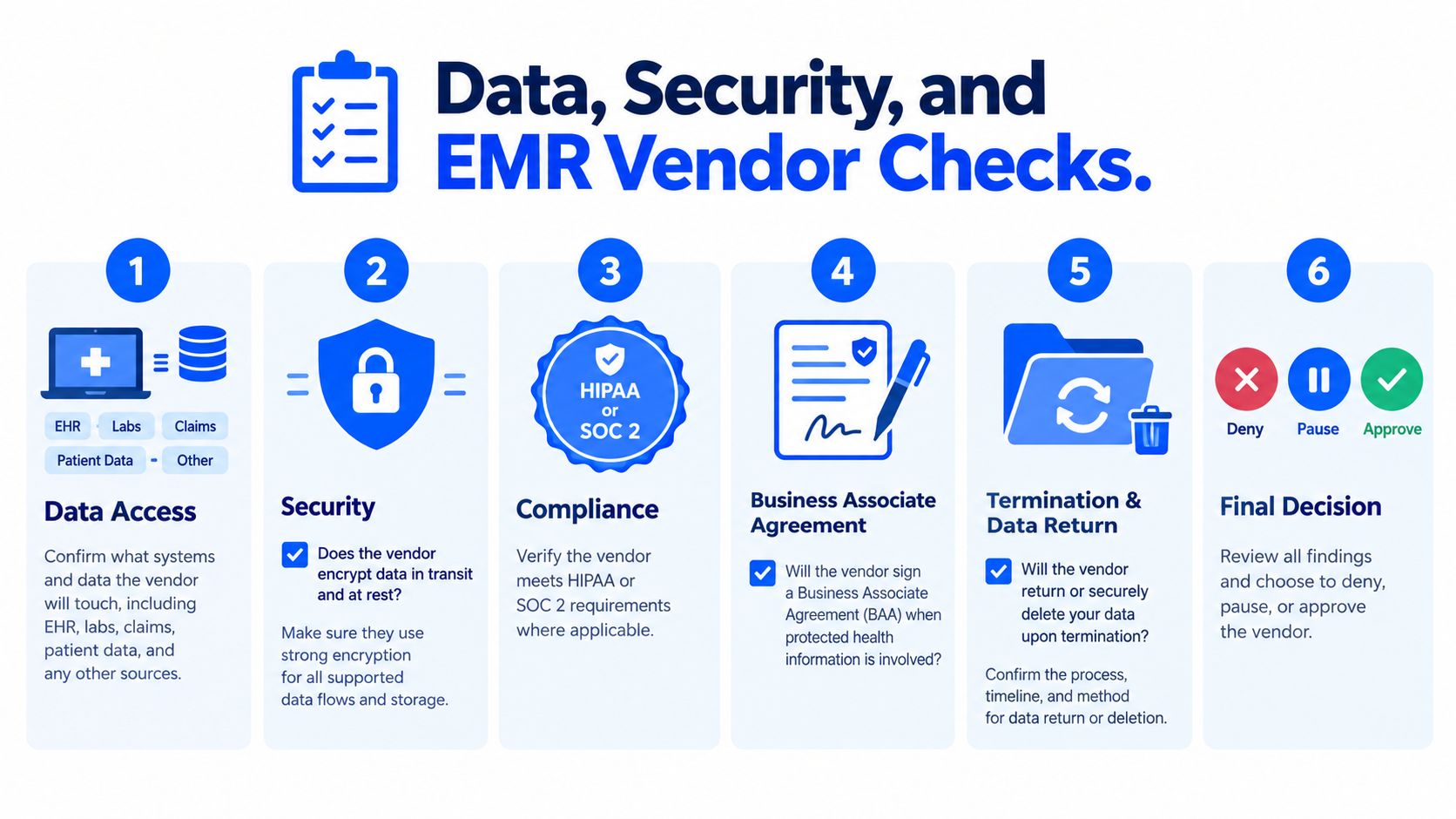
Finance shouldn't answer every question alone. Escalate data-handling, security architecture, privacy, and contractual risk to IT, information security, privacy, or legal. Finance's responsibility is to make sure the escalation happens, the decision is documented, and the vendor isn't activated while a required review is unresolved.
Vanta's guidance recommends financial, legal, and operational checks, including sanctions and watchlist screening, followed by assigning a vendor risk tier. It also emphasizes retaining what was collected, when it was verified, and who approved the vendor. The Vanta vendor onboarding guidance provides a useful control model for that evidence trail.
For healthcare organizations, the ERP should retain the business owner, access scope, approval status, review date, contract status, and evidence expiration. A finance system and electronic medical record integration should be treated as a controlled relationship, not merely a technical connection.
The final decision should be explicit: deny, pause for remediation, or approve with a documented condition. If access is granted, record the role, removal trigger, renewal date, and post-onboarding review date. Those fields turn an initial security review into a manageable lifecycle.
Monitoring After Approval, Not Just Activating
Most vendor playbooks end when the record becomes active. That's the wrong endpoint. Approval is the start of vendor governance, especially when the supplier has system access, handles sensitive data, or supports a critical operating process.
Set review triggers in the policy. A review should occur after an ownership change, a new system connection, a material change in services or spend, a regulatory change, a security incident, or expansion into additional locations. A vendor that was low risk as a local facilities provider may need enhanced review after gaining access to corporate systems.
Use proportionate monitoring
Low-risk vendors can follow a lighter evidence-refresh cycle. High-risk vendors need more deliberate contract, insurance, security, and access reviews. Critical vendors may require continuous monitoring of incidents, access, assurance evidence, continuity information, and unresolved remediation.
The process owner should maintain renewal dates, evidence expiration, access-removal triggers, and post-onboarding review dates in the vendor master or connected control system. The business sponsor should confirm that the service and scope remain accurate. IT or security should own technical reassessment when access changes.
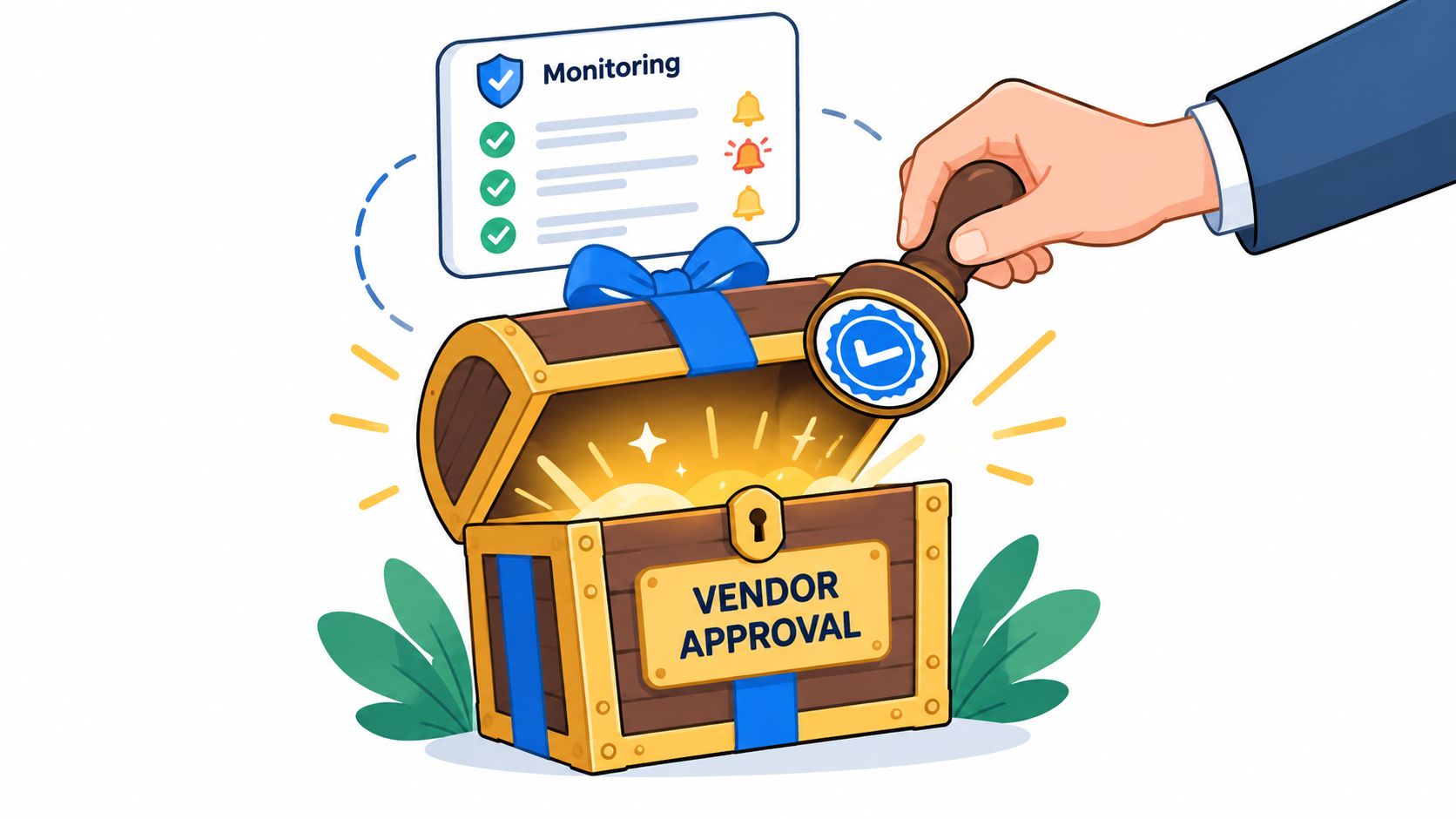
A useful dashboard connects monitoring to finance outcomes. Track cycle time, exception rate, duplicate records, rejected banking or tax details, stalled approvals, and the percentage of vendors reviewed before access. A missed renewal may delay a payment, but an unreviewed security change can create a much harder problem to reverse.
The Controller should be able to answer not only whether a vendor was approved, but whether the vendor is still operating within the conditions that justified approval.
Timelines, Owners, and KPIs That Actually Matter
The timeline should begin when an approved vendor request enters the queue and end when the vendor has an active, payment-ready record. Don't hide waiting time inside a single average. Separate vendor response time from internal review time, and identify whether the delay sits with the requester, budget owner, finance approver, IT administrator, compliance reviewer, legal team, or vendor.
A risk-tiered service model is more useful than one promise for every supplier. Low-risk vendors should move through a short validation path. Moderate-risk vendors need time for contract and finance review. Critical vendors need a deliberate security, legal, access, and continuity assessment. The target should protect control quality rather than reward teams for activating incomplete records.
Put the right measures on the dashboard
Track these measures monthly:
- Cycle time by tier: Count elapsed time from approved request to payment-ready record.
- Intake completeness: Show how often requests arrive with the required fields and evidence.
- Duplicate rate: Identify duplicate legal entities, tax identifiers, or bank details.
- Exception rate: Record how often the standard path is bypassed and why.
- Approval aging: Expose requests waiting on each internal reviewer.
- Pre-access review rate: Confirm that required vendors were reviewed before system access.
- Close-cycle connection: Compare onboarding discipline with reconciliations, accrual quality, and close duration.
A 2025 survey of 100 finance professionals found that 27% of organizations took more than seven business days to close the books, while 18% closed in three business days or fewer. The findings are reported in Dokka's month-end close benchmark analysis. Vendor master quality won't solve every close problem, but weak vendor data, late approvals, and manual reconciliations make a controlled close harder.
For broader risk context, ThreatExploit AI's third-party risk assessment resource can help leadership teams frame supplier exposure alongside operational and cybersecurity decisions. The finance team still needs its own dashboard, with owners attached to every exception.
Take this checklist to your next leadership meeting:
- Name one process owner for vendor onboarding.
- Approve three risk tiers and the evidence required for each.
- Block payment and access activation until the required gates are complete.
- Report cycle time, aging, duplicates, exceptions, and pre-access review monthly.
- Tie vendor master quality to close performance and audit readiness.
Lucentive is a Sage Intacct National Premier Partner serving mid-market organizations across healthcare, nonprofits, and general business. If your vendor process is tangled with QuickBooks limitations, multi-entity reporting, EMR access, or a slow close, schedule a 30-minute working session with the team to map the control design and ERP fit, then visit Lucentive to request a Sage Intacct conversation.
Summary
Vendor onboarding should be owned as a finance control process, not treated as a procurement form. A sound process assigns ownership, classifies risk, verifies documentation, separates requester and approver duties, and activates payment or system access only after required gates are complete. Sage Intacct can support vendor master discipline, approval history, dimensional reporting, and payment workflows, but implementation design matters. Ongoing monitoring, clear service expectations, and dashboard measures connect onboarding quality to close performance, audit readiness, and operational control.
Frequently Asked Questions
What is the onboarding vendor process?
The onboarding vendor process is the controlled workflow used to request, validate, approve, configure, and monitor a supplier. It includes business justification, legal and tax information, banking details, risk classification, required reviews, contract status, ERP setup, and access decisions. Finance should treat the process as complete only when the vendor has the evidence and approvals required for its risk tier and is ready for the permitted transactions.
Who should own vendor onboarding?
A single process owner should manage the queue, usually someone in accounts payable or finance operations. A risk reviewer handles the appropriate finance, compliance, IT, security, or legal review, while a business sponsor confirms the need, budget, and operational scope. Assigning one accountable owner prevents requests from sitting between departments while each team assumes another group is responsible.
What documents should a new vendor provide?
The core intake should capture the legal entity name, tax identifier, ownership, services, geographic exposure, insurance, banking details, and business owner. Required evidence should vary by risk tier. Low-risk vendors may need validated tax and banking information, while high-risk vendors may also require a signed contract, security and privacy evidence, references, insurance documentation, and documented approval.
When should a vendor receive system access?
System access should follow the required contract, security, privacy, and approval gates. Before activation, identify what data and systems the vendor will touch, who receives access, which role is appropriate, and what triggers removal. EMR, payroll, benefits, and other sensitive-data vendors should be escalated to IT, security, privacy, or legal when the review involves technical or contractual risk beyond finance's authority.
Is vendor approval a one-time decision?
No. Approval starts the governance lifecycle. Re-review should be triggered by ownership changes, new system access, expanded services or locations, material spend changes, regulatory changes, or incidents. The vendor record should include evidence expiration, renewal dates, access-removal triggers, and the next review date so the company can reassess whether the original approval conditions still apply.
Which vendor onboarding KPIs should a CFO track?
Track cycle time by risk tier, intake completeness, duplicate rate, exception rate, approval aging, and the percentage of vendors reviewed before access. Connect those measures to close performance, reconciliations, accruals, payment accuracy, and audit questions. Averages alone can hide stalled critical vendors, so stage-level ownership and exception reasons are necessary for meaningful management action.