Month-end is still open, the board package is due, and your Controller is stitching together exports from QuickBooks, spreadsheets, payroll, and operational systems. Reconciliations live in shared drives, approval histories are difficult to reconstruct, and every new entity adds another manual rollup. The finance team isn't short on effort. It's working inside a structure that no longer matches the business.
Sage Intacct can provide a dimensional general ledger, continuous consolidation, workflow automation, drill-down reporting, and an audit trail designed for growing finance organizations, according to Sage's product materials. But software is only one part of the outcome. The implementation question is who owns the data, process decisions, testing, and stabilization after go-live. For finance leaders comparing cloud ERP options, Gartner's finance software research hub is also useful for framing close, control, and reporting priorities.
Table of Contents
- When the Books Become the Bottleneck
- The Five Phases of a Sage Intacct Implementation
- Roles and Governance That Decide Success
- Configuration and Data Work That Matters
- Realistic Timelines and What Stretches Them
- Testing, Training, and a Confident Go-Live
- Why the Partner You Pick Changes the Outcome
- Summary
- FAQ
When the Books Become the Bottleneck
A Controller at a growing healthcare organization may start the week chasing intercompany balances across locations. A nonprofit finance director may be rebuilding fund reports manually because the general ledger doesn't reflect how grants are managed. A professional services CFO may wait for project data to move from an operational system before revenue and margins can be reported with confidence.
The symptoms look different, but the underlying problem is similar. The accounting system captures transactions, yet it doesn't give leadership a dependable operating view. Close work stretches late, revenue recognition requires ad hoc intervention, audit requests create friction, and management reporting depends on spreadsheet expertise held by a few people. Broader close-process research from Deloitte and The Hackett Group reinforces the same point: manual finance operations limit speed, control, and visibility.
That creates a business constraint, not merely an accounting inconvenience. New legal entities, additional sites, fundraising, lender reporting, audit readiness, and more demanding SaaS or project metrics all increase the cost of manual work. A team can keep adding workarounds, but each workaround makes ownership less clear and future migration harder.
Practical rule: If your finance team can't explain which system owns a number, who approved it, and how it reached the report, the issue is already bigger than QuickBooks training.
Sage Intacct's history helps explain why it fits this transition. Intacct Corporation was founded in 1999 and launched a web-based, multi-tenant financial management system in 2000. The Sage Group acquired Intacct for $850 million in 2017, and Intacct was recognized by the AICPA as a Preferred Provider of Financial Applications in 2007, retaining that standing for more than a decade, as detailed in this history of Sage Intacct.
Those milestones matter when you're moving from an entry-level accounting platform or older on-premises software. They point to a cloud-first product with a long development history, not a newly packaged trend. For executives evaluating the investment, Sage's broader recurring-revenue scale also signals an established owner. Sage reported £2,436 million in underlying recurring revenue for FY2025, up 10% year over year, and £2,093 million in software subscription revenue, up 12%, with subscription penetration at 83%, according to Sage's FY2025 results.
The right Sage Intacct dashboards and reporting approach can turn that platform investment into usable visibility. The catch is that dashboards only become trustworthy after finance leaders agree on definitions, dimensions, ownership, and source data. That governance lens should drive the rollout. For teams formalizing reporting definitions, the AICPA & CIMA finance and accounting resource center offers additional guidance on controls, reporting, and finance process maturity.
The Five Phases of a Sage Intacct Implementation
A strong Sage Intacct implementation follows business decision gates, not a consultant's calendar alone. Five phases provide a practical structure.
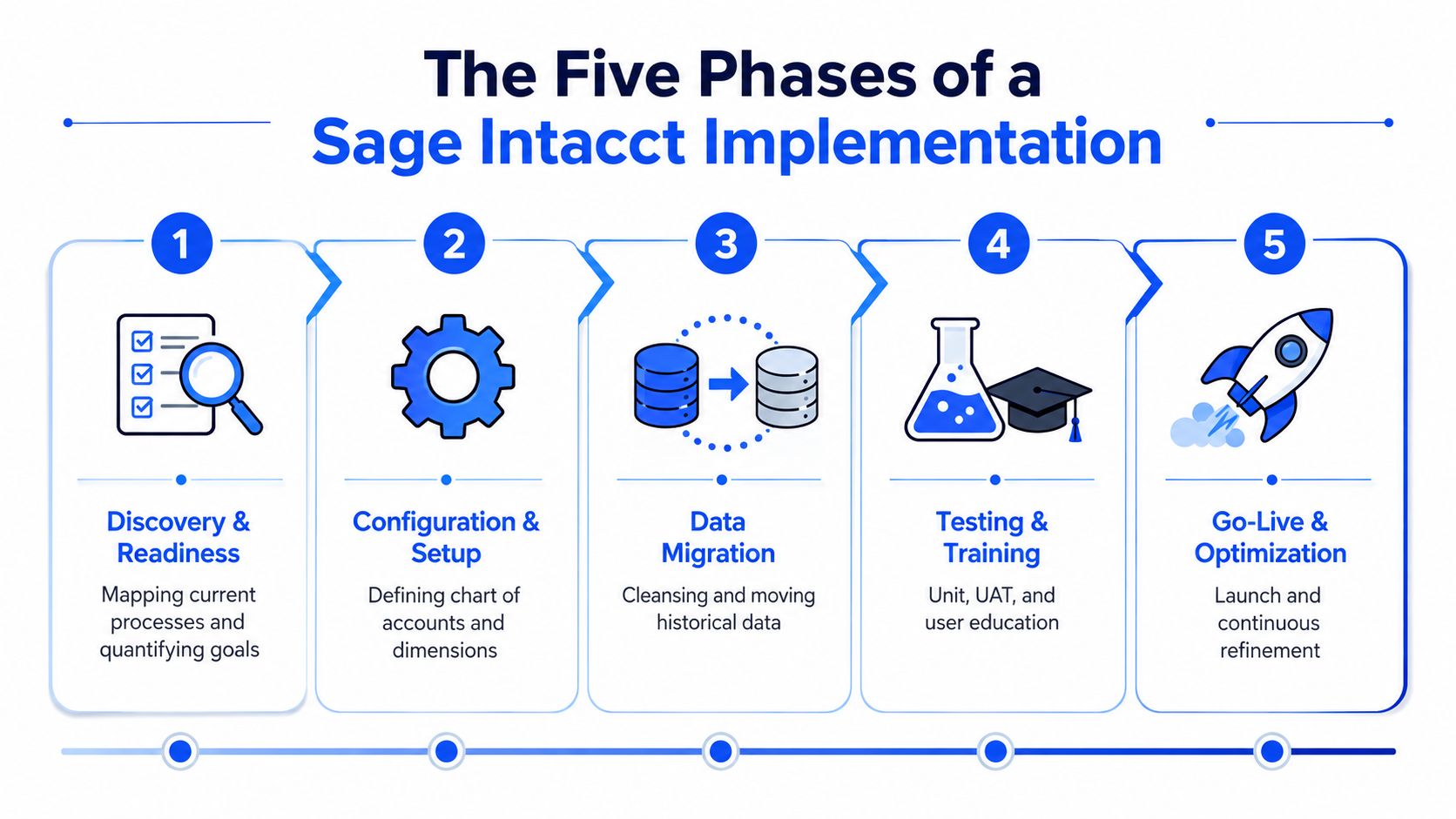
Discovery and readiness
The outcome is an agreed case for change. Map the current close, procure-to-pay, order-to-cash, payroll, reporting, and approval processes. Define the business objectives, owners, constraints, and required integrations before anyone starts configuring screens. For organizations building a formal business case, PwC's finance transformation insights can help frame readiness and operating model questions.
This phase can be short when the organization is aligned, but it expands when executives disagree about scope or finance can't identify authoritative source data. Its common failure mode is treating discovery as a sales exercise rather than a decision-making exercise.
Design and blueprinting
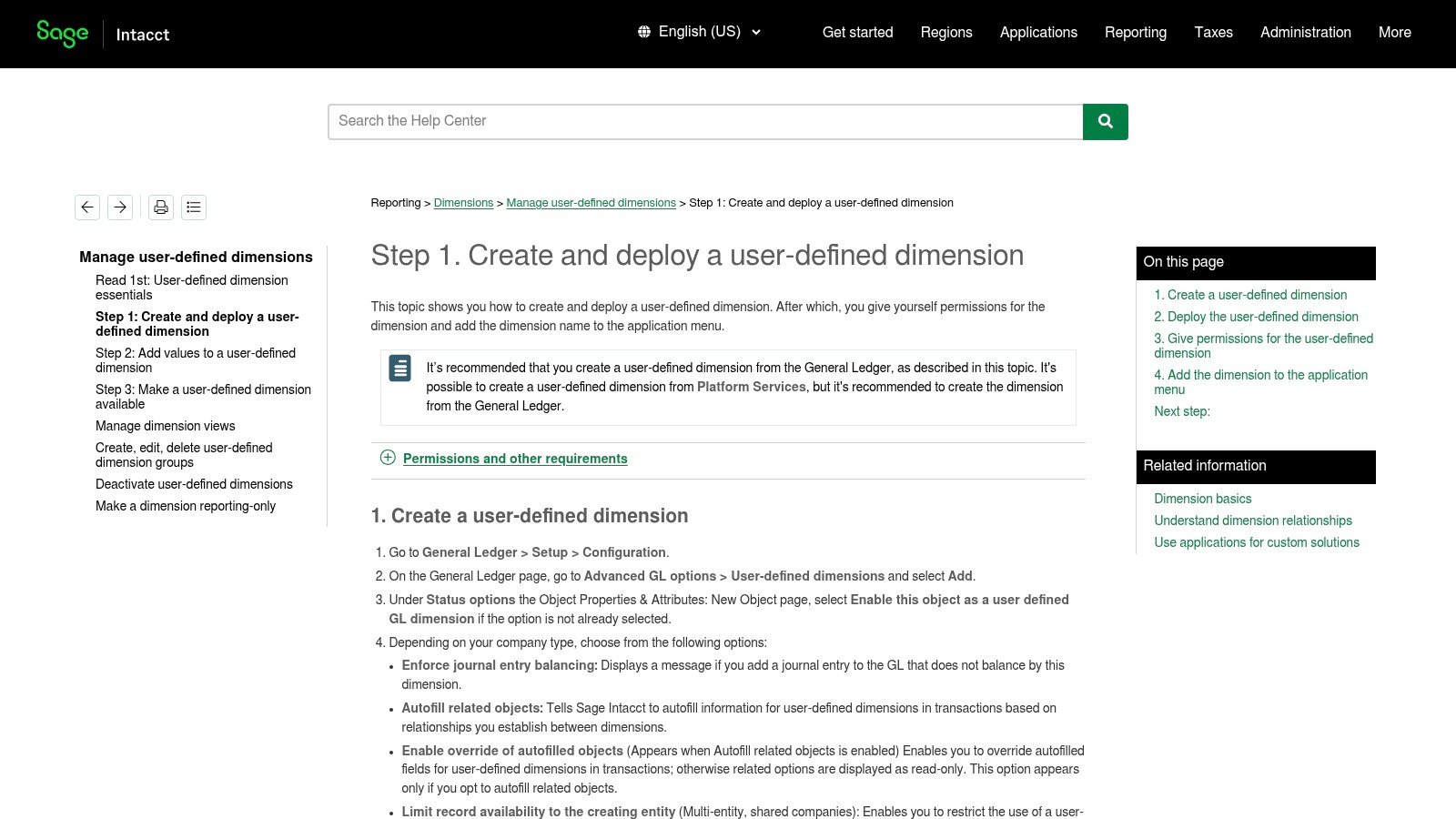
The outcome is a signed blueprint for the chart of accounts, entities, books, dimensions, workflows, reporting structures, security, and integrations. Sage Intacct supports user-defined dimensions, and administrators can restrict a dimension to the creating entity in a multi-entity company, as explained in the user-defined dimensions documentation.
The main failure mode is allowing configuration preferences to replace operating decisions. If nobody signs off on what “department,” “location,” “project,” or “fund” means, users will create inconsistent data after launch. Governance models used in broader ERP programs, such as those discussed by KPMG, support documenting these definitions early.
Build and configuration
The outcome is a working environment populated with validated configuration and migration files. Consultants configure the agreed design, while internal owners review workflows, reports, integrations, and converted balances.
The usual failure is scope creep. Teams add custom fields, reports, and integrations because the project is already underway, without deciding what those additions do to testing and ownership. External ERP implementation checklists from Oracle NetSuite can be useful as a cross-check for build dependencies and change control.
Testing, training, and change readiness
The outcome is evidence that real users can execute real processes. Test the close, purchasing, billing, cash application, intercompany activity, allocations, reporting, and exception handling. Train users by role and require functional owners to sign off on acceptance criteria.
Rushed testing is the predictable failure. A successful demo isn't proof that the finance team can close the books under production conditions. The Project Management Institute offers practical project governance standards that support stronger acceptance and issue management practices.
Go-live and stabilization
The outcome is controlled cutover, supported users, and a measured first close. Plan hypercare, defect triage, reconciliation reviews, and clear escalation paths before launch.
The most common failure is declaring victory at go-live. A practical sequence freezes scope before configuration, assigns business-side process owners during the build, and plans a 90-day hypercare period with rollback capability for 60 days after go-live, as recommended in this ERP modernization guidance.
Phase gates should control progression. Don't advance because a date arrived. Advance when the design is approved, the data reconciles, the integrations are tested, and the people responsible for the process can perform it.
Roles and Governance That Decide Success
The most expensive implementation mistake is assigning ownership to “the project team” as if that were a person. Sage Intacct can be configured correctly and still fail if nobody owns the business decisions behind the configuration.
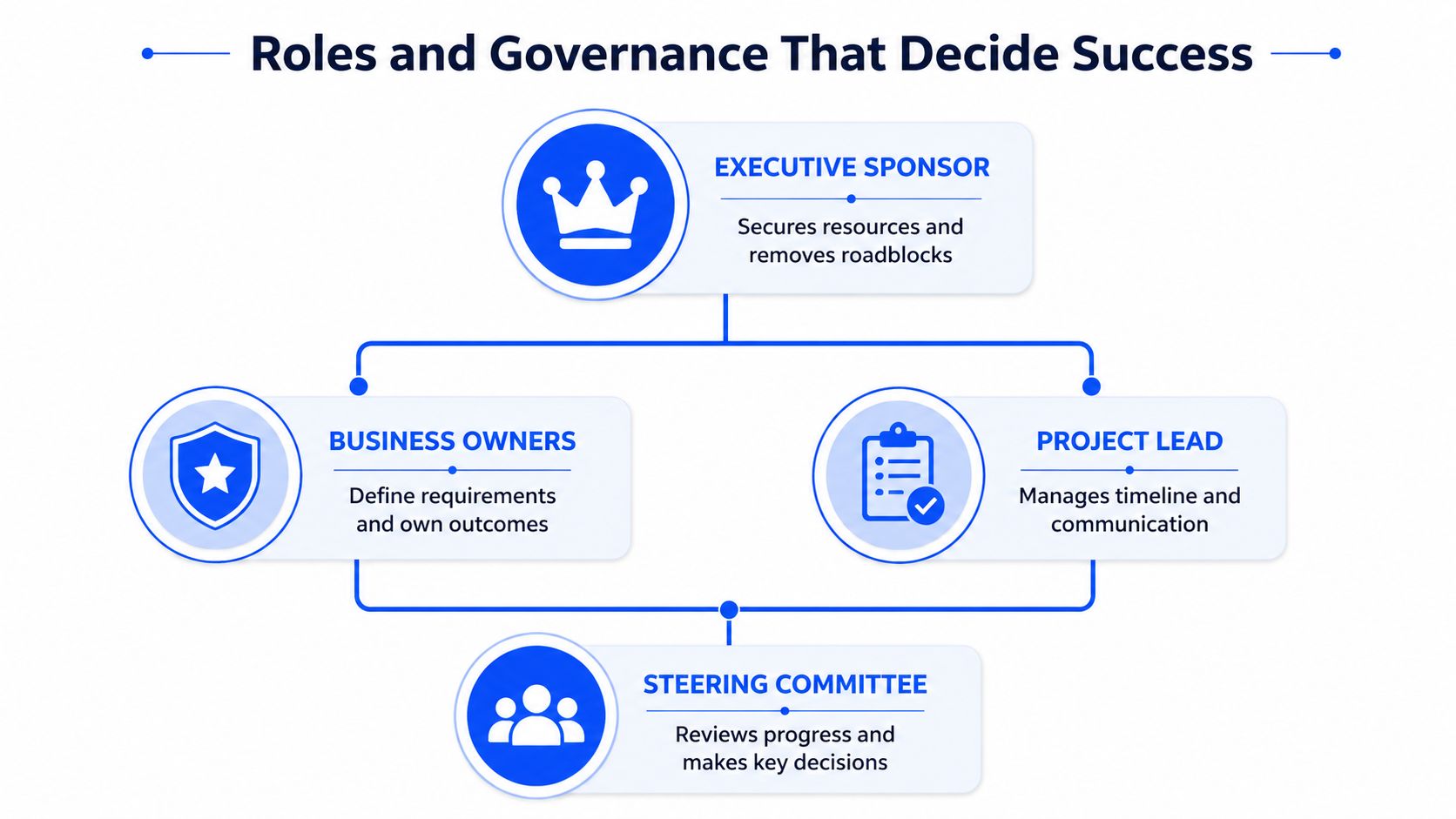
The CFO usually serves as Executive Sponsor. That role owns the business case, resolves escalations, protects decision speed, and approves trade-offs when scope, timing, or internal capacity collide. The internal Project Manager needs enough authority and time to maintain the schedule, RAID log, decision register, and meeting cadence. For boards and audit committees focused on accountability, Deloitte's governance resources provide a useful reference point.
The business owners
Process Owners should own the future state for Record-to-Report, Order-to-Cash, Procure-to-Pay, and Payroll. They aren't just subject-matter experts attending workshops. They decide what changes, document exceptions, approve requirements, and accept the process after testing.
Functional Leads for AP, AR, GL, Revenue, and Reporting translate those decisions into detailed requirements. A Data Migration Lead reconciles opening balances and defines what historical information is required. A Change and Training Lead prepares users for new responsibilities instead of treating adoption as a final presentation.
Use this language with the executive team:
“We aren't asking for extra project meetings. We're assigning accountable owners for the decisions that determine whether our reports and controls work after go-live.”
The partner and steering structure
The Implementation Partner should provide a Solution Architect and Lead Consultant who understand the approved design and can explain trade-offs in business terms. The Steering Committee should review progress, resolve cross-functional conflicts, and decide whether requested changes belong in the current scope.
Skipping these seats creates predictable handoff gaps. Doubling them up can be just as harmful when a Controller is expected to manage the project, own every process, clean the data, test reports, and maintain daily finance operations.
A governance model works when every major deliverable has one accountable owner, a decision deadline, acceptance criteria, and an escalation route. The partner facilitates and advises. Your finance leaders own the business outcome.
Configuration and Data Work That Matters
A finance team can configure Intacct quickly and still create reporting problems that last for years. Start with the reporting model, then decide how the chart of accounts, entities, books, and dimensions will represent the business before loading transactions.
Sage Intacct's multi-entity reporting structures place account groups and dimension structures under General Ledger reporting. Defined report structures support consolidated reporting without relying on manual spreadsheet assembly, as shown in the multi-entity report structures documentation. For finance teams cleaning up source data, Microsoft's data governance overview offers a helpful framework for ownership, stewardship, and policy discipline.
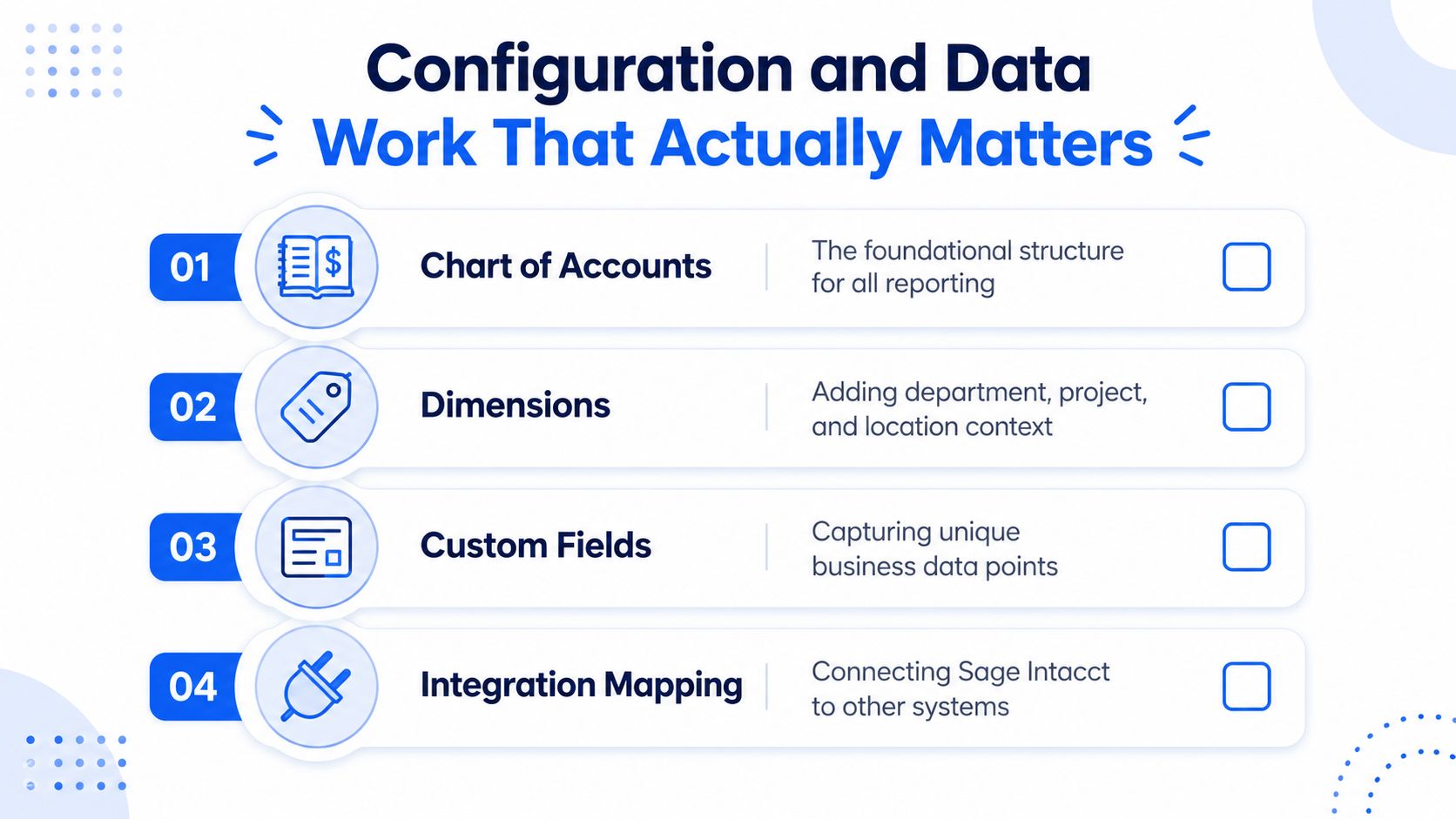
Four decisions to settle early
Chart of accounts. Keep the account structure useful for statutory reporting and management analysis. Do not recreate every historical legacy account when dimensions can provide better context.
Dimensions. Define the controlled vocabulary for department, location, project, class, vendor type, fund, and other reporting needs. Document who creates values, who approves them, and when they can be retired. Review Sage Intacct dimensions guidance from Lucentive when the reporting model needs context that account numbers cannot provide.
Custom fields. Add a field only when a business process or report requires it. Each field creates a data-quality obligation, so assign an owner before approving the design.
Integration mapping. Identify systems that should remove double entry, including payroll, bank feeds, expense management, CRM, revenue, and inventory systems. For every connection, document the source of truth, field mapping, error handling, and reconciliation method. Broader integration planning guidance from MuleSoft can help teams document these handoffs more rigorously.
Finance owns data cleansing. IT and the partner support the work, but a named data steward must own duplicate vendors and customers, inactive accounts, dimension values, open AR, open AP, and the historical trial balance.
Validate the design against source data before migration. Use representative transactions to confirm revenue recognition, allocations, intercompany eliminations, and currency translation. Keep a configuration log recording each approved change, its reason, owner, and effect on testing.
The design decision matters more than the screen setup. If users apply dimensions inconsistently, leadership will not trust the reports, regardless of how well the partner configured the system.
Realistic Timelines and What Stretches Them
A focused, single-entity Sage Intacct implementation with clean data commonly runs three to six months, while added modules, integrations, and complex data extend the schedule. ERP implementation timeline guidance supports using scope-based planning rather than accepting a vendor promise detached from the work required. Additional ERP benchmarking from Panorama Consulting Group can also help leaders pressure-test estimates and risk assumptions.
Use this planning range to challenge the estimate:
| Implementation Scope | Typical Duration | Primary Timeline Drivers |
|---|---|---|
| Core financials with limited integrations | Three to six months | Data quality, chart of accounts decisions, reporting requirements, user availability |
| Multi-entity or multi-site finance | Six to nine months | Entity design, intercompany processes, consolidation, security, dimension governance |
| Module-rich or integration-heavy rollout | Six to nine months | Revenue, project accounting, payroll, CRM, expense, inventory, and integration testing |
| Complex migration from fragmented systems | Nine to twelve months | Historical data, open transactions, duplicate masters, reconciliation, and parallel close |
Schedules slip when source data is incomplete, approval hierarchies remain undefined, dimension structures lack sign-off, or integrations expose work omitted during sales. Optional workshops create avoidable delays. The partner cannot finalize a workable design while process owners are unavailable, and no project plan can compensate for missing decisions.
Broad ERP research places projects that fail to meet objectives or exceed budget or timeline targets at roughly 55% to 75%, according to the earlier ERP implementation research. Treat that range as a risk warning, not a forecast. Define success measures, assign data ownership, plan integrations, and schedule training before the project reaches configuration.
Require a phase-by-phase plan with named owners, acceptance criteria, dependencies, and contingency. Each gate should state what must be complete before the next phase begins. An eight-week promise for a multi-entity build deserves scrutiny, not excitement.
Use this ERP planning resource for costs, time, and internal resources to test the proposal against the people your organization can assign. The partner's staffing model matters as much as the software scope.
Testing, Training, and a Confident Go-Live
The final stretch determines whether the first close feels controlled or chaotic. Confidence comes from rehearsed scenarios, reconciled data, and users who know what they own. It doesn't come from a clean demonstration by the implementation partner.
Test the work, not just the screens
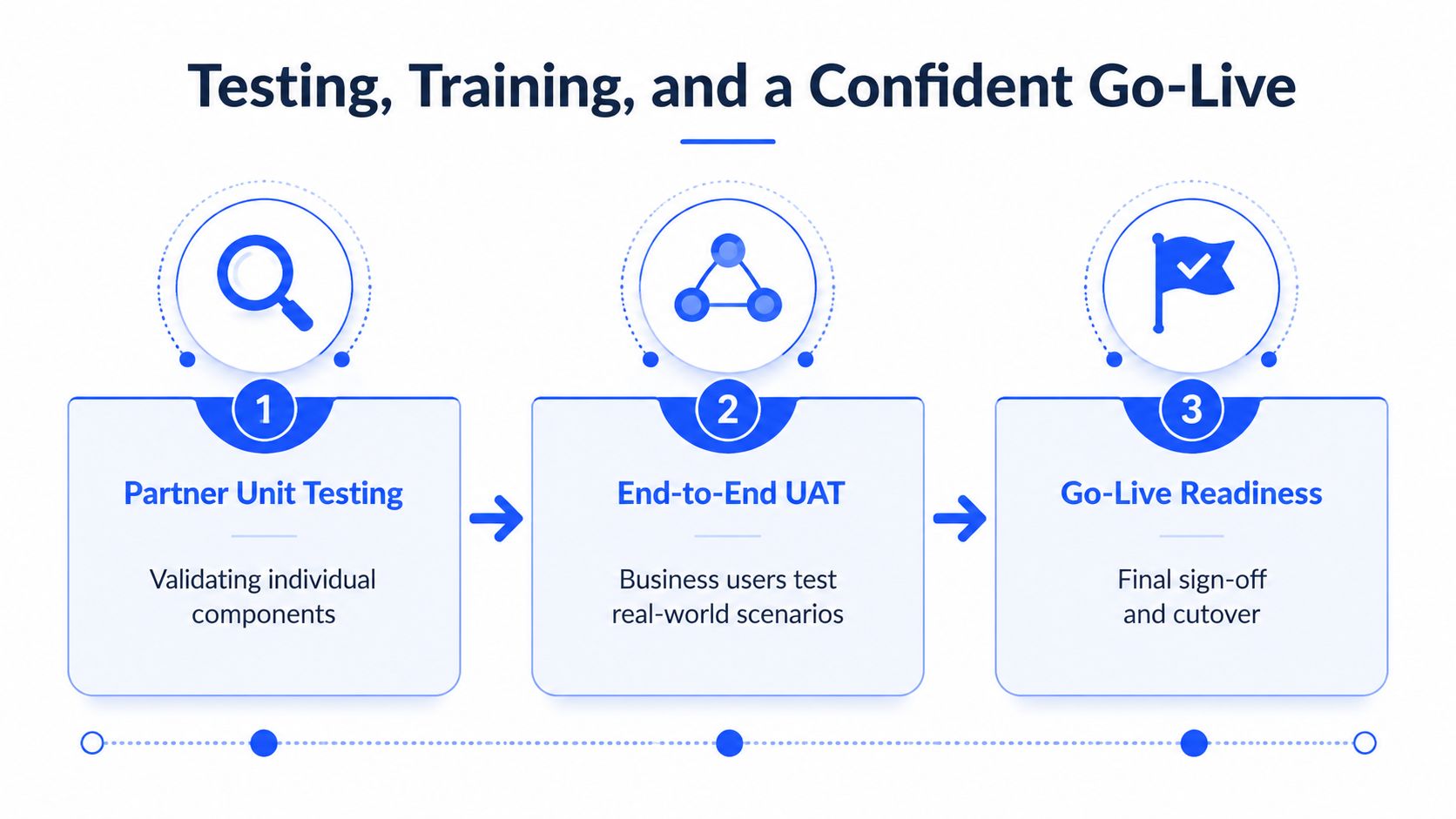
Partner unit testing checks whether individual configurations and integrations behave as designed. The finance team then performs end-to-end scenario testing across the full process. A close scenario should move through journals, approvals, allocations, intercompany activity, reporting, and reconciliation.
Formal user acceptance testing needs sign-off from each functional owner. Define the expected result before running the scenario, record defects in one system, assign severity and ownership, and retest after correction.
Include at least these scenarios:
- Close and reporting: Post recurring journals, review approvals, run management reports, and trace balances to source transactions.
- Intercompany activity: Create the transaction, complete the approval path, match the counterpart entries, and investigate exceptions.
- Revenue and projects: Test the contract or project flow, recognition logic, billing, and reporting outputs that executives rely on.
- Cash and payables: Reconcile bank activity, process invoices, apply payments, and confirm the audit evidence.
- Access and controls: Test security roles, approval limits, segregation of duties, and the reports users should or shouldn't access.
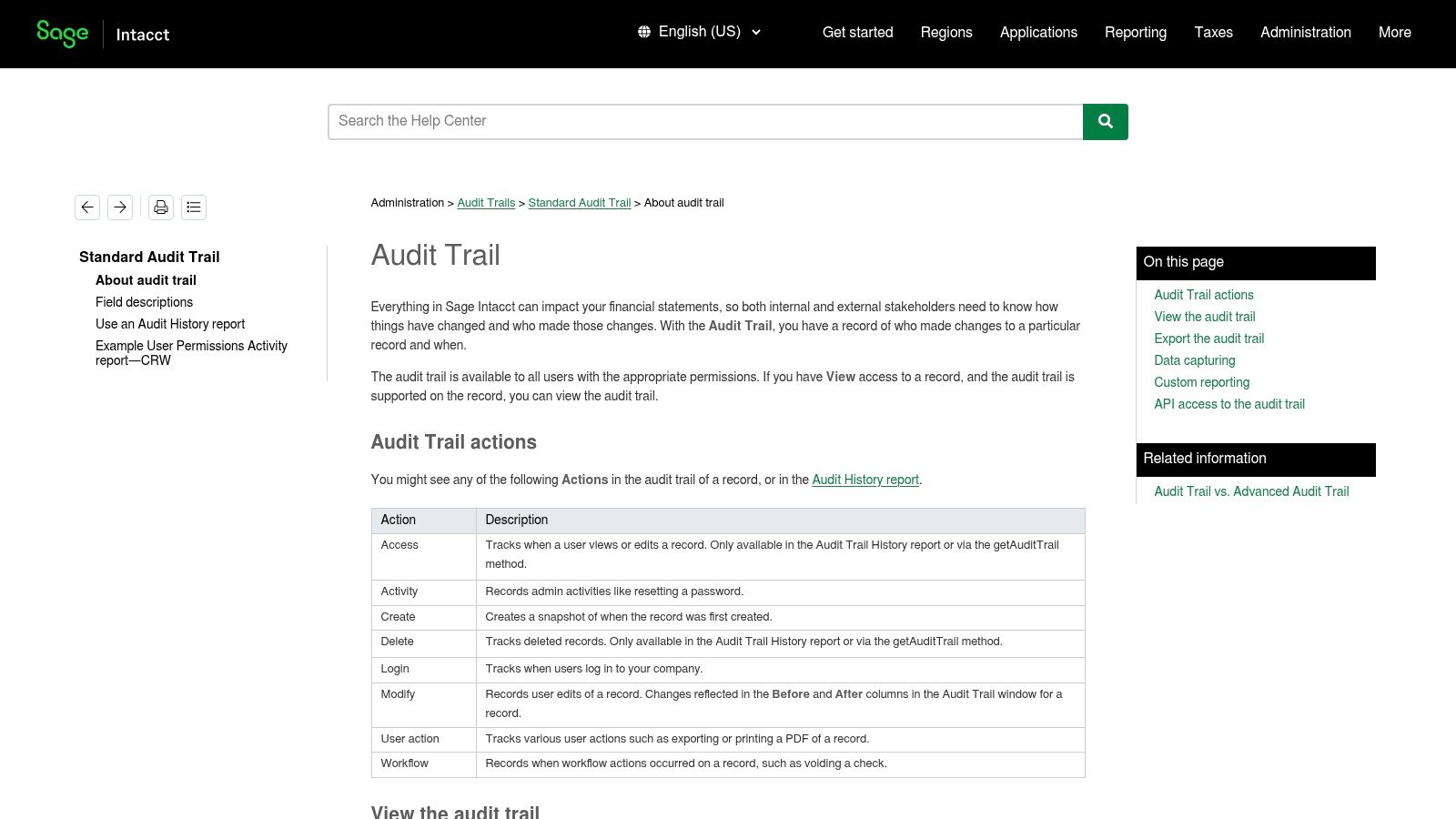
Sage Intacct's audit trail lets a user open a record and select "View audit trail," review field-level change history, and export the result to CSV, Excel, or PDF, as described in the audit trail documentation. Test that capability with the controls and records your auditors request. The Institute of Internal Auditors also provides useful audit and controls perspective when defining evidence requirements.
Train by role and rehearse cutover
A Controller needs close controls and reporting. AP and AR users need transaction workflows and exception handling. Project accountants need project and billing scenarios. Executives need dashboards, drill-down paths, and the definitions behind the numbers.
Training should happen alongside configuration, not be compressed into the final week. Users need enough time to practice, report confusion, and influence usable procedures before acceptance.
Cutover rehearsal is essential. Tie the opening trial balance to the legacy system, validate open AR and AP, confirm master data, review security, and document the order in which integrations and users will be activated. A parallel close or trial balance tie-out exposes defects while the old system remains available for comparison. For teams formalizing cutover checklists, ISACA offers useful governance and control resources.
Stabilize for the first year
Treat go-live as the start of operational ownership. A practical 30-60-90 day rhythm creates clear checkpoints:
- First 30 days: Hold daily standups during the first week, triage defects, review journal entries, monitor integrations, and resolve user blockers quickly.
- Days 31 through 60: Move to weekly stabilization meetings, walk through reconciliations, review recurring exceptions, and confirm that process owners are handling decisions internally.
- Days 61 through 90: Conduct a formal stabilization review, assess open defects, audit dimension usage, and decide which deferred improvements belong in the next release.
After stabilization, run monthly close monitoring, dimension usage audits, and integration health checks. Hold quarterly steering reviews to re-baseline scope and compare adopted capabilities with the original business objectives.
The handoff must name owners for master data, security roles, change requests, reports, integrations, and release readiness. Sage Intacct continues to evolve after implementation. Its 2025 review notes approximately 254 new features added across the product, while release notes describe workflow and payment changes, including the retirement of Authorize.net and PayPal customer payment services on November 7, 2025, as documented in the 2025 Sage Intacct release materials.
That makes release governance an operating responsibility. Review upcoming changes, test affected integrations, assess payment-provider dependencies, and approve adoption deliberately. Don't let the partner remain the only person who understands why a workflow works.
Watch these leading indicators:
- Close cycle: Are close activities completing on the agreed schedule?
- Intercompany matching: Are exceptions declining, and does someone own unresolved balances?
- Integration usage: Are transactions posting through approved integrations instead of manual workarounds?
- Dimension quality: Are required dimensions populated consistently?
- Defect aging: Are issues being resolved, or just moved from one meeting to the next?
- User ownership: Can internal champions explain the process without partner intervention?
For organizations that need structured adoption support, change management for a successful ERP implementation should be part of the delivery plan, not an afterthought.
Why the Partner You Pick Changes the Outcome
The license doesn't own your chart of accounts. It doesn't reconcile your opening balances, decide which department values are valid, or train a Controller on the reports required for the board. The partner and your internal owners determine whether the software becomes a controlled finance system or an expensive collection of configured features.
Rank implementation partners against delivery evidence, not presentation quality.
What to evaluate
First, examine bench depth. Ask who will perform the work, how many consultants can support the account, what product certifications those resources hold, and whether the proposed Lead Consultant will remain through hypercare. A partner that sells with senior people and delivers with an unknown team creates avoidable risk.
Second, look for vertical experience that affects design. Healthcare organizations may need multi-site reporting and operational integrations. Nonprofits may need fund and grant reporting. Professional services firms may prioritize project accounting, billing, and utilization visibility. SaaS organizations may need revenue and contract workflows. Templates can accelerate discovery, but the partner should still document your actual requirements.
Third, inspect the methodology. A sound statement of work identifies discovery outputs, design sign-offs, migration responsibilities, integration assumptions, test scripts, training milestones, acceptance criteria, and stabilization services. A transactional reseller that primarily hands over licenses won't provide the same operating accountability as a delivery partner with a named lead and defined outcomes. Buyers can also use vendor-selection guidance from G2's ERP software resource center and Software Advice to compare evaluation criteria.
Questions for the final SOW review
Ask each finalist:
- Who owns master-data cleansing, and who signs off on the result?
- Which opening balances and historical records will be migrated?
- How will open AR, open AP, and historical trial balances be validated?
- What is included in payroll, CRM, expense, revenue, inventory, and bank integrations?
- Which deliverables are fixed scope, and what triggers a change request?
- What happens when an acceptance criterion fails?
- Who provides hypercare, and will that be the same team that built the system?
- How are Sage releases, integration changes, and payment-provider migrations governed?
- What internal time is required from the CFO, Controller, process owners, and data steward?
- Which assumptions could change the schedule or partner fees?
Cost has four practical drivers: Sage Intacct licensing, partner services, integration development, and internal time. The right comparison isn't the lowest proposal. It's the proposal that makes the work visible enough for you to understand the total investment and the risks hidden outside the stated fee.
Mid-market projects often need a planning window of three to nine months, depending on entities, modules, integrations, data condition, and decision speed. Sage Intacct supports multi-entity consolidation, intercompany processes, revenue recognition, including ASC 606 requirements where the configured solution and business processes support them, and project accounting capabilities. Your finalist should show how those requirements will work in your organization, not just check them off in a demo. For revenue-policy context, many finance teams also reference the FASB ASC 606 overview when evaluating implementation impacts.
Partner certification also deserves a precise conversation. Sage Intacct Business User certification indicates user knowledge of the application. Implementation Certification addresses the ability to configure and deliver implementations. Ask how many people assigned to your project hold the relevant implementation credentials, and ask for examples of similar scope.
Lucentive is a Sage Intacct National Premier Partner with experience serving mid-market organizations, healthcare providers, and nonprofits, and it offers implementation and project-takeover services through its Sage Intacct reseller practice. That makes a focused discovery conversation useful before capital is committed, especially when the organization is migrating from QuickBooks, coordinating multiple entities, or inheriting a project with unclear ownership.
The best partner conversation is not a generic demo. It is a working session that tests your close, reporting, data, integrations, controls, and internal capacity against a realistic delivery plan.
Summary
A Sage Intacct implementation succeeds when finance leaders treat it as an operating model project, not just a software install. The core work is deciding who owns processes, data definitions, testing, controls, training, and post-go-live support.
For most CFOs, the practical priorities are clear:
- Define the reporting model before configuring the system.
- Assign accountable owners for each major process and data domain.
- Use phase gates tied to sign-off, reconciliations, and tested workflows.
- Budget enough time for migration, training, and stabilization.
- Evaluate implementation partners on delivery evidence, not demos alone.
Organizations that do those things are far more likely to get faster closes, more reliable reporting, and stronger control over multi-entity growth.
FAQ
How long does a Sage Intacct implementation usually take?
A focused single-entity deployment often takes three to six months. Multi-entity, module-rich, or integration-heavy projects commonly take six to nine months, and more complex migrations can take nine to twelve months.
Who should own a Sage Intacct implementation internally?
The CFO usually sponsors the project, but day-to-day success depends on named business owners for core processes, a project manager, a data migration lead, and functional leads who can approve requirements and testing.
What causes Sage Intacct implementations to slip?
The most common issues are unclear ownership, late design decisions, weak data quality, undefined approval structures, scope creep, and inadequate user testing.
What should CFOs finalize before configuration starts?
They should finalize the reporting model, chart of accounts approach, dimension definitions, integration scope, migration rules, and acceptance criteria for each phase.
What should happen after go-live?
Teams should run a structured stabilization period with defect triage, reconciliation reviews, user support, and ownership handoff for reports, integrations, security, and master data.
Lucentive helps finance leaders plan and deliver Sage Intacct implementations around governance, data ownership, process redesign, and post-go-live stabilization. Schedule a 30-minute working session or customized Sage Intacct demo with the team through Lucentive to pressure-test fit, scope, and implementation risk without committing to a purchase.