Two-tier ERP keeps a primary Tier 1 system at headquarters and runs separate Tier 2 systems at subsidiaries or business units, linked so standardized group data flows between them. The core decision isn't whether two systems cost less than one; it's whether local operating needs justify a portfolio of systems that your finance team can govern and eventually exit.
If the close is slow, reports arrive in different formats, or an acquired entity still runs its own books, the appeal is easy to see. A separate system can preserve local workflows while headquarters retains consolidated oversight. But every added ERP also creates another data boundary to secure, reconcile, and maintain. For a CFO or Controller, the test is whether local fit is worth that continuing work, and whether the architecture will still make sense as the company grows.
Table of Contents
- What Two-Tier ERP Is and How the Two Tiers Work
- Two-Tier Compared With Single-Tier and Multi-Tier Setups
- Benefits and Risks of Running Two Tiers
- Where Two-Tier ERP Fits Multi-Site and Multi-Entity Organizations
- Implementation Decisions and a Migration Checklist
- Confirm the Fit Before You Buy Sage Intacct
- Summary
- Frequently Asked Questions
What Two-Tier ERP Is and How the Two Tiers Work
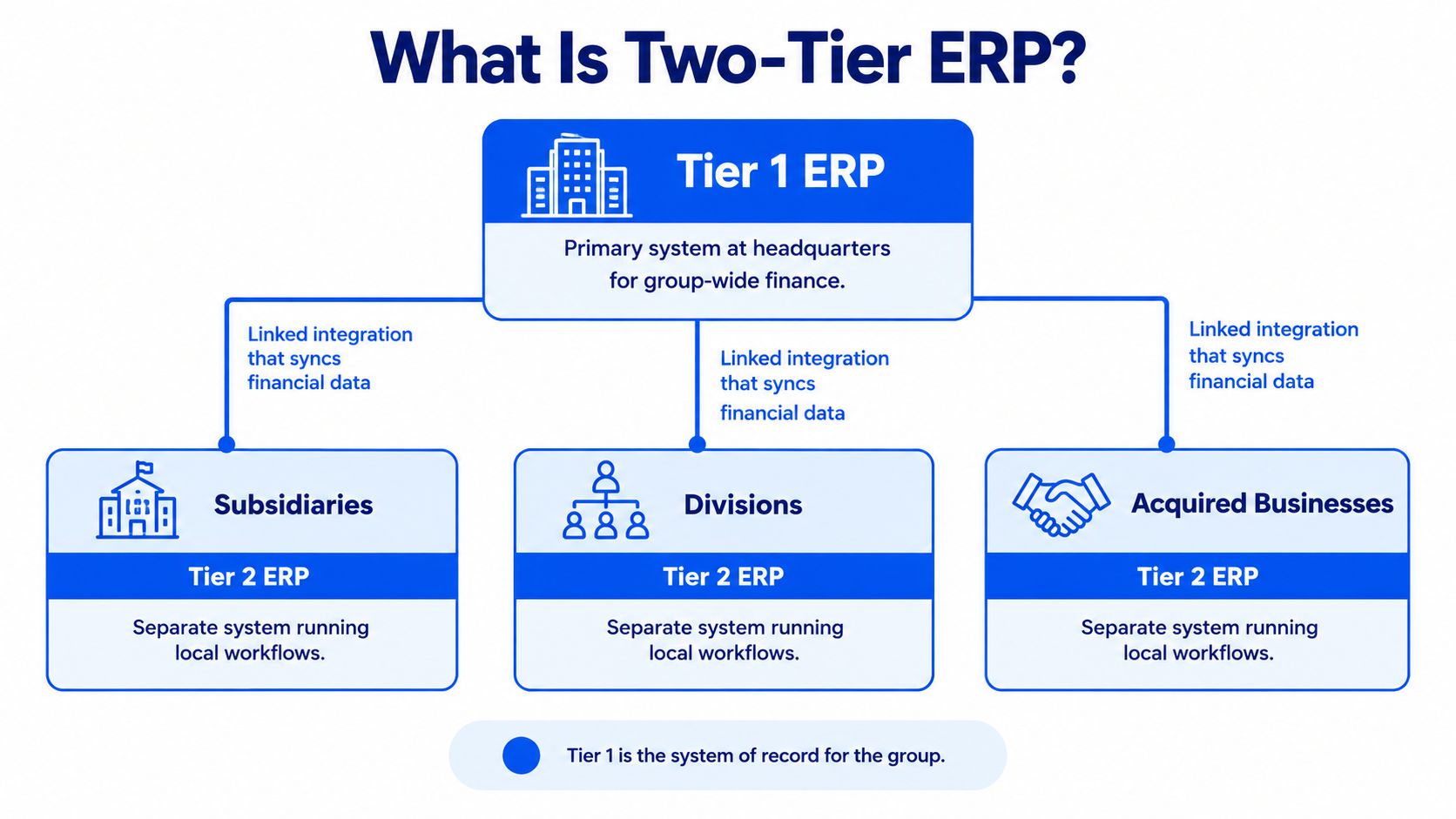
What is two-tier ERP? It's an enterprise architecture with a primary, or Tier 1, ERP at headquarters and separate Tier 2 ERPs at subsidiaries, divisions, or acquired businesses. SAP's overview of two-tier ERP describes this parent-and-subsidiary arrangement. The systems are integrated so standardized information, such as general-ledger balances, master data, compliance information, and consolidated results, can flow between corporate and local operations. Oracle's subsidiary consolidation guidance illustrates how entity structures support group reporting. An academic review of ERP architecture describes the model as a deliberate balance of central governance and local autonomy, not just the use of two accounting packages (academic review of two-tier ERP).
Think of headquarters as holding the group rulebook and consolidated ledger. Each branch follows the rules that matter to the group, but runs the local workflows it actually needs and reports its results in the group's format. The arrangement became more relevant as multinational organizations accumulated systems through acquisitions and expansion. Cloud ERP later made it easier to deploy separate systems for headquarters and subsidiaries.
The division of responsibility is the design. SAP's two-tier ERP guidance describes integration across headquarters and subsidiary processes, including finance and procurement. SAP also identifies analytics, master-data sharing, and end-to-end process integration as common integration priorities. If no one can say which system owns each important record or process, the company hasn't designed two tiers; it's just operating separate software.
| Area | Tier 1, headquarters ERP | Tier 2, subsidiary ERP |
|---|---|---|
| Chart of accounts and reporting structure | Owns the corporate standard and group reporting | Uses the standard and maps local accounts to it |
| Legal entities | Holds entity structure and consolidation rules | Records transactions for its own legal entity |
| Local tax and compliance | Sets group policy and compliance information | Handles country- or industry-specific tax and rules |
| Master data, including customers, vendors, and items | Owns selected shared records | Creates and maintains local records within group rules |
| Day-to-day operations | Runs central processes such as consolidated finance, HR, and procurement | Runs local sales, field service, and unit workflows |
| Consolidated results | Produces group financial statements | Supplies local balances and operating results |
Choose the data-flow pattern deliberately
In an autonomous model, the subsidiary completes most processes locally, then sends selected master data and financial results to headquarters. That can suit a unit with distinct workflows that doesn't need corporate staff to process every transaction.
In a shared-services model, transaction-level information flows to headquarters for centralized work such as accounts payable, invoicing, or order management. SAP's two-tier integration scenarios include cross-tier finance, procurement, and order processes. That choice changes what must cross the system boundary: headquarters may need detailed transactions, not only summarized balances.
Before comparing platforms, list your five or six most important processes and assign each a likely owner. For example, decide whether vendor creation belongs to the group, the local entity, or both under different approval rules. SAP's discussion of subsidiary integration explains why synchronizing shared customer and product records matters. The answers will expose integration and control requirements before a demo makes the choice look like a software preference.
Two-Tier Compared With Single-Tier and Multi-Tier Setups
| Setup | Systems in use | Governance | Local fit | Integration load | Best suited to |
|---|---|---|---|---|---|
| Single-tier | One ERP for every entity | Uniform and fully central | Low, entities follow the corporate process | Minimal | One entity or tightly standardized groups |
| Two-tier | Headquarters ERP plus one or more subsidiary ERPs | Central for group standards, shared with local units | High for subsidiaries that need their own workflows | One defined interface set between two systems | Groups with a few distinct subsidiaries, clinics, or acquired entities |
| Multi-tier | Three or more layers, such as parent, regional hub, and local sites | Layered, with each layer owning part of the rules | High, based on layer design | Several interface chains that compound | Large regional structures a single hub cannot serve |
“Multi-tier” isn't a single standard label across vendors. Here, it means an architecture with at least three system layers, such as a parent company, regional hubs, and local sites.
The central trade-off is agility versus integration complexity. A Tier 2 system lets a subsidiary keep suitable local processes rather than forcing every unit onto the corporate platform. But headquarters and local finance teams must define a reliable system-of-record boundary and a reconciliation process. An ERP integration paper explains that earlier two-tier deployments often relied on batch exchanges, which could delay analysis and expose teams to timing mismatches, duplicate records, failed interfaces, and inconsistent master data (two-tier ERP integration paper).
That means integration is not a plumbing detail to settle after selection. Decide which system owns each customer, vendor, item, employee, entity, and account mapping. Set validation rules, identifiers, effective dates, and a procedure for resolving rejected records. Modern cloud platforms may offer APIs or prebuilt connectors; older environments may need middleware. SAP's integration monitoring documentation shows the kind of message-status visibility an integration owner should assess. For example, Microsoft's recurring integration documentation shows how one ERP supports scheduled exchanges and monitors import status.
For a business comparing a full ERP with familiar bookkeeping tools, this Sage Intacct versus QuickBooks comparison can help frame the broader system decision. The setup verdict is straightforward: choose single-tier for one entity or operations that need tight standardization. Choose two-tier for a group with distinct local requirements. Add regional layers only when those hubs have a real governance role, because every layer creates another interface chain to own.
Benefits and Risks of Running Two Tiers
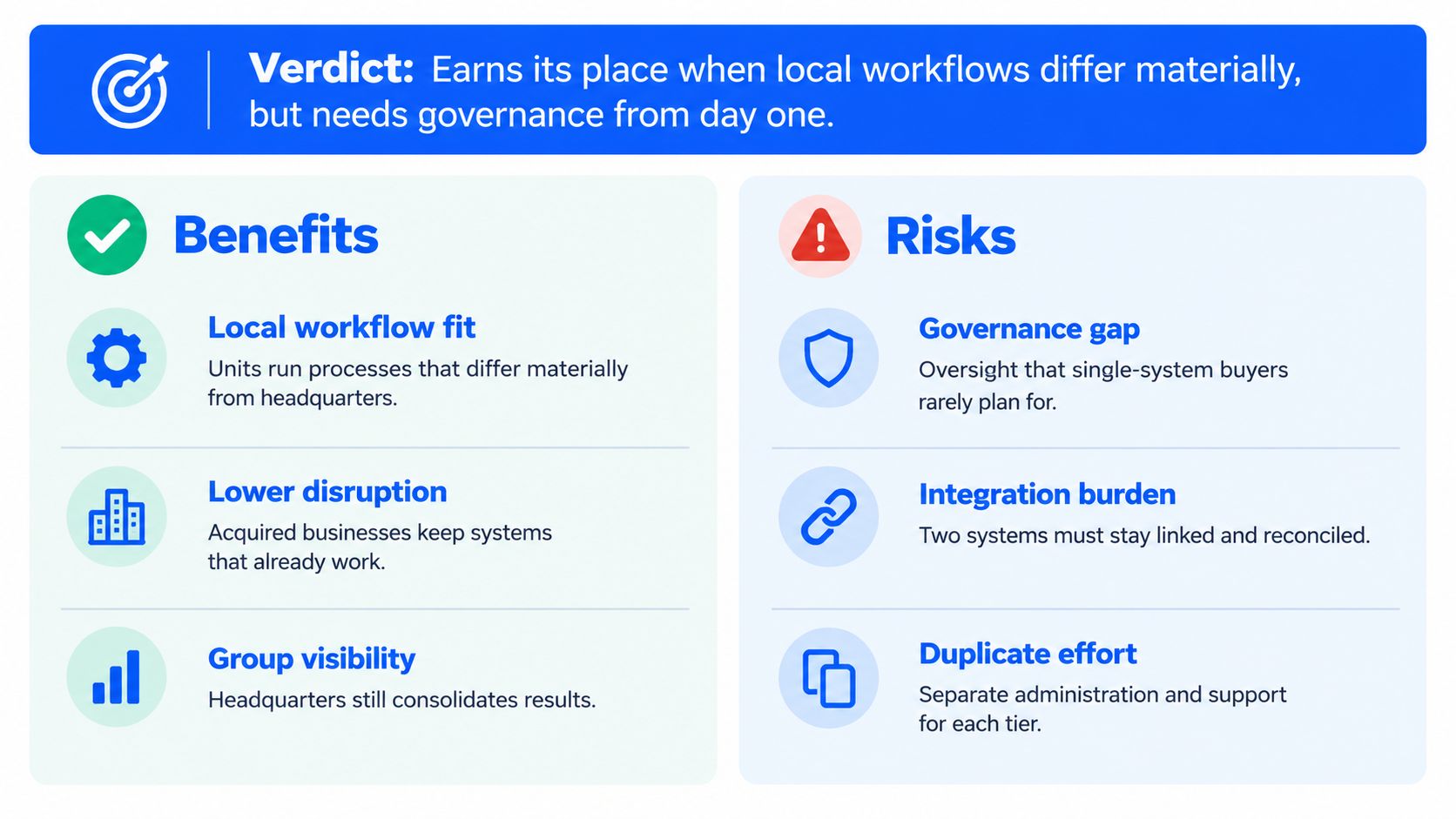
Two-tier ERP earns its place when local workflows differ materially. Treat it as a portfolio decision: every Tier 2 platform is an asset you will support, secure, scale, and eventually replace. The decisive question is whether the company can keep control of its books across that whole life, entity by entity.
A cloud-enabled design can reduce disruption for local operations. An academic review identifies lower implementation risk, shorter installation time, and greater agility in updating local operations as practical effects of cloud-based two-tier ERP (academic review of two-tier ERP). Shared policies, reusable analytics, and common training can also cut repeated development across units, provided the systems integrate and follow shared standards.
Put the long-term risks on the decision sheet
Day-one risks are visible: mismatched timing, duplicate customer or vendor records, failed interfaces, and inconsistent master data. Long-term risks are easier to miss, and they grow with the portfolio. As entities, countries, transaction volumes, reporting needs, and acquisitions expand, a Tier 2 platform may hit scaling limits. The connectors you rely on may stop being maintained, customizations may accumulate until upgrades stall, or the product may turn out to be a poor fit for your industry.
Then there is the exit problem. What happens if the Tier 2 vendor is acquired, changes pricing, or drops an integration? Can you reconcile historical records across systems and consolidate the entity later? An analysis of two-tier ERP risks emphasizes testing those questions early, alongside connector availability, customization creep, and vertical fit (two-tier ERP scaling and exit risks).
Security belongs in the same conversation. Multiple systems mean more interfaces, identities, and control points to monitor, and a working data feed says nothing about how access is managed. Each connected system needs its own access controls and security standards. Apply least-privilege access to users and integration processes, as described in NIST SP 800-53's access-control guidance. NIST's cybersecurity supply chain guidance provides a framework for assessing supplier and integration risks over time.
Five-year test: Forecast entity and transaction growth, document integration dependencies, assign data ownership, estimate recurring reconciliation effort, and define an exit or convergence path.
Use that test to compare total ownership over time rather than the initial setup alone. Include recurring support and reconciliation in your ERP total cost of ownership assessment, and for a practical companion on reducing manual bookkeeping work as a UK business grows, see bookkeeping automation for scaling UK SMEs. If your five-year plan has no credible answer for growth or exit, do not approve the architecture yet.
Where Two-Tier ERP Fits Multi-Site and Multi-Entity Organizations
| Sector | Typically on Tier 1 | Typically on Tier 2 | Pressure point to plan for |
|---|---|---|---|
| Healthcare and multi-site clinics | Group finance, accounts payable, and compliance policy | Clinic billing and location operations alongside EMR systems | Reconciling clinic revenue to the group ledger |
| Nonprofits and faith-based networks | Group chart of accounts and consolidated statements | Fund accounting and grant reporting per chapter or program | Restricted fund dimensions rolling up cleanly to the parent |
| Dental practices and DSOs | Group finance, purchasing controls, and consolidated results | Practice-level operations and local billing | Acquired practices with different systems and charts of accounts |
| Professional services firms | Firm-wide reporting and corporate finance | Practice-office project accounting and billing | Consistent client and engagement records across offices |
The rule is consistent across sectors: keep group-wide standards and reporting at Tier 1; leave local work at Tier 2 when local needs genuinely shape the process. The benefit is not autonomy for its own sake. It's preserving local workflows while giving corporate finance comparable results.
For a clinic group, headquarters can standardize finance, accounts payable, and compliance policy while each location handles billing alongside its electronic medical record system. The finance challenge is making sure clinic revenue ties back to the group ledger. A nonprofit or faith-based network faces a different version of the same design problem: each chapter or program needs fund and grant reporting, while restricted balances must roll up cleanly to the parent. This nonprofit accounting guide explains why tracking restrictions separately matters. A clear multi-entity accounting approach helps define what the group needs to compare without flattening meaningful local dimensions.
Dental service organizations often acquire practices with different systems and charts of accounts. A Tier 2 system can serve as a bridge while finance teams bring their reporting and controls into line. Professional services firms can keep firm-wide reporting central while practice offices handle project accounting and billing, provided client and engagement records map consistently across offices.
Two-tier ERP fits when local dimensions matter to the people running each unit and the group still needs consolidated oversight. It's the wrong answer when a single location, or one set of rules for every entity, would do. In that case, another system boundary adds work without solving a real operating problem.
Implementation Decisions and a Migration Checklist
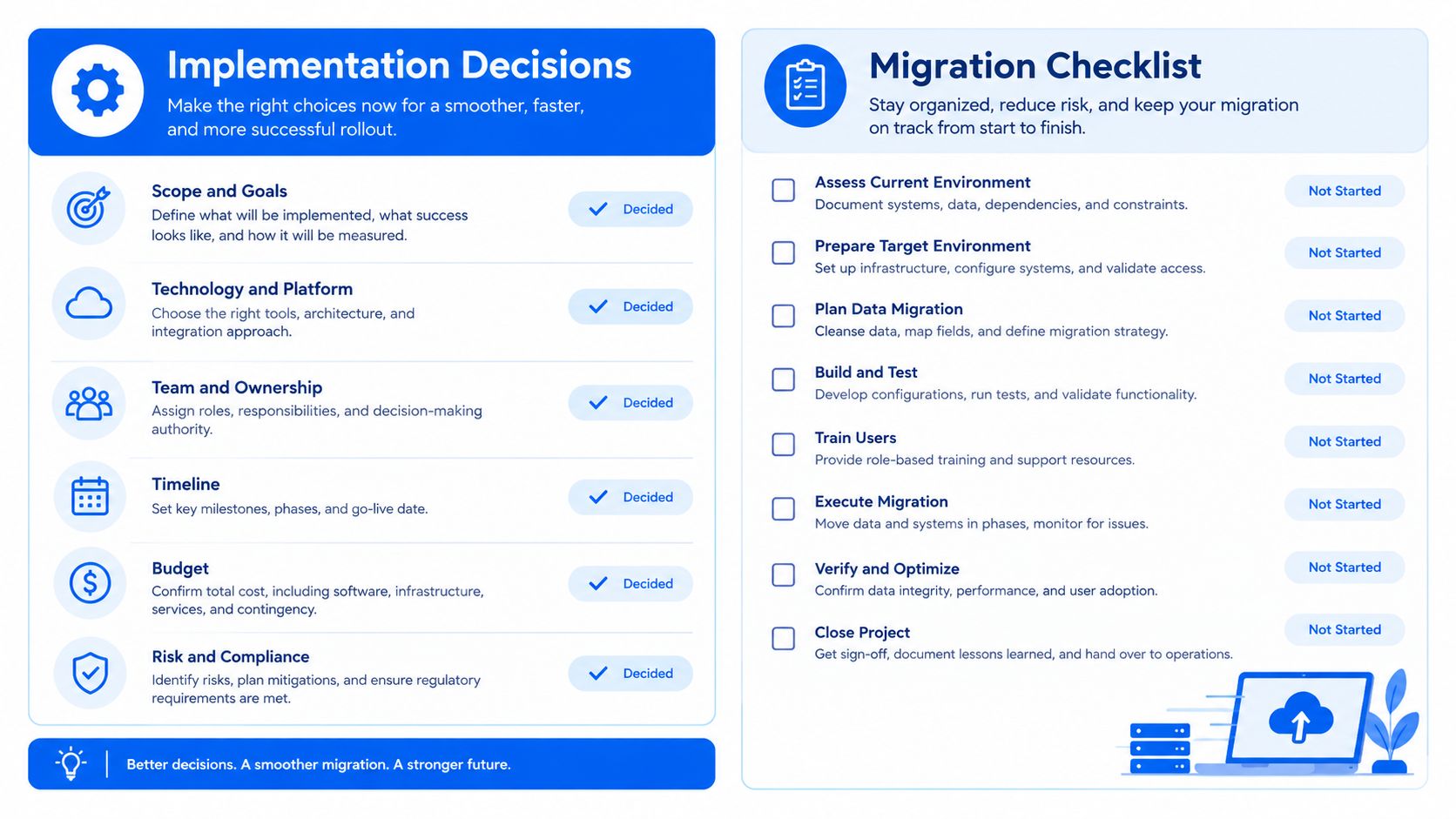
Buying software gives you a platform. It doesn't decide which system owns the chart of accounts, how data moves, or whether the month-end close works across the boundary. Those design decisions determine whether a two-tier arrangement produces reliable group reporting or a permanent stream of manual corrections.
Use this sequence to settle the operating model before go-live:
- Map entities and calendars. Record each legal entity, its current system, local owner, and close calendar so the rollout reflects how the company really operates.
- Set the central-versus-local gate. Decide which processes must be common across the group and which can remain local. Tie the choice to accountability and reporting requirements, not software defaults.
- Design the shared reporting structure. Create one group chart of accounts and reporting dimensions, then document how each entity maps local accounts to the standard. Microsoft's subsidiary consolidation guidance illustrates account and dimension mapping.
- Assign master-data ownership. Name an owner for each customer, vendor, item, and other shared record. Write validation rules so teams know who can create, change, and approve records.
- Inventory integrations. List every data flow and choose a suitable method, such as a prebuilt connector, API, or middleware. Include the owner and error-resolution process for each connection. Review connector capabilities and limits against the specific systems involved, as illustrated by Microsoft's SAP ERP connector documentation.
- Clean and reconcile. Remove duplicate master records before migration, then reconcile opening balances so each entity starts with numbers that tie out. If entities transact with one another, define how intercompany balances will be reconciled and eliminated; Oracle's intercompany elimination documentation illustrates why this needs a defined close workflow. Oracle's financial consolidation guidance also explains when transactions qualify for elimination. Oracle's consolidation overview also distinguishes reporting-only, balance-transfer, and financial-management approaches, depending on the entities' charts of accounts, calendars, and reporting needs.
- Run a parallel close. Compare the new process against the existing close before go-live. Agree the scope up front, including which entities, accounts, and reconciliation checks count as proof.
- Track performance after launch. Capture a baseline before migration and monitor the measures below. A KPI with no starting point can't demonstrate whether the change helped.
The sequence is more important than a feature checklist. Lucentive's Sage Intacct implementation work includes a chart of accounts and dimensions designed for the organization's reporting, custom ERP work only where standard configuration doesn't fit, integrations to systems already in use, and a parallel close before go-live with fixed scope agreed in advance. A structured ERP implementation process helps keep those design decisions connected through delivery.
| KPI | How to measure | Baseline to capture | What it proves |
|---|---|---|---|
| Days to close | Business days from period end to final close, per entity | Last six closes | Whether Tier 2 feeds consolidation on time |
| Consolidation time | Hours needed to produce group statements | Most recent quarter-end | Whether the tier boundary removed manual rework |
| Interface exception rate | Failed or rejected records per 1,000 transactions across each link | Set target during parallel close, since no pre-migration baseline exists | Timing and mapping problems in the integrations |
| Duplicate master records | Customers and vendors that exist in more than one tier | Cut-over date | Whether data ownership rules hold |
| Open intercompany balances | Count and value of unreconciled items at month-end | Each month before go-live | Whether intercompany flows tie out |
| Board or funder pack turnaround | Days from close to delivered pack | Last four packs | Whether the visibility gain is real |
| Entities on the common chart of accounts | Share of entities mapped to the standard | Pre-go-live | Whether group reporting is comparable across entities |
Capture the baselines before migration, not after the new system goes live. Set targets for the measures that don't have a meaningful pre-migration baseline, particularly interface exceptions, during the parallel close. Define time-to-value as the number of closes it takes to complete the first clean parallel close against the baseline. That gives decision-makers a measurable milestone without promising savings before they have evidence.
Confirm the Fit Before You Buy Sage Intacct
A two-tier design is a portfolio decision, not a shortcut around one large system. The platform you pick now has to carry entities you have not acquired yet and unwind cleanly if you ever sell one. So before anyone signs a contract, test whether your current setup can support the next stage instead of buying on a polished demo.
Lucentive is a Sage Intacct Value Added Reseller and Premier Implementation Partner, serving healthcare, nonprofit, and general business organizations. Its fixed-fee ERP advisory runs two to four weeks, builds requirements from your actual close, includes a side-by-side platform comparison, and ends with an honest fit assessment that may recommend staying where you are. The fee starts at $5,000 and is credited against implementation if you proceed with Lucentive.
For a two-tier plan, that assessment should work from your entity map, close calendar, and data ownership rules. Review Sage Intacct for growing organizations against those requirements, then put it through a working session or a custom demo built around your entities and close calendar.
Summary
Two-tier ERP pairs a headquarters Tier 1 system with linked Tier 2 systems for subsidiaries. Tier 1 owns group standards and consolidation; Tier 2 supports local workflows. Data can flow through autonomous or shared-services models. Compared with single-tier or multi-tier setups, two-tier trades local agility for integration and governance work. It can suit clinics, nonprofits, dental groups, and professional services firms, but scaling, connector, and exit risks need attention. Map entities, define data ownership, test a parallel close, and baseline KPIs. A fixed-fee assessment and a 30-minute working session can help test Sage Intacct fit before purchase.
Frequently Asked Questions
What is the difference between a two-tier ERP and a single ERP?
A single-tier ERP runs one system across every entity, while two-tier ERP keeps a headquarters system and separate subsidiary systems linked by integration. The single-tier approach has minimal integration between ERP instances because there's one system to govern. Two-tier gives local entities more room to run distinct workflows, but finance teams must define data ownership, reconciliation, and reporting across the system boundary.
Is two-tier ERP the same as multi-tier ERP?
No. Two-tier ERP uses a headquarters system and one or more subsidiary systems. Multi-tier ERP, as used here, means three or more layers, such as a parent company, regional hubs, and local sites. Each added layer creates more interface chains and ownership decisions, so use multi-tier only when regional structures need their own governance role.
Which organizations benefit most from two-tier ERP?
Multi-site clinics, nonprofits with fund and grant reporting, dental groups with acquired practices, and professional services firms with practice-level project accounting can benefit when local processes differ from group requirements. The key condition is that local dimensions matter to the people running each unit, while headquarters still needs consolidated reporting. If all entities follow the same rules, a single-tier setup may be simpler.
What is the biggest long-term risk of two-tier ERP?
The main risk is an architecture that becomes difficult to scale or exit as the organization adds entities, countries, transactions, and reporting needs. Connector availability, customization creep, and a poor vertical fit can also create problems. Before committing, establish what happens if a Tier 2 product changes ownership or pricing, or drops an integration, and how historical records would be reconciled.
What should a buyer check before committing to two-tier ERP?
Check the entity map, data ownership rules, integration inventory, and plan for a parallel close. Capture baseline KPIs before migration so the finance team can assess close timing, consolidation effort, and reporting comparability after go-live. A fixed-fee advisory can help test whether the current setup can support the next stage and whether a new system is warranted.
Lucentive offers ERP advisory and implementation support to help finance leaders assess whether a two-tier Sage Intacct design fits their entities, reporting needs, and close process. Schedule a 30-minute working session or a demo built around your company's requirements by visiting Lucentive.