The controller has stopped promising a reliable close date. A U.S. parent, a U.K. subsidiary, and a Canadian entity now share one finance team, but each company still behaves like a separate accounting environment. Bank reconciliations happen manually, intercompany invoices wait for someone to match them, and leadership receives consolidated results after the decisions those results should have supported.
That's the point where multi entity accounting becomes a close-cycle and control problem before it becomes a reporting problem. Sage Intacct can provide the financial architecture, but the outcome depends on entity design, policies, data discipline, and implementation decisions. Software alone won't repair a structure that was never designed to close cleanly.
Table of Contents
- The Three-Entity Finance Team That Stopped Closing on Time
- What Multi Entity Accounting Actually Means
- How Consolidation Works in Practice
- Intercompany Transactions and the Matching Control That Catches Them
- Currency, Tax, and Cross-Border Realities
- What to Fix First When the Books Start Slowing You Down
- Why the Partner Matters More Than the Software
- Summary
- Frequently Asked Questions for Finance Leaders
- What counts as multi entity accounting?
- When should a company move beyond separate QuickBooks files?
- How do intercompany eliminations work during consolidation?
- What is an elimination entity in Sage Intacct?
- Should intercompany balances be eliminated automatically or manually?
- What close-cycle improvement should finance leaders expect after implementation?
The Three-Entity Finance Team That Stopped Closing on Time
The controller's calendar looked manageable when the U.S. parent operated alone. After adding a U.K. subsidiary and a Canadian entity, the same close process began stretching from five days to fourteen. That close-delay range is consistent with independent coverage describing four to ten additional days for teams managing three to five entities, including a median of six days in APQC benchmarking. The operational impact of adding entities is often more immediate than the consolidation issue executives first notice.
The team reconciled three bank accounts manually. A transfer-priced services invoice sat in the U.S. ledger while the U.K. entity recorded the related expense under a different account and without a consistent counterparty reference. Then two people touched the same GBP revaluation journal, leaving the controller to determine which entry belonged in the books.
Nothing about the individual ledgers looked catastrophic. Each entity could produce a trial balance. The problem surfaced when the team tried to prove that the ledgers belonged together. Different account structures, timing differences, and unclear ownership of journal entries turned a routine close into an investigation.
Practical rule: If adding an entity extends the close before it improves visibility, treat the structure as a control issue, not merely a software limitation.
I've watched this pattern play out across mid-market finance teams scaling beyond three to five entities. The controller doesn't want another spreadsheet or a later reporting deadline. They want a predictable close, defensible numbers, and a chart of accounts that behaves consistently across entities.
What Multi Entity Accounting Actually Means
Multi entity accounting means maintaining the books for more than one legal or operating entity under one finance function, then bringing those records together for group reporting. Each entity may have its own bank accounts, customers, vendors, tax obligations, statutory filings, and trial balance. Group finance still needs a consistent view of performance, liquidity, obligations, and financial position.
A legal entity is an incorporated company, LLC, subsidiary, or other organization that files or reports in its own name. A management entity is an internal structure, such as a division, region, location, department, or profit center, used for decision-making without necessarily being a separate legal filer. Confusing the two creates bad design decisions. A management dimension usually belongs inside a ledger, while a legal entity may require separate books, policies, currency treatment, and statutory reporting.
The group reporting layer is consolidation. Under IFRS 10 and U.S. GAAP ASC 810, the parent presents the group as a single economic entity by combining assets, liabilities, equity, income, expenses, and cash flows, then eliminating intra-group effects. PwC's consolidation guidance explains why this matters. Without eliminations, the same transaction can appear in both the seller's and buyer's books, overstating activity at the group level.
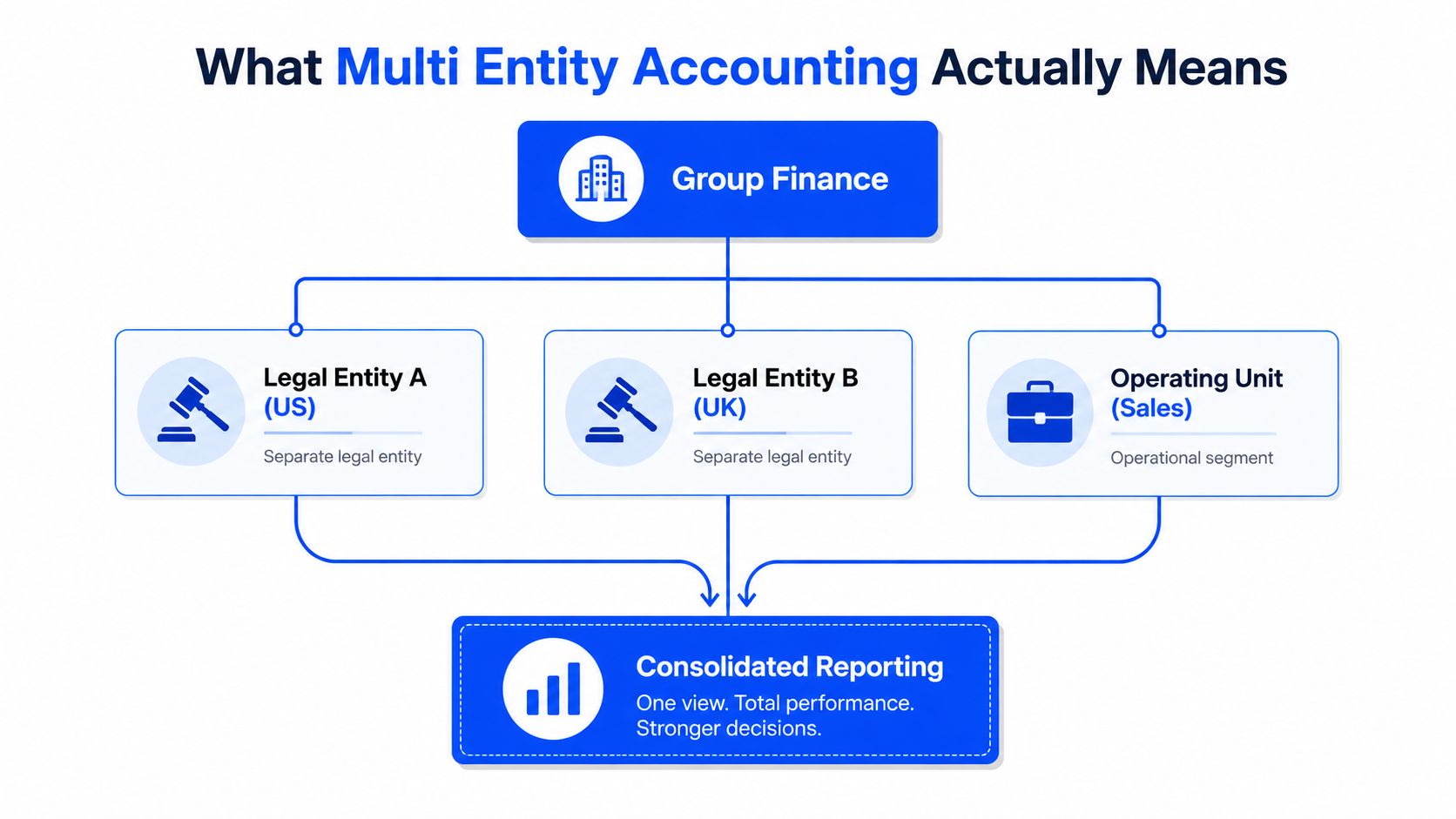
The complexity usually comes from four sources:
- Different accounting frameworks: Entities may report under U.S. GAAP, IFRS, or local statutory rules.
- Different calendars: Fiscal years, reporting cutoffs, and filing deadlines may not align.
- Different account structures: Similar transactions may land in different accounts or dimensions.
- Different currencies: Entity books may need translation into a group reporting currency.
A practical overview of the benefits of consolidating and automating finances is useful, but the implementation question is more pointed: can your finance team produce group numbers without rebuilding the organization in spreadsheets?
How Consolidation Works in Practice
A sound consolidation process follows the order in which accounting decisions affect the group financials. Teams that reverse the order often spend close week correcting configuration decisions that should have been settled before transactions were posted.
Start with control, not ownership alone
First determine who controls each entity and which consolidation method applies. Under ASC 810, a reporting entity consolidates a separate legal entity when it has a controlling financial interest. For a variable interest entity, the analysis considers whether the reporting entity has a variable interest that provides control, while the voting-interest model may apply for non-VIEs. More than 50% voting ownership generally points toward consolidation for a non-VIE, but majority ownership doesn't remove the need to assess whether the entity is a VIE first. Deloitte's ASC 810 overview provides the relevant framework.
IFRS uses a single control model, while U.S. GAAP uses separate VIE and voting-interest models. Deloitte's comparison of U.S. GAAP and IFRS highlights why entity structure data must include decision rights and exposure to losses or returns, not just an ownership percentage.
Normalize before you consolidate
Next, align the chart of accounts and entity dimensions. The consolidation system needs to know that “professional services revenue” in one entity maps to the group's required revenue line, even if the local ledger uses a different account name. If that mapping happens manually every month, the finance team hasn't solved consolidation. It has moved the work into a recurring spreadsheet task.
Then load each entity's trial balance into the consolidation environment. Foreign currency books must be translated using a method consistent with functional currency and reporting requirements. Transaction-level remeasurement, period-end revaluation, and financial statement translation serve different purposes, so the configuration must distinguish them.
Eliminate, then present
Elimination journals remove intercompany receivables and payables, revenue and expense, loans, dividends, the parent's investment in subsidiary equity, and applicable unrealized profit in inventory. The result should show the group's relationship with external parties, not internal trading between entities.
| Step | What It Does | Impact on Consolidated Statements |
|---|---|---|
| Control assessment | Determines which entities belong in the group and how they're consolidated | Establishes the reporting perimeter and ownership treatment |
| Account and dimension mapping | Standardizes entity-level trial balances | Places local activity into consistent group reporting lines |
| Trial balance upload and translation | Brings entity books into the reporting currency and period | Creates comparable balances across entities |
| Elimination journals | Removes intra-group balances and transactions | Prevents double-counted revenue, expenses, assets, and liabilities |
| Final statement production | Presents the consolidated balance sheet, income statement, and cash flow | Shows the group as one economic unit, including non-controlling interests where applicable |
The practical test is simple. If the controller has to export every entity, map accounts manually, calculate eliminations separately, and explain FX differences from memory, the process is leaking time before the consolidated statements are even produced. Organizations with complex ownership structures can also review Sage Intacct options for family offices when entity-level reporting and group oversight must coexist.
Intercompany Transactions and the Matching Control That Catches Them
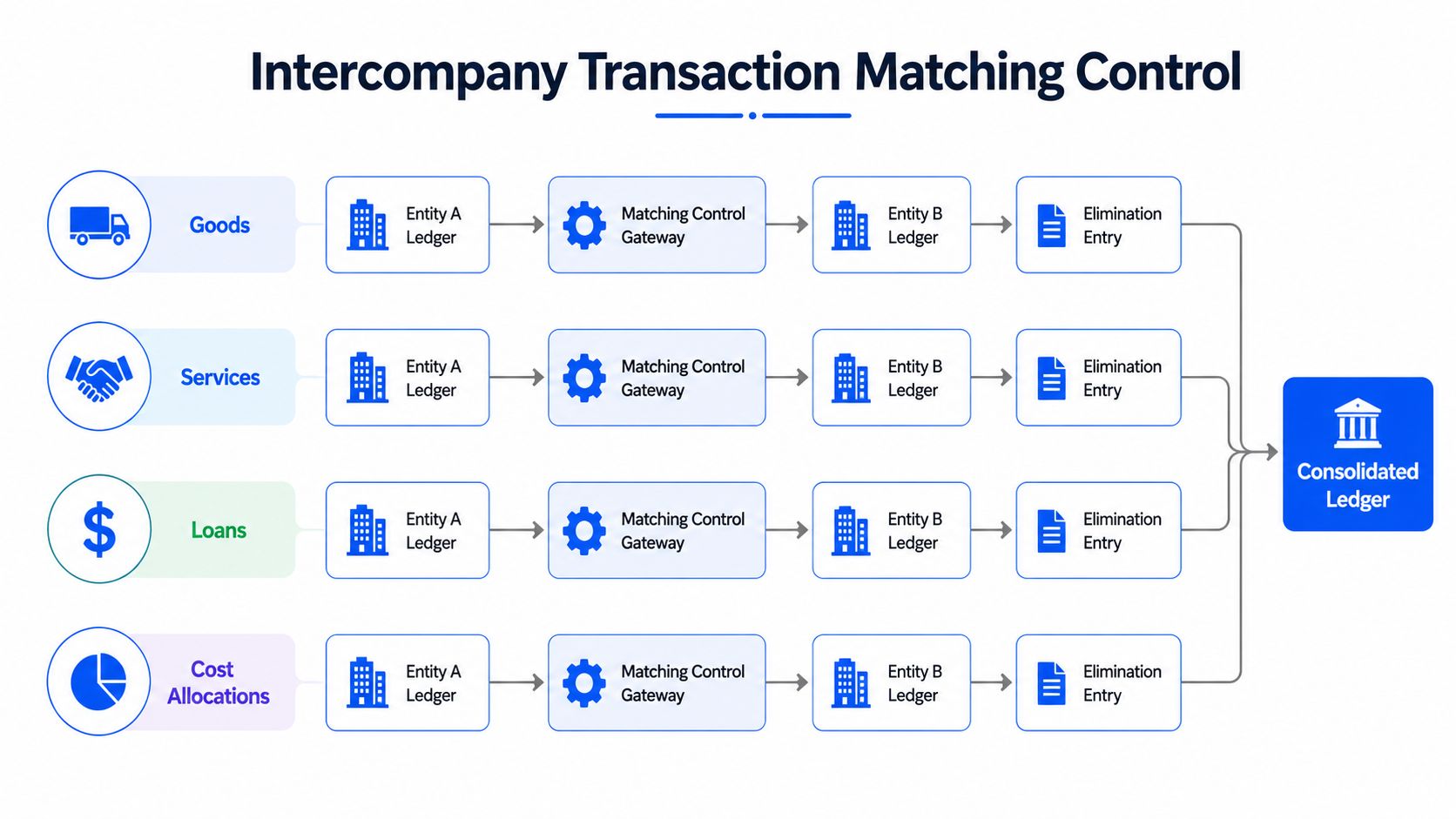
Intercompany accounting covers more than a parent lending cash to a subsidiary. Four transaction types create recurring work:
- Goods: One entity sells inventory or supplies to another, creating revenue, cost, receivables, and payables.
- Services: A shared-services entity bills another company for finance, technology, HR, or management support.
- Loans: One entity funds another, creating principal, interest, and related balance sheet accounts.
- Cost allocations: A central entity distributes insurance, payroll, rent, or other shared costs across operating entities.
Each side records its own entry before consolidation. The group then removes the internal activity. Oracle's intercompany elimination guidance describes the requirement to eliminate balances and transactions between entities under common control, including related rent income and expense.
The weak control is a month-end tie-out performed after all entries are posted. By then, the team is comparing two ledgers under deadline pressure and trying to determine whether a difference comes from timing, currency, account coding, tax treatment, or a missing entry.
Match at capture, not at the deadline
Every intercompany transaction should carry a counterparty field, transaction type, reference, currency, and agreed accounting treatment. The system should use those fields to identify the expected reciprocal entry as soon as the transaction is captured.
Common causes of mismatch include:
- Timing differences: The selling entity posts before the buyer receives or approves the invoice.
- FX revaluation gaps: Each entity revalues the balance using a different rate or date.
- Account errors: One side uses an intercompany receivable while the other uses a general receivable.
- Tax and book divergence: The invoice is treated differently for VAT, GST, withholding, or local book purposes.
- Missing references: The entry exists, but no counterparty or transaction identifier connects the two sides.
The elimination journal should be the final result of clean upstream data, not a disguise for unresolved differences. A balanced elimination entry can still conceal a source-system problem if the underlying transactions were never matched.
Control test: Elimination journals should have offsetting debits and credits, but a balanced journal doesn't excuse an unexplained source mismatch.
The Sage Intacct reseller overview can help finance leaders assess the platform and partner model together. That distinction matters because matching rules, approval paths, and counterparty data need to be configured before the first close, not invented during it.
Currency, Tax, and Cross-Border Realities
Cross-border accounting fails when teams treat currency, tax, and transfer pricing as separate workstreams. They're connected through the intercompany matrix, the entity's functional currency, the reporting currency, and the timing of each transaction.
Start by identifying the functional currency for each entity under ASC 830 or IAS 21. That decision determines whether transactions are remeasured into the functional currency or translated for group reporting. A transaction-date spot rate, a period-end revaluation rate, and an average rate used for income statement translation are not interchangeable.
Use the right rate for the right purpose
| Statement Area | Rate Applied | Revaluation Trigger |
|---|---|---|
| Foreign-currency transaction | Transaction-date spot rate | Settlement or period-end remeasurement under the entity's policy |
| Monetary balance | Period-end rate for remeasurement | Reporting cutoff or another defined close event |
| Income statement activity | Approved average rate for the reporting period, where appropriate | Period close and consolidation translation |
| Equity and historical balances | Rate required by the applicable accounting framework | Original recognition or designated reporting event |
| Consolidated presentation | Entity results translated into the group reporting currency | Consolidation calendar and reporting cutoff |
The process must also identify where FX gains and losses belong. Remeasurement affects the entity's books, while translation differences may be presented through other income depending on the applicable framework and facts. A finance team that posts foreign currency adjustments directly into whatever account appears convenient will eventually struggle to explain the movement to auditors and board members.
Put tax policy inside the transaction design
VAT and GST registrations, withholding taxes on intercompany payments, U.S. state nexus, and EU transfer-pricing documentation affect how entities invoice and record activity. These obligations don't run in parallel with accounting. They influence the counterparty, account, tax code, documentation, and settlement process.
Transfer pricing policy should exist before the first cross-border services invoice. If the policy is created only after a tax authority inquiry, finance may need to reconstruct the commercial rationale, pricing basis, invoice history, and supporting documentation from fragmented records. Guidance on international expansion accounting challenges reinforces the need to design for multiple reporting frameworks, digital reporting requirements, transfer pricing, and currency volatility together.
The right sequence is clear: establish functional currencies, define translation and revaluation rules, document the intercompany pricing model, map tax treatment, then configure the accounting workflow. Don't let a software default decide any of those policies.
What to Fix First When the Books Start Slowing You Down
CFOs often ask whether to start with software, the chart of accounts, intercompany reconciliation, FX, or the reporting calendar. The answer is a sequence, not a shopping list. Fixing the issues out of order creates rework because each downstream process depends on the structure above it.
First, establish the reporting foundation
Begin with the consolidated chart of accounts and entity dimensions. Define the group-level reporting lines, required statutory accounts, departments, locations, programs, funds, projects, and other dimensions before migrating historical data or configuring reports.
This is the foundation because every consolidation, dashboard, allocation, and audit request relies on consistent classification. A healthcare group may need entity, clinic, provider, payer, and service-line visibility. A nonprofit may need fund, grant, restriction, and program reporting. A professional services firm may need entity, project, client, and practice-level views. Those management dimensions shouldn't be confused with legal entities, but they must work together.
Second, write the intercompany policy
The policy should name:
- Required fields: Counterparty, transaction code, currency, invoice reference, and approval owner.
- Matching rules: What constitutes a match and which differences require investigation.
- Timing tolerance: When a timing difference remains acceptable and when it escalates.
- Resolution ownership: Which entity controller corrects the source entry.
- Elimination treatment: Which accounts and transaction classes are removed at consolidation.
Third, design FX around the reporting currency
Set the rate sources, rate dates, revaluation ownership, translation approach, and review controls before configuring reports. This prevents each entity from creating its own interpretation of the group's currency process.
Fourth, connect the statutory calendar
Tie entity close dates, tax filings, audit requests, board reporting, and consolidation deadlines into one dependency map. A statutory filing that relies on a local close should be visible to group finance before the consolidated reporting deadline becomes immovable.
CFO's priority: Build the shared structure first, then automate the transactions that depend on it.
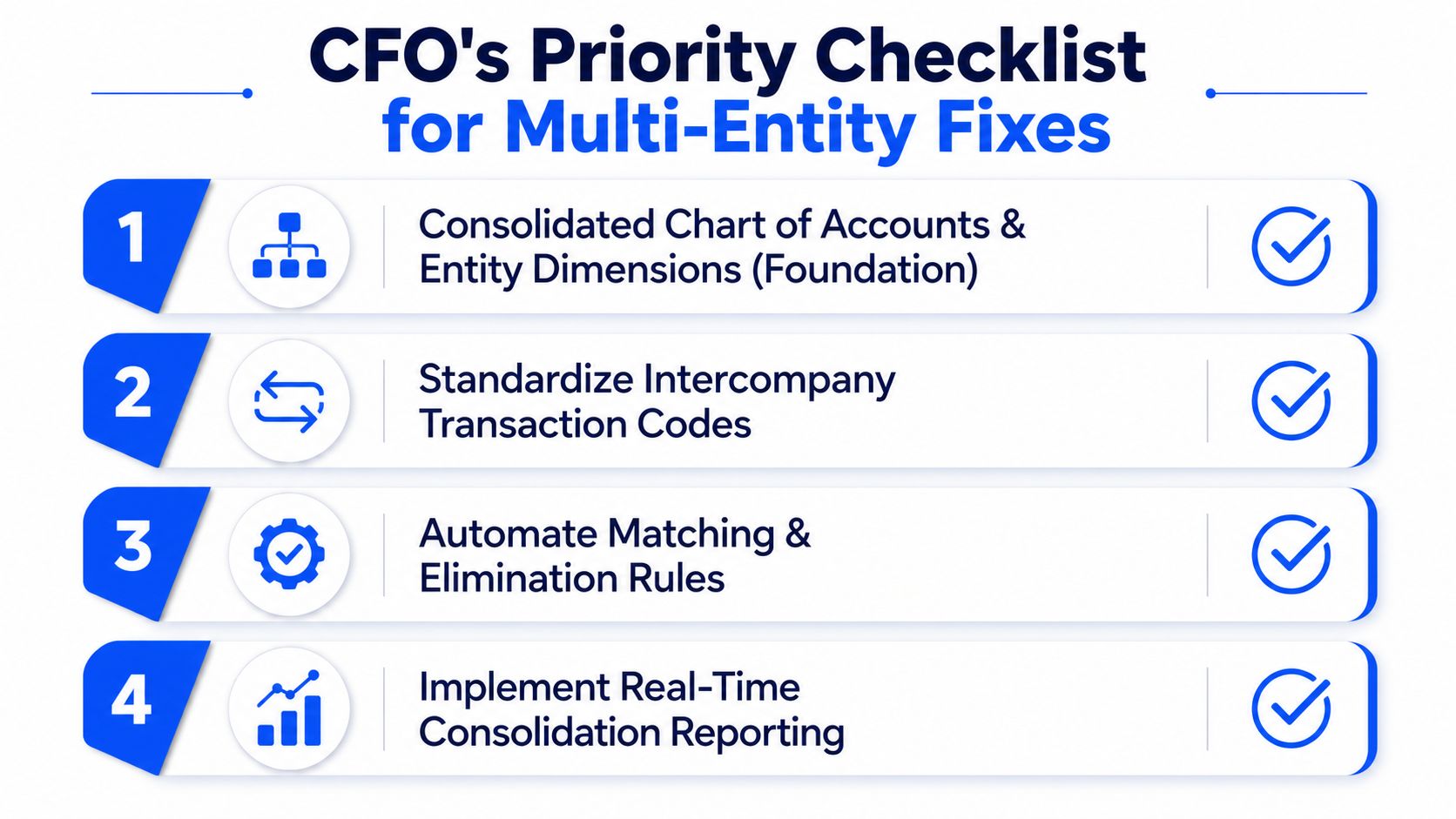
This sequence also makes change management more practical. The ERP change management approach should give entity controllers clear ownership of new fields, approvals, close tasks, and exception handling. Otherwise, the organization may install a better system while preserving the old behaviors that caused the delays.
Why the Partner Matters More Than the Software
Three general ledgers from the same vendor can still produce three different consolidated trial balances when the implementation is wrong. The vendor may provide the engine, but the partner decides how entity relationships, accounts, dimensions, intercompany rules, FX tables, approvals, and cutover controls fit together.
A specialist implementation should address the operating model before configuration:
- Entity structure: Determine which organizations belong in the reporting group and how ownership, control, and statutory needs affect design.
- Chart of accounts: Build a structure that supports statutory reporting and management analysis without forcing recurring manual remapping.
- Intercompany controls: Configure transaction codes, counterparty requirements, matching logic, approvals, and eliminations in the right order.
- FX governance: Align rate tables, revaluation tasks, translation rules, and the consolidation calendar.
- Cutover discipline: Preserve the audit trail, opening balances, supporting schedules, and approval evidence through migration.
The weaker approach is easy to recognize. A generic reseller configures the modules used in a demonstration, loads sample entities, and declares success at go-live. The finance team discovers the missing account mappings, inconsistent dimensions, and broken intercompany logic during the first real close, when correcting the design is more disruptive and expensive.
Lucentive is a Sage Intacct National Premier Partner with experience serving mid-market organizations, including healthcare and nonprofits. Its Sage Intacct implementation work can address multi-entity ledgers, intercompany transactions, consolidations, approvals, and reporting as part of the finance operating model rather than treating them as isolated features.
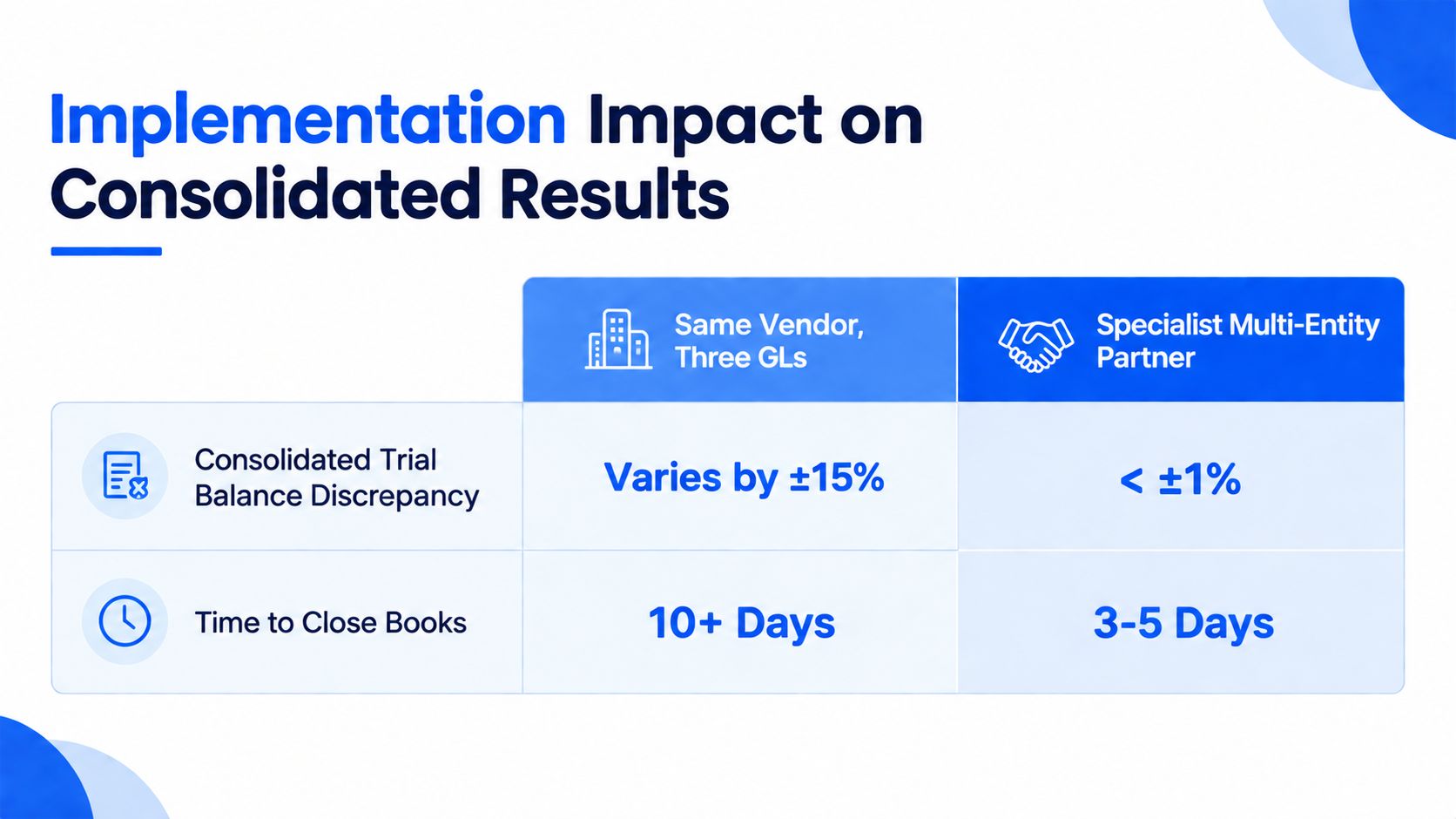
The meaningful milestone isn't go-live. It's the first month-end close after go-live, when the team must produce defensible numbers without recreating the old spreadsheet process. CFOs evaluating Sage Intacct should ask prospective partners to explain how they'll test that close, document exceptions, and transfer ownership to the finance team. A multi-entity readiness review is a better starting point than a generic product demo, and this ERP implementation change-management guidance offers a useful lens for evaluating adoption risk.
Summary
Multi entity accounting breaks down when entity design, intercompany policy, FX rules, and reporting calendars evolve separately. The practical fix is to build a shared reporting structure first, enforce intercompany matching at capture, define currency and tax treatment before volume grows, and test the first post-implementation close as rigorously as go-live. For finance leaders, the goal is not simply consolidated reporting. It is a close process that stays predictable as new entities, currencies, and statutory obligations are added.
Frequently Asked Questions for Finance Leaders
What counts as multi entity accounting?
Multi entity accounting covers any finance environment where one team manages the books for more than one legal or operating entity and needs both entity-level and group-level reporting. In practice, the challenge is not just maintaining separate ledgers. It is aligning account structures, currencies, intercompany activity, and close controls so the group can report as one economic unit.
When should a company move beyond separate QuickBooks files?
The right time is when each added entity creates recurring manual work in consolidation, intercompany reconciliation, FX, or reporting. The operational trigger is usually not entity count alone. It is when finance can no longer produce timely consolidated numbers without exporting files, remapping accounts, and rebuilding support outside the system.
How do intercompany eliminations work during consolidation?
Intercompany eliminations remove internal balances and activity so the consolidated statements reflect only the group's position with outside parties. Typical eliminations include intercompany receivables and payables, loans, revenue and expense, inventory transfers, and stock ownership effects. Sage Intacct documentation also highlights these categories and explains that the elimination process is handled through an elimination entity within consolidation (intacct.com, intacct.com).
What is an elimination entity in Sage Intacct?
An elimination entity is the entity used to hold consolidation entries that remove intercompany activity at the group level. Sage Intacct states that elimination entries, currency translation adjustments, and other consolidation postings can be recorded there during the consolidation process. For finance leaders, that matters because it creates a clearer audit trail than disconnected spreadsheet journals (intacct.com).
Should intercompany balances be eliminated automatically or manually?
Automatic elimination is usually the stronger control when the underlying intercompany data is complete and consistently coded. Sage Intacct documentation notes that when auto-elimination is not enabled, users must manually post elimination entries. Manual elimination may still be necessary for unusual transactions or cleanup, but it should be the exception rather than the default because manual journals are harder to scale and review consistently (intacct.com).
What close-cycle improvement should finance leaders expect after implementation?
The best outcome is a shorter and more predictable close because the team is no longer repeating account mapping, intercompany tie-out, FX adjustments, and consolidation steps in spreadsheets. Improvement depends on the starting process and adoption quality, but vendor messaging around multi-entity automation often points to major efficiency gains, including claims to cut close time substantially when consolidation and eliminations are configured correctly (sage.com). Finance leaders should still ask for a baseline, a target-state workflow, and proof during the first live close rather than accepting a generic promise.
The right next step is a readiness review that examines entity structure, account mapping, intercompany policy, FX, reporting deadlines, and the first-close plan before anyone recommends a package.
Lucentive helps finance leaders evaluate and implement Sage Intacct for multi-entity accounting, with practical attention to consolidation, intercompany controls, reporting, and audit readiness. Visit Lucentive to schedule a 30-minute working session or request a custom Sage Intacct demo focused on your company's entity structure and close process.