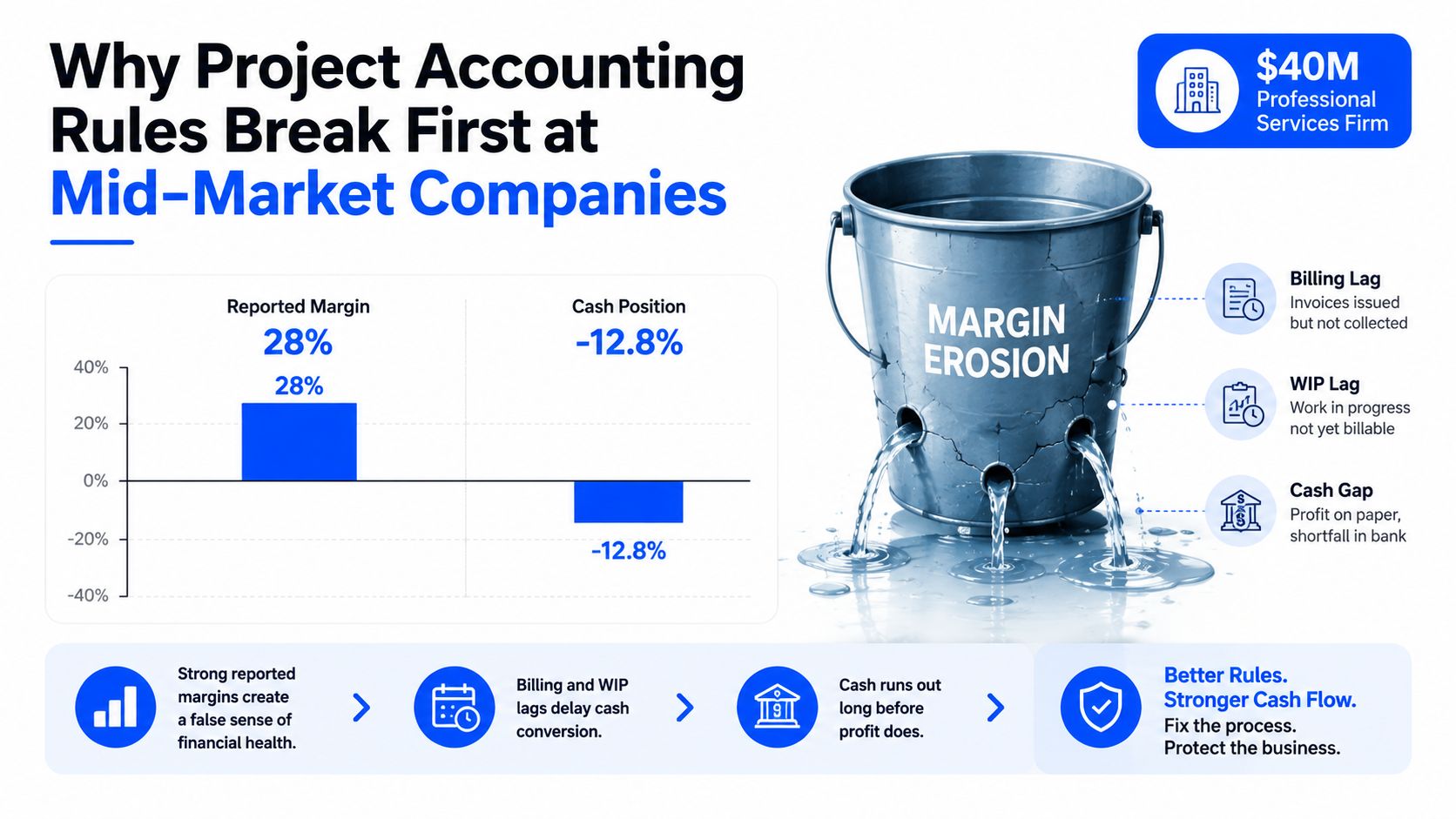
A project with 28% reported margin can still leave the bank account trailing by $1.2 million when billing lags, WIP is misclassified, and cost-to-complete estimates aren't refreshed. The project accounting rules that close that gap are straightforward: define the project structure, measure progress objectively, capture costs completely, tie billing to contractual events, and reconcile earned revenue to billed and unbilled work.
The situation is familiar. A CFO at a $40 million professional services firm reviews the monthly project report and sees healthy margins, yet cash is short and the Controller is posting late WIP entries during the close. Project managers trust their own spreadsheets, billing owns a separate schedule, and finance discovers estimate changes only when the quarter is nearly over.
Project accounting rules are the connective tissue between operational decisions and the financial statements the board reads. They determine when work becomes revenue, which costs belong to a project, what can be billed, how WIP is classified, and whether a reported margin reflects current economics or stale assumptions.
Mid-market companies hit this wall when spreadsheets no longer provide control, but the existing ERP still stores time, expenses, contracts, billing, and the general ledger in disconnected places. A real fix requires more than a new report. It requires a defined project structure, disciplined cost and revenue recognition, complete time and expense capture, billing cadence tied to milestones, and exception dashboards reviewed before the close.
Table of Contents
- Why Project Accounting Rules Break First at Mid-Market Companies
- Setting Up the Project Structure Before the Rules
- Cost and Revenue Recognition Rules That Hold Up to Audit
- Applying the Recognition Rules to a Live Project
- Time, Expense, and Billing Rules That Protect Margin
- Reporting Rules and Dashboards Finance Leaders Actually Use
- From Rules on Paper to Rules in the System
- Summary
- FAQ
- What are project accounting rules?
- Why do project accounting rules matter to CFOs?
- What is the biggest project accounting risk at mid-market companies?
- How often should estimate-at-completion be updated?
- What is the difference between earned revenue and billed revenue?
- Which dashboards should finance review each month?
Why Project Accounting Rules Break First at Mid-Market Companies
The first failure usually isn't a technical accounting error. It's an operating gap.
A project manager updates an estimate in a spreadsheet, the billing team works from a contract folder, and accounting recognizes revenue from data that arrived late. Each team may perform its task reasonably well, yet the company still reports a margin that doesn't explain the cash position. The bank account exposes the problem because cash follows collections, not reported revenue.
Practical rule: If finance can't trace a project margin from contract terms to costs, recognized revenue, invoices, and collections, the margin isn't decision-ready.
The problem becomes more severe as the organization adds entities, service lines, project managers, and billing models. A fixed-fee engagement needs different controls from time-and-materials work. A retainer may produce recurring invoices while costs fluctuate. A milestone contract can show strong earned revenue before the related invoice is issued, or substantial billings before the underlying obligation is satisfied.
A finance leader should insist on five connected controls, consistent with governance principles emphasized by the Committee of Sponsoring Organizations of the Treadway Commission (COSO):
- A controlled project hierarchy: Every engagement needs an owner, customer, entity, service line, status, and billing model.
- Reliable cost capture: Labor, subcontractors, expenses, and overhead must reach the right project and task.
- A documented recognition method: The contract file should support the choice between over-time and point-in-time recognition.
- Billing tied to the contract: Invoice triggers should follow milestones, recurring periods, or approved time, not habit.
- Weekly exception reporting: Finance should see stale estimates, unbilled WIP, margin variance, and overdue approvals before month-end.
Companies often start looking for multi-entity accounting controls after the reporting problem has already affected cash planning. That timing is understandable, but the better approach is to design entity, project, and billing rules before the ERP configuration hardens them into workflows.
The target isn't a larger reporting package. It's a clean relationship between work performed, costs incurred, revenue earned, invoices issued, and cash collected. For finance teams tightening close discipline, the AICPA's resources on revenue recognition and financial reporting also provide useful context for documenting policy decisions and review controls. Once those relationships are explicit, project accounting stops being a quarter-end reconstruction exercise.
Setting Up the Project Structure Before the Rules
No recognition rule can rescue a project structure that finance can't report on. Start with the accounting architecture, then add the operational detail required to explain performance.
Establish the entity and ledger layer
Every project must belong to the correct legal entity and ledger, especially where legal form and reporting boundaries affect presentation and disclosure, as discussed by the IFRS Foundation on consolidated financial statements. This affects currency, intercompany activity, tax treatment, bank accounts, revenue ownership, and the accounts that appear in consolidated reporting. Don't let users create projects without selecting the entity that owns the contract and the costs.
The ledger layer should also define the chart-of-accounts treatment for labor, subcontractors, materials, reimbursable expenses, deferred revenue, contract assets, and contract liabilities. The Corporate Finance Institute overview of deferred revenue is a useful plain-language reference for teams aligning operational billing with balance sheet presentation. Project dimensions add detail, but they shouldn't replace a coherent general ledger.
Use segments and dimensions with a reporting purpose
Departments, locations, customers, service lines, and projects are common segments. Cost centers and work breakdown structures can provide additional dimensions when managers need to compare phases, deliverables, or internal responsibility.
The test is practical. If a dimension cannot support a report, approval rule, allocation, restriction, or reconciliation, don't add it just because the software permits it. Excessive tagging creates user fatigue and inconsistent data.
A well-designed structure usually answers these questions, and it should support clear management accountability in the way operating metrics roll into financial reporting, a theme also reflected in CIMA guidance for performance management and the IMA's performance management resources:
- Which entity owns the engagement?
- Which customer and service line generate the work?
- Which department or location carries responsibility?
- Which task or work breakdown element receives the cost?
- Which manager approves progress and estimate changes?
- Which billing owner controls invoices and collections?
Classify the commercial model
Project classes should group work by how the company earns and bills:
- Fixed-fee: Revenue and billing depend on deliverables, progress, or acceptance terms.
- Time-and-materials: Approved hours, rates, and expenses drive invoices.
- Cost-plus: Eligible costs form the billing base, with the contractual markup applied according to the agreement.
- Retainer: Recurring billing may coexist with usage, service limits, or separate deliverables.
Status fields also matter. Quote, active, on-hold, and closed statuses control whether users can enter time, whether invoices can be generated, and whether a project remains in forecast reports. Assign a project manager and billing owner at setup, not after the first invoice fails.
Use Sage Intacct dimensions to make those reporting choices visible in the system. My rule is simple: if a dimension can't be reported on or restricted by, it doesn't belong in the project structure yet.
Cost and Revenue Recognition Rules That Hold Up to Audit
ASC 606 and IFRS 15 aren't abstract references for the Controller. They determine whether the system can explain why revenue appeared in a period, why costs sit in WIP, and why billed amounts differ from earned revenue.
Both standards use a five-step model: identify the contract, identify performance obligations, determine the transaction price, allocate the price to those obligations, and recognize revenue as each obligation is satisfied. The IFRS 15 standard and the FASB summary of ASC 606 make the control-transfer principle explicit. For an over-time obligation, progress must faithfully depict performance, rather than just follow invoice timing.
Make the recognition decision explicit
The first decision is whether the obligation is satisfied over time or at a point in time. Under ASC 606, an over-time obligation is recognized by measuring progress toward complete satisfaction, and the standard doesn't require the old label “percentage-of-completion.” It does require an objective measure of progress, as explained in Deloitte's guidance on measuring progress.
Input methods can use costs incurred, labor hours, labor dollars, machine hours, or material quantities. Output methods can use milestones, surveys of work performed, appraisals, or units delivered, as summarized in Baker Tilly's ASC 606 construction guidance. Choose the method that reflects actual performance and document why.
| Contract Type | Recognition Method | Key Estimate Inputs | Audit Documentation |
|---|---|---|---|
| Fixed-fee implementation | Over time when criteria are met, otherwise point in time | Total estimated cost, costs incurred, deliverable evidence | Contract, performance-obligation analysis, approved EAC, progress support |
| Time-and-materials services | As approved services are performed | Labor hours, billing rates, approved expenses | Time records, rate schedule, approvals, invoices |
| Milestone engagement | At or over milestones when the obligation is satisfied | Acceptance evidence, milestone status, remaining effort | Contract, acceptance record, milestone reconciliation |
| Retainer arrangement | As the contracted service obligation is satisfied | Service scope, usage, recurring obligations | Order terms, service records, recurring invoice support |
Cost codes must distinguish labor, subcontractor fees, allocated overhead, materials, reimbursable items, and assets that qualify for capitalization, particularly where capitalization policy and subsequent measurement need to be applied consistently under guidance such as IAS 38 Intangible Assets. Don't bury all project spending in one “project cost” account. Auditors need to see what was incurred, what was capitalized, what was billed, and what remains in WIP.
The file should contain the contract, approved estimate-at-completion, periodic EAC refreshes, evidence supporting progress, and the reconciliation between recognized revenue and billed versus unbilled WIP. Teams documenting those judgments may also find the KPMG handbook on revenue recognition helpful when comparing policy interpretations and disclosure expectations. For subscription and recurring-service models, Sage Intacct subscription and SaaS accounting can be evaluated alongside project controls, but the accounting conclusion still comes from the contract terms and performance obligations.
Applying the Recognition Rules to a Live Project
Consider a 12-month fixed-fee implementation project priced at $480,000. The approved estimate assigns $320,000 to labor, subcontractors, and materials. The contract is treated as one performance obligation satisfied over the engagement, and the cost-to-cost input method measures progress.
By month six, the team has incurred $160,000 of eligible project cost. That represents 50% completion, so earned revenue is $240,000, calculated as project price multiplied by actual completion. The remaining $160,000 of expected cost stays in WIP until later periods, assuming the costs meet the project's capitalization and recognition policy.
The billing schedule is separate from revenue recognition. Three milestone invoices of $120,000 each are triggered by deliverable acceptance, not calendar dates. If the first two milestones have been accepted by month six, the project has billed $240,000, matching earned revenue. If only the first milestone has been accepted, the project has earned $240,000 but billed $120,000, creating an under-billed position.
| Month | Costs Incurred | Cumulative Cost % | Earned Revenue | WIP Balance | Billed to Date | Over/(Under) Billed |
|---|---|---|---|---|---|---|
| 1 | $26,667 | 8.33% | $40,000 | $26,667 | $0 | ($40,000) |
| 2 | $26,667 | 16.67% | $80,000 | $53,334 | $0 | ($80,000) |
| 3 | $26,666 | 25.00% | $120,000 | $80,000 | $120,000 | $0 |
| 4 | $26,667 | 33.33% | $160,000 | $106,667 | $120,000 | ($40,000) |
| 5 | $26,667 | 41.67% | $200,000 | $133,334 | $120,000 | ($80,000) |
| 6 | $26,666 | 50.00% | $240,000 | $160,000 | $240,000 | $0 |
| 7 | $26,667 | 58.33% | $280,000 | $186,667 | $240,000 | ($40,000) |
| 8 | $26,667 | 66.67% | $320,000 | $213,334 | $240,000 | ($80,000) |
| 9 | $26,666 | 75.00% | $360,000 | $240,000 | $360,000 | $0 |
| 10 | $26,667 | 83.33% | $400,000 | $266,667 | $360,000 | ($40,000) |
| 11 | $26,667 | 91.67% | $440,000 | $293,334 | $360,000 | ($80,000) |
| 12 | $26,666 | 100.00% | $480,000 | $320,000 | $360,000 | ($120,000) |
The table assumes evenly incurred costs and milestone billing in months three, six, and nine. Actual projects rarely behave so neatly, which is why the Controller should refresh the EAC and milestone evidence rather than let the template drive the close.
The common implementation failures are predictable: a team mixes time-and-materials and fixed-fee allocations on one project, treats subcontractor cost as reimbursable pass-through without contract support, or applies over-time recognition when the customer controls the deliverable only at the end. Guidance from the AICPA revenue recognition resources can help teams pressure-test those conclusions, and the Journal of Accountancy's coverage of ASC 606 is another practical source for implementation questions. Construction project accounting in Sage Intacct should be configured around those contract distinctions, not around a generic project screen.
Time, Expense, and Billing Rules That Protect Margin
Margin leaks at the capture layer long before they appear as a recognition adjustment. If employees record time against a vague task, or submit expenses without project coding, the accounting team can't repair the economics reliably at month-end.
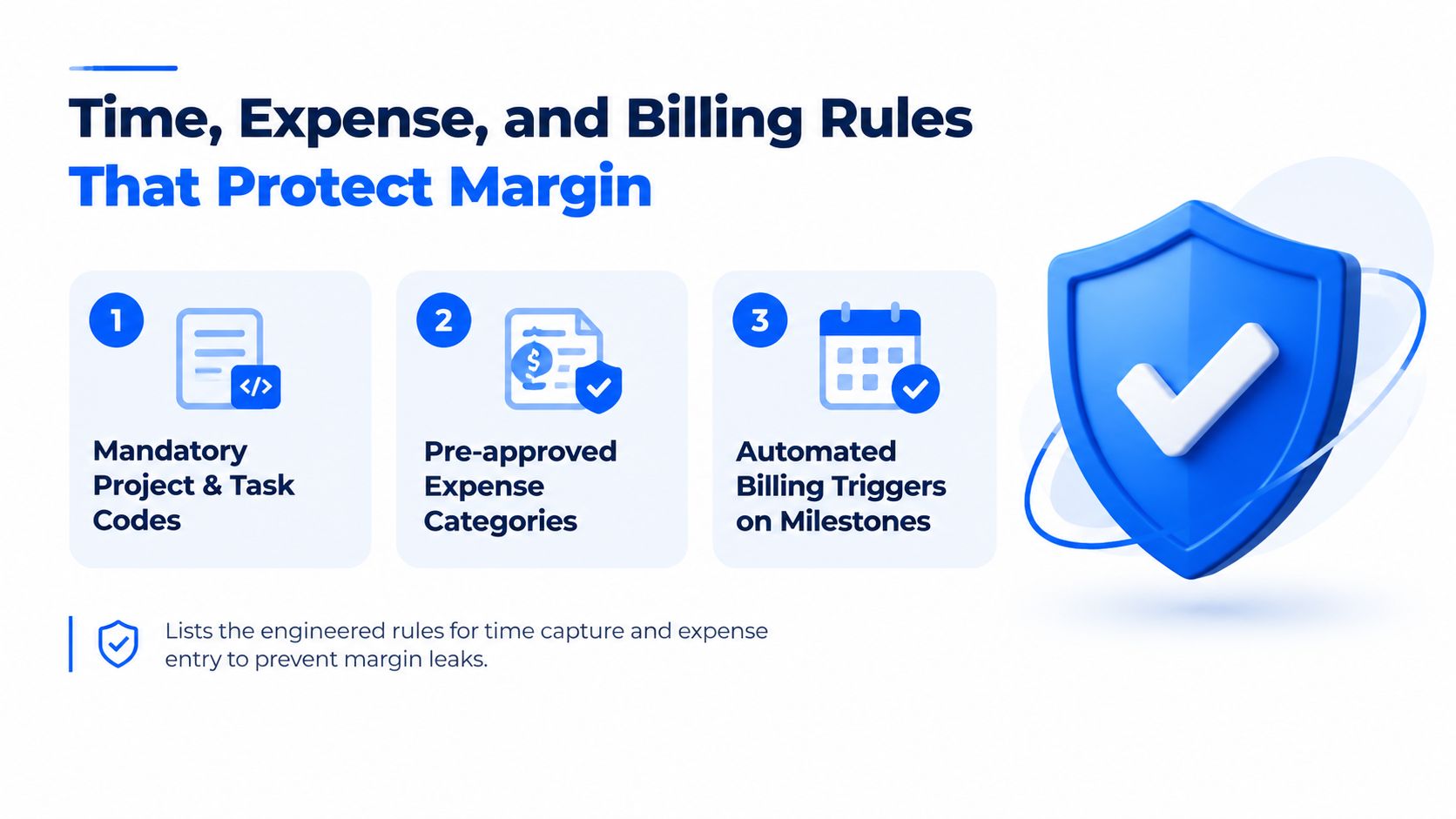
Make project, task, and billable or non-billable coding mandatory on every timesheet line. Require employees to submit the prior week's time by Monday, give managers 48 hours to approve it, and lock the period at month-end. A late entry should create a visible exception, not change WIP after the Controller has reviewed the close.
The strongest project margin control is a complete source transaction, captured when the work or expense occurs.
Expense policy should follow the same design. Require project coding, attach receipts at capture, and distinguish reimbursable expenses from internal project costs. A travel charge that is contractually billable should not be confused with an internal cost that reduces margin. The system should also flag expenses entered to closed, on-hold, or unauthorized projects.
Billing rules should reflect the commercial model:
- Fixed-fee work: Trigger invoices from approved milestones or documented progress.
- Managed services: Generate recurring invoices for the contracted service period.
- Staff augmentation: Bill approved time and eligible expenses at the contracted rates.
- Retention: Show the holdback as a separate invoice line so finance can track the amount due at acceptance.
For the worked example, a $20,000 retention holdback can remain unpaid until acceptance. That amount must be visible in the billing schedule and cash forecast, rather than buried in an aged receivable balance.
A professional services accounting system should support these controls without forcing finance to rebuild the project ledger in spreadsheets. Software can't make an incomplete timesheet accurate, but it can enforce required fields, route approvals, apply billing templates, and preserve the audit trail.
Reporting Rules and Dashboards Finance Leaders Actually Use
Project accounting rules earn their keep in the Monday morning review. The Controller doesn't need a thicker reporting deck. The Controller needs a short exception list that explains which projects threaten margin, cash, or the close.
Build four dashboards, and give each one an owner, refresh cadence, and escalation threshold.
Project margin by engagement
Show labor cost, subcontractor cost, other project cost, earned revenue, billed revenue, and the earned-versus-billed spread by project. Let the CFO drill from the portfolio view to the contract, task, time entry, expense, invoice, and journal entry.
Billing backlog and WIP aging
A billing backlog should be aged into 0 to 30 days, 31 to 60 days, 61 to 90 days, and over 90 days. Include customer, project manager, billing owner, milestone status, and reason for delay. This discipline aligns well with broader CFI working capital management guidance because delayed billing directly weakens cash conversion.
WIP aging needs a separate view because an unbilled balance can represent legitimate progress, a missed invoice, weak acceptance evidence, or a classification risk. Flag balances older than 60 days for review, especially when the project manager's estimate hasn't changed.
Cash forecast confidence
Layer the contractual billing schedule against collection probability. A scheduled invoice isn't the same as expected cash. The forecast should identify acceptance dependencies, disputed invoices, retention, customer concentration, and overdue balances. For teams tightening forecasting discipline, broader treasury guidance from the Association for Financial Professionals is also useful.
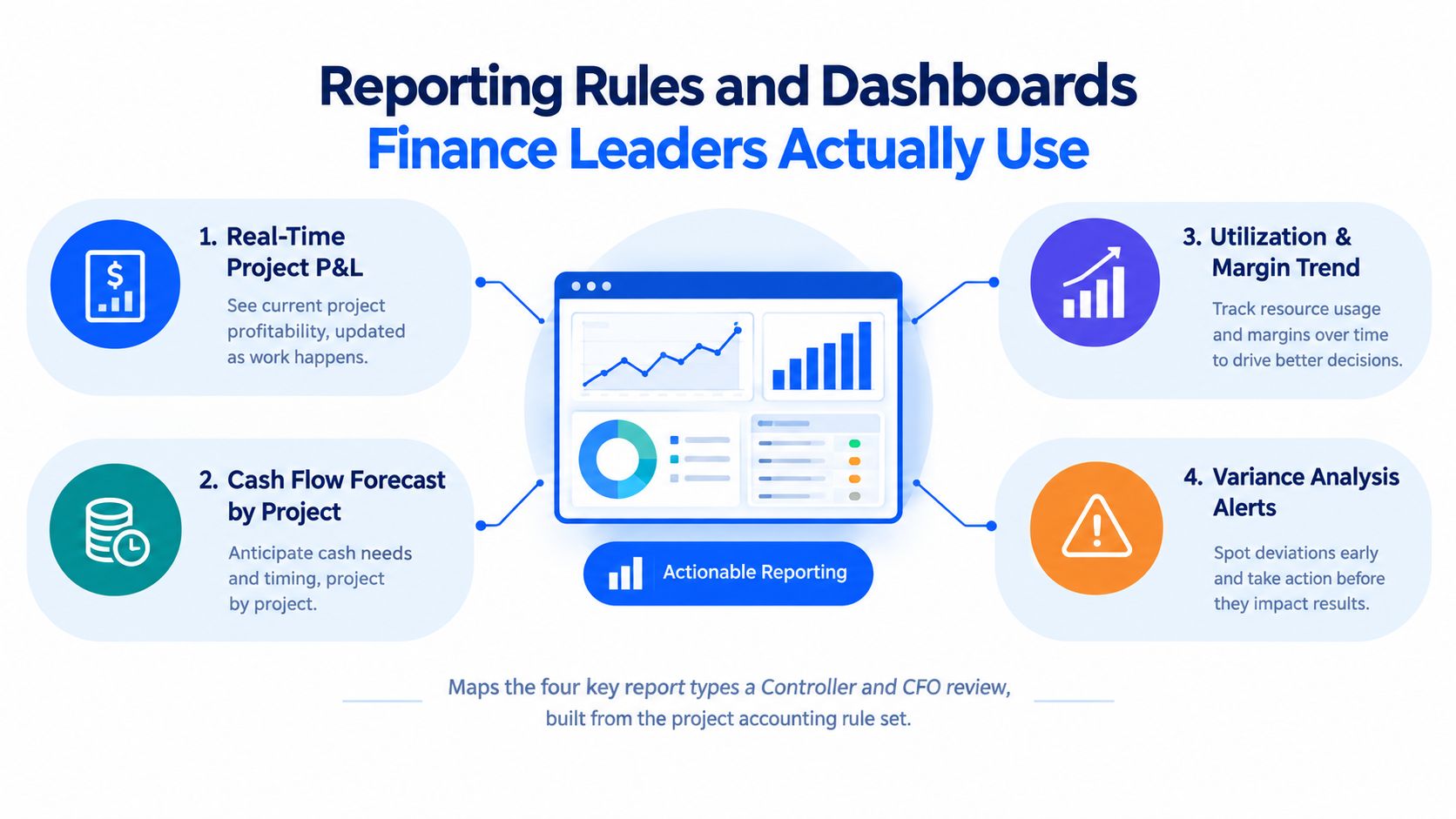
The fourth view should be an exception dashboard, not another summary. It should surface margin variance, EAC changes, missing approvals, stale WIP, overdue milestones, and projects where billings materially differ from earned revenue.
Reporting standard: Every dashboard must reconcile to the general ledger, name its owner, and tell someone what action to take.
When those reports tie cleanly to the GL, project accounting becomes a forward-looking control surface. Finance can challenge scope changes, update forecasts, accelerate billing, and address collection risk before the close turns into a reconstruction.
From Rules on Paper to Rules in the System
Buying an ERP module doesn't establish project accounting discipline. It gives you a place to configure the discipline.
The default setup rarely matches a mid-market company's actual contract mix, billing cadence, cost allocations, approval paths, or entity structure. If finance loads projects without resolving those decisions, the company moves the old margin-versus-cash gap into a more expensive system.
A self-led implementation often starts with good intentions. The team imports the chart of accounts, adds a few dimensions, turns on time entry, and plans to refine the rules later. That “later” tends to produce inconsistent project tagging, manual month-end journals, duplicate spreadsheets, and an audit trail that stops at the invoice.
A guided rollout should map the operating model before configuration:
- Review real contracts: Select representative fixed-fee, time-and-materials, retainer, milestone, and mixed engagements.
- Design the data model: Define entities, dimensions, project classes, tasks, cost codes, statuses, and ownership.
- Document recognition decisions: Record performance obligations, progress methods, EAC requirements, and evidence standards.
- Build billing templates: Connect milestone acceptance, recurring periods, approved time, expenses, and retention to invoice workflows.
- Test the close: Reconcile costs, WIP, earned revenue, billings, receivables, and the GL before go-live.
Sage Intacct can provide the accounting platform, but implementation quality determines whether the rules hold under pressure. Lucentive is a Sage Intacct National Premier Partner with experience serving mid-market organizations, healthcare providers, nonprofits, and professional services firms. Its role is to translate the company's contracts and operating decisions into a usable system, rather than asking the company to conform to generic defaults.
The right partner should help finance reach a clean first close, reduce manual journal work, and give auditors a traceable path from contract to invoice, WIP, and recognized revenue. Those are implementation outcomes worth testing before software selection is final.
Summary
Project accounting rules matter because reported margin does not always translate into cash. For a mid-market CFO, the core discipline is to connect contract terms, project setup, cost capture, revenue recognition, billing, WIP, and collections in one auditable workflow.
The most effective operating rules are consistent across project-based businesses:
- Set up every project with the right entity, owner, billing model, status, and reporting dimensions.
- Document whether revenue is recognized over time or at a point in time, then apply a defensible progress method.
- Capture labor, subcontractor, expense, and other project costs completely and at the source.
- Tie invoices to contract terms, approved time, milestones, recurring periods, or acceptance events.
- Review exception dashboards before close so finance can address stale estimates, aging WIP, delayed billing, and margin variance early.
When these rules are configured in the system, finance gets a cleaner close, better cash visibility, stronger forecast confidence, and a clearer path from project activity to the general ledger.
FAQ
What are project accounting rules?
Project accounting rules are the policies and system controls that determine how a company sets up projects, records costs, recognizes revenue, bills customers, tracks WIP, and reports project profitability.
Why do project accounting rules matter to CFOs?
They matter because project margins can look healthy while cash lags behind. Strong rules help CFOs reconcile earned revenue, billed revenue, unbilled WIP, receivables, and collections so reported performance matches financial reality.
What is the biggest project accounting risk at mid-market companies?
The biggest risk is disconnected data across project managers, billing, and finance. When estimates, time, expenses, contract terms, and invoice triggers live in different places, the close becomes manual and project margin becomes less reliable.
How often should estimate-at-completion be updated?
Estimate-at-completion should be refreshed on a regular cadence, often monthly at minimum, and sooner when scope, staffing, subcontractor cost, or milestone timing changes materially.
What is the difference between earned revenue and billed revenue?
Earned revenue reflects performance delivered under the recognition policy. Billed revenue reflects invoices issued under the contract. The two can differ when billing follows milestones, acceptance, or recurring schedules instead of the timing of work performed.
Which dashboards should finance review each month?
Finance should review project margin by engagement, billing backlog, WIP aging, cash forecast confidence, and a focused exception dashboard that highlights stale estimates, missing approvals, overdue milestones, and significant earned-versus-billed gaps.
Schedule a 30-minute working session with Lucentive to review your project structure, billing cadence, WIP controls, and recognition workflow against your actual contracts. Visit Lucentive to arrange a Sage Intacct conversation and see whether the platform and implementation approach fit your company.