The close is late again. Restricted funds are difficult to trace, clinic locations depend on spreadsheet allocations, and leadership is still waiting for a reliable view of cash, program performance, or entity-level results. QuickBooks may have handled the early years, but it often stops answering the questions a CFO, Controller, CEO, or VP Finance needs answered before approving the next major investment.
The best fund accounting software depends on your operating model, not the length of a vendor feature list. A grant-funded nonprofit needs different controls from a private fund, while a multi-site healthcare organization needs dependable connections to its EMR, billing systems, and operational data. Entity structure, reporting obligations, integrations, budget, implementation capacity, and the complexity of restricted funds all matter.
This comparison evaluates ten platforms by fund and grant accounting, project and dimensional reporting, consolidation control, healthcare or fundraising connectivity, cost posture, implementation burden, and partner support. It also addresses the problem buyers often miss: software alone may not eliminate the spreadsheet handoff between operational systems and the general ledger.
Lucentive is a Sage Intacct National Premier Partner with experience serving mid-market, healthcare, and nonprofit organizations. The right decision may be a smaller purpose-built platform, a healthcare ERP, or Sage Intacct implemented with the right advisory support. The shortlist below is designed to help you decide that before signing a contract.
Table of Contents
- 1. Sage Intacct for Nonprofit and Healthcare
- 2. Blackbaud Financial Edge NXT
- 3. MIP Fund Accounting by Community Brands
- 4. Aplos
- 5. Fund EZ
- 6. AccuFund Anywhere Online and Accounting Suite
- 7. FastFund Accounting by Araize
- 8. Multiview ERP
- 9. Oracle NetSuite for Nonprofits
- 10. SylogistMission ERP
- Top 10 Fund Accounting Software Comparison
- Turn the Shortlist Into a Defensible Decision
1. Sage Intacct for Nonprofit and Healthcare
Sage Intacct is the strongest reference point for mid-market organizations that have outgrown QuickBooks and need cloud financials with real fund, grant, entity, and dimensional control. Its dimensional general ledger can organize activity by funds, grants, programs, locations, departments, and projects without forcing every reporting need into a rigid chart of accounts.
For nonprofit and healthcare finance teams, the value is operational. Native grant tracking, billing, nonprofit revenue recognition, dynamic allocations, dashboards, and multi-entity consolidations connect day-to-day accounting with board, grantor, and executive reporting. Open integrations, including Salesforce and fundraising tools, make it a practical choice when finance needs dependable data from CRM or donor systems.
Practical rule: Choose Sage Intacct when the cost of continued spreadsheet consolidation, weak audit trails, and delayed reporting is greater than the cost of implementing a scalable cloud ERP.
The trade-off is clear. Pricing is quote-based, the total cost is normally higher than entry-level nonprofit tools, and implementation requires disciplined design of dimensions, workflows, integrations, permissions, and historical data. Sage Intacct also offers AI-assisted capabilities such as Financial Intelligence and a Close agent, but those tools only create value when the underlying processes and data are well structured.
Lucentive's perspective on the business case is outlined in why cloud accounting is a smart choice for nonprofit healthcare organizations. For organizations that need scalable fund accounting, strong auditability, and partner-led implementation, Sage Intacct's nonprofit capabilities make it the best overall choice on this list.
2. Blackbaud Financial Edge NXT
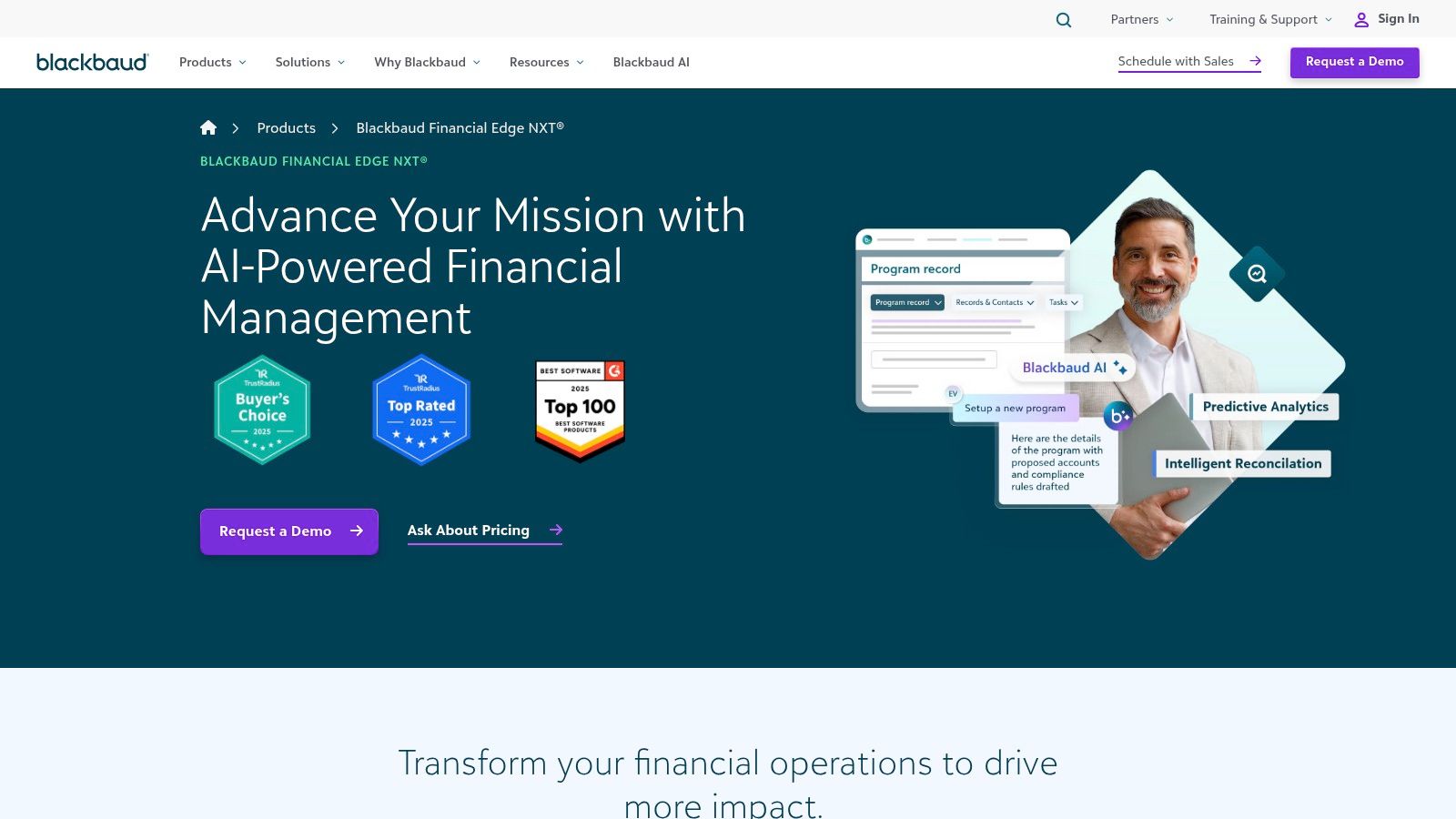
Blackbaud Financial Edge NXT is the natural contender for nonprofits already committed to Blackbaud's fundraising ecosystem. Its value increases when finance, advancement, and development teams rely on Raiser's Edge NXT and want financial activity to connect closely with donor and fundraising data.
The platform supports segmented chart structures, subfund accounting, grant and endowment tracking, compliance reporting, budgeting, and nonprofit-specific workflows. AI-assisted reconciliation and anomaly detection can help finance teams identify exceptions earlier, but those capabilities shouldn't distract from the main buying question: how much of the organization's operating data already lives in Blackbaud?
Best fit and implementation risk
Financial Edge NXT is a good fit for established nonprofits that want nonprofit-specific reports and tight fundraising connectivity without building a separate finance architecture. It's less compelling for a healthcare organization, a diversified multi-entity company, or a nonprofit that uses Salesforce and several operational systems outside Blackbaud.
The main limitation is ecosystem dependence. Buyers should test integrations beyond Blackbaud, validate data ownership, and confirm how exceptions move between fundraising, subfund, and general ledger workflows. Pricing is customized, with no public rate card, so the purchase decision needs to include implementation, training, integrations, reporting work, and ongoing administration.
For a broader view of nonprofit finance requirements, see Lucentive's guide to nonprofit fund accounting software. Select Financial Edge NXT when the Blackbaud ecosystem is already central to fundraising. If finance needs a more open cloud ERP foundation across healthcare, nonprofit, and general business operations, Sage Intacct deserves the closer evaluation.
3. MIP Fund Accounting by Community Brands
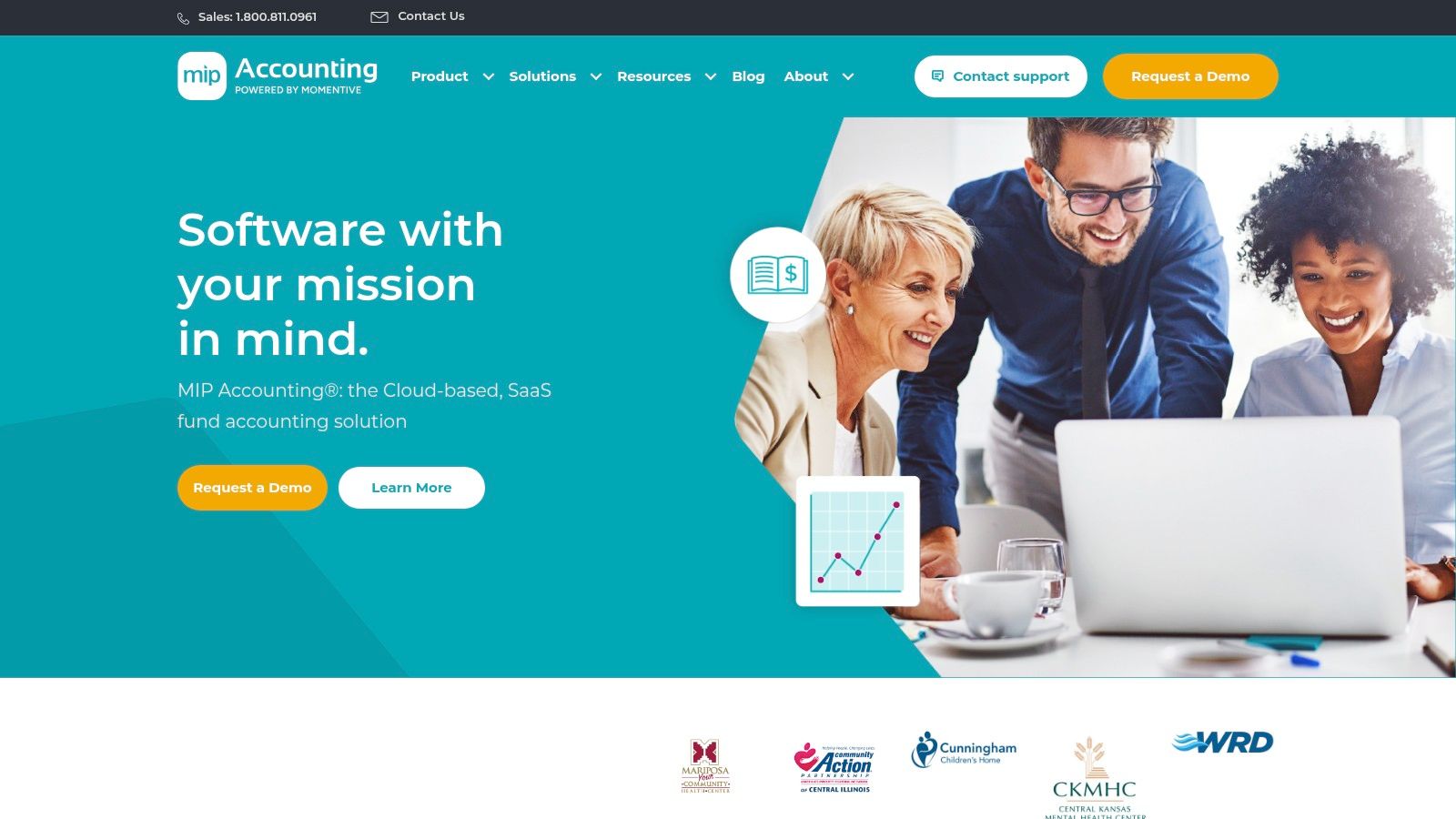
MIP Fund Accounting remains a practical choice for nonprofits, government organizations, and education-focused institutions that need purpose-built fund and grant compliance. It offers core general ledger, accounts payable, accounts receivable, budgeting, bank reconciliation, audit trails, and a broad module library covering areas such as payroll, purchasing, and human resources.
Its strongest differentiator is configurability. Organizations can choose cloud or on-premises deployment and add modules as their needs develop. That flexibility can matter when leadership has specific grant, budget, or public-sector requirements that simpler cloud products can't support without workarounds.
Where MIP earns its place
MIP is a strong candidate when compliance structure matters more than a polished user experience. Its multi-dimensional chart of accounts and audit trails support controlled fund reporting, while the deployment options give organizations more control over technology architecture.
The trade-off is modernization. User experience and reporting depth can vary by module, and the product's modernization pace may feel incremental compared with newer cloud ERP platforms. Pricing is quote-based, and modules are priced separately, so the apparent entry cost may not represent the full operating model.
MIP also demands a realistic implementation plan. Finance leaders should identify which modules are essential, who owns configuration, how reporting will be maintained, and whether the organization has the internal capacity to support a configurable platform. Fund accounting for nonprofit organizations should improve control without creating a new dependency on manual reporting specialists.
Choose MIP when you want established fund accounting with deployment flexibility. Choose Sage Intacct when executive visibility, cloud consolidation, dimensional reporting, and broader integration depth are more important than preserving a traditional modular architecture.
4. Aplos
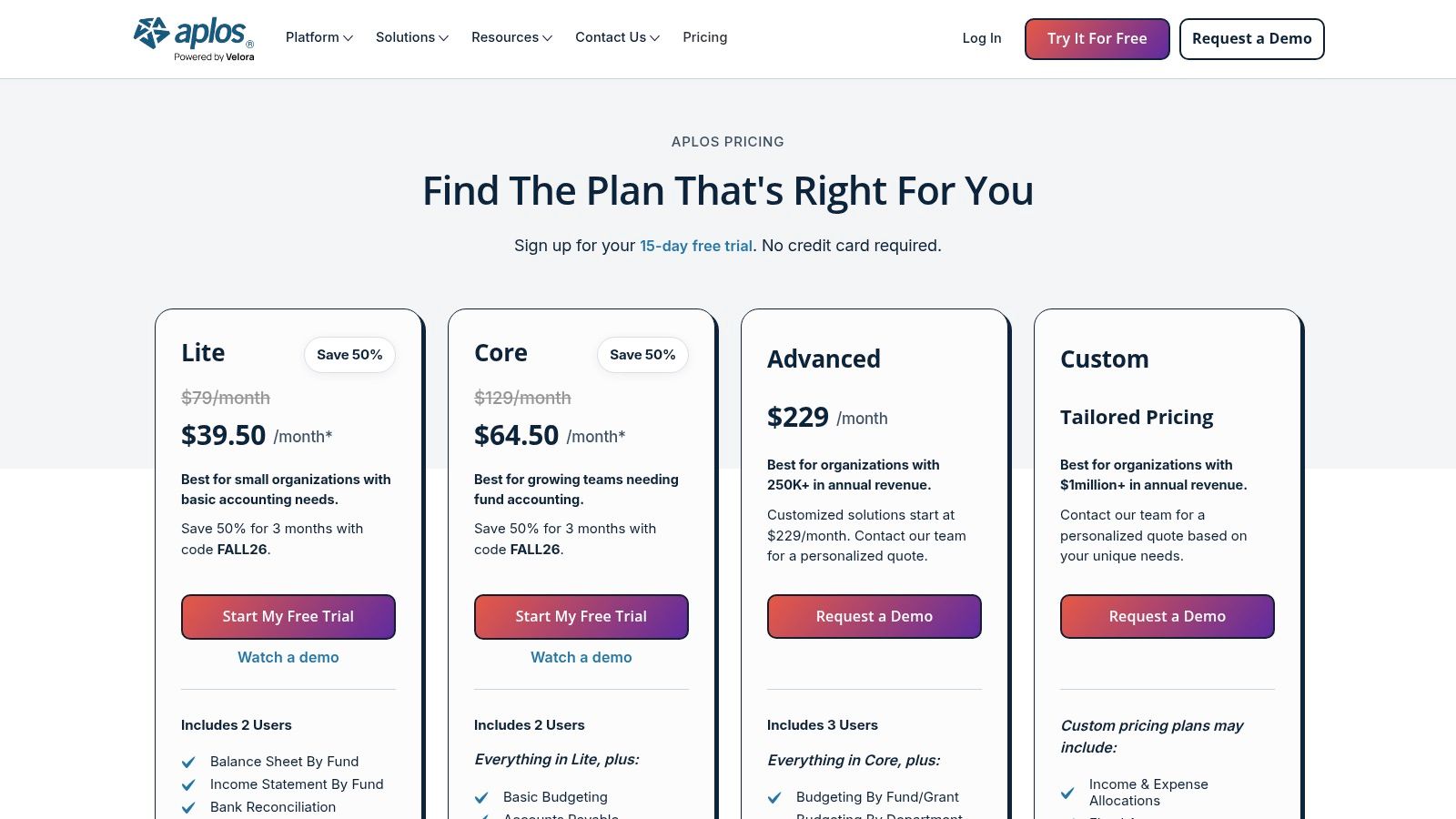
Aplos is designed for smaller nonprofits, churches, and foundations that need true fund accounting without the cost or complexity of a full ERP. It combines fund-based financials with donor management, online giving, events, and simple CRM capabilities, which can reduce the number of disconnected tools a small finance team has to maintain.
The platform's published pricing is a meaningful advantage for organizations that need budget predictability. Bank feeds, budgeting, reporting, board access, 1099 support, and multifactor authentication cover the everyday requirements of a lean back office.
The point where Aplos stops being enough
Aplos works best when the organization has straightforward funding structures, limited entities, and modest consolidation needs. It's easier to adopt than enterprise ERP software, and that shortens time to value for small teams that are still managing donations, budgets, and fund reports through spreadsheets or general accounting tools.
The limits appear as operating complexity grows. Advanced capabilities require higher-tier plans, and complex multi-entity consolidations may push the organization back toward manual work or external reporting tools. Healthcare providers with clinic locations, EMR integrations, allocations, and entity-level reporting should test those workflows before treating Aplos as a long-term platform.
The chart of accounts still matters, even in an easy-to-use system. Lucentive's guidance on a nonprofit chart of accounts is useful for determining whether a simpler structure can support future reporting.
Select Aplos when affordability, adoption speed, and integrated giving are the priorities. Move directly to Sage Intacct when leadership already needs multi-entity control, deeper dashboards, complex allocations, or an implementation partner capable of connecting finance to operational systems.
5. Fund EZ
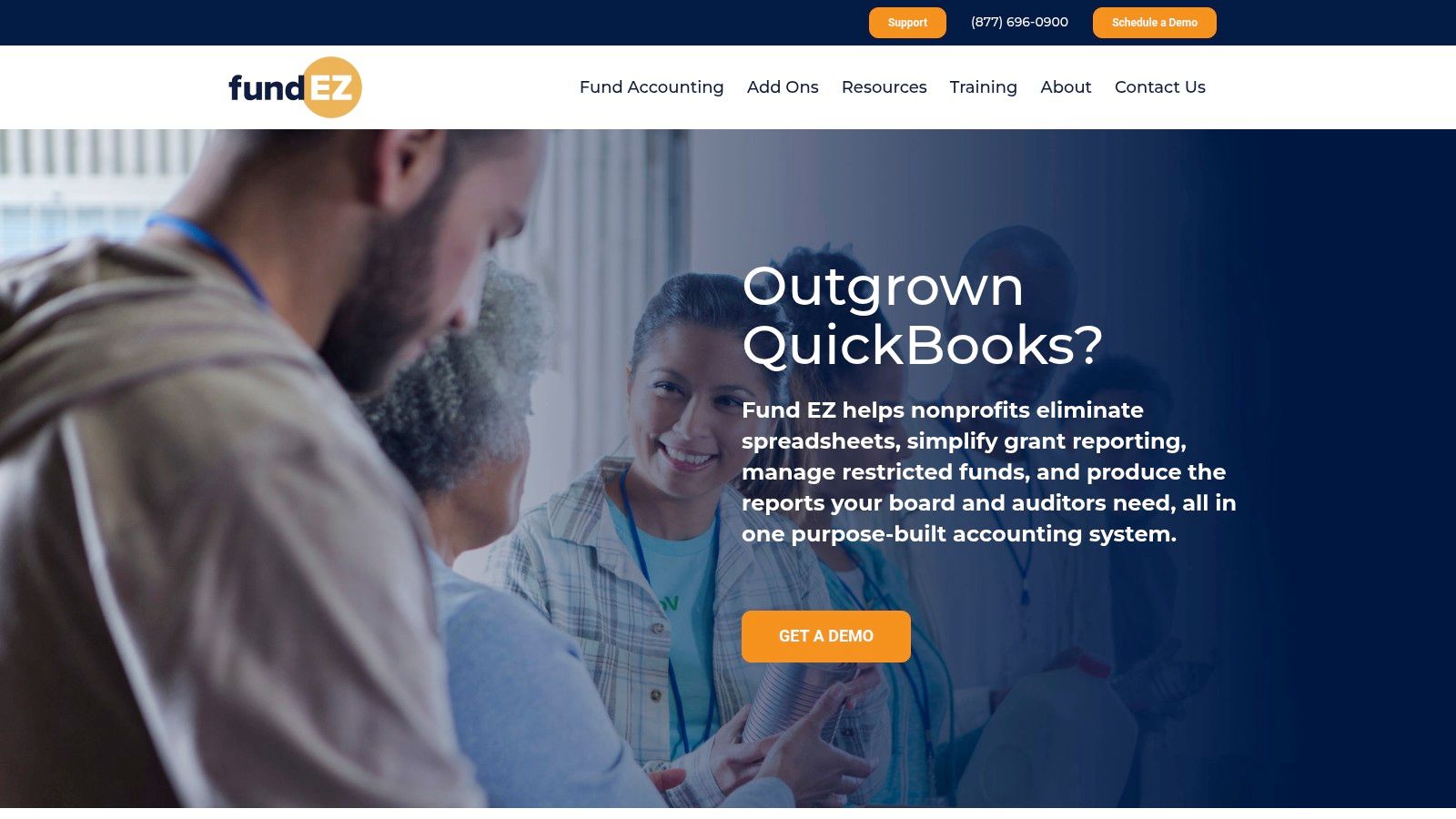
Fund EZ is built for nonprofit organizations that have outgrown general accounting tools but don't yet need the full breadth of an enterprise ERP. It focuses on restricted funds, grants, allocations, budgeting, encumbrances, and compliance reporting, with a segmented chart of accounts that supports detailed nonprofit financial statements.
The platform also offers optional modules for fixed assets, Medicaid billing, and fundraising. Those add-ons make it particularly relevant for social services and healthcare-adjacent organizations that need more than a basic nonprofit ledger but want to avoid paying for a broad ERP footprint.
A sensible upgrade from QuickBooks
Fund EZ's core accounting depth is its main advantage. It supports budget control by segment, allocation capabilities, purchase orders, accounts payable, accounts receivable, and auditable transaction records. For a grant-heavy nonprofit, that structure can make restricted spending and funder reporting more defensible than a collection of QuickBooks classes and spreadsheets.
The platform is more accountant-centric than entry-level tools. Pricing isn't publicly listed and generally requires a demonstration and quote, so leaders should ask for a complete scope that includes add-ons, reporting, migration, integrations, training, and support.
Migration quality will decide whether the new system reduces risk. Before selecting Fund EZ, document which historical transactions, fund balances, grant budgets, vendor records, and supporting documents need to move. Lucentive's QuickBooks data migration services reflect the broader principle that migration is a control project, not a file conversion exercise.
Choose Fund EZ for solid nonprofit accounting depth at a narrower scope. Choose Sage Intacct when growth requires stronger multi-entity consolidation, more open integrations, or executive reporting across programs, locations, and entities.
6. AccuFund Anywhere Online and Accounting Suite
AccuFund serves nonprofit and government organizations that need a broad fund accounting suite with specialized modules. Its capabilities cover general ledger, accounts payable, accounts receivable, purchasing, requisitions, grants, payroll, fixed assets, and multi-segment chart structures. Government-focused functions, including utility billing and representative payee workflows, give it relevance beyond conventional nonprofit finance.
The cloud offering is important for organizations moving away from locally managed infrastructure. AccuFund also presents audited controls for security and compliance, which should be validated during vendor due diligence rather than accepted as a substitute for reviewing the organization's own access, approval, and retention policies.
Broad modules, traditional trade-offs
AccuFund's strongest fit is a public-sector or nonprofit organization that wants many specialized modules from one vendor. Purchasing and requisition workflows can help finance teams impose stronger spending controls, while grants and fixed assets support more complete fund reporting than a basic small-business platform.
The compromise is user experience. The interface and analytics may feel dated beside newer cloud ERPs, and pricing is quote-based, usually shaped by the base platform, selected modules, and users. That makes a workflow demonstration essential. Don't evaluate only the general ledger. Ask the vendor to show a grant expense from source entry through allocation, approval, reporting, and audit review.
AccuFund is a reasonable choice when specialized public-sector modules drive the buying decision. For a mid-market healthcare or nonprofit organization focused on cloud dashboards, multi-entity consolidation, CRM connectivity, and implementation guidance, Sage Intacct may offer a more adaptable operating foundation.
7. FastFund Accounting by Araize
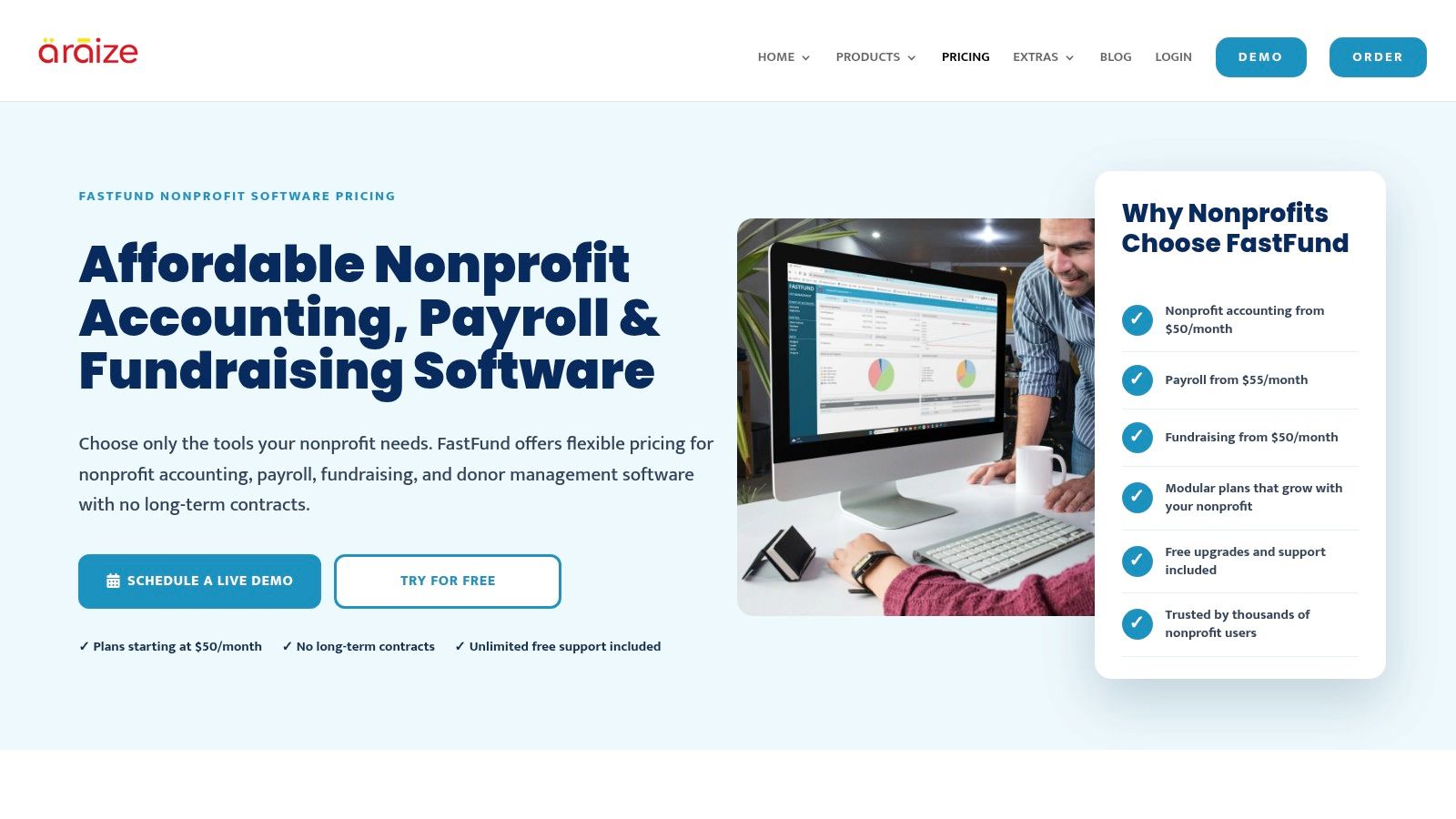
FastFund is the practical budget option for small nonprofits that need to move beyond spreadsheets or QuickBooks without taking on ERP-level complexity. It provides true fund accounting, allocations, nonprofit reporting, bank integrations, recurring transactions, and optional donor CRM, payroll, and fundraising modules.
Transparent, low monthly pricing and no long-term contracts lower the financial barrier to adoption. Unlimited support is also relevant for small organizations where the Controller may be a part-time employee, an executive director, or an outside accounting resource rather than a dedicated systems administrator.
Buy it for simplicity, not scale
FastFund should be on the shortlist when the organization's primary need is affordable fund accounting with quick onboarding. It can bring basic allocations, bank activity, recurring entries, and reports into one system without forcing a small team to implement a full financial management platform.
It isn't designed for complex multi-entity consolidation. Feature depth is also below mid-market ERP solutions, so leaders should consider the next transition before signing up. A tool that solves today's bookkeeping problem may create another migration when the organization adds entities, locations, grant programs, or more demanding board reporting.
The lowest software subscription is not always the lowest-cost finance system. Include the cost of future migration, manual reporting, and external workarounds.
Select FastFund when the organization has simple structures, limited administrative capacity, and a clear need for affordability. If the current pain already includes multi-entity reporting, healthcare integrations, or executive dashboards, skip the intermediate step and evaluate Sage Intacct with a partner-led implementation.
8. Multiview ERP
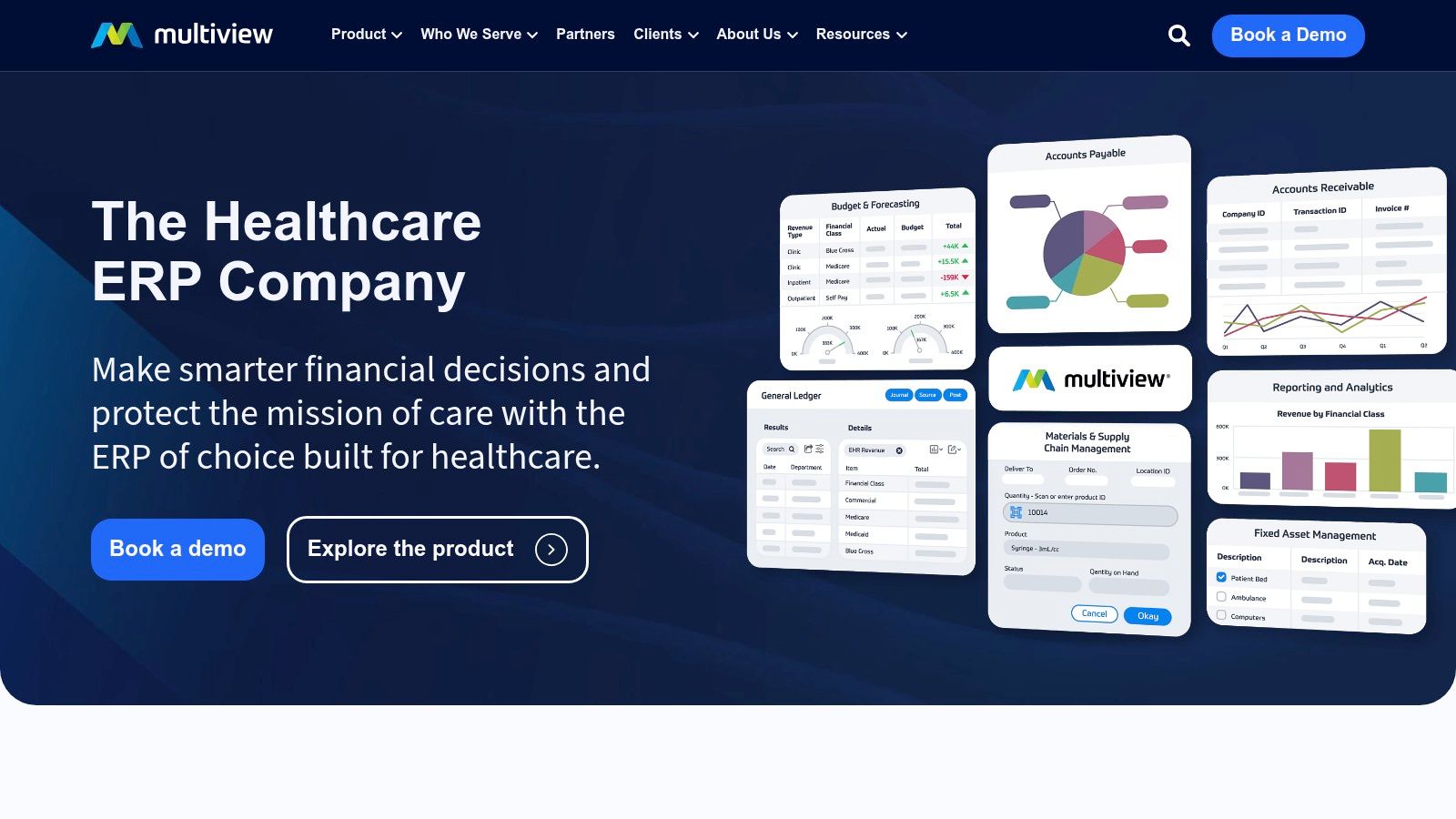
Multiview ERP is the strongest healthcare-specific option in this comparison. It is designed for community health centers, clinics, hospitals, and multi-site healthcare organizations that need financial information connected to clinical and operational systems.
The platform combines a general ledger with audit trails, consolidations, allocations, budgeting, forecasting, accounts payable automation, and drill-down reporting through ViewSource 360. Its healthcare orientation is especially valuable when finance needs to trace a number from the financial statement to the transaction and EHR batch level.
When EMR connectivity outweighs fundraising depth
Multiview's native EHR integrations and HIPAA-minded posture make it a serious candidate for healthcare finance leaders. It supports the operating reality of multiple sites, clinical data batches, program reporting, and allocations that general nonprofit accounting systems may not handle as naturally.
The trade-off is specialization. Multiview is primarily focused on healthcare and offers fewer native fundraising tools. Pricing is quote-based, and implementation is required, so the evaluation must include interface ownership, EHR mapping, reporting design, historical data, user roles, and close procedures.
Healthcare leaders should also test the system with real operational scenarios. Ask the vendor to demonstrate a clinic-level close, an allocation from source activity to program reporting, and an exception that requires correction without compromising the audit trail.
Choose Multiview when EMR connectivity and healthcare analytics are the central requirements. Choose Sage Intacct when the organization needs broader nonprofit, fundraising, professional services, or general business flexibility alongside healthcare operations.
9. Oracle NetSuite for Nonprofits
Oracle NetSuite is a full-suite cloud ERP for complex, multi-entity, or global nonprofit organizations. It supports fund, grant, and program segmentation, nonprofit financial statements aligned with FASB ASU 2016-14, planning and budgeting, global consolidations, and broad integrations across finance and operations.
NetSuite's Social Impact programs may provide donated or discounted editions for qualifying nonprofits, along with Suite Pro Bono resources. Those programs can affect cost posture, but they shouldn't obscure the implementation question. A discounted license still requires governance, configuration, migration, training, integrations, and ongoing administration.
Enterprise breadth comes with enterprise change
NetSuite is attractive when finance and operations need one scalable platform. Multi-entity consolidation, planning, CRM connectivity, revenue processes, and a broad ERP footprint can reduce the number of disconnected systems a global or complex nonprofit must manage.
The cost is significant change management. Pricing and contracts are highly customized, and partner-led implementation is normally necessary. CFOs should demand clarity on the future operating model, not just a demonstration of features. Who owns the chart of accounts? How will grant data enter the ledger? Which integrations are standard, and which require custom development? How will finance staff be trained?
Oracle NetSuite's nonprofit offering is best suited to organizations with the budget, governance, and internal capacity to operate a large ERP. For many mid-market organizations, Sage Intacct may provide the required fund, grant, and entity controls with a more focused implementation scope.
10. SylogistMission ERP
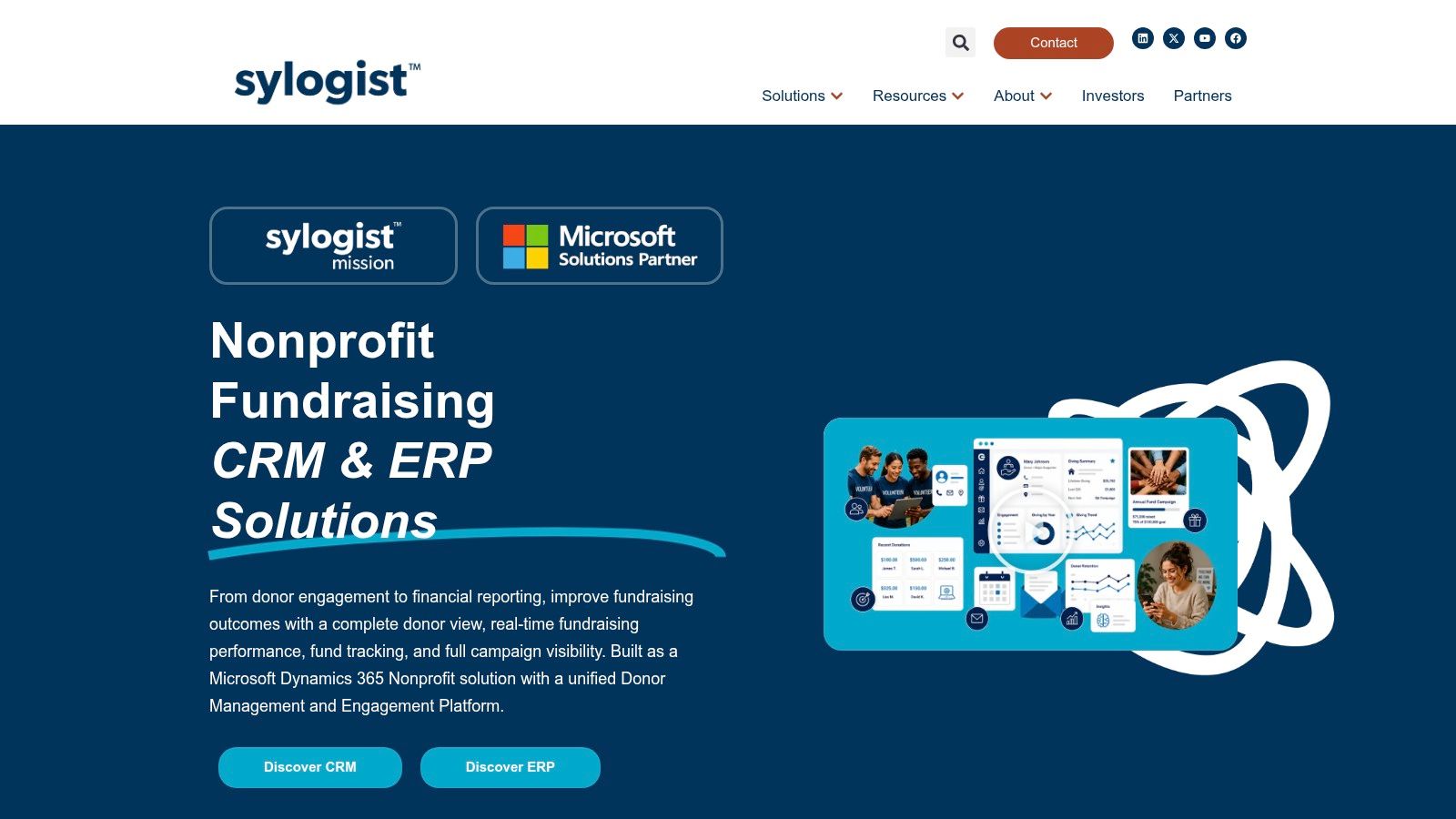
SylogistMission ERP, formerly Serenic, runs on Microsoft Dynamics 365 Business Central and is aimed at nonprofits that want fund accounting and grant management within the Microsoft ecosystem. It combines restricted fund tracking, budgeting, multi-entity consolidation, workflow automation, and optional donor CRM capabilities.
The Microsoft foundation is a major fit factor. Organizations already using Microsoft tools may value Power BI, Power Platform, Copilot, and familiar Office workflows. A single stack can also reduce the friction between finance, donor engagement, reporting, and operational automation when the implementation is designed well.
Choose the ecosystem before the feature list
SylogistMission makes sense when Microsoft standardization is already a strategic decision. The organization can use the Business Central foundation for finance while extending reporting and workflows through Microsoft's broader platform. That can be powerful for a nonprofit with internal technology resources and a clear appetite for a connected Microsoft architecture.
Implementation quality remains decisive. Pricing is customized based on scope, including ERP, CRM, or both, and success depends heavily on partner expertise. Teams should validate fund setup, grant reporting, consolidation, donor data, role security, Power BI ownership, and the long-term cost of administration.
The platform is less suitable when the organization wants a focused financial management system without committing to the Microsoft stack. Sage Intacct is the more practical comparison for mid-market leaders who need strong nonprofit and healthcare financials, open integrations, and a partner that can guide the design rather than just implement software.
Top 10 Fund Accounting Software Comparison
| Solution | Core features | UX / Quality (★) | Value & Pricing (💰) | Target Audience (👥) | Standout / Unique (✨/🏆) |
|---|---|---|---|---|---|
| Sage Intacct (Nonprofit & Healthcare) | Dimensional GL, fund/grant tracking, multi-entity consolidations, AI close/insights | ★★★★★, robust reporting & auditability | 💰💰💰💰, quote-based, mid‑to‑high TCO | CEOs/CFOs at mid‑market nonprofits & healthcare | 🏆 Scalable fund accounting, AI assistants, large partner ecosystem ✨ |
| Blackbaud Financial Edge NXT | Segmented COA, subfund/endowment, AI reconciliation, native fundraising links | ★★★★, nonprofit-tailored workflows | 💰💰💰, custom pricing; best value with Blackbaud stack | Nonprofits using Raiser's Edge / Blackbaud ecosystem | ✨ Tight fundraising connectivity; anomaly detection 🏆 |
| MIP Fund Accounting (Community Brands) | Multi‑dimensional COA, GL/AP/AR, budgeting, modular library, cloud/on‑prem | ★★★, highly configurable; modernization steady | 💰💰, quote + per‑module pricing | Nonprofits & government needing compliance & config | ✨ Deployment flexibility and broad module set |
| Aplos | Fund‑based financials, integrated donations/CRM, board portal, published tiers | ★★★★, simple, quick adoption | 💰💰, transparent monthly tiers; affordable | Small–midsize nonprofits & churches | ✨ All‑in‑one accounting + donor tools; published pricing |
| Fund EZ (Fund E‑Z) | Multi‑segment COA, ASU 2016‑14 formats, budgeting, PO/encumbrances, add‑ons | ★★★, deep accountant‑centric core | 💰💰, quote/demo required | Orgs outgrowing QuickBooks needing fund depth | ✨ Strong nonprofit & healthcare add‑ons |
| AccuFund (Accounting Suite) | Fund accounting, purchasing/workflows, grants, government modules, SOC controls | ★★★, broad feature set; dated UI | 💰💰💰, modular quote pricing | Nonprofits & public sector with specialty needs | ✨ Government modules (utility billing), audited cloud controls |
| FastFund Accounting (Araize) | True fund accounting, allocations, 990 reporting, bank feeds, optional donor/payroll | ★★★★, practical, easy onboarding | 💰, transparent, low monthly pricing | Small nonprofits moving up from QuickBooks | ✨ Clear pricing + unlimited support; quick migration |
| Multiview ERP | Robust GL, ViewSource 360 drill‑down, consolidations, native EHR integrations | ★★★★, excellent healthcare analytics | 💰💰💰, quote-based; partner implementation | Community health centers, clinics, hospitals | 🏆 Native EHR integrations & HIPAA-minded posture ✨ |
| Oracle NetSuite for Nonprofits | Full ERP suite, fund/grant segmentation, global consolidations, planning tools | ★★★★, enterprise-grade, powerful but complex | 💰💰💰💰, highly customized; can be costly (Social Impact options) | Large, complex or global nonprofits | 🏆 Scale & broad ERP capabilities; Social Impact programs ✨ |
| SylogistMission ERP (formerly Serenic) | Dynamics 365 BC‑based fund accounting, grant mgmt, Power Platform/BI integration | ★★★★, familiar MS UX; partner‑dependent success | 💰💰💰, scope‑based pricing (ERP±CRM) | Organizations standardized on Microsoft tech | ✨ Embedded Microsoft AI/Power Platform; single‑stack finance+donor |
Turn the Shortlist Into a Defensible Decision
A defensible selection starts with the work your finance team performs, not with vendor demos. Document every fund, grant, entity, location, program, project, revenue stream, and reporting obligation. Include the close bottlenecks that currently require spreadsheets, manual allocations, offline approvals, or repeated data entry between the EMR, CRM, spend tools, and general ledger.
The market data supports taking that exercise seriously. Fund accounting software was valued at USD 3.5 billion in 2023 and is projected to grow at more than 6% CAGR from 2024 through 2032, according to 6sense's fund accounting category view. The demand reflects sustained regulatory and reporting complexity across nonprofit, institutional, and investment use cases. The same view describes North America as holding about 33% of revenue in 2023 and major platforms such as NetSuite and Sage Group as representing roughly 35% of share, which reinforces the importance of enterprise controls, auditability, and multi-entity reporting.
Don't assume that a familiar general ledger is sufficient. NTEN survey data reported that 56% of organizations under USD 1 million in annual revenue used QuickBooks as their primary accounting system, while 22% used a purpose-built nonprofit platform and 22% used spreadsheets, manual systems, or other tools, as summarized by MarketIntelO's fund accounting software report. In organizations with revenue between USD 1 million and USD 5 million, the same source reported 38% using QuickBooks or a similar small-business platform, 41% using purpose-built fund accounting software, and 21% using a hybrid approach involving QuickBooks and spreadsheet-based grant tracking.
Test workflows, not feature checklists
Request a workflow-based demonstration. Give each finalist the same scenarios:
- Restricted fund reporting: Show how a transaction moves from entry to funder or board report, with supporting audit history.
- Grant control: Demonstrate budgets, allowable costs, allocations, billing, amendments, and remaining balances.
- Multi-entity close: Show intercompany activity, eliminations, consolidation, and entity-level dashboards.
- Operational integration: Trace data from the EMR, fundraising CRM, spend platform, or payroll system into the ledger.
- Exception handling: Reverse or correct an entry while preserving a clean audit trail and clear approval history.
QuickBooks has documented limitations for growing finance teams. RSM's review of QuickBooks notes that its audit-trail design can make it easy to modify or remove valid transactions, reporting by dimensions is limited, and automatic consolidation and eliminations aren't built in. Those gaps often move work outside the system, exactly where controls become harder to defend.
Price the whole decision
Compare pricing only after defining users, entities, modules, integrations, implementation services, migration, training, support, and reporting scope. Quote-based products can appear comparable while carrying very different assumptions about configuration and partner work. Published pricing can be easier to budget, but it may also signal a narrower operating model that won't handle future complexity.
Multi-entity consolidation deserves particular attention. One published CFO guide says mid-market organizations commonly spend 5 to 12 days on multi-entity consolidation, while environments with more than 50 entities may require 10 to 14 days manually, as described in ChatFin's multi-entity consolidation guide. Your own close data matters more than any benchmark. Measure how many days your team spends, who performs the work, which spreadsheets support it, and what errors or review delays result.
Implementation partner fit can determine whether the platform produces value. Independent review data shows that buyers care about usability and support alongside accounting depth. Capterra's FundCount reviews list 4.4 out of 5 for ease of use and 4.5 out of 5 for customer service, while an Info-Tech review panel for Linedata Fund Accounting and Valuation reports 80% likeliness to recommend and 87% positive sentiment, according to the verified market data. Those figures aren't a substitute for references, but they highlight a real selection issue: implementation quality and workflow fit matter as much as feature coverage.
For most mid-market nonprofits and healthcare organizations, Sage Intacct with the right implementation partner offers the clearest balance of fund control, dimensional reporting, multi-entity visibility, integrations, and manageable scope. Lucentive brings Sage Intacct implementation and optimization experience across healthcare, nonprofit, and general business environments. Leaders should select the platform that reduces audit and reporting risk without creating an implementation burden their team can't absorb.
Lucentive helps CFOs, Controllers, CEOs, and VP Finance leaders evaluate and implement Sage Intacct for fund accounting, grants, multi-entity reporting, and healthcare or fundraising integrations. Visit Lucentive to schedule a 30-minute working session or custom Sage Intacct demo and assess the right platform and implementation approach before buying software alone.