Your controller blocks out the first eight business days of every month. Not because the transactions are complicated, but because the numbers live in four places: QuickBooks for the ledger, one spreadsheet for the entity roll-up, another for the department split, and somebody’s inbox for approvals that never got written down. Core financials is the software category sold to fix exactly that, and the monthly close is where you find out whether it did.
Vendor pages tell you what each module does. They do not tell you which parts of your current month disappear, which parts move to a different owner, and which get harder before they get easier.
What follows is the implementation view. Lucentive implements Sage Intacct out of Frisco, Texas, and this is what we see when a finance team moves its accounting spine off QuickBooks.
Key Takeaways
- Core financials is a module set, not a single product: general ledger, AP, AR and cash management on one ledger, usually with purchasing and order management alongside.
- The close time you recover comes from deleting re-keying and manual consolidation, not from posting entries faster.
- The hardest part of the project is agreeing on a dimension structure, which is a leadership decision rather than a configuration task.
- Your first close in the new system takes longer than your last close in QuickBooks. Budget for that and it is a non-event.
- Analyst scores and the AICPA endorsement tell you the platform is credible. They say nothing about whether it fits your entity structure.
- One entity, one location, no departmental reporting and no plans to add any? This is more system than you need, and we will say so.
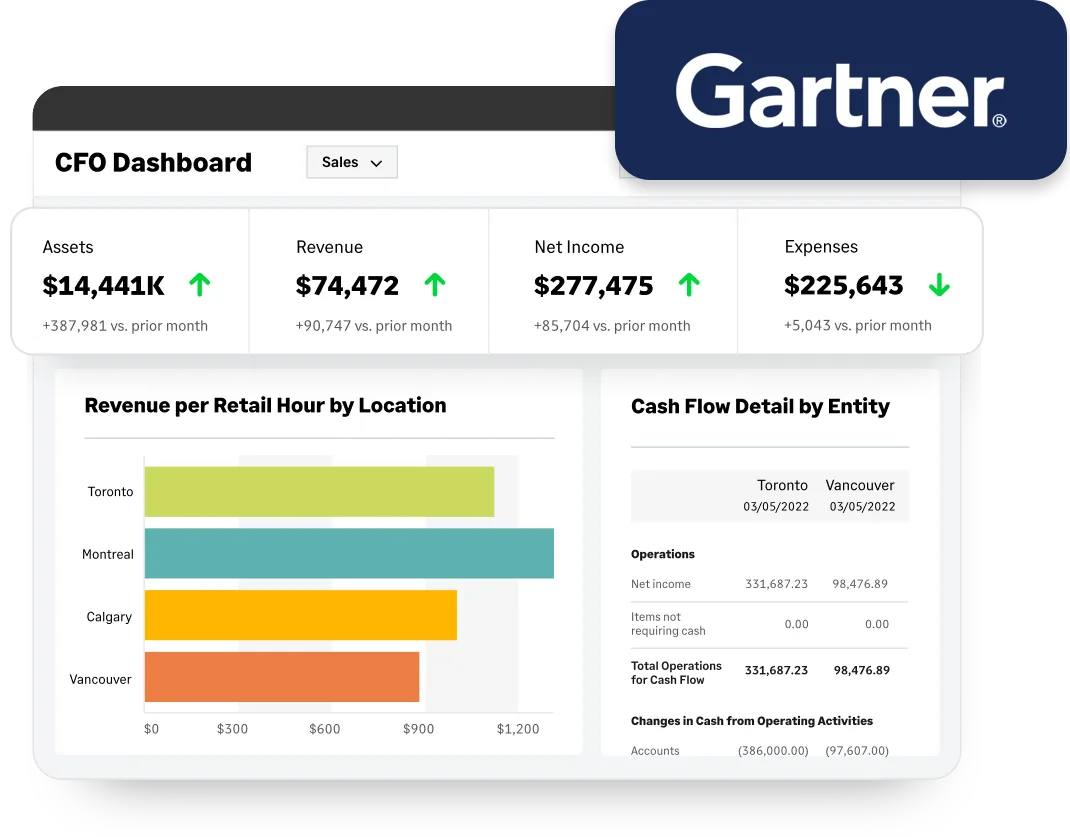
Screenshots throughout are Sage Intacct product material. The figures shown in them are Sage’s demonstration data, not Lucentive client results.
What core financials actually means
Core financials is the accounting spine: general ledger, accounts payable, accounts receivable and cash management, with purchasing and order management normally in the same conversation. In Sage Intacct these run as one application over one ledger, so a vendor bill, its approval, its payment and its effect on cash are a single record seen from four angles.
Every vendor claims that, so use a practical test. In your current setup, how many systems have to agree before you trust a number? If the bill lives in QuickBooks, the approval in email and the department allocation in a spreadsheet, you have three sources of truth and a reconciliation habit. Core accounting software collapses that into one place, where the allocation is a property of the transaction rather than a step somebody performs afterward.
Cloud core financials adds one constraint worth naming early. Sage Intacct is multi-tenant, so everyone runs the same version and releases arrive on Sage’s schedule rather than yours. You stop paying for upgrade projects, and in exchange anything you customise has to survive quarterly change.
What the QuickBooks close actually costs you
The cost is rarely the license. It is the hours your team spends producing numbers the system already contains but cannot assemble: multi-entity roll-ups done by hand, department splits kept in a parallel spreadsheet, intercompany entries typed twice, a management pack stale by the time it is approved.
Look at your last three closes and see where the calendar actually went. In most QuickBooks-based teams we assess, ledger work is a small share. The bulk sits in consolidation, in rebuilding management reporting the ledger cannot produce natively, and in chasing documentation for entries made without an approval trail. Those are data-structure problems, not accounting problems. The second cost is less visible: when reporting takes eight days, the business stops asking finance questions it assumes finance cannot answer quickly. Our note on the signals that you have outgrown QuickBooks covers what we look for.
[DATA: Lucentive’s average reduction in close days for clients migrating off QuickBooks — Rich to confirm]
What changes in the finance team’s week after go-live
Three things change immediately. Approvals move out of email into the transaction, so the audit trail builds itself. Consolidation stops being a task and becomes a report you run. Reporting shifts from a monthly event to something anyone with a login can pull, which changes who asks you for what.
Finance leaders feel the consolidation change first. If you have been closing entities sequentially and then combining them, that sequence collapses. Entities close in parallel, eliminations run as rules, and the roll-up exists continuously instead of being assembled at the end.
The second change catches teams off guard. Your AP clerk stops keying invoices and starts reviewing exceptions. That is a different job with a different skill profile. Most people prefer it, but it is not automatic, and we have watched implementations wobble because nobody told the AP team their role was being redesigned. Have that conversation during design, not during training week.
The third change is that numbers start getting argued about. When department heads see their own margin without asking finance for it, they dispute allocations they previously never saw. That is the system working. Plan for a few weeks of it.
What implementing core financials actually takes
Four workstreams run at once: design the dimension structure, migrate the data, rebuild the approval and access model, and connect the systems that feed the ledger. Software configuration is the smallest of the four, and the sequencing between them determines whether you go live on the date you promised the board.
The dimension structure comes first, and it is a business decision
In a dimensional general ledger, location, department, project, customer and class are tags applied to transactions rather than segments buried in an account number. That is why companies moving to Sage Intacct usually end up with a shorter chart of accounts than the one they left. The account says what happened; the dimensions say where, for whom and under which program. Projects stall here, almost never for technical reasons. Deciding what “department” means when operations and finance have used the word differently for a decade is a leadership conversation. We push to close it in the first three weeks, because reworking it after migration is expensive.
Data migration is smaller than you fear and messier than you hope
Most companies migrate open balances, customer and vendor masters, open AR and AP, and a window of historical summary data. You do not push ten years of transaction detail into a new ledger; you keep the old system readable for lookback and start clean. The mess is in the masters: duplicate vendors, customers spelled three ways, inactive records nobody will declare dead. Cleaning that list is client work, it always takes longer than estimated, and it is the most common reason a go-live date moves.
Approvals and access get designed, not inherited
QuickBooks environments accumulate permissions rather than define them. Real role-based access means writing down who approves what, at what threshold, and who can post to a closed period. That document does not exist at most companies beforehand. Producing it is useful in its own right, and your auditors will notice.
Integrations decide your real go-live date
Payroll, banking, expense management, a CRM, the industry system that generates your revenue transactions. Each connection is a small project with its own owner and its own testing. Sage Intacct has a published API and a marketplace of prebuilt connectors, but “there is a connector” and “the connector maps your data correctly” are different statements. We test integrations against a real month of your data before anyone commits to a date, and our guidance on planning implementation costs, time and resources goes deeper on scoping it.
[DATA: Lucentive’s typical elapsed timeline for a core financials go-live, by company size — Rich to confirm]
What the analyst scores and the AICPA endorsement really tell you
They tell you the platform is established, supported and unlikely to disappear, which is worth knowing. What they cannot tell you is whether it fits your entity structure, your revenue model or your team’s capacity to absorb change. Those three questions decide whether your project succeeds.

The AICPA endorsement is worth what any professional-body endorsement is worth: accountants vetted the product and were comfortable attaching their name. It filters the unserious options off your shortlist. It is not a reason to buy, and a partner who leads with it is handing you the vendor’s brochure instead of an implementation plan. Analyst scores behave the same way. A high score reflects functional depth measured against a general rubric, and your requirements are not that rubric. We have talked companies out of Sage Intacct that would have scored it highly on every published dimension, because their real constraint was one warehouse process the platform handles awkwardly.
Peer-review badges belong in the same bucket. Sage collects them for Sage Intacct and reprints them on pages like the one this post replaces, and what sits behind them is real enough: people who use the product every day were asked what they thought of it, and enough of them answered warmly. That is genuine signal about daily usability, which matters when your AP clerk will be in the system every morning. It still says nothing about your entity structure or your close.

The gated whitepaper and eBook path is the same problem in another costume. Those downloads exist to capture your details and route you into a sales motion. If you want an evaluation document worth reading, ask a partner for a fit assessment against your actual entity list, billing model and reporting requirements, and ask what the platform does badly for a company like yours.
Where Sage Intacct is the wrong answer
One entity, one location, no departmental reporting, no project accounting and no plan to add any: cloud core financials of this class is more platform than the business needs. QuickBooks or a mid-tier alternative will serve you better and cost less.
Two other situations give us pause. Heavy discrete manufacturing, with bills of material, shop-floor routing and production scheduling, is the first. Sage Intacct is a financial platform with strong distribution capability, not a manufacturing execution system, and the honest answer is often a different product. The second is a finance team with no bandwidth. If your controller is the only person who can explain how the business works and they are already at capacity, the project will consume them, because the dimensional general ledger design work cannot be delegated to a consultant alone.
Cost is the third filter, and the one we will not publish without sign-off. Software subscription, implementation and support are three separate lines, and the implementation line varies more with your data condition and entity count than with anything on a price list.
[DATA: Lucentive’s current software, implementation and support cost ranges by company size — Rich to confirm]
Summary
Core financials is not a feature you buy. It is a decision to stop maintaining the truth in spreadsheets and put structure into the ledger instead, and the value shows up on your close calendar rather than on a feature list. The platform absorbs consolidation, approval trails and management reporting. It hands back a design problem: what your dimensions mean and who approves what.
If you are evaluating core accounting software now, the useful next step is not another gated download. It is an hour with someone who will map your entity structure and tell you honestly whether this is the right platform, including when the answer is no. Talk to Lucentive about your close, and bring your last three month-end calendars.
Frequently Asked Questions
What is core financials in accounting software?
Core financials means the foundational accounting modules a business runs on: general ledger, accounts payable, accounts receivable and cash management, usually with purchasing and order management alongside. The defining characteristic is that they share one ledger and one set of master records, so a transaction entered once is visible everywhere it matters, without anyone re-keying it or reconciling two systems at month-end.
What is the difference between Sage and Sage Intacct?
Sage is the parent company and sells several accounting products at different sizes, including Sage 50, Sage 100 and Sage Intacct. They are separate applications rather than tiers of one product, so moving between them is a migration, not an upgrade. Sage Intacct is the cloud, multi-entity, dimensional platform for mid-sized organisations, and it is the one Lucentive implements.
Is core financial software the same as a banking core system?
No, and the shared vocabulary causes real confusion in search results. In banking, a core system is the platform holding deposit and loan accounts. Core financials in the accounting sense means the general ledger and its surrounding modules, for any type of company. If your results mix the two, add “accounting” or “ERP” to the query and they separate cleanly.
Do we have to replace QuickBooks all at once?
For the ledger, effectively yes. Running two general ledgers in parallel means maintaining two sets of truth, and teams that try it do double work and trust neither. What you can phase is everything around the ledger: start with core financials, then add project accounting, planning or advanced revenue recognition in later phases. Keep QuickBooks readable for historical lookback rather than live.
How long does a core financials implementation take?
The realistic driver is not company size. It is your number of entities, the condition of your master data, and how fast leadership settles the dimension structure. A single-entity company with clean vendor and customer lists moves quickly. A multi-entity group with duplicate masters and an unresolved definition of “department” takes considerably longer, and the extra time goes to decisions rather than to software.