The close is late again, project managers are chasing time entries, and the CFO still can't see which clients are making money. That's the point where the best accounting software for professional services stops being a bookkeeping question and becomes an operating model decision. If you need project margin, utilization, multi-entity control, and clean audit trails, the right answer is usually a cloud finance platform with real implementation support, not another desktop ledger with a better invoice screen. Sage Intacct is the strongest fit for many growing services firms, and Lucentive, a Sage Intacct National Premier Partner, can help you pressure-test the fit in a short, no-pressure working session before you buy software or a partner you'll outgrow.
Table of Contents
- 1. Sage Intacct
- 2. Deltek Vantagepoint
- 3. Oracle NetSuite With SuiteProjects
- 4. Microsoft Dynamics 365 Business Central
- 5. QuickBooks Online Advanced
- 6. Xero With Xero Projects
- 7. Certinia ERP Cloud
- Top 7 Accounting Software for Professional Services, Feature Comparison
- Choose the System and the Implementation Path
1. Sage Intacct
Sage Intacct belongs at the top of the list for one reason, it is built for finance leaders who need more than bookkeeping. For professional services firms, that means project costing and billing, revenue recognition, multi-entity consolidations, and real-time dimensional reporting that lets you look at profit by project, client, or practice area. Its direct website is Sage Intacct, and its value is clearest when the firm has already outgrown “good enough” accounting.
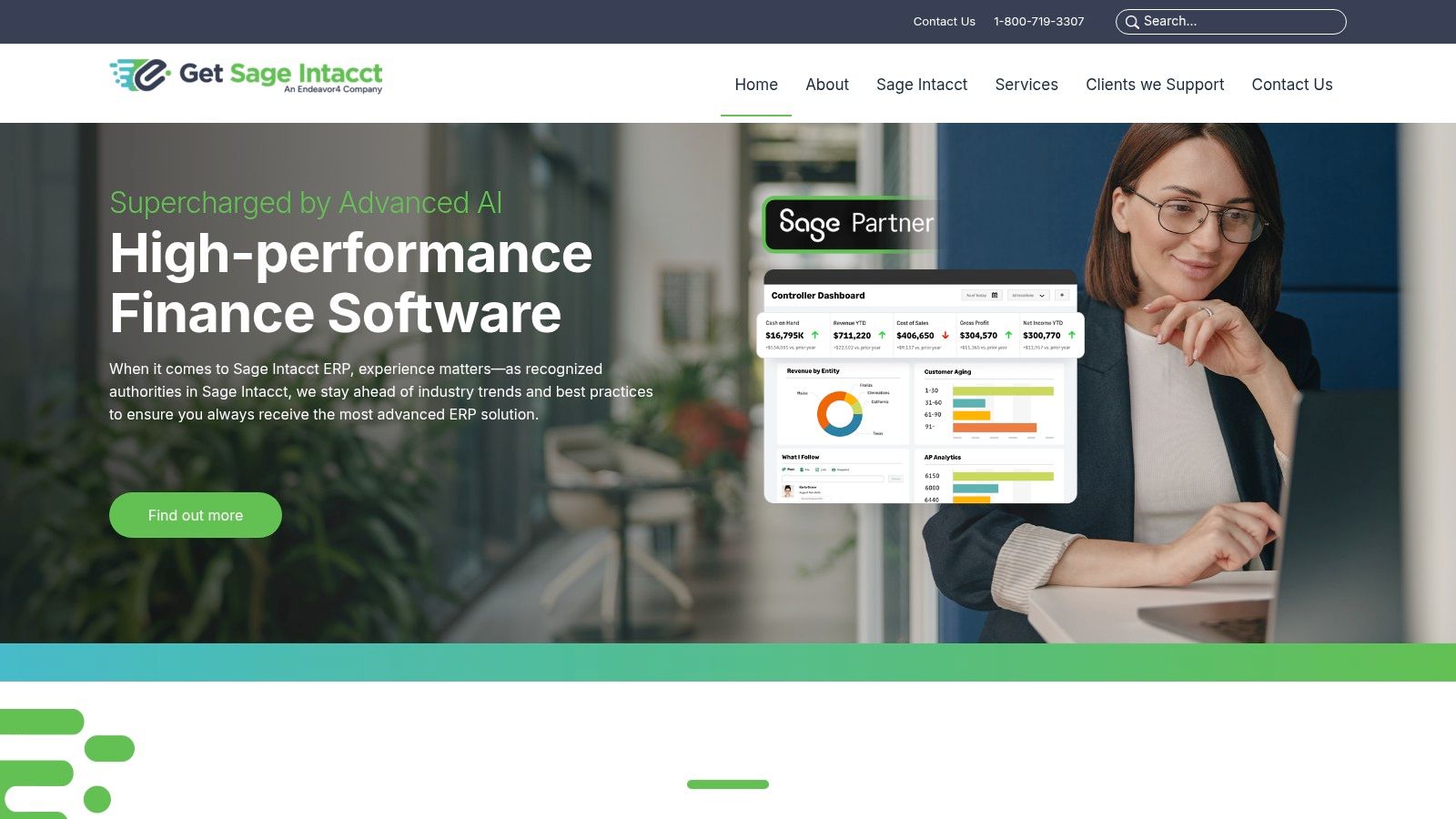
The reason this platform wins for mid-market services firms is simple. The buying decision is no longer just about invoices and the general ledger, it is about whether leadership can see real-time project margin, billable utilization, and unbilled WIP without spreadsheet gymnastics. Generic tools can handle core accounting, but they often stop treating the project as a first-class financial object, which is where the leakage starts.
Why it ranks first
Practical rule: If your leadership team needs to manage profitability before the invoice goes out, Sage Intacct deserves to be first on the shortlist.
Sage Intacct also fits the market shift toward cloud-first finance. A 2022 SMB survey found 56% of businesses relied on accounting or financial software such as QuickBooks or Xero, 35% used only cloud-based software, and 24% used a mix of cloud and on-premises systems, while 53% of practices' client bases were already using cloud accounting software SMB survey. That matters because your clients and your internal team both expect connected, remote-access finance workflows now.
Sage Intacct is the right call when you want the finance system to become a control system, not just a record system. If you are still debating whether to stay in QuickBooks or move to cloud ERP, this is usually the point where the answer becomes obvious.
2. Deltek Vantagepoint
Deltek Vantagepoint is the cleanest fit when your firm lives and dies by projects. It is designed for architecture, engineering, consulting, and other delivery-heavy services businesses that need CRM, resource planning, time and expense, billing, and financials in one place. You can review the platform on the Deltek Vantagepoint website.
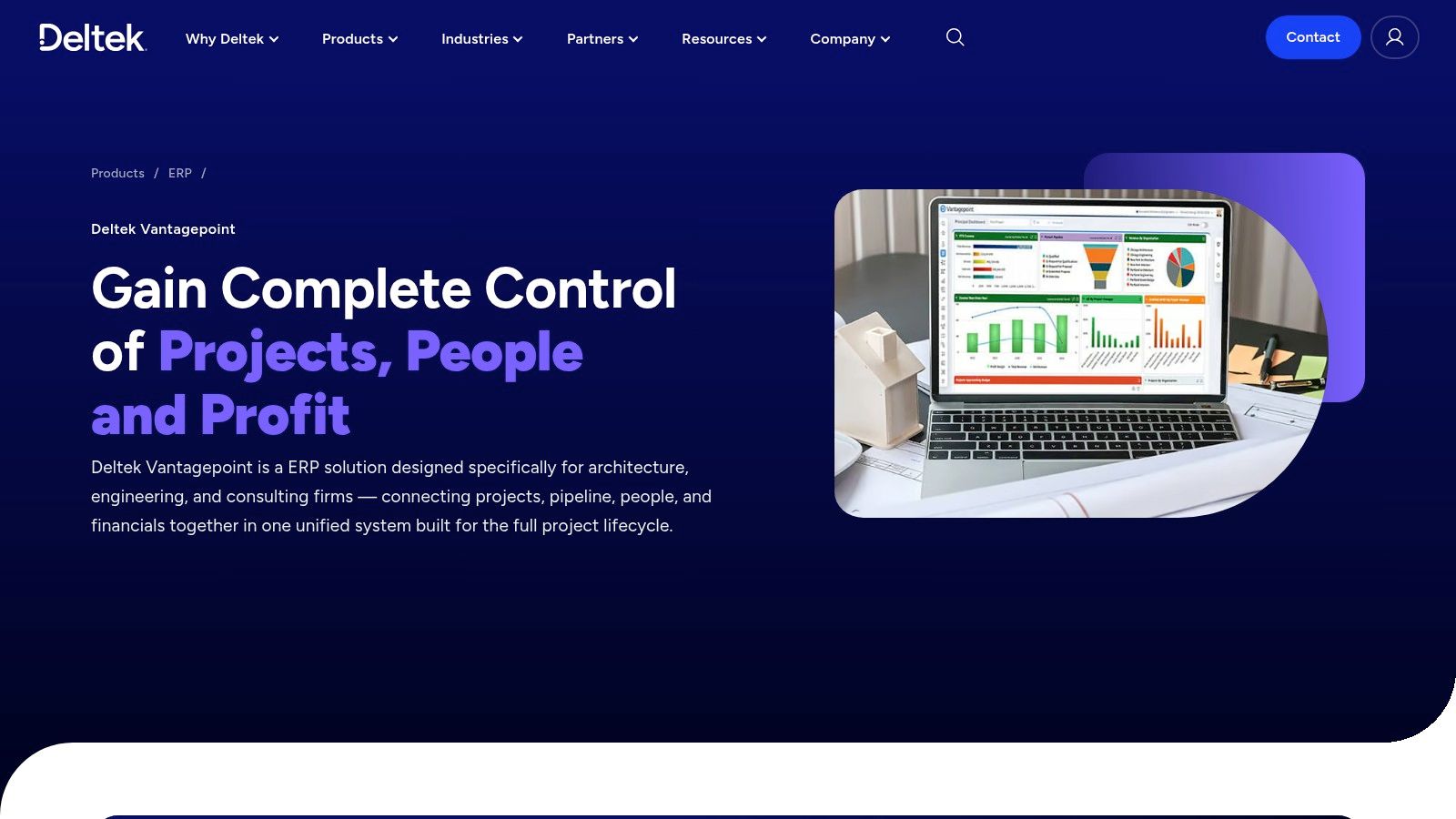
What makes Deltek different is the operational link between delivery and accounting. A project manager can see what is happening in the pipeline, finance can see WIP and billing status, and resource planning sits closer to the revenue engine than it does in a generic ERP. That makes it a strong option when the firm's biggest risk is margin drift caused by staffing, timing, or scope creep.
Where Deltek makes sense
The trade-off is also clear. Deltek is powerful, but it assumes you are serious about PSA-style process discipline. That's exactly why it works for firms that already think in terms of utilization, project lifecycle, and billable capacity. It is not the lightest option on this list, and smaller firms often find it heavier than they need.
Decision point: Choose Deltek if project execution drives the business and the accounting team needs to stay tightly tied to staffing and delivery.
For firms with a true project-centric operating model, Deltek can be a better fit than a finance-first ERP because it keeps the people who deliver work closer to the numbers that matter.
3. Oracle NetSuite With SuiteProjects
NetSuite earns its spot when a services firm needs breadth, not just accounting depth. The platform combines core financials with SuiteProjects, which covers project accounting, resource management, time and expense, and advanced billing. That makes it a serious option for organizations that expect to scale across entities, geographies, or service lines.
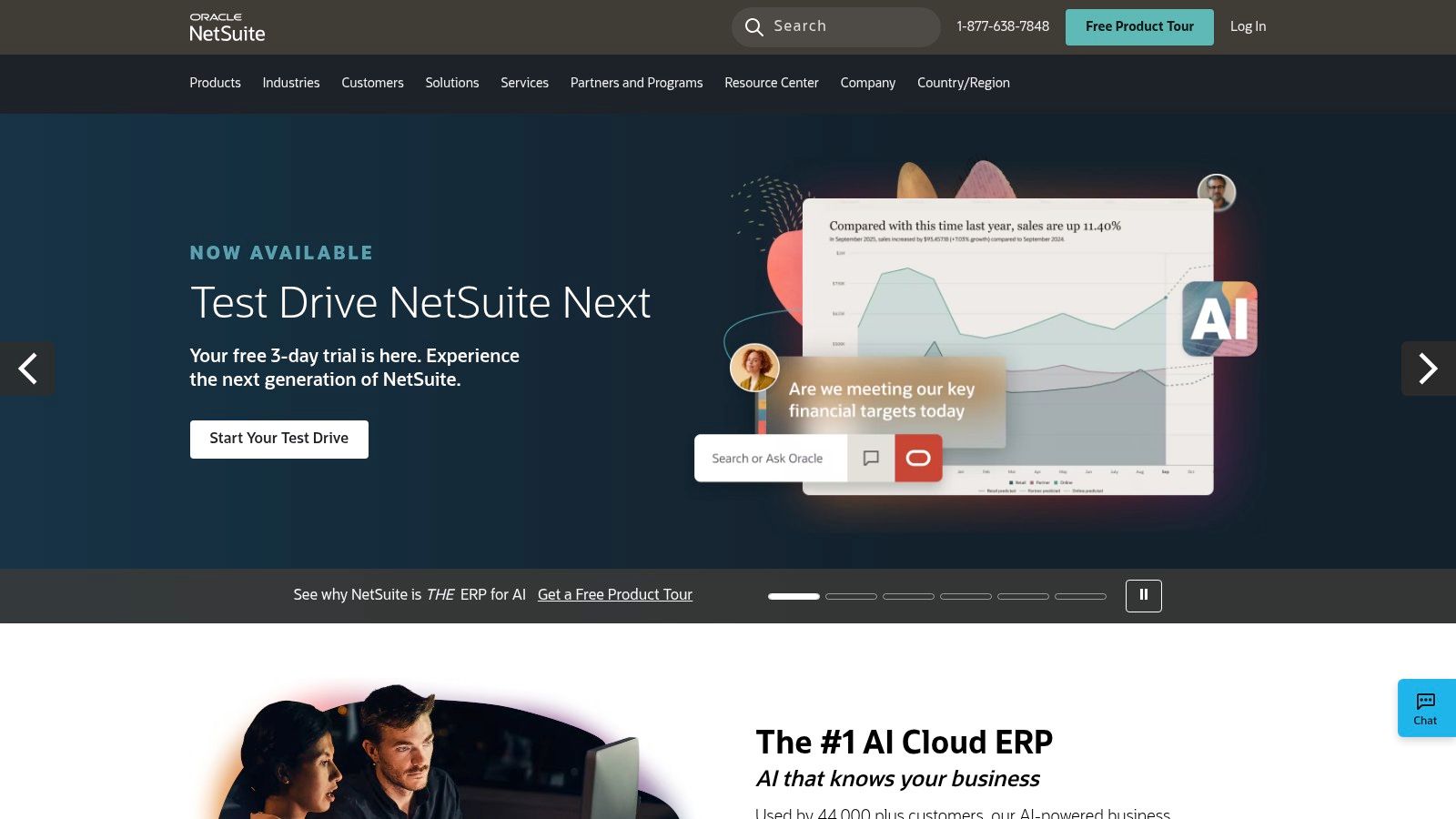
NetSuite's advantage is consolidation. If your firm is juggling different systems for finance, project tracking, and reporting, a unified suite can reduce friction and make leadership reporting more reliable. That matters when controllers are closing books across multiple entities and CEOs want one version of the truth without waiting for manual rollups.
When NetSuite is the right trade-off
The downside is equally real. NetSuite is not a casual purchase, and implementation can be substantial. SuiteProjects also sits alongside the core ERP, so buyers need to understand licensing and rollout scope before they commit. It is a strong platform, but it is rarely the simplest one.
A 2026 industry estimate valued the accounting software market at USD 23.47 billion in 2026 and projected growth to USD 35.86 billion by 2031, with an 8.85% CAGR market estimate. That kind of growth reflects exactly why platforms like NetSuite keep winning enterprise-minded buyers. The market is rewarding systems that support scale, process control, and deeper operational reporting.
NetSuite is a better shortlist candidate than QuickBooks or Xero when your finance team needs an ERP spine, not a point solution.
4. Microsoft Dynamics 365 Business Central
Business Central makes sense for firms already standardized on Microsoft tools. It brings finance, projects, reporting, and operations into one ERP environment, and its biggest advantage is how naturally it fits with Excel, Teams, Power BI, and Power Automate. The platform is available at Microsoft Dynamics 365 Business Central.
What keeps Business Central relevant for professional services is its Jobs/Projects functionality. Firms can track budgets, time, costs, and WIP inside the same system they use for core finance, which gives controllers a practical way to manage project profitability without building a custom stack.
Where Business Central wins
Its real strength is familiarity. Many finance teams already live in Microsoft software, so adoption is often easier than with a system that feels foreign from day one. That can shorten the internal learning curve and reduce resistance from users who spend all day in Excel anyway.
Practical rule: If your team already runs on Microsoft 365 and you want ERP discipline without leaving that ecosystem, Business Central is a sensible choice.
The caution is that project accounting usually needs solid partner guidance. Business Central can do a lot, but the quality of the outcome depends on configuration, process design, and whether you add the right extensions for your service model. That makes the implementation partner almost as important as the software.
Business Central belongs in the middle of the pack for firms that want a broader ERP platform with project capability, especially if Microsoft standardization is already part of the operating model.
5. QuickBooks Online Advanced
QuickBooks Online Advanced is the right answer for smaller professional services firms that need speed, not a heavyweight ERP rollout. It gives you project profitability, custom fields, permissions, automation, and stronger reporting than the lighter plans, and the product page is QuickBooks Online pricing. For many firms, that is enough for a while.
The appeal is obvious. QuickBooks is familiar to accountants, easy to deploy, and backed by a broad app marketplace. If you need to start tracking project labor, expenses, and payroll costs without forcing the whole firm into a new operating system, it gets you moving fast.
Where QuickBooks stops being enough
The problem is scale. As soon as the firm needs multi-entity visibility, stronger revenue recognition discipline, or cleaner operational reporting across projects, QuickBooks starts leaning on workarounds. That is where finance teams begin stitching together add-ons and spreadsheets to get the answers leadership needs.
A June 2026 report on professional services bookkeeping found that only 32.6% of invoices are processed without manual work, and that 200 monthly documents can consume over 16 hours of data entry at five minutes each workflow report. That is the hidden cost of staying too long in a light system and layering on manual processes around it.
QuickBooks Online Advanced is fine when the firm still behaves like a smaller services business. Once it starts behaving like a mid-market operation, it becomes a bridge, not a destination.
6. Xero With Xero Projects
Xero is a strong fit for smaller, distributed services teams that want clean accounting and lighter project tracking without too much complexity. Its direct pricing page is Xero pricing plans, and the platform's appeal is its simplicity. Xero Projects adds time and cost tracking plus basic project profitability, which is enough for firms that do not need a full PSA suite.
The experience is usually easier than larger ERP systems. Finance leaders like the interface, accountants adapt quickly, and integrations can fill in gaps for payroll, billing, and adjacent workflows. For a lean professional services firm, that can be the difference between real adoption and another system that gets ignored.
Where Xero fits best
Xero works when the reporting question is still fairly simple. Which jobs made money, which ones didn't, and what do we need to bill next month? That's a different operating model from a firm that needs entity consolidation, advanced billing rules, or revenue recognition tied to complex delivery contracts.
The challenge is that the project feature set is intentionally lighter than PSA or ERP systems. Once the business needs deeper multi-entity control or more advanced financial rules, the platform usually depends on add-ons. That can work, but it also creates more moving parts for the finance team to manage.
Decision point: Xero is a practical choice for simple project accounting. It is not the choice for firms that already need finance to act like an executive control tower.
If your team values usability above all else and your project model is still uncomplicated, Xero deserves a look. If you need more than that, it will start to feel thin.
7. Certinia ERP Cloud
Certinia ERP Cloud is the right answer for firms that are already built around Salesforce and want financials, PSA, and customer data in one native environment. The platform lives on Salesforce, and you can review it on the Certinia website. That architecture matters because it reduces the gap between pipeline, delivery, and finance.
Certinia's strength is continuity. Sales, project delivery, resource planning, utilization, and finance all sit in a system designed for services businesses, which gives leaders a clearer line of sight from opportunity to cash. That is valuable when revenue depends on keeping the customer record, engagement, and project economics tightly connected.
Where Certinia is strongest
It belongs near the top of the list for Salesforce-centric organizations that want services KPIs and forecasting without forcing data into a separate finance silo. The platform is especially relevant when the business already treats Salesforce as the operational center of gravity.
The trade-off is straightforward. If you are not running Salesforce day to day, Certinia is usually too much platform for the need. It also tends to require Salesforce expertise and partner-led implementation, which adds cost and complexity that smaller teams may not want.
Mid-market finance teams are still feeling the pressure of slow closes. One 2025 benchmark reported that 50% of teams need six or more business days to close the books, while only 18% finish in three business days or less close benchmark. Certinia can help reduce some of that friction if your process design is disciplined, but the system only works as well as the underlying implementation.
For Salesforce-first professional services firms, Certinia is a serious contender. For everyone else, it is probably more platform than necessary.
Top 7 Accounting Software for Professional Services, Feature Comparison
| Solution | Implementation complexity 🔄 | Resource requirements 💡 | Expected outcomes 📊 ⚡ | Ideal use cases | Key advantages ⭐ |
|---|---|---|---|---|---|
| Sage Intacct | Moderate–high; typically partner-led | Mid-market finance + integration resources (APIs/SFDC) | Deep, real-time project financials and revenue control | Services orgs outgrowing entry-level systems; multi-entity projects | Strong project accounting, robust APIs, dimensional reporting |
| Deltek Vantagepoint | High; extensive PSA configuration & training | Project SMEs, implementation partner, change management | Unified delivery + financials; tighter WIP/margin control | A/E, engineering, consulting with complex project lifecycles | Purpose-built PSA workflows and resource planning |
| Oracle NetSuite (with SuiteProjects) | High; modular ERP + SuiteProjects setup | ERP project team, partners, additional SuiteProjects licensing | Scalable unified ERP/PSA, consolidated global reporting | Growing to large services firms needing one suite | Broad unified suite, mature PSA, multi-subsidiary support |
| Microsoft Dynamics 365 Business Central | Moderate; partner configuration recommended | Microsoft admins, optional Power Platform skills | Integrated project jobs with strong Microsoft integrations | SMB–midmarket on Microsoft 365 seeking project accounting | Competitive pricing, Excel/Power BI/Teams integration |
| QuickBooks Online Advanced | Low; fast deployment and setup | Minimal IT; accountants/common apps for extensions | Quick project profitability views; fast time-to-value | Small and growing services firms needing simplicity | Rapid deployment, familiar ecosystem, transparent pricing |
| Xero (with Xero Projects) | Low; simple, intuitive setup | Small finance team; add-ons for advanced needs | Lightweight job costing and time tracking | Small professional services teams preferring simplicity | Easy UX, clear pricing, good third-party integrations |
| Certinia ERP Cloud (FinancialForce) | High; Salesforce-native, partner-led rollout | Salesforce expertise, integration/configuration resources | End-to-end CRM→PSA→finance visibility and services KPIs | Organizations standardized on Salesforce needing front-to-back | Native Salesforce continuity, strong forecasting and utilization |
Choose the System and the Implementation Path
Pick the tool based on the operating model, not the feature checklist. QuickBooks Online Advanced and Xero fit lighter project needs, smaller teams, and firms that can live with basic profitability tracking. Deltek Vantagepoint and Certinia make sense when PSA depth, delivery workflows, and utilization management are central to how the business runs. Business Central and NetSuite belong on the shortlist when you need a broader ERP platform with finance, project, and multi-entity control in one place.
For many mid-market services firms, Sage Intacct sits in the best position because it balances project profitability, revenue recognition, multi-entity reporting, and executive visibility without forcing the business into an overly rigid operational model. That said, software alone won't fix a weak chart of accounts, messy dimensions, bad integrations, or a poor migration plan. Those are implementation problems, and they can sink even the right platform if the partner doesn't know how to design for your business.
That's where Lucentive matters. As a Sage Intacct National Premier Partner with mid-market implementation experience, the team can help you evaluate fit, risks, and time-to-value before you commit to Intacct alone or sign with the wrong reseller. If you are a CEO, CFO, Controller, or VP of Finance trying to get out of spreadsheet-driven close cycles and into cleaner project visibility, schedule a 30-minute working session with Lucentive and pressure-test your shortlist against the way your firm operates.
If you're deciding between QuickBooks, a broader ERP, or Sage Intacct, Lucentive can help you sort out the trade-offs before you buy. Book a conversation with the team at Lucentive to review your project accounting, reporting, and implementation needs, then move forward with a plan your finance team can defend.