It's day eight of the close. Three legal entities still live in three company files, and the intercompany items sit in one spreadsheet the controller does not trust. The CEO wants a group cash figure before the board packet goes out. You can build a rollup. You cannot walk every elimination back to a source document without opening another file.
That is the choice in front of a finance leader. Cloud based accounting software is not a shopping list of hosted apps. It is a decision about how the close runs, who owns the controls, and which class of system can carry the reporting you already owe the board.
Table of Contents
- Which Cloud Accounting Class Fits the Close
- How the Ledger Runs and Who Owns the Controls
- Healthcare Nonprofit and Multi-Entity Stress Tests
- Integrations Worth the Subscription
- Decide Whether This Close Is Ready to Move
- Summary
- Frequently Asked Questions
Which Cloud Accounting Class Fits the Close
A controller closing three legal entities from three company files and one spreadsheet, with intercompany items still open on day eight, is not short of software. The books were never built to produce one controlled group result. Before you buy another license on your own, pressure-test the close through cloud ERP implementation. A design built from the close will tell you whether a new system pays off, or whether the pain is the process.
| System class | Who it fits | Multi-entity | Inventory | Reporting | Implementation and ownership cost |
|---|---|---|---|---|---|
| Separate company files | One entity, or a tiny group willing to export | One file per entity, no parent-child chart, manual intercompany | Item list inside each file | File reports plus spreadsheet rollups | Low license cost, rising close labor as entities grow |
| Entry-level cloud books | Single company or a simple second company with light stock | Separate organizations and limited automated eliminations | Basic stock and cost of goods | Standard statements and simple dashboards | Fast start; subscriptions multiply per company and add-on app |
| Mid-market cloud financial management | Healthcare, nonprofit, and services groups that have outgrown files | Shared structure with automated consolidation, intercompany, and currency | Often a connected inventory tool rather than a warehouse system | Dimensions for location, fund, grant, project, and department | Higher setup effort, less spreadsheet labor after go-live |
| Broader cloud ERP | Product or multi-site operators that need operations and finance together | Strong when entities, currencies, and eliminations are configured | Native inventory and costing | Operational and financial reports, more modules to govern | Longest implementation and the widest ongoing subscription |
What the table cannot show
Entity-level bookkeeping does not create consolidated financial control. A comparison of life after separate QuickBooks files states that QuickBooks requires a separate company file for each legal entity, with no parent-child relationship between files, no consolidated chart of accounts spanning them, and no synchronized intercompany balances. When one entity pays a supplier invoice for another, the transaction must be recorded in both files, coded consistently, and matched at period-end. At three to five entities, that manual workload is increasingly difficult to sustain. Beyond five, currency discrepancies and unmatched intercompany balances can persist for weeks.
Cloud based accounting software is a delivery model, not one product. No class wins for every company. A single company with light stock belongs in entry-level books. A healthcare, nonprofit, or services group that has outgrown files belongs in mid-market financial management. A product company or multi-site operator that must run inventory and finance together belongs in broader cloud ERP.
Sage Intacct is Sage's cloud financial management product, aimed at organizations that have outgrown single-entity accounting. It sits inside the mid-market class beside its peers. It is not a verdict, and it is not the only serious option in that class. Check the subscription before treating a feature as included: Sage's consolidation options distinguish core multi-entity functionality from currency translation and advanced ownership consolidation. Sage's consolidation book documentation shows how consolidation books define included entities and reporting settings. Ask vendors to demonstrate the exact entity structure, eliminations, and currencies your close requires.
A clinic that still argues about charges before finance sees them will not fix that argument by adding another company file. Compare medical billing providers first, then decide what the ledger is actually allowed to receive.
How the Ledger Runs and Who Owns the Controls
The vendor hosts the application and the database, and the vendor applies the updates. Your team works in a browser under named users. Subledgers, journals, approvals, and source documents sit in one system instead of a file on one computer. That is the whole operating shift. It does not hand the close to the vendor.
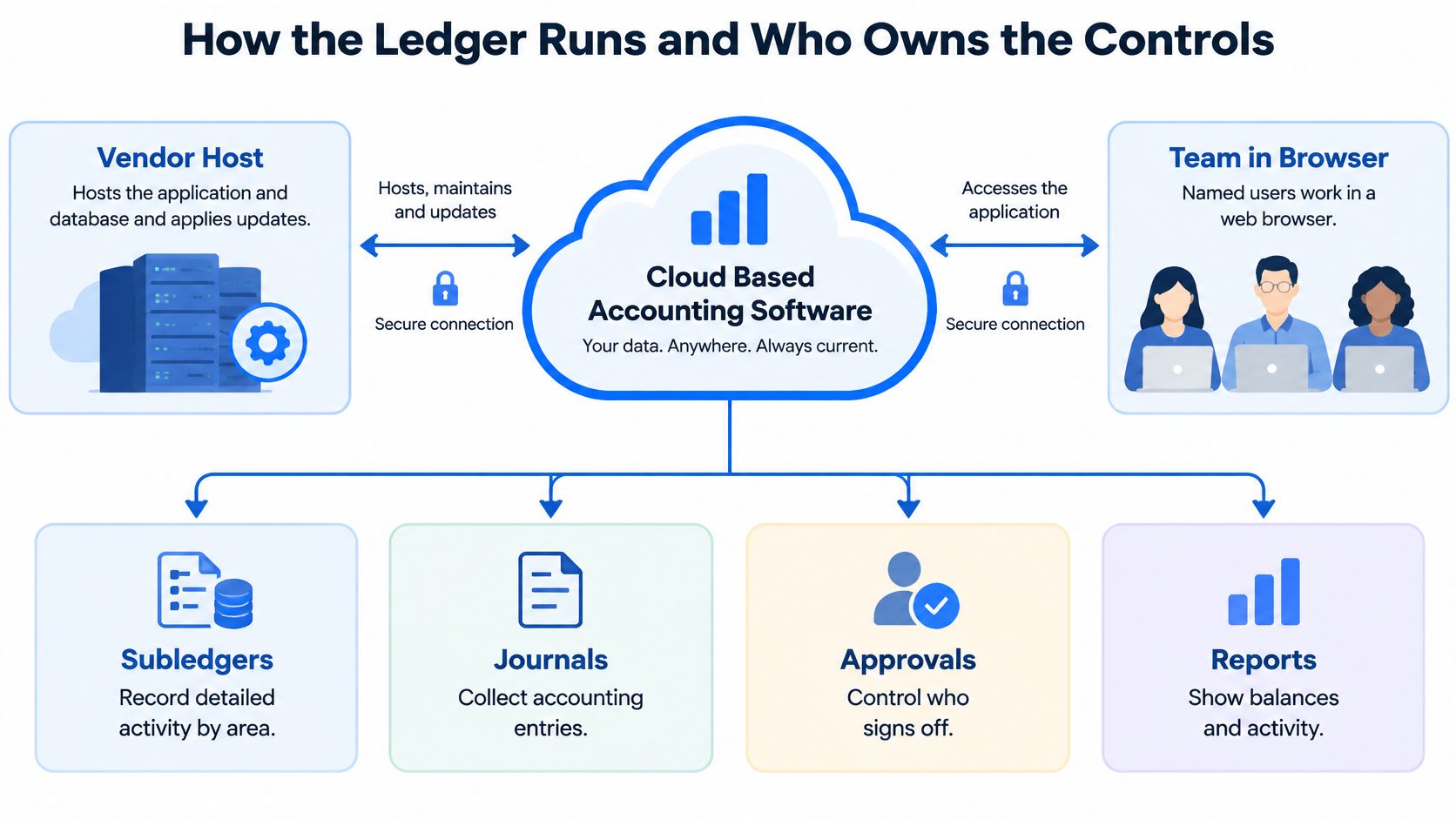
From a bank line to a signed close
Take one deposit that hits the operating account on the second of the month. A named user codes it to the right cash account, the right entity, and the dimensions the board uses, such as location, fund, grant, project, or department. The approval follows the delegation of authority you already use, not a generic workflow the software suggested. A second person reconciles the bank line to the statement. The close owner reviews the exception list on a published calendar and signs the package.
Think of the vendor as the building owner. Finance designs the floor plan, the locks, and who may post. If the coding at entry is sloppy, the dashboard is current and still wrong. A general ledger built for dimensional reporting only earns its place when every group figure can be traced to the document that created it.
Integrity before the marketing line
Treat the system as a distributed information system. NIST's cloud-security guidance names confidentiality, integrity, and availability as the core objectives. For a ledger, integrity comes first. A changed journal, a rewritten subledger line, or an edited approval history can still look available while the statements are wrong.
Ask for evidence, not a slogan that the data is "secure." Request the provider's current SOC 2 report and review its scope: confirm the accounting service is covered, read the auditor's findings, and identify controls your team must operate. Check whether the report covers controls at a point in time or their operation over a period. The packet should show all of the following.
- Role-based access: each named user sees and posts only what the role allows.
- Segregation of duties: the person who enters a payment is not the person who approves it.
- A tamper-evident audit trail: journal, subledger, and approval history cannot be rewritten without detection.
- Multifactor authentication: a password alone is not enough for anyone who can post or approve.
- Documented recovery objectives: you know how far back a restore goes and how long it takes.
- A contractual availability commitment: uptime is a service term, not a brochure line.
- A tested restore: someone on your team has watched a backup come back as usable books.
NIST also notes that cloud architectures must address security from physical infrastructure through the application. A control that stops at the data center wall does not protect a journal entry. Its cloud-security guidance makes the customer responsible for understanding and overseeing the protections it relies on.
Trade-offs buyers skip
Release timing belongs to the vendor. You do not pick the weekend for a patch, so you plan the close around a published calendar. An outage is no longer something a local server in the closet can fix. Shared infrastructure speeds patches, which is a real gain, and it also means a bad release hits every customer of that environment.
Leaving is the quieter risk. Nonstandard interfaces and weak export rights make a move expensive just when service has already disappointed you. Confirm the export format, the API limits, and who owns the historical detail before you sign.
The buyer still owns user reviews, retention rules, master data, backup tests, and an exit file after go-live. If a group total cannot be walked back to its source document, the close is not finished.
Healthcare Nonprofit and Multi-Entity Stress Tests
Three buyers hit the same wall in different clothes. The class that usually fits is the one that can hold the reporting object inside the ledger. Buying another set of company files fails all three.
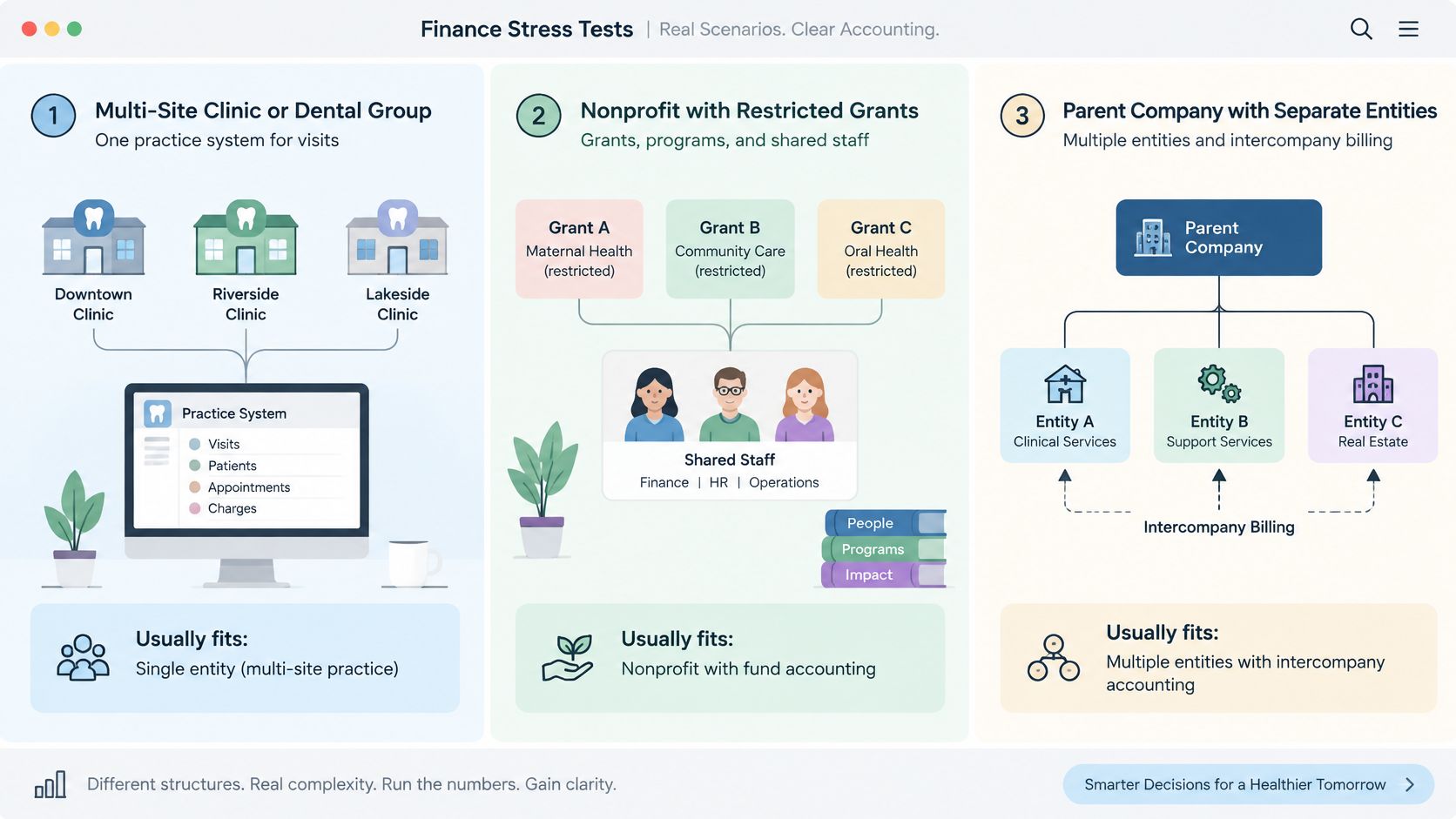
A multi-site clinic or dental group keeps the clinical or practice system as the system of record for visits. Finance needs charges, payments, and a location result without rekeying. A location dimension and a controlled feed matter more than a long app list. More company files give you three income statements and no reliable location result. Healthcare finance on a shared ledger is the shape of the problem, not a product pick.
A nonprofit or faith-based organization has to keep funds, grants, and restrictions inside the ledger so the board package is not a second set of books. FASB's nonprofit reporting standard requires reporting net assets with and without donor restrictions. FASB's overview of the reporting changes also explains the need to disclose the nature and amounts of donor restrictions. Entry-level profit-and-loss reports may not provide the detail needed to support that reporting. When restrictions and grant activity are tracked only in a workbook, the board package becomes a second set of books.
A growing company leaving desktop files usually breaks at the third or fourth entity, or at the first foreign subsidiary. Eliminations and currency translation move into spreadsheets. Separate files keep each set of books tidy and leave the group result outside any audit trail.
Data quality is a close risk
In Gartner's December 2024 survey of 250 CFOs and finance leaders, 14% selected enterprise data quality as a concern for 2025, beside 19% for slower top-line growth and 18% for hiring and retaining critical talent. Respondents could select more than one issue. Poor structure undermines dashboards, forecasts, and entity reporting. Fixing the chart and the controls is how you cut reporting risk, not a cosmetic upgrade.
Lucentive helps these buyers plan a move off QuickBooks, Xero, Dynamics GP, or an older ERP, including healthcare and nonprofit work. The same fit work can recommend staying put when the books are not the constraint.
Integrations Worth the Subscription
An integration checklist is not an operating model. More connectors can raise both risk and subscription cost when nobody owns master data and nobody clears exceptions. Accounting firms already feel that load. A 2025 Intuit QuickBooks survey found firms use an average of eight applications for core work, 41% report integration difficulties, and 44% cite subscription costs. Two-thirds feel overwhelmed by technology complexity at least weekly.
A four-part test
- What must post to the ledger. Payroll journals, billing summaries, bank activity, donor receipts, practice charges, and project costs belong in the books only at the level you will reconcile and audit.
- What should stay upstream. Visit detail, donor cultivation notes, and timesheet comments do not need a journal line. Keep them in the system that owns them.
- Who owns the shared list. One owner maintains locations, funds, grants, projects, and departments. Two lists means two truths.
- How an exception is found and cleared. Name the person, the report, and the day it must be cleared. An API with no exception owner is a silent duplicate.
In multi-site healthcare, dental groups, nonprofits, and professional services, a real-time report misleads when upstream systems use different patient, location, fund, grant, or project dimensions. Success is fewer manual touches, a shorter close, a lower reconciliation-exception rate, and a trail an auditor can follow. An API that exists is not success.
Bring one question to a partner: which few feeds change a decision this month, and who reconciles them?
A controlled CRM feed into the books is worth the subscription only when contract and invoice data land in the same ledger that recognizes revenue, and someone reconciles the difference before the close owner signs.
Decide Whether This Close Is Ready to Move
Cloud is not automatically more secure or more scalable. Outcomes depend on controls, configuration, staff capability, and governance. Buy the move only after the scorecard is honest.
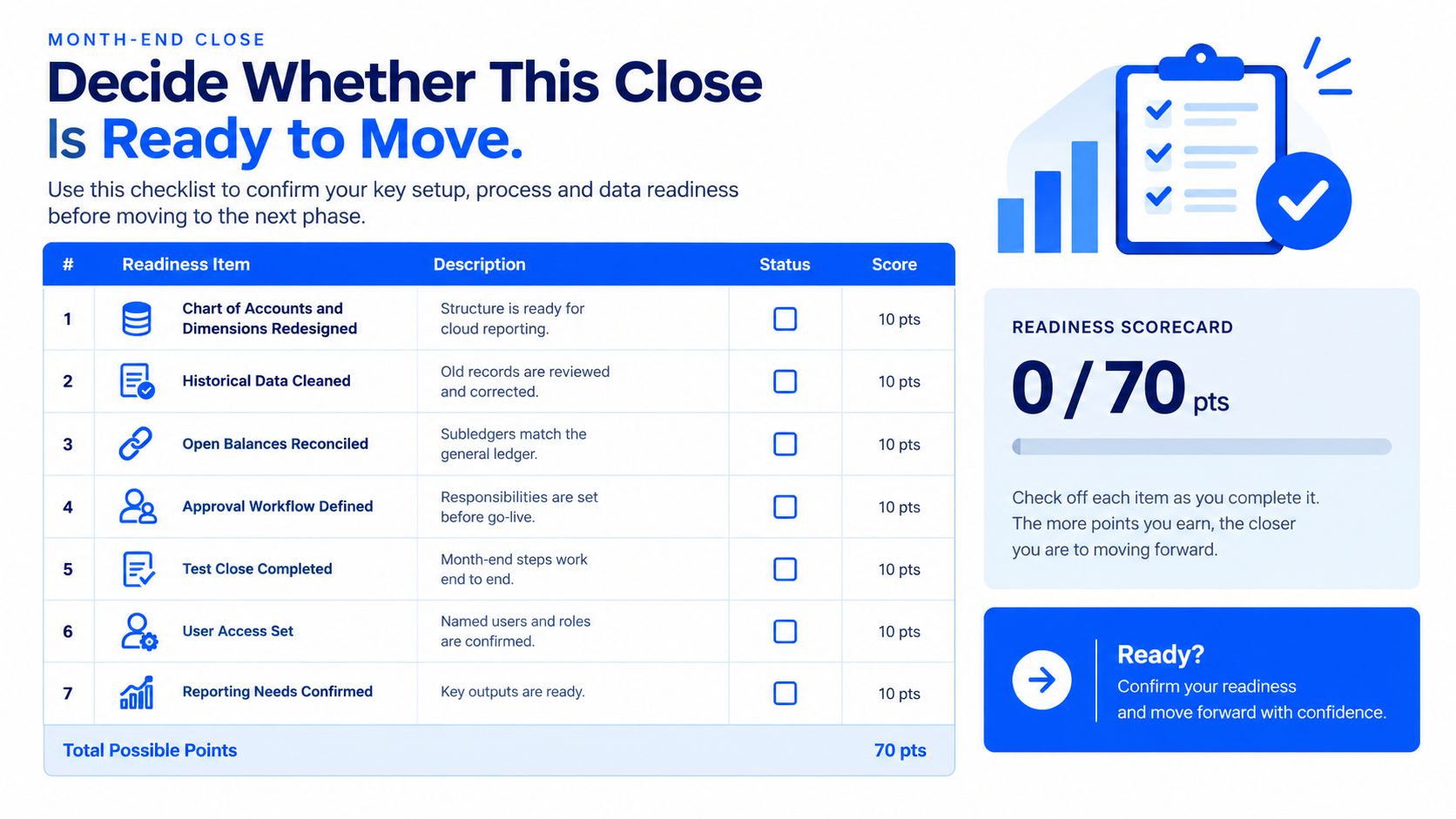
| Item | Ready when | Stop signal |
|---|---|---|
| Chart and dimensions | Locations, funds, grants, projects, and entities are mapped once | Each team codes its own version |
| Historical data | Opening balances tie to source records and the owner signs off | No one trusts the opening balances |
| Roles and duties | Access matches approval limits and segregation of duties is tested | Shared logins or one person can both post and approve |
| Close ownership | A named owner, a calendar, and a review step | The close lives in one person's spreadsheet |
| Training | Everyone who posts has practiced in a test company | Training was a single demo |
| Parallel close | One full close runs in both systems and differences are explained | The parallel run is skipped |
| Restore and exit | A restore is tested and the export format is confirmed | No restore or export has been tried |
A readiness assessment built from your close is the decision tool, not a feature demo. Do not move yet if nobody trusts the history, nobody owns the close, or the pain is a broken process rather than the software. A 2025 study of SMEs found only 25% believed their accounting information system fully matched business needs, while a separate 2025 firm survey found 67% viewed cloud migration as highly or very highly valuable but only 20% had migrated all data and applications, as reported in that readiness research. Wanting the move and finishing it are different facts. The same research notes that security coverage is uneven: many firms report network safeguards, and far fewer have endpoint detection on every device. Hosting does not close that gap for you.
Software alone reproduces the old chart in a browser. A partner who builds the design from the actual close will phase the work, validate fund, grant, location, and entity reporting before go-live, and keep the audit trail intact through cutover. That partner should also be willing to tell you to stay where you are.
If you are the CEO, CFO, or controller who will sign the spend, schedule a 30-minute working session with our team and test fit for your company before you pick a class of system.
Summary
Cloud based accounting software is a hosted ledger, not one product and not an automatic fix for a slow close. Separate company files fit a simple company and strain once entities, intercompany, and currency move into spreadsheets. Entry-level cloud books start fast and stay limited on multi-entity depth. Mid-market financial management fits dimensional reporting for locations, funds, grants, and projects. Broader cloud ERP fits when inventory and operations must live with the books. The buyer still owns access, duties, data definitions, reconciliations, backups, and an exit file. Connect only the feeds that shorten the close, and move only after the chart, history, roles, and a parallel close are ready.
Frequently Asked Questions
What is cloud based accounting software?
It is a hosted application and database that your team uses in a browser under named users. The vendor applies updates. Subledgers, journals, approvals, and documents sit in one system instead of a file on one computer. Finance still designs the chart, the approvals, and the close calendar. The vendor maintains the building. You still own the floor plan, the locks, and the signature on the package.
When do separate company files stop working?
They strain as the entity count grows. Each legal entity needs its own file, with no parent-child chart and no synchronized intercompany balances. A bill paid by one entity for another must be keyed in both files and matched at period-end. At three to five entities that workload is hard to sustain. Beyond five, currency differences and unmatched balances can linger for weeks, and the group result lives in a spreadsheet.
Does hosted software mean stronger security?
No. Hosting helps only when you can show role-based access, segregation of duties, a tamper-evident audit trail, multifactor authentication, and a tested restore. Confidentiality, integrity, and availability all matter, and integrity matters most, because a changed journal can still look available while the statements are wrong. A line that says the data is secure is not evidence. You also still own device security, user reviews, and backup tests.
How do healthcare and nonprofit needs differ?
A multi-site clinic or dental group needs a location result for charges and payments, while the clinical system stays the system of record for visits. A nonprofit or faith-based organization needs funds, grants, and restrictions to survive in the ledger so the board package is not a second set of books. Both objects should be dimensions in one ledger. Another stack of company files gives neither a controlled location result nor a grant schedule.
Which integrations are worth paying for?
Pay for the few feeds that cut rekeying and reconciliation exceptions, not for a longer connector list. Post only what the ledger must hold. Leave detail in the upstream system. Name one owner for locations, funds, grants, projects, and departments. Name who clears exceptions. More connectors raise risk and subscription cost when those owners are missing. Judge success by a shorter close and a trail an auditor can follow.
How do you judge total cost without a price sheet?
Add the license, the add-on apps, the implementation effort, the close labor you keep or remove, and the cost of a weak exit. Entry-level books look cheap until each company and each app adds a subscription and the rollup stays manual. Mid-market setup costs more up front and should cut spreadsheet labor after go-live. Broader ERP is the longest implementation and the widest ongoing subscription. A restore you have never tested is part of the cost too.
Lucentive helps CEOs, CFOs, and controllers decide whether a hosted ledger will shorten the close, hold multi-entity and dimensional reporting, and survive an audit. We plan the move from the current close, including when the honest answer is to stay put. Visit Lucentive to schedule a 30-minute working session and test fit for your company.