You're on day nine of the close. The parent is ready, two subsidiaries are still posting accruals, and a third can't explain why its intercompany payable doesn't match the receivable it's supposed to mirror. That's the moment most controllers recognize. The entries themselves aren't complicated. Getting multiple legal entities to record, match, and eliminate the same transaction the same way, in the same period, is what breaks.
Table of Contents
- Why Intercompany Entries Break the Close
- Core Entry Mechanics for Loans, Management Fees, and AP/AR Swaps
- Cross-Border Services and Transfer Pricing Controls
- Timing Differences and the Cutoff Decision Tree
- Layered Eliminations Beyond the Basic Offset
- Reconciliation as a Control Sequence Not a Spreadsheet Check
- What the Right ERP and Partner Actually Change
- Summary
- Frequently Asked Questions
Why Intercompany Entries Break the Close
Most intercompany problems aren't bookkeeping failures. They're methodology failures. Each entity records its side correctly by its own rules, but there's no shared approach for transaction ID, counterparty, currency, period, and account mapping. By consolidation, the differences look like errors even when neither ledger is wrong.
The accounting requirement leaves no room for that ambiguity. Standards treat a corporate group as a single economic entity, so consolidation must combine parent and subsidiary financials and eliminate intragroup amounts in full, as described in the IFRS discussion of eliminating intragroup amounts in consolidation. That scope covers receivables, payables, revenue, expenses, loans, interest, dividends, cash flows, and unrealized profits embedded in assets. The same group reporting logic also sits behind IAS 27 Separate Financial Statements and IFRS 10 Consolidated Financial Statements, which frame how entities distinguish legal books from group presentation.
Where the Breakdown Starts
It usually starts with four quiet choices made independently.
- Different cutoff calendars: One entity closes shipping early, another books on receipt, and the pair lands in different periods.
- Incomplete counterparty coding: A charge posts to a generic intercompany account with no entity tag, so nobody can match it at transaction level.
- Inconsistent charts of accounts: The same management fee hits three different expense accounts across clinics, sites, or subsidiaries.
- One-sided corrections: One controller fixes a variance in her ledger and tells no one, creating a new variance for the other side.
Each choice is defensible locally. Together, they make elimination impossible without a spreadsheet investigation. This is why close teams often borrow discipline from broader internal control principles under the COSO framework, especially around control activities, information quality, and accountability across entities.
What a Controlled Approach Requires
A controlled process standardizes how intercompany accounting journal entries are initiated before anyone worries about consolidation. That means a common cutoff calendar, mandatory counterparty and document fields, and a rule that both sides post from the same source document. Teams evaluating finance architecture more broadly often compare approaches like Central Finance architecture benefits against a native multi-entity ledger, but the design question is the same either way. Who records what, when, and with which identifiers?
If your consolidation team is discovering intercompany differences, your process has already failed upstream. Discovery belongs at posting, not at elimination.
For growing groups, that discipline usually starts with a structured approach to multi-entity accounting that treats matching and elimination as part of daily posting. Once that foundation exists, the close stops depending on whoever remembers last month's spreadsheet logic. Organizations formalizing that model often align it with AICPA guidance and resources for financial reporting controls.
Core Entry Mechanics for Loans, Management Fees, and AP/AR Swaps
Textbook examples show symmetrical debits and credits and stop there. In practice, the entry is only half the control. The other half is proving both entities recorded the same transaction, for the same period, with evidence an auditor can follow.
Intercompany Loans and Interest
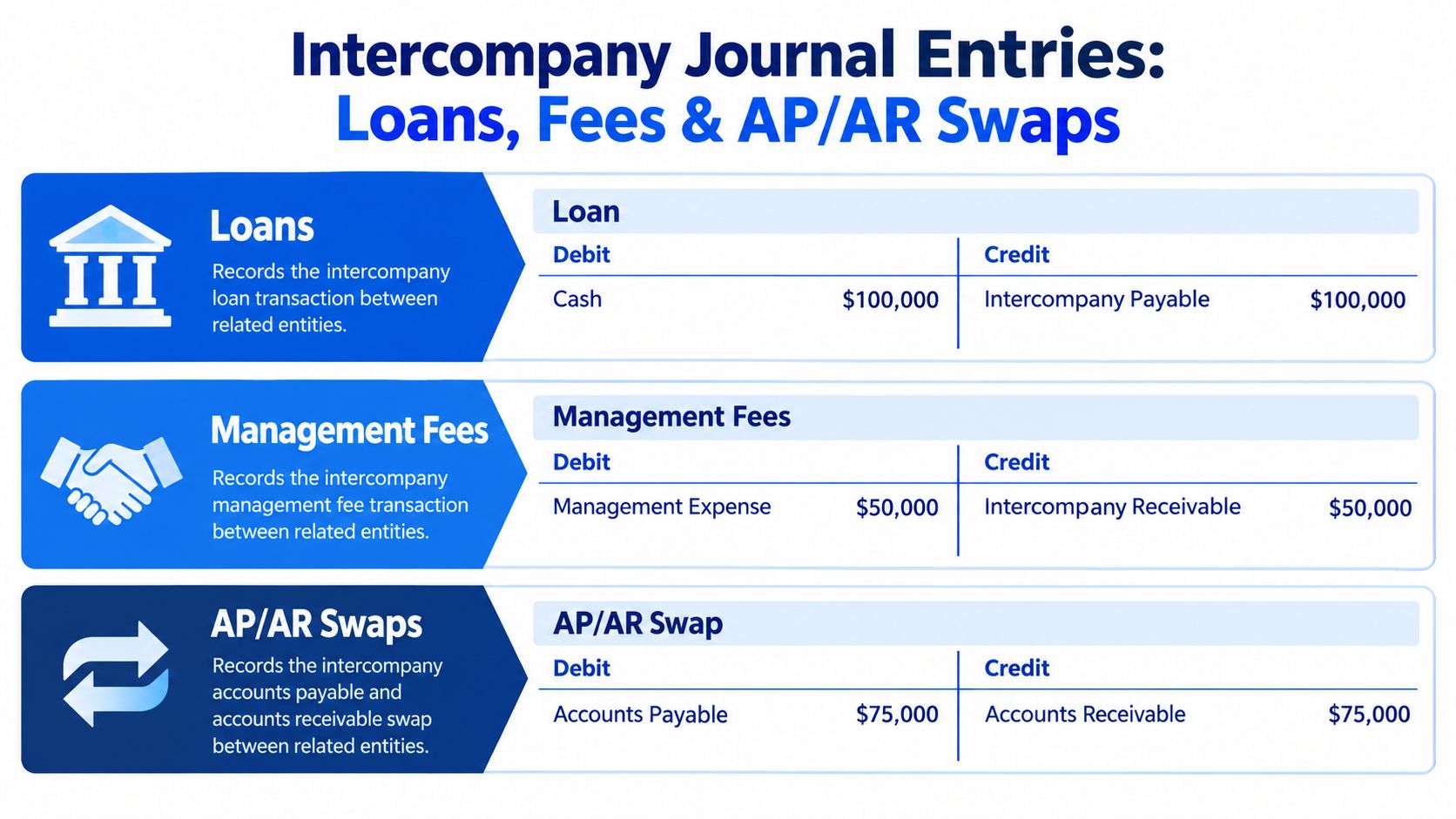
The lender debits intercompany loan receivable and credits cash. The borrower debits cash and credits intercompany loan payable. Each period, the borrower accrues interest expense against the payable or a separate accrued interest account, and the lender accrues the mirror interest income and receivable.
That pairing sounds simple until terms drift. If one side accrues monthly and the other records on payment, balances won't agree and the elimination won't clear. The loan agreement, rate, and accrual cadence need to sit behind both postings, not in one controller's email. For a broader view of how related-party financing is disclosed and scrutinized, IAS 24 Related Party Disclosures is a useful reference point.
Management Fees and Shared Services
The provider debits intercompany receivable and credits intercompany revenue. The recipient debits the relevant intercompany expense and credits intercompany payable. Both entries should carry the same transaction ID, service period, and allocation basis, supported by the agreement, calculation, invoice, and approval.
At consolidation, that activity disappears. Under US GAAP, intra-entity balances and transactions must be eliminated in full, and for a basic service transaction the worksheet debits intercompany revenue and credits the corresponding expense for the same amount, as set out in PwC guidance on intercompany transactions and eliminations. The same guidance treats a loan by eliminating receivable and payable in equal amounts. For a second practitioner reference, BDO's insights on consolidations and eliminations can help finance teams compare treatment across common transaction types.
AP and AR Swaps in Shared Services
When one entity pays a vendor on behalf of another, the paying entity doesn't book the expense. It books an intercompany receivable. The benefiting entity books the expense or asset and the intercompany payable. Settlement then nets through the intercompany accounts rather than each entity paying the vendor separately.
Dimensional tagging is what keeps this traceable at scale. Using dimensions to tag entity, counterparty, and cost type on every posting lets you match swaps without multiplying GL accounts for every entity pair. Without that tagging, shared services become the fastest route to unidentifiable net balances. In AP environments, this discipline mirrors broader three-way match and invoice control concepts, even though the counterparty is internal rather than external.
Practical rule: If you can't trace a posting to a counterparty, document, and period in under a minute, the entry isn't finished, however balanced it looks.
Cross-Border Services and Transfer Pricing Controls
Cross-border fees, royalties, and cost allocations carry a risk domestic entries don't. A balanced debit and credit proves arithmetic. It doesn't prove the charge is commercially supportable, and tax authorities care about the second question far more than the first.
A Four Stage Method That Holds Up
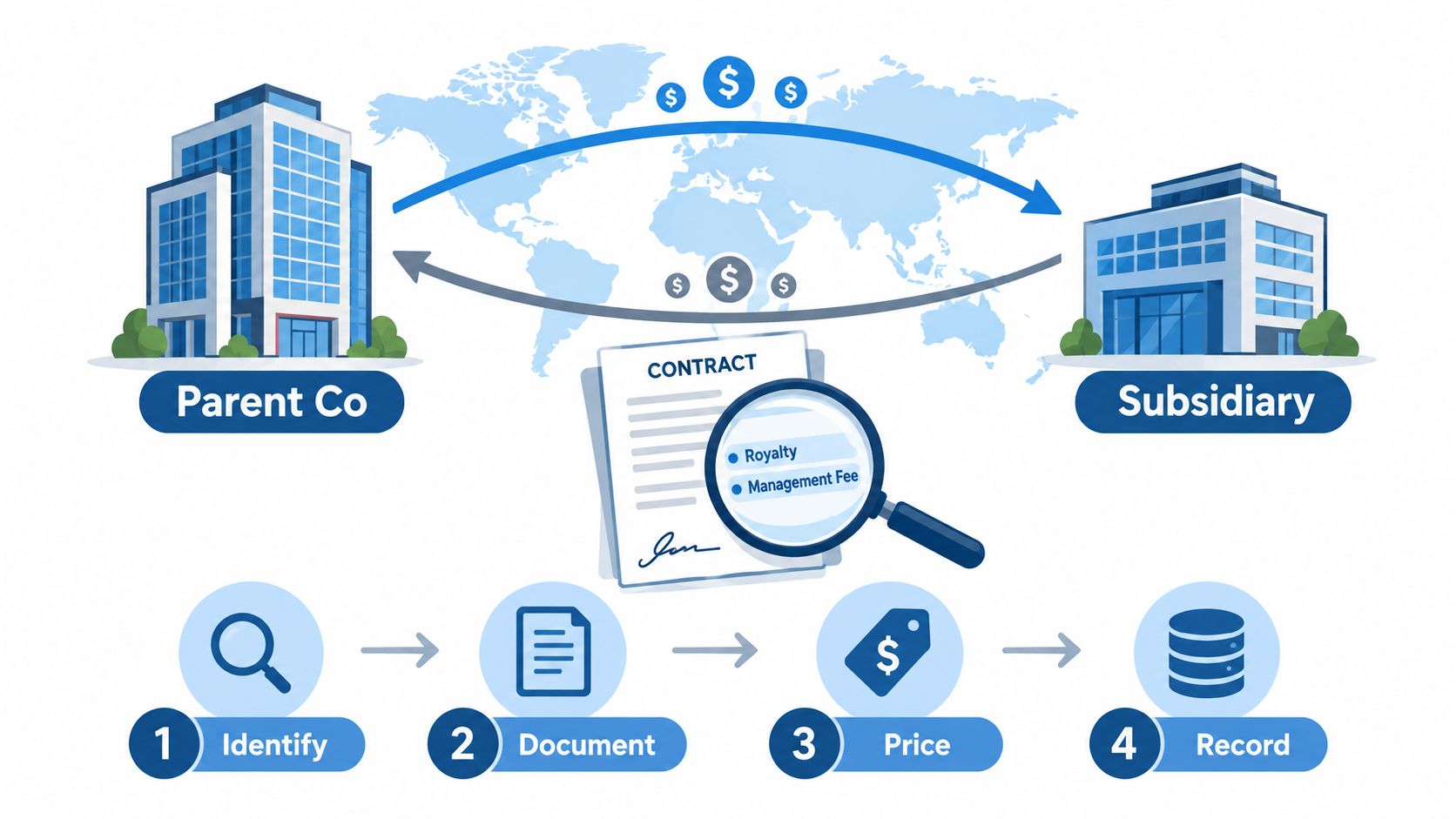
Use the same sequence every time, regardless of which entities are involved.
- Identify the transaction properly: Name each legal entity, the transaction flow, each party's functional profile, and who bears which risks.
- Post matched entries: Provider and recipient use the same transaction ID, counterparty, currency, and service period in both ledgers.
- Validate the price: Test the charge against the most reliable arm's length method, supported by comparable company or comparable transaction analysis.
- Reconcile and retain evidence: Eliminate reciprocal positions in consolidation and keep the agreement, calculation, invoice, and approval together.
Skip stage three and you've built a tax exposure with perfect bookkeeping. Skip stage two and you'll never reconcile cleanly, whatever your documentation says. The broader international baseline remains the OECD Transfer Pricing Guidelines for Multinational Enterprises and Tax Administrations, which helps anchor method selection and documentation expectations.
Documentation and Posting Controls
The IRS expects transfer pricing documentation to explain the selected method, rejected alternatives, controlled transactions, comparables, economic analysis, and relevant year-end data, and it generally must exist when the return is filed and be producible within 30 days of a request, per the IRS transfer pricing documentation guidance. That timeline means documentation can't be reconstructed during an audit. It has to be created as entries post.
Build that into the system. Prohibit posting when a two-sided entry lacks a matching counterparty. Enforce period and currency tolerances. Route FX differences, withholding tax, and out-of-period corrections through an exception workflow instead of letting controllers force a match. Groups operating in the Gulf face their own documentation expectations, and a UAE intercompany transaction guide is a useful regional reference alongside US rules. Teams with activity across Europe may also need to consider EU transfer pricing developments and administrative expectations.
Regulated and multi-jurisdiction groups, including those using Sage Intacct for financial services operations, feel this most sharply because the same entry must satisfy consolidation, tax, and audit reviewers who ask different questions. Design for all three at posting and none of them becomes a year-end project.
Timing Differences and the Cutoff Decision Tree
Two entities post valid entries in different periods. Neither is wrong, yet consolidation shows an imbalance. This is the most common intercompany problem and the one basic guidance handles worst, because it isn't an error to fix. It's a cutoff decision to govern.
Causes are mundane. Different close calendars, shipping terms that transfer ownership before receipt, goods received but not yet invoiced, and accrual practices that differ by site. A multi-site healthcare group or DSO sees this constantly when a central entity allocates costs before a clinic has closed its own books. Many of these judgment calls ultimately connect back to core period-end guidance such as ASC 855 subsequent events discussions and close timing considerations, especially when teams are deciding whether an event belongs in the reporting period.
Working the Decision Tree
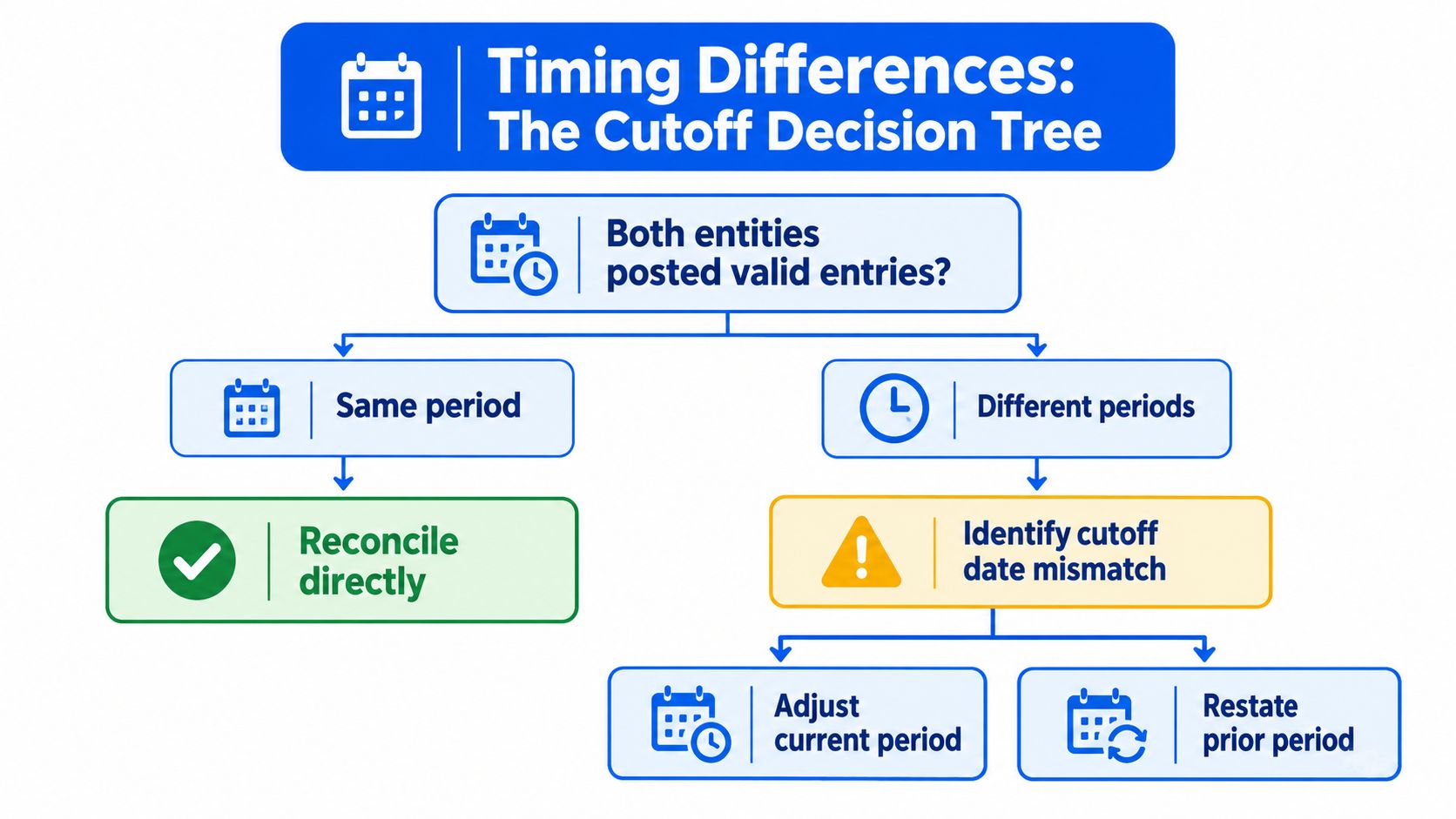
Start with one question. Did the underlying transaction occur before or after each entity's cutoff?
- Obligation established before cutoff, invoice not yet recorded: The receiving entity books an accrual in the current period and reverses it next period when the actual entry posts.
- Transaction occurred after cutoff for both sides: No accrual. Document it as a timing item and let it match naturally next period.
- One side missed an established obligation entirely: That's a correction in the originating books, not a consolidation adjustment, and the receiving entity owns it.
- Both sides are right but periods legitimately differ: Handle the gap through a documented consolidation adjustment, owned by the consolidation team, with the reversal tracked.
Ownership is the point controllers skip. Every open item needs a named owner, the originating entity, the receiving entity, or consolidation, plus a due date. Unowned timing items become permanent reconciling balances. That ownership model is consistent with month-end close best practices discussed by the Corporate Finance Institute, particularly around accountability and variance resolution.
Matching Is Not Recognition
Operational matching asks whether two postings pair up. GAAP or IFRS recognition asks whether revenue, expense, or a liability belongs in the period at all. Forcing a match can produce a clean reconciliation and a wrong answer, particularly when an accrual would recognize an obligation that doesn't yet exist.
Automation doesn't resolve that judgment. In survey data cited for finance professionals, 93% rated automated, standardized close processes and alerts as important or very important, while 52% were adding automation to journal-entry management, figures reported in HashMicro's discussion of intercompany accounting and close automation. Automate an ambiguous cutoff rule and you create consistently wrong entries faster. Standardize calendars, cutoff rules, and ownership first, then automate. This is the same caution raised in broader financial close automation discussions from Gartner, where process design still determines whether automation improves or magnifies close quality.
Layered Eliminations Beyond the Basic Offset
Eliminating intercompany revenue against expense and receivable against payable is the entry-level version. Real consolidations layer additional adjustments on top, and those layers live only in the consolidation process. They never touch either entity's statutory ledger, which preserves separate legal entity books while presenting the group correctly.
Unrealized Profit in Inventory
Internal profit isn't earned until inventory sells to an outside customer. A published US GAAP example uses a $100 intercompany sale where embedded profit in ending inventory is $40 and the buyer's recorded cost is $60, eliminated by debiting Sales $100, crediting Cost of Sales $60, and crediting Inventory $40, as shown in the US GAAP intercompany transactions example. Eliminate only revenue and expense and inventory stays overstated by the internal margin. When the inventory later sells externally, the deferred profit releases through consolidation so group gross profit reflects the outside sale.
Direction matters when a subsidiary is partially owned. For a downstream sale from parent to subsidiary, eliminated profit is attributed to the parent. For an upstream sale from subsidiary to parent, all unrealized profit is still eliminated, but attribution follows a consistently applied policy election, a distinction covered in Deloitte guidance on attribution of eliminated income. Identify direction and ownership before posting the elimination, not after noncontrolling interests look wrong. For additional context on inventory cost flow and margin presentation, IAS 2 Inventories helps frame why embedded internal profit must be removed.
Foreign Exchange and Account Classification
Currency adds a second layer that a simple offset can't handle. Under IAS 21, an intragroup monetary asset or liability can't be eliminated without recognizing the effects of currency fluctuations in the consolidated statements, as stated in the IAS 21 standard on foreign exchange effects. Eliminate the reciprocal principal, then address the exchange difference separately. Forcing both ledgers to agree with an arbitrary reclass destroys that information.
Classification creates a quieter version of the same problem. Two balances can match in amount while sitting in incompatible accounts because entities use different charts or mappings. The elimination then clears numerically and misstates line items. In practice, finance teams often supplement policy with foreign currency accounting explainers from major firms such as KPMG when deciding whether a balance is monetary, how it should be remeasured, and where FX effects belong.
| Type of Difference | Correct in Originating Books | Handle via Consolidation Journal | Requires Policy or Disclosure Review |
|---|---|---|---|
| One-sided or missed posting | Yes | No | No |
| Legitimate period timing gap | Accrual only if obligation exists | Yes, with tracked reversal | No |
| Unrealized inventory profit | No | Yes | No |
| FX movement on monetary balance | Remeasure locally | Yes, separately from principal | Sometimes |
| Upstream profit with noncontrolling interest | No | Yes | Yes, policy election |
| Inconsistent account mapping | Yes, reclass to standard | Temporary only | Yes, chart governance |
Perfect bilateral matching isn't always the goal. Controlled, explainable differences are acceptable when recognition, elimination, FX, and audit evidence are each governed separately.
Reconciliation as a Control Sequence Not a Spreadsheet Check
Reconciliation done on the last day of close isn't a control. It's a search. Treating it as a sequence that starts before period end changes both the workload and what auditors see when they test your close.
The Seven Step Sequence
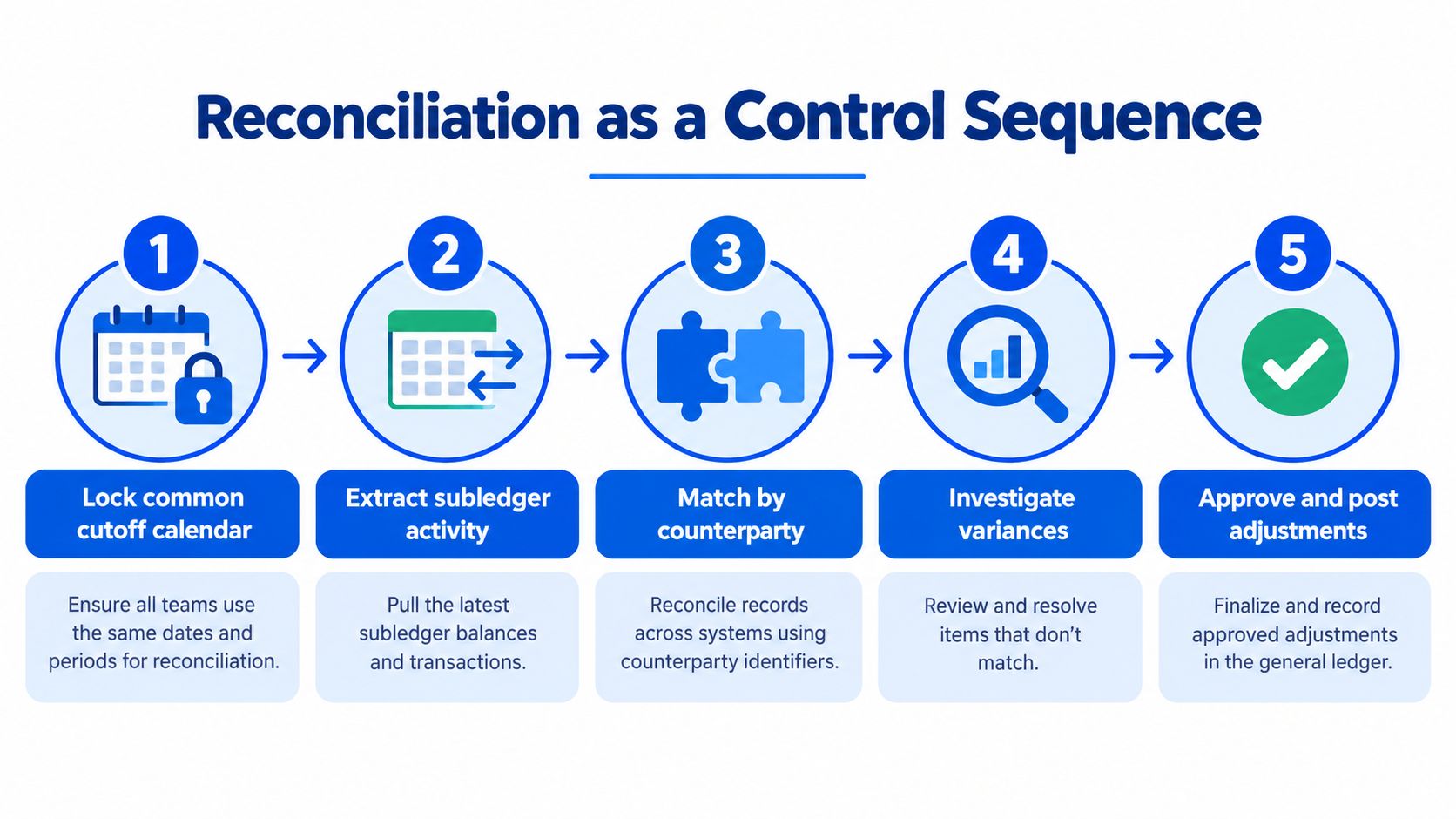
- Lock a common cutoff calendar so every entity extracts activity for the same window.
- Extract both entities' subledger activity at transaction level, not net balance level.
- Match on six fields: counterparty, document number, amount, currency, tax, and accounting period.
- Classify every difference as timing, FX, coding, tax, settlement, or unilateral posting.
- Assign an owner and due date to each open item before consolidation begins.
- Post approved corrections in both ledgers, never in one ledger alone.
- Independently review unresolved items and document why each remains open.
Add aging discipline on top. High-value or consolidation-blocking variances get same-day resolution. Anything still open after close gets documented escalation with a named owner, so stale items can't become permanent. This sequence fits naturally inside a disciplined record to report process flow rather than running as a side spreadsheet. It also aligns with broader account reconciliation guidance published by the Association of International Certified Professional Accountants.
Pitfalls That Conceal Real Problems
Five habits cause most audit findings in this area. Allowing one-sided manual entries. Reconciling only net balances, which hides offsetting errors. Omitting FX rate and tax code fields from matching. Permitting post-close edits without an audit trail. And eliminating mismatched balances automatically, which can conceal duplicate charges, unrecorded liabilities, and incorrect markup calculations.
The control value is measurable in adjacent research. ACFE analysis found organizations with anti-fraud controls experienced reductions in fraud duration ranging from 14% to 50%, with management review, account reconciliations, and monitoring identified as loss-mitigating mechanisms, reported in the ACFE occupational fraud report. Transaction-level matching with supervisory sign-off is exactly that kind of control, applied to your close. For another external perspective on why reconciliations surface hidden financial reporting issues, Controllers Council resources on reconciliation and close governance are useful background reading.
What the Right ERP and Partner Actually Change
Software alone doesn't fix intercompany accounting. A platform can enforce mandatory counterparty fields, generate the offsetting side of an entry, and run eliminations, but someone still has to design the cutoff calendar, matching rules, chart governance, and exception workflow. Buy the tool without that design and you've automated your current mess at higher speed.
What Native Multi-Entity Design Gives You
A true multi-entity cloud ERP changes the mechanics described throughout this guide. Shared charts of accounts reduce mapping drift. Dimensional tagging replaces an exploding account structure. Automated intercompany generation removes the one-sided entry, which is the single most common source of unmatched balances. Consolidation eliminations, including layered adjustments, run from the same data rather than from an exported spreadsheet.
The outcome a CFO buys isn't any single feature. It's a shorter close, multi-entity visibility during the month instead of after it, and an audit trail that shows who posted, who approved, and what evidence supported each intercompany accounting journal entry. Evaluating platforms against those outcomes, rather than feature lists, is the point of comparing financial consolidation software options for multi-entity groups before committing. Buyers often sanity check those priorities against broader market overviews such as G2's financial close software category, which highlights the operational capabilities finance teams actually compare.
The platform determines what's possible. The implementation determines whether your controllers actually get it.
Why the Partner Is Part of the Control
Implementation is where matching tolerances, period locks, approval thresholds, and elimination logic get decided. Those decisions are accounting policy choices dressed as configuration, and they're expensive to reverse after go-live. Lucentive, a Sage Intacct National Premier Partner with mid-market, healthcare, and nonprofit implementation experience, configures Sage Intacct around the methodology in this article and trains entity controllers on it, rather than handing over a configured system and a manual.
That distinction matters most for organizations outgrowing QuickBooks, where intercompany activity was handled by journal entry and memory. Moving to a real multi-entity ledger is the right step. Moving without redesigning cutoff, ownership, and reconciliation just relocates the day nine problem to a more expensive system. Time to value comes from getting the design right once. This is also why many finance teams evaluate implementation risk using independent ERP selection checklists like software due diligence guidance from TechTarget.
Summary
Intercompany entries break the close when entities lack shared rules for cutoff, counterparty coding, currency, and account mapping, even though consolidation must eliminate intragroup balances, revenue, expenses, loans, interest, dividends, and unrealized profit in full. Loans, management fees, and AP and AR swaps need matched two-sided postings with supporting evidence. Cross-border charges also need arm's length pricing and contemporaneous documentation. Timing gaps require owned accrual or consolidation decisions, layered eliminations address inventory profit, FX, and ownership, and transaction-level reconciliation turns those controls into a defensible close.
Frequently Asked Questions
Why Must Intercompany Transactions Be Eliminated
Consolidated statements present the group as a single economic entity, so internal activity can't inflate group revenue, expenses, assets, or liabilities. Each legal entity keeps its own statutory entry, and the elimination happens only during consolidation. That covers receivables and payables, internal revenue and expense, loans, interest, dividends, cash flows, and unrealized profit sitting in inventory or fixed assets at period end.
What Happens When Entities Post in Different Periods
First determine whether the transaction occurred before or after each entity's cutoff. If an obligation was established before cutoff, the receiving entity books an accrual and reverses it next period. If both entries are valid but legitimately fall in different periods, document the gap and handle it through a consolidation adjustment with a named owner. A missed obligation is corrected in the entity's own books instead.
How Is Unrealized Inventory Profit Eliminated
The consolidation entry removes both the internal sale and the profit still embedded in unsold inventory. In the published example, a $100 internal sale with $40 of embedded profit is eliminated by debiting Sales $100, crediting Cost of Sales $60, and crediting Inventory $40. That profit is only recognized at group level when the inventory sells to an outside customer.
What Documentation Should Support Cross-Border Fees
Keep the intercompany agreement, pricing calculation, invoice, and approval evidence together for every charge. Transfer pricing documentation should explain the selected arm's length method, rejected alternatives, controlled transactions, comparables, and economic analysis. It generally must exist when the tax return is filed and be producible within 30 days of an IRS request, so it can't be assembled after an audit begins.
If your close still depends on spreadsheet matching and unowned intercompany variances, schedule a 30-minute working session with our team to map your current entries, cutoff rules, and eliminations against a Sage Intacct multi-entity design. Visit Lucentive to book a demo and see whether the fit, and the implementation approach behind it, will shorten your close and clean up your audit trail.