Your month-end close keeps slipping, the controller is reconciling entities in spreadsheets, and the audit team still asks for support that should already be in the system. QuickBooks may have served the business well, but it wasn't designed for complex entities, dimensional reporting, or finance teams that need answers while decisions are still being made.
That's the context behind Sage Intacct vs NetSuite. You're not just choosing accounting software. You're choosing between a finance-first platform that connects to the systems you already use and a broader ERP suite that may replace more adjacent applications. The right answer depends on whether your primary risk is weak financial control or fragmented operational technology.
| Decision area | Sage Intacct | NetSuite |
|---|---|---|
| Core positioning | Finance-first cloud financial management | Broad cloud ERP suite |
| Strongest fit | Finance-led, services, healthcare, nonprofit, and multi-entity organizations | Businesses needing finance, operations, inventory, CRM, and commerce together |
| Accounts Payable workflow support | 98.65% in one independent comparison | 86.43% in the same comparison (Technology Evaluation Centers comparison) |
| Ease of setup | Scored 1.3 points higher than NetSuite in aggregated reviews (G2 comparison) | Lower ease-of-setup score in the same comparison |
| Operational breadth | Relies more on partner integrations for areas such as CRM, HR, payroll, manufacturing, and inventory | Commonly bundles broader operational modules |
| Best executive question | How can finance gain control without replacing every surrounding system? | How can we run finance and operations in one broader platform? |
Table of Contents
- When Your Current System Starts Holding You Back
- Core Financial Architecture and Market Positioning
- Multi-Entity Consolidation and Financial Operations
- Industry-Specific Fit and Integration Burden
- Implementation Complexity and Time-to-Value
- Making the Right Choice for Your Organization
When Your Current System Starts Holding You Back
A growing company often notices the problem in small ways first. The controller exports a trial balance into Excel, a department manager emails an updated budget, and someone maintains a separate schedule for intercompany balances. None of those tasks looks catastrophic alone. Together, they create a close process that depends on memory, manual review, and one or two people who know how the work really gets done.
The pain becomes obvious during expansion. A healthcare group adds another clinic, but the EMR remains separate from accounting. A nonprofit adds restricted programs and grant reporting requirements, yet the finance team still assembles reports manually. A professional services firm needs project profitability, but revenue and labor data sit in different tools. Leadership receives a financial package after the operating decision has already been made.
Companies searching for cloud ERP for small businesses usually aren't asking for more screens. They're trying to remove bottlenecks that prevent the finance function from acting as a control center for the business.
The close is a symptom, not the whole problem
A slow close often points to deeper structural weaknesses:
- Disconnected entities: Each entity maintains its own process, coding conventions, and supporting schedules.
- Manual consolidation: Intercompany activity and eliminations require spreadsheet intervention.
- Limited dimensions: The chart of accounts becomes overloaded because finance can't report cleanly by department, location, project, fund, or program.
- Audit exposure: Supporting documents and approval history aren't consistently connected to transactions.
- Delayed visibility: Executives wait for reports instead of reviewing current information through dashboards.
The Sage Intacct vs NetSuite choice becomes strategic. Sage Intacct generally appeals to organizations that want stronger financial management while keeping specialized systems such as EMR, payroll, CRM, or billing in place. NetSuite appeals to organizations willing to bring more operational functions into one suite, even when that means a larger transformation project.
Practical rule: Don't choose a platform because it has more modules. Choose the architecture that removes the most manual work from your actual operating model.
Software alone won't fix inconsistent approval policies, poor master data, or an undefined entity structure. The implementation partner has to translate those issues into a workable design, migrate clean data, and keep the project from becoming an expensive exercise in reproducing old habits.
Core Financial Architecture and Market Positioning
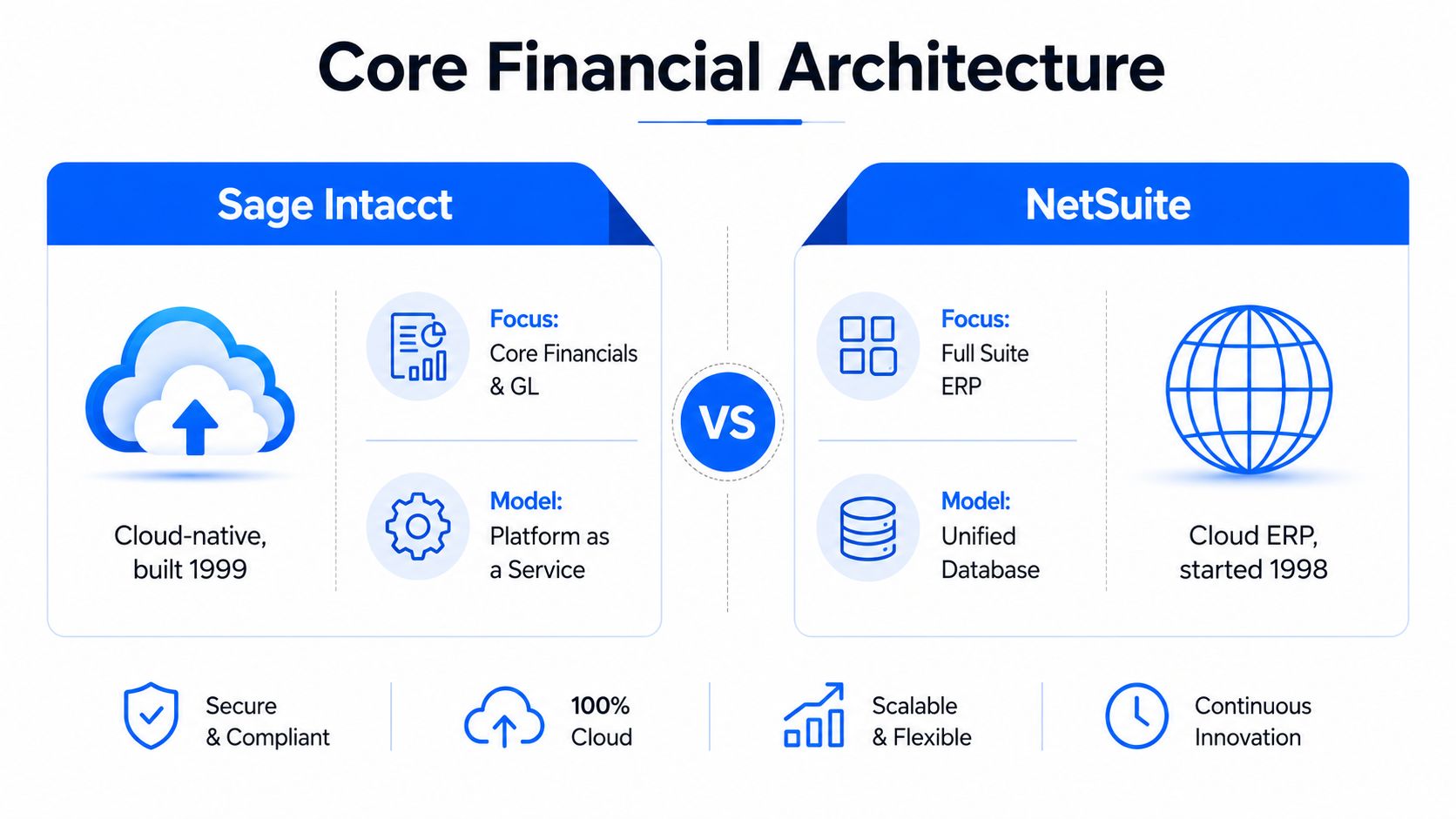
Sage Intacct was founded in 1999 as a cloud-based financial management and accounting provider. The Sage Group acquired it in 2017 for $850 million, then rebranded it as Sage Intacct while preserving its focus on core financial management for lower-mid-market businesses, as described in NetSuite's ERP comparison.
That history shapes the product. Intacct was built around accounting teams, controllers, and CFOs managing reporting, compliance, revenue, entities, and dimensions. For a finance-led organization, this concentration can reduce the need to customize a broad operational suite just to handle core finance. Review the Sage Intacct overview alongside your current systems before deciding whether its finance-first architecture fits your operating model.
Market presence tells two different stories
NetSuite has the larger installed base across broad accounting and ERP markets. Independent 6sense data published in 2025 estimated NetSuite at 27,610 domains and 7.92% market share in the accounting category, compared with Sage Intacct at 3,407 domains and 1.35% in a related financial reporting category (6sense market-share data).
Market size reflects platform breadth, not automatic finance-team fit. NetSuite's wider ERP strategy attracts organizations that want operational functions in one environment. Intacct's smaller footprint reflects a narrower position, often centered on financial management rather than full-suite replacement.
Fund-accounting figures reinforce that distinction. The same market analysis reported NetSuite at 18,639 customers and Sage Intacct at 2,003 customers, with NetSuite holding 51.21% market share and Sage Intacct 5.50% in that category. Buyers should treat those figures as evidence of market reach, not as a substitute for evaluating reporting depth, integrations, and implementation partner capability.
Sage Intacct also showed meaningful traction in specialized finance environments. Independent SaaS market data cited in 2024 placed Intacct at 17% market share for core accounting among 535 SaaS companies. Community discussion often points in the same direction. In several Reddit threads, finance users describe Intacct as the cleaner fit when the priority is accounting depth, reporting, and lower day-to-day friction, while NetSuite is favored when broader ERP breadth and customization matter more (Reddit discussion 1, Reddit discussion 2, Reddit discussion 3, Reddit discussion 4, Reddit discussion 5). Independent comparison communities also frame the market similarly, with NetSuite positioned as the broader ERP and Sage Intacct as the finance-first option (ERP Research comparison, ERP Research comparison 2, ERP Lenz comparison, FinderERP comparison). The practical conclusion is clear: Intacct's strongest positioning is with companies that prioritize accounting depth, reporting speed, and finance specialization.
Choose the architecture before the feature list
NetSuite can reduce the number of systems needed for CRM, inventory, order management, manufacturing, HR, payroll, and commerce. Choose it when those functions must share one environment and leadership is prepared to standardize processes across departments.
Sage Intacct is usually the better starting point when capable operational tools are already in place and finance needs a stronger backbone. The trade-off is integration work. A capable implementation partner must define ownership between systems, protect data quality, and prevent interfaces from recreating manual processes. For mid-market buyers, finance-first depth can outweigh broader suite coverage when integration scope is controlled from the start.
Multi-Entity Consolidation and Financial Operations
For a multi-entity organization, consolidated reporting is only the visible output. The core test is whether finance can produce it under consistent rules, trace every figure to source transactions, and avoid spreadsheet-driven corrections at period-end. Both platforms can support serious financial operations, but they impose different operating models.
A reliable consolidation model requires one closing date, one reporting schedule, shared valuation rules, and period-by-period reconciliation of internal flows. These controls preserve the path from consolidated totals to source documents and reduce year-end cleanup, as outlined in industry guidance on nonprofit consolidation. Teams evaluating multi-entity accounting in Sage Intacct should define those rules before configuring entities, dimensions, and approval paths.
Where Intacct has a practical edge
Accounts Payable exposes process weakness quickly. An independent comparison reported 98.65% weighted support for AP workflow for Sage Intacct, compared with 86.43% for NetSuite (Technology Evaluation Centers comparison).
That result supports Intacct's finance-first positioning. Invoice routing, coding, approvals, and audit evidence directly affect cash control, vendor relationships, and close reliability. For a finance team handling substantial invoice volume, those workflows deserve more weight than a feature checklist.
| Capability | Sage Intacct | NetSuite |
|---|---|---|
| Multi-entity consolidation | Strong fit for finance-led organizations managing multiple entities | Strong fit when consolidation is part of a broader operational ERP |
| Intercompany control | Supports structured finance processes and reconciliation | Supports intercompany activity within a wider unified suite |
| AP workflow support | 98.65% weighted support in one independent comparison | 86.43% weighted support in the same comparison |
| Reporting focus | Finance-centered reporting and dimensions | Financial reporting connected to broader operational data |
| Source traceability | Supports controlled transaction and reporting workflows | Supports traceability within a wider ERP data model |
| Best operating model | Existing best-of-breed applications around a finance core | Consolidated platform strategy across finance and operations |
Nonprofits make the consolidation trade-off easy to see. Multi-entity nonprofit consolidation may take days or weeks, while cloud accounting can reduce the work to hours or minutes. The Intuit ERP nonprofit fund accounting guidance presents the cloud-finance benchmark accurately: nonprofits using cloud finance software closed their books two days faster on average, despite managing more complex financial operations.
The benchmark matters less than the setup behind it. Entity structures, fund rules, approval ownership, and close responsibilities must be standardized before configuration. A platform cannot repair unclear ownership or inconsistent accounting policies.
Consolidation design determines the result
Choose NetSuite when finance needs inventory movements, sales activity, operational transactions, and other business events in the same platform. Choose Sage Intacct when finance needs a controlled accounting layer connected to specialized systems.
Before signing, require the implementation partner to document:
- Entity responsibilities: Identify who owns local close tasks and who owns consolidation.
- Intercompany policy: Document internal charges, balances, and eliminations.
- Reporting dimensions: Decide which attributes must be captured at transaction entry.
- Close evidence: Specify the approvals, reconciliations, and attachments auditors must trace.
The partner's design discipline determines whether the platform reduces manual work or relocates it into interfaces and spreadsheets.
Industry-Specific Fit and Integration Burden
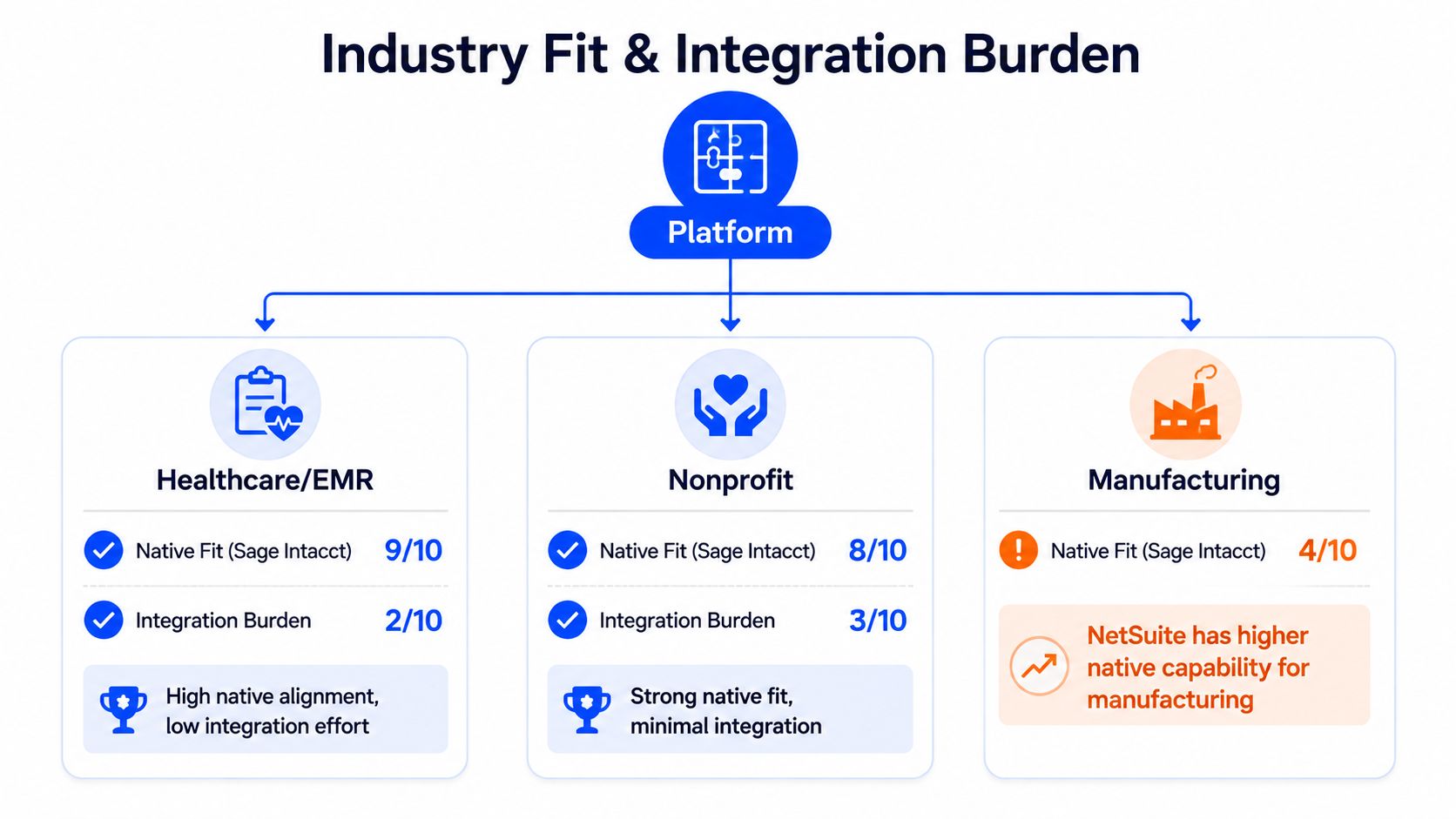
The hidden cost in the Sage Intacct vs NetSuite decision is often the number of systems that must exchange data after go-live. A broader suite may eliminate some integrations, but only if its native modules fit the business. A finance-first platform may require more connectors, yet still create less operational disruption when the company already depends on an EMR, payroll provider, CRM, or industry billing system.
Healthcare and dental organizations
Healthcare providers rarely get to replace the EMR because they're implementing ERP. The accounting platform must receive reliable financial information from clinical and operational systems while preserving appropriate dimensions for locations, service lines, providers, and entities. Sage Intacct can make sense when the EMR remains the operational system of record and finance needs stronger control, reporting, and consolidation around it.
Dental service organizations face a similar decision across multiple practices and locations. If the central finance team needs entity-level reporting, intercompany visibility, and standardized close procedures, Intacct's finance focus can be attractive. NetSuite becomes more compelling when the organization also needs broad operational functionality that its existing applications don't provide.
Nonprofits and professional services
Nonprofits often need fund accounting, grant reporting, donor restrictions, and multi-entity consolidation. The implementation challenge isn't just configuring fields. It's designing a structure that lets program leaders report what they need without making the general ledger impossible to manage.
Professional services firms typically care about project accounting, utilization, billing, revenue, and profitability. If those firms already use a CRM, time-tracking application, or resource-management tool, Sage Intacct may serve as the financial control point while those systems continue doing their specialized jobs.
Manufacturing and product operations
NetSuite has the stronger argument when the operating model depends on complex inventory, manufacturing, warehouse processes, ecommerce, or a unified order-to-cash flow. NetSuite's broader modules can reduce the need to connect multiple operational applications.
Sage Intacct's 2026 product direction remains finance-centered. The release calendar lists four automatic 2026 releases, including 2026 R1 in February, R2 in May, R3 in August, and R4 scheduled for November, with the Sage Intacct AI Gateway included among the AI- and workflow-oriented updates in 2026 R2 (Sage Intacct 2026 release calendar). That cadence suggests faster finance automation rather than a move toward becoming a full-suite operational ERP.
The right question is not “How many integrations does this platform need?” It's “Which system should own each process, and what will finance have to reconcile afterward?”
Map every integration by owner, frequency, failure handling, and reconciliation responsibility. That exercise reveals total cost of ownership more accurately than comparing license features.
Implementation Complexity and Time-to-Value
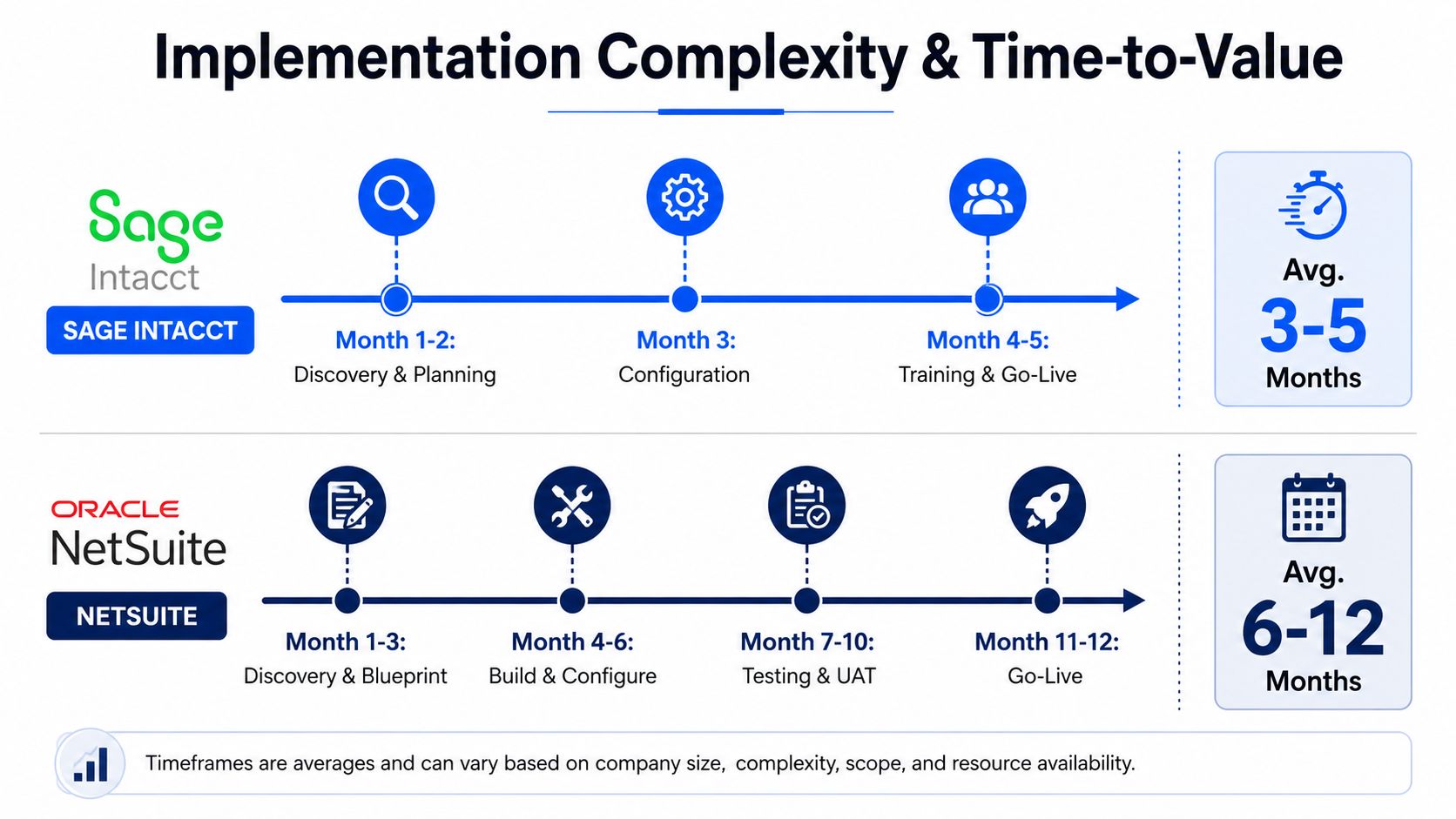
ERP projects usually stall because teams underestimate decisions, data quality, testing, and ownership. Mid-market implementations can take 3 to 9 months from project start to full optimization, while larger or more customized deployments may extend to 6 to 18 months (Lake implementation guidance). Those ranges describe project scope, not a guaranteed timeline for either product.
A finance-led Sage Intacct deployment can reach value sooner than a broad NetSuite transformation. That advantage disappears when integrations lack clear owners or years of unreliable data must be repaired during the project. Before approving a plan, use this guide on how to plan ERP costs, time, and resources.
Four decisions that protect the schedule
1. Define the first release.
Separate required finance capabilities from later enhancements. The first release should establish the chart of accounts, entities, dimensions, reporting, AP, controls, and required integrations. Keep go-live focused on an operating finance process rather than every requested improvement.
2. Assign business owners.
The CFO should own outcomes and escalation. The Controller should own accounting design and close requirements. Operational leaders must approve processes affecting their teams. A partner can facilitate decisions, but company leaders remain accountable.
3. Treat data as a workstream.
Clean vendors, customers, accounts, dimensions, opening balances, and historical reporting before migration. Loading inaccurate master data into a new platform exposes the underlying problem and creates avoidable reconciliation work.
4. Test the close, not isolated features.
Run entity consolidation, intercompany activity, AP approvals, allocations, reporting, and audit support as one end-to-end scenario. Individual features may work while the month-end process still fails.
Independent review aggregation gives Sage Intacct a 1.3-point advantage in Ease of Setup over NetSuite, along with stronger Price/Cost satisfaction (G2 comparison). Broader review communities point in a similar direction. TrustRadius shows close recommendation scores for both products, while user threads often describe NetSuite as more customizable but also more complex to implement and administer (TrustRadius Sage Intacct, TrustRadius NetSuite ERP, Reddit implementation discussion). For a finance-led mid-market deployment, that supports choosing Intacct when implementation friction and administrative capacity matter more than broader suite coverage.
The partner changes the economics
The implementation partner determines how much customization gets approved, whether integrations support reliable reconciliation, and whether finance can administer the system after launch. Partner quality often matters as much as product selection.
For Intacct, choose a team that understands your entity model, reporting requirements, and existing applications. For NetSuite, require demonstrated experience with the operational modules being purchased, not only financial configuration. Before signing off, review the proposed scope, decision log, data plan, testing approach, integration ownership, and post-go-live support model.
Making the Right Choice for Your Organization
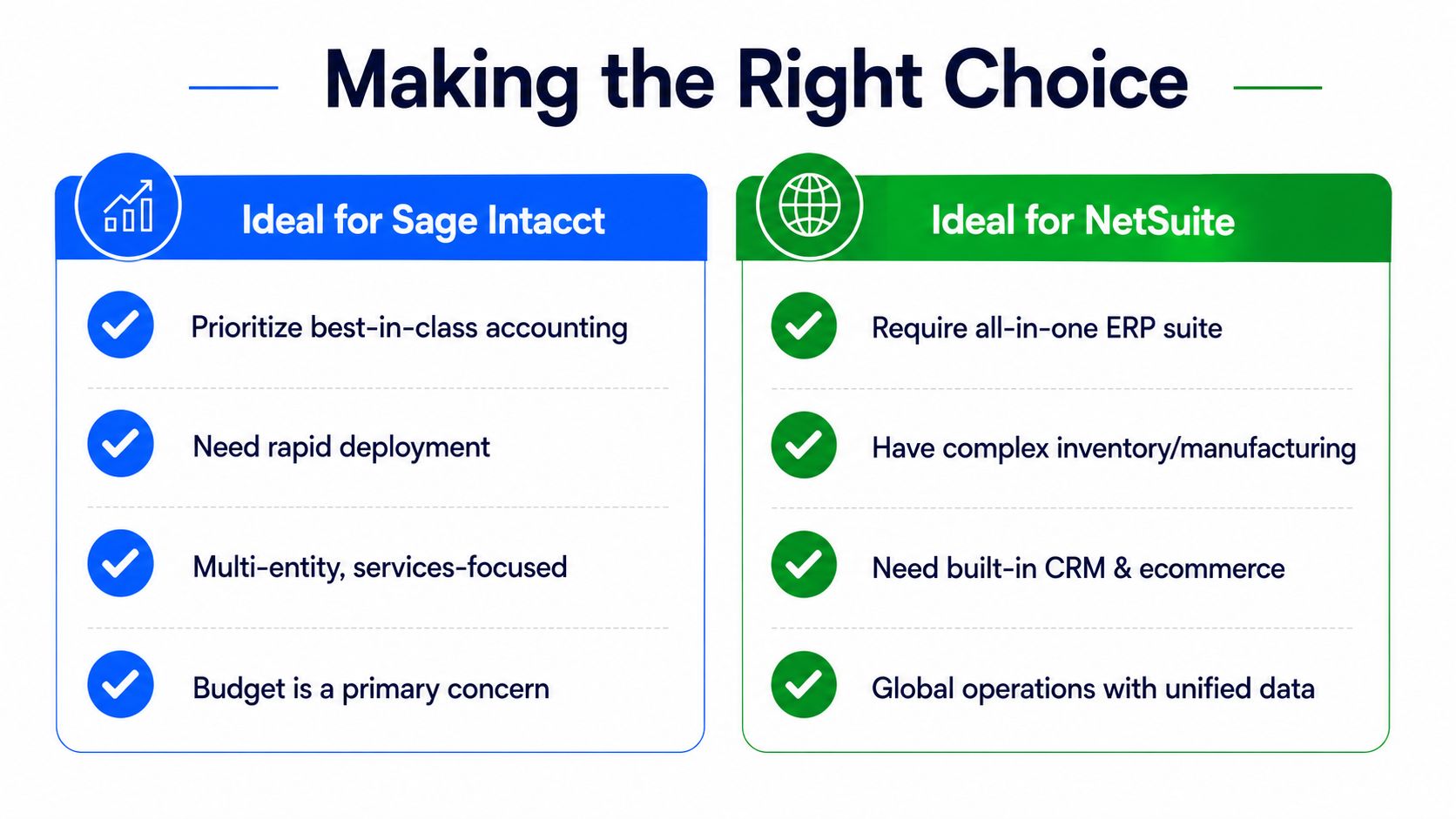
My recommendation is straightforward. Choose Sage Intacct when finance is the constraint. Choose NetSuite when operational breadth is the constraint. Don't buy a broad suite to solve a close problem, and don't buy a finance-first platform when inventory, manufacturing, ecommerce, or unified CRM is central to how the company makes money.
Sage Intacct is the stronger choice when
- Finance needs control first: Your most urgent problems are the close, consolidation, dimensional reporting, AP approvals, audit support, or visibility into entity performance.
- Specialized systems already work: Your healthcare EMR, payroll platform, CRM, billing application, or practice-management system is valuable and should remain in place.
- Your organization is services-oriented: Professional services, nonprofit, healthcare, dental, and other finance-led organizations often gain more from deeper financial controls than from unused operational modules.
- Implementation risk matters: You want a focused deployment with clear scope, manageable administration, and a partner that can keep integrations and customizations under control.
NetSuite deserves the decision when the company needs one broader platform for finance and operations. Choose it when manufacturing, inventory, warehouse management, ecommerce, order management, CRM, or unified operational data is important enough to justify the wider implementation effort.
Use the operating model as the tie-breaker
A healthcare provider with a strong EMR and a finance team struggling with entity reporting should usually start with Sage Intacct. A nonprofit with fund accounting and grant reporting needs should evaluate whether its existing donor and program systems can integrate cleanly with a finance-first platform. A DSO should focus on practice-level reporting, intercompany control, and the reliability of feeds from practice systems.
A professional services firm should test project profitability from source transaction through billing and financial reporting. A product company should test inventory, purchasing, fulfillment, returns, and revenue together. If you want an extra reality check before the final demo round, review a few community threads from teams making the same choice. They tend to surface practical issues such as admin burden, customization trade-offs, and whether a finance-first platform is enough for the operating model (Reddit thread on ERP shortlist decisions, Reddit thread on buyer trade-offs). Those demonstrations will produce a more trustworthy decision than a generic feature presentation.
Partner selection is part of product selection
Lucentive is a Sage Intacct National Premier Partner with experience serving mid-market, healthcare, and nonprofit organizations. Its role includes Sage Intacct advisory and implementation work, which is relevant when the buyer needs to evaluate not just software capabilities, but also entity design, integrations, migration, training, and post-go-live administration.
The Sage Intacct reseller and implementation option should be evaluated the same way you'd evaluate any partner. Ask how the team will document requirements, control scope, handle data, test integrations, train users, and measure readiness. The software can provide dashboards and controls, but the implementation team determines whether those capabilities match the way your company operates.
The following video can provide additional context as you compare the two platforms:
Don't make the decision from a feature matrix alone. Bring your chart of accounts, entity structure, close calendar, integration list, and reporting examples to a working session. You'll quickly see whether Sage Intacct can become the finance backbone you need, or whether NetSuite's broader operational model is justified.
Lucentive can help you assess Sage Intacct against your entity structure, existing systems, reporting requirements, and implementation priorities. Schedule a 30-minute working session or custom Sage Intacct demo with the team through Lucentive, and leave with a clearer view of fit before you buy software or select an implementation partner.