Month-end shouldn't require a controller to keep 14 browser tabs open, reconcile Stripe payouts to deferred revenue, export MRR cohorts, and rebuild ASC 606 waterfalls in spreadsheets. Yet that's where many SaaS finance teams end up after QuickBooks or a basic cloud ledger stops matching the business.
The product may be scaling well, but finance becomes the bottleneck. Billing gets more complicated, contracts change mid-term, entities multiply, and leadership still expects current answers on ARR, cash, deferred revenue, and profitability. The best accounting software for a SaaS business isn't just the platform with the longest feature list. It's the combination of revenue-recognition depth, billing connectivity, consolidation control, and implementation discipline that keeps the close reliable as complexity increases.
Cloud accounting is already the dominant architecture for modern finance teams. One industry summary reports that 90% of SaaS companies use cloud accounting software for financial management, while independent market estimates place cloud solutions at 68.08% of accounting software market share in 2025 (industry accounting software data). The decision now is less about whether to move to the cloud and more about choosing a system that can carry the operating burden.
Table of Contents
- Why SaaS Finance Breaks Before the Product Does
- The Evaluation Checklist That Actually Matters for SaaS
- Revenue Recognition Under ASC 606 and Why Native Support Changes Everything
- Side by Side Comparison of Leading Platforms for SaaS
- Multi Entity Consolidation and the Growth Stage Inflection Point
- Migration and Implementation Considerations for Mid Market SaaS
- Software Alone vs the Right Partner and Implementation
- Next Steps for Choosing the Right Path for Your Company
- Summary
- Frequently Asked Questions
- What is the best accounting software for a mid-market SaaS company?
- Why does ASC 606 matter so much for SaaS accounting?
- Can QuickBooks Online support a SaaS business?
- What should finance leaders test during an accounting software demo?
- When should a SaaS company move to multi-entity accounting?
- Why is the implementation partner part of the software decision?
Why SaaS Finance Breaks Before the Product Does
The first warning sign is usually a slow close, not a failed audit. The controller has a billing export, a bank feed, a spreadsheet for contract schedules, and a separate dashboard for SaaS metrics. Each file looks manageable on its own. Together, they create a close process that depends on one or two people remembering which version is current.
A basic general ledger can record invoices and cash. It won't necessarily understand that an annual subscription must be recognized over its contract term, that onboarding may be a separate performance obligation, or that a mid-term upgrade changes the accounting treatment. Under SaaS revenue recognition guidance, subscription revenue is recognized over the contract period, while setup fees, support, and usage may need to be evaluated separately.
The predictable breaking points
Finance teams usually encounter the same failures:
- Billing outgrows the ledger: Stripe, Chargebee, or Zuora contains contract activity that the accounting system receives only as summarized invoices or cash movements.
- Manual entries multiply: Every new plan, upgrade, downgrade, proration, and usage true-up adds another adjustment to the close checklist.
- Deferred revenue becomes an audit project: The team has to explain how schedules were built, changed, reviewed, and tied back to source contracts.
- Leadership loses confidence in metrics: The CFO asks for ARR, MRR, churn, or cohort reporting, and finance needs to reconcile multiple systems before answering.
- Growth creates organizational friction: A second entity or foreign currency introduces intercompany balances and consolidation work that spreadsheets weren't designed to control.
The consequence isn't only extra labor. It's delayed decisions, weaker audit evidence, and a finance function that spends its best hours reconstructing history instead of advising the business.
Practical rule: If the close depends on a spreadsheet that only one person fully understands, the accounting system has already become a growth constraint.
The central question is straightforward: which platform absorbs SaaS complexity natively, and which one forces the team to bolt on tools and workarounds? Brand recognition matters less than the system's ability to manage revenue recognition, connect to the billing stack, support multiple entities, and preserve a defensible audit trail.
The Evaluation Checklist That Actually Matters for SaaS
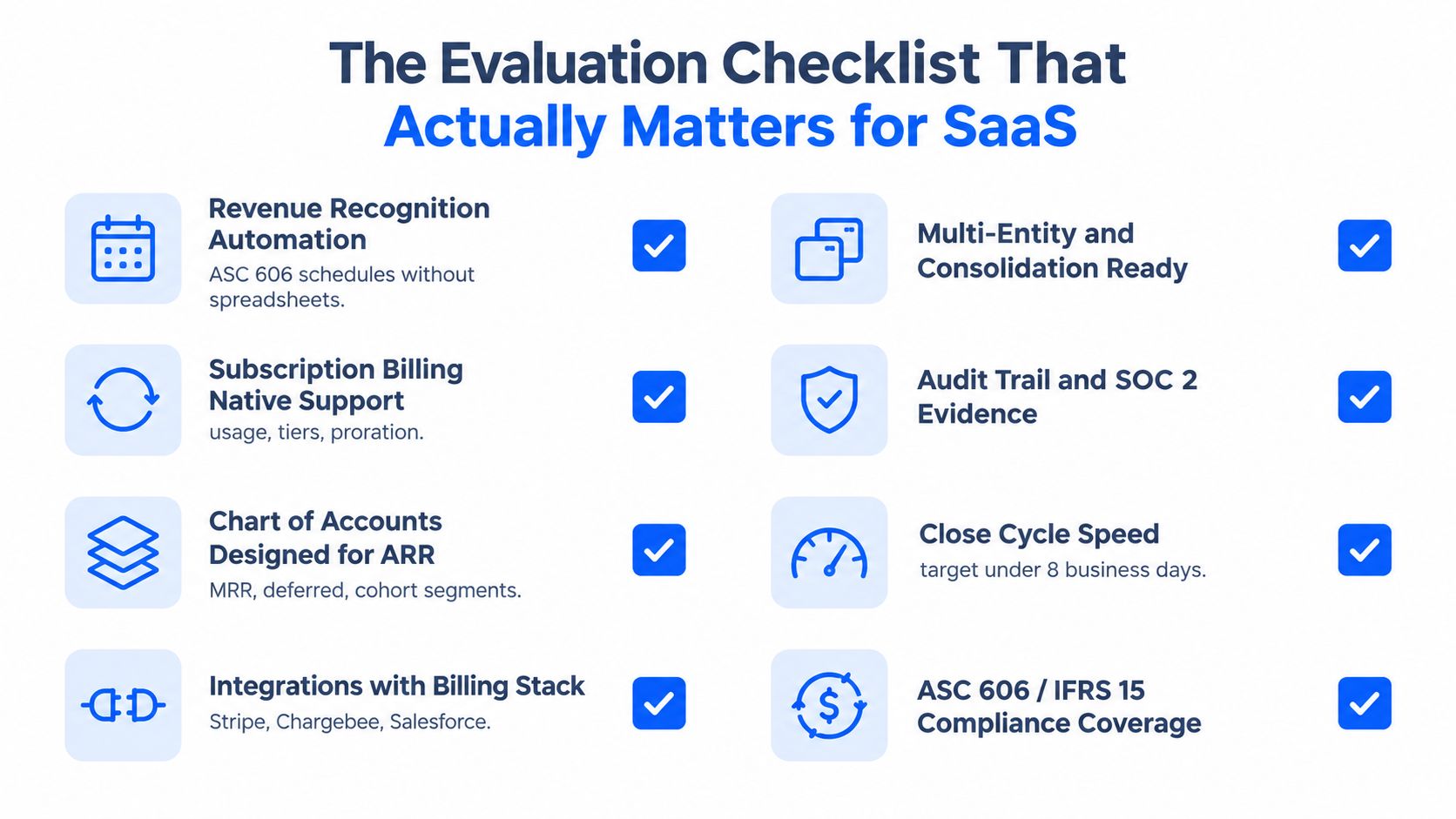
A SaaS accounting evaluation should begin with failure modes, not product demonstrations. Ask what breaks when contract volume rises, pricing becomes usage-based, or the company adds another legal entity. Then score each platform against the operational consequence of that gap.
Eight criteria worth testing
ASC 606 revenue recognition: The system should support deferred revenue schedules, allocations, modifications, and audit-ready journal entries. Without that depth, a simple contract change can trigger manual waterfalls and review delays.
Subscription billing connectivity: Test integrations with platforms such as Stripe, Chargebee, and Zuora. A feed that imports only invoices may omit the contract events finance needs to calculate recognition correctly.
SaaS analytics: MRR, ARR, churn, cohort reporting, and deferred revenue should be traceable to source transactions. If analysts have to rebuild every metric in a separate workbook, the company doesn't have a dependable financial view.
Multi-entity and multi-currency control: The system should handle subsidiaries, eliminations, currency translation, and consolidated reporting without forcing finance to maintain an external consolidation model. Multi-entity tools exist to manage exactly these requirements across subsidiaries and locations (multi-entity accounting overview).
Automated bank and revenue feeds: Automation should reduce duplicate entry while retaining clear exception handling. A feed that fails without notice is worse than a manual process because it creates false confidence.
Security and audit evidence: Role-based access, approval workflows, change history, and evidence that supports control testing should be part of the evaluation. Security isn't a checkbox for a finance system that holds contract and payment data.
API openness: The platform needs to exchange reliable data with a warehouse, CRM, billing platform, and planning tools. Weak APIs create shadow spreadsheets and make reconciliations harder to reproduce.
Implementation partner depth: A platform can have the right functions and still fail if the team configures the wrong revenue rules or leaves ownership unclear after go-live. Partner experience with SaaS close processes matters as much as software capability.
Use these criteria as a weighted scoring template. Don't give every category equal importance. For a company facing audit pressure, rev-rec and auditability should outweigh interface preferences. For a company preparing for international expansion, consolidation and currency handling should carry more weight. The right system is the one whose weaknesses won't become unacceptable at the next stage of complexity.
Revenue Recognition Under ASC 606 and Why Native Support Changes Everything
Revenue recognition is the operating constraint in SaaS accounting. Billing tells you what the customer was charged. Cash tells you what the customer paid. Neither answer tells you automatically what revenue belongs in the current period.
Under ASC 606, the finance team identifies the contract, identifies the performance obligations, determines the transaction price, allocates that price across the obligations, and recognizes revenue as each obligation is satisfied. A simple annual platform subscription may be recognized ratably over the contract term. A contract containing onboarding, premium support, and usage overages may require separate evaluation and allocation.
Where contract changes create risk
The accounting gets harder when the contract doesn't remain static:
- A mid-term upgrade can change the promised services and transaction price.
- A co-term expansion can combine new commitments with an existing service period.
- A trial that converts to paid service can create a new contract event.
- A usage true-up can alter the consideration after the original invoice.
- A downgrade or renewal can require the team to reassess the remaining obligations.
The treatment of modifications under ASC 606-10-25-12 may involve a separate contract, a prospective termination and new contract, or a cumulative catch-up adjustment, depending on the facts. Auditors may sample contracts and reperform the schedule mathematics, tracing recognized revenue back to source documentation (native ASC 606 ledger guidance).
A generic ledger usually needs manual journal entries or an external calculator for these scenarios. That approach can work while contracts are simple and volume is low. It becomes fragile when finance must update schedules, reconcile billing events, document assumptions, and explain exceptions under deadline pressure.
Native depth beats a disconnected billing feed
A billing integration is useful, but it isn't a revenue-recognition engine. The integration must carry the contract details and modification events needed to support allocation, timing, and deferred revenue. Otherwise, finance receives a clean invoice feed and still has to rebuild the accounting logic elsewhere.
The best-fit tools for SaaS combine a general ledger with a billing layer or native revenue-recognition workflow, supporting scheduled deferrals, automated recognition timing, and audit-ready entries (SaaS accounting software comparison). This is why revenue recognition should be tested with real contract examples, not shown through a standard product tour. Ask each vendor to demonstrate an annual subscription, a bundled onboarding fee, an upgrade, and a usage adjustment.
For a closer look at how this operating model fits Sage Intacct, review subscription and SaaS accounting capabilities. The goal isn't to buy a checkbox labeled ASC 606. It's to determine whether the platform can produce a schedule your team can trust when the contract changes.
Side by Side Comparison of Leading Platforms for SaaS
For a finance leader at a 50 to 500 employee SaaS company, the question isn't whether each product can produce a basic income statement. They all can. The question is which platform can support the next audit, the next entity, and the next layer of pricing complexity without making the controller rebuild the process.
| Platform | ASC 606 Revenue Recognition | Subscription Billing Integrations | Multi-Entity & Multi-Currency | SaaS Analytics (MRR/ARR/Deferred) | Implementation Complexity | Best Fit Stage |
|---|---|---|---|---|---|---|
| Sage Intacct | Strong with the right configuration and connected rev-rec workflow | Strong ecosystem and integration options | Strong for mid-market requirements | Strong when reporting dimensions and billing data are designed correctly | Moderate to high | Mid-market SaaS and growing multi-entity teams |
| NetSuite | Strong, often through configured modules or connected solutions | Broad integration options | Strong and highly configurable | Broad, but may require significant design work | High | Larger or operationally complex organizations |
| QuickBooks Online | Limited native SaaS revenue-recognition depth | Broad app ecosystem, but often dependent on add-ons | Limited for growing complexity | Basic without specialized connected tools | Low initially | Early-stage teams with simple contracts |
| Xero | Simple core accounting, limited SaaS-specific depth | Useful integrations, but often requires a specialized billing layer | More limited at mid-market complexity | Basic without external systems | Low initially | Smaller businesses with straightforward operations |
Sage Intacct
Sage Intacct is my recommendation for the mid-market SaaS company that has outgrown QuickBooks and needs a real cloud financial system. It is stronger on multi-entity accounting, consolidated reporting, dimensions, and structured financial management than entry-level tools. The trade-off is implementation effort. It should be configured around the company's contract model and close calendar, not treated as a software install.
NetSuite
NetSuite wins when the organization needs broad ERP coverage, extensive configuration, and a platform that can span complex operations. It can be a sensible choice for larger organizations with a capable internal systems team. The downside is cost, complexity, and the risk of building more platform than the finance function can govern effectively.
QuickBooks Online
QuickBooks Online remains practical for a small team with straightforward billing and limited organizational complexity. It has a low barrier to adoption and a broad app ecosystem. It strains when finance needs detailed deferred revenue schedules, structured contract modifications, unlimited collaboration, or dependable consolidated reporting without multiple add-ons.
Xero
Xero is attractive for simplicity and core bookkeeping. It can suit an early-stage company that hasn't yet developed complex contract or entity requirements. Its ceiling is thinner for a mid-market SaaS business preparing for more demanding reporting, audit support, or multi-entity consolidation.
The broader market is moving toward cloud-first, recurring-revenue-oriented systems. A market estimate places the global cloud accounting software market at USD 14.2 billion in 2025, with a projection of USD 32.7 billion by 2033, while another forecast estimates the broader accounting software market at USD 23.47 billion in 2026 and USD 35.86 billion by 2031 (cloud accounting market estimates). Those figures describe market direction, not a reason to buy any particular product.
Choose the platform whose weakest dimension you can still live with when the business is three times its current ARR.
Multi Entity Consolidation and the Growth Stage Inflection Point
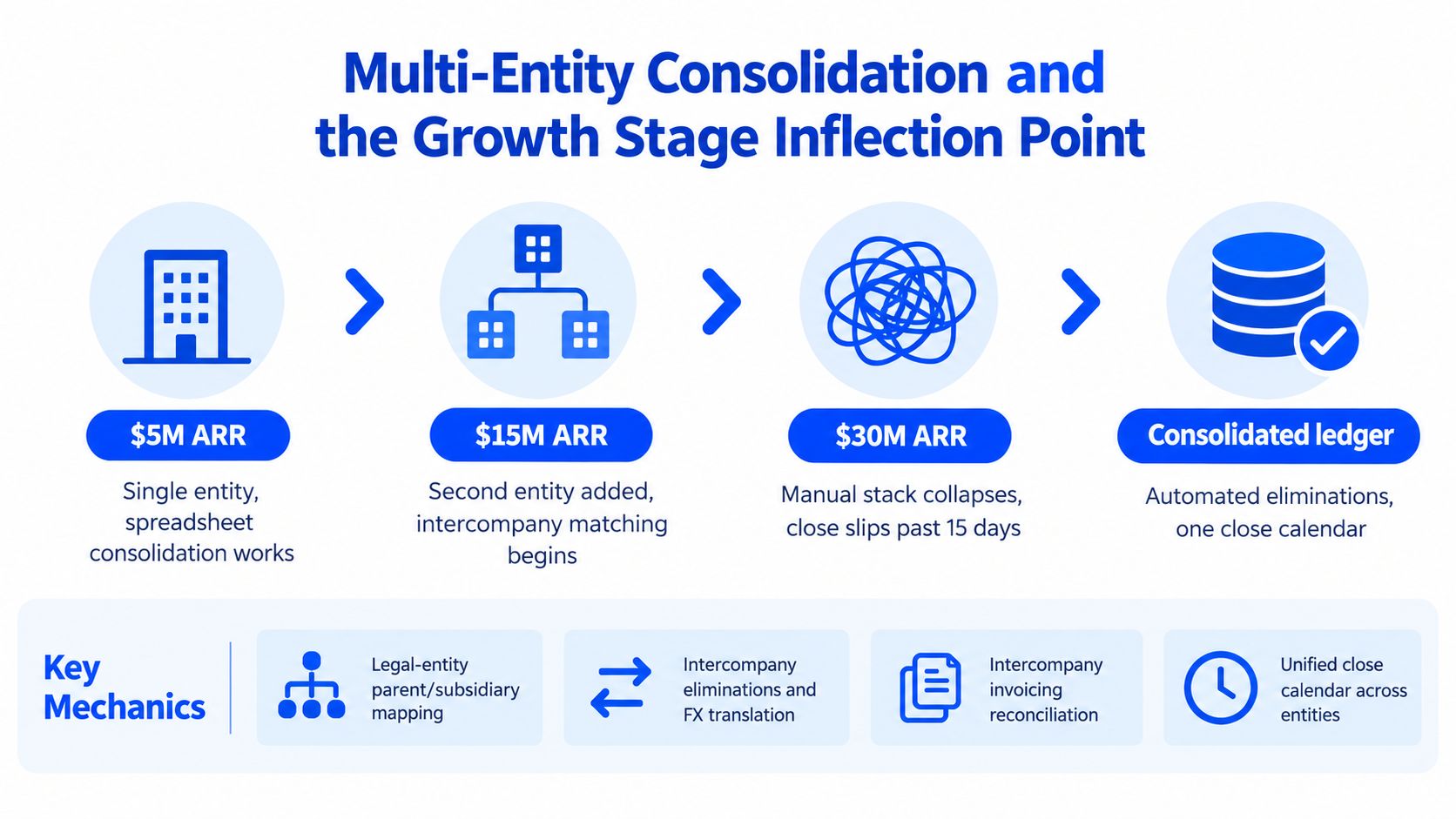
A SaaS finance stack can look fine with one legal entity and still fail as soon as the company adds a subsidiary. The breaking point arrives when the board, auditor, or acquirer asks for consolidated financials with intercompany balances eliminated and currency effects clearly explained.
At that point, finance must manage a legal-entity hierarchy, intercompany invoices, eliminations, currency translation, security, and consolidated reporting. A single general ledger may accommodate an early-stage company, but a growing corporation needs a controlled subledger approach that doesn't depend on manually copying balances between files.
What the close must control
The mechanics are familiar, but the ownership often isn't:
- Entity mapping: Parent and subsidiary relationships need consistent dimensions and reporting structures.
- Intercompany activity: Receivables, payables, revenue, and expense balances must match before elimination.
- Currency handling: Foreign subsidiary results need a repeatable translation process and clear documentation.
- Close coordination: Each entity needs deadlines, approvals, exception management, and one consolidated reporting calendar.
Manual Excel workarounds hide errors until late in the close. One entity may record an intercompany invoice while another misses the corresponding payable. A currency adjustment may be posted in one file but not reflected in the consolidated model. Finance then spends the final days of the close hunting for differences instead of reviewing results.
Sage Intacct is a stronger operational option when multi-entity accounting becomes a core requirement, provided the implementation establishes entity structure, intercompany rules, dimensions, and approval workflows correctly. The platform choice matters, but the design decisions matter just as much. The multi-entity accounting approach from Lucentive illustrates the type of control framework finance leaders should expect to discuss before selecting a system.
Migration and Implementation Considerations for Mid Market SaaS
Most implementation problems start before the software is configured. The team migrates a dirty customer ledger, carries forward unexplained deferred revenue, and discovers during testing that nobody agreed whether Stripe or Chargebee is the source of truth for subscription events.
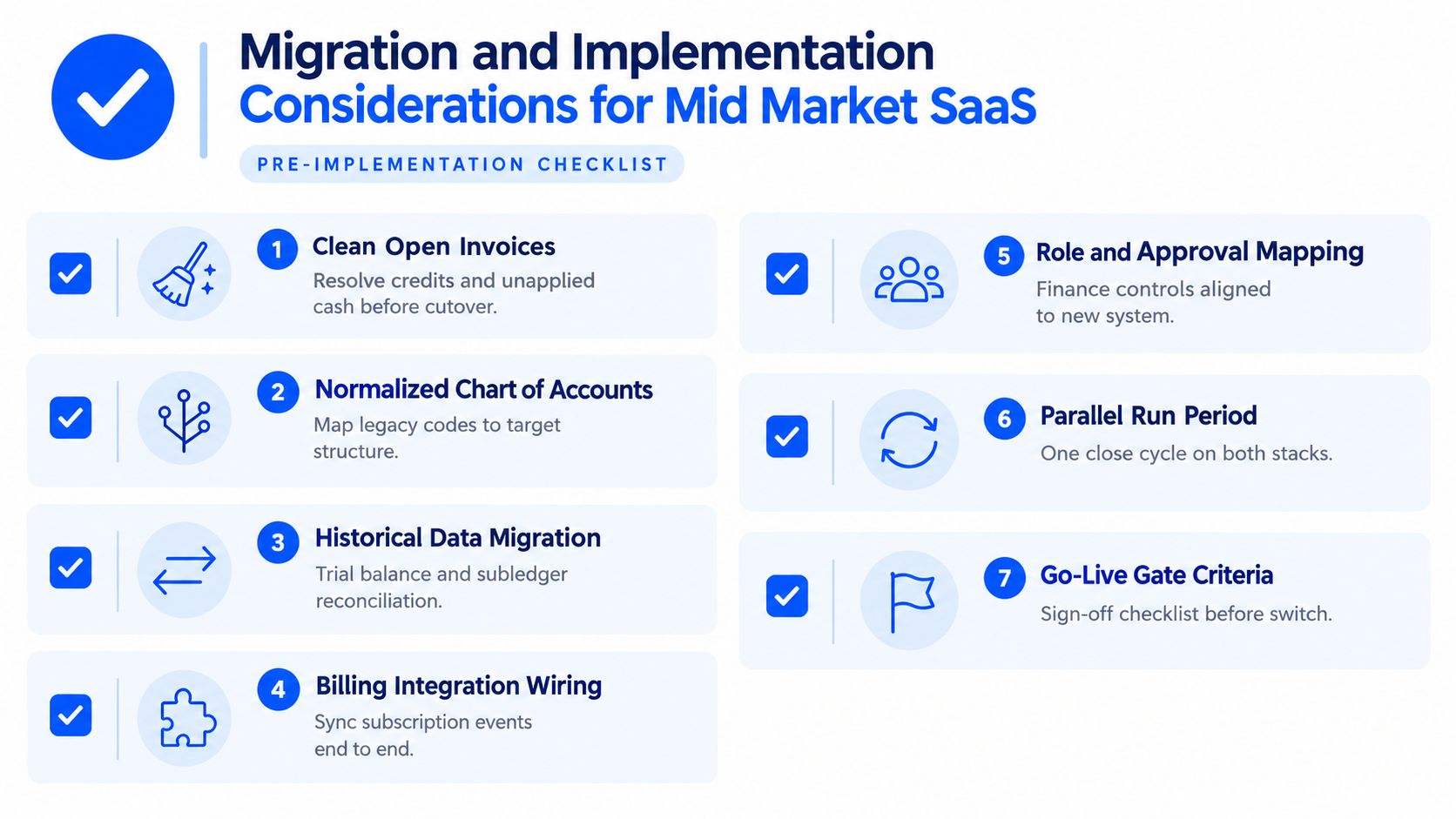
A disciplined project starts with the accounting foundation:
- Clean open invoices: Resolve credits, unapplied cash, disputed balances, and duplicate customer records before cutover.
- Normalize the chart of accounts: Map legacy codes to a structure that supports management reporting, entity reporting, and revenue analysis.
- Codify the ASC 606 policy: Document contract types, performance obligations, allocation logic, modification treatment, and recognition timing.
- Choose the billing source of truth: Decide which system owns customer, product, invoice, payment, and subscription-event data.
- Reconcile historical balances: Tie opening trial balances and deferred revenue schedules to the legacy system and source subledgers.
- Define controls and roles: Map approvals, access, review responsibilities, and close ownership before users begin testing.
- Protect the first close: Treat the first post-go-live close as the true acceptance test, not merely a technical milestone.
Keep the scope under control
The most common scope creep involves custom dashboards, unusual objects, and reports that haven't been tied to a decision or control. Those requests may be valid, but they shouldn't displace the work required to make the core ledger, revenue schedules, integrations, and close process reliable.
A partner should explain what belongs in the initial deployment and what can wait. Evaluate SaaS-specific implementation experience, a documented methodology, post-go-live support, and references from organizations with comparable contract and entity complexity. You should also ask who owns integration monitoring and rev-rec accuracy after the project team leaves.
The ERP implementation phases used by Lucentive provide a useful basis for that conversation. Regardless of the chosen partner, insist on written cutover criteria, reconciliation evidence, user sign-off, and a clear plan for the first close.
Software Alone vs the Right Partner and Implementation
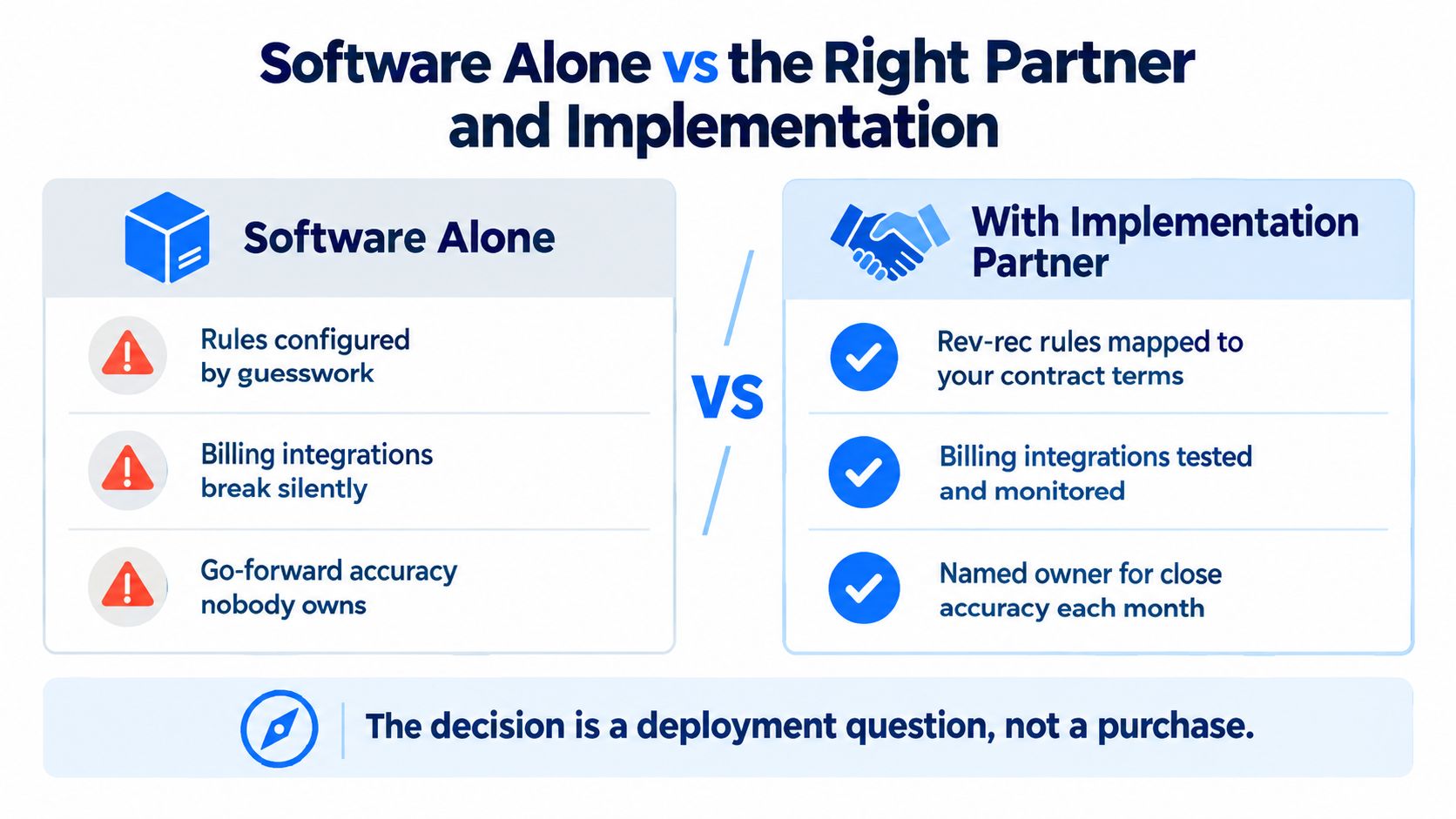
Buying Sage Intacct is a software decision. Deploying it successfully for a SaaS company is an operating-model decision.
A vendor-led onboarding model can work for a straightforward finance setup. It often focuses on configuration and user enablement, while leaving the company to define contract rules, close ownership, billing exceptions, and reporting design. A fractional CFO model can provide strategic guidance, but may not have the implementation capacity to build and test the system.
A specialized implementation partner sits between those needs. The right partner should translate contract terms into rev-rec rules, connect the billing stack, test exceptions, design the close calendar, and make sure finance knows who owns each control after go-live.
Where each delivery model strains
Direct vendor onboarding tends to work best when the business has simple contracts, one entity, and a finance team that already knows the target operating model. It becomes risky when the vendor doesn't own the customer's detailed close design.
A certified partner implementation is the stronger choice when the company needs a controlled migration, multiple entities, billing integrations, and revenue-recognition testing. The partner should challenge assumptions, document decisions, and pressure-test the process against the first audit.
Fractional CFO plus platform can be useful when strategic finance leadership is the gap. It still requires an implementation team capable of configuring, integrating, testing, and supporting the system.
Lucentive is a Sage Intacct National Premier Partner with experience serving mid-market organizations, healthcare, and nonprofits. For SaaS companies, its relevant role is advisory and implementation work around subscription billing, deferred revenue, ASC 606 workflows, reporting, and the connected finance stack. The Sage Intacct consultant service is the type of partner engagement to assess alongside the software itself.
The system records the accounting. The implementation determines whether the accounting is dependable.
Next Steps for Choosing the Right Path for Your Company
Start with the close, not the demo. Write down the specific work that consumes time today and classify each issue under one of three headings: ASC 606 and deferred revenue, billing and data integration, or entity consolidation. That gives the evaluation a business case instead of a collection of feature requests.
Then use the checklist from earlier in this article to score two or three platforms. Ask each vendor to work through your actual contract patterns, including an annual subscription, a bundled service, an upgrade, a downgrade, and a usage adjustment. Require the demonstration to show the resulting journal entries, schedules, exception handling, and audit evidence.
A practical decision path
- Map the current pain: Document slow reconciliations, spreadsheet dependencies, reporting gaps, and consolidation workarounds.
- Score the shortlist: Weight rev-rec depth, billing connectivity, analytics, security, APIs, and entity support according to your next growth constraint.
- Test the partner: Ask who will configure the rules, reconcile the integrations, train the team, and own post-go-live accuracy.
- Pressure-test the stack: Review software and implementation together against the first post-go-live close, including deferred revenue and consolidated reporting.
The right working session isn't a generic product demonstration. It should walk through your close calendar, deferred revenue waterfall, billing source of truth, and consolidation requirements. A useful outcome is a written readiness summary that your finance team and board can use to compare the path forward.
Summary
The best accounting software for a SaaS business must handle more than invoices and bank feeds. Finance leaders should prioritize ASC 606 revenue recognition, contract modifications, deferred revenue, billing integrations, SaaS reporting, multi-entity consolidation, security, APIs, and implementation ownership. Sage Intacct is a strong mid-market option when configured around the company's contract model and close process. The purchase decision should include the implementation partner because software alone won't define revenue rules, reconcile integrations, or assign responsibility for post-go-live accuracy.
Frequently Asked Questions
What is the best accounting software for a mid-market SaaS company?
For a mid-market SaaS company that has outgrown QuickBooks, Sage Intacct is a strong option when the business needs structured financial management, multi-entity reporting, and deeper revenue-recognition workflows. NetSuite may suit a larger or more operationally complex organization. QuickBooks Online and Xero can work when contracts, entities, and reporting requirements remain simple, but they tend to require more external tools as SaaS complexity increases.
Why does ASC 606 matter so much for SaaS accounting?
ASC 606 determines when subscription revenue belongs in the financial statements. SaaS teams often need to separate platform access, onboarding, support, and usage, then allocate consideration and recognize it as obligations are satisfied. Upgrades, downgrades, renewals, and usage adjustments can change the accounting treatment. A billing feed alone doesn't solve that timing problem, which is why native or closely connected revenue-recognition support matters.
Can QuickBooks Online support a SaaS business?
QuickBooks Online can support a SaaS company with straightforward contracts, limited entities, and basic accounting requirements. It becomes less suitable when the finance team needs detailed deferred revenue schedules, contract modification handling, consolidated reporting, or deeper MRR and ARR analysis. Specialized billing and revenue tools can extend its capabilities, but the resulting stack may require more reconciliation and ownership than a mid-market finance team wants.
What should finance leaders test during an accounting software demo?
Finance leaders should test actual contract scenarios rather than generic screens. Include an annual subscription, a bundled onboarding or support service, a mid-term upgrade, a downgrade, and a usage true-up. Ask the vendor to show allocation, recognition timing, deferred revenue schedules, journal entries, exception handling, and audit evidence. The same demonstration should cover billing integration, entity reporting, and the close workflow.
When should a SaaS company move to multi-entity accounting?
The move should happen before consolidated reporting becomes an urgent board, auditor, or acquirer request. A second legal entity, international sales structure, acquisition, or intercompany activity can expose weaknesses in a single-ledger and spreadsheet process. The required capabilities include entity hierarchy, intercompany matching and elimination, currency handling, security, and consolidated reporting. Waiting until the close is already slipping makes migration harder.
Why is the implementation partner part of the software decision?
The partner configures revenue rules, maps the chart of accounts, connects billing systems, migrates balances, designs controls, and helps the team run the first close. A software vendor may provide the platform without designing the company's operating process in enough detail. For SaaS, implementation quality directly affects deferred revenue accuracy, audit evidence, integration reliability, and ownership after go-live.
Lucentive provides Sage Intacct advisory and implementation support for SaaS finance teams evaluating revenue recognition, billing integrations, reporting, and multi-entity control. Visit Lucentive to schedule a 30-minute working session and review your close calendar, deferred revenue waterfall, and shortlist without committing to a software purchase.