Your Controller has closed the operating companies, but the family's financial picture still isn't ready. Trust balances sit in separate ledgers, private-investment statements arrive as documents, and someone is reconciling intercompany loans in a spreadsheet. The CFO needs consolidated results while family members want different views of the same assets.
Buying another dashboard won't fix that disconnect. The best family office accounting software should preserve entity-level detail, support dependable consolidation, and let your team trace reported balances back to transactions and supporting documents. For finance-led offices, Sage Intacct with a properly scoped Lucentive implementation offers a route toward faster consolidation, operational dashboards, and stronger multi-entity control. Investment reporting may still need a separate layer.
The distinction matters. In RSM's survey of family-office technology adoption, 87% used wealth-aggregation software, but only 16% used customizable accounting software and 8% used integration software for an enterprise-level view. Aggregating assets isn't the same as maintaining controlled books.
Choose by operating model, not feature count:
- Accounting-led investment systems connect portfolio records, partnership allocations, and the ledger.
- Unified operating platforms coordinate accounting with documents, payments, trusts, and investment operations.
- Focused general ledgers prioritize entity accounting, consolidation, and financial controls.
- Complementary reporting layers organize investment information without replacing bookkeeping.
The recommendations below distinguish those roles, then address implementation scope, selection criteria, and the questions decision-makers should resolve before approving a purchase. The strongest choice is the system your team can operate reliably, not the one with the most impressive demonstration.
Table of Contents
- 1. FundCount
- 2. Eton Solutions AtlasFive
- 3. Archway Platform
- 4. Asset Vantage
- 5. SumIt
- 6. Asseta
- 7. Sage Intacct
- 8. SoftLedger
- 9. Addepar
- 10. Masttro
- Top 10 Family Office Accounting Software Comparison
- Build the Right System, Not the Longest Feature List
- Summary
- Frequently Asked Questions
- Which family office accounting software should we shortlist first?
- Can Addepar or Masttro replace our general ledger?
- Is Sage Intacct a good fit for a family office?
- What should we include in the implementation budget?
- How do we test whether advertised automation will work?
- What should we discuss with Lucentive before choosing a system?
1. FundCount
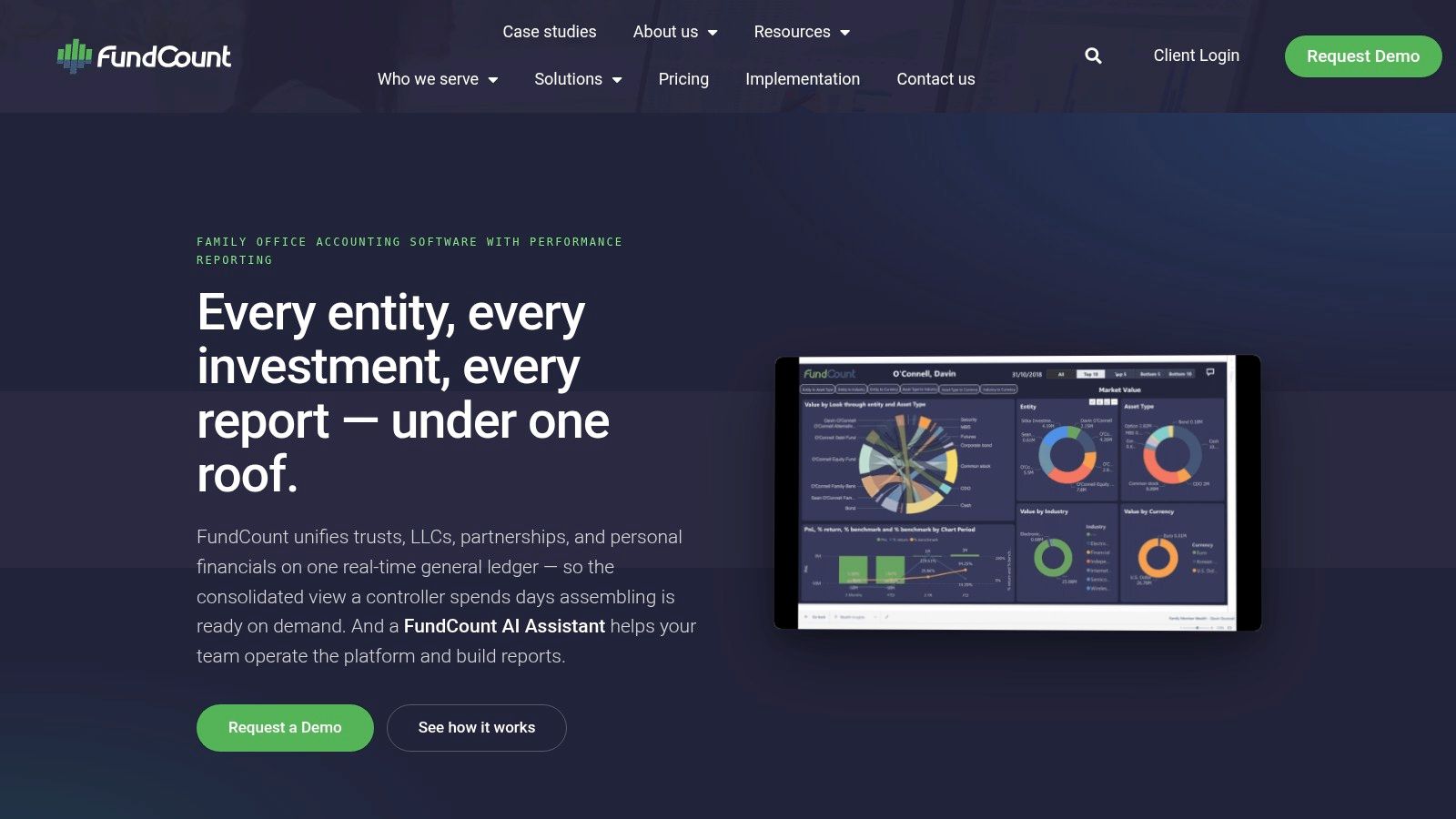
Shortlist FundCount when investment accounting and partnership accounting drive the complexity. Its combination of portfolio accounting, partnership accounting, a general ledger, and reporting makes it an accounting-led candidate rather than merely a wealth dashboard.
FundCount's family-office platform supports multi-entity and multi-currency reporting, partnership allocations, capital accounts, waterfall workflows, and investor reporting. That combination deserves attention when staff must reconcile investment activity with entity books and ownership interests.
Where the depth earns its keep
Ask the demonstrator to process a capital call, record a distribution, allocate results across partners, and produce both entity-level and consolidated reports. Include side pockets or waterfall requirements if those exist in your structure. A clean portfolio screen doesn't establish that the partnership accounting matches your agreements.
- Strength: Investment records and accounting records are designed to work together, reducing the need to maintain disconnected processes.
- Trade-off: Institutional functionality can create unnecessary configuration and training work for a simpler office.
- Commercial check: The vendor publishes an approximate annual entry license fee of $25,000 on its linked family-office page, but implementation and other charges require a scoped proposal.
Recommendation: Choose FundCount for substantive investment and partnership-accounting requirements. Don't buy its breadth unless your team can identify the workflows that justify it, and have the staff who close the books test report-building themselves.
2. Eton Solutions AtlasFive
Replacing a ledger is a narrower project than replacing the operating infrastructure of a family office. AtlasFive belongs on the shortlist for the broader project.
Eton Solutions AtlasFive combines general-ledger, trust, partnership, and tax-ledger functions with investment operations, documents, bill pay, and reporting. Its scope includes automated feed processing, journal creation, and daily bank-to-book reconciliation.
That breadth is useful when accounting staff, investment personnel, and administrators currently coordinate through separate applications. It also means the implementation must address responsibilities and approvals, not just account mappings.
Scope warning: A unified platform still needs clearly assigned owners for data, approvals, reconciliations, and exceptions.
Buy the operating model, not just the interface
Build your demonstration around a complete workflow: receive a document, identify the entity, approve the transaction, create the accounting entry, reconcile the cash movement, and report the result. Use your family-office reporting requirements to define the outputs before discussing dashboard layouts.
The advantage is family-office-specific breadth, including trust accounting and complex family structures. The cost risk is organizational change: staff may need to replace established procedures across several functions.
Public software pricing isn't listed. Require a proposal that separates licensing, migration, configuration, integrations, training, and ongoing support.
Recommendation: Evaluate AtlasFive when leadership wants coordinated family-office operations. If the immediate problem is an unreliable multi-entity close, compare a focused accounting foundation before committing to this wider scope.
3. Archway Platform
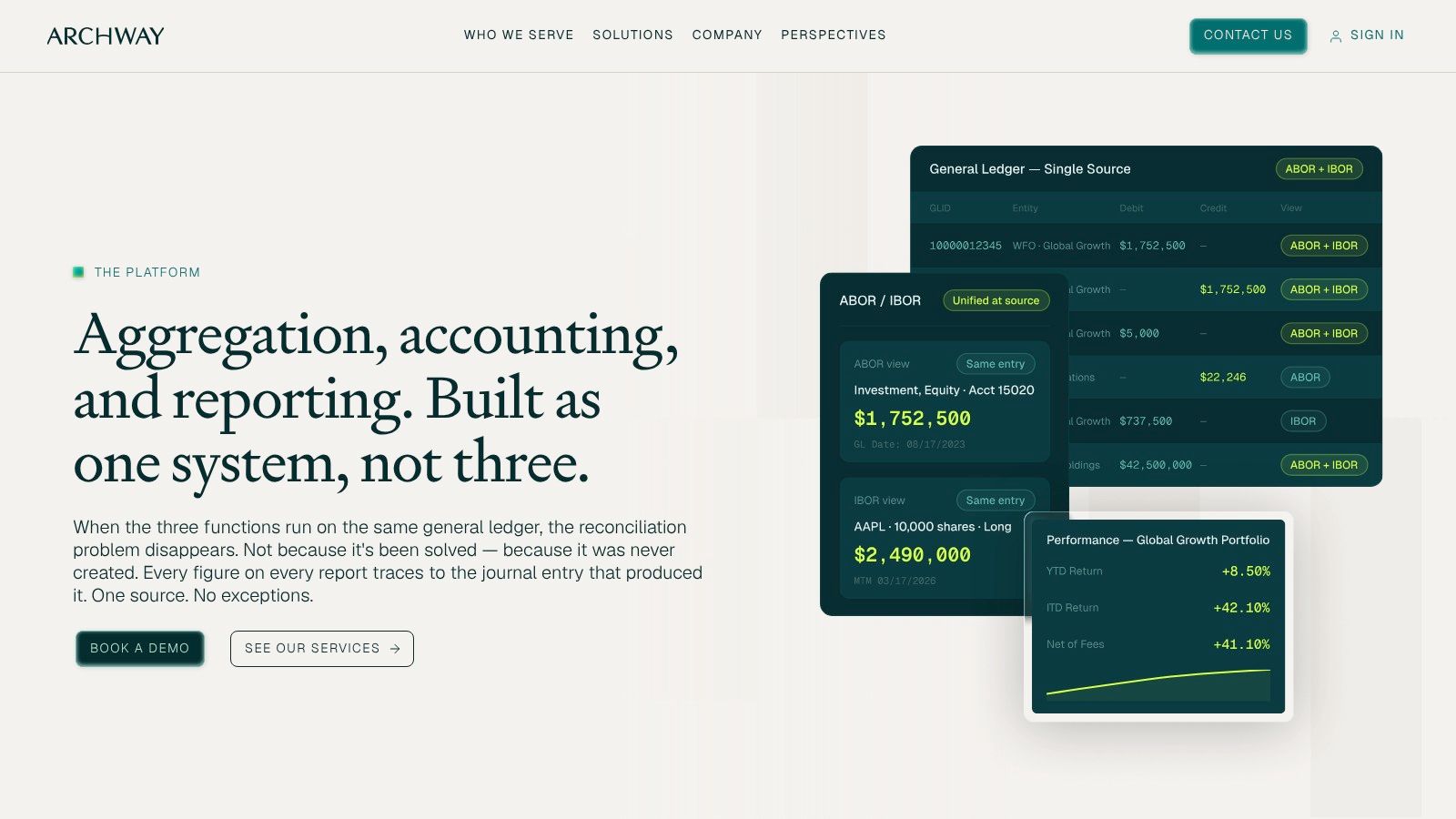
Who will do the accounting after go-live? That question should lead an Archway evaluation, particularly when the office has limited internal capacity.
The Archway Platform combines a general ledger with investment-data aggregation and reporting. Archway also offers outsourced accounting, cash and expense management, and fund administration, allowing buyers to consider software-only, outsourced, or hybrid arrangements.
Its multi-entity and partnership-accounting capabilities are relevant to nested ownership structures. The practical differentiator, however, is the ability to discuss both technology and the staffing model around it.
- Keep accountability explicit: Define who posts transactions, reviews reconciliations, resolves exceptions, and approves final statements.
- Separate software from services: Identify which activities are included in the license and which require additional service agreements.
- Protect continuity: Require documented procedures and access to supporting records rather than relying on an individual service contact.
Compare the retained workload
An outsourced arrangement shouldn't be evaluated against software subscription cost alone. Compare it with the internal accounting work you'll retain, including review, cash approvals, document collection, and adviser coordination.
Pricing depends on entity count, investment complexity, and the service model. Require those assumptions in writing so later changes don't become unexplained scope increases.
Recommendation: Shortlist Archway when back-office capacity is part of the problem. For a finance-led alternative, compare its operating model with Sage Intacct for family offices, particularly if you intend to retain accounting internally.
4. Asset Vantage

Asset Vantage occupies the space between a standalone ledger and a broader family-office operating suite. Evaluate it when the main objective is a connected accounting-and-investment view.
Asset Vantage combines general-ledger accounting, portfolio-performance reporting, financial-data aggregation, partnership accounting, and multi-entity consolidation. Document tools and optional managed services extend that scope for teams seeking accounting or reconciliation support.
The appeal is straightforward: finance staff and investment staff can evaluate information on the same platform. The buying decision still depends on whether the system can handle your actual sources and reporting conventions.
Test the difficult feeds first
Don't begin with the custodian connection that everyone expects to work. Start with the private partnership, unusual statement format, or operating-entity import that creates recurring manual work.
Simple's family-office software report found that 73% of surveyed platforms identified private-market data as their hardest problem. Its findings emphasize data structure as a foundation for successful automation.
- Data fit: Confirm coverage for your banks, custodians, and investment providers.
- Accounting fit: Test entity ownership, currency handling, consolidation, and corrections.
- Service fit: Define the responsibilities covered by optional managed services.
Public list pricing isn't displayed. Treat configuration, historical-data conversion, and feed maintenance as separate commercial questions.
Recommendation: Shortlist Asset Vantage for integrated accounting and investment reporting. Use a documented multi-entity accounting software evaluation to ensure the consolidated view doesn't obscure entity-level controls or create hidden reconciliation work.
5. SumIt
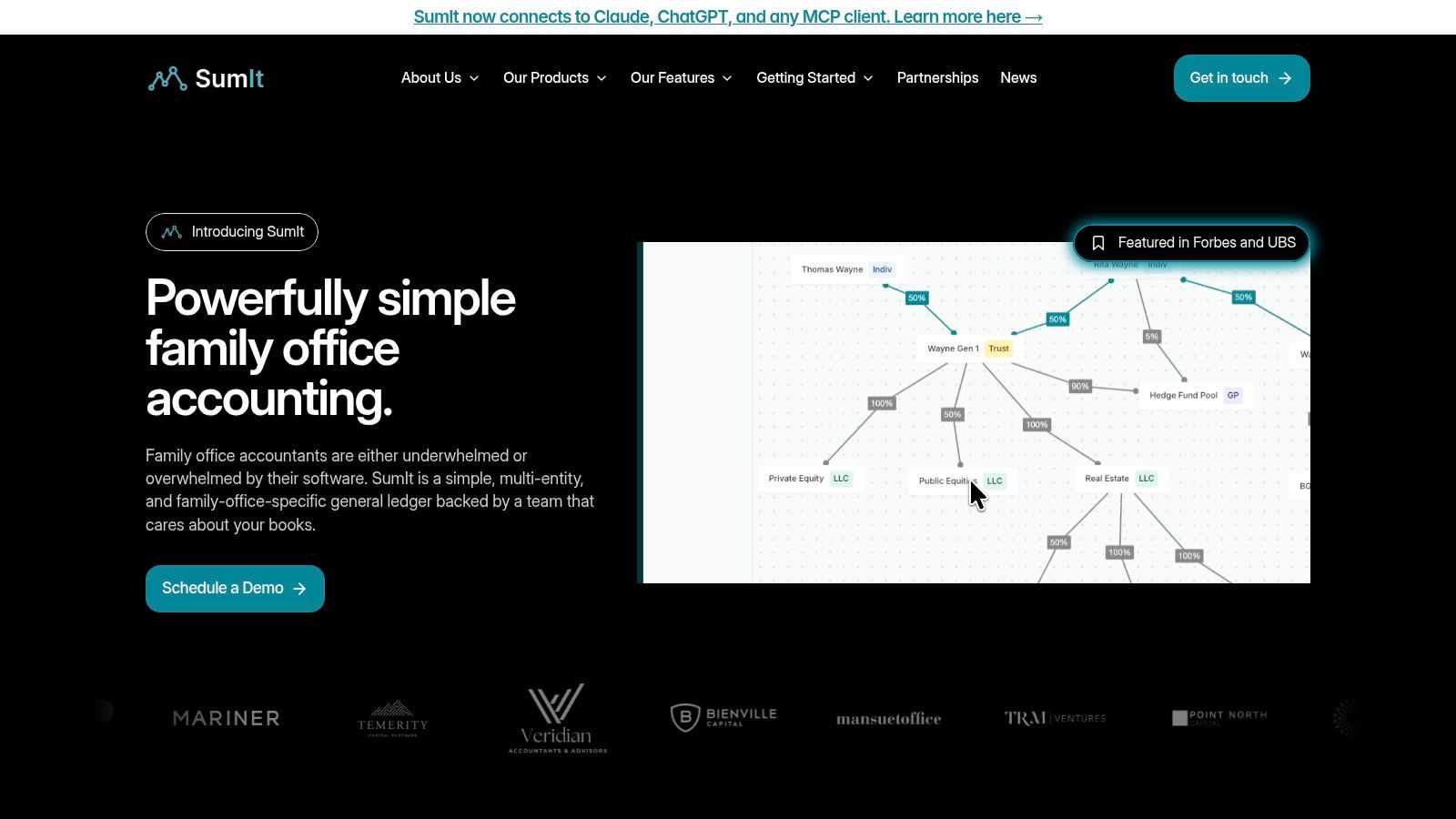
SumIt is a focused ledger candidate for offices moving beyond QuickBooks without replacing every investment application. That narrower mandate can make the buying decision more manageable.
SumIt positions its general ledger around single- and multi-family offices, multi-entity accounting, and consolidated reporting. The company also identifies integrations with Addepar and Bill, which is relevant if you want accounting, investment reporting, and payments to remain distinct but connected.
The company reports typical implementation of 8–12 weeks, with some projects as short as six weeks, on its linked website. Treat that as vendor guidance, not your project commitment: migration quality, entity complexity, and staff availability still determine your plan.
A focused ledger is a good choice only if its boundaries match the work you intend to keep elsewhere.
Check the boundary conditions
Ask SumIt to demonstrate the accounting tasks that won't move into an investment-reporting tool. Those include intercompany corrections, ownership changes, consolidation adjustments, and access restrictions between families.
The strength is a family-office-specific accounting focus without the scope of a complete wealth-management suite. The caution is that partnership, investment, and tax-accounting depth must be established through actual workflows rather than inferred from the product category.
Public pricing isn't listed. Request clear terms for entities, users, integrations, migration, and support.
Recommendation: Include SumIt when ledger usability and consolidated reporting are the immediate priorities. Keep specialist investment systems where they add value, but assign responsibility for every interface and reconciliation.
6. Asseta

For an office juggling accounting, investment data, payables, and reconciliations, Asseta merits a workflow-led evaluation. Don't evaluate it solely as a replacement chart of accounts.
Asseta's family-office platform includes a multi-entity, multi-currency general ledger, consolidated reporting, automated intercompany activity, banking, investment data, bill pay, and reconciliation features. The company reports typical implementation of 8–12 weeks, subject to scope and readiness, on its linked website.
Asseta also states that data is hosted in the United States on AWS and encrypted in transit and at rest. Those are useful vendor disclosures, but finance leaders still need to examine how users approve payments, change banking details, and access sensitive records.
Keep accounting policy separate from automation
The vendor notes that software alone doesn't guarantee GAAP-compliant results. That's an important buying principle: your accounting policies, configuration, review procedures, and source data determine the reliability of the output.
- Demonstrate intercompany activity: Include a correction and its effect on consolidated statements.
- Inspect payment controls: Show who can create, approve, release, and amend a payment.
- Assess reporting depth: Test your own entities and transactions rather than relying on sample reports.
Public pricing isn't listed. Ask for implementation deliverables and acceptance criteria alongside the subscription proposal.
Recommendation: Evaluate Asseta for family-office-specific accounting with connected cash and investment workflows. Where foundations or restricted resources are involved, add fund-accounting requirements to the evaluation rather than assuming a family-office ledger covers them automatically.
7. Sage Intacct

Sage Intacct is my recommendation for finance-led offices that need a scalable accounting foundation, especially when operating businesses sit alongside family entities. Start here when the CFO's priority is controlled financial reporting rather than replacing every wealth-management application.
Sage Intacct's family-office offering describes multi-entity financial management, consolidation, GAAP financial statements, reporting, and dashboards across entities, funds, assets, currencies, and locations. Its accounting scope includes general ledger, payables, receivables, and cash management.
That makes it relevant to organizations needing conventional financial statements and operational visibility. Its public review footprint spans multiple industries, so family-office buyers should validate their specific workflows rather than extrapolate from general user feedback.
Draw the investment boundary early
Investment aggregation, private-asset tracking, and family-level wealth reporting may require companion software. Map partnership allocations, capital accounts, and ownership reporting before assuming those requirements are covered natively.
- Best fit: Finance teams managing operating companies and complex entity reporting.
- Key advantage: An accounting foundation that can connect with other business systems.
- Main caution: Quote-based pricing and configuration require a clearly scoped implementation.
For offices evaluating accounting software for multiple businesses, the design should establish account mappings, reporting dimensions, intercompany rules, and approval responsibilities before migration begins.
Recommendation: Shortlist Sage Intacct when consolidation, auditability, and operating-company reporting lead the decision. Pair it with the right implementation partner and add investment tools where they serve a defined purpose, rather than forcing every requirement into the ledger.
8. SoftLedger
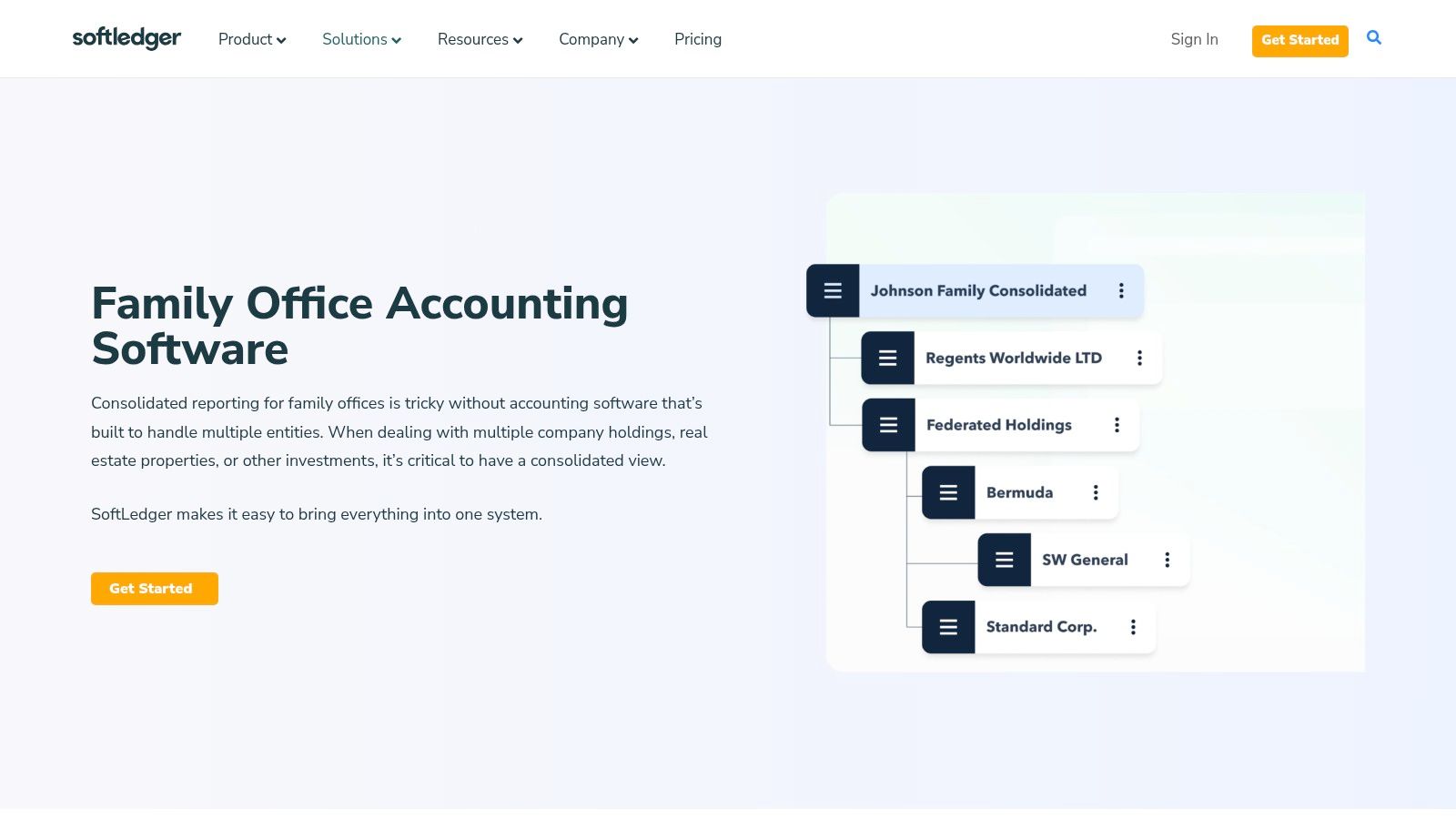
Not every family office needs a broad operating suite. SoftLedger is a candidate when the requirement centers on cloud accounting, intercompany activity, and consolidation with a lighter ERP footprint.
SoftLedger's family-office accounting platform includes multi-entity consolidation, automatic intercompany entries, real-time reporting, dashboards, API connectivity, and open-banking connections. The vendor describes a modular subledger approach and emphasizes approachable cloud workflows and faster onboarding.
The value proposition is accounting flexibility rather than deep native coverage of every family-office specialty. That distinction should shape your demonstration.
Verify the specialist accounting
Use SoftLedger to demonstrate routine entity accounting, then deliberately introduce your exceptions. Ask how the system handles alternative investments, capital accounts, trust requirements, and ownership look-through.
Automatic intercompany entries are useful only when the underlying entity relationships and posting rules are correct. Ask the vendor to show how staff identify mismatches, reverse mistakes, and explain consolidation adjustments.
- Architecture check: Establish which requirements are native, integrated, or manual.
- Integration check: Confirm transaction detail, error handling, and responsibility for maintaining connections.
- Commercial check: Pricing isn't displayed on the family-office product page, so request a complete scoped quote.
Compared with specialist platforms, SoftLedger is less family-office-specific in trust, partnership, and investment accounting. Don't treat those functions as interchangeable with general multi-entity capability.
Recommendation: Evaluate SoftLedger for a focused cloud-accounting architecture. Select it only after you've established where specialist investment and ownership workflows will live and who will reconcile them to the books.
9. Addepar
Addepar belongs beside the general ledger, not in its place. Choose it for investment visibility when the accounting foundation is already sound or is being replaced separately.
Addepar's family-office platform focuses on investment-data aggregation, analytics, ownership modeling, private-market reporting, granular permissions, and client portals. It brings together custodian, bank, and alternative-investment information to support custom views of family wealth.
Its materials describe connections with general ledgers and existing infrastructure, including an example involving Sage Intacct integration. That makes it relevant to an accounting-core-plus-reporting-layer architecture.
Architecture rule: Decide which system owns each balance, transaction, valuation, and ownership record before connecting platforms.
Make the interface an accounting deliverable
The important question isn't whether systems can exchange information. It's whether finance staff can explain differences between investment reports and accounting statements.
Define valuation dates, cash-flow classifications, ownership conventions, and correction procedures. Establish what happens when a private-market statement arrives late or a provider revises historical data.
- Strength: Consolidated investment visibility and family-specific reporting.
- Limitation: Bookkeeping and journal-entry workflows require a separate accounting system.
- Cost consideration: Pricing isn't public, and integrations add implementation and support questions.
Aggregation quality depends on provider feeds and the availability of alternative-investment information. Require a demonstration using your actual custodians and representative private assets.
Recommendation: Shortlist Addepar when investment reporting is the missing layer. Don't use an attractive consolidated portfolio view as evidence that entity books, payables, and accounting controls have been addressed.
10. Masttro
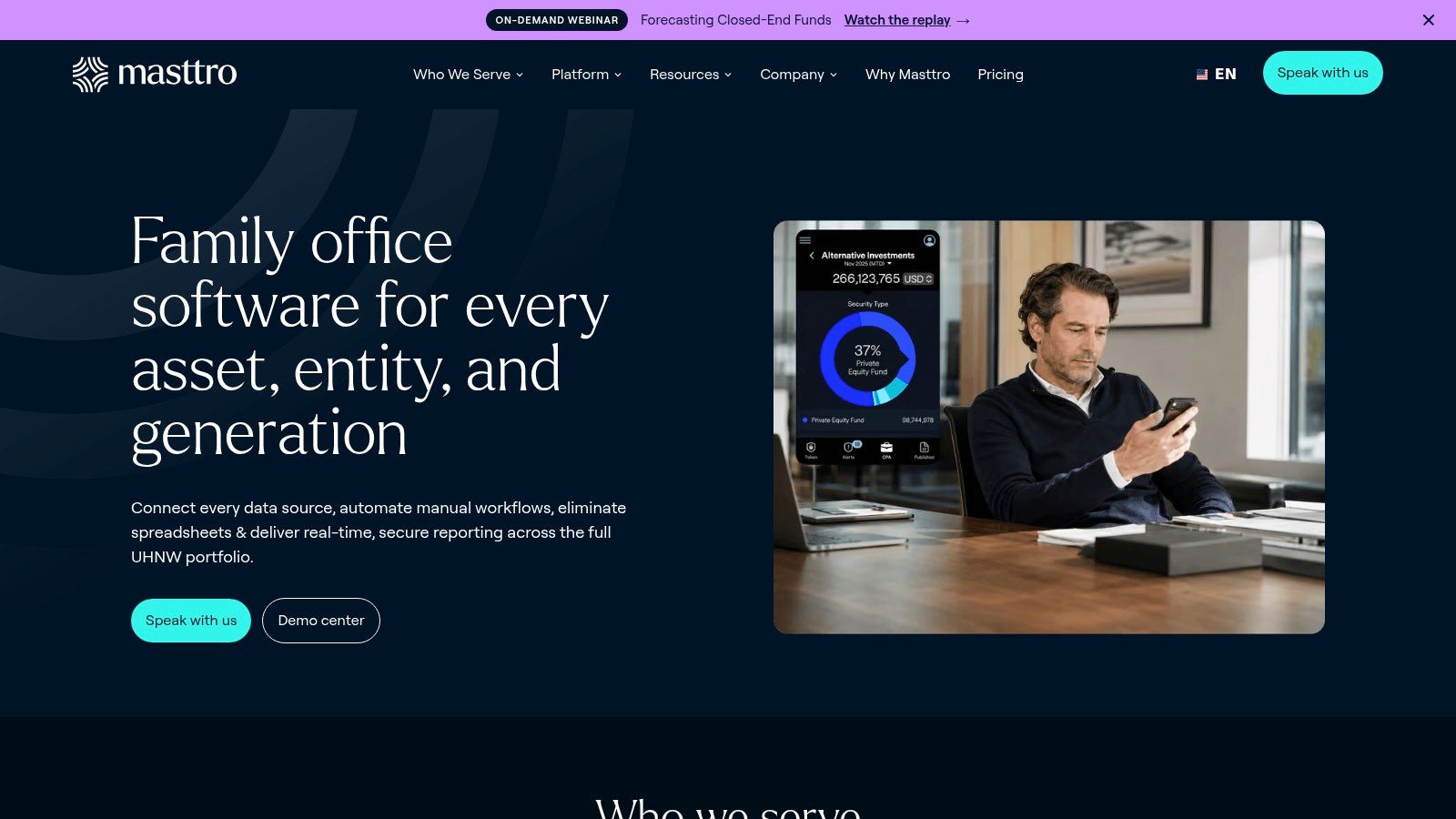
When family members need a coherent view of financial and non-financial assets, Masttro is a reporting-layer candidate. Its role differs from the accounting systems earlier in this comparison.
Masttro aggregates liquid investments, alternatives, real estate, and other assets, with reporting, ownership visualization, document storage, integrations, mobile access, and AI-enabled extraction workflows. The vendor distinguishes this role from accounting software.
That distinction is useful. Masttro doesn't replace general-ledger systems such as Sage, QuickBooks, or NetSuite, and your finance team still needs a controlled process for bookkeeping and journal entries.
Test documents through to reported values
A document-extraction demonstration should show more than successful capture. Ask staff to follow a value from the original statement through review, correction, asset reporting, and any transfer into the accounting environment.
The advantage is a unified visibility layer for disparate assets and family-facing reports. The risk is maintaining an attractive reporting environment while accounting staff continue substantial reconciliation work elsewhere.
- Feed coverage: Test your custodians and assets, including less-standard providers.
- Document controls: Confirm retention, permissions, review responsibilities, and correction history.
- Reporting ownership: Assign responsibility for approving valuations and resolving differences from ledger balances.
Public pricing isn't listed. Include integrations, document processing, and ongoing data-management responsibilities in the commercial discussion.
Recommendation: Evaluate Masttro when wealth visibility and document organization are priorities. Keep the ledger decision separate, then design a controlled connection between the accounting records and family-facing reports.
Top 10 Family Office Accounting Software Comparison
| Platform | Core capabilities | Best fit / target audience | Standout value | Pricing / considerations |
|---|---|---|---|---|
| FundCount | Portfolio, partnership, and general-ledger accounting; multi-entity reporting | 👥 Offices managing complex investments, funds, and ownership structures | ★ Integrated investment and accounting records; ✨ waterfalls and capital accounts | 💰 Approx. $25,000 annual entry license; implementation and scope may add costs |
| Eton Solutions AtlasFive | Accounting, entity management, tax ledger, documents, bill pay, and investment workflows | 👥 Family offices coordinating many operational workflows | ✨ Broad, family-office-specific platform with trust accounting | 💰 Pricing not public; broad scope may mean substantial implementation |
| Archway Platform | Multi-entity ledger, investment aggregation, reporting, cash and expense management | 👥 Offices considering in-house, outsourced, or hybrid operations | ✨ Software, outsourced services, or hybrid model | 💰 Depends on entity count, complexity, and service model |
| Asset Vantage | General ledger, portfolio reporting, data aggregation, partnership accounting | 👥 Offices seeking a unified accounting-and-investment view | ✨ Optional managed accounting and reconciliation services | 💰 Pricing not public; verify data-feed coverage |
| SumIt | Family-office general ledger, multi-entity accounting, consolidation | 👥 Single- and multi-family offices moving beyond basic accounting software | ✨ Focused ledger with Addepar and Bill integrations, per vendor | 💰 Pricing not public; confirm investment and partnership-accounting depth |
| Asseta | Multi-entity ledger, investment data, reconciliations, payables, reporting | 👥 Offices needing family-office-specific accounting capabilities | ✨ Combines accounting, cash management, and investment data | 💰 Pricing not public; assess fit with real workflows and reporting needs |
| Sage Intacct | General ledger, multi-entity consolidation, AP/AR, cash management, dashboards | 👥 Finance-led offices and organizations with operating businesses | 🏆 Scalable accounting foundation; works with companion investment tools | 💰 Quote-based; investment and partnership needs may require additional tools or configuration |
| SoftLedger | Cloud accounting, consolidation, intercompany entries, real-time reporting | 👥 Teams seeking a cloud accounting platform with a simpler ERP footprint | ✨ Modular subledgers and API connectivity | 💰 Pricing not public; test family-office-specific accounting needs |
| Addepar | Investment data aggregation, analytics, ownership modeling, reporting | 👥 Offices prioritizing consolidated portfolio visibility | ✨ Detailed family ownership and private-market reporting; can complement a ledger | 💰 Pricing not public; not a general-ledger replacement |
| Masttro | Asset aggregation, reporting, document management, data extraction | 👥 Offices needing a family wealth-visibility and document layer | ✨ Covers financial and non-financial assets; mobile access | 💰 Pricing not public; requires separate accounting software |
Build the Right System, Not the Longest Feature List
Document the operating problem before requesting proposals. Record current close time, entity and account complexity, currencies, trust and partnership requirements, custodian feeds, reporting audiences, migration constraints, internal ownership, budget, and target time-to-value.
Use those facts to choose an architecture. Accounting-led investment systems suit offices whose hardest work involves portfolios and partnerships; broader operating platforms suit coordinated administration. Focused ledgers address accounting control, while reporting layers improve investment visibility without replacing the books.
Use a practical selection checklist
Run scripted demonstrations with representative transactions and reports. Include a capital call, distribution, intercompany loan, bank-detail change, corrected valuation, consolidated statement, and a restricted user's access.
- Migration: Define historical detail, opening balances, document retention, account mapping, and reconciliation sign-off.
- Implementation: Name owners for configuration, testing, training, integrations, and post-launch support.
- Cost: Compare five-year ownership costs, including subscriptions, services, connectors, internal effort, and ongoing administration.
- Evidence: Require references from comparable offices and written acceptance criteria tied to your workflows. For security reviews, use NIST's security and privacy control catalog to frame questions about access, audit logs, and external providers.
The accounting audit-trail guidance from the University of Colorado describes traceability from originating documents to financial statements and back again. Make that bidirectional traceability a demonstration requirement, not a promise deferred until implementation.
Treat security and source data as accounting controls
A global family-office cybersecurity survey summary reports that 70% ranked cybersecurity as their top operational risk in 2025, while 60% reported experiencing a cyberattack. Test segregation of duties, approval thresholds, access revocation, activity logs, and recovery procedures alongside reporting features.
For foundations using expenditure responsibility, IRS grantee-reporting requirements include annual accounting and final reporting on expenditures and progress. The IRS also outlines records foundations must retain for those grants, including grant agreements and reports received from grantees. Demonstrate grant-level tracking, deadlines, and supporting documentation where those obligations apply.
If statement capture is a bottleneck, this guide to OCR for bank workflows provides a separate evaluation starting point. Keep extraction distinct from validation, reconciliation, and approval.
Choose the partner with the architecture
Software alone doesn't remove accounting risk or guarantee a faster close. For scalable consolidation, conventional financial reporting, and operational visibility, Sage Intacct is a strong accounting foundation, with complementary tools where family-level investment reporting requires them.
Lucentive is a Sage Intacct National Premier Partner with deep mid-market, healthcare, and nonprofit experience. The implementation conversation should connect entity design, data migration, reporting, and controls to the outcomes your CFO needs, rather than configure a subscription.
Summary
The best family office accounting software matches the office's operating model. FundCount emphasizes investment and partnership accounting; AtlasFive and Archway address broader operating needs; Asset Vantage connects accounting and investment reporting. SumIt, Asseta, Sage Intacct, and SoftLedger offer different accounting foundations, while Addepar and Masttro serve complementary reporting roles. For finance-led offices with operating entities, Sage Intacct deserves a place on the shortlist. Make the decision through representative demonstrations, migration planning, control testing, and complete ownership-cost comparisons. The implementation partner matters as much as the software selection.
Frequently Asked Questions
Which family office accounting software should we shortlist first?
Start with the work that creates the most accounting risk. Evaluate FundCount for investment and partnership accounting, AtlasFive for broad operating workflows, and Archway when outsourced or hybrid accounting is part of the decision. For finance-led offices managing operating businesses and consolidated financial statements, start with Sage Intacct. Consider focused ledger alternatives where their boundaries fit your requirements.
Can Addepar or Masttro replace our general ledger?
Neither should be evaluated as a complete general-ledger replacement. Addepar focuses on investment aggregation, analytics, ownership modeling, and reporting, while Masttro emphasizes wealth visibility, documents, and asset information. Your office still needs accounting software for bookkeeping and journal entries. Define which system owns each record and how staff reconcile investment reports with entity-level financial statements.
Is Sage Intacct a good fit for a family office?
Sage Intacct is a strong candidate when the priority is multi-entity accounting, consolidation, conventional financial statements, and operational visibility. It's particularly relevant when operating businesses sit alongside family entities. Investment aggregation, private-asset tracking, and family-level wealth reporting may require companion tools. Map partnership-accounting requirements before assuming they're covered natively, and scope implementation around actual transactions and reports.
What should we include in the implementation budget?
Include more than the software subscription. Budget for historical-data conversion, account mapping, configuration, integrations, testing, training, internal staff effort, and ongoing support. Define which documents and transaction history must migrate and who approves reconciled opening balances. Compare complete ownership costs rather than treating the lowest license quote as the lowest-cost operating environment.
How do we test whether advertised automation will work?
Use your own representative documents, transactions, entities, and reports. Ask vendors to demonstrate capital calls, distributions, intercompany corrections, valuation changes, and failed imports, including exception handling and human review. Follow the resulting values back to source documents. For connected accounting and investment systems, establish correction procedures and responsibility for explaining differences between the reports.
What should we discuss with Lucentive before choosing a system?
Bring your entity structure, close process, reporting examples, existing systems, and migration concerns. Discuss whether Sage Intacct should become the accounting foundation and where investment-reporting tools would remain necessary. Ask how the implementation would address account mappings, intercompany rules, approval responsibilities, testing, and training. The discussion should establish fit and scope before you commit to software.
Lucentive helps finance leaders evaluate and implement Sage Intacct around multi-entity accounting, reporting, and financial controls. Visit Lucentive to schedule a 30-minute working session or demo, and bring your entity structure and reporting examples so the team can test fit without pressure to buy.