Your controller shouldn't need a spreadsheet relay race to answer a basic question: how did the group perform last month? Yet that's the situation for many companies running separate QuickBooks files, manually matching intercompany balances, and rebuilding consolidated reports after each entity closes. The books may be accurate individually, but the group view arrives late, audit evidence is scattered, and finance leadership spends time assembling information instead of using it.
The right accounting software for multiple businesses is not a system that stores several company files. It's a decision about how your finance function will operate across entities, locations, currencies, shared services, and acquisitions. Sage Intacct can provide the centralized financial layer, but the operating model and implementation discipline determine whether that layer produces faster close, real-time visibility, and a cleaner audit trail.
| Business need | Separate company files | Multi-entity cloud ERP |
|---|---|---|
| Entity-level books | Maintained independently | Preserved within one shared environment |
| Consolidated reporting | Often assembled manually | Produced from connected entity data |
| Intercompany activity | Requires duplicate entries and reconciliation | Designed around matching and eliminations |
| Currency handling | May require external workarounds | Supports group-level translation workflows |
| Audit evidence | Spread across files and spreadsheets | Connected to transaction history and approvals |
| Management reporting | Rebuilt for each reporting cycle | Organized through shared dimensions and permissions |
Table of Contents
- Why Growing Finance Teams Outgrow Single Company Books
- The Inflection Point Beyond QuickBooks
- Multi-Entity Platforms Compared on What Actually Matters
- Designing the Operating Model Before Choosing Software
- Matching the Right Fit to Your Business Model
- Why the Right Partner Changes the Outcome
- A Practical Checklist for Mid-Market Buyers
- Summary
- Frequently Asked Questions
- How many entities can a company manage before QuickBooks breaks down?
- What should a realistic mid-market close look like after switching?
- How long does a phased implementation take?
- What does consolidation cost compared with late closes and restatements?
- When is a controller-only solution the wrong answer?
- Should a company buy Sage Intacct directly or use an implementation partner?
Why Growing Finance Teams Outgrow Single Company Books
A multi-entity close becomes painful before it becomes obviously broken. One ledger may still be manageable. Several active ledgers create dependencies: one entity waits for an invoice from another, shared costs need allocation, intercompany balances must match, and the controller can't finalize the group until each local book is ready.
That's why the problem is usually coordination, not transaction volume. Each additional legal entity brings its own general ledger, bank accounts, reconciliations, approvals, and close dependencies, as described in this practical guide to closing across multiple LLCs. Finance teams often respond by adding more spreadsheets and manual review. That approach can preserve control for a while, but it makes the group increasingly dependent on individual knowledge. Teams looking for broader guidance on legal entity structures and reporting obligations can also review the U.S. Small Business Administration and the Corporate Finance Institute's accounting resources.
Start with the operating failure
Before choosing software, document where the close stalls.
- Intercompany matching: Identify which balances depend on another entity's entries and who resolves differences.
- Consolidation: Trace how trial balances move into the group report and where manual adjustments enter.
- Shared services: Record how payroll, technology, facilities, and other common costs are allocated.
- Audit support: Follow a sample transaction from the consolidated report back to the source document and approval.
A useful framework for consolidating and automating multi-entity finances starts with these workflows rather than with a vendor feature list. The purpose isn't to erase local accounting. Each entity still needs its own books, controls, and reporting. The purpose is to create a shared financial structure that lets the parent organization see consistent information without repeatedly rebuilding it. For additional best practices on close processes and internal controls, the AICPA & CIMA finance and accounting resource center offers practical reference material.
Cloud accounting is now the control layer
Cloud accounting has become the dominant delivery model for SMBs managing multiple entities or locations from a shared finance stack. One independent 2026 industry summary reported that 71% of SMBs under USD 10 million in revenue use cloud accounting, up from a market where on-premise systems dominated five years earlier, reflecting the shift toward multi-user, multi-business visibility (Eagle Rock CFO).
The significance isn't the label “cloud.” It's the operating model cloud platforms enable: entity-level books connected to group reporting, controlled access by role, centralized dimensions, and evidence that stays attached to the accounting activity. That structure gives the CFO a reliable group view and gives the Controller a repeatable close process. Buyers comparing deployment models can also browse current accounting software coverage from Capterra and Software Advice.
Practical rule: If the team can produce a consolidated report only after exporting, cleaning, and manually reconciling several files, the reporting process is the constraint, not the people.
The Inflection Point Beyond QuickBooks
The decision to leave QuickBooks should follow the operating model, not a simple entity count. A group with independent businesses and little interaction may manage separate files for longer than a smaller group sharing vendors, intercompany loans, currencies, or compliance obligations.
QuickBooks stores each company in its own file. It lacks native group consolidation, intercompany transaction workflows, and a shared chart of accounts across entities, so finance teams often build manual Excel rollups, as outlined in this analysis of QuickBooks for multiple businesses. QuickBooks Online Advanced can extend capabilities within one company file, but it does not change the underlying multi-file model. Readers who want a broader market view can compare product categories and reviews on G2's accounting software category.
Look for complexity signals
The tipping point arrives when the Controller cannot answer group-level questions without assembling data by hand. Warning signs include:
- Intercompany balances need recurring journal entries and detective work.
- Leadership reports wait on another entity's close.
- Shared vendors or customers appear repeatedly across company files.
- Currency translation happens outside the core ledger.
- Audit requests require searching old files, spreadsheets, and email approvals.
- Department, location, fund, project, or program reporting requires more dimensions than the current structure supports.
QuickBooks Online users should also review audit-log retention. One published analysis states that QuickBooks retains audit logs for two years, which can create a problem when auditors request older evidence for intercompany transactions or compliance reviews (Accord Consulting). For a practical overview of audit-readiness and documentation expectations, the PCAOB standards page and Journal of Accountancy are useful references.
Where the gap opens
| Capability | QuickBooks, multi-file | Cloud ERP, such as Sage Intacct |
|---|---|---|
| Entity structure | Separate company files | Entities managed in a shared financial environment |
| Consolidation | Manual rollup and adjustments | Native consolidated reporting with entity detail |
| Intercompany accounting | Duplicate activity and reconciliation | Matching, due-to and due-from workflows, and eliminations |
| Chart of accounts | Separate structures unless standardized manually | Shared group reporting structure with entity-level flexibility |
| Multi-currency | Limited group-level control | Currency translation and revaluation designed for multi-entity use |
| Audit trail | Evidence may be distributed across files | Drill-down and approvals can remain connected to transactions |
A narrow workflow problem may justify a targeted fix. When the close, audit support, and management reporting all depend on manual consolidation, the architecture has become the constraint.
Choose the replacement and the implementation partner as one operating-model decision. The right combination standardizes ownership, intercompany rules, and evidence handling before migration begins. A disciplined QuickBooks data migration approach can preserve useful history while moving the group toward a controlled process, faster close, and cleaner audits. For additional context on financial system migrations and ERP change management, see Deloitte Insights and PwC's finance transformation coverage.
Multi-Entity Platforms Compared on What Actually Matters
A platform comparison should start with consolidation depth, not the number of modules in a product brochure. The decisive questions are whether each entity can keep its own books, whether the system can match and eliminate intercompany activity, how it handles currency translation, and whether a reviewer can drill from group results to supporting evidence. Buyers evaluating broader finance-system criteria can also reference Gartner's finance software research hub, G2's accounting software category, CFO Dive, and the AICPA & CIMA finance and accounting resource center for market context, practitioner analysis, and peer feedback.
Sage Intacct is a strong fit for mid-market organizations that need structured multi-entity consolidation, dimensional reporting, and a clear audit trail without adopting an enterprise platform heavier than the business requires. Its trade-off is that the design still matters. Poorly defined entities, dimensions, and intercompany rules will create a poor result even in a capable system.
NetSuite offers broad enterprise functionality and can suit organizations with complex global structures, extensive operational requirements, or a long-term enterprise roadmap. The trade-off is greater implementation weight, more design decisions, and a need for experienced governance. Buyers often pair vendor materials with third-party commentary from sources such as Nucleus Research and TrustRadius.
Microsoft Dynamics 365 Business Central makes sense when the organization already operates in the Microsoft ecosystem and wants financials connected to broader business processes. It can support substantial complexity, but the quality of the multi-entity outcome depends heavily on configuration, extensions, and the implementation team's understanding of the group's close. Comparative overviews on SelectHub can help frame shortlist discussions.
Acumatica is attractive for organizations that want ERP breadth and operational flexibility, particularly where distribution, project, or industry workflows sit close to accounting. The evaluation should focus on how its entity structure, intercompany process, reporting dimensions, and audit evidence map to the finance team's actual close.
| Platform | Consolidation depth | Intercompany handling | Multi-currency | Audit trail | Best fit |
|---|---|---|---|---|---|
| Sage Intacct | Strong mid-market consolidation with entity-level visibility | Native workflows for intercompany activity and eliminations | Designed for group reporting and currency handling | Drill-down, permissions, and approval evidence | Mid-market groups prioritizing finance control and reporting |
| NetSuite | Broad consolidation for complex enterprise structures | Strong, but implementation requires disciplined design | Suited to multinational operating models | Comprehensive controls with significant configuration | Larger or globally complex organizations |
| Dynamics 365 Business Central | Capable within a wider Microsoft-centered ERP model | Depends on configuration and extensions | Appropriate for organizations with broader operational needs | Strong when configured and governed correctly | Microsoft-oriented businesses needing ERP breadth |
| Acumatica | Flexible consolidation within a broad ERP platform | Supports connected entity workflows | Suitable where operational and financial requirements converge | Dependent on configuration and process design | Growing organizations seeking operational flexibility |
The comparison should be grounded in the Sage Intacct versus NetSuite decision, but the same principle applies to every platform. Native consolidation, intercompany matching and eliminations, multi-currency revaluation, dimensional reporting, and audit-ready drill-down matter more than surface-level feature volume.
Designing the Operating Model Before Choosing Software
Software can execute a finance model. It can't decide what that model should be.
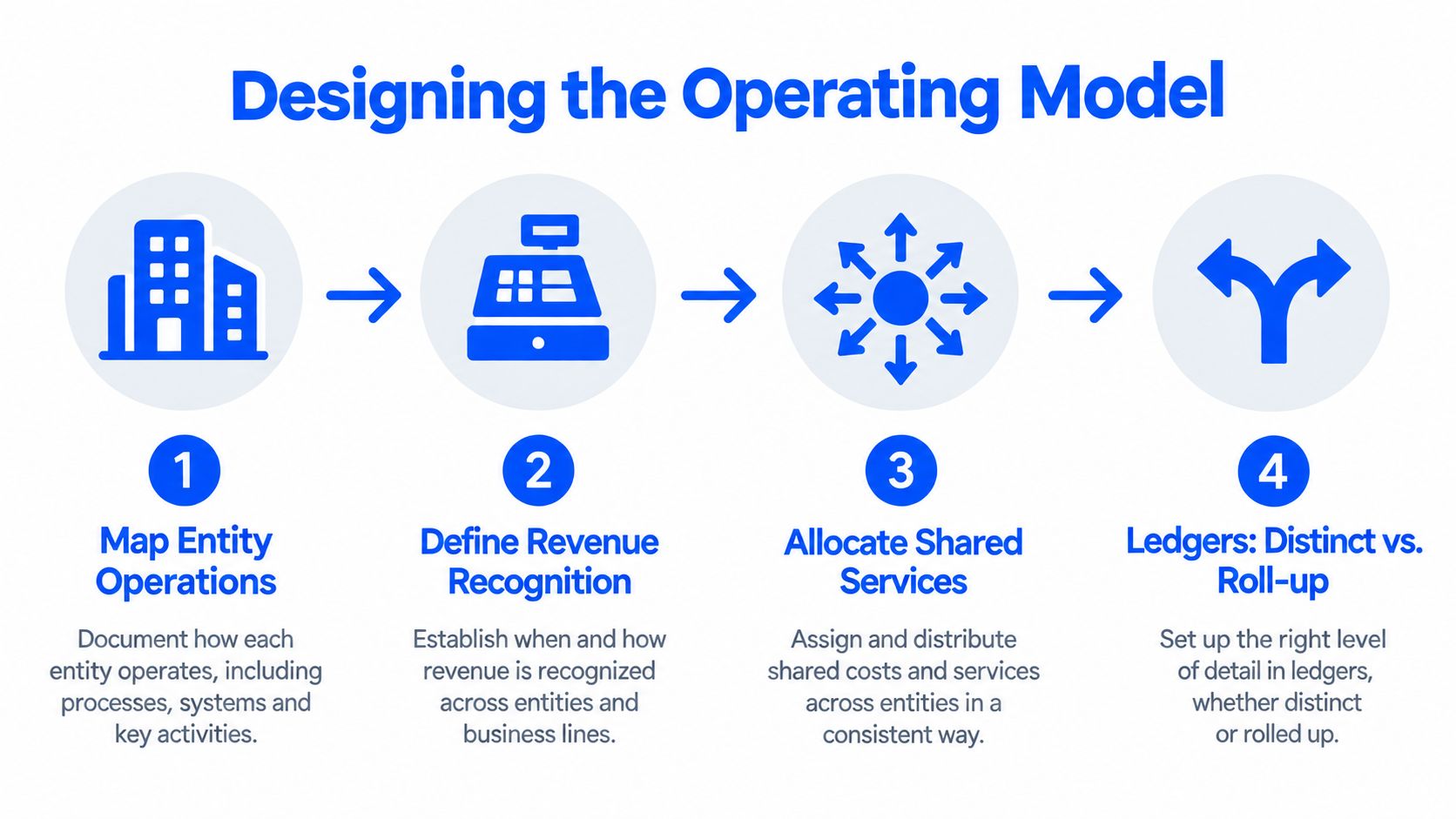
Start by mapping each entity's role in the group. Document where revenue is recognized, which costs belong directly to an entity, which services are shared, and which ledgers must remain distinct for statutory or operational reasons. Then define what the parent needs to see, such as entity, location, department, fund, project, program, or practice area. Teams that want a structured way to document processes can borrow ideas from Smartsheet's process mapping resources and control documentation guidance published by Protiviti.
Build the shared structure carefully
A unified chart of accounts should support group reporting without ignoring local statutory requirements. Don't force every entity into identical detail if the businesses operate differently. Instead, define the parent reporting structure, map local accounts to it, and establish ownership for changes.
Your intercompany policy needs the same discipline. Write down:
- Counterparty ownership: Which entity initiates and records each transaction?
- Timing: When must both sides post the activity?
- Pricing: How are shared services, loans, and other intercompany charges calculated?
- Eliminations: Which balances and transactions disappear in consolidated statements?
- Approval: Who can approve exceptions, corrections, and reopened periods?
Sage Intacct dimensions can support the reporting model, but dimensions shouldn't become a substitute for governance. Every dimension needs a business purpose, a clear owner, and a rule for how users apply it. The IMA resource center is also useful for policy, controls, and management accounting guidance.
Use the close as the test
Measure the current process. If intercompany matching takes eight days today, the future design must show exactly how that work changes. If no candidate platform can model the workflow without manual exports, it shouldn't pass the evaluation.
A proper multi-entity close locks each entity ledger before consolidation. Reopening a ledger should require documented approval, while intercompany matching, elimination entries, and foreign-subsidiary translation should happen through defined steps, as explained in this multi-entity month-end close guidance. Finance leaders can also benchmark close practices and controllership priorities using resources from Controllers Council.
The operating model is the specification. The platform is the tool that executes it.
Matching the Right Fit to Your Business Model
The best platform depends on what the entities do, not just how many entities exist. Healthcare, nonprofit, and professional services groups may all need consolidation, but their reporting structures and control requirements differ substantially.
Multi-site healthcare groups
A healthcare organization with multiple clinics usually needs entity-level visibility alongside reporting by location, service line, provider, or clinical cost center. The finance team may also need fund accounting, grant tracking, and access controls that respect sensitive operational information.
Sage Intacct's dimensional model can fit this structure when the implementation team understands how clinical cost centers, shared services, and entity reporting interact. The important test is whether the CFO can see the group result, then move into the clinic, department, or transaction that explains it without rebuilding the analysis outside the ledger. Healthcare buyers may also want to monitor compliance and reporting developments through HFMA and HHS.
Federated nonprofit networks
A nonprofit network often needs autonomy at the organization level and consistency at the parent level. Each charity may maintain its own books, programs, grants, and approvals, while the central finance team needs consolidated statements and reliable visibility across the network.
The operating model should preserve those local controls while standardizing the reporting structure. That means agreeing on account mappings, fund and program dimensions, intercompany rules, and approval responsibilities before configuring the system. A platform that consolidates cleanly without erasing entity-level accountability is more valuable than one that merely offers multiple logins. For governance and grant reporting context, many teams reference the National Council of Nonprofits and GrantSpace.
Professional services firms
Professional services groups tend to care about project profitability, practice-area performance, partner allocations, utilization reporting, and shared corporate costs. Separate legal entities may bill one another, share personnel, or operate with different project economics.
That environment can push the evaluation toward platforms with deeper job costing and project accounting. Sage Intacct may fit when financial control and dimensional reporting are central, while Business Central or Acumatica may deserve closer review when the broader operational ERP requirement is substantial. Readers comparing project-centric accounting needs can also review guidance from the Project Management Institute and CPA Practice Advisor.
The decision should follow the management questions. If leaders ask which clinic, program, project, or practice area generated a result, the system must capture that context at the transaction level.
Why the Right Partner Changes the Outcome
The operating model comes first. Software follows. In a multi-entity rollout, implementation judgment determines whether the group closes faster or recreates old workarounds inside a new system.
A capable partner tests difficult workflows before configuration hardens them. That includes elimination entries, shared-service allocations, currency translation policies, entity permissions, acquisition scenarios, and the route from consolidated trial balance to source document. These decisions shape the audit trail and determine whether the finance team can run the process without constant outside help. Broader implementation and transformation case studies from McKinsey can also help teams think through change adoption.
Judge the implementation, not just the demo
Ask the partner to demonstrate how it will handle:
- Chart-of-accounts design: How will local statutory requirements map to group reporting?
- Intercompany rehearsal: Can the team complete a full transaction cycle in a test environment?
- Close pressure testing: Will the partner simulate the group's actual month-end sequence?
- Historical migration: Which QuickBooks data will move, and how will opening balances be validated?
- Internal ownership: Who will train the Controller and finance team to administer the process afterward?
Implementation schedules vary by organization. Mid-market rollouts can take days in limited-scope cases, while broader multi-entity implementations may take months and enterprise or multinational deployments longer, according to the cited LiveFlow implementation timeline guidance. Use those ranges for planning, not as promises. Scope, data quality, integrations, approvals, and operating-model decisions set the schedule.
Lucentive is a Sage Intacct National Premier Partner serving mid-market, healthcare, and nonprofit organizations. Its Sage Intacct reseller and implementation services suit buyers that need support with configuration, migration, training, and multi-entity controls. The partner-plus-software decision should be judged by two outcomes: a faster, repeatable close and cleaner audit evidence.
Software is the engine. The implementation partner sets the route, tunes the engine, and teaches the driver to operate it.
A Practical Checklist for Mid-Market Buyers
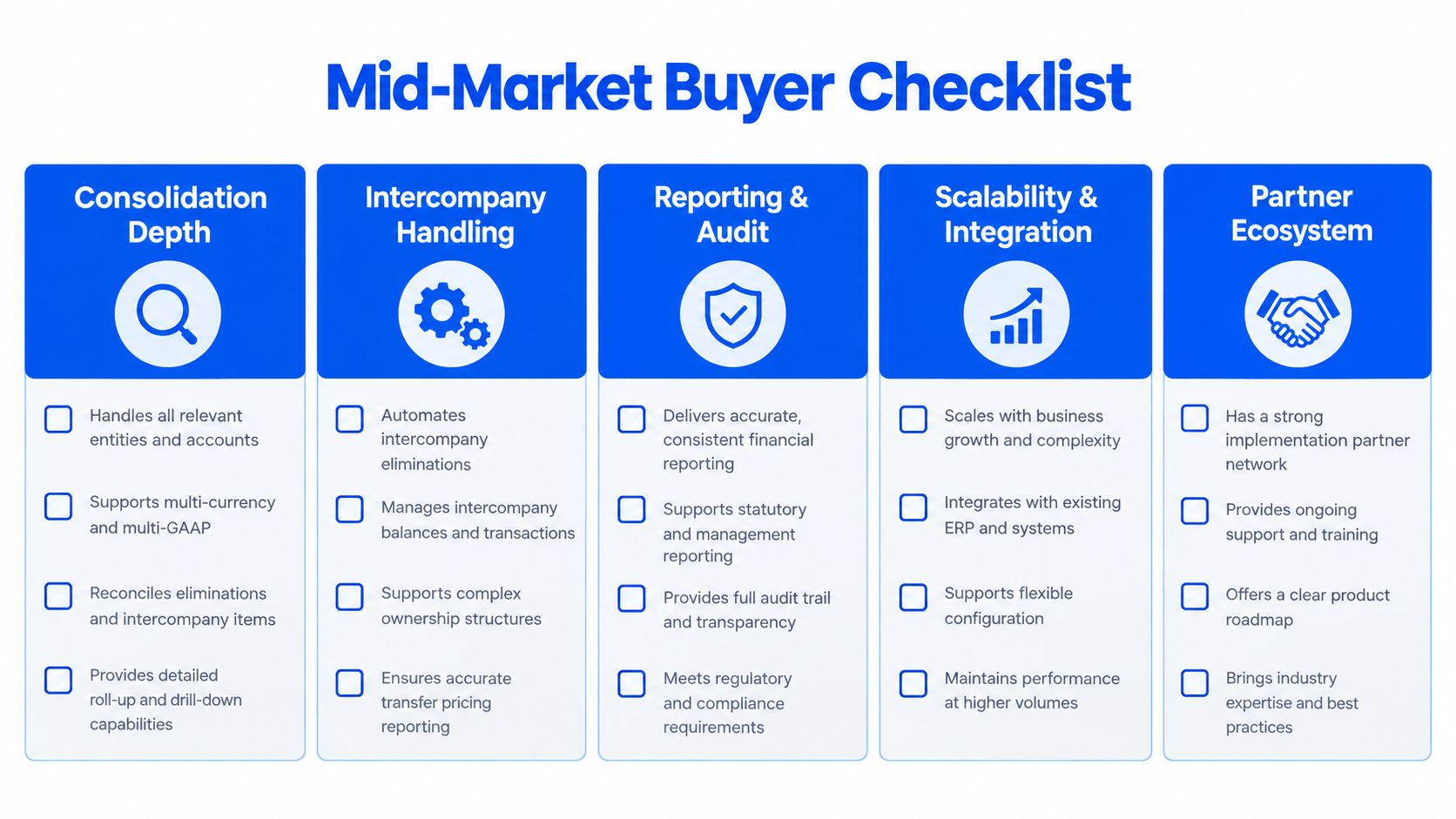
A good demo should function like a working session, not a guided tour. Bring your entity structure, current close calendar, intercompany examples, reporting dimensions, and audit questions. Then make the vendor prove how the system handles your process.
Test consolidation depth
- Entity preservation: Can each company maintain its own ledger while the parent produces consolidated statements?
- Drill-down evidence: Can a reviewer move from the consolidated trial balance to the entity, journal, and source document without exporting?
- Elimination control: Can matched intercompany transactions be eliminated through a defined workflow with an approval trail?
Test intercompany and currency handling
Ask the candidate system to process a realistic intercompany transaction, including the originating entry, counterparty entry, reconciliation, exception handling, and elimination. Then test currency translation at the rates and reporting levels your group uses.
The question isn't whether a platform displays a converted amount. It's whether the finance team can explain the translation, review the adjustment, and reproduce the result during an audit. Teams can compare questions and templates with software evaluation resources from TechRepublic and The CFO Club.
Test reporting and controls
- Dimensions: Can users report by the organization's actual locations, departments, programs, projects, or practice areas?
- Permissions: Can access reflect entity responsibilities without blocking legitimate group review?
- Audit history: Can the system show who entered, approved, changed, and reopened relevant activity?
- Close workflow: Is the first consolidated close timeline documented in writing?
Evaluate integration and partner capability
Review integrations with payroll, banking, billing, expense management, customer relationship management, clinical systems, or project tools. An integration that creates duplicate data or weakens the audit trail isn't a benefit.
Finally, ask for a named implementation lead and relevant multi-entity references. The partner should explain how it will migrate data, configure the operating model, rehearse the close, and transfer ownership to your finance team. Independent product directories such as GetApp can also help buyers validate shortlist criteria.
A useful next step is a 45-minute working session using your entity structure and one recent close. That will reveal more than another generic product demonstration.
Summary
Choose accounting software for multiple businesses as an operating-model decision first. Set entity responsibilities, shared services, account mappings, intercompany rules, dimensions, approvals, and close steps before reviewing vendors. Compare Sage Intacct, NetSuite, Dynamics 365 Business Central, and Acumatica by consolidation depth, intercompany processing, currency translation, dimensional reporting, and audit evidence.
The implementation partner carries equal weight with the license. Strong configuration, migration, rehearsal, and training turn the chosen system into a faster close and cleaner audit trail. Select the partner and platform together, then test them against your group's actual reporting and control requirements.
Frequently Asked Questions
How many entities can a company manage before QuickBooks breaks down?
There isn't a universal entity count. Complexity is the better test. QuickBooks becomes harder to operate when separate company files require manual consolidation, intercompany entries, shared-vendor coordination, currency translation, dimensional reporting, or extensive audit support. If the Controller can't produce a reliable group view without spreadsheets and repeated reconciliation, the organization should evaluate a true multi-entity platform.
What should a realistic mid-market close look like after switching?
A realistic close should preserve each entity's ledger, complete intercompany matching and elimination through defined workflows, translate foreign activity appropriately, and lock entity books before consolidation. The group report should connect to entity-level detail and supporting transactions. The exact timeline depends on the operating model, data quality, integrations, approvals, and implementation scope, so vendors should demonstrate the process using the buyer's own close structure.
How long does a phased implementation take?
Implementation timelines vary by segment and complexity. Independent 2026 summaries describe some mid-market rollouts taking 11 days or less, mid-market multi-entity implementations taking three to six months, and enterprise or multinational deployments taking six to twelve months (LiveFlow). Those ranges are planning references, not guarantees. The partner should explain the phases, dependencies, data work, testing, training, and first-close support in writing.
What does consolidation cost compared with late closes and restatements?
The comparison should include more than license cost. Measure Controller and staff time spent on spreadsheets, intercompany reconciliation, manual reporting, audit requests, corrections, and delayed decisions. Then compare that burden with implementation, subscriptions, integrations, training, and ongoing administration. The right answer depends on your group, but a platform should be judged by whether it removes repeatable manual work while strengthening traceability and control.
When is a controller-only solution the wrong answer?
A controller-only fix is insufficient when the underlying problem affects entity structure, intercompany policy, shared master data, dimensions, permissions, or consolidated reporting. In those cases, changing a few workflows won't resolve the operating-model failure. The organization needs executive agreement on how the group should operate, followed by software and implementation decisions that support that model.
Should a company buy Sage Intacct directly or use an implementation partner?
Software alone won't decide how accounts map, entities roll up, intercompany transactions eliminate, currencies translate, or approvals work. A qualified partner can help design the operating model, migrate and validate data, rehearse the close, configure controls, and train the internal team. Buyers should evaluate the partner's named lead, relevant experience, implementation plan, and ability to support the finance team after go-live.
Lucentive helps mid-market healthcare, nonprofit, professional services, and general business organizations design and implement Sage Intacct for multi-entity accounting, consolidation, intercompany controls, and reporting. Visit Lucentive to schedule a 30-minute working session or Sage Intacct demo using your company's entity structure and close process.