Your month-end close is late again. The plant manager has one spreadsheet for production output, purchasing has another for shortages, and finance is trying to reconcile both against inventory balances across several entities. Work-in-progress is only partly costed, intercompany transfers don't line up, and the Controller can't explain margin movement without asking three people to rebuild the numbers.
That isn't just an accounting inconvenience. It means your operating data isn't producing reliable financial control. ERP discrete manufacturing gives finance a way to connect material consumption, labor, production orders, inventory valuation, and the general ledger in one governed process. For a mid-market company that has outgrown QuickBooks or a basic accounting package, that connection matters more than a longer feature list.
Table of Contents
- The Financial Cost of Disconnected Production Data
- Core Modules That Drive Manufacturing Financials
- Discrete vs Process Manufacturing ERP Models
- Defining the Boundary Between ERP and MES
- Selection Criteria for Multi-Entity Manufacturers
- Why Implementation Partners Outperform Software Alone
- Summary
- Frequently Asked Questions
The Financial Cost of Disconnected Production Data
A disconnected production environment creates a familiar month-end scene. Finance waits for completed work orders, operations sends revised spreadsheets, and the inventory team reports that physical stock doesn't match the system. Meanwhile, partially assembled products sit across multiple work centers without a dependable financial status.
The Controller can eventually produce a set of statements, but the process is built around investigation rather than control. Raw material consumption may be recorded in one place, labor in another, and finished-goods receipts after the fact. That makes it difficult to determine whether a margin change comes from material pricing, production inefficiency, scrap, a routing problem, or an inventory adjustment.
The cost is decision delay. A CFO can't manage working capital confidently when the business doesn't know what is actually available, committed, in production, or held at another entity. A CEO can't evaluate growth using gross margin reports that depend on manual allocations and late journal entries.
Practical rule: If finance has to ask the plant to explain the inventory balance before it can trust the close, the ERP design isn't doing enough financial work.
A manufacturing ERP should create a traceable path from the sales order to the bill of materials, from the bill of materials to material issues, and from production activity to inventory and cost postings. It should also preserve the distinction between what happened operationally and how that event affects the books.
This is why data quality assurance isn't a side project for a manufacturing finance team. Standardized item masters, controlled units of measure, accurate BOM revisions, and disciplined transaction timing determine whether the general ledger reflects production reality. Finance leaders evaluating that problem can use this guidance on gaining confidence in decisions through data quality assurance as a useful starting point. Teams also dealing with fragmented operational data may find it helpful to review broader thinking on data integration strategy when planning how production, inventory, and finance systems should share information.
The category has matured because manufacturing is the largest industry category in one independent ERP implementation corpus. That dataset counted 43,338 vendor-published implementations, with manufacturing representing 6,333 implementations, or 22% of industry-tagged cases, and SAP representing 3,745 manufacturing implementations, or 59% of that subset. The figures are from ERP implementation market data, and they show that manufacturing ERP is an established enterprise software category, not a niche tool for plant administration.
For CFOs, the implication is direct. The right system should turn shop-floor activity into governed financial data, while the right implementation approach should prevent that data from being weakened by poor master-data decisions or uncontrolled customization.
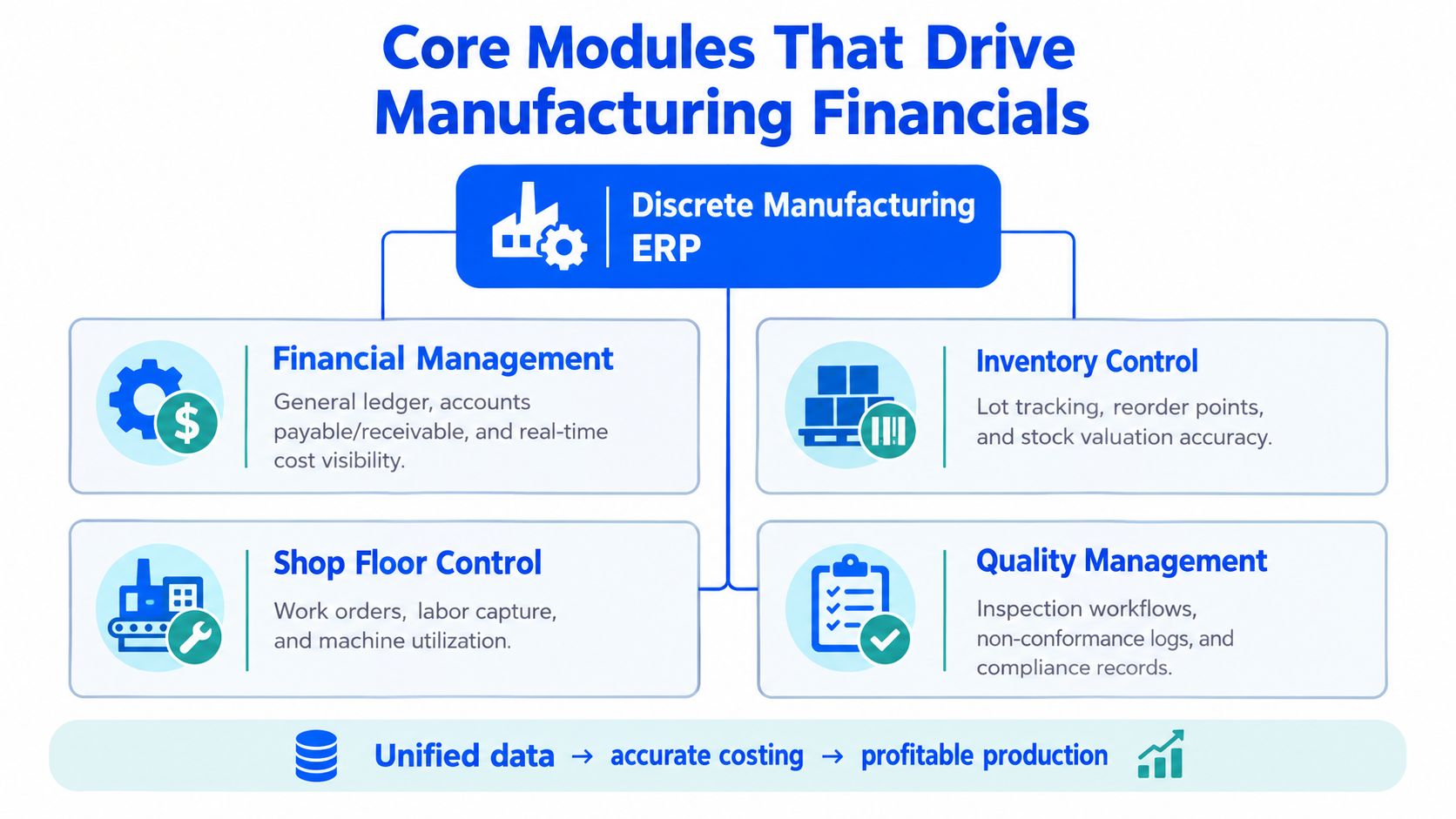
Core Modules That Drive Manufacturing Financials
Discrete manufacturing ERP connects identifiable products with the parts, labor, machines, and production steps used to build them. Its core structure typically includes bills of materials, routings, production orders, shop-floor confirmations, inventory management, and product costing in one governed system of record, as described in this overview of manufacturing management ERP modules.
For a CFO, module names matter less than transaction design. Each material issue, labor confirmation, completion, transfer, and adjustment should create the accounting detail required for inventory valuation, variance analysis, and a controlled close. In a multi-entity group, the ERP must also assign activity to the correct legal entity, plant, warehouse, and financial dimensions. When manufacturers benchmark process maturity, resources on manufacturing operations management can also help frame where ERP fits relative to planning and execution.
Bills of materials and routings
A multi-level BOM defines what the company intends to build. A routing defines how it will build the product, including operation sequence, work centers, labor requirements, and machine activity. Together, these records connect engineering decisions to purchasing, production control, standard cost, and actual cost.
The connection matters most when products contain subassemblies. A parent item may depend on several lower-level components, each with its own material requirements and labor steps. The ERP should preserve those relationships across revisions and entities, so finance can explain how a finished product cost was formed rather than accept an unexplained total.
Work orders and WIP
A production order gives the business a controlled object for comparing expected and actual activity. Material issues, labor capture, machine time, completions, scrap, and variances can be evaluated against that order instead of reconstructed from separate files.
WIP requires the same discipline. Inventory value sits in raw materials, staged components, and partially completed subassemblies, not only in finished goods. Receiving, labeling, location control, and scan-validated put-away practices are associated with materially higher inventory accuracy, as described in neutral guidance on inventory accuracy in discrete manufacturing. Manufacturers with distribution operations should also assess our wholesale and distribution ERP capabilities when defining inventory ownership, warehouse controls, and intercompany flows. For teams refining costing methods, this overview of work in process inventory provides additional context on how WIP is tracked and valued.
Scheduling and real-time posting
Finite scheduling and real-time WIP posting directly affect financial visibility. Planners need current availability, capacity constraints, sequence-dependent changeovers, and operator or tool limitations before releasing work. Controllers need those transactions to flow into inventory valuation and cost analysis without relying on a manual period-end estimate.
A practical architecture assigns responsibility clearly:
- Financial management: The general ledger, payables, receivables, and cost dimensions should reflect production events within controlled entity and accounting structures.
- Inventory control: Lot tracking, location management, component availability, and stock valuation should support physical control and financial reconciliation.
- Shop-floor control: Work orders, labor capture, machine utilization, and production confirmations should provide the operational evidence behind cost postings.
- Quality management: Inspections, non-conformance records, and compliance documentation should remain connected to the item, order, lot, or serial record used in financial and operational investigations.
A system that posts finished goods only after production closes hides the timing and composition of WIP. An ERP that records material and WIP movement as work progresses gives finance stronger control over the close, inventory valuation, production variances, and margin reporting. That result depends on disciplined configuration and partner-led implementation, not on purchasing software alone.
Discrete vs Process Manufacturing ERP Models
The first selection mistake is choosing software based on the industry label rather than the production method. A company assembling configurable equipment, machinery, electronics, or component-based products needs a different transaction model from a producer making liquids, chemicals, food, or other formula-based goods.
Discrete manufacturing ERP treats products as identifiable and countable units. Process manufacturing ERP centers on formulas, recipes, batches, yields, co-products, and consumption relationships that may change based on production conditions. Both models can support inventory and financials, but they answer different operational questions. Finance teams comparing the two models can also review this practical breakdown of discrete vs process manufacturing for a concise operational contrast.
| Feature | Discrete Manufacturing | Process Manufacturing |
|---|---|---|
| Product structure | Multi-level BOMs made of countable parts and subassemblies | Formulas, recipes, and ingredient relationships |
| Production execution | Work orders, routings, operations, and labor or machine confirmations | Batches, yields, co-products, and process steps |
| Inventory identity | Individual items, components, lots, and serial numbers | Bulk materials, lots, batches, and measured quantities |
| Costing focus | Material, labor, machine time, subcontracting, and production variance | Ingredient consumption, yield variance, batch cost, and by-product value |
| Quality control | Inspection by item, operation, order, lot, or serial number | Testing by batch, formula, characteristic, or process stage |
| Planning challenge | Component availability, capacity, routing sequence, and product variants | Ingredient availability, formula compliance, yield, and batch capacity |
| Typical financial risk | Uncosted WIP, inaccurate labor capture, and BOM revision errors | Yield differences, formula changes, and batch valuation errors |
Why the distinction affects finance
A discrete manufacturer often needs to answer, “What did this unit cost, and which materials and operations created that cost?” A process manufacturer may need to answer, “What quantity did this batch produce, what yield did it achieve, and what happened to the co-products?”
Those questions lead to different master data and control points. In a discrete environment, serialized components, subassembly status, route-specific labor, and engineering revisions can materially affect the cost of a completed unit. A generic ERP may technically store the data, but forcing it to handle assembly logic through workarounds creates reporting and audit problems.
The selection test should be practical. Ask the vendor to demonstrate a real product variant, a component shortage, a BOM revision, a partial completion, and a production variance. Then follow each event into inventory and the general ledger. If the demonstration skips those transitions, you haven't tested the system's financial fitness.
Don't buy an ERP that makes your basic production method look like a customization project.
Sage Intacct may be part of a broader cloud financial architecture for a growing company, but finance leaders should evaluate how manufacturing execution, inventory, costing, and integrations will work together. The decision isn't whether a platform has an attractive accounting interface. It's whether the complete design supports the way your company builds and values products.
Defining the Boundary Between ERP and MES
CFOs don't need the ERP to perform every shop-floor task. They need a clean boundary between systems, reliable integration, and enough control to prove how an operational event became a financial transaction.
The ERP should remain the system of record for items, BOMs, routings, purchasing, production orders, inventory, and financials. The MES should handle detailed execution, including real-time dispatching, cycle-time capture, work instructions, in-process quality, and lot or serial genealogy. This division is described in the manufacturing ERP and MES architecture guidance. Teams mapping that handoff can also look at broader examples of MES and ERP integration to clarify where execution ends and financial ownership begins.
What belongs in ERP
ERP owns the structures that define what the company buys, builds, values, and reports. It should control the approved item master, the BOM revision used for a production order, the purchasing relationship, the financial entity, and the accounting treatment.
For a finance leader, that ownership supports auditability. A Controller can trace a material issue to a work order, connect the work order to a product structure, and review the resulting inventory or cost posting without relying on an operator's private spreadsheet.
What belongs in MES
MES is closer to the work center. It can tell an operator which job to run next, capture the actual cycle time, record an inspection result, provide work instructions, and preserve detailed genealogy as production happens.
That information is valuable to finance because actual execution changes cost and availability. But putting every execution detail directly into the financial core can create unnecessary complexity, weaker upgrade paths, and a difficult support model.
The integration loop
The important design isn't ERP versus MES. It's the loop between them.
Suppose a work center reports that a job took longer than the planned routing. Or a component shortage appears after the schedule has been released. The integrated loop should allow operations to report the fact, the planning layer to re-sequence work or re-plan materials, and ERP to preserve the updated order and cost structure.
That cause-and-effect chain reduces the need for expediting and post-period reconstruction. It also gives finance a more defensible view of actual production cost.
Control point: Keep financial ownership in ERP, execution detail in MES, and define exactly which events cross the boundary.
The same principle applies across multiple plants. Each site may have different equipment or execution practices, but group finance still needs consistent definitions for items, orders, inventory, entities, and postings. An integrated approach can support that balance, as illustrated in this manufacturing and distribution integration example.
Don't customize the ERP to imitate an MES just because the two systems need to exchange data. Define the event model first. Decide which system creates the event, which system validates it, which system stores the authoritative record, and which accounting result should follow.
Selection Criteria for Multi-Entity Manufacturers
A multi-entity manufacturer doesn't need another general ledger with a manufacturing label. It needs a control model that centralizes financial governance without forcing every plant to operate identically.
Start with the transaction flows that create the most reconciliation work. Document how the company buys materials, moves inventory between entities, consumes components, completes subassemblies, sells finished goods, and records intercompany activity. Then require each ERP candidate to show those flows using your terminology and representative master data.
Test the group structure before the demo ends
The vendor should demonstrate how the platform handles:
- Intercompany transactions: Show the movement of materials, finished products, services, and charges between entities, including the resulting accounting entries.
- Transfer pricing: Confirm how the system supports the company's policy and how finance reviews the resulting balances.
- Centralized control: Test whether group finance can standardize chart-of-accounts structures, item definitions, approval rules, and reporting while allowing local operating requirements.
- Production cost postings: Trace material, labor, overhead, and production variances into the appropriate entity and ledger structure.
- Audit trails: Review who changed a master record, approved a transaction, posted an adjustment, or modified a configuration.
For multi-site companies, centralized control doesn't mean identical workflows everywhere. A plant may need local work-center practices while the group requires consistent item numbering, financial dimensions, approval controls, and reporting definitions.
Treat master data as a finance issue
Bad master data doesn't stay in operations. An incorrect unit of measure can distort purchasing and inventory. An outdated BOM can misstate product cost. An uncontrolled customer or vendor record can complicate entity reporting. A poorly governed item revision can leave finance unable to explain why two sites value similar products differently.
Ask the implementation team to identify the owners of each critical data domain. Finance may own the chart of accounts and entity structure. Engineering may own BOM revisions. Operations may own routings. Procurement may own supplier records. The system needs rules for approval, effective dates, and change visibility. For finance leaders building governance processes, this overview of master data management is a useful companion concept.
Evaluate integration readiness
A cloud ERP won't remove the need to integrate MES, warehouse tools, payroll, tax, banking, or customer systems. It should make those connections governed and maintainable.
Review the integration architecture, error handling, reconciliation reports, and ownership model. Ask what happens when a production confirmation fails to post, a serial number is missing, or an intercompany transaction arrives without the required dimension. A polished happy-path demonstration tells you very little about control under exception conditions.
For multi-entity manufacturers, platforms can centralize control while preserving local flexibility. Some systems support intercompany transactions, transfer pricing, production cost postings into the general ledger, and secure audit trails, as outlined in this multi-entity discrete manufacturing ERP discussion.
The best selection document is not a list of features. It's a set of financial and operational scenarios that expose where the candidate system needs configuration, integration, customization, or a process change.
Why Implementation Partners Outperform Software Alone
Buying software doesn't create control. The implementation does.
A software-only purchase often leaves the company to translate messy production practices into a target data model, decide which historical records matter, map operational events to accounting entries, and coordinate integrations. Those decisions determine whether the new ERP produces reliable financial visibility or merely gives the company a more modern place to store inconsistent data.
A partner-led implementation adds accountability for the design between operations and finance. The team should document current processes, challenge unnecessary workarounds, configure the core system carefully, define integration ownership, test exceptions, prepare users, and establish a disciplined cutover.
The partner's financial role
A manufacturing implementation partner should help answer questions such as:
- Which production events should create inventory or cost postings?
- How should WIP be valued and reconciled?
- Which master-data fields require finance approval?
- Where should MES detail stop and ERP ownership begin?
- How will intercompany production and transfers be represented?
- Which reports should replace spreadsheet reconciliations?
- What must be migrated, archived, or rebuilt from legacy systems?
Those aren't software questions alone. They're governance questions with consequences for the close, audit support, working capital, and management reporting.
What Lucentive brings to the decision
Lucentive is a Sage Intacct National Premier Partner with experience serving mid-market organizations, including healthcare and nonprofit organizations. Its role is to help finance and operating leaders evaluate requirements, shape an ERP design, and manage implementation rather than treating software selection as the end of the project.
That distinction matters for a company considering Sage Intacct. Finance leaders should understand where Sage Intacct fits in the financial architecture, how manufacturing and operational systems will connect to it, and which requirements belong in an integrated specialist system rather than in the financial core. A partner can make those trade-offs explicit before the company commits to a design.
The implementation plan should also be visible before signing. Review the workstreams for discovery, data, configuration, integrations, testing, training, cutover, and post-launch support. A documented ERP implementation methodology gives the CFO a better basis for evaluating time-to-value and delivery risk than a generic promise to “go live quickly.”
Measure value through control
Don't evaluate the project only by whether users can enter transactions. Define the operating outcomes finance needs to see:
- A close process with fewer manual reconciliations.
- Clear WIP and inventory explanations.
- Consistent reporting across entities.
- Traceable production cost postings.
- Fewer spreadsheet-dependent approvals.
- Reliable exception handling between operational systems and finance.
- A reporting structure that supports decisions without rebuilding data every month.
The right partner won't eliminate every implementation trade-off. It will surface them early, assign ownership, and keep the solution aligned with the company's financial control objectives.
Before you buy Sage Intacct alone, schedule a 30-minute working session with Lucentive to walk through your entities, production data, integrations, and reporting requirements. A short fit discussion can reveal whether the proposed architecture supports the business or just moves the current reconciliation problem into the cloud.
Summary
Discrete manufacturing ERP should connect production activity to financial governance. Multi-level BOMs, routings, work orders, WIP, inventory, costing, and the general ledger need a controlled relationship. ERP should own financial and master-data records, while MES handles detailed execution and sends the right events back. Multi-entity buyers must test intercompany flows, transfer pricing, data ownership, integrations, and audit trails. Sage Intacct should be evaluated as part of that complete architecture, with an implementation partner helping finance and operations make the trade-offs visible.
Frequently Asked Questions
What should a CFO look for in discrete manufacturing ERP
Look for a system design that connects BOMs, routings, work orders, inventory, WIP, production costing, and financial reporting. The key test is whether finance can trace a production event into inventory and the general ledger without rebuilding the explanation in spreadsheets. Multi-entity companies should also test intercompany transactions, transfer pricing, centralized controls, local flexibility, audit trails, and integration exceptions.
Should ERP replace the MES
No. ERP should remain the system of record for items, BOMs, routings, purchasing, production orders, inventory, and financials. MES should manage detailed execution such as dispatching, cycle-time capture, work instructions, in-process quality, and genealogy. The systems should exchange defined events so actual production activity can inform planning, inventory, costing, and financial reporting without forcing ERP to imitate an MES.
How does WIP affect financial visibility
WIP represents value in raw materials, partially completed subassemblies, and staged components before a product becomes finished goods. If WIP isn't posted and controlled as production progresses, finance may rely on estimates or late adjustments to explain inventory and margin. Real-time WIP transactions, disciplined inventory practices, and accurate work-order structures give the Controller a clearer basis for valuation and close support.
Can Sage Intacct support a manufacturing finance architecture
Sage Intacct should be evaluated as part of the complete architecture rather than in isolation. Finance leaders need to determine how manufacturing execution, inventory, costing, MES data, and other operational systems will connect to the financial core. A partner-led assessment can clarify which requirements belong in Sage Intacct, which belong in specialist systems, and how the resulting transactions will support reporting and control.
What does an implementation partner actually do
An implementation partner translates business processes into data structures, configurations, integrations, controls, reports, testing plans, training, and cutover activities. For a discrete manufacturer, that includes decisions about WIP, production cost postings, BOM ownership, entity reporting, MES boundaries, and exception handling. The partner's value goes beyond installing software. It is making the operating and financial design work together.
How should a multi-entity manufacturer evaluate a cloud ERP
Use real business scenarios rather than a feature checklist. Test intercompany inventory movements, transfer pricing, production cost postings, entity reporting, master-data approvals, audit trails, and failed integrations. Confirm that group finance can standardize definitions and controls while plants retain necessary operating flexibility. Require the vendor and implementation partner to explain what will be configured, integrated, customized, migrated, or retired.
Lucentive helps finance leaders evaluate and implement Sage Intacct with a focus on manufacturing data, multi-entity governance, and practical integration decisions. Visit Lucentive to schedule a conversation or a 30-minute working session about your company's ERP fit.