A modern cloud ERP is now the near-standard operating platform for wholesale distribution, with adoption reaching 92% of distributors in recent industry surveys. Fragmented tools no longer support growth when inventory, orders, warehouses, and finance must move together.
That becomes obvious at month-end. Your Controller is waiting for inventory adjustments, warehouse data sits in a separate system, intercompany balances need spreadsheet work, and the leadership team still can't trust a dashboard without asking someone to reconcile it first. The business may be growing, but the books are becoming a constraint.
The answer isn't to buy more disconnected tools. It's to choose ERP software for wholesale distribution that connects operational transactions to the general ledger, then pair it with an implementation partner that knows how to migrate imperfect data and change the way people work. Sage Intacct can be part of that answer, but the software alone won't clean your item master, resolve ownership gaps, or make users follow the new process.
Table of Contents
- Why Wholesale Distributors Are Moving Beyond QuickBooks
- Core ERP Features Built for Distribution Operations
- Disconnected Tools Versus an Integrated Platform
- Business Outcomes That Impact the Bottom Line
- How to Select the Right ERP Partner
- Common Implementation Pitfalls and How to Avoid Them
- Summary
- Frequently Asked Questions
Why Wholesale Distributors Are Moving Beyond QuickBooks
QuickBooks can be a sensible starting point. It gives a smaller company a usable accounting foundation without forcing a large systems project before the business needs one. The problem begins when finance has to reconstruct operational truth from outside the ledger.
A distributor may have one file for accounting, another for inventory, spreadsheets for customer pricing, email for order exceptions, and manual entries for intercompany activity. Each system may work on its own. Together, they create timing differences and unexplained variances that consume the close.
Recent industry reporting found that 92% of wholesale distributors used ERP software in 2024, while distributors represented roughly 18% of ERP buyers, second only to manufacturing at about 47%. About 67% of surveyed distribution companies ranked inventory and distribution management as their most critical ERP function. Those figures support a clear conclusion: ERP has moved beyond a specialist back-office tool for complex enterprises. It has become a standard operating platform for distributors that need dependable stock, order, and financial visibility. Industry ERP adoption and distribution data

The ceiling is usually visibility
The CFO pain isn't just that QuickBooks lacks a particular button. The deeper issue is that finance can't see the full transaction chain without asking employees to assemble it manually.
A connected platform lets the sale, shipment, invoice, receipt, inventory movement, and accounting entry share a common record. That gives finance a better basis for margin analysis, working-capital decisions, customer profitability, and audit support. It also gives operations a clearer answer to a basic question: can we promise this order from available stock?
Cloud deployment matters because it makes the operating model easier to access across sites without maintaining a separate local infrastructure. A 2026 market report estimated that cloud deployments represented 58.3% of distribution ERP revenue in 2025, and reported that 62% of distribution companies integrated ERP with warehouse management systems while 44% connected ERP to e-commerce platforms. Distribution ERP market and integration data
For a CFO evaluating the move, the practical question is whether the current system helps the company scale or merely records the consequences of growth. A useful Sage Intacct versus QuickBooks comparison should focus on that distinction, not on feature counts.
Core ERP Features Built for Distribution Operations
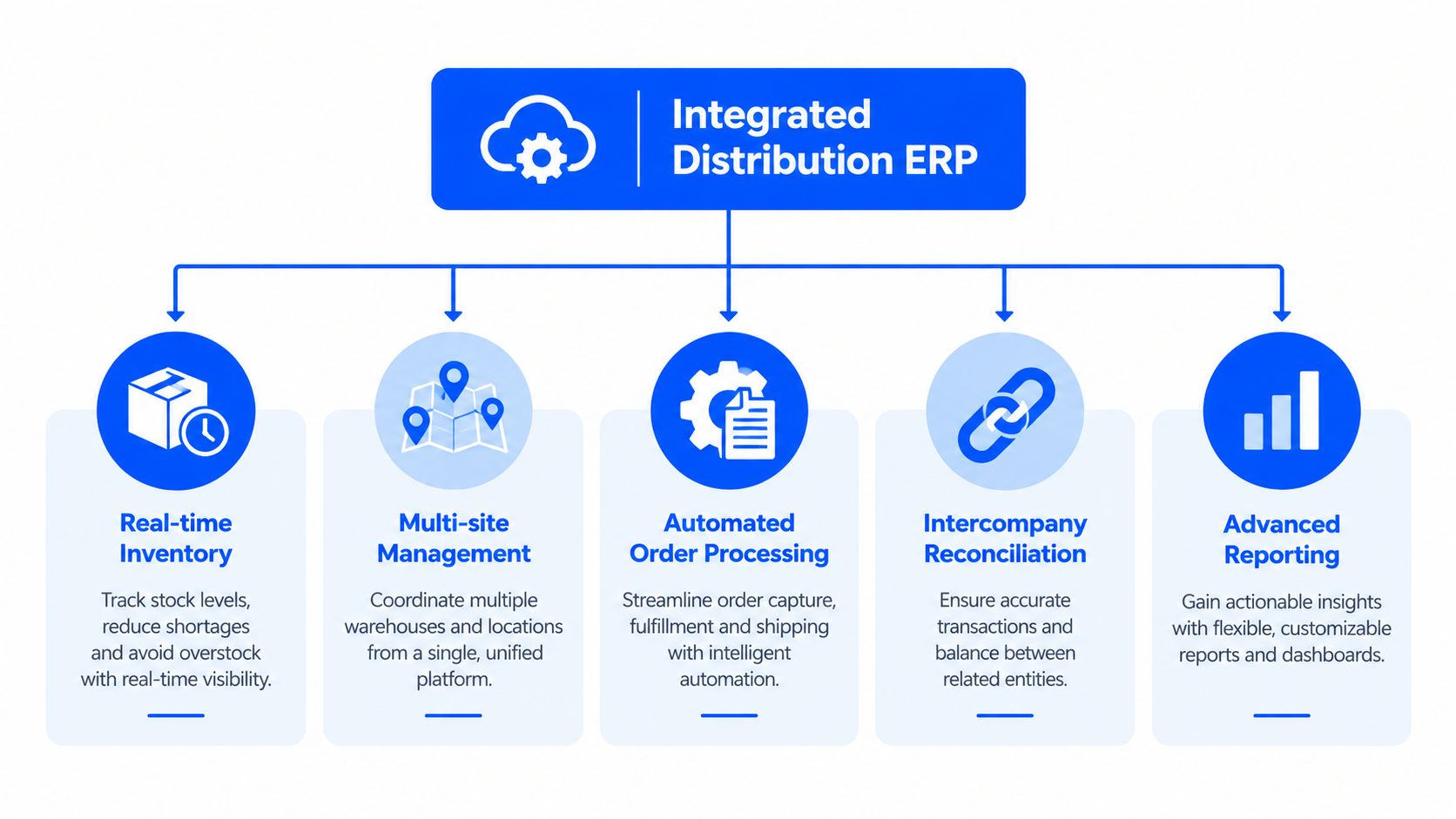
Generic accounting software records financial events. Distribution ERP must help control the operational events that create those financial results. If the system can't handle inventory availability, warehouse activity, customer-specific pricing, and trading-partner transactions, finance will continue cleaning up after operations.
Inventory must be operationally real
Real-time inventory management is more than a quantity displayed on a screen. The system needs to distinguish available, committed, in-transit, damaged, and reserved stock across warehouses and locations. It should also support replenishment decisions based on demand, lead times, and current commitments.
Lot and serial tracking becomes essential when customers, regulators, or suppliers require traceability. The ERP should show where an item came from, where it went, and which orders or customers it affected. That information protects the company during returns, recalls, disputes, and audits.
Orders need to flow without re-keying
A distributor's order process often crosses sales, purchasing, warehouse, shipping, and finance. Automated order processing reduces the number of times employees type the same information, while warehouse workflows can support wave picking, cycle counting, and RF scanning.
EDI deserves particular attention. Distribution systems commonly exchange 850 purchase orders, 855 acknowledgments, 810 invoices, and 856 advance shipping notices with trading partners. These workflows should be native to the ERP or closely integrated with it, not treated as an afterthought. Unified EDI and WMS processes can reduce manual touches and improve order accuracy toward 99% or higher, according to distribution technology guidance. EDI and WMS requirements for distribution ERP
Pricing and consolidation protect the margin
Wholesale pricing rarely follows one simple list. Customer contracts, quantity breaks, rebates, landed costs, and location-specific terms can all affect the final margin. A pricing engine should apply those rules consistently and show finance how the sale was calculated.
Multi-site management also needs to reach beyond inventory. The ERP should support entity-level reporting, intercompany entries, eliminations, and consolidated financial statements. That connection matters because the CFO shouldn't have to choose between operational detail and group-level control.
Sage Intacct is worth evaluating when the priority is cloud financial control combined with distribution-oriented visibility. Lucentive's Sage Intacct wholesale distribution solution addresses areas such as inventory valuation, landed cost handling, and margin reporting across items, customers, warehouses, and product lines.
Disconnected Tools Versus an Integrated Platform
The cost of disconnected tools rarely appears as a single line on the income statement. It shows up in duplicated data entry, late reconciliations, avoidable order exceptions, slow decisions, and finance employees spending close time proving that two systems agree.
Use the following matrix to separate the current workaround from a scalable operating model.
Comparing Distribution Software Approaches
| Approach | Data Accuracy | Automation Level | Scalability | Primary Risk |
|---|---|---|---|---|
| Spreadsheets supporting accounting | Dependent on manual updates and version control | Low | Weak across locations and entities | Errors remain hidden until close or fulfillment |
| Standalone inventory system plus accounting software | Better operational detail, but reconciliation depends on integration quality | Moderate | Suitable only while transaction flows remain simple | Inventory and financial records drift apart |
| Point tools connected through custom processes | Variable, based on interface design and ownership | Moderate to high in selected workflows | Can support growth, but complexity increases with every exception | No clear owner when a transaction fails |
| Integrated cloud ERP | Shared records across finance and operations | High when workflows are configured correctly | Designed to extend across sites, entities, and channels | Poor implementation or bad master data can spread errors quickly |
The strongest case for integration appears when one transaction is entered more than once. A sales order that gets typed into an order system, emailed to the warehouse, and re-entered into accounting is not merely inefficient. It creates three opportunities for inconsistent quantities, prices, dates, or customer details.
A unified platform doesn't eliminate judgment. It gives people one controlled place to apply it. Finance can trace the invoice back to the order and shipment, while operations can see the financial consequence of an exception without waiting for a spreadsheet update.
Decision rule: If the company needs people to reconcile routine transactions before management can trust the numbers, the problem is architectural, not just procedural.
Before choosing a platform, document where data is entered, transformed, approved, and reconciled. That exercise often reveals that the biggest requirement isn't another report. It's a dependable transaction flow. A practical review of the impact of an integrated solution should therefore be framed around process ownership and data movement, not software screenshots.
Business Outcomes That Impact the Bottom Line
A CFO shouldn't approve ERP software because it has more modules. The investment needs to improve the quality and speed of decisions that affect revenue, inventory, cash, and financial control.
Fill rate is one useful operating measure. It represents the share of demand shipped from available stock without backorder. Industry guidance commonly places a solid benchmark at about 95%, with excellence at 98% or higher, while average operations can sit in the mid-80s to mid-90s depending on the segment. Wholesale distribution fill-rate guidance
Inventory visibility changes the decision point
Many stockouts become expensive before the warehouse knows there is a problem. If available-to-promise data is delayed, sales may accept an order that cannot ship, purchasing may replenish too late, and finance may discover the working-capital impact after the fact.
An integrated ERP improves the timing of the decision. Real-time availability, automated replenishment, and tighter demand planning help the distributor address a potential stockout before order release rather than after a shipment exception. That can support a stronger fill rate, but the value is broader than the metric itself. Better availability data also helps sales set reliable expectations, purchasing avoid excess stock, and finance understand how inventory decisions affect cash.
Close speed reveals control quality
The close is where disconnected systems become visible to senior leadership. If the Controller spends the month-end period chasing inventory balances, unresolved intercompany items, and unsupported adjustments, the organization receives financial information later than it should.
The APQC median annual close cycle is 18 days, making a shorter close a concrete goal for finance leaders seeking to reduce reporting lag and audit friction. Distribution finance and close-cycle guidance
A good ERP doesn't make the close faster merely by adding a dashboard. It creates clearer ownership over reconciliations, standardizes cutoff procedures, and links operational activity to the ledger. That means the finance team can spend less time asking where a number came from and more time explaining what it means.
Audit readiness is an operating discipline
For a multi-entity group, an audit-ready close requires visibility into what remains unreconciled, who owns it, and how long it has been open. The system should also preserve a clear trail for intercompany activity, settlements, and other high-risk accounts. Multi-entity audit and reconciliation guidance
These outcomes affect the P&L and balance sheet directly. Better inventory control can reduce avoidable revenue leakage and excess stock. Faster reporting can improve management response. Stronger audit trails can reduce the disruption caused by close questions. The right cloud ERP benefits are therefore measured in decision quality and control, not in the number of screens purchased.
How to Select the Right ERP Partner
Software demonstrations are persuasive because vendors control the data, the workflow, and the pace. Partner due diligence is harder, but it matters more. A platform can be technically capable and still produce a poor outcome if the implementation team doesn't understand distribution processes or the company's financial controls.
Start with the operating model
Ask the partner to map your order-to-cash, procure-to-pay, inventory, close, and intercompany processes before recommending a configuration. The team should understand how warehouses operate, how pricing exceptions are approved, how landed costs are assigned, and where finance currently relies on manual work.
Don't accept a generic demonstration. Use your own item categories, locations, customer terms, order exceptions, and reporting requirements. The partner should be able to explain which processes fit standard Sage Intacct capabilities, which require integration, and which should be redesigned rather than customized.

Ask questions that expose delivery risk
A serious evaluation should include questions such as:
- Who will lead the project? Request the actual implementation team's roles, relevant certifications, and experience with multi-site or distribution finance.
- How will data be migrated? Ask how the partner will profile, cleanse, map, validate, and reconcile item, customer, supplier, and historical accounting data.
- What happens after go-live? Clarify training, support ownership, issue escalation, and how the team will handle process changes after users begin working in the system.
- What stays standard? Customization can solve a legitimate requirement, but it can also preserve a broken process and make future maintenance more difficult.
- How will success be measured? Define operational and financial acceptance criteria before configuration begins.
Lucentive is a Sage Intacct National Premier Partner with mid-market, healthcare, and nonprofit experience. For a distributor, the relevant point isn't the label alone. It's whether the team can translate operational requirements into financial controls, prepare users for the change, and stay accountable for the result.
Ask for the uncomfortable version of the plan: What data will be rejected, which workflows will change, and what decisions must management make before configuration starts?
A partner should make those issues visible early. If every answer focuses on features and no one asks about ownership, data quality, or adoption, the evaluation is incomplete.
Common Implementation Pitfalls and How to Avoid Them
The greatest ERP risk isn't usually a missing feature. It's assuming that the new system will somehow correct the data and habits that made the old environment unreliable.
Neutral industry coverage reports that 47% of ERP projects exceed their timelines and 45% go over budget. ERP implementation risk data Those figures make implementation discipline a financial issue, not a project-management detail.
Bad master data becomes a live operating problem
A distributor may carry duplicate items, inconsistent units of measure, inactive customers, incomplete supplier records, outdated costs, and conflicting warehouse codes. If those records move into the new ERP without governance, replenishment, order release, pricing, and financial reporting can all inherit the problem.
Treat migration as a controlled business process:
- Assign ownership. Name the person accountable for each data domain, including items, customers, suppliers, locations, costs, and chart-of-accounts mappings.
- Define standards. Decide how the organization will name products, classify units, manage inactive records, and handle exceptions.
- Clean before mapping. Remove duplicates and resolve conflicts before the data reaches configuration.
- Reconcile results. Compare migrated balances and records to the legacy system using agreed acceptance criteria.
- Test real transactions. Run representative orders, receipts, shipments, invoices, adjustments, and close activities through the new workflows.
Change management starts before cutover
Users often resist a new ERP because the rollout changes responsibilities that were previously hidden in spreadsheets. A warehouse employee may now need to scan or confirm a step that used to be informal. A finance analyst may lose a personal workaround but gain a controlled workflow. Those changes need to be explained and practiced before go-live.
Keep the scope focused on the operating model the company can support. Lucentive's ERP implementation phases provide a useful framework for sequencing discovery, design, migration, testing, training, and deployment.
The project sponsor should review readiness through evidence, not optimism. Can users complete the core transactions? Do balances reconcile? Are exception owners known? If the answer is no, moving the date won't solve the problem.
Summary
Wholesale distributors outgrow QuickBooks when finance must reconcile disconnected inventory, order, warehouse, and accounting data by hand. A cloud ERP can connect those processes, but distribution requires more than generic financial software. Real-time inventory, EDI, WMS workflows, pricing controls, multi-site reporting, and intercompany visibility should be tested with real business scenarios. Fill rate and close speed provide practical outcome measures, while clean master data and user adoption protect the investment. The right implementation partner matters because software alone won't redesign processes or prepare the organization for cutover.
For finance leaders comparing options, it can also help to review adjacent expert resources on ERP software, warehouse management systems, and inventory management best practices. These references add outside context to the operational and financial issues discussed above.
Additional practical reading can also support vendor selection and rollout planning, including guidance on wholesale inventory management, demand planning best practices, EDI in supply chain operations, cycle counting methods, and order fulfillment process improvement.
Frequently Asked Questions
When should a wholesale distributor replace QuickBooks
Replace or move beyond QuickBooks when month-end depends on manual reconciliation between accounting and inventory, when the same transaction is entered into multiple systems, or when growth adds warehouses, entities, channels, or complex pricing rules. A connected ERP becomes more appropriate when finance can't produce trusted operational and financial information without spreadsheet intervention.
What should a distribution ERP demonstration include
The demonstration should use your own distribution scenarios. Test available-to-promise inventory, multi-location transfers, customer-specific pricing, lot or serial tracking, EDI transactions, warehouse workflows, intercompany activity, and the path from order to invoice. Ask the partner to show how each transaction affects reporting and the general ledger, not just how the screen looks.
Is Sage Intacct enough without an implementation partner
Software alone won't cleanse item masters, assign data ownership, redesign weak processes, or train users. Sage Intacct may provide the financial and cloud foundation, but the implementation partner must translate distribution requirements into configuration, integrations, controls, migration rules, and adoption plans. The partner's approach should be evaluated as carefully as the product.
How can a distributor reduce ERP implementation risk
Start with process discovery and data profiling before configuration. Assign owners for item, customer, supplier, location, and financial data. Clean and reconcile records, test real transactions, define acceptance criteria, and train users on the new workflows before cutover. Keep customization controlled and resolve scope decisions early so the project doesn't inherit avoidable complexity.
Schedule a 30-minute working session with Lucentive to review your current distribution processes, migration risks, and Sage Intacct fit. A customized demo can show decision-makers how the platform and implementation approach would handle their actual inventory, close, and multi-entity requirements.