Most mid-market companies still need six to eight days to close, largely because of manual reconciliations and fragmented data sources, not because reporting itself is slow. The record to report process flow works when finance leaders control the data, ownership, approvals, and consolidation logic before the final reports are due.
You may recognize the pattern. Your team closes one entity, then waits for another. Intercompany balances don't agree. Currency translation raises questions late in the cycle. A Controller spends days chasing spreadsheet support instead of explaining what changed in the business. By the time the numbers reach the CEO, they're accurate enough to publish, but too late to guide decisions.
That isn't a bookkeeping problem. It's an operating model problem. Sage Intacct, implemented with the right design and discipline, can give growing companies a stronger general ledger, multi-entity control, real-time dashboards, and a cleaner audit trail. But software alone won't fix unclear ownership or poor upstream data.
Table of Contents
- Understanding the Record to Report Process Flow
- Roles, Responsibilities, and Control Points
- QuickBooks Limitations versus Sage Intacct Capabilities
- Automation Maturity and Close Speed Benchmarks
- The Continuous Controllership Shift
- Why Implementation Partnership Matters
- Summary
- Frequently Asked Questions
- Why do mid-market companies need six to eight days to close?
- What does continuous controllership mean?
- Which R2R steps should finance automate first?
- How can healthcare and nonprofit organizations benefit from Sage Intacct?
- Why work with an implementation partner instead of buying Sage Intacct alone?
Understanding the Record to Report Process Flow
A record to report process flow turns operational activity into financial statements and management reporting. The traditional five-phase description is record, close, consolidate, analyze, and report, although the practical workflow often includes validation, adjustments, and reconciliations inside those phases. The purpose is straightforward, raw transactions must become reliable information that leaders can use.
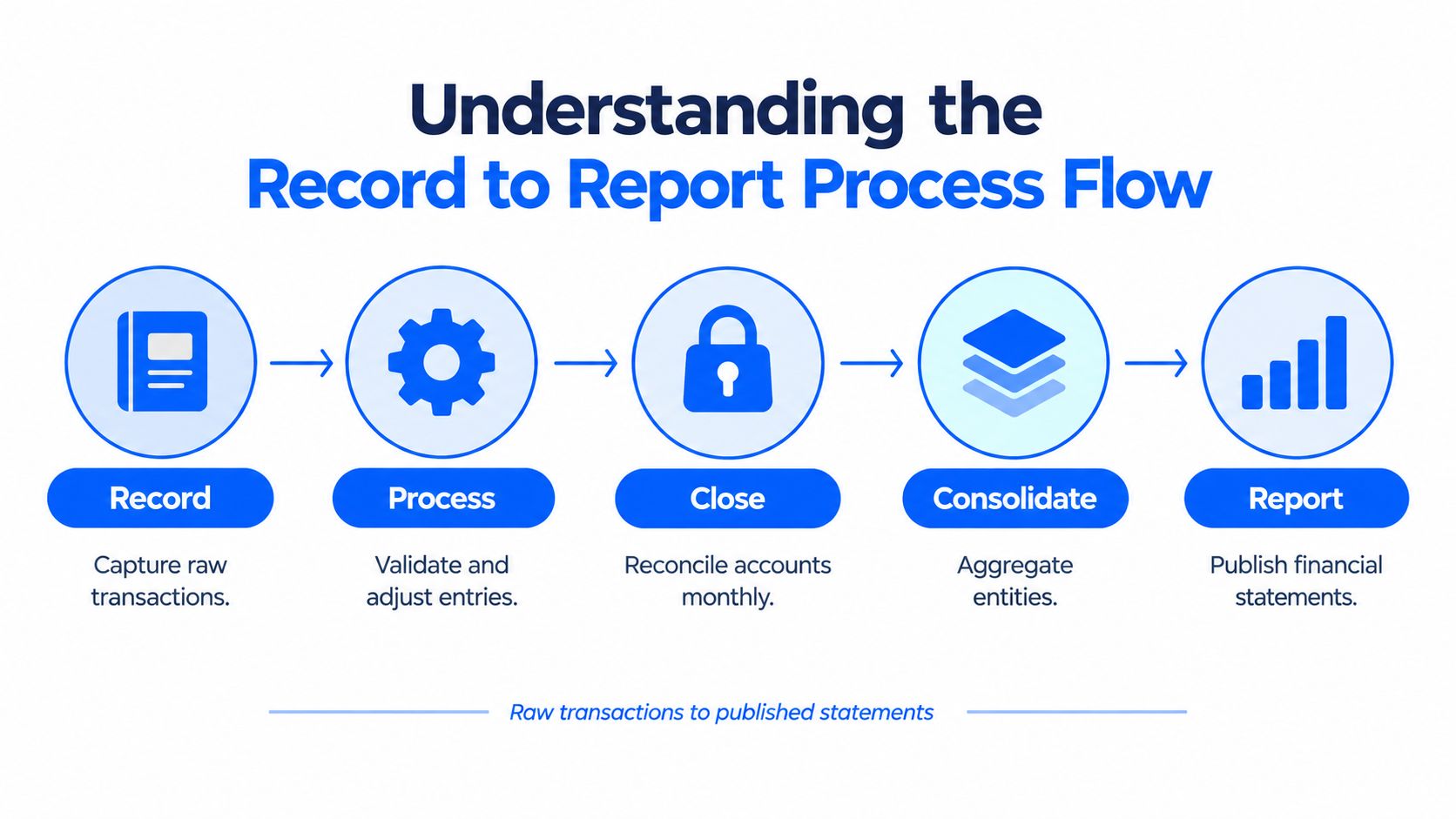
The flow evolved from manual ledgers and paper reconciliations to ERP-centered finance operations. ERP systems centralized transactional data and reduced dependence on handwritten or spreadsheet-based bookkeeping, a shift described in this overview of the R2R process. That history matters, but the design question today is more demanding: can the process support several entities, currencies, systems, and reporting requirements without relying on heroic effort at month-end? For broader context on financial close modernization, see this guide to financial close and automation trends. Teams comparing process models may also find this overview of the financial close process from Investopedia, this finance and accounting automation perspective from Oracle, this record to report overview from SAP, and this close process overview from FloQast helpful.
The five phases and their dependencies
- Record: Capture activity from operational subledgers and other sources, then post it to the general ledger with the right account, entity, period, and dimensions.
- Close: Complete reconciliations, accruals, adjustments, reviews, and approvals so the books can be finalized.
- Consolidate: Combine entity results, eliminate intercompany activity, and apply the required currency translation logic.
- Analyze: Review balances and variances to determine what changed and whether the explanation makes business sense.
- Report: Prepare financial statements, management reporting, and disclosures for sign-off.
A strong general ledger foundation supports the entire chain. If a subledger feed arrives late, contains duplicates, or maps transactions incorrectly, the problem doesn't stay in the record phase. It creates reconciliation exceptions, complicates consolidation, and weakens confidence in the final report. For a deeper external primer on how general ledgers support the accounting cycle, see this general ledger overview from AccountingTools.
Practical rule: Improve the earliest controllable point in the flow before automating the last visible step.
Finance leaders should map each handoff, not just document each activity. Identify which system supplies the data, who reviews it, what evidence proves completion, and what happens when an exception appears. That map turns a textbook sequence into an operating process.
Roles, Responsibilities, and Control Points
R2R is a data pipeline from operational subledgers to the general ledger, reconciliations, adjustments, consolidation, and reporting. The process breaks when responsibility changes hands without a clear control. A late AP feed, an unapproved journal, or an unresolved intercompany balance can hold up work far beyond the person who caused the delay.
The Controller should own the close calendar, accounting policies, materiality rules, review standards, and final readiness for sign-off. Accounting managers typically coordinate daily execution, while staff accountants prepare entries, reconciliations, and supporting schedules. AP and AR leaders own the completeness and quality of their subledger activity. Finance directors or CFOs should challenge unusual movements and confirm that reporting answers the questions management has. Teams building better role clarity often borrow from established internal control frameworks such as COSO. For companies formalizing review and approval workflows, this SOX compliance overview from Workiva can add practical context.
Assign ownership where errors surface
The most important controls sit at three points:
- Account reconciliation: The preparer matches the general ledger to supporting records, explains differences, and escalates aged or unusual items.
- Journal approval: A reviewer confirms the business purpose, accounting treatment, period, amount, and supporting documentation before posting.
- Entity-level consolidation logic: The close owner verifies eliminations, ownership relationships, currency treatment, and the completeness of each entity submission.
These aren't administrative checkpoints. They're where finance can catch errors before statements are published. The R2R data pipeline guidance makes the dependency clear: incomplete or misclassified upstream data causes exceptions to compound downstream. Another helpful external reference is this account reconciliation explainer from NetSuite, which shows why unresolved differences create reporting risk.
A responsibility matrix should answer five questions for every material task:
| Question | Required decision |
|---|---|
| Who prepares it? | Name a role, not a department |
| Who reviews it? | Assign an independent reviewer |
| What proves completion? | Define the required support |
| When is it due? | Tie the task to the close calendar |
| What happens on exception? | Set an escalation path |
Design for multi-entity accountability
Multi-entity finance needs both local ownership and global governance. Each entity should know its cutoff policy, submission deadline, intercompany responsibilities, and required reconciliations. Corporate finance should own the common chart of accounts, consolidation rules, reporting definitions, and approval thresholds.
The CFO's role in digital transformation includes making those design choices explicit. A system can route a task, but leaders must decide who has authority, what evidence is sufficient, and which exceptions require judgment. For additional external guidance, this multi-entity accounting overview from Tipalti highlights the governance challenges that emerge as organizations expand. Teams refining entity governance may also find this intercompany accounting overview from Stripe and this multi-entity accounting guide from NetSuite helpful.
QuickBooks Limitations versus Sage Intacct Capabilities
QuickBooks can support straightforward bookkeeping for a smaller organization. The strain appears when the business needs a controlled R2R process across entities, locations, funds, service lines, or reporting dimensions. Manual workarounds may keep the books moving, but they make the close dependent on individual knowledge and spreadsheet discipline.
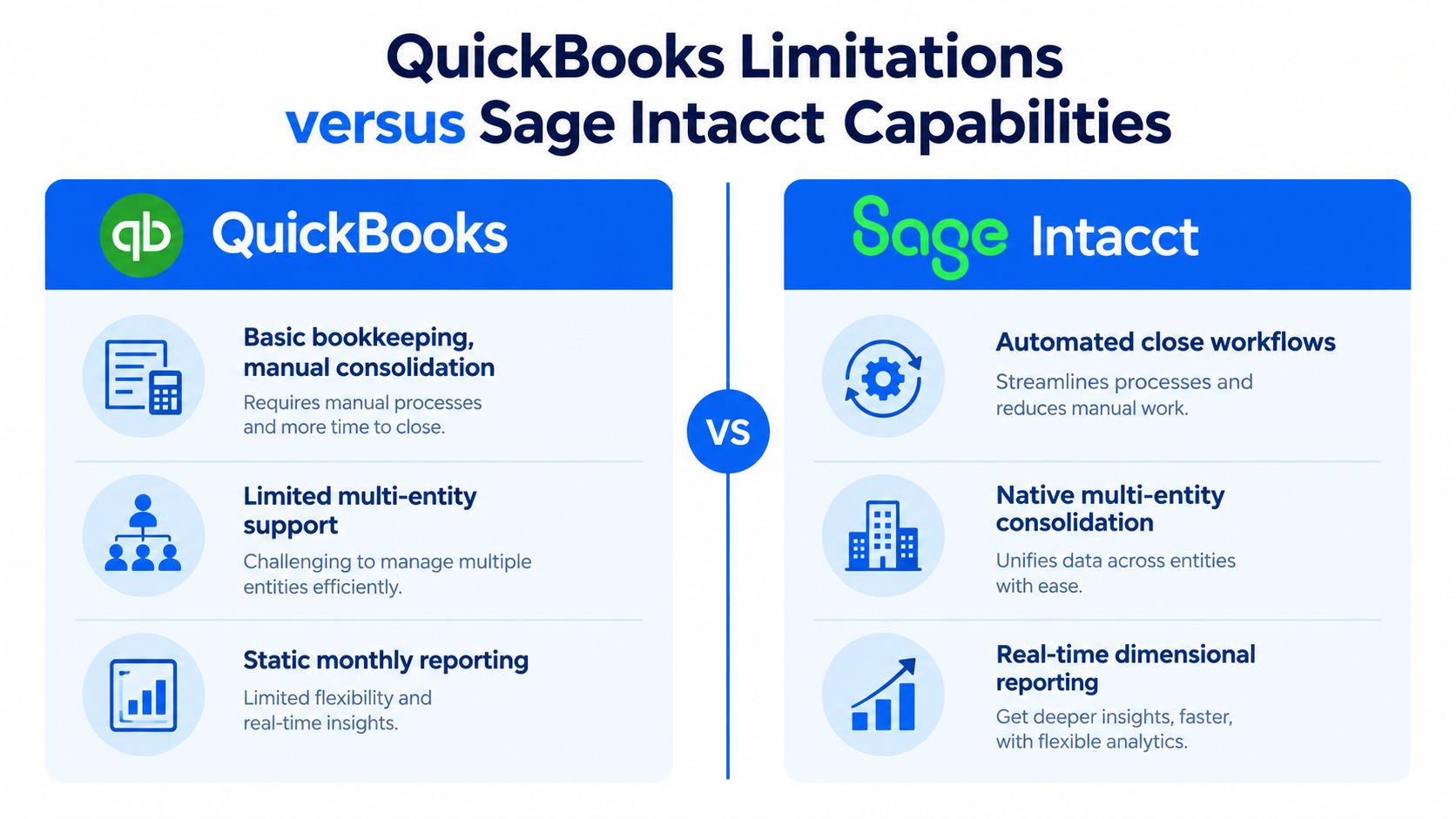
The difference is not merely a longer feature list. A strong close includes transaction collection, account reconciliation, accruals and other adjusting entries, variance analysis, multi-entity consolidation, and financial-statement sign-off, as outlined in this financial close process guide. Your accounting system must help people perform and control that work. For another independent view of ERP selection criteria, this accounting software comparison resource can help frame evaluation priorities. Buyers early in the evaluation cycle may also benefit from this ERP selection guide from Panorama Consulting Group.
Where the operating model starts to fail
| R2R requirement | Common QuickBooks workaround | Sage Intacct design advantage |
|---|---|---|
| Multi-entity reporting | Separate files and manual consolidation | Centralized entity reporting and consolidation workflows |
| Intercompany activity | Spreadsheet tracking and manual eliminations | Structured intercompany processes and elimination logic |
| Dimensional visibility | Static reports assembled after close | Real-time reporting by relevant dimensions |
| Audit support | Files, emails, and manual evidence collection | More consistent transaction and approval history |
| Fund or program reporting | Custom workarounds and separate schedules | Better support for specialized reporting structures |
The practical impact varies by organization. A healthcare provider may need visibility across clinics while reconciling activity from EMR and billing systems. A nonprofit may need fund, grant, and program reporting without losing control of the general ledger. A dental service organization may need a consistent close across locations and entities. In each case, the issue is less about entering transactions and more about producing a reliable consolidated view. Readers in nonprofit finance may also find this nonprofit accounting guide from Jitasa useful for understanding why fund and program reporting create extra structural requirements.
Upgrade the process, not just the license
Moving from QuickBooks to Sage Intacct shouldn't reproduce the same chart-of-accounts confusion, manual cutoff rules, or uncontrolled journal process in a new interface. Before migration, define entity structures, dimensions, approval rules, reconciliation ownership, intercompany treatment, and reporting requirements.
The Sage Intacct and QuickBooks comparison is useful for framing the decision, but the implementation design determines whether the system delivers a cleaner close. Software can provide the capability. Your team still needs a controlled process that people will follow. For a broader external migration lens, this accounting system migration checklist from FloQast can help teams think through change management and close impact. Buyers planning a transition may also benefit from this ERP data migration overview from IBM and this financial systems implementation guide from Microsoft.
Automation Maturity and Close Speed Benchmarks
Automation maturity correlates with close performance, but the sequence matters. IBM found that top-performing organizations share three traits: more mature information availability, robotic process automation, and artificial intelligence, according to its record-to-report automation analysis.
Benchmarking summarized by finance sources places best-in-class monthly close performance at under five days, while mid-market organizations without process optimization commonly need six to eight days. The gap usually comes from manual reconciliations, fragmented data sources, and delayed approvals, not from the final reporting stage. Additional perspective from the Association for Financial Professionals can help finance leaders compare process maturity and close practices. This month-end close guide from Wolters Kluwer also offers useful operational benchmarks and checklist ideas.
Start with the constraint, not the trend
A finance leader should identify the largest source of delay before selecting automation targets. If the team can't confirm whether every entity submitted complete data, automating consolidation may only move unreliable information faster. If journal approvals sit in email, a close-management workflow may produce more value than an advanced analytics tool.
Prioritize in this order:
- Data availability: Make source data timely, complete, and consistently mapped.
- Reconciliations: Standardize account support, matching rules, exception handling, and review.
- Journal governance: Centralize preparation, approval, posting, and documentation.
- Close coordination: Make dependencies, due dates, and escalations visible.
- Analysis: Give finance direct access to transaction detail and dimensional reporting.
An aging trial balance review can expose unresolved receivables, weak follow-up, and cutoff issues that affect the close. That kind of diagnostic work belongs before a team promises touchless processing. For another external operational lens, this month-end close checklist from Corporate Finance Institute can help teams assess where work is still too manual.
The fastest close isn't the one with the most automation. It's the one with the fewest unresolved exceptions.
Automation should remove repetitive execution while preserving human judgment. Reconciliation matching can identify clean items, but a Controller still needs to review unusual balances. A system can route a journal, but an approver must decide whether the accounting treatment is defensible.
The right question for a CFO isn't, “How much can we automate?” It's, “Which controls can we make consistent, visible, and repeatable without weakening review quality?”
The Continuous Controllership Shift
The traditional close treats period-end as the moment when finance discovers what needs attention. That design creates a predictable problem: reconciliations, journal reviews, flux analysis, and exception resolution all compete for the same final days.
Continuous controllership distributes that work across the period. Teams monitor transactions, reconcile accounts on a rolling basis, prepare recurring entries, and resolve exceptions while the underlying activity is still easy to trace. The close remains important, but it becomes a controlled finalization rather than the starting point for investigation.

What changes in a continuous model
A continuous model changes the cadence and the evidence:
- Reconciliations happen throughout the month instead of waiting for the ledger to close.
- Anomaly detection surfaces unusual entries earlier.
- Journal preparation and review move closer to the transaction event.
- Controllers see task status, exceptions, and dependencies before they become close blockers.
- Audit support accumulates as work is completed, rather than being reconstructed later.
Agentic AI and automation are pushing R2R toward always-on anomaly detection, close orchestration, and touchless processing. One 2026 industry article cites leading implementations reaching about 70% faster period-end close, up to 85% touchless processing, and a 20% reduction in cash conversion cycles in its discussion of continuous controllership. Those figures describe cited implementations, not a promise for every company, and the operating prerequisites remain essential. Read the discussion of agentic AI and continuous controllership. For a broader market lens, this finance automation overview from Deloitte offers related context on digital finance transformation. Teams evaluating AI in finance may also want this overview of AI in accounting from PwC.
Stabilize before you accelerate
Adding automation to fragmented processes can create a faster close with weaker confidence in the numbers. If entity mappings are inconsistent, an automated feed can distribute the inconsistency everywhere. If cutoff policies differ by location, a workflow can make the disagreement harder to spot.
Design continuous controllership around clear guardrails:
- Standardize policy: Set common cutoff, accrual, intercompany, and approval rules.
- Define materiality: Decide which exceptions require human review.
- Preserve evidence: Link entries, reconciliations, approvals, and explanations.
- Separate preparation from review: Automation should support independent control.
- Monitor exceptions: Measure unresolved items, not only completed tasks.
The objective isn't to eliminate the close. It's to make the close predictable, auditable, and less dependent on late-night investigation. For another external viewpoint on finance operating model maturity, see this controllership perspective from EY. Finance leaders exploring continuous models may also want this finance transformation overview from KPMG and this continuous accounting resource from Trintech.
Why Implementation Partnership Matters
Buying Sage Intacct doesn't automatically create a controlled R2R process. The difficult work happens before and during configuration: deciding how entities map, which dimensions matter, how intercompany transactions flow, who approves journals, and what management needs to see without rebuilding reports in spreadsheets.
That is why the right partner matters more than a software-only purchase. An experienced implementation team can challenge inherited processes, identify unnecessary complexity, translate accounting policy into system design, and help users adopt the new close discipline.

Choose advisory depth that matches the risk
A multi-site healthcare organization, nonprofit, DSO, or growing professional-services company rarely has the same requirements as a single-entity business. The implementation should reflect the organization's reporting dimensions, operational systems, audit expectations, and internal capacity.
Lucentive is a Sage Intacct National Premier Partner with mid-market, healthcare, and nonprofit experience. Its advisory and implementation work is relevant when the company needs more than configuration, especially where the R2R design includes multiple entities, specialized reporting, or a transition from QuickBooks. See the Sage Intacct consultant services for the type of support involved.
The business case is risk reduction and time-to-value. A well-designed implementation can reduce rework, clarify ownership, and establish an audit-ready posting and approval structure. It also gives the CFO a practical way to assess whether Sage Intacct fits before approving the full investment. For an outside perspective on implementation risk, this ERP implementation guide from CIO is another useful reference.
Software supplies the platform. Implementation determines whether finance can trust and use it.
Summary
The record to report process flow moves from transaction capture through close, consolidation, analysis, and reporting. Its performance depends on upstream data quality, clear ownership, account reconciliations, journal approvals, and entity-level consolidation logic. Sage Intacct can support stronger multi-entity control, reporting visibility, and audit history than a spreadsheet-dependent process, but automation should follow process stabilization. Continuous controllership spreads work across the month, while the right implementation partner turns software capability into a controlled operating model.
Frequently Asked Questions
Why do mid-market companies need six to eight days to close?
Mid-market companies commonly need six to eight days because manual reconciliations, fragmented data sources, and delayed approvals create exceptions late in the cycle. Reporting itself usually isn't the main constraint. Teams can shorten the timeline by improving source-data completeness, standardizing reconciliations, centralizing journal approvals, and coordinating entity dependencies before the final reporting stage.
What does continuous controllership mean?
Continuous controllership distributes R2R work across the month instead of treating period-end as the first opportunity to investigate problems. Finance teams reconcile accounts on a rolling basis, monitor transactions, prepare recurring entries, and resolve exceptions earlier. The close still provides final review and sign-off, but it becomes a controlled finalization rather than a compressed investigation.
Which R2R steps should finance automate first?
Start with the steps that create the most repeatable work and the clearest control benefit. Improve data availability and mapping first, then standardize reconciliations, journal approvals, close coordination, and exception handling. Advanced automation and AI are more reliable after the underlying policies, ownership, and evidence requirements are stable.
How can healthcare and nonprofit organizations benefit from Sage Intacct?
Healthcare organizations can use a stronger R2R structure to coordinate reporting across locations and operational systems. Nonprofits can benefit from more controlled fund, grant, and program reporting. In both cases, the value comes from a properly designed implementation that connects specialized reporting needs with general-ledger controls, consolidation, approvals, and audit support.
Why work with an implementation partner instead of buying Sage Intacct alone?
A partner helps translate accounting policies and operational requirements into entity structures, dimensions, workflows, approval rules, and reporting. That matters when a company has outgrown QuickBooks or manages multiple entities and specialized requirements. Software provides capability, while advisory and implementation support reduce design risk and help the finance team adopt a repeatable close process.
Schedule a 30-minute working session with Lucentive to map your current record to report process flow, identify the controls and handoffs slowing the close, and assess Sage Intacct's fit for your organization. Visit Lucentive to book a discovery call or personalized Sage Intacct demo without committing to a purchase.