Month-end closes on day nine. One entity is waiting on intercompany cleanup. Another is still posting manual journals from a spreadsheet someone emailed at 10:47 p.m. The board wants margin by location, cash visibility by entity, and a forecast they can trust. Your team is working hard, but the books are now the bottleneck.
That's the moment when the CFO role in digital transformation stops being theoretical. It becomes operational. If finance can't produce reliable numbers quickly, growth slows, audits get harder, and leadership starts making decisions on stale data.
For mid-market companies that have outgrown QuickBooks or stitched together too many point tools, this isn't an IT problem with a finance side effect. It's a finance problem with enterprise consequences.
Table of Contents
- Introduction Why Digital Transformation Now Falls to the CFO
- What CFO Led Digital Transformation Really Means
- Core Responsibilities of the CFO in Transformation
- Sector Specific Considerations for Healthcare Nonprofits DSOs and Services
- Capability Roadmap Metrics and How Sage Intacct Supports Execution
- Common Pitfalls That Stall Finance Transformation
- Summary
- Frequently Asked Questions
- Should the CFO or CIO own digital transformation?
- How should a CFO measure digital transformation success?
- What should happen in the first 30 days of a finance transformation?
- Why do finance transformation projects stall after software is purchased?
- How does Sage Intacct fit a mid-market company that has outgrown QuickBooks?
- Why meet with an implementation partner before choosing software?
Introduction Why Digital Transformation Now Falls to the CFO

It usually starts the same way. The CEO asks for a forecast by entity, the board wants faster reporting, department leaders question the numbers, and finance is left stitching answers together from spreadsheets, inboxes, and disconnected systems. At that point, digital transformation lands on the CFO because the failure is showing up in finance first.
The ownership debate misses a critical issue. The CFO should lead transformation when the business needs measurable operating outcomes: a shorter close, better forecast accuracy, cleaner controls, and actual system adoption across teams. Analysts at Grant Thornton found that many CFOs already oversee transformation, enterprise change, and AI initiatives in practice (Grant Thornton CFO survey findings). That reflects what happens in the field. Once reporting quality and decision speed are at risk, finance becomes the operating center of the project.
This matters even more in the mid-market. Healthcare groups, nonprofits, DSOs, and multi-entity services firms do not have room for vague transformation programs. They need billing, entity reporting, approvals, revenue recognition, grant or fund visibility, and audit support to work inside one disciplined operating model. If those pieces stay fragmented, growth creates more noise, not better control.
Why finance ends up carrying the mandate
Finance sees the breakdown before the rest of the company names it correctly. The problem rarely starts as "we need new software." It shows up as delayed closes, forecast misses, weak adoption of existing tools, and leaders spending too much time debating report logic.
A CFO is the only executive who can force decisions on chart structure, dimensions, approval rules, entity design, and reporting governance. IT can configure systems. Operations can ask for dashboards. The CFO has to define what the numbers mean, how fast they need to be available, and which process changes the business will adopt.
That last point gets missed. ERP projects fail less often because of software limits and more often because the operating model never changed. Team capability has to change with the platform. The case for combining systems work with finance talent design is laid out well in this perspective on blending tech with talent to build a stronger finance team. The same theme shows up in broader finance transformation guidance from Deloitte on finance transformation and operating model change.
Here is the practical standard: if transformation does not improve close speed, forecast reliability, and user adoption, the CFO should treat it as incomplete.
What CFO Led Digital Transformation Really Means
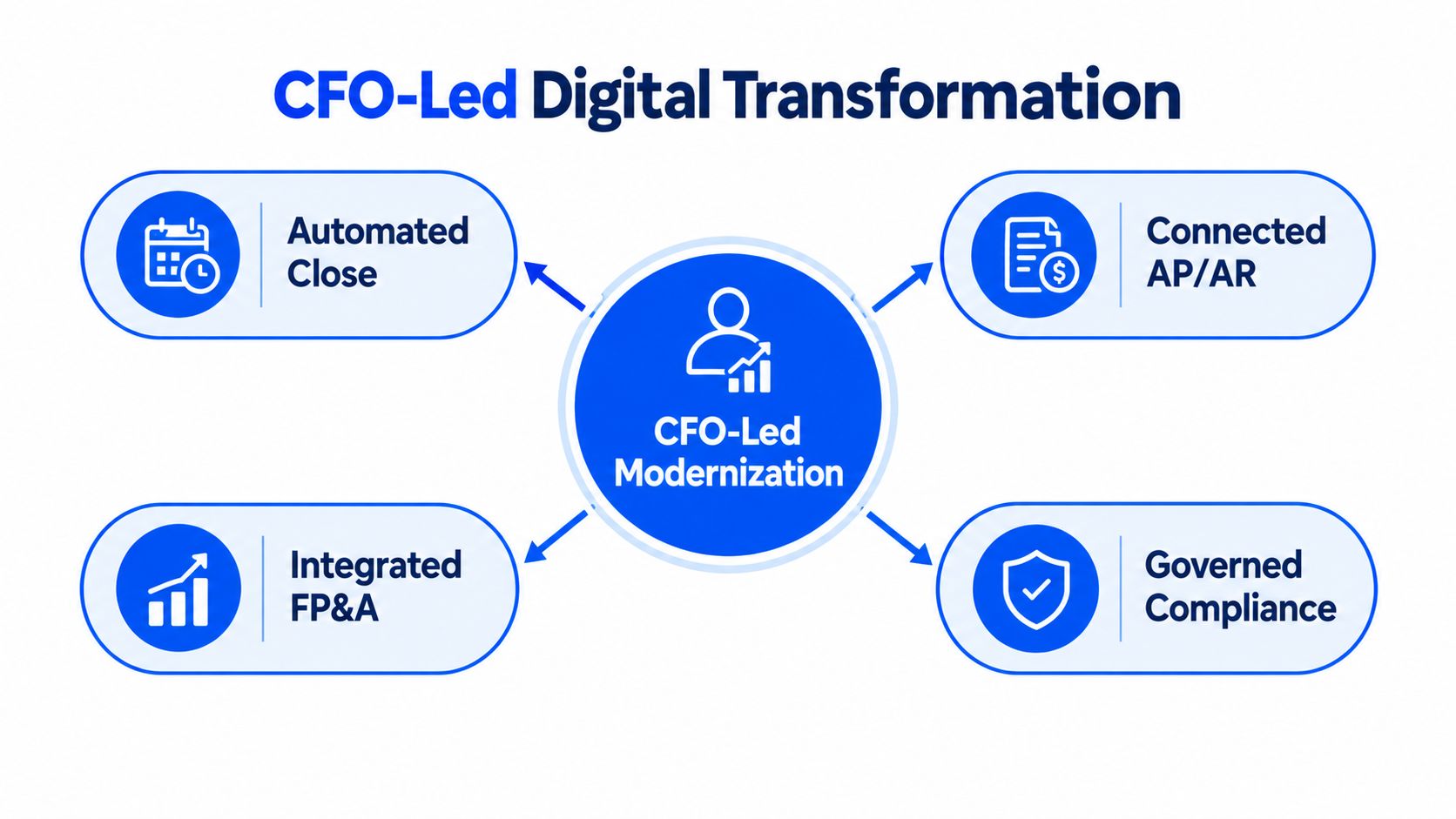
Month-end is five days late. Department leaders are still arguing over whose revenue report is right. AP is pushing invoices through one workflow, grants or locations are tracked somewhere else, and the board packet gets rebuilt in spreadsheets the night before review. In that situation, CFO-led digital transformation means fixing the operating model that produces the numbers, not just installing software.
For a mid-market CFO, this work should be judged by three outcomes. Close faster. Forecast more accurately. Get real adoption from the people entering, approving, and using the data. If those three numbers do not improve, the transformation is incomplete.
A practical definition is straightforward. CFO-led transformation is a finance-led redesign of processes, controls, reporting structure, and system behavior so accounting, planning, cash management, and compliance run from one agreed model. The ERP matters. The chart, dimensions, approval logic, entity structure, and reporting rules matter more because they determine whether the system produces decisions people trust.
The difference between implementation activity and CFO-led change
Projects go sideways when the team confuses technical completion with business improvement. Data migration can finish on time. Integrations can pass testing. User roles can be set correctly. None of that guarantees a shorter close or a better forecast.
CFO-led change starts with harder questions.
- Which steps in close still rely on offline workarounds?
- Which reports require manual reconciliation before anyone believes them?
- Where do entity, fund, department, or location definitions break consistency?
- Which approvals protect control, and which only slow the process?
- What must front-line managers do differently for adoption to stick?
Those questions matter more than ownership debates between finance and IT. IT should handle architecture, security, and technical execution. The CFO should define the operating outcomes, the rules behind the numbers, and the decisions the new process must support. PwC makes a similar case that finance transformation succeeds when operating model decisions, governance, and technology execution are aligned around business outcomes (PwC on finance transformation).
Why the role now sits with finance leadership
As noted earlier, finance leaders are putting AI and automation much closer to core finance work. That shift changes the job. Transformation now reaches forecasting, anomaly detection, close management, reporting, and audit readiness. Someone has to decide where automation belongs, where human review stays in place, and which controls cannot be compromised. That is CFO work.
This is even more important in healthcare, nonprofit, DSO, and services environments where reporting logic is rarely simple. Multi-entity structures, grant restrictions, location-level accountability, provider or program profitability, and approval requirements create operational friction fast. A generic system rollout will not solve that. A CFO-led model will, because it forces process standardization around the realities of the business.
CFO-led transformation means finance owns the business result, while partners and internal teams execute the technical work.
The strongest programs also build shared accountability across controllers, department leaders, system owners, and the implementation partner. That cross-functional discipline is why many finance leaders stay active in the broader tech finance community, where operating model decisions, system design, and finance execution are discussed together instead of in silos.
Core Responsibilities of the CFO in Transformation
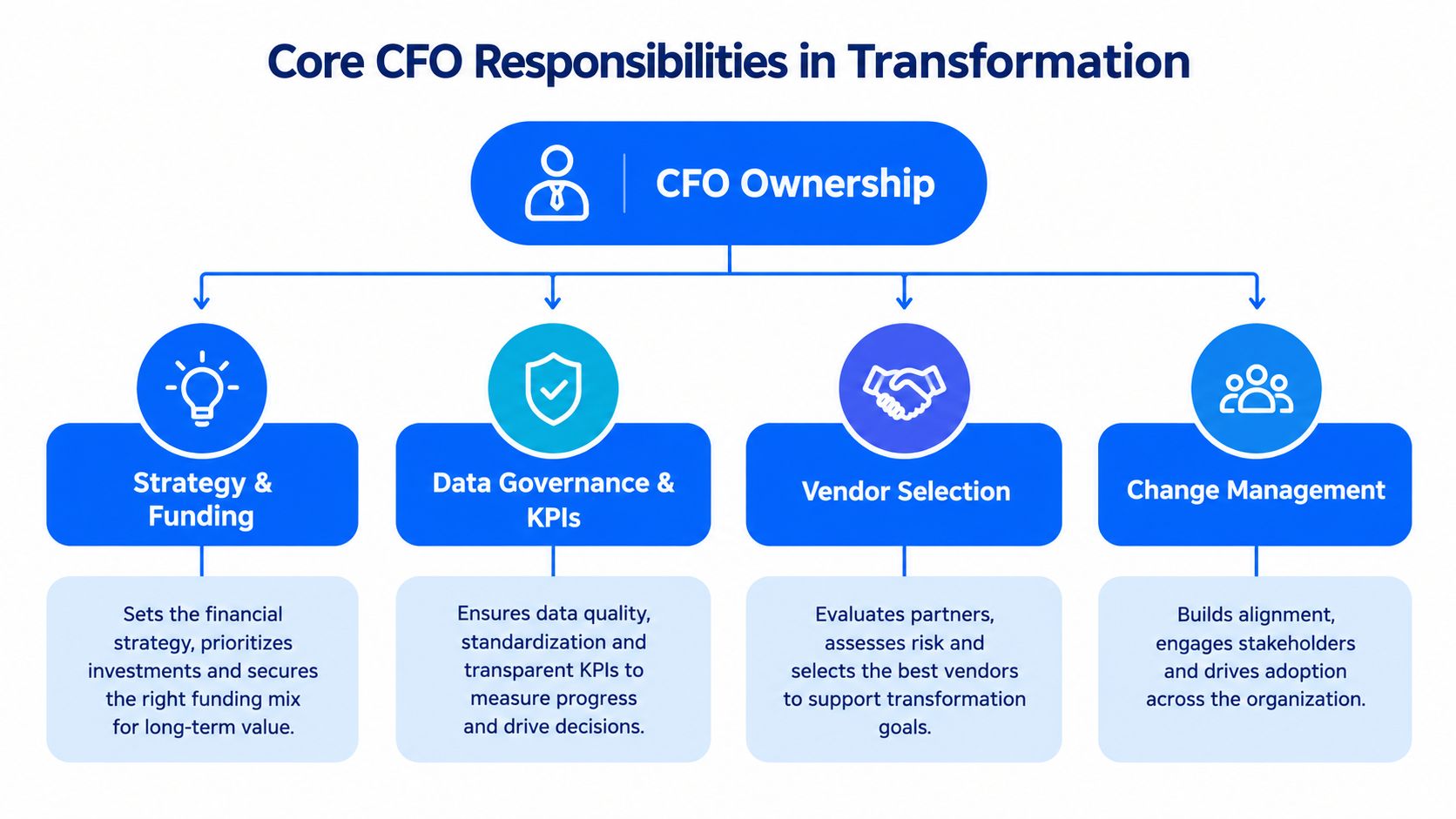
Monday morning. The close is still dragging, forecast calls are full of caveats, and department leaders are exporting data back into spreadsheets because they do not trust the system. At that point, the CFO's job is not to argue about who owns transformation. It is to fix the operating model and hold the program to measurable outcomes.
That means three scorecards matter more than the software demo. Close speed. Forecast accuracy. User adoption.
Own the business case and funding discipline
ERP programs fail in the budget, not just in configuration. The CFO has to define what the company is buying in operational terms and what will count as success six months after go-live.
Set targets before approval:
- Days to close
- Time spent in manual reconciliations
- Forecast variance
- Percentage of reports built outside the ERP
- Approval cycle time
- Adoption by role and process
If those measures are unclear, the project will drift into feature discussions, custom requests, and scope creep. Mid-market teams feel that drift fast because they do not have spare capacity to absorb a slow implementation.
A finance-led business case also changes the funding conversation. Instead of approving software because the legacy system is old, approve a program that reduces close effort, improves planning confidence, and cuts spreadsheet risk. Gartner also frames finance technology investment around measurable business outcomes such as efficiency, insight, and control rather than feature accumulation alone (Gartner finance transformation insights).
Set the data model before the dashboard
Bad structure creates permanent reporting pain. Good structure makes every later phase easier.
KPMG recommends building a finance data strategy that connects transactional data, reference data, and metadata so reporting can support decision-making instead of just producing output (finance data strategy guidance). McKinsey also points to data architecture and standardized finance processes as core enablers of better decision support in transformation programs (McKinsey on finance transformation). In practice, the CFO needs to settle core design choices early and enforce them across entities, departments, and reporting teams.
Lock down these items first:
- Chart of accounts: Keep it simple enough to maintain and detailed enough to report without workarounds.
- Entity and dimension structure: Build for how the business operates and how leadership reviews results.
- Master data ownership: Assign who controls vendors, customers, locations, classes, funds, or programs.
- KPI definitions: Finance and operations need one definition for margin, utilization, days cash, program spend, or provider productivity.
- Reporting hierarchy: Board, management, and site-level views should roll up from the same source data.
For a practical data-governance lens, the IBM guide to data governance is a useful outside reference on ownership, quality, and consistency.
If the design team skips this work, dashboard projects just scale confusion.
Drive process adoption and accountability
Software does not improve finance performance. Process compliance does.
Earlier research already established that finance leaders see adoption as a major reason transformation efforts miss the mark. That tracks with what happens in ERP projects. Teams attend training, nod through testing, then return to side spreadsheets and inbox approvals the minute pressure hits month-end.
The CFO has to prevent that fallback by setting clear operating rules:
- assign named owners for close, AP, AR, approvals, and reporting
- publish standard procedures tied to actual tasks and deadlines
- require system use for approvals, reconciliations, and reporting handoffs
- review adoption metrics by team, not just project status by milestone
- intervene fast when managers allow off-system workarounds
Partner quality shows up. A technical installer can load workflows. An advisor-led team can help finance redesign work, align controls, and push adoption into daily operations. That is why many mid-market organizations use an experienced Sage Intacct implementation consultant instead of treating ERP as a basic software purchase.
Choose the operating model and partner with implementation discipline
The CFO should not delegate core design decisions and hope the partner gets them right. That is how companies end up with messy dimensions, weak approval logic, and reporting structures that break the first time leadership asks a new question.
Choose a partner and delivery model based on four things:
- accounting architecture experience
- multi-entity reporting design
- integration planning discipline
- ability to manage change with controllers and department leaders
This matters even more in healthcare, nonprofit, DSO, and services environments. The project usually has to support entity complexity, restricted reporting, location accountability, and cross-system data flows. A generic rollout method will miss those realities.
Review performance after go-live
Go-live is the start of accountability, not the end of the project.
The CFO should run a standing post-implementation review against the business case. If close time did not improve, forecast accuracy did not tighten, or reporting still depends on manual extracts, the transformation is incomplete. Fix the process, retrain the team, and clean up the design.
Here is the operating lens that keeps the program grounded:
| Responsibility | CFO Owns | Measured Outcome |
|---|---|---|
| Business case and funding | Outcome targets, scope discipline, investment sequencing | Clear ROI, less wasted spend |
| Data governance | Master data rules, KPI definitions, reporting logic | Trustworthy reporting and planning |
| Process design | Close, AP/AR, approvals, intercompany, controls | Less manual work, faster close, stronger audit trail |
| Partner and operating model | Delivery approach, capability fit, accountability model | Better implementation quality and fewer redesign cycles |
| Adoption management | Role clarity, SOPs, training expectations, compliance follow-up | Higher system use and less spreadsheet fallback |
| Post-go-live review | Outcome tracking, issue escalation, process correction | Sustained gains in close speed, forecast accuracy, and adoption |
Sector Specific Considerations for Healthcare Nonprofits DSOs and Services
The CFO role in digital transformation changes shape by industry. The core responsibility stays the same. The design choices don't.
Healthcare and multi-site clinics
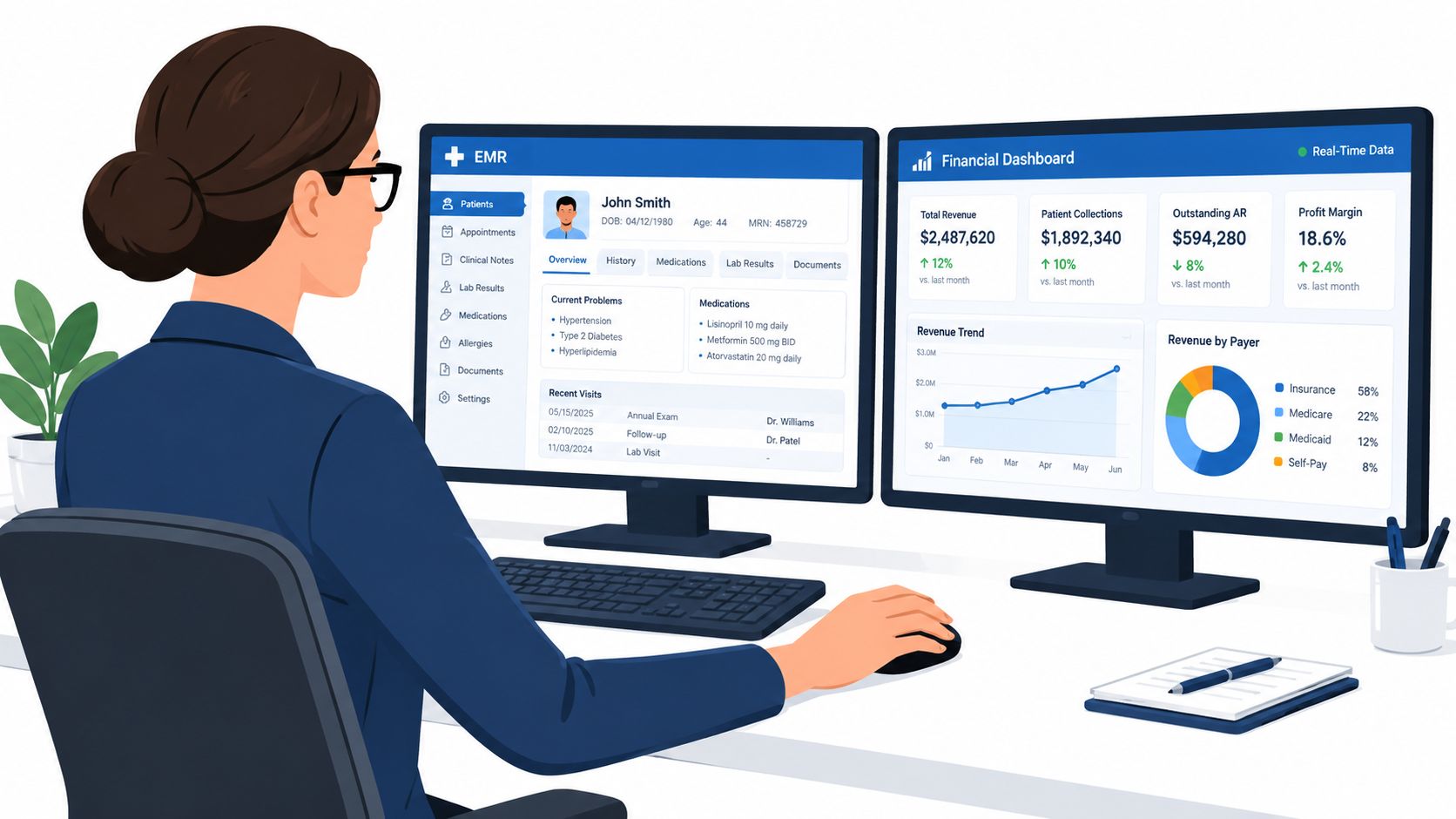
Healthcare finance teams usually deal with fragmented systems. Clinical data lives in the EMR. Financial data lives somewhere else. Reporting by provider, service line, or location often depends on workarounds.
That creates two immediate requirements. First, the ERP has to support clean multi-entity visibility. Second, integration design has to respect how operational data feeds finance without turning month-end into a reconciliation project.
Nonprofits and faith-based organizations
Nonprofit finance teams need something many generic ERP conversations ignore. They need books that support accountability to boards, grantors, and program leaders, not just standard corporate reporting.
That means the CFO has to evaluate transformation through a different lens:
- Fund accounting: Can the structure support restrictions and board-required views cleanly?
- Grant reporting: Can the system produce dependable reporting without side spreadsheets?
- Approval controls: Can finance maintain discipline without slowing program operations?
DSOs and professional services
Dental service organizations often need fast consolidation across locations while preserving local visibility. Professional services firms care about project accounting, real-time reporting, and the ability to see performance before the month is already gone.
One-size ERP evaluation fails here because each model has different pressure points. A DSO may care about entity rollups and location performance. A services firm may care more about project-level financial visibility and timely reporting for utilization and margin management.
The right system matters. The design of entities, dimensions, reporting logic, and integrations matters more.
Why partner-led implementation matters more in these sectors
Healthcare, nonprofit, SMB, and location-based organizations usually can't afford a long detour through avoidable mistakes. Budgets are tighter. Internal teams are leaner. Legacy processes are more customized than leaders expect.
That's why a partner-led approach tends to outperform software-only buying in these environments. The value isn't just licensing. It's getting entity structure, reporting needs, and integration risk right before the project becomes expensive to correct later. BDO likewise emphasizes that industry complexity, controls, and reporting requirements should shape ERP design decisions early, especially in regulated or multi-entity organizations (BDO on ERP and digital finance transformation).
Capability Roadmap Metrics and How Sage Intacct Supports Execution
A lot of finance transformation talk stays too abstract. It shouldn't. Good execution follows a sequence.
A practical finance transformation blueprint recommends Days 1 to 15 for baseline metrics and approval matrices, Days 16 to 30 for ERP and bank-feed connection plus shadow runs, and Days 31 to 60 for live operation on low-risk invoices and reconciliations, with weekly value-and-variance reviews and evidence packs throughout (30-60-90 finance transformation blueprint).
Days 1 to 15 establish the baseline
Start by measuring the current state. Not opinions. Actual process performance.
Document:
- Close timing: Where the delays happen and who owns each step
- Control points: Approval matrices, journal review, reconciliation ownership
- Manual work: Spreadsheet dependencies, rekeying, email approvals
- Reporting pain: Which reports are rebuilt manually and how often
If you don't baseline the process, you won't know whether the transformation improved anything or just changed the interface.
Days 16 to 30 prove the process in shadow mode
Disciplined teams avoid expensive surprises. Connect the ERP, connect bank feeds where relevant, and run parallel activity on selected workflows before switching the business over fully.
Shadow testing is where you catch the issues that demos hide:
- dimensions that don't support the reporting structure you need
- approval paths that look fine in theory but break in daily use
- integrations that pass data but not in a usable format
- reporting logic that needs revision before executives rely on it
Days 31 to 60 go live in low-risk areas first
Go live on controlled, lower-risk processes before pushing everything into production. Invoices and reconciliations are common starting points because they show process discipline quickly without exposing the whole organization to unnecessary disruption.
This is also where modern cloud ERP starts proving its value. Finance digital transformation is commonly defined around reducing cycle times, improving accuracy and control, and freeing up working capital. Those outcomes come from workflow discipline, governed data, and connected reporting, not from feature lists alone. The AICPA also highlights stronger controls, standardization, and visibility as practical benefits of finance process modernization (AICPA resources on finance transformation). For an additional outside view on ERP planning and phased rollouts, see Oracle's ERP implementation guidance.
Use close automation as the proving ground
Benchmark data shows 47% of organizations prioritize automating the close, yet 42% still require more than 8 days to close the books (close automation benchmark and implementation guidance). That gap creates a straightforward mandate. Redesign record-to-report around automated reconciliations, journal-entry controls, exception handling, and intercompany workflows.
SAP's implementation guidance in that same body of reference emphasizes the sequence: harmonize the chart of accounts and close calendar ownership first, then pilot in the most manual areas such as journals, reconciliations, and intercompany work, then monitor cycle time, error rate, and effort reduction.
If you want a practical scorecard, start with close speed, exception volume, and how often people fall back to offline work.
Where Sage Intacct fits
For companies that have outgrown QuickBooks, a cloud ERP such as Sage Intacct supports the mechanics finance leaders usually need most: faster close processes, real-time dashboards, multi-entity control, and cleaner audit support when the system is designed properly.
Implementation quality decides time-to-value. Lucentive's published materials state that it is a Sage Intacct National Premier Partner with mid-market, healthcare, and nonprofit implementation experience, and that it offers a 30-minute working session to pressure-test entity structure, reporting needs, and integration risk (Sage Intacct partner and working session details). That's useful because ERP selection without implementation scrutiny usually leaves the hardest questions unanswered.
If you're evaluating fit, the practical move is to review entity structure, reporting needs, workflow ownership, and integration points before configuration starts. That's the foundational work behind a successful Sage Intacct implementation.
Common Pitfalls That Stall Finance Transformation
Most stalled projects don't fail because the software was weak. They fail because leadership mistook tool purchase for operating change.
The maturity gap is real
An underserved but important angle in this conversation is execution maturity. In 2026, Wolters Kluwer reported that 69% of finance teams see themselves only in early or established stages of digital maturity, while just 18% are digitally advanced. Related coverage also noted that 50% of North American CFOs say digital transformation of finance is their top priority for 2026, while shortages in data, digital, and AI skills are a major barrier for more than half of CFOs (future-ready CFO maturity and priority findings).
That should change how you assess readiness. The core question isn't who “owns” transformation. The key question is whether the finance function can turn intent into measurable operating change.
Common failure patterns I see repeatedly
Some patterns show up over and over in mid-market projects:
- Buying ahead of readiness: Teams invest in new tools before standardizing data, approvals, and role ownership.
- Confusing access with adoption: Users have logins, but core work still happens outside the system.
- Treating AI as a shortcut: Leaders expect better outcomes without cleaning up source data and process design.
- Underweighting change management: Training gets compressed, accountability gets blurred, and old habits survive the launch.
A separate 2026 survey found nearly 47% of CFOs cite data accuracy and deployment as areas needing improvement, about 31% flag unclear AI applications as an efficiency barrier, and 28% report insufficient digital and AI fluency in their teams (FTI Consulting CFO survey findings). That aligns with what finance leaders already know in practice. Poor data, unclear use cases, and weak user fluency stall progress long before feature gaps do.
Stop asking whether you need more finance tech. Ask whether your team can govern, adopt, and use what you already plan to deploy.
What to prioritize instead
Focus on three things:
- Governance first. Clean ownership, definitions, approvals, and reporting logic.
- Adoption second. Measure whether people are using the system to do the work.
- Capability third. Build finance skills in data, systems, and process discipline.
If your organization is wrestling with role clarity, process adoption, or resistance to new workflows, structured ERP change management matters. Not as a soft add-on. As a control mechanism for getting the operating model to stick. For a broader external framework on organizational change, Prosci's change management overview is also worth reviewing.
Summary
The CFO role in digital transformation has shifted from finance stewardship toward broader transformation leadership, with many finance leaders now overseeing enterprise change and AI priorities. In practice, that role is less about owning software and more about producing measurable operating outcomes such as faster close, stronger reporting, cleaner controls, and better adoption. The work starts with governed data, process design, and role clarity, then moves through a disciplined roadmap. For mid-market, healthcare, nonprofit, DSO, and services organizations, partner-led ERP design and implementation usually matter as much as the software itself.
Frequently Asked Questions
Should the CFO or CIO own digital transformation?
The CFO should own the finance outcome. That includes process priorities, KPI definitions, controls, and adoption expectations. IT still plays a critical role in architecture, security, integration, and deployment. The mistake is treating this as a turf question. When close speed, reporting trust, and approval discipline are the goals, finance has to lead the business design while IT supports technical delivery.
How should a CFO measure digital transformation success?
Measure operating change, not project completion. Start with close speed, exception volume, manual handoffs, and whether teams still rely on offline spreadsheets. Add reporting reliability and user adoption. If the system is live but leaders still debate the numbers or staff keep working outside the process, the transformation hasn't landed.
What should happen in the first 30 days of a finance transformation?
The first phase should establish baseline metrics, control points, and approval ownership. After that, connect core ERP and banking workflows where relevant, then run shadow testing on selected processes before broad go-live. This sequence matters because it exposes issues in reporting structure, workflow design, and integration logic before they disrupt live finance operations.
Why do finance transformation projects stall after software is purchased?
They usually stall because governance and adoption were underbuilt. Teams buy tools before standardizing master data, approvals, and KPI definitions. Users get access, but real work keeps happening in spreadsheets and email. Weak data quality, unclear AI use cases, and low digital fluency also slow execution. The problem usually isn't lack of software. It's lack of operating discipline.
How does Sage Intacct fit a mid-market company that has outgrown QuickBooks?
A cloud ERP such as Sage Intacct fits when finance needs stronger multi-entity control, faster close processes, real-time dashboards, and a cleaner audit trail than entry-level accounting systems can support. The bigger issue is implementation quality. Entity structure, reporting design, workflow ownership, and integration planning determine whether the system improves operations or merely replaces one set of workarounds with another.
Why meet with an implementation partner before choosing software?
Because software demos rarely surface the hard issues. Entity design, reporting requirements, approval structure, and integration risk are what drive success in the production environment. A partner-led review helps leadership test whether the system fits the business model and whether the rollout approach matches the team's capacity to adopt change.
If you're trying to turn the CFO role in digital transformation into better close speed, cleaner reporting, and stronger multi-entity control, Lucentive offers Sage Intacct advisory, implementation support, and a practical working session to pressure-test fit before you commit. Visit Lucentive to schedule a 30-minute conversation around your entity structure, reporting needs, and integration risk.