A month-end surprise rarely starts at month-end. It starts when a customer pays later than expected, payroll lands before a reimbursement arrives, or one entity's cash position gets blended into another's. By the time the close exposes the problem, the CFO is already deciding which vendor to delay, which hire to pause, or whether available cash can support the next operating commitment.
A rolling cash flow forecast gives finance leaders a short-horizon view that can support those decisions before they become emergencies. But the spreadsheet itself isn't the solution. The forecast only becomes useful when bank activity, accounts receivable, accounts payable, payroll, entity data, and operating assumptions follow one process with clear ownership.
Table of Contents
- Why Most Mid-Market Finance Teams Struggle With Cash Visibility
- What Is a Rolling Cash Flow Forecast and How It Works
- Forecast Components, Accuracy Targets, and Refresh Cadence
- Common Pitfalls That Break Rolling Forecasts
- Use Cases Across Healthcare, Nonprofits, DSOs, and SMBs
- Implementation Roadmap and Ongoing Maintenance Best Practices
- Summary
- Frequently Asked Questions
- When is a rolling forecast better than a static budget?
- How often should a mid-market finance team refresh its forecast?
- What accuracy target is reasonable?
- Can a rolling forecast work across multiple entities?
- How should nonprofits handle restricted funds?
- Does Sage Intacct replace the need for forecast governance?
Why Most Mid-Market Finance Teams Struggle With Cash Visibility
A mid-market operator can have a clean-looking close and still lack a usable cash view. After moving beyond QuickBooks, the business may add entities, locations, staff, and specialist systems. Bank activity sits in one place, receivables in another, and payroll or purchasing data arrives on a different schedule. The accounting team can close the books, yet leadership still cannot answer with confidence: what will cash look like over the next several weeks?
Static monthly and quarterly plans rarely resolve that gap. They set targets, but assumptions change before the next reporting cycle. A slow close delays actual results, while multi-entity reporting can hide which unit holds cash. Weak audit trails make adjustments difficult to explain, and uncertain collection timing leaves the CFO weighing payroll, vendor payments, debt commitments, and covenants with incomplete information.

A rolling forecast functions as a liquidity management discipline rather than an annual planning file. It combines actual inflows and outflows with forward-looking expectations, then recalculates ending cash each period. The record should show what changed, why it changed, and which management action follows.
Practical rule: A forecast that arrives after the decision isn't a decision tool. It's a historical report with a future column.
The harder problem is workflow ownership. Department leaders may own collection assumptions, procurement may control payment timing, and accounting may reconcile source data. If those inputs refresh on different cycles, finance spends its time reconciling versions instead of testing decisions. Everyone contributes, but no one owns forecast quality.
That's why the CFO's role in digital transformation matters. A partner-led Sage Intacct implementation, supported by Lucentive, can connect financial data, close controls, dashboards, entity reporting, and audit trails in one operating process. The value comes from agreed ownership and refresh rules, not from adding another file. When leaders trust the process, the forecast can guide cash decisions before pressure becomes an emergency.
What Is a Rolling Cash Flow Forecast and How It Works
A rolling cash flow forecast keeps a constant forward-looking horizon. As one period ends, finance replaces that period with actual results and adds a new period at the end. The forecast therefore moves forward continuously instead of expiring when a month, quarter, or year closes.
The most widely used enterprise format is the 13-week rolling forecast, updated weekly. Each week typically contains:
- Opening cash balance, taken from the prior period's closing position.
- Expected inflows, such as customer receipts, financing, refunds, or other cash receipts.
- Expected outflows, including payroll, suppliers, taxes, debt service, and planned spending.
- Closing cash balance, calculated by adding net cash flow to opening cash.
The core calculation is straightforward:
Closing cash = opening cash + total inflows − total outflows
That simplicity is useful. It makes the model explainable to operating leaders and gives finance a clear way to trace a change. If a customer receipt slips, the impact appears in the relevant week and carries into the next period's opening balance. If a vendor payment is rescheduled, the forecast should show both the timing change and the resulting liquidity effect.
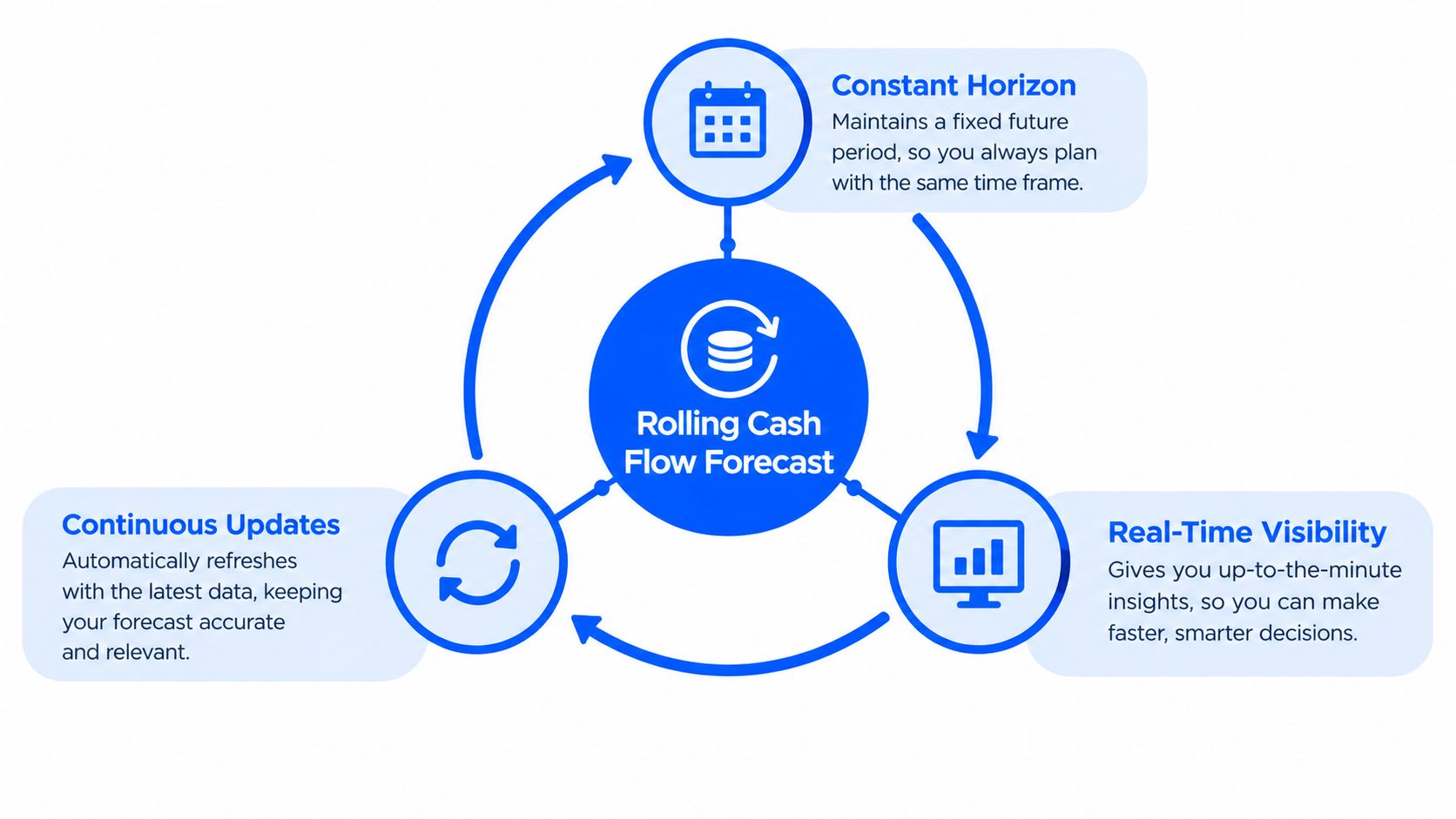
An annual budget answers a different question. It describes planned revenue, expenses, and profitability over a longer period. A rolling cash flow forecast focuses on when money is expected to enter and leave the bank, which makes it more useful for near-term decisions such as payment prioritization, hiring timing, or covenant monitoring.
Treasury guidance commonly treats 13 weeks or one quarter as a typical short-to-medium-term horizon, although the appropriate length depends on the organization. For example, Ripple Treasury describes the 13-week model as a common format for short-term liquidity planning, because it gives teams enough runway to spot pressure points without losing transaction-level visibility (Ripple Treasury). A company with tight margins or highly variable receipts may need more frequent updates or a shorter decision horizon. The important point isn't choosing a fashionable template. It's maintaining a forecast that leadership can use before the next cash decision arrives.
For finance leaders evaluating Sage Intacct, cash management capabilities should be assessed against this operating requirement. The question is whether the system and implementation process can connect actual financial activity to a forecast that people trust.
Forecast Components, Accuracy Targets, and Refresh Cadence
A rolling forecast is only as useful as its method and inputs. The direct method maps expected cash receipts and payments, which suits short-term liquidity decisions. Treasury-focused guidance consistently treats the direct method as the preferred approach for near-term cash visibility because it relies on expected receipts and disbursements instead of accounting accruals (Atlar, Ripple Treasury). The indirect method begins with net income, then adjusts for non-cash items and working-capital movements such as accounts receivable, accounts payable, and inventory.
The choice depends on the decision being supported. Treasury teams managing payment timing need direct visibility into expected inflows and outflows. A broader planning process may use the indirect method to connect operating performance with cash movement. Some organizations use both, provided the profitability view is not mistaken for a forecast of the bank balance.
The model should also assign clear definitions and owners to each input. Finance teams should specify how they handle:
- Customer receipts, based on expected collection timing rather than invoice dates alone.
- Vendor payments, including approved invoices, purchase commitments, and likely payment dates.
- Payroll and taxes, which usually allow less timing flexibility than discretionary spending.
- Debt and financing activity, including scheduled payments and expected draws.
- One-time events, such as major purchases, grants, refunds, or settlements.
Accuracy targets are management references, not permission to create false precision. A useful benchmark for a rolling 13-week direct forecast is 95% or greater accuracy, as outlined in Sage's cash flow forecasting guidance. Shorter horizons should generally produce tighter results, while forecasts covering several months require wider tolerance because collection timing, spending decisions, and financing needs can change.
Variance review keeps performance from deteriorating. Each cycle, compare forecast results with actual receipts and payments, identify the cause, assign an owner, and update the assumption. Late customer payments, optimistic sales expectations, and unplanned expenses are common sources of error. If systems refresh on different schedules, document which data is current and which remains provisional.
Refresh cadence should match cash volatility and decision deadlines. Weekly updates often fit a 13-week operating model, while stable organizations may use a different rhythm for longer-range planning. The practical test is whether new information reaches decision-makers before it affects payroll, payables, collections, or financing. Sage Intacct teams can connect this cadence to a broader budget and planning process, giving finance and operating owners one process instead of separate files that drift apart.
Common Pitfalls That Break Rolling Forecasts
Most failed forecasts don't fail because the arithmetic is difficult. They fail because the organization can't produce consistent, timely inputs. Bank feeds may be incomplete, AR data may reflect invoices instead of likely collection dates, AP may contain unapproved or duplicated commitments, and operational systems may use different entity or customer definitions.
Fragmentation creates a second problem, ownership ambiguity. Accounting may own the file, but sales owns collection expectations, operations owns hiring plans, and procurement influences disbursement timing. If nobody is accountable for each assumption, the forecast becomes a negotiation rather than a controlled process.
The failure pattern to watch
A forecast loses credibility when finance updates it only after the close, treats it as a presentation artifact, or changes assumptions without documenting the reason. The team then sees variance but can't determine whether the issue came from data latency, a missed payment, an optimistic assumption, or an unplanned expense.
A forecast should trigger a conversation about action, not just explain why last week was different.
Common failure points include:
- Late actuals: Bank and ERP data arrive after the forecast cycle.
- Unrealistic collections: Teams base receipts on contractual due dates instead of observed payment behavior.
- Uncontrolled commitments: Purchase orders and approved spending aren't connected to the cash view.
- No exception rules: Finance reviews every line manually instead of escalating meaningful variances.
- No named owner: Everyone supplies data, but nobody signs off on the forecast.
This is why spreadsheet-versus-software debates miss the central issue. A platform won't repair undefined ownership or inconsistent master data. Finance leaders should review vendor master data management practices alongside the forecast design, because duplicate suppliers, inconsistent payment terms, and weak approval controls can distort projected outflows before the model ever runs.
Use Cases Across Healthcare, Nonprofits, DSOs, and SMBs
The value of a rolling cash flow forecast depends on the organization's cash cycle. A multi-site healthcare provider may need to separate clinic-level receipts, central payroll, payer timing, and intercompany transfers. The CFO isn't only asking whether the group has cash. They need to know which entity has liquidity, which location is consuming it, and whether a delayed reimbursement changes the next payment decision.

For nonprofits and faith-based organizations, unrestricted and restricted funds can't be treated as interchangeable. Grant timing, program commitments, and compliance reporting affect how leadership interprets available cash. Nonprofit accounting guidance consistently notes that restricted funds do not need to sit in a separate bank account, but they do need to be tracked separately and reported clearly so leaders do not treat them as available for general operations (Intuit Enterprise Suite, NetSuite). The forecast needs to show not just the total balance, but the practical constraints around using that balance.
A dental service organization may focus on collection cycles across practices, payroll timing, supply purchases, and support-company disbursements. A small or midsize business moving beyond QuickBooks often needs entity-level visibility, cleaner approvals, and a dependable link between the general ledger and forward cash expectations.
Professional services firms face a different pattern. Project billing, staffing decisions, reimbursable costs, and delayed client payments can create cash pressure even when the income statement appears healthy. In each environment, the forecast works when it reflects how the business receives and spends cash.
The implementation implication is important. A healthcare group, nonprofit, DSO, and professional services firm shouldn't receive the same assumptions, approval rules, or reporting dimensions. Sage Intacct can support structured financial data, but the partner must translate each organization's operating model into usable workflows. That is particularly important when teams are replacing disconnected files while trying to preserve reporting continuity and audit discipline.
Implementation Roadmap and Ongoing Maintenance Best Practices
A rolling forecast becomes sustainable when implementation starts with workflow, not configuration. Before selecting software, document where actual cash data originates, who owns each assumption, how entities reconcile, and which decisions the forecast must support. A rapid diagnostic usually exposes more risk than a feature comparison because it shows where timing, ownership, and data quality break down.
Start small, then expand deliberately
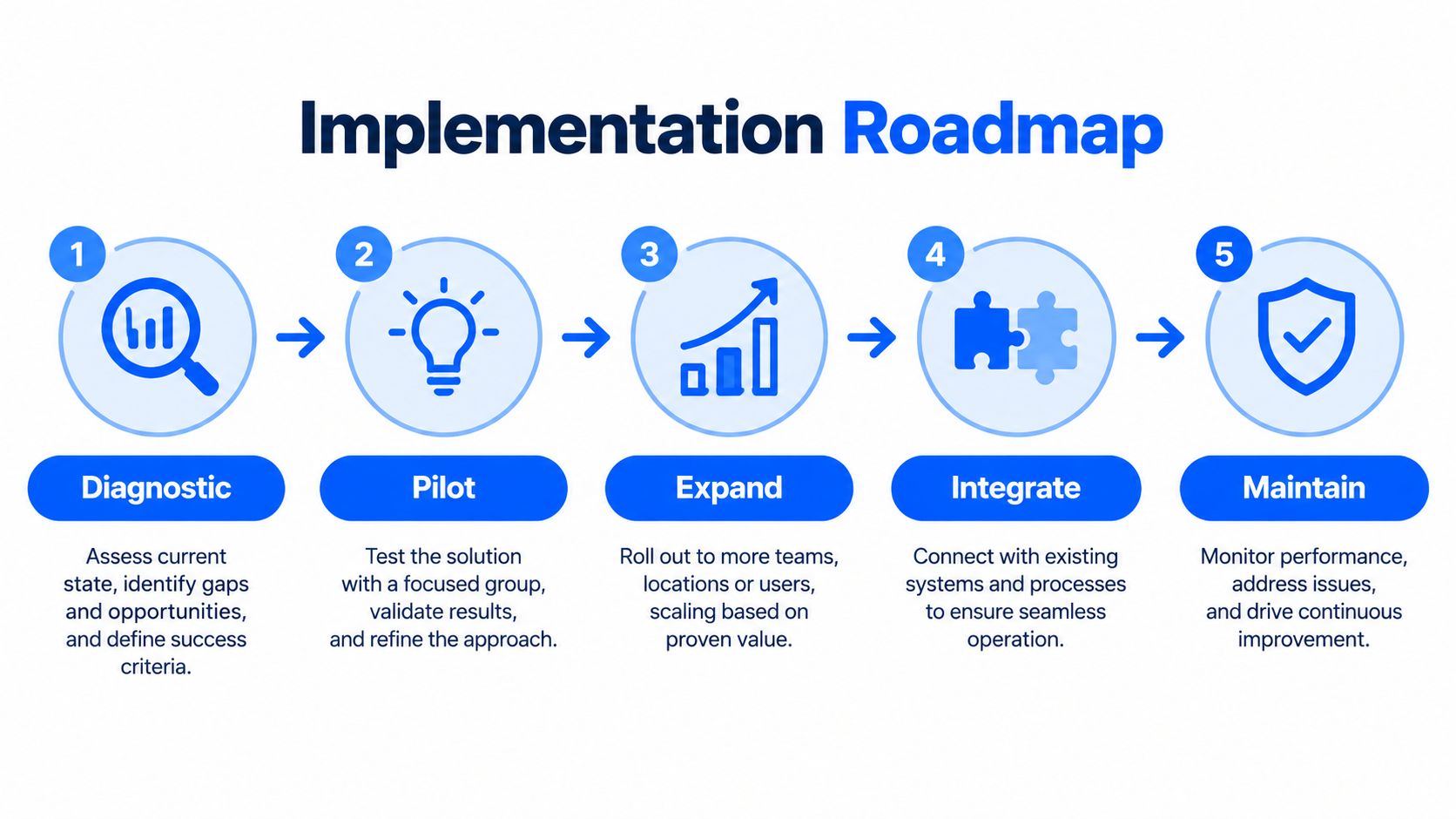
A practical rollout can follow five stages:
- Diagnostic: Map bank feeds, ERP data, AR, AP, payroll, debt, restricted funds, and operational systems. Identify manual handoffs and missing approvals.
- Pilot: Test the forecast in one entity, business unit, or cash cycle. Use the pilot to establish definitions for inflows, outflows, exceptions, and variance review.
- Expand: Add entities and functions after the first workflow is understood. Standardize chart-of-accounts mappings, dimensions, payment terms, and ownership.
- Integrate: Connect bank and accounting actuals with the operating data that drives cash timing. Reduce duplicate entry and create a consistent audit trail.
- Maintain: Refresh on the agreed cadence, compare actuals to forecast, investigate material variances, and update assumptions.
Sage Intacct can provide a stronger foundation for multi-entity accounting, bank-connected actuals, dashboards, approvals, and audit-ready reporting. Software alone, however, won't decide whether a receipt belongs in the expected week, who approves an unusual payment, or what variance requires escalation. Those choices need to be designed and adopted by the finance team.
Lucentive is a Sage Intacct National Premier Partner with experience serving mid-market organizations, including healthcare and nonprofits. Its role is to help translate cash visibility requirements into configured workflows, reporting structures, and user responsibilities rather than leaving the buyer with a standalone platform purchase. A disciplined approach to the ERP implementation phases can improve time-to-value by addressing process and data decisions before they become expensive rework.
Set a weekly owner, a review agenda, and a written variance threshold. Give leaders a view that answers what changed, what is at risk, and what action is available. That's how a forecast earns a place in operating meetings.
Summary
A rolling cash flow forecast keeps liquidity visibility current by replacing completed periods with actuals and adding new forward periods. Its value depends on standardized inputs, realistic receipt and payment assumptions, variance review, and a refresh cadence that matches business volatility. Fragmented systems and unclear ownership can undermine even a sound model. Healthcare providers, nonprofits, DSOs, professional services firms, and growing SMBs benefit when the forecast reflects their specific cash cycles. A partner-driven Sage Intacct implementation can reduce the risk of buying software without the workflows needed to use it.
Frequently Asked Questions
When is a rolling forecast better than a static budget?
A static budget supports longer-range planning for revenue, expenses, and profitability. A rolling cash flow forecast supports near-term decisions by showing when expected receipts and payments will affect the bank balance. It is most useful when collections, payroll, vendor payments, entity transfers, or financing commitments change faster than the monthly or quarterly planning cycle.
How often should a mid-market finance team refresh its forecast?
Many finance teams update a constant 13-week horizon weekly, but the right cadence depends on volatility, margins, and the decisions under review. A company with variable receipts or tight liquidity may need more frequent assumption checks. Longer-range planning can follow a separate schedule. The practical test is simple: update the forecast quickly enough to influence payment timing, funding choices, and operating decisions.
What accuracy target is reasonable?
Use accuracy targets to manage the process, not to create a decorative scorecard. Assign an owner to each major cash category, set a variance threshold that requires investigation, and review actuals against forecast during the weekly cash meeting. Targets should reflect the forecast horizon and the quality of available inputs. Sage's forecasting guidance provides useful context, and treasury explainers from Upflow and NetSuite offer additional benchmarks for how teams monitor forecast reliability across shorter and longer horizons.
Can a rolling forecast work across multiple entities?
Yes, provided the organization standardizes entity definitions, bank and ERP inputs, intercompany activity, approvals, and ownership. A consolidated balance can conceal a problem when one entity holds cash while another faces immediate obligations. Reporting should preserve the group view and the entity-level detail required for payment and funding decisions. Fragmented systems and different refresh cycles often cause more trouble than the forecasting method itself.
How should nonprofits handle restricted funds?
Separate restricted and unrestricted cash so leaders do not treat every balance as available for general operations. Include grant timing, program commitments, and compliance reporting in the assumptions and reporting structure. The forecast should show when receipts and disbursements occur while preserving the restrictions governing how funds may be used.
Does Sage Intacct replace the need for forecast governance?
No. Sage Intacct can support centralized financial data, multi-entity reporting, dashboards, approvals, and audit trails. The organization still needs clear owners, standardized inputs, refresh rules, and variance thresholds. Lucentive can configure the implementation around actual cash cycles and decision processes, rather than just turning on available software features.
Schedule a 30-minute working session with Lucentive to map your cash inputs, entity structure, close workflow, and forecasting gaps. Visit Lucentive to book a discovery call or request a customized Sage Intacct demo without committing to a software purchase.