Your close is late, consolidation still lives in spreadsheets, and audit preparation depends on people remembering which version of a report is current. The ERP quote on your desk looks manageable, but it excludes the internal hours, data cleanup, integrations, training, and disruption required to make the system work.
That's why total cost of ownership for ERP is a finance decision, not a software-shopping exercise. For a growing company moving beyond QuickBooks, the right question isn't “What's the subscription?” It's “What will this decision cost to implement, adopt, operate, and stabilize, and when will the business begin receiving value?”
Table of Contents
- Why ERP Price Quotes Mislead Growing Finance Teams
- What ERP Total Cost of Ownership Really Includes
- How Cloud and On Premise Change ERP TCO
- A Practical Framework to Calculate ERP TCO
- Worked Examples for Healthcare Nonprofits DSOs and QuickBooks Migrators
- Summary
- Frequently Asked Questions
Why ERP Price Quotes Mislead Growing Finance Teams
A CFO can approve an ERP subscription and still be unprepared for the investment. The quote may cover licenses or subscriptions and perhaps a block of implementation services. It rarely captures the time finance leaders spend resolving scope questions, the hours subject-matter experts lose to testing, or the temporary workarounds that appear when the old and new systems operate together.
The pressure usually starts before implementation. A controller waits for entity results before preparing the board package. A healthcare group reconciles information between an EMR, practice-management software, payroll, and accounting. A nonprofit's grant reports require manual rework. A DSO's leadership team can't see performance consistently across locations. The organization has outgrown QuickBooks, but the business hasn't yet agreed on the process discipline needed for a larger platform.

The cost problem is predictable. A review of ERP implementation research reports that approximately 90% of implementations were estimated to finish late, exceed budget, or both when failure meant failing the original time and cost plan (ERP implementation research review). That figure doesn't mean every project fails outright. It does mean a budget that ignores organizational complexity isn't a serious budget. For a broader industry view, Panorama Consulting's ERP report archive and Gartner's overview of ERP fundamentals both reinforce how often scope, governance, and change management drive cost beyond the initial quote.
Practical rule: Treat the vendor quote as one input to the business case, not as the business case itself.
The most common mistake I see is comparing platforms before defining the work. Teams ask whether cloud ERP costs more than on-premise ERP, but they haven't mapped entities, reporting requirements, integrations, historical data, approval workflows, or user adoption. They select a product, then discover that the implementation partner must solve all of those questions under a fixed timeline.
Start with a documented scope and a five-year view. Finance leaders can also use this guide to planning ERP costs, time, and resources before requesting final proposals. Procurement discipline matters too. A practical resource on how to compare vendors and control TCO can help buyers test assumptions instead of accepting the lowest initial bid. CFOs that want a finance-led lens can also compare software evaluation criteria with this overview of technology due diligence and software selection from BDO. For broader finance benchmarking, APQC's resources on finance transformation are useful for pressure-testing process maturity and expected improvement areas before software selection.
Lucentive's perspective is relevant here because it works as a Sage Intacct National Premier Partner with experience across mid-market, healthcare, and nonprofit organizations. The useful question isn't whether Sage Intacct has the right feature list. It's whether the implementation approach produces faster close, real-time dashboards, multi-entity control, and a clean audit trail without shifting hidden labor into your finance team.
What ERP Total Cost of Ownership Really Includes
ERP TCO is the full cost of owning and using the system across its lifecycle. For a finance-led business case, that usually means building a five-year model with three layers: initial investment, ongoing operation, and indirect or hidden cost.
The first layer is the work required to reach go-live. Include implementation services, process design, configuration, data cleansing and migration, integrations, testing, training, change management, reporting, and internal project labor. If finance, IT, operations, and subject-matter experts spend time on the project, assign their hours an internal rate. Unpriced labor is still cost.
The second layer is the cost of running the environment. Include subscriptions or maintenance, support, hosting or infrastructure, internal IT, help-desk operations, reporting tools, monitoring, upgrades, and integration maintenance. Cloud ERP may reduce infrastructure ownership, but it doesn't eliminate administration, release testing, user support, or governance.
The third layer is where many proposals become unreliable. Include overtime, contractor backfill, temporary dual-system operation, productivity loss during cutover, manual reconciliation, increased error rates while users adapt, and delayed benefits. These costs may never appear on the vendor's order form, but they affect cash flow and capacity.

A defensible five-year model should include implementation services, data cleansing and migration, integrations, configuration or customization, training, internal project labor, support, upgrades, hosting or infrastructure, reporting tools, and productivity losses during cutover (ERP TCO calculation guidance). For another useful finance angle, NetSuite's guide to ERP implementation costs and CIO's coverage of ERP implementation pitfalls help illustrate how hidden costs accumulate after contract signature. Teams that want another CFO-oriented perspective can also review Houseblend's summary of NetSuite total cost of ownership for CFOs and Priority Software's overview of ERP for CFOs.
Build the model by workstream
Organize the worksheet so every assumption has an owner:
- Implementation: Scope the partner's discovery, configuration, testing, cutover, and stabilization responsibilities.
- Data: Separate extraction, cleansing, transformation, validation, and archival access.
- Integration: List each connection to payroll, banking, CRM, EMR, practice-management, reporting, and other systems.
- People: Price finance, IT, operations, executives, and subject-matter experts by internal hourly rate.
- Adoption: Include training, workflow redesign, communications, support, and productivity loss.
- Run costs: Capture subscriptions, hosting, support, upgrades, monitoring, and integration maintenance.
A low bid often shifts cost rather than removing it. A system may appear inexpensive because the proposal excludes customization, manual reconciliation, internal testing, or post-go-live support. Before approving a design, review a practical ERP post-implementation checklist so stabilization work doesn't disappear from the financial model. For another useful perspective, compare the software discussion with a broader view of what accounting really costs. It can also help to benchmark support ownership against APQC process resources on finance and accounting performance.
How Cloud and On Premise Change ERP TCO
Cloud and on-premise ERP place cost, responsibility, and risk in different parts of the organization. The right choice depends on how your team operates, not on which pricing model looks cheaper in a sales proposal.
Cloud ERP replaces much of the infrastructure investment with a recurring subscription. The vendor manages core hosting and standard updates, reducing the need for internal hardware administration. Your team still owns business testing, release coordination, integrations, security controls, and user adoption. For a QuickBooks migration, that distinction matters. A faster implementation can improve time to value, but unused modules, weak process design, or poor training can leave the organization paying for capability it never uses. Lucentive's overview of ERP cloud benefits provides useful context for assessing that operating model. For an external benchmark, IBM's primer on cloud ERP and Oracle's guide to ERP deployment models are useful for comparing responsibility splits.
On-premise ERP demands more capital and more internal ownership at the start. Budget for licenses, infrastructure, deployment, security, monitoring, application support, and upgrades. Annual maintenance commonly equals 15% to 22% of the original license price (ERP TCO guidance). Major upgrades can approach 25% to 50% of the original implementation cost, particularly when custom code affects workflows and reports (ERP implementation cost breakdown). Those costs are easy to miss when a CFO compares only subscription fees with license prices.
Cloud versus on-premise cost drivers
| Cost Area | Cloud SaaS | On Premise |
|---|---|---|
| Cash flow | Recurring subscription with lower upfront infrastructure spending | Larger license and infrastructure investment |
| Hosting | Vendor-managed core hosting | Organization-managed hardware or hosting arrangement |
| IT workload | Administration, integrations, security, support, and adoption | Infrastructure, monitoring, maintenance, upgrades, and application support |
| Customization | Configuration is usually preferred because custom work can complicate future changes | Greater control, with more responsibility for custom code and remediation |
| Updates | Vendor-managed releases still require testing and training | Organization plans, funds, tests, and executes upgrades |
| Scale | New entities and users increase recurring subscription cost | Expansion may require infrastructure and internal capacity |
Healthcare organizations often favor cloud hosting when IT must prioritize clinical systems and integrations. Nonprofits may value predictable operating costs, while DSOs need to assess entity growth, practice-management connections, and reporting demands. An unusual workflow can justify on-premise control, but only after pricing the technical debt and upgrade effort. For teams comparing delivery models more formally, Microsoft offers a concise overview of SaaS economics and AWS explains common cloud cost optimization concepts.
For growing finance teams, cloud ERP usually offers a simpler operating model. It is not automatically cheaper. Choose it when faster time to value, limited infrastructure capacity, and standard processes outweigh the subscription and vendor-dependency trade-offs. Choose on-premise when control and specialized requirements justify the additional ownership.
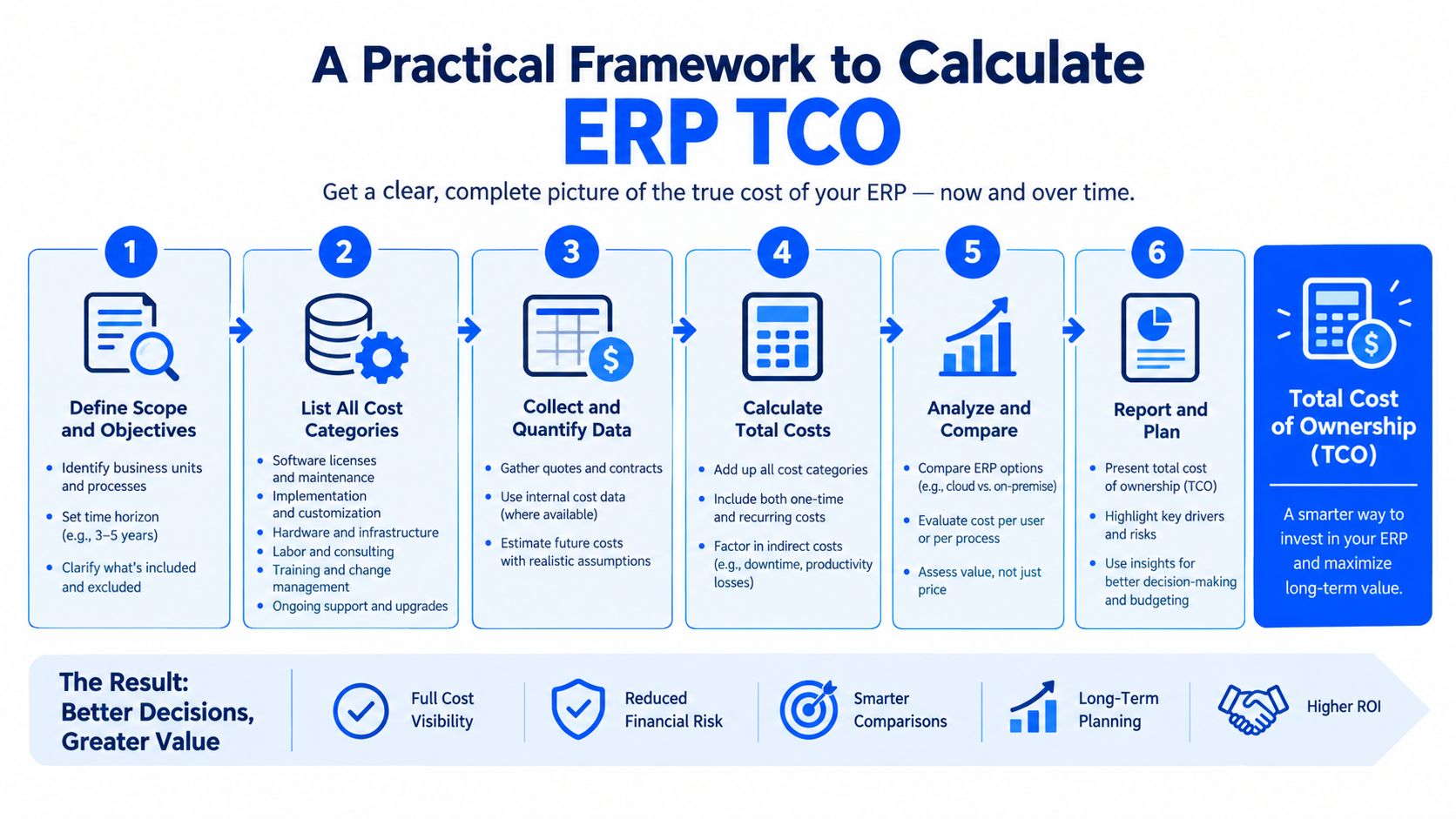
A Practical Framework to Calculate ERP TCO
A useful TCO worksheet should produce a range, not a single impressive quote. I recommend building the model in five passes and requiring the implementation partner to show which assumptions drive each line.
Start with Year 1 concentration
List every one-time and upfront cost first. That includes implementation services, data work, integrations, configuration, training, testing, internal labor, cutover, and temporary operating duplication. For a mid-market deployment with about 100 users, one industry cost model estimates that Year 1 represents 45% to 65% of five-year TCO because implementation, migration, and training are concentrated upfront (ERP TCO calculator).
Then calculate the run rate for Years 2 through 5. Add subscriptions, support, hosting, internal IT, reporting tools, integration maintenance, upgrades, and continuing training. Don't assume post-go-live costs fall to zero. The organization still needs ownership, controls, issue resolution, and release management. If you want a broader framework for total technology budgeting, Gartner's IT key metrics research overview and McKinsey's perspective on capturing value from tech investments can help pressure-test long-term assumptions. For another angle on budgeting structure, NBS's CFO guide to ERP evaluation and Rand Group's discussion of cloud ERP cost savings offer additional context on planning assumptions and operating tradeoffs.
Price internal capacity
Create separate lines for the CFO, Controller, finance users, IT, operations, executives, and subject-matter experts. Use an internal hourly rate for each group and estimate time spent on discovery, design, data validation, testing, training, cutover, and stabilization.
This step changes the conversation. The project may be affordable in cash terms but unaffordable in operational capacity if the finance team can't maintain the close while implementing the new system. For a practical management accounting lens, the Corporate Finance Institute's resource on cost allocation methods can help teams assign labor cost more consistently.
Model risk and adoption
Build at least three cases:
- Baseline: Planned scope, schedule, staffing, and adoption.
- Overrun: Apply sensitivity to implementation cost using the 17% and 32% overrun scenarios supported by ERP cost research (ERP cost overrun research).
- Delayed value: Add consulting, internal labor, temporary workarounds, and postponed benefits when the schedule slips or adoption remains incomplete.
The final worksheet should show planned cost, risk-adjusted cost, recurring cost, transition cost, and the economic effect of delayed reporting or automation. It should also show what happens if the business licenses more functionality than users adopt.
A readiness review is valuable before negotiations begin. Use a structured ERP readiness assessment checklist to expose data, process, staffing, and decision gaps while there's still time to address them. PMI's library of project risk resources at Project Management Institute can also help finance teams think more rigorously about contingency planning and governance.
Worked Examples for Healthcare Nonprofits DSOs and QuickBooks Migrators
The same TCO framework behaves differently depending on how the organization operates. The implementation isn't expensive because it has a particular industry label. It's expensive when the label represents more entities, more integrations, more reporting obligations, more users, or more difficult adoption.
Healthcare and multi-site clinics
A healthcare provider may need accounting to connect with an EMR, practice-management platform, payroll, banking, and reporting tools. The TCO model should price interface design, transaction mapping, reconciliation, security decisions, testing, and the internal time required from people who already support patient operations.
The business case should also measure time-to-value. If finance leaders can't see location performance, provider economics, or cash activity until manual reconciliations are complete, delayed visibility has an operational cost. Sage Intacct with a disciplined Lucentive implementation can be evaluated against outcomes such as real-time dashboards, multi-entity control, and a clean audit trail. For external context, HFMA's healthcare finance resources at HFMA, HFMA UK's publication on implementing electronic patient records, and HIMSS guidance on healthcare interoperability are useful when estimating integration and reporting effort.
Nonprofits and faith-based organizations
Nonprofits need more than a general ledger replacement. Fund accounting, grant reporting, restricted funds, program dimensions, donor reporting, and board reporting affect configuration, chart-of-accounts design, data migration, and testing.
Budget for the people who understand grant rules and program operations. If those subject-matter experts can't participate, the organization may complete technical configuration while missing the reporting structure leadership needs. Independent Sector's nonprofit resource library at Independent Sector and the National Council of Nonprofits page on financial management offer additional context for governance and reporting expectations.
DSOs and professional-services firms
DSOs often face entity, location, transaction-volume, and practice-management complexity. Professional-services firms may need project accounting, time capture, billing, revenue visibility, and project reporting. In both cases, the cost of a module depends on whether users adopt the workflow and whether leadership uses the resulting information.
The adoption question is frequently missing from ERP calculators. A 2025 survey of 1,000 UK and Irish CFOs and finance leaders found that 60% used half or fewer of the features they had purchased, while 95% reported hidden post-go-live costs (CFO and finance leader ERP adoption survey). Treat those findings as a warning about utilization, not as an argument to buy less software automatically. Services Performance Insight also publishes benchmarking research at SPI Research that can help professional-services firms assess utilization and reporting expectations.
QuickBooks migrators
A QuickBooks migration often looks simpler than it is because the organization knows the current system intimately. The hard work is deciding which history to move, cleaning the chart of accounts, standardizing entities, designing dimensions, defining approval controls, and replacing spreadsheets that support critical reporting.
Map every paid module to actual users, transactions, reports, and business outcomes. Then compare fully adopted, partially adopted, and minimum viable configurations. Lucentive's Sage Intacct versus QuickBooks comparison can help frame the decision around control and reporting rather than feature volume. It also helps to review Intuit's own overview of when to move beyond QuickBooks and CPA Practice Advisor's articles on finance system upgrades when setting realistic migration expectations.
The first 90 to 180 days after go-live deserve their own budget line for training, stabilization, support, and productivity loss. A system creates value only when people use the processes consistently.
Across the body of the business case, it also helps to anchor assumptions to outside benchmarks. For implementation governance and finance transformation context, CFOs can reference Deloitte's perspective on ERP implementation and finance modernization, PwC's guidance on digital finance and operating model change, and KPMG's overview of technology implementation risk and controls. For operating-cost benchmarking, Nucleus Research's resource center at Nucleus Research adds another useful lens when evaluating ERP value, adoption, and payback assumptions.
Summary
ERP TCO is a five-year business model covering implementation services, migration, integrations, training, internal labor, support, hosting, upgrades, and cutover productivity loss. Cloud and on-premise systems place cost and responsibility in different areas, especially maintenance, infrastructure, customization, and upgrade work. The actual cost also depends on adoption, unused capability, internal capacity, and time-to-value. For CFOs moving beyond QuickBooks, the right partner and implementation discipline matter as much as the software. Evaluate Sage Intacct against faster close, real-time dashboards, multi-entity control, and a clean audit trail before approving a platform alone.
Frequently Asked Questions
What does ERP total cost of ownership include?
ERP TCO includes the full lifecycle cost, not just licensing or subscription fees. Include implementation, data cleansing and migration, integrations, configuration, customization, testing, training, internal project labor, support, hosting, reporting, upgrades, and productivity loss during cutover. Also account for temporary dual-system operation, overtime, contractor support, manual reconciliation, and the internal capacity diverted from normal finance and operations work.
Is cloud ERP always cheaper than on-premise ERP?
No. Cloud ERP usually shifts more cost into recurring subscription and operating expense while reducing infrastructure ownership. On-premise ERP may offer greater control, but the organization owns more hardware, maintenance, internal support, custom-code remediation, and upgrade work. Compare five-year cash flow, IT capacity, customization needs, security responsibilities, and update requirements instead of judging either model from the initial invoice.
How should a CFO budget for ERP overruns?
Build a baseline case and a risk-adjusted range. Show implementation, operating, transition, and internal labor costs separately, then test sensitivity for schedule slippage, staffing changes, scope growth, and delayed benefits. The model should also include the cost of temporary workarounds and incomplete adoption. A partner should document assumptions, dependencies, change-order exposure, and stabilization responsibilities before the contract is approved.
What changes for healthcare and nonprofit ERP projects?
Healthcare organizations should price EMR, practice-management, payroll, banking, reporting, security, reconciliation, and multi-site requirements. Nonprofits should account for fund accounting, grant reporting, restricted funds, program dimensions, and board reporting. Both need internal subject-matter experts involved in design, validation, testing, and training. Those requirements affect TCO because they increase process, data, integration, and adoption work.
How should QuickBooks migrators avoid overbuying?
Start with the reporting and control gaps that caused the organization to outgrow QuickBooks. Map each proposed module to users, transactions, reports, and measurable business outcomes. Compare fully adopted, partially adopted, and minimum viable configurations. A broader ERP only creates value when finance and operations can absorb its workflows, maintain clean data, and use the reporting consistently.
When should we speak with Lucentive?
Speak with Lucentive before selecting a partner or approving Sage Intacct alone. A working session can clarify scope, internal capacity, integrations, data requirements, adoption risks, and the outcomes you need from the investment. That gives the CFO, Controller, CEO, or VP Finance a more reliable basis for evaluating fit and time-to-value.
Lucentive helps mid-market, healthcare, nonprofit, DSO, and professional-services organizations evaluate Sage Intacct through a practical TCO and implementation lens. Visit Lucentive to schedule a 30-minute working session or customized Sage Intacct demo and see whether the platform and implementation approach fit your company.