Your month-end close is slipping, but the problem isn't always the accounting software. It may be the decision behind the implementation. A weak Sage Intacct consultant can leave you reconciling two systems, defending inconsistent revenue classifications, and rebuilding reports that were supposed to replace spreadsheets. A strong one gives your finance team a controlled migration, reliable dimensions, tested integrations, and a practical path to better reporting.
That distinction matters for CEOs, CFOs, Controllers, and VPs of Finance moving beyond QuickBooks or trying to bring order to a multi-entity environment. QuickBooks was designed for simplicity, but that simplicity can make it easy to modify or remove valid transactions accidentally or fraudulently, as RSM's white paper on financial controls beyond QuickBooks explains. Sage Intacct can provide a more structured financial foundation, but software alone won't create control. The consultant you hire determines how well the system reflects your business.
Table of Contents
- The Cost of Hiring the Wrong Sage Intacct Consultant
- Migration Specialist Versus Implementation Partner
- Questions That Expose a Strong or Weak Consultant
- Engagement Models and How to Choose One
- What Happens After Go-Live
- Red Flags That Predict a Failed Implementation
- Summary
- Frequently Asked Questions
The Cost of Hiring the Wrong Sage Intacct Consultant
A Controller takes over a finance operation where the close keeps stretching, audit questions keep multiplying, and leadership still depends on Excel to explain revenue. QuickBooks may have worked with one entity and a simple chart of accounts. Growth changes the equation. More locations, contracts, departments, projects, and billing arrangements expose weaknesses that manual workarounds once hid.
The wrong consultant converts that pressure into rework. A poorly designed chart of accounts forces finance to rebuild reports outside the ERP. Weak revenue recognition configuration creates classification disputes. Incomplete migration mapping leaves the team comparing legacy balances with new-system activity without a clear reconciliation trail. The company then pays for reimplementation while finance leaders explain why the system does not reflect the business.
Hiring standard: Buy implementation judgment, not just access to Sage Intacct.
What the consultant owns
A qualified Sage Intacct consultant is a financial systems professional, not a salesperson who can enter configuration settings. The role should cover implementation, post-go-live support, integrations, reporting, and client training. Recent hiring activity places experienced consultant compensation at about $80,000 to $150,000 per year, while some contract guidance places rates around $75 to $135 per hour. These figures indicate the specialized nature of the work, as shown in this Sage Intacct consultant hiring profile. For a broader view of what ERP consultants and implementation teams typically handle, compare those expectations with guidance from Indeed's ERP consultant job overview and CFO.com's coverage of ERP implementation accountability.
Require specific deliverables throughout the engagement:
- Requirements discovery: Document revenue recognition, entity structure, reporting needs, approval rules, and operational pain points.
- Chart of accounts redesign: Separate account structure from business context so management reporting does not depend on endless account proliferation.
- Dimensional planning: Define how department, location, project, customer, class, vendor, and other dimensions will support reporting.
- Migration mapping: Identify which historical transactions, open receivables, payables, assets, and balances will move, then define how the team will validate them.
- Integration architecture: Assign ownership for EMR, payroll, billing, CRM, AP automation, and other connected systems.
- Close configuration: Build workflows, reconciliations, allocations, and reports around the actual close process.
- Stabilization: Resolve defects, retrain users, and adjust reporting after live activity begins.
The first weeks should produce requirements and design decisions, not rushed configuration. Use a requirements matrix with phase gates tied to sign-off, reconciliations, and tested workflows. That control matters. Broader ERP research reports that 55% to 75% of ERP projects miss objectives, while only about 23% to 32% are considered fully successful. The same ERP project risk analysis identifies data migration, change management, and inexperienced teams among recurring failure drivers. Similar themes appear in Panorama Consulting's ERP Report, which highlights project overruns, scope issues, and adoption challenges. Additional context from TechTarget's ERP implementation guide reinforces how often planning and governance failures undermine ERP outcomes.
Consultant role versus generic reseller
| Capability | True Consultant | Reseller |
|---|---|---|
| Discovery | Documents finance requirements and operational constraints | Leads with a standard product demonstration |
| Design | Builds a chart of accounts and dimensional model for the business | Reuses a template with limited redesign |
| Migration | Maps, validates, and reconciles legacy data | Treats data transfer as a technical task |
| Integrations | Defines ownership, testing, exception handling, and support | Hands complex connections to another party |
| Training | Provides role-based instruction tied to real workflows | Delivers broad system orientation |
| Post-go-live | Plans stabilization and continuous optimization | Considers the project substantially complete at launch |
Read the project economics before approving a proposal. This guide to planning ERP implementation costs, time, and resources provides a framework for staffing, timing, and budget. It is also worth comparing the vendor's promises with broader implementation guidance from Gartner's ERP research overview, NetSuite's ERP implementation planning guide, and IBM's ERP explainer. Set the hiring bar clearly: the assigned lead must understand accounting design, data reconciliation, integrations, and organizational change under operating pressure. Ask for named owners, written deliverables, and evidence that the firm will remain accountable after launch.
Migration Specialist Versus Implementation Partner
The first decision isn't whether a firm can configure Sage Intacct. It's whether your project is mainly a clean implementation or a difficult migration.
Start with the legacy environment. Review trial balances, open AR and AP, intercompany balances, fixed asset registers, revenue contracts, and transaction history. If those records come from multiple systems or contain inconsistent coding, a migration specialist should own extraction, mapping, validation, and reconciliation. A standard implementation partner may be perfectly capable of configuring modules, but that doesn't mean the firm can reconstruct an audit-sensitive history.
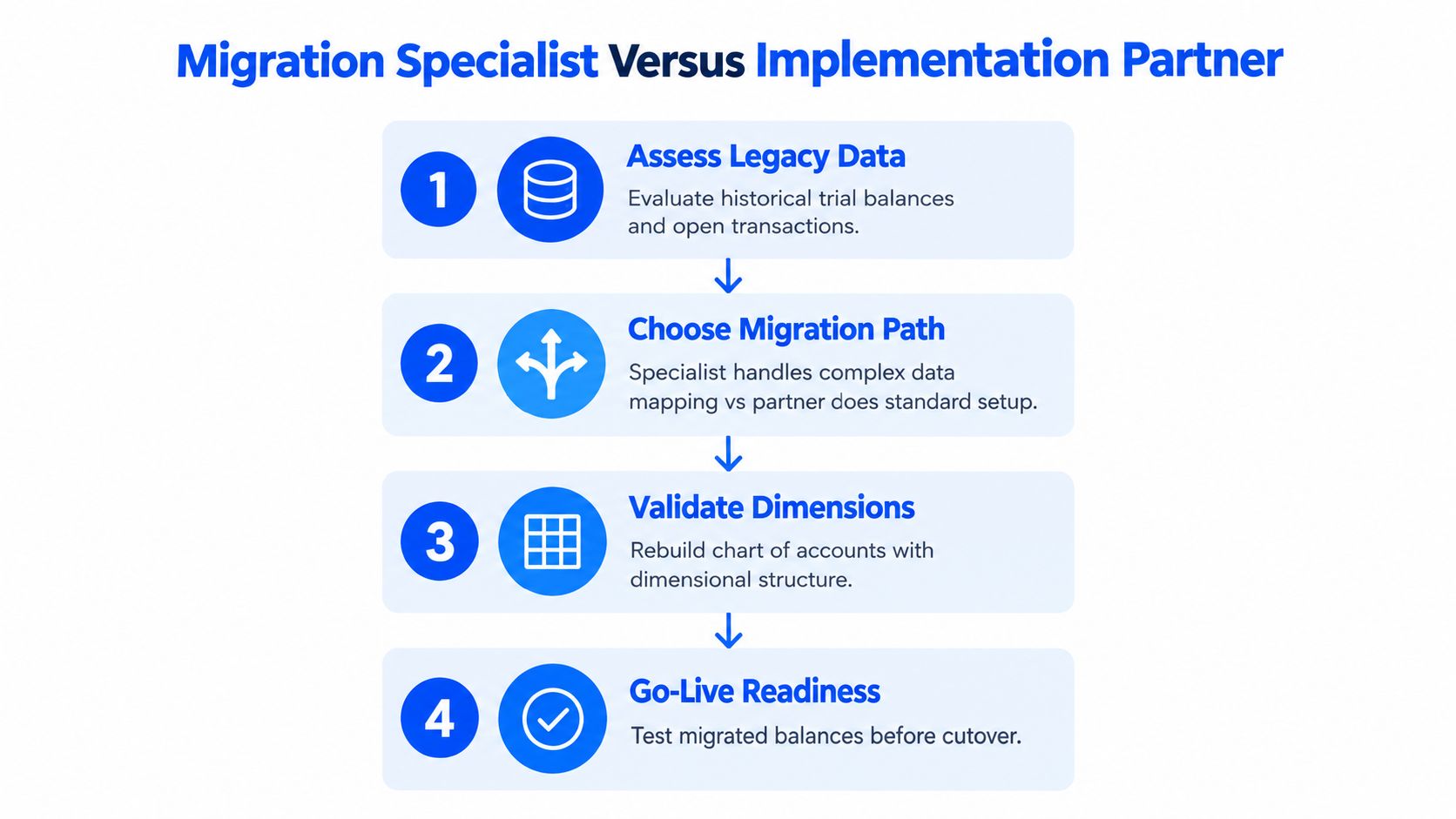
Use this decision flow:
- Assess the legacy data. Clean books, consistent account structures, and limited history may support a focused implementation. Fragmented records point toward migration expertise.
- Review the integrations. Native connectors can help, but your stack may still require middleware or custom API work. Ask who owns failures after launch. For a practical framing of API and middleware trade-offs, see MuleSoft's integration strategy overview.
- Test dimensional conversion. Sage Intacct's general ledger stores business context for transactions, budgets, and measures, with dimensions such as project, customer, location, department, vendor, item, employee, and class, as documented in Sage Intacct's general ledger materials.
- Validate before cutover. The consultant should profile data early, clean duplicates and inconsistencies, and test migrated balances before the business relies on them.
Healthcare groups may need to reconcile EMR, billing, payroll, and entity data. Nonprofits may need to preserve fund and grant reporting. DSOs often inherit different practice systems and inconsistent historical coding. In those environments, a migration specialist isn't an optional upgrade. The partner's ability to preserve relationships among transactions, dimensions, and audit trails is the risk decision. For additional migration due diligence, review Deloitte's guidance on ERP data migration risks, Oracle's overview of ERP integration considerations, and BMC's summary of common data migration risks.
For teams moving from QuickBooks, review the scope of QuickBooks data migration services before accepting a proposal that treats migration as a checkbox.
Questions That Expose a Strong or Weak Consultant
Vendor interviews should operate like an investment committee review. Don't score chemistry first. Score evidence.
Ask the assigned lead how many Sage Intacct implementations they ran in the relevant period, and how many involved companies in your revenue band and industry. Ask for a redacted chart of accounts from a comparable build. A capable consultant should explain why dimensions were structured in that way, which reports the design supports, and which compromises the client accepted.
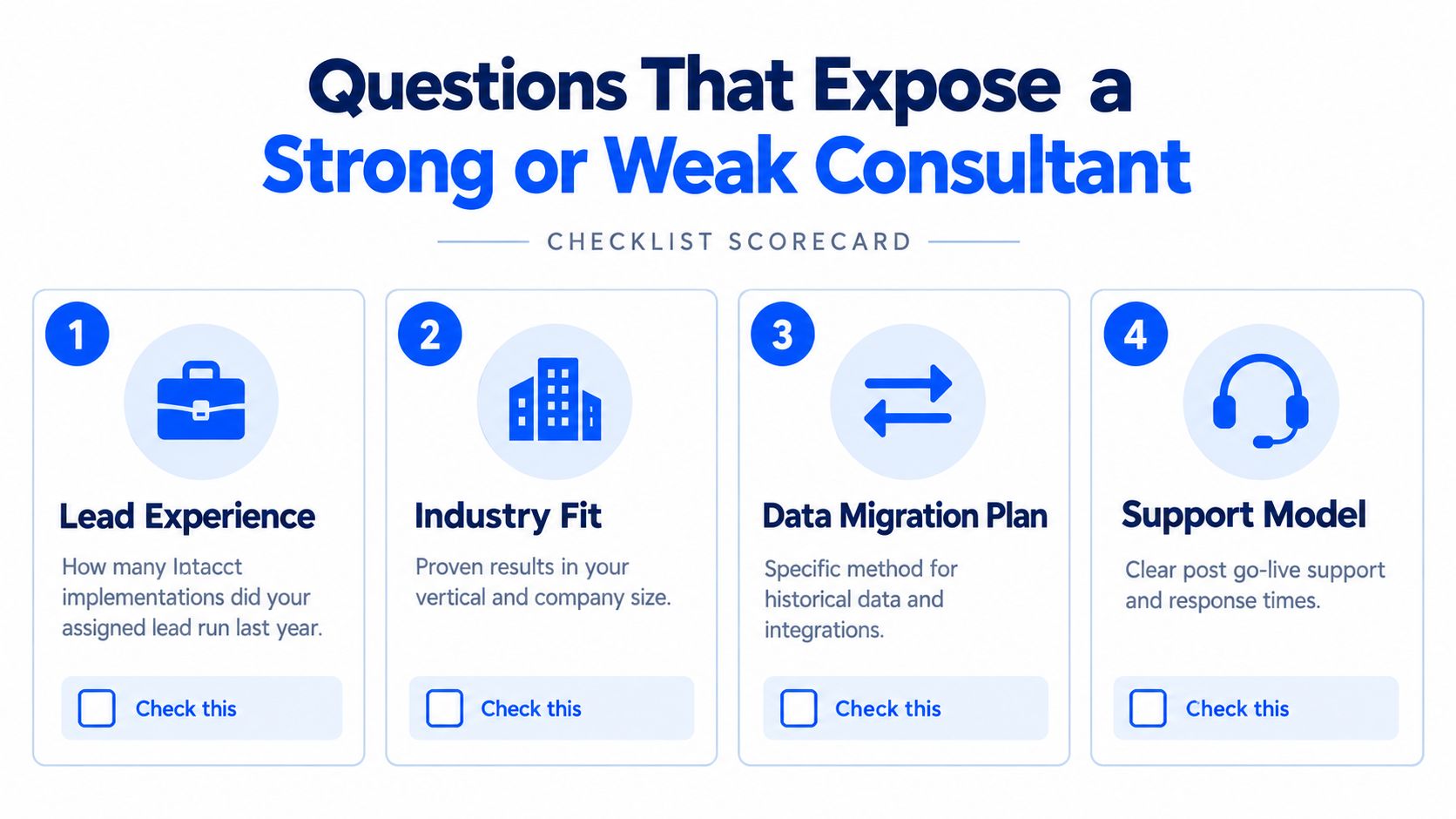
Use these questions as decision criteria:
- “How do you handle historical subledger detail that won't reconcile one-to-one?” Look for a documented mapping and validation approach, not a promise to “clean it up later.”
- “Which integrations do you own?” The proposal should identify responsibility for EMR, payroll, billing, CRM, AP, middleware, and custom API work.
- “Who is named on our statement of work?” If the seller can't identify the delivery lead, you don't know who you're hiring.
- “What happens if that consultant leaves?” Require a transition process, documentation standards, and an accountable replacement.
- “How would you respond to an audit trail problem or restated financials during cutover?” The answer should address governance, reconciliation, escalation, and documentation.
- “How does post-go-live support work?” Ask about defect triage, training, release updates, response commitments, and ownership when a connector breaks.
Weak vendors hedge, offer vague references, or avoid showing their work. Strong vendors can discuss trade-offs. They'll tell you when full historical detail is unnecessary, when a standard connector is insufficient, and which requirements should remain outside the initial scope. If you want a neutral procurement lens, McKinsey's work on technology transformations, PwC's ERP advisory perspective, and Harvard Business Review's change management archive all reinforce the importance of operating model fit, governance, and adoption.
Your scorecard should separate proof of execution from enthusiasm. A polished demo proves that someone knows the product. It doesn't prove that the team can protect your close, migration, or audit trail.
Engagement Models and How to Choose One
Contract structure should match project risk. Vendors often prefer the structure that makes their revenue easiest to forecast. You should choose the structure that makes scope, accountability, and change visible.
| Model | Best Fit | Risk to Buyer | Cost Predictability |
|---|---|---|---|
| Fixed scope | Standard implementation with defined requirements and limited integrations | Hidden assumptions can trigger change orders | High at signing, weaker if scope is incomplete |
| Time and materials | Complex migration, evolving requirements, and integration-heavy work | Spend can expand without strong governance | Moderate |
| Managed services | Ongoing support, close assistance, training, and system optimization | The buyer may pay for capacity it doesn't use | High on a recurring basis |
| Hybrid | Core build with uncertain integrations, reports, or enhancements | Responsibility can become unclear between workstreams | Moderate to high |
Fixed scope works only when requirements, data complexity, and integrations are known. That condition is uncommon in a messy mid-market migration. If a vendor offers a low fixed price without inspecting your data, the price is likely hiding assumptions rather than reducing risk.
Time and materials is often the most honest structure for complicated work. Require a written cap, weekly burn reports, named hourly rates by role, and a clear approval process for work beyond the cap. The contract should also explain what happens to unused hours.
Managed services makes sense when your finance team wants a fractional Controller-plus-systems function after launch. It can combine user support, month-end close assistance, release updates, and reporting improvements.
Hybrid pricing often gives buyers the best balance. Fix the core design and configuration scope, then use time and materials for integrations, custom reports, and approved change requests. Ask who owns scope creep, how change orders are priced, and whether stabilization is included or billed separately.
A proposal should be evaluated on total cost, not the opening number. Budget overruns can be severe in ERP work. Some research reports average implementation cost overruns of about 189%, while 64% of organizations exceed original budgets, according to implementation cost research cited by Rand Group. A clear contract is risk control. For another outside view on cost planning and scope discipline, see Forbes Advisor's ERP implementation overview, Microsoft's ERP implementation guidance, and Investopedia's ERP definition and planning summary.
For a practical view of the core delivery scope, compare the proposal with Sage Intacct implementation services.
What Happens After Go-Live
Go-live is not the finish line. It's the point when your configuration meets live bank feeds, real invoices, actual payroll, intercompany activity, and users working under close pressure.
The first 90 days need a defined stabilization plan. Bank feeds may fail. Intercompany eliminations may drift. Dimensional reports may reveal errors that test scripts didn't expose. Auditors may ask questions that weren't obvious during design. A serious partner assigns a named escalation contact, runs regular defect triage, and provides a written commitment for response handling.
Your support conversation should cover four operating stages:
- Stabilization: Fix access, bank feeds, workflows, and data exceptions quickly.
- Optimization: Correct reporting, allocations, eliminations, and approval paths that don't work as expected.
- Review: Validate the close process, automation, integration health, and user adoption.
- Scale: Decide which deferred capabilities, such as revenue recognition, fixed assets, or project accounting, deserve attention next.
Sage Intacct delivered 254 new features in 2025, increasing the importance of structured release management, as reported in this consultant selection guidance. Your partner should review release changes, perform regression testing, explain potential impact in plain English, and retrain affected users. That expectation aligns with broader software governance advice from ISACA's guidance on change management, KPMG's technology risk insights, and Atlassian's release management overview.
Ask for a roadmap review at the six-month mark. The discussion should cover custom report performance, integration reliability, workflow friction, close effectiveness, and the modules originally deferred. Change management isn't a training event. It is the operating discipline that keeps the system aligned with the business, which is why ERP change management support belongs in the buying criteria.
Finance teams already feel the cost of a slow close. A 2025 survey cited in a mid-market close benchmark found that 50% of finance teams take six or more business days to close, while 18% close in three days or less. Post-go-live optimization should focus on the work that determines whether your team can produce reliable reporting faster. For a broader finance operations perspective, see AFP's treasury and finance resources and The CFO Club's finance leadership insights.
Red Flags That Predict a Failed Implementation
A polished sales presentation can hide a weak delivery plan. Test the consultant during discovery. The questions they ask, the evidence they provide, and the risks they name reveal more than presentation quality.
The warning signs
- Vague timeline: The proposal gives a launch date but omits requirements sign-off, migration rehearsal, testing gates, training milestones, and the cutover decision.
- Senior seller disappears: The person who understands your business sells the work, then a junior team takes over without a documented handoff or continuity plan.
- No data strategy: The consultant explains configuration but cannot show how it will profile, cleanse, map, validate, and reconcile legacy data.
- Fixed price without scope: The bid looks unusually low, while exclusions, assumptions, integrations, reports, and change-order pricing remain unclear.
- Demo data only: The consultant presents a generic company instead of testing your chart of accounts, dimensions, approval paths, and reporting questions.
- Unclear integration ownership: The proposal names connectors but does not state who resolves failures across Sage Intacct, payroll, billing, EMR, CRM, or middleware.
The vague timeline and missing data strategy are deal-breakers. Without phase gates and a migration method, you cannot govern the work or verify readiness. A senior consultant can leave the account only when the firm names the delivery lead, documents responsibilities, and commits to continuity. Fixed price works when scope is defined. Low pricing without clear exclusions is a risk signal, not a bargain. For a broader warning framework, compare finalists against CIO's ERP failure analysis, BAIN's change management insights, and MIT Sloan Management Review's digital transformation analysis.
Practical test: Ask each finalist to identify the three assumptions most likely to change the project price. If they cannot, they have not investigated the project thoroughly enough.
Score every finalist against the same criteria: lead experience, industry fit, data methodology, integration accountability, scope control, and post-go-live support. Require evidence for each score, including sample deliverables, named responsibilities, and relevant references. A reference from a simple implementation does not validate a complex healthcare, nonprofit, or DSO migration.
Use Sage Intacct's solution overview to sharpen questions about capabilities and implementation fit. It should support vendor diligence, not replace it. The consultant still must prove how the proposed design, migration controls, and ownership model will work for your finance team.
Summary
The Sage Intacct consultant you choose will shape your migration, close process, reporting model, and ongoing finance operations. Match the consultant type to your data and integration complexity. Evaluate finalists with evidence about assigned leads, migration methods, ownership, scope, and support instead of relying on sales chemistry. Treat the first 90 days after go-live and continuing release management as part of the purchase. Sage Intacct can provide structured dimensional reporting and stronger financial control, but the right partner turns those capabilities into a working operating system for your finance team.
Frequently Asked Questions
What does a Sage Intacct consultant typically cost?
Experienced Sage Intacct consultant compensation is commonly advertised around $80,000 to $150,000 per year, with some contract guidance placing hourly rates around $75 to $135. Your project cost will depend on migration complexity, integrations, reporting, training, and post-go-live support. Compare proposals by scope, staffing, assumptions, and accountability. The lowest initial quote may not produce the lowest total cost if it excludes migration validation or stabilization.
How long should a mid-market implementation take?
There isn't a responsible universal timeline. The duration depends on the number of entities, quality of historical data, integrations, reporting requirements, workflow design, training, and decision speed. Require a plan with requirements sign-off, configuration, migration rehearsals, testing, training, cutover, and stabilization. A launch date without phase gates is a warning sign because it hides the work required to make the system dependable.
Should the implementation firm also provide post-go-live support?
Usually, yes, if the firm has the right support model and understands your configuration. The first 90 days can expose bank-feed, intercompany, dimensional-reporting, access, and workflow issues. Your agreement should identify a named escalation contact, defect-triage process, response commitments, release-management responsibilities, and training support. If another provider will handle support, define the handoff before signing the implementation contract.
How can we verify Sage Intacct certifications?
Ask the firm to identify the certifications held by the people assigned to your project, then confirm that those individuals are named in the statement of work. Certification matters, but it doesn't replace evidence of relevant implementation experience. Ask for comparable references, a redacted chart of accounts, examples of migration work, integration ownership, and an explanation of how the lead would handle reconciliation or audit issues.
How should we choose between two strong finalists?
Compare the assumptions and delivery commitments. Ask who owns data migration, integrations, change requests, training, stabilization, and release updates. Review the assigned team's industry experience and the quality of the proposed phase gates. If pricing and references are similar, choose the firm that explains trade-offs more clearly and provides stronger continuity after launch. You're buying operating judgment, not merely a Sage Intacct license.
Lucentive helps finance leaders plan, implement, optimize, and support Sage Intacct across healthcare, nonprofit, dental, and growing mid-market organizations. Schedule a 30-minute working session or demo through Lucentive to pressure-test your migration risks, reporting needs, and partner selection before you commit.