If your family office still closes the month through a chain of spreadsheets, custodian exports, emailed PDFs, and a controller who knows where everything lives, your reporting risk is already too high. The problem usually isn't one filing. It's that one entity is treated like an investment vehicle, another like an operating company, a third like a holding company, and nobody has mapped what each one owes, where, and when.
That's why most discussions of family office reporting requirements miss the point. This isn't a single checklist problem. It's a structure problem, a data problem, and then a software problem. When the structure is messy, the reporting stack turns into rework, conflicting submissions, weak audit trails, and governance packs that arrive too late to help anyone decide anything.
Table of Contents
- The Reporting Reality Most Family Offices Face
- What Counts as a Family Office for Reporting Purposes
- US Regulatory and Tax Reporting Obligations
- Cross-Border Reporting Under FATCA CRS and New Transparency Rules
- Financial Statements Consolidation and Governance Reporting
- AML KYC and Day-to-Day Compliance Operations
- Audit Documentation and the Technology Behind It
- Putting It Together A Reporting Checklist and Next Step
- Summary
- Frequently Asked Questions
- Why do family office reporting requirements get so messy?
- Does being a family office automatically determine which rules apply?
- When does a family office need to think about Form 13F?
- What is the biggest mistake in cross-border reporting?
- What should be in a monthly family office reporting pack?
- How should a family office handle beneficial ownership data operationally?
- Is software enough to fix reporting problems in a family office?
The Reporting Reality Most Family Offices Face
Most family offices weren't built as reporting organizations. They were built to get things done. One trust held the marketable securities. Another entity owned real estate. A management company paid staff. A private vehicle handled a co-invest. Then someone added a foundation, an overseas holding entity, or a special-purpose company for a one-off asset.
That works until the office grows. Then every entity has its own deadline, its own support files, and its own version of “final.” The finance team starts reconciling the same activity more than once. Legal keeps one ownership chart, tax keeps another, and the investment team has a third version in a deck.
What usually breaks first
The first thing that breaks is consistency. The second is timing.
You see the same issues repeatedly:
- Entity sprawl: New vehicles get formed faster than reporting ownership is documented.
- Manual consolidation: Trial balances are exported, reformatted, and stitched together outside the ledger.
- Conflicting classifications: One entity is treated one way for tax, another way for transparency reporting, and nobody checks whether those positions line up.
- Weak evidence control: Support sits in inboxes and shared drives instead of a system with a clean trail.
- Late decision support: By the time the principal or board sees a report, the decisions have already been made informally.
Practical rule: If your reporting depends on one person remembering which spreadsheet drives which filing, you don't have a reporting process. You have a key-person risk.
Good family office reporting requirements start with a map, not a form. You need a legal entity list, ownership chain, jurisdiction list, filing calendar, and data owner for each reporting obligation. Only after that should you decide how to automate it.
For finance leaders evaluating platforms, that's where a purpose-built family office accounting approach in Sage Intacct becomes relevant. The value isn't the software alone. It's the ability to run one reporting cadence across separate entities without losing privacy, tax separation, or control.
The seven areas that matter
In practice, a family office reporting stack stands or falls on seven areas:
- Entity and jurisdiction mapping
- U.S. regulatory and tax filings
- Cross-border transparency
- Financial statements and governance packs
- AML and KYC operations
- Audit documentation discipline
- Technology and workflow control
If those seven aren't aligned, reporting runs the office instead of the office running reporting.
What Counts as a Family Office for Reporting Purposes
A principal asks for a “family office reporting checklist.” The controller pulls one together. Two weeks later, legal points out that the trust company, Delaware LLC, Cayman vehicle, and operating holding company do not share the same reporting status. That is the normal starting point, and it is why weak reporting programs miss filings.
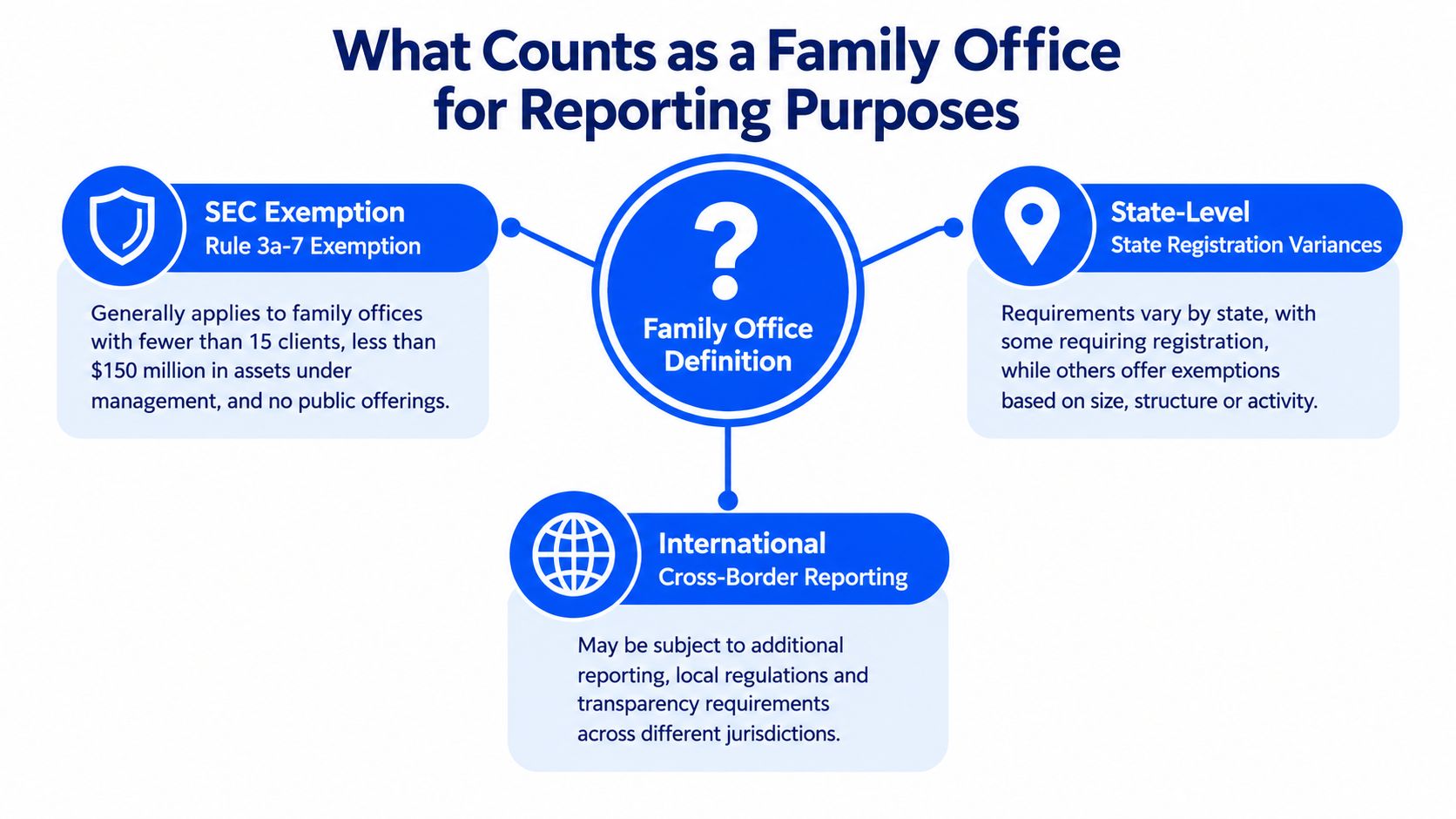
The label sounds like a category, but for reporting purposes it describes nothing on its own.
Structure decides the rulebook
Reporting obligations attach to legal entities, activities, assets, and jurisdictions. “Family office” is only an umbrella term for a collection of those parts.
A management company, trust structure, private investment vehicle, and holding company can all sit under one family office banner while falling into different reporting buckets. One may be an investment adviser for one purpose, a service company for another, and outside scope entirely for a third. For FATCA and CRS, the classification question is usually more specific: is the entity a financial institution, an active NFE, or a passive NFE? The answer drives due diligence, self-certifications, account reviews, and reporting workflows, as the OECD's CRS guidance makes clear (OECD guidance on CRS due diligence and entity classification).
Start with five questions and answer them for every entity:
- What is the legal form of the entity
- Where is it formed, managed, and tax resident
- What activity does it perform
- Who owns it or controls it
- Which filings depend on data from that entity
That exercise sounds basic. It is where good reporting stacks are built. For U.S. entity classification, state-level formation records and tax residency analysis often need to be reconciled against IRS entity treatment rules and filing posture, which is why many teams keep the IRS businesses and self-employed portal and current entity form instructions close at hand during setup.
One office, multiple reporting identities
A single family office can sit in several reporting regimes at the same time. That is the point many teams miss.
A U.S. management entity may avoid SEC registration and still have other securities reporting exposure. A domestic holding company may have beneficial ownership reporting triggered by its formation or registration status. A non-U.S. investment vehicle may create FATCA or CRS work even if the U.S. entities do not. An underlying trust may drive tax documentation and governance reporting even when it never files market-facing forms itself.
Good practice is to build an entity matrix before you build a filing calendar. Put each entity on one line. Assign its jurisdiction, tax status, ownership chain, operational role, and likely reporting regimes. Then force every later process to use that same map across CTA or BOI, FATCA or CRS, Form 13F, Form PF, audit support, and board reporting.
Good reporting starts with classification discipline. If the entity map is wrong, every downstream filing, certification, and control review gets harder.
The right question is never “does the family office have a reporting obligation?” The right question is “which entity has which obligation, in which jurisdiction, based on which activity?” Once you work that way, the reporting stack becomes consistent instead of reactive.
US Regulatory and Tax Reporting Obligations
U.S. family office reporting obligations don't come from one regime. They come from several, each with a different trigger. If you treat them as one bucket, you'll miss something important.
The filings that matter most
Form 13F is where many larger family offices get surprised. In the United States, a family office can become subject to SEC Form 13F reporting even if it isn't a registered investment adviser, because Section 13(f) applies to any “institutional investment manager” with discretion over at least US$100 million in Section 13(f) securities. The threshold is tested on the last trading day of any month, the filing is quarterly and public, and the SEC's FAQ states the filing is due within 45 days after each calendar quarter-end (SEC Form 13F FAQ). For teams that want the primary filing document, the SEC also publishes the official Form 13F. Once triggered, the manager must keep filing for four consecutive quarters even if assets later fall below the threshold. The SEC also expanded the framework so each Form 13F filer must make an annual Form N-PX filing beginning July 1, 2024, disclosing votes on pay-related shareholder proposals in public-company portfolios. The official filing form is available directly from the SEC as Form N-PX, alongside the practical overview in Squire Patton Boggs on Section 13(f) compliance.
Form PF is a separate question. Under SEC Form PF rules, advisers that are registered or required to be registered with the SEC and that manage one or more private funds must file Form PF if they and their related persons collectively have at least $150 million in private fund assets under management as of the last day of the most recently completed fiscal year. A proposal would raise that threshold to $1 billion, and separately operated related persons are excluded from the threshold calculation (SEC proposed Form PF threshold update). For primary-source reference, the SEC also publishes the official Form PF and maintains the Private Fund Reporting Depository information page, which confirms electronic filing through the PFRD system.
Corporate transparency changed the entity analysis
Beneficial ownership reporting has become more nuanced than many offices expected. FinCEN's updated rule now exempts U.S. companies from beneficial ownership information reporting, and only certain foreign companies registered to do business in the U.S. must report. Those foreign companies do not need to report BOI for U.S. person beneficial owners or U.S. person company applicants (FinCEN BOI reference materials).
Recent guidance has also sharpened the practical question for multi-entity family structures. The issue isn't “Do we have CTA work?” It's “Which entities are in scope?” That matters even more in cross-border structures, where jurisdiction-specific changes can alter what gets filed and by whom (Squire Patton Boggs on updated beneficial ownership requirements).
US Family Office Reporting Obligations at a Glance
| Filing | Triggering Threshold | Frequency | Typical Deadline | Owner |
|---|---|---|---|---|
| Form 13F | Discretion over at least US$100 million in Section 13(f) securities | Quarterly | Quarterly filing after trigger | CFO, Controller, compliance lead |
| Form N-PX | Applies to each Form 13F filer beginning July 1, 2024 for pay-related shareholder proposal voting disclosure | Annual | Annual | Compliance lead with investment operations |
| Form PF | Adviser is registered or required to be registered with the SEC, manages private funds, and has at least $150 million in private fund AUM with related persons collectively, subject to proposed increase to $1 billion | Periodic under rule framework | Based on SEC filing rules | CFO, CCO, outside counsel |
| BOI reporting | For certain foreign companies registered to do business in the U.S. under updated FinCEN rule | Ongoing filing regime | Based on applicable BOI timing rules | Legal, compliance, corporate secretary |
My recommendation is simple. Put these regimes on separate tracks. Different trigger logic means different owners, support files, and review calendars. For teams building an internal filing calendar, it also helps to reference the SEC's EDGAR filer support resources and the SEC forms list so filing mechanics and form updates are checked alongside the legal analysis.
Cross-Border Reporting Under FATCA CRS and New Transparency Rules
A family office opens an account in Zurich through a BVI holding company, adds a Singapore investment vehicle, and has family members tax resident in the U.S., U.K., and Italy. Three months later, the controller is chasing three versions of the same owner list, two tax residency questionnaires, and a legal chart that does not match the onboarding file at the bank. That is the cross-border reporting problem. It is not one rule. It is conflicting data across entities, jurisdictions, and reporting regimes.
Treat FATCA, CRS, DAC6, and the newer transparency rules as one reporting architecture. Separate workpapers create avoidable breakpoints. Good family offices map obligations first by entity type and jurisdiction, then run them through one controlled data model for ownership, tax residency, controlling persons, account status, and documentation dates.
Classification determines the operating burden
The first decision is classification. Get that right before you discuss forms, portals, or filing calendars.
Under FATCA and CRS, the practical question is whether an entity is a reporting financial institution, a non-reporting financial institution, or a non-financial entity. That classification determines who performs due diligence, which self-certifications you must collect, whether controlling persons must be identified, and whether the entity itself reports or gets reported by a bank or custodian. In family office structures, one wrong classification tends to spread. It shows up in account opening records, tax forms, annual reporting files, and audit support.
My advice is blunt. Freeze classification centrally and review it whenever you add an entity, change investment activity, replace a manager, or move tax residency. Do not let each bank, administrator, or local adviser maintain its own version.
One operating model works better. Keep a single record for each entity and person, with fields for FATCA status, CRS status, tax residencies, TINs, controlling-person status, document expiry, and local filing owner. A cleaner multi-entity accounting structure supports that model because the legal entity map, consolidation logic, and compliance population draw from the same underlying records.
What each regime actually asks you to do
The table below is the version I would use with a family office team because it helps assign owners and calendars, not just define acronyms.
| Regime | Main trigger | Typical filer | Core timing | Practical threshold or test |
|---|---|---|---|---|
| FATCA | Entity is a foreign financial institution or other in-scope payee/account holder under FATCA rules | Reporting foreign financial institution, or withholding agent/bank depending on role | Usually annual reporting under local IGA rules. IRS Form 8966 is generally due by March 31 following the reporting year, and the IRS provides both the About Form 8966 page and the Form 8966 instructions for current filing details | No simple dollar threshold for whether classification applies. The threshold question is status and account relationship |
| CRS | Entity is a reporting financial institution in a CRS-participating jurisdiction and maintains reportable accounts | Reporting financial institution | Annual due diligence and annual reporting to the local authority, which then exchanges information with partner jurisdictions. The OECD's CRS resources and the broader CRS standard publication are useful primary references | No universal de minimis threshold for entity classification. Reportability turns on tax residence, account status, and controlling-person review |
| DAC6 | A reportable cross-border arrangement with one or more hallmarks and an EU nexus | Intermediary first. Taxpayer if no intermediary can report | Report within 30 days of the triggering event, typically when the arrangement is made available, ready for implementation, or the first step is taken. The European Commission's DAC6 page is the cleanest official overview | Trigger is hallmark-based. Some hallmarks also require the main benefit test |
| DAC8 | Crypto-asset and certain platform reporting under EU expansion rules | Crypto-asset service providers and other in-scope operators under implementing rules | Member-state implementation applies first, then recurring reporting under the local regime. The European Commission's DAC8 page outlines the current framework | Activity-based. The threshold is whether the entity provides in-scope services or facilitates reportable activity |
The point is simple. FATCA and CRS are recurring classification and due diligence regimes. DAC6 is an event-driven disclosure regime with a short reporting window. DAC8 extends the reporting perimeter again, especially where digital assets or platform activity are involved. If you assign all four to the same annual tax compliance checklist, you will miss deadlines.
Build one cross-border stack, not four filing habits
A dual-resident family with offshore holding companies and EU touchpoints can trigger several regimes at once. The answer is not more spreadsheets. The answer is one stack with clear owners.
I recommend five controlled data layers:
- Entity master data. Legal name, jurisdiction, tax residence, formation date, functional role, and classification under each regime.
- Ownership and control data. Direct owners, indirect owners, controlling persons, settlors, trustees, protectors, and signatories where relevant.
- Tax documentation. Self-certifications, W-8 or W-9 forms, TINs, reasonableness checks, and expiry tracking.
- Event tracking. New entities, redomiciliations, account openings, distributions, manager changes, and cross-border restructurings.
- Filing calendar and evidence. Local deadlines, responsible owner, submission proof, and retained support.
That structure cuts rework. It also exposes conflicts early. If the legal chart says one thing, the bank onboarding file says another, and the consolidation system uses a third version, your problem is governance, not just tax reporting.
One more point matters. New transparency rules rarely arrive as clean replacements for old ones. They stack on top of FATCA, CRS, beneficial ownership regimes, and local registers. Family offices that handle this well do not build a separate process every time a rule changes. They update the classification matrix, data fields, and review calendar once, then use the same controlled stack across jurisdictions. For example, OECD updates to implementation materials and administrative guidance can materially affect local CRS handling, so the OECD tax transparency resources are worth monitoring alongside local-country releases.
If your FATCA file, CRS file, and ownership chart define the same person or entity differently, fix the data model first. Filing cleanup comes second.
Financial Statements Consolidation and Governance Reporting
Family office reporting requirements don't end with regulators. In many offices, the monthly and quarterly package is the most important reporting output because it shapes decisions before any examiner shows up.
What a clean reporting pack includes
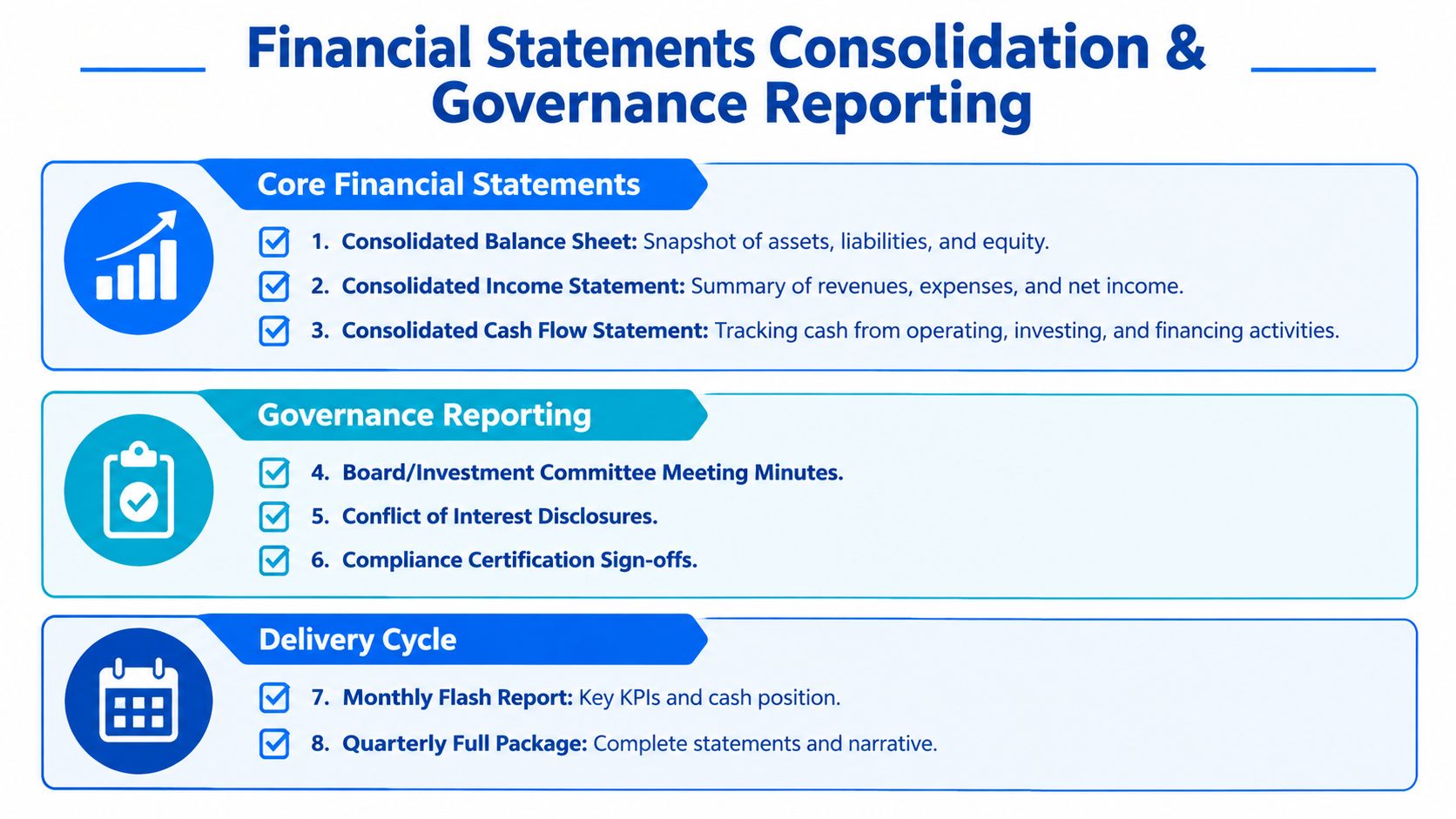
At minimum, I expect a reporting pack to include the three core statements at the consolidated level:
- Balance sheet
- Income statement
- Cash flow statement
That sounds basic, but many family offices still circulate portfolio snapshots without a real consolidated financial view. That's not enough. The principal may want investment performance, but the controller still needs a financial package that can survive audit scrutiny and support governance decisions.
A useful monthly pack usually includes:
- Entity-level trial balances with a consistent chart structure
- Intercompany elimination support that can be traced, reviewed, and rerun
- Consolidated cash visibility by entity and group
- Variance commentary explaining what changed and why
- A short family summary for readers who don't want ledger detail
Governance reporting should use the same data spine
Governance breaks when the board memo, investment committee pack, and accounting close rely on different underlying numbers. They should come from the same source and the same close discipline.
That means your quarterly governance package should pull from the same books and support files used for finance and audit work. In practical terms, I'd include:
- Quarterly investment committee materials tied back to the ledger where relevant
- Approval and conflict documentation stored with the supporting records
- Distribution and capital activity reporting for any co-invest or shared vehicle
- A review trail showing who prepared, reviewed, and approved the package
Good governance reporting isn't a separate presentation exercise. It's the finished version of a disciplined close.
This is also where technology starts to matter. Intercompany activity is one of the biggest sources of delay and confusion in multi-entity structures, especially where management entities, trusts, and operating companies transact with one another. A stronger intercompany transaction workflow cuts noise out of the close because eliminations stop being detective work.
What good looks like
Good looks boring. Reports arrive on the same cadence. Entity names match legal records. Cash, ownership, and intercompany balances reconcile cleanly. The board sees the same numbers finance sees. That's the standard.
AML KYC and Day-to-Day Compliance Operations
AML and KYC work often gets treated like a bank problem. That's a mistake. In a family office, the core issue is operational discipline. If the office can't document who owns what, who controls what, where funds come from, and why a transfer happened, the reporting stack is weaker than management thinks.
The operating model that works
A practical AML and KYC process has four moving parts.
First, customer due diligence. That means onboarding principals, related entities, and counterparties with enough detail to support ownership, control, and source-of-wealth review. Don't stop at the intake form. If the office uses external vehicles, nominee layers, or cross-border structures, your file needs enough support to explain them.
Second, ongoing monitoring. That doesn't mean a generic watchlist exercise. It means documented review rules around the office's real activity pattern, including wires, distributions, subscriptions, redemptions, and unusual account movement.
Third, recordkeeping. Evidence should be retained in a secure, structured repository, not split across email and personal drives.
Fourth, independent review and named accountability. One person needs to own the process, and someone else needs to test it.
Where beneficial ownership data should live
FinCEN's beneficial ownership framework says a beneficial owner is a natural person who directly or indirectly exercises substantial control over the company or owns or controls at least 25% of its ownership interests. Required data include a beneficial owner's date of birth and residential address for reporting companies (FinCEN BOI final rule Q&A). For broader primary guidance, FinCEN also maintains its CDD final rule, CDD FAQs, and beneficial ownership guidance resources.
That matters operationally even where an entity's reporting posture has changed. Your KYC files should already be structured to hold that information where relevant. If finance, legal, and compliance all collect it separately, you're creating duplicate work and inconsistent records.
What the auditor or examiner will ask for
Keep these ready and current:
- AML policy: Approved and version-controlled
- Risk assessment: Customized to the office's structure and activity
- Training records: Current and attributable
- CDD and EDD files: Complete and easy to retrieve
- Escalation log: Issues, reviews, and dispositions in one place
The standard is simple. A third party should be able to understand the office's compliance decisions without interviewing the one employee who “knows how it works.” For sanctions and higher-risk counterparty checks, many offices also align their procedures with public guidance from the U.S. Treasury's OFAC sanctions programs and information page and broader AML expectations published by the Financial Action Task Force.
Audit Documentation and the Technology Behind It
Audit readiness is the true test of family office reporting requirements. A filing can be completed late, corrected, or amended. A weak audit trail exposes something deeper. It shows the office doesn't control its data.
What auditors expect to see
Auditors usually want a coherent chain from legal structure to books to support to final statements. If any part of that chain lives outside a controlled process, the audit gets slower and more expensive.
At minimum, keep these items organized and current. If the structure includes investment entities or pooled vehicles, it is also worth cross-checking document retention and books-and-records expectations against current SEC compliance materials such as the Division of Examinations resources and the Investment Advisers Act of 1940 page:
- A full legal entity and ownership register
- An org chart tied to actual control and ownership
- Signed governing and management agreements
- Custody and cash confirmations
- Reconciled cash and position reports
- A traceable link from source documents to the general ledger and final reports
That's why I'm opinionated here. The office should build for audit first. Regulatory filings then become outputs of the same system instead of side projects.
Software alone won't fix bad process
The wrong setup is a generic ERP plus uncontrolled spreadsheets doing all the work. That creates version problems, review problems, and audit-log problems.
The better setup is a ledger and reporting stack that can handle multi-entity close, permissions, supporting documents, and repeatable reporting. Depending on the office, that may include portfolio tools like Addepar, document extraction tools like Canoe, or an ERP such as Sage Intacct for the accounting spine. In a mid-market environment, working with the right implementation partner matters as much as the product because chart design, entity structure, approval workflows, and reporting output determine whether the system helps or just stores transactions. A collaborative implementation model matters more than a license agreement, especially where several stakeholders need one controlled process, which is why teams often focus on financial collaboration and workflow design in Sage Intacct.
Technology stack options for family office reporting
| Platform Type | Consolidation | Multi-Currency | Audit Trail | Cost |
|---|---|---|---|---|
| Generic ERP plus Excel | Basic to moderate, often manual | Varies by product and workbook design | Weak if key work happens outside the system | Often lower software cost, higher process cost |
| Portfolio platform plus separate accounting tools | Strong investment visibility, accounting depth varies | Often strong for investment views | Split across platforms | Moderate to high depending on stack |
| Cloud ERP with controlled multi-entity design | Strong when properly implemented | Typically stronger and more controlled | Better if close and approvals stay in-system | Moderate to high depending on scope |
Buy software for control, not for screenshots. If the approval, reconciliation, and evidence trail still live outside the system, the platform isn't solving the reporting problem.
Minimum hygiene you shouldn't compromise on
- Role-based access: Not everyone should see every entity or function.
- Immutable audit trails: Changes need timestamps and user attribution.
- Segregation of duties: Deal entry, approval, and payment shouldn't sit with one person.
- Automated feeds where appropriate: Manual rekeying creates avoidable errors.
Putting It Together A Reporting Checklist and Next Step
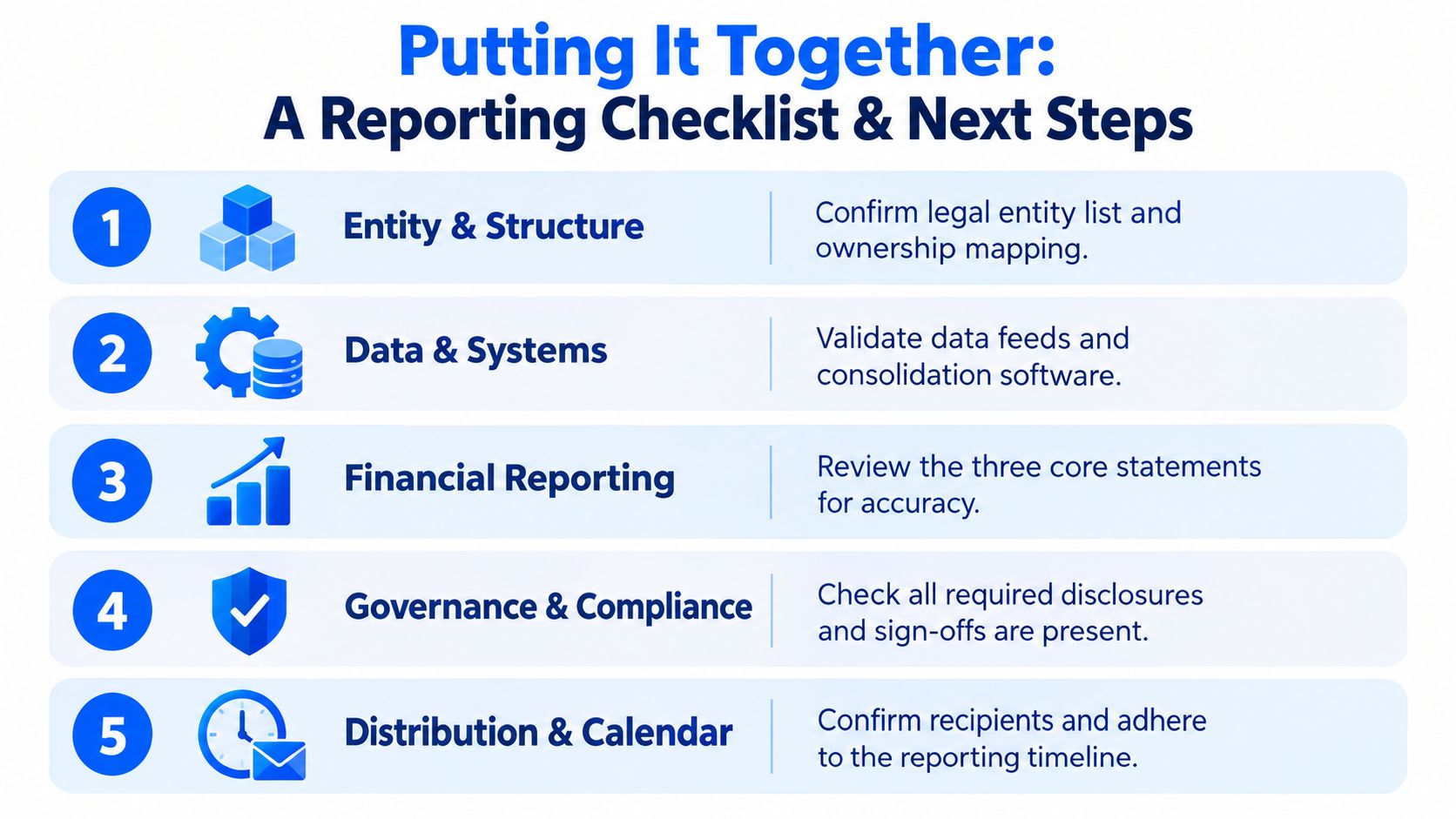
The right way to assess family office reporting requirements is to run one disciplined checklist across the whole structure. If a CFO, controller, or principal can't answer these questions quickly, the reporting stack needs work.
The management checklist
Use five blocks.
Entity and jurisdiction map
- Confirm entity inventory: Every legal entity, ownership link, and controlling person should be documented.
- Check jurisdiction touchpoints: Formation, registration, banking, investment activity, and tax presence should all be listed.
Regulatory and tax filings
- Assign filing ownership: Every filing should have one internal owner and one reviewer.
- Match triggers to entities: Don't assume one rule applies at the family level.
Cross-border transparency
- Lock entity classification: FATCA and CRS treatment should be documented and supportable.
- Standardize tax residency data: The same residency data should feed every relevant process.
Financial and governance reporting
- Review the monthly pack: Make sure consolidated statements, entity detail, intercompany support, and commentary are all present.
- Align governance outputs: Board and committee packs should use the same underlying books.
AML and audit readiness
- Test document retrieval: Pick a transaction and confirm the office can pull support quickly.
- Review control design: Access, approvals, and evidence retention should be current.
The next move should be operational, not theoretical
Don't start with a software demo. Start with a working session that maps the current structure against actual reporting obligations and current process ownership.
That's the point where many finance leaders realize they don't just need software. They need a redesigned reporting model, then an implementation plan. If you're planning a system change, include the reporting stack in the design from day one. A solid Sage Intacct implementation approach should account for legal entities, close process, audit trail, approvals, and reporting outputs before anyone starts building dashboards.
Summary
Family office reporting requirements are driven by entity type, jurisdiction, and activity, not by the family office label alone. U.S. obligations can include Form 13F, annual Form N-PX for Form 13F filers, Form PF for qualifying advisers, and beneficial ownership analysis for certain foreign companies registered in the U.S. Cross-border work turns on FATCA and CRS classification, which affects due diligence and disclosure scope. Strong reporting also requires disciplined consolidation, governance reporting, AML and KYC operations, audit-ready documentation, and a technology stack that keeps entity data, approvals, and reporting evidence consistent.
Frequently Asked Questions
Why do family office reporting requirements get so messy?
They get messy because most offices add entities over time without redesigning the reporting model. A trust, holding company, management entity, or foreign vehicle may each fall under different rules. The problem usually isn't one missed filing. It's that ownership data, classifications, deadlines, and financial reporting sit in separate places, so teams end up reconciling the same facts repeatedly.
Does being a family office automatically determine which rules apply?
No. The label doesn't decide the reporting obligation. Structure does. Each entity's legal form, jurisdiction, activity, and ownership profile determine which regimes apply. That's why one family office can have one entity with securities reporting exposure, another with cross-border transparency work, and a third that mainly affects internal governance and consolidation.
When does a family office need to think about Form 13F?
A family office needs to evaluate Form 13F when it exercises discretion over Section 13(f) securities and approaches the trigger described in the SEC framework. The important point is that the rule can apply even when the office is not a registered investment adviser. Once triggered, the filing becomes a recurring public reporting obligation for the required period, and annual Form N-PX reporting also becomes relevant for that filer.
What is the biggest mistake in cross-border reporting?
The biggest mistake is treating FATCA, CRS, and other transparency regimes as unrelated compliance exercises. They rely on overlapping data, especially entity classification, tax residency, and controlling-person information. If different teams maintain different versions of those facts, filings become inconsistent. A single cross-border data model is more reliable than separate workpapers built for each regime.
What should be in a monthly family office reporting pack?
A solid monthly pack should include consolidated financial statements, entity-level trial balances, intercompany support, cash visibility, and variance commentary. It should also be suitable for more than one audience. Finance needs detail, while principals and governance bodies need a clear summary. The key is that all versions come from the same underlying books and support files.
How should a family office handle beneficial ownership data operationally?
It should store beneficial ownership and control data in a controlled, reusable process instead of recollecting it in separate spreadsheets and emails. Where relevant, the file should support ownership and control analysis and hold required personal data fields used in compliance work. That reduces duplication and makes it easier for finance, legal, and compliance teams to work from the same record.
Is software enough to fix reporting problems in a family office?
Usually not. Software helps only when the entity map, chart design, workflows, approvals, and reporting outputs are designed properly. A bad process inside a new platform is still a bad process. The right partner and implementation approach matter because family office reporting requires controlled multi-entity accounting, clean audit trails, and consistent reporting logic across finance, governance, and compliance.
Lucentive helps finance leaders turn messy multi-entity reporting into a controlled close, cleaner audit trail, and a reporting stack that supports decisions. If you're evaluating Sage Intacct for a family office or another complex reporting environment, schedule a short working session with the team at Lucentive to map your entity structure, reporting obligations, and implementation fit before you buy software alone.