You're closing the month with numbers scattered across QuickBooks, spreadsheets, banking portals, and separate systems for billing or operations. Consolidation takes too long, approvals happen by email, and the audit trail depends on people remembering which file contains the latest adjustment. Meanwhile, leadership wants reliable reporting before the next decision can wait.
That's the point where an ERP software selection consultant should enter the conversation, before anyone starts comparing feature lists. The right advisor connects your financial close, internal controls, integrations, implementation plan, and business case. For a mid-market CFO, the question is not just which cloud ERP looks strongest in a demonstration. It's whether the chosen system and implementation partner can produce controlled, traceable financial processes that your team will fully adopt.
Table of Contents
- What Outgrowing Your Financial System Really Costs
- Building a Defensible Evaluation Methodology
- Designing Internal Controls and Integration Architecture
- Comparing Vendor-Neutral Advisors and Implementation Partners
- Interviewing Consultants and Measuring True Value
- Summary
- Frequently Asked Questions
- What does an ERP software selection consultant do?
- Why shouldn't we choose an ERP from a feature comparison?
- How should AI be evaluated during ERP selection?
- What should a consultant own during data migration?
- Is a vendor-neutral advisor better than an implementation partner?
- How should we measure ERP value after go-live?
What Outgrowing Your Financial System Really Costs
Month-end starts with one number in QuickBooks, another in a spreadsheet, and a third in the billing or operations system. By the time your team finishes reconciling entities, chasing approvals by email, and rekeying exports, finance is no longer running a system. It is holding together a process that the software no longer supports.
QuickBooks can serve a company well for years. The break point comes when finance needs consolidated reporting across entities, project-level visibility, formal approvals, audit-ready history, or dependable connections to operational systems. Then the hidden cost shows up outside the subscription line. Staff spend time on spreadsheets, manual exports, duplicate entry, and side processes that keep reporting alive but weaken control.
That cost is not abstract. Repeated spreadsheet adjustments make version control, review, and accountability harder. A multi-site clinic may have to reconcile an EMR or practice-management system with payroll, banking, billing, and reporting tools. A nonprofit may need fund and grant activity tied directly to general ledger results. A professional-services firm may need project accounting without forcing finance to rebuild reports by hand every month.
A CFO should build the case for cloud ERP around control, visibility, and time-to-value only after those terms are translated into operating evidence. Require the consultant to document a baseline close calendar, a control matrix, and an integration inventory before any software is shortlisted. Those deliverables show where approvals break down, which data source is authoritative, where reconciliations stall, and what has to change to shorten the close and reduce manual adjustments. General summaries of cloud ERP benefits are useful only when they are tied to those facts inside your business.
Why implementation risk starts before the contract
ERP risk starts in selection, not configuration.
Academic ERP research reports that implementation projects average 2.5 times their projected duration, run 178% over budget, and deliver only about 30% of the benefits originally agreed. The same research summarizes failure estimates of roughly 60% to 70%, while noting that definitions vary and may include missed schedules, cost overruns, incomplete benefits, or unsuccessful adoption rather than total abandonment. The ERP implementation failure analysis explains that distinction.
Treat those figures as a warning about decision quality. Weak requirements, unrealistic timelines, poor data preparation, excessive customization, and weak stakeholder alignment are usually in place before the contract is signed. A low license price does not protect you from an expensive close process, weak approval evidence, or broken integrations.
Practical rule: Treat ERP selection as business design. If the evaluation does not document how finance closes, how transactions are approved, how systems exchange data, and how success will be measured, you are not ready to select software.
ERP selection became strategically important during the 1990s, when organizations replaced inflexible custom-built systems with integrated enterprise packages. The Year 2000 problem and the launch of the euro accelerated demand for date conversion, multiple currencies, standardized processes, and cross-functional data. By 2000, the global ERP market had reached approximately US$19.9 billion, with SAP holding 32%, Oracle 14.5%, PeopleSoft 9%, JD Edwards 5%, and Baan 3%, while other vendors accounted for 41%, as documented in this Cambridge ERP history excerpt.
The lesson still applies. A consultant earns value by translating close cycles, controls, and integrations into requirements before software is purchased. Brand recognition does not do that work. Demonstrations do not do it either. A disciplined advisor does, especially in healthcare, nonprofit, professional-services, and multi-site organizations.
Building a Defensible Evaluation Methodology
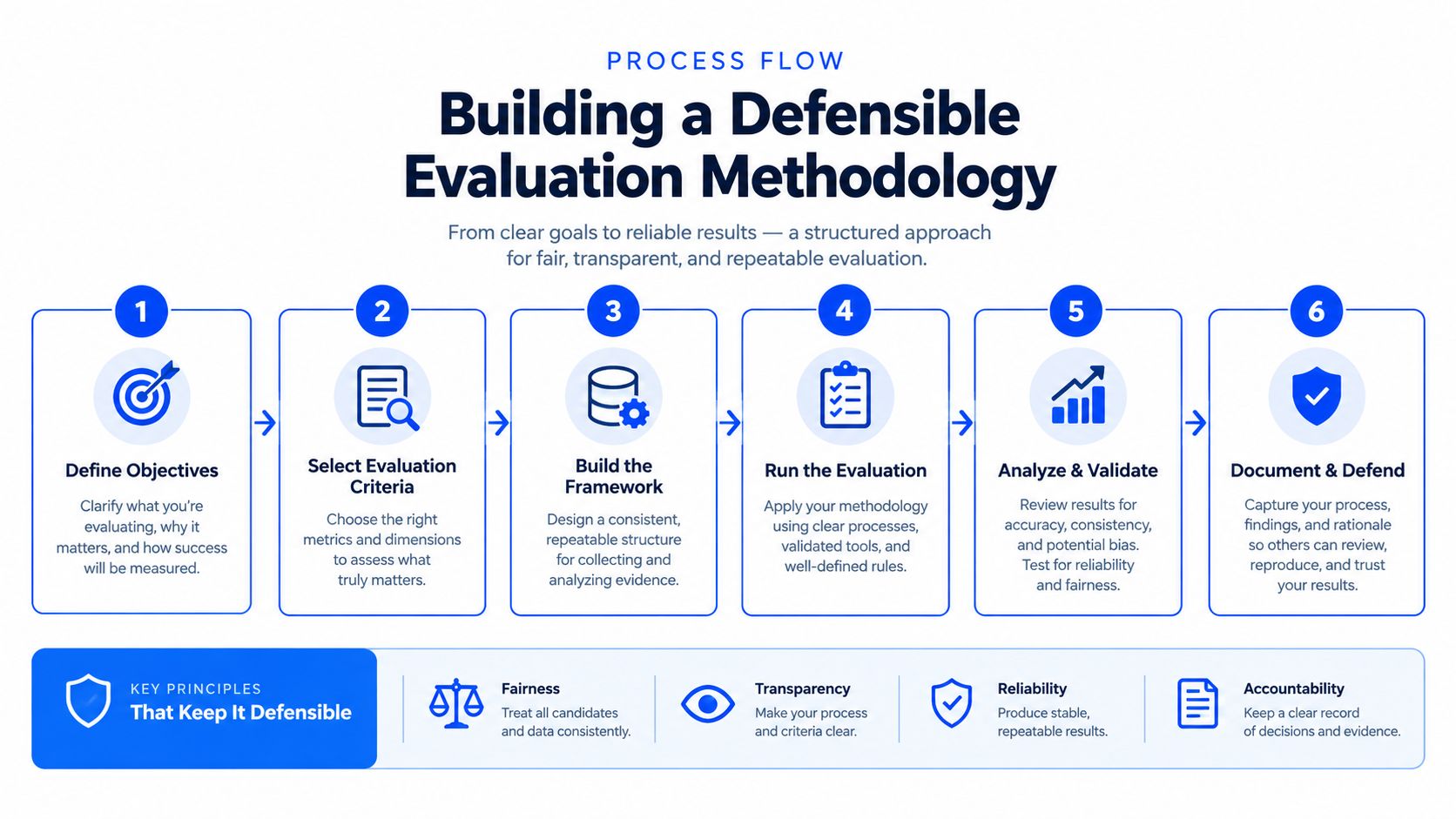
A defensible evaluation begins before the first vendor demonstration. Put an executive decision owner in place, assign finance and technical leads with protected time, and include the people who execute the close, approve transactions, manage data, and produce reports.
Use a written process rather than an informal shortlist.
Form the steering team. Give the CFO, Controller, operations lead, technical lead, and representative end users defined responsibilities. Executive sponsorship matters because selection decisions often involve process ownership, not just software preferences.
Document the current state. Map the close calendar, entity structure, approvals, reconciliations, reporting dependencies, integrations, spreadsheet handoffs, and pain points. Record where data originates, who changes it, and who reviews the result.
Define the future state. Translate problems into measurable objectives, such as a shorter end-to-end close, earlier management reporting, fewer manual adjustments, stronger approval evidence, or more reliable consolidated reporting.
Separate mandatory requirements from preferences. A requirement such as configurable approval limits or a necessary integration shouldn't receive the same treatment as a preferred dashboard layout. Require written evidence for every high-weight claim.
Script the demonstrations. Give finalists role-based scenarios using your own sample data. Ask the Controller to run an approval and reconciliation workflow, a department leader to review reporting, and a technical lead to test integration behavior.
Score and validate. Use a documented decision matrix covering functional fit, total cost, implementation risk, integration architecture, security, scalability, vendor capability, and partner readiness. Then validate assumptions through references, contract review, implementation planning, and a negotiated statement of work.
Test the process, not the presentation
A polished demonstration can hide gaps in reporting, migration, integrations, and process compliance. Ask each finalist to show the same scenario, with the same assumptions, and document what the system does without custom development, what requires configuration, and what requires a workaround.
The ERP readiness assessment checklist can help organize that preparation. Your team should also test how a proposed system handles an exception. For example, what happens when an invoice exceeds an approval limit, a subsidiary submits a late adjustment, an intercompany balance doesn't reconcile, or a source system sends incomplete data?
Research on ERP selection describes a comparable sequence, from team formation and information gathering through feature identification, objective hierarchy construction, vendor filtering, analytical evaluation, and final decision discussion. A systematic evaluation model also supports pre-selection followed by narrowing and negotiation, rather than choosing directly from an unstructured demo.
The evaluation should end with more than a preferred product. It should produce a documented future-state design, an implementation scope, a risk register, a data and integration inventory, and a business case that finance leadership can defend.
Designing Internal Controls and Integration Architecture
A modern ERP doesn't automatically create strong controls. If one person can authorize a transaction, record it, and maintain custody of the related asset, the risk remains even after a cloud migration. The software can support better control design, but your team must define the roles, evidence, review points, and compensating controls first.
Guidance based on the COSO Internal Control, Integrated Framework identifies five components: control environment, risk assessment, control activities, information and communication, and monitoring. It also emphasizes written, advance authorization with documentation that creates an audit trail, together with segregation of incompatible duties. Those principles are summarized in this internal controls guidance.
Ask control questions in the demonstration
Don't ask whether the ERP “has controls.” Ask the vendor and implementation partner to demonstrate how your controls work.
- Approval routing: Can approval limits be configured by role, entity, department, fund, or transaction type?
- Audit evidence: Can the system preserve who created, changed, approved, and posted a transaction?
- Segregation of duties: Can preparation, authorization, recording, and reconciliation be separated?
- Exceptions: Can the organization document and monitor compensating controls where staffing prevents full separation?
- Monitoring: Can finance identify unusual activity, overdue approvals, or failed reconciliations without rebuilding the evidence manually?
These questions matter for healthcare providers, nonprofit organizations, and multi-site businesses with distributed users. Control configuration should be tested before deployment, not accepted as a promise during procurement.
Integration requires the same discipline. Recent IDC research found that 22% of midsize businesses identify integration with the current technology stack as the top factor influencing software purchases, while 45.5% say implementing new technology securely is one of their biggest technology challenges, according to the IDC MarketScape report.
Build an integration inventory before choosing the ERP
List every system that exchanges, receives, or manually supplies financial data:
- EMR or practice-management systems
- Payroll and time tracking
- Banking and payment platforms
- CRM and billing tools
- Donor and grant systems
- Reporting applications
- Spreadsheets used for recurring adjustments or reconciliations
For each connection, identify the authoritative source, data owner, frequency, error-handling process, reconciliation control, security model, and exit option. Ask whether the proposed architecture uses APIs, webhooks, middleware, scheduled exports, or controlled file exchange. Then test what happens when a message fails or a record doesn't match.
Sage Intacct integration work should be evaluated against that architecture, not against a generic promise of connectivity. Lucentive's Sage Intacct API resource is relevant to that discussion, but the decision centers on ownership. Someone must monitor interfaces, resolve exceptions, maintain mappings, and confirm that integration activity remains auditable.
AI requires the same governance. Recent reporting on Panorama's 2025 survey indicates that organizations reporting significant or moderate AI deployment increased from 53.4% in 2024 to 72.6% in 2025, based on the Panorama ERP report. Ask what data models can access, whether sensitive information is used for training, who reviews outputs, and how errors are logged, reversed, and audited. Rank lower-risk, reversible use cases before considering autonomous posting or allocation.
Comparing Vendor-Neutral Advisors and Implementation Partners
A vendor-neutral advisor and an implementation partner solve different parts of the selection problem. The independent advisor can create distance from product pressure, structure an RFP, compare several platforms, and help negotiate terms. That model is attractive when your organization has strong internal implementation capacity or wants an external party to challenge every vendor equally.
The tradeoff is handoff friction. After selection, another firm may need to reinterpret requirements, rebuild the process model, estimate integrations, and convert evaluation language into a statement of work. The advisor can be independent, but independence doesn't remove the need for implementation accountability.
An implementation partner brings product knowledge and deployment responsibility into the selection discussion. That can make the conversation more concrete. The partner can identify configuration boundaries, define migration ownership, estimate integration effort, design testing, and establish post-go-live support before the contract is signed.
The risk is bias. A partner that sells one platform may naturally emphasize its strengths. You should address that directly by requiring written responses to mandatory requirements, documenting limitations, and asking the partner to show where the platform won't fit without customization.
| Engagement model | Where it helps | Risk to control |
|---|---|---|
| Vendor-neutral advisor | Broad comparison, independent requirements work, and negotiation support | Handoff gaps and duplicated discovery after selection |
| Implementation partner | Connected selection, configuration, migration, testing, and support planning | Product bias and pressure to accept standard assumptions |
| Combined model | Independent selection with specialist deployment support | More coordination, duplicated accountability, and unclear ownership |
Research on ERP success factors places top-management support, a dedicated project champion, and project management among the highest priorities. User training, participation, standardization, limited customization, clear scope, communication, and vendor partnership also matter. A broader review of 320 publications identified 31 success factors and again ranked executive involvement, project management, and user training highly, as described in this ERP success-factor review.
Lucentive is a Sage Intacct National Premier Partner with mid-market, healthcare, and nonprofit experience. Its Sage Intacct reseller services are most relevant when the buyer wants selection, implementation planning, migration, and financial-process design considered together.
Interviewing Consultants and Measuring True Value
Interview consultants as if you're hiring the person responsible for protecting the close, not merely installing software. Ask each candidate to work through your actual process map and explain what they would change before issuing a recommendation.
Start with three questions:
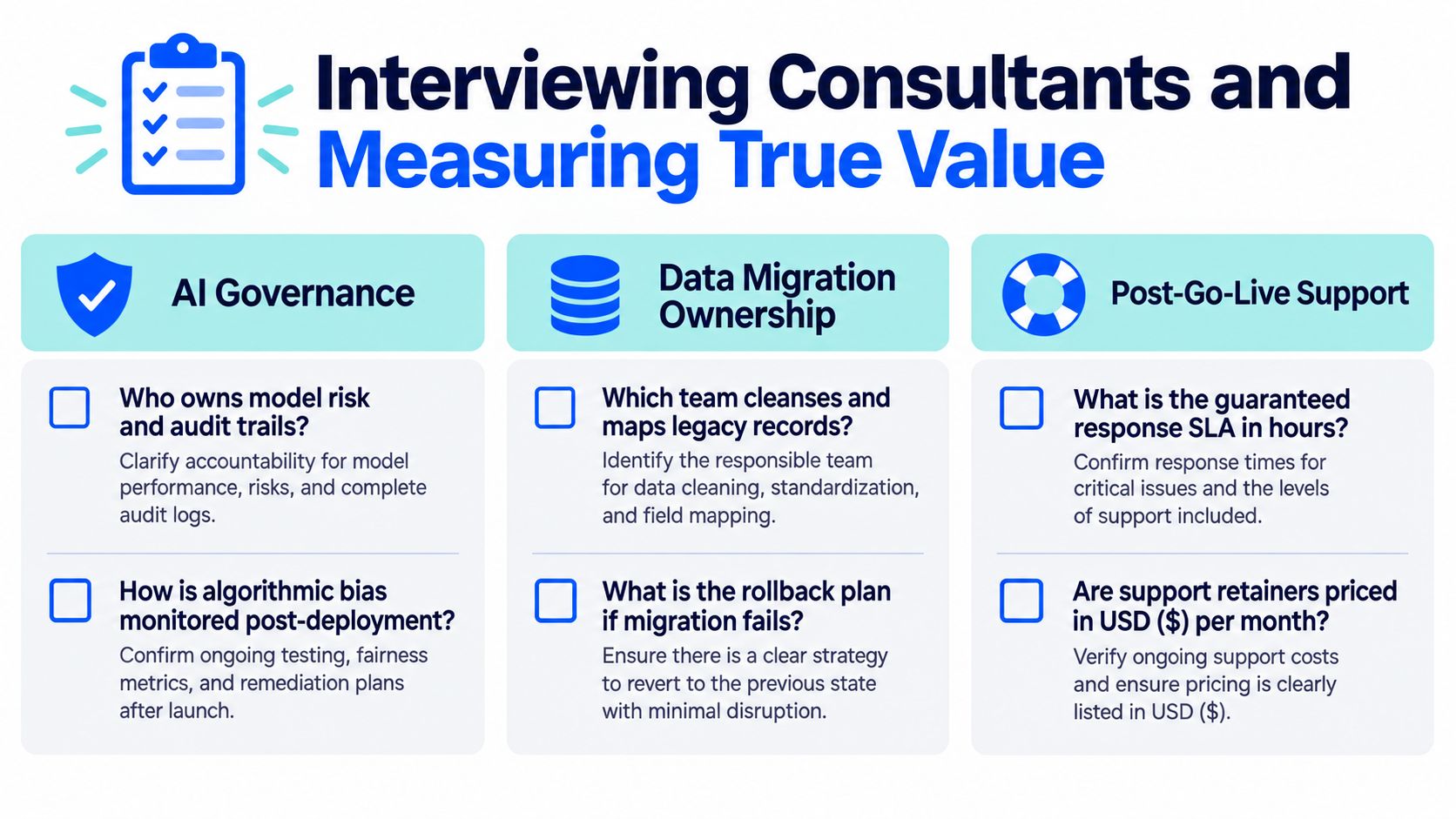
- What will you own? Require a clear division of responsibility for requirements, data cleansing, mapping, integrations, testing, training, control design, and post-go-live support.
- How will you prove fit? Ask for a demonstration script, scoring method, evidence standard, reference process, and approach to documenting exceptions.
- How will we measure value? Require a baseline and target for close-cycle time, reporting timeliness, manual work, data accuracy, control evidence, and adoption.
APQC defines close cycle time as the total elapsed time, including waiting time, from running the trial balance to completing consolidated financial statements. That means a consultant should map approvals, data collection, intercompany review, and reporting delays, not just count hours spent entering journals. Use the APQC close-cycle definition to keep the measurement consistent.
Interview for the risks executives usually discover too late
AI governance: Who approves an automated journal entry, forecast, coding recommendation, or grant allocation? What data can the model access? How can a reviewer explain, reverse, and audit the output?
Data migration: Which team cleanses legacy records? Who maps the chart of accounts, entities, customers, vendors, projects, funds, and historical transactions? What happens if the migrated balances don't reconcile?
Integration ownership: Who monitors interfaces after go-live? Who resolves failed messages? Which system owns each master record? How does finance prove that the connected data is complete?
Support and adoption: Who trains each role? Who owns the close calendar after deployment? What response process applies when a reporting issue affects management decisions?
The consultant should connect each answer to a deliverable. If AI governance produces a policy, identify the approver and audit evidence. If migration produces a reconciliation, identify the preparer, reviewer, and sign-off. If support produces a service commitment, identify the owner and escalation path.
A PwC CFO survey found that 61% of surveyed organizations reported closing within five days, while 34% still loaded accounting data into spreadsheets for manual adjustment, according to the PwC CFO survey. That combination matters. A fast close can still carry reconciliation and version-control risk if spreadsheet work remains outside a traceable workflow.
Judge the partner by the value case
Deloitte's interviews with 26 CFOs and finance-transformation teams that had recently launched ERP systems found that many organizations weren't achieving the full benefits expected from technology-enabled transformations, as discussed in this Deloitte ERP implementation analysis.
Your business case should therefore cover more than license and implementation cost. It should connect the proposed design to close-cycle reduction, earlier reporting, control improvements, reduced manual work, implementation effort, training, and post-go-live ownership. Lucentive's Sage Intacct consultant service is one example of a partner-led approach that can connect platform fit with those operational questions.
Summary
Outgrowing QuickBooks is a process and control problem before it's a software problem. A disciplined ERP selection maps the current close, defines future-state outcomes, separates mandatory requirements from preferences, tests integrations, and demonstrates internal controls using real scenarios. Buyers should evaluate vendor-neutral advisors and implementation partners based on ownership, evidence, migration readiness, governance, and post-go-live support. Sage Intacct may fit organizations seeking stronger visibility and multi-entity control, but the partner's ability to translate requirements into a controlled deployment will shape time-to-value. A short working session with Lucentive can help assess that fit.
Frequently Asked Questions
What does an ERP software selection consultant do?
An ERP software selection consultant translates business processes into software requirements, compares platforms, evaluates implementation partners, and validates the commercial and operational assumptions behind a purchase. The work should include process mapping, fit-gap analysis, total-cost modeling, scripted demonstrations, integration review, reference checks, contract review, and implementation planning. The consultant's value is strongest when the selection connects directly to financial controls, reporting, data ownership, and measurable business outcomes.
Why shouldn't we choose an ERP from a feature comparison?
Feature lists rarely show how a system handles your close, approvals, reconciliations, integrations, exceptions, or reporting dependencies. A scripted demonstration using your own scenarios exposes whether a requirement works through configuration, requires customization, depends on an integration, or remains a manual workaround. Separating mandatory requirements from scored preferences also prevents an attractive dashboard or broad module list from hiding a critical control or data gap.
How should AI be evaluated during ERP selection?
Evaluate AI as a governance and value-realization issue, not as a checklist feature. Ask what data models can access, whether sensitive information is used for training, whether outputs can be explained and reviewed, and who approves automated actions. Start with use cases that are lower risk and reversible, such as anomaly detection or draft summaries, before considering autonomous posting. Define how errors are logged, reversed, audited, and measured after deployment.
What should a consultant own during data migration?
The engagement should identify who cleanses legacy records, maps the chart of accounts and related master data, validates opening balances, performs reconciliation, and approves the final migration. Ownership should also cover a rollback plan if the migration doesn't reconcile or a critical record is incomplete. Data migration isn't an IT-only task. Finance and operational owners need to confirm that the migrated information supports reporting, controls, and ongoing business processes.
Is a vendor-neutral advisor better than an implementation partner?
Neither model is automatically better. A vendor-neutral advisor can provide broader comparison and challenge vendor claims, but a separate implementation partner may need to repeat discovery after selection. An implementation partner can connect selection with configuration, migration, testing, and support, but the buyer must control product bias through written evidence and documented scoring. Choose based on your internal capacity, risk tolerance, need for independence, and requirement for continuous accountability.
How should we measure ERP value after go-live?
Measure the complete financial process, not isolated automation. Track elapsed close time from trial balance through consolidated statements, including waiting time, approvals, data collection, and intercompany review. Also measure reporting timeliness, manual adjustments, data accuracy, control evidence, adoption, exception volume, and achievement of defined business benefits. A system that posts journals faster but leaves spreadsheet reconciliations and approval delays untouched hasn't solved the full finance problem.
Lucentive helps mid-market finance teams evaluate Sage Intacct through requirements built around the close, reporting, controls, and integrations, then plan the migration and implementation around those priorities. Schedule a 30-minute working session or customized Sage Intacct demo by visiting Lucentive to discuss your company's specific needs without committing to a software purchase.