Your finance team is eight days into the close. One entity is still exporting trial balances from the old system. Another is posting manual journals because the inventory-to-GL bridge broke. Someone has a NetSuite admin login, but nobody's sure who owns it. The controller can publish tentative numbers, not final numbers, and the audit team is already asking about revenue recognition, intercompany eliminations, and what changed since last month.
That's the moment most executives realize an ERP project isn't an IT project. It's a business control project.
If you've outgrown QuickBooks, or you're running multiple systems across entities, locations, or departments, the person who keeps this from turning into a prolonged accounting fire drill is the ERP project manager. Not the software vendor. Not the CFO in spare hours. Not the controller trying to close the books and lead design workshops at the same time.
Table of Contents
- When the Close Takes Two Weeks and Nobody Trusts the Numbers
- Defining the ERP Project Manager Role
- ERP Project Manager Responsibilities by Phase
- ERP Project Manager vs Change Manager
- Skills Certifications and Hiring Checklist
- Steering Committee KPIs That Actually Predict Go-Live
- Common Pitfalls and the Partner Question
- Summary
- Frequently Asked Questions
- Who owns data migration in an ERP project
- Do we need a separate change manager
- When should a controller stop wearing the project manager hat
- What should a CFO look for in an ERP project manager
- How do healthcare and nonprofit ERP projects differ from general SMB finance projects
- Is software-only ever the right choice
When the Close Takes Two Weeks and Nobody Trusts the Numbers
Mid-market companies usually don't decide they need ERP because they love software. They decide because the books are slowing down the business.
The pattern is familiar. A company adds locations, acquires another entity, or layers nonprofit funds, healthcare billing workflows, or inventory complexity onto a finance stack that was never built for it. The result is a slow close, weak visibility, audit friction, and too many workarounds sitting in spreadsheets.
What failure looks like in real life
Five entities. Two ERP instances. One login nobody formally owns. A controller waiting on reconciliations from operations before posting eliminations. The CEO wants a board pack. The CFO wants confidence in margin by entity. The audit team wants support for cutoffs and policy application. Nobody agrees on which numbers are final.
If you're also dealing with broken intercompany flows, intercompany transaction control starts to matter. Not as a feature checklist item, but as a close process issue with executive consequences.
The ERP project manager is the one person who has to understand both the accounting impact and the delivery sequence.
That's the part many companies miss. They treat the ERP PM like a scheduler. In practice, the role is closer to a control tower. This person has to read the general ledger, sit with the AR clerk, challenge the implementation partner, and still walk into a steering committee with a cutover plan that's usable.
Why this role carries so much weight
Independent ERP guidance describes the ERP project manager as owning the master plan, tracking milestones and dependencies, aligning executives and department heads, maintaining steering-committee reporting, and managing risks such as data migration, scope creep, and integration issues in addition to budget oversight, issue resolution, training coordination, and organizational change during rollout (ERP Research on ERP project manager responsibilities). That lines up with broader project management guidance from the Project Management Institute and ERP implementation advice published by Gartner. It also matches control-focused guidance that recommends bringing finance, accounting, and internal controls into ERP planning from the start, not after design is already set (Deloitte on ERP implementation, ICFR, and SOX).
That's why the rest of the conversation about ERP project manager roles and responsibilities should start with business pain, not project jargon. If the close is slow, visibility is weak, or your entities aren't under control, you need a clear ownership map. The ERP PM sits at the center of that map.
Defining the ERP Project Manager Role
For a CFO or CEO, the simplest definition is this: the ERP project manager owns delivery discipline across the whole program.
That means scope, schedule, issue tracking, risk tracking, steering committee reporting, resourcing gaps, and cutover readiness. It also means pushing decisions to closure when finance, operations, IT, and the implementation partner all want different things.
What the ERP PM owns day to day
The ERP PM is the person who maintains the integrated plan, updates the decision log, chases overdue owners, escalates unresolved design conflicts, and decides whether a defect is annoying or cutover-blocking.
They don't own every business process. They own getting every process workstream to a decision and a delivery date.
A practical way to approach this:
- Functional leads decide how AP, AR, procurement, payroll, inventory, or grant reporting should work.
- The change lead owns adoption, communications, training readiness, and resistance management when that role exists.
- The ERP PM sequences all of it, forces trade-offs into the open, and keeps the whole program from slipping into ambiguity.
The role most companies understate
The strongest ERP PMs are usually acting as business-process negotiators. That phrase matters.
ERP implementations always create tension between standardization and local exceptions. Corporate finance wants one chart, one approval pattern, one close calendar. Site leaders want to preserve local workflows. Healthcare groups want to respect clinical realities. Nonprofits want fund controls. Multi-entity businesses want local flexibility without losing consolidated visibility.
The PM is often the person standing in the middle of that conflict saying, “This stays standard. This is a justified exception. This needs executive approval.”
Practical rule: If two smart people disagree about process design and nobody can explain the cost of each option, the ERP PM hasn't finished the job.
That's why the role is broader than most job postings admit. Public-sector and practitioner guidance separates project management from change management, but still places accountability for plan, schedule, resource tracking, governance, approvals, communications, and vendor accountability with the project manager, with change responsibilities added only when the project needs dedicated adoption support (public-sector ERP project management framework).
If you want a plain-English argument for why this matters, look at the business case for ERP itself. A system only helps if someone can translate operational mess into controlled execution, which is exactly where ERP software benefits only materialize with disciplined implementation.
ERP Project Manager Responsibilities by Phase
A lot of articles list responsibilities as verbs. Plan. Coordinate. Communicate. That's too vague for an executive team. A CFO needs to know what the ERP PM must put on the table at each phase.
What good accountability looks like
The PM should be accountable for named deliverables, named owners, and dated decisions. If those don't exist, you don't have project control. You have meetings.
Planning ERP costs, time, and resources gets easier once each phase has concrete outputs tied to a steering committee decision.
ERP Project Manager Deliverables by Phase
| Phase | Key Deliverables | PM Accountability |
|---|---|---|
| Discovery | Process heat map, stakeholder RACI draft, integrated timeline, baseline business case | Build the master plan, identify decision-makers, expose high-risk processes early |
| Fit-gap | Signed design decisions log, open item register with owners and dates, confirmed data migration inventory | Run workshops, force design choices, prevent “we thought that was included” surprises |
| Build | Configuration status report, integration test plan executed, end-to-end scripts ready | Track build progress, coordinate partner and internal teams, escalate slippage |
| UAT | Defect log with severity and owner, UAT exit memo, written go or no-go recommendation | Protect production from unresolved defects and document readiness honestly |
| Cutover | Cutover checklist with owner and timestamp, rollback criteria, accounting close rehearsal | Own sequence control, approval gates, and final cutover coordination |
| Stabilization | 30, 60, and 90-day hypercare tickets, adoption metrics, project-to-operations handoff memo | Transition the program into steady-state ownership without losing accountability |
The deliverables that separate strong PMs from weak ones
In discovery, the PM should force clarity on operating reality. Which entity closes late? Which reporting packs are still manual? Which integrations touch revenue, inventory, payroll, donor restrictions, or clinical systems? A RACI should be drafted now, not after design is already underway.
In fit-gap, the PM has to lead the hard conversations. What stays standard? What becomes a local exception? What must be redesigned? Recent ERP hiring and role descriptions increasingly emphasize fit-gap workshops, process and integration gap documentation, and balancing global templates against local business requirements across stakeholders (ERP role description with fit-gap and localization emphasis). That approach also aligns with current ERP selection guidance that starts with defined business use cases and requirements before matching vendor capabilities (Gartner ERP topic guidance).
In build, the PM doesn't just ask for status. The PM checks whether the configuration supports signed decisions, whether integrations are testable, and whether reporting assumptions still match finance requirements.
The phases executives underestimate
UAT is where weak accountability shows up fastest. A clean status report means nothing if defect severity is undefined or owners are vague. The PM should issue a written exit memo and a recommendation that the steering committee can approve or reject. Good UAT practice also uses real end-to-end business scenarios, business-user sign-off, and test cycles that reflect how work actually gets done after go-live (ERP migration checklist guidance).
Cutover is where the role earns its keep. If no one has rehearsed the accounting close in the new system, you're guessing. If rollback criteria aren't named, leadership is making a one-way decision without guardrails.
Stabilization matters because go-live isn't the finish line. A detailed ERP implementation profile describes the project manager as accountable from initiation through closure, including stakeholder and partner management, scope and schedule control, project reviews, risk mitigation, escalation, reporting, and delivery of systems and information security controls (ERP implementation project manager profile).
ERP Project Manager vs Change Manager
These roles get blurred constantly, and that causes missed ownership.
The ERP PM and the change manager work side by side, but they don't do the same job. One owns delivery control. The other owns adoption quality.
ERP Project Manager vs Change Manager Ownership Split
| Workstream | ERP Project Manager | Change Manager | Hybrid (no change lead) |
|---|---|---|---|
| Scope and schedule | Owns | Supports with readiness inputs | PM owns |
| Vendor coordination | Owns | Informed | PM owns |
| Data migration and testing | Owns | Informed | PM owns |
| Training design | Consulted | Owns | PM coordinates with functional leads |
| Communications plan | Consulted | Owns | PM drafts, executives and managers reinforce |
| Stakeholder sentiment and resistance | Informed | Owns | PM flags risks, managers address locally |
| Go-live readiness | Owns | Supports with adoption readiness | PM owns |
| Hypercare adoption follow-up | Supports | Owns | PM and functional leads share |
The cleanest rule for splitting ownership
Use this rule when the lines blur: if a missed deliverable blocks go-live, the ERP PM owns it. If poor user adoption causes rework after go-live, the change lead owns it.
That's the cleanest way to handle communications, training, and readiness without turning accountability into a group project. It also matches change-management guidance that treats ERP implementation as both a technical and people transition, with project management and adoption workstreams running together (Prosci on ERP change management).
In many mid-market implementations, one person ends up covering both roles. That can work, but only if executives acknowledge the load and assign functional managers to help with training and local communication.
A major staffing firm's ERP project manager description includes planning, development, integration oversight, upgrades, issue tracking and resolution, budget responsibility, steering committee reporting, communication of delays and work changes, user training, and organizational change management (Robert Half ERP project manager job description).
That breadth is real. It's also why companies without a separate change lead should decide during discovery who owns training content, communications cadence, and post-go-live adoption follow-up. If you leave that blurry, hypercare gets ugly. If you need a practical starting point, ERP change management ownership should be explicit before UAT begins.
Skills Certifications and Hiring Checklist
If you're hiring or assigning this role, stop screening for generic project management first. Start with business-process control under ERP pressure.
A weak ERP PM can run meetings. A strong ERP PM can walk into a fit-gap workshop, hear three conflicting process requests, and drive a documented decision that protects reporting, controls, and timeline.
The skills that actually matter
Look for these capabilities first:
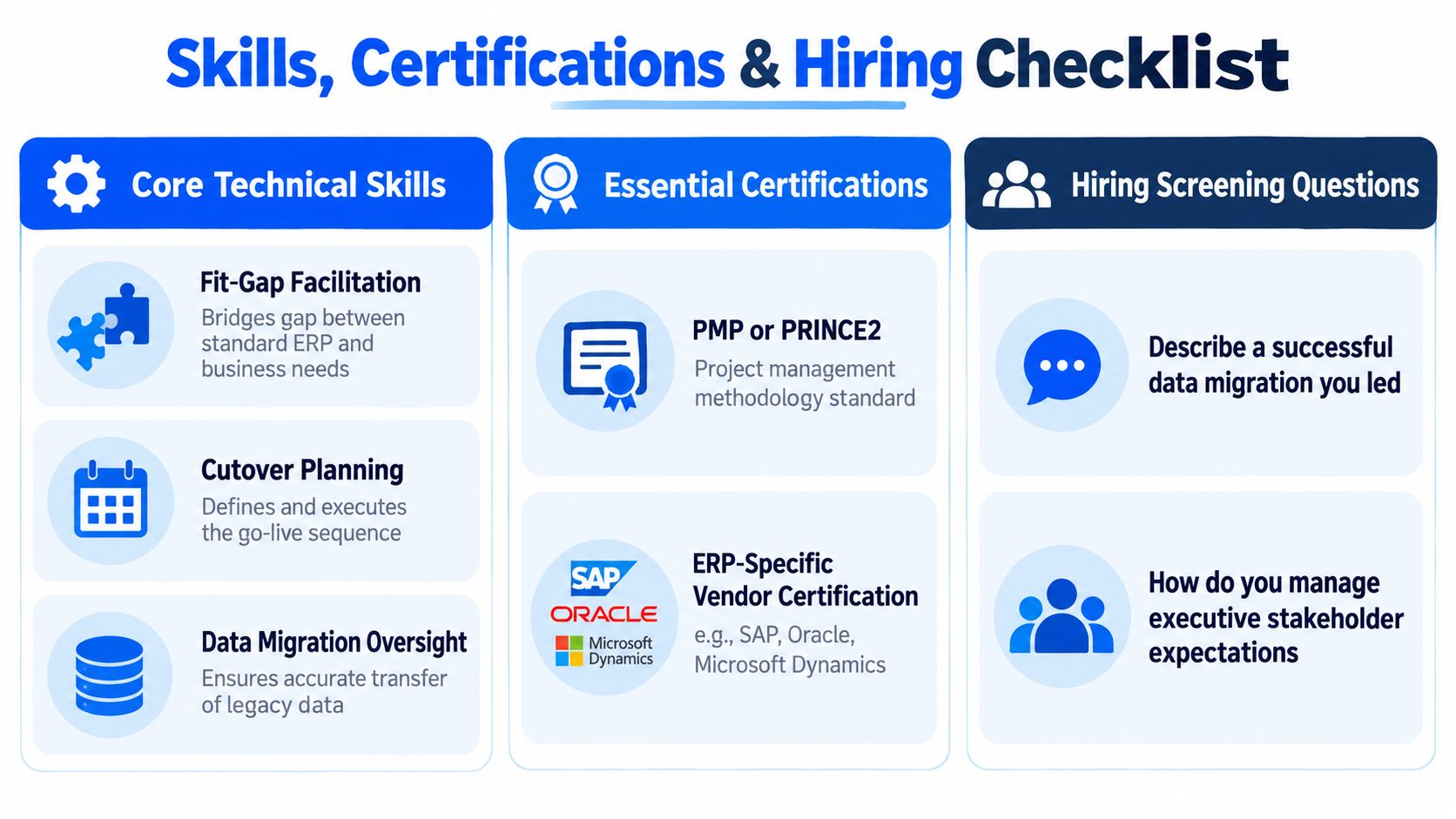
- Fit-gap facilitation: The candidate should be able to lead process workshops and document what the business needs versus what the system does out of the box.
- Cutover planning: They need experience sequencing go-live steps, approvals, dependencies, and rollback criteria.
- Data migration oversight: They don't have to write scripts, but they must know how to validate ownership, mapping, and reconciliation.
- Executive reporting: A CFO should get concise steering-committee reporting, not page after page of noise.
- Functional depth: Finance matters most in mid-market projects, but supply chain, HR, or industry process depth can be decisive depending on scope.
- Vendor management: The PM must hold the partner or vendor accountable to dates, deliverables, and open issues.
Current UK vacancy data shows a median ERP project manager salary of £57,500 per year and a median contract rate of £500 per day, which tells you the market treats this as a specialized leadership role, not a generic coordinator job (LHH ERP, HRIS, CRM project manager guide).
Which certifications carry weight
I'd treat certifications as supporting evidence, not the decision.
- PMP or PRINCE2: Useful if the person can show disciplined governance and escalation habits.
- Vendor credentials: Helpful when tied to the ERP you're deploying.
- Resume padding: Lots of badges with no cutover stories usually means exactly what you think it means.
What matters more is whether the candidate has owned design conflicts, testing pressure, go-live risk, and post-launch stabilization in a real operating business.
A one-page hiring brief and interview screen
Use this simple job description in your hiring process:
Role summary: Own end-to-end ERP program management from discovery through stabilization, including project planning, scope and schedule control, risk management, issue resolution, steering committee reporting, vendor coordination, testing oversight, cutover readiness, and handoff to operations.
Key responsibilities: Maintain the integrated plan, run governance, manage open decisions, coordinate functional leads, oversee migration and test readiness, prepare executive updates, and escalate risks early.
Ask these five questions in interviews:
- Tell me about a data migration that almost failed. What did you change?
- How do you decide whether a local exception is justified?
- What belongs in a go or no-go memo?
- How do you handle a functional lead who won't make design decisions?
- What did hypercare look like on your last implementation?
Red flags are easy to spot:
- Only vendor-side experience with no internal ownership view
- No direct cutover responsibility
- Vague answers on reconciliation and defect severity
- Heavy methodology language, thin business examples
- Treats training as an afterthought
Healthcare, nonprofit, dental, and SMB finance teams should weight industry context more heavily than generic software exposure. If the system touches fund accounting, EMR-adjacent workflows, insurance edits, or multi-entity close controls, domain awareness saves time and reduces rework.
Steering Committee KPIs That Actually Predict Go-Live
Most steering committee decks are bloated and useless. Executives don't need twenty project metrics. They need a few indicators that expose delivery risk early enough to act.
The mistake I see most often is overvaluing schedule and undervaluing readiness. A project can look “green” on dates right up until defects, training gaps, or data issues derail cutover.
Six KPIs That Predict ERP Go-Live Success
| KPI | Target Range | Data Source | What Movement Tells Leadership |
|---|---|---|---|
| Close days | Downward trend toward target-state close | Finance close calendar and controller reporting | Whether the new process is reducing reporting friction |
| On-time task completion | Consistent completion against committed dates | PMO task tracker | Whether owners are reliable or slippage is spreading |
| Defect leakage from UAT | Low leakage into cutover and hypercare | UAT defect log and production issue log | Whether testing is catching real operational risk early |
| Training completion | High completion before go-live by role | LMS, attendance logs, manager sign-off | Whether users are actually prepared to perform core tasks |
| User adoption in hypercare | Upward trend in correct process use | Ticket themes, workflow completion, manager feedback | Whether people are using the system correctly or reverting to workarounds |
| Budget variance | Stable and explainable | Project budget tracker and steering reports | Whether scope and resourcing are under control |
Leading indicators matter more than vanity metrics
If I had to choose one early warning sign, I'd watch defect leakage. A project can recover from a delayed task. It rarely recovers smoothly from unresolved process-breaking defects that appear after go-live.
Training completion also needs context. Seat counts alone are useless. Managers should confirm whether users can execute the transactions that matter to close, billing, purchasing, grants, or entity reporting.
A good steering-committee slide answers one question fast: are we getting safer, or are we just getting closer?
Healthcare and nonprofit teams should also watch whether revenue-cycle reporting, fund restriction outputs, and required reconciliations are working in test cycles. SMB finance teams should pay close attention to weekly cash-close readiness because it exposes whether transaction flow, approvals, and reporting logic are holding together.
If you want a cleaner executive discussion, KPI design should make leaders more proactive, not more reactive.
Common Pitfalls and the Partner Question
The most expensive ERP mistakes usually happen before configuration starts.
Companies under-scope migration, tolerate weak sponsorship, let local exceptions multiply, or buy software without deciding who will run the implementation. Then they act surprised when the schedule slips and finance ends up carrying the burden.
The pitfalls I'd escalate early
Watch for these signs right away:
- Data migration is treated like a late-phase task: It isn't. If ownership, field mapping, and reconciliation rules aren't set early, the project will absorb hidden rework. Current migration guidance also recommends multiple validation cycles, reconciliation of opening balances, and business sign-off before go-live (ERP data migration strategy best practices).
- Executives delegate decisions but not authority: Functional leads need escalation paths and real decision-makers.
- The chart of accounts debate never settles: That usually means nobody has defined the reporting model clearly enough.
- Testing becomes a calendar event instead of a business rehearsal: UAT has to prove process performance, not just screen navigation.
- Cutover planning starts too late: If finance hasn't rehearsed close tasks in the future-state environment, go-live risk is being understated.
- Training is scheduled but not operationalized: Attendance is not readiness.
- Local exceptions keep appearing: This usually signals weak governance, not genuine business necessity.
Software-only versus partner-led
Buyers often make a bad trade-off. They compare software subscription cost and ignore delivery risk.
Software-Only vs Partner-Led ERP Implementation
| Dimension | Software-Only | Partner-Led |
|---|---|---|
| Discovery | Internal team defines scope and requirements | Partner helps structure scope, priorities, and process decisions |
| Fit-gap | Internal leaders run workshops and document gaps | Partner facilitates workshops and pressures decisions to closure |
| UAT | Internal users create scripts and manage defects | Partner coordinates scripts, defect triage, and readiness gates |
| Cutover | Internal staff own plan and sequencing | Partner helps build and manage cutover control |
| Stabilization | Internal team absorbs hypercare while doing day jobs | Partner supports transition and structured handoff |
| Risk profile | Higher if no experienced ERP PM exists internally | Lower when delivery governance is staffed properly |
| Time-to-value | Often slower if decisions and ownership are diffuse | Usually cleaner when ownership and accountability are explicit |
Software alone can work when the company already has internal ERP leadership, a clean reporting model, and enough bandwidth to run discovery through stabilization without starving the close.
A partner-led model is usually the better call when there's no ERP-experienced PM in-house, when the chart of accounts needs redesign, or when leadership needs go-live inside a compressed timeline. Lucentive is one option in that category as a Sage Intacct National Premier Partner with mid-market, healthcare, and nonprofit implementation experience.
Sector-specific traps executives underestimate
Healthcare teams run into integration and compliance complexity fast. Nonprofits get tripped up by fund reporting and grant logic. Dental groups often discover that operational workflow differences across locations are bigger than expected. General SMB finance teams underestimate how hard multi-entity consolidation becomes once intercompany and close controls move into a new ERP. Healthcare ERP guidance also puts more weight on audit trails, segregated duties, and integrated administrative and financial controls, while nonprofit finance design has to support net asset classes and donor restrictions under ASC 958 (Oracle healthcare ERP buyers guide, ERP Research on Oracle Cloud ERP for healthcare).
The partner question isn't really about who installs software. It's about who owns disciplined execution when the business has already outgrown its old operating model.
Summary
An ERP project manager owns delivery discipline across the whole implementation, not just the schedule. The role includes scope control, risk tracking, steering-committee reporting, vendor coordination, testing oversight, and cutover readiness. In complex organizations, the ERP PM also acts as the business-process negotiator between standardization and local exceptions. Strong accountability shows up in concrete deliverables by phase, a clear split between project management and change management, practical hiring criteria, and a short KPI set leadership can review quickly. Companies that treat ERP as software alone usually underestimate the execution load on finance and operations.
Frequently Asked Questions
Who owns data migration in an ERP project
The ERP project manager should own migration oversight, timeline, and accountability, while technical staff and functional leads handle mapping and validation details. If nobody is managing migration as a business-risk workstream, finance usually finds the problem late during testing or close rehearsal.
Do we need a separate change manager
Not always. Many mid-market teams run with one PM covering both delivery and change responsibilities. If you do that, decide early who owns training content, communications, and post-go-live adoption follow-up so those tasks don't get lost during UAT and hypercare.
When should a controller stop wearing the project manager hat
A controller can carry the role early in a small project, but that stops working once the close, data migration, fit-gap decisions, and cutover planning all hit at once. If the business is multi-entity, under audit pressure, or redesigning reporting structures, dedicated project ownership is usually the safer move.
What should a CFO look for in an ERP project manager
Look for fit-gap facilitation, cutover planning, migration oversight, executive reporting, and the ability to force decisions across finance, operations, and vendors. Certifications help, but practical experience with design conflicts, UAT pressure, and go-live risk matters more.
How do healthcare and nonprofit ERP projects differ from general SMB finance projects
Healthcare and nonprofit teams usually have more workflow variation, reporting constraints, and integration or operational dependencies to manage. SMB finance teams often feel the biggest pressure in multi-entity close control, weekly cash visibility, and replacing spreadsheet-heavy workarounds with disciplined processes.
Is software-only ever the right choice
Yes, but only when the company already has internal ERP implementation leadership and enough bandwidth to run discovery through stabilization without compromising normal operations. Teams that have outgrown QuickBooks or are untangling multi-entity reporting need more structure than software alone provides.
If you're evaluating Sage Intacct, the right conversation isn't just about modules. It's about who will own fit-gap decisions, cutover discipline, and close readiness in your business. Lucentive helps finance leaders work through that in a practical, low-pressure way, whether you're replacing QuickBooks, cleaning up multi-entity reporting, or deciding if a partner-led implementation makes more sense than buying software alone.