It's late December, the close is already tight, and someone in accounts payable finds a dozen contractor payments with no tax ID on file. The contractors aren't answering email, January is close, and the team is trying to reconstruct a year of vendor setup decisions from invoices and memory.
That's the Form 1099 problem. The form itself is simple. The data behind it usually isn't. If a vendor's legal name, tax classification, and payment category weren't captured correctly when the work started, filing season turns into cleanup. Treat Form 1099 as a year-round control, not a January print run, and most of that scramble disappears.
Table of Contents
- Form 1099 Types and What Each One Reports
- 2026 Payment Thresholds and a Worked Example
- Filing Deadlines, E-File Rules and Penalty Exposure
- How to Run Your Year-End 1099 Process
- Mistakes That Create 1099 Errors and How to Prevent Them
- Decide Whether Your System Can Carry 1099 Compliance Alone
- Summary
- Frequently Asked Questions
Form 1099 Types and What Each One Reports
Start with the plain definition. The IRS page titled Am I required to file a Form 1099 or other information return? describes Form 1099 as not a single tax form but a family of U.S. information returns used to report payments and other transactions to the Internal Revenue Service (IRS) and recipients. Think of it this way: your business keeps the vendor record, and the IRS receives a matching copy of the same payment information.
That matching matters. If your copy and the recipient's copy don't agree, or the name and taxpayer identification number (TIN) don't match IRS records, you've created follow-up work for everyone.
Major Form 1099 types and their typical business use
| Form | What It Reports | Typical Business Situation |
|---|---|---|
| 1099-NEC | Nonemployee compensation paid for services | Paying independent contractors and consultants |
| 1099-MISC | Rents, prizes, awards and other reportable payments not covered by another form | Paying landlords, prize or award winners and certain other payees |
| 1099-K | Payment card and third-party network transactions, reported gross | Sellers receive it from card processors and payment platforms |
| 1099-INT | Interest income | Banks report interest to account holders; businesses check it against their own interest records |
| 1099-DIV | Dividends and distributions | Corporations paying dividends to shareholders |
| 1099-R | Retirement plan distributions | Plan administrators paying retirement benefits to participants |
| 1099-G | Certain government payments | Government agencies paying benefits or refunds to individuals |
Payer versus recipient
Most operating businesses issue 1099-NEC and 1099-MISC. That's where your control effort belongs: vendor onboarding, approval coding, and calendar-year totals. By contrast, 1099-K is usually issued to a seller by a card processor or payment platform. You're reconciling it, not creating it.
That distinction causes confusion because 1099-K amounts are gross. They can differ from taxable profit after refunds, fees, chargebacks, and cost of goods. The IRS explains how to review and reconcile Form 1099-K against your records. A seller who treats the gross number as profit will overstate income. A seller who ignores the form because it doesn't match the ledger creates a different problem. If you sell through payment platforms, it's worth understanding updated 1099-K reporting rules before you reconcile, because the platform view and the book view answer different questions.
Practical rule: Don't force every form into one workflow. Separate what you issue from what you receive, and assign a different owner and reconciliation for each.
Do one useful thing before you go further. List each form your business likely touches, as payer or recipient, and name one owner for each. If nobody owns 1099-K reconciliation or 1099-MISC rent reporting, it'll surface in January as somebody else's emergency.
2026 Payment Thresholds and a Worked Example
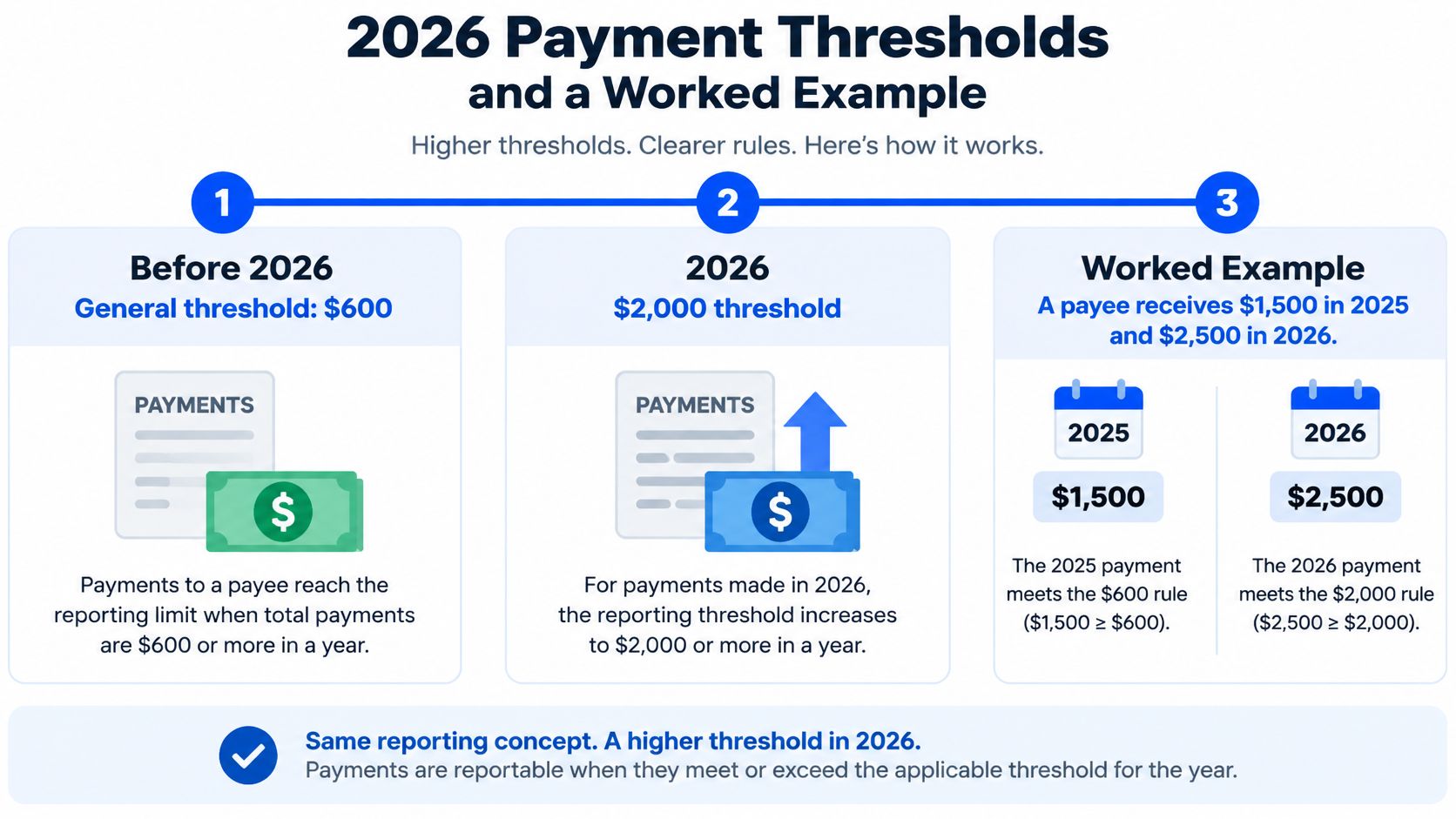
The costly habit here is applying last year's rule to this year's payments. The IRS page Am I required to file a Form 1099 or other information return? sets out a general threshold that changes by payment year, and each form and payment category still has its own rules and exceptions.
For payments made before 2026, the general reporting threshold is $600. Beginning with payments made in 2026, the general threshold increases to $2,000 for certain categories, as explained in the IRS instructions for Forms 1099-MISC and 1099-NEC, and amounts for later years may be adjusted for inflation. Don't read that as permission to stop tracking smaller payments. Read it as a new cutoff inside a system that still needs complete records.
Reporting thresholds by situation
| Situation | Threshold or Rule | What It Means for Your Books |
|---|---|---|
| Payments made before 2026 (general) | $600 general threshold | Most vendor payments above $600 need tracking and a form where the category applies |
| Payments made in 2026 (certain Form 1099 categories) | $2,000 threshold | Track every payee's calendar-year total; check each form's rule |
| Payment-card transactions (1099-K) | No minimum reporting amount | Even $0.01 of card receipts can generate a form |
| Third-party settlement organizations (1099-K) | More than $20,000 gross and more than 200 transactions | Both conditions must be met for the federal threshold |
| Backup withholding | Any amount when federal income tax is withheld | A form is required regardless of payment size |
A worked example with round numbers
Say Contractor A does design work for you. In 2025, you pay Contractor A $1,800 in total across the calendar year. That's above the $600 threshold for payments made before 2026, so a form is generally required for that category.
Now say you pay Contractor A the same $1,800 in 2026. That total falls below the $2,000 threshold for that category, so no form is generally required on amount alone. Contractor B, who receives $2,500 in 2026, is above the threshold, so a form is required.
The control point is aggregation. Totals are built per payee, per calendar year, not per invoice and not netted across unrelated payments. Ten small invoices to the same contractor are one annual total. If your approval process doesn't preserve payee and category at the transaction level, a tool for reviewing spend management software options won't fix the underlying total. Classification has to happen before payment, not after.
A payment below a Form 1099 threshold isn't invisible. It can still matter for income-tax records, another reporting rule, or backup withholding.
Watch the exceptions closely. Backup withholding overrides the ordinary minimum: when federal income tax is withheld, you file regardless of amount. 1099-K follows its own logic entirely, so don't apply the $600 or $2,000 vendor-payment mindset to card or platform receipts.
Filing Deadlines, E-File Rules and Penalty Exposure
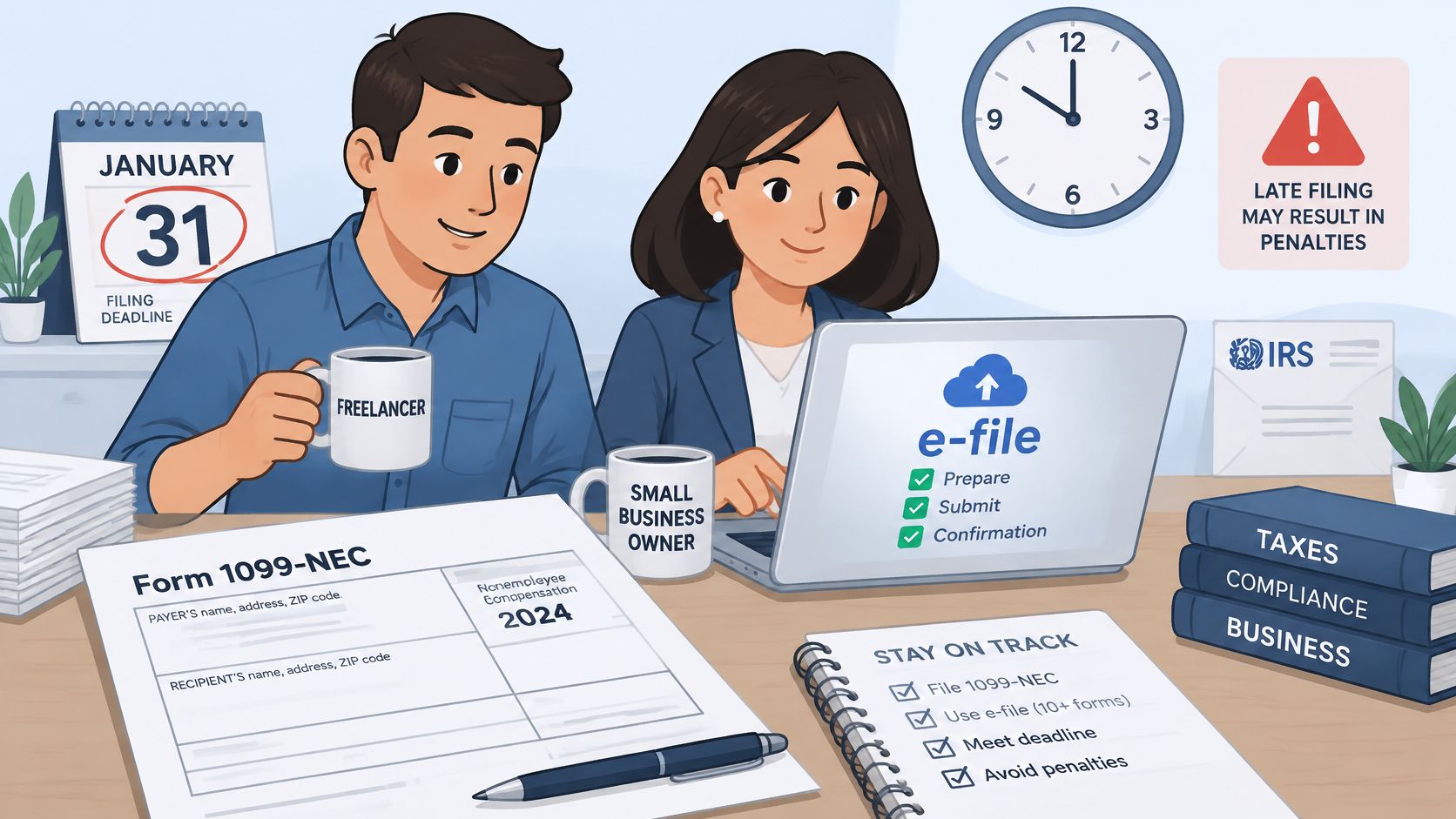
The date people remember is January 31. For Form 1099-NEC, nonemployee compensation is generally reported to both the recipient and the IRS by January 31. If that date falls on a weekend or legal holiday, the IRS instructions for information returns generally move the deadline to the next business day. For 2026 payments, January 31, 2027, falls on a Sunday, so the deadline is generally Monday, February 1, 2027. Even with that adjustment, December data quality matters: there's very little recovery time after year-end close.
The electronic filing count
Many mid-sized filers still underestimate the e-file rule. According to the IRS Form 1099-K frequently asked questions, Treasury and the IRS reduced the electronic-filing threshold for information returns from 250 returns to 10, effective for returns required on or after January 1, 2024. The IRS Information Returns Intake System (IRIS) offers electronic filing options for covered returns.
In practice, a filer that submits 10 or more information returns in aggregate must generally file electronically. The count isn't limited to one form type. Forms 1099, W-2, and other covered information returns can add together and trigger the requirement. A company with only a handful of each type can cross the line without feeling like a large filer.
Penalty exposure by filing timing for 2026
The IRS General Instructions for Certain Information Returns set the 2026 penalty schedule at $60 per return up to 30 days late, $130 per return from 31 days through August 1, and $340 per return after August 1 or not filed, subject to annual caps that vary by business size.
| Filing Timing | Penalty Per Return | Notes |
|---|---|---|
| Filed up to 30 days late | $60 | Applies per return; annual caps vary by business size |
| Filed 31 days through August 1 | $130 | Applies per return; annual caps vary by business size |
| Filed after August 1 or not filed | $340 | Applies per return; annual caps vary by business size |
That's the nonlinear risk. One bad field in your workflow, repeated across hundreds of vendor records, doesn't stay a small error. It becomes a per-return liability. Strong accounts payable invoice processing controls reduce that exposure because they catch miscoding while you can still fix the source transaction.
Work backward from January 31 in plain milestones. Set a vendor data freeze date, a separate reconciliation to the ledger date, and a separate filing date. Give each milestone an owner who can clear exceptions.
Before the season starts, count last year's total information returns across all types. If the count reached 10, confirm your electronic filing process, credentials, and acknowledgment storage are ready now, not during filing week.
How to Run Your Year-End 1099 Process
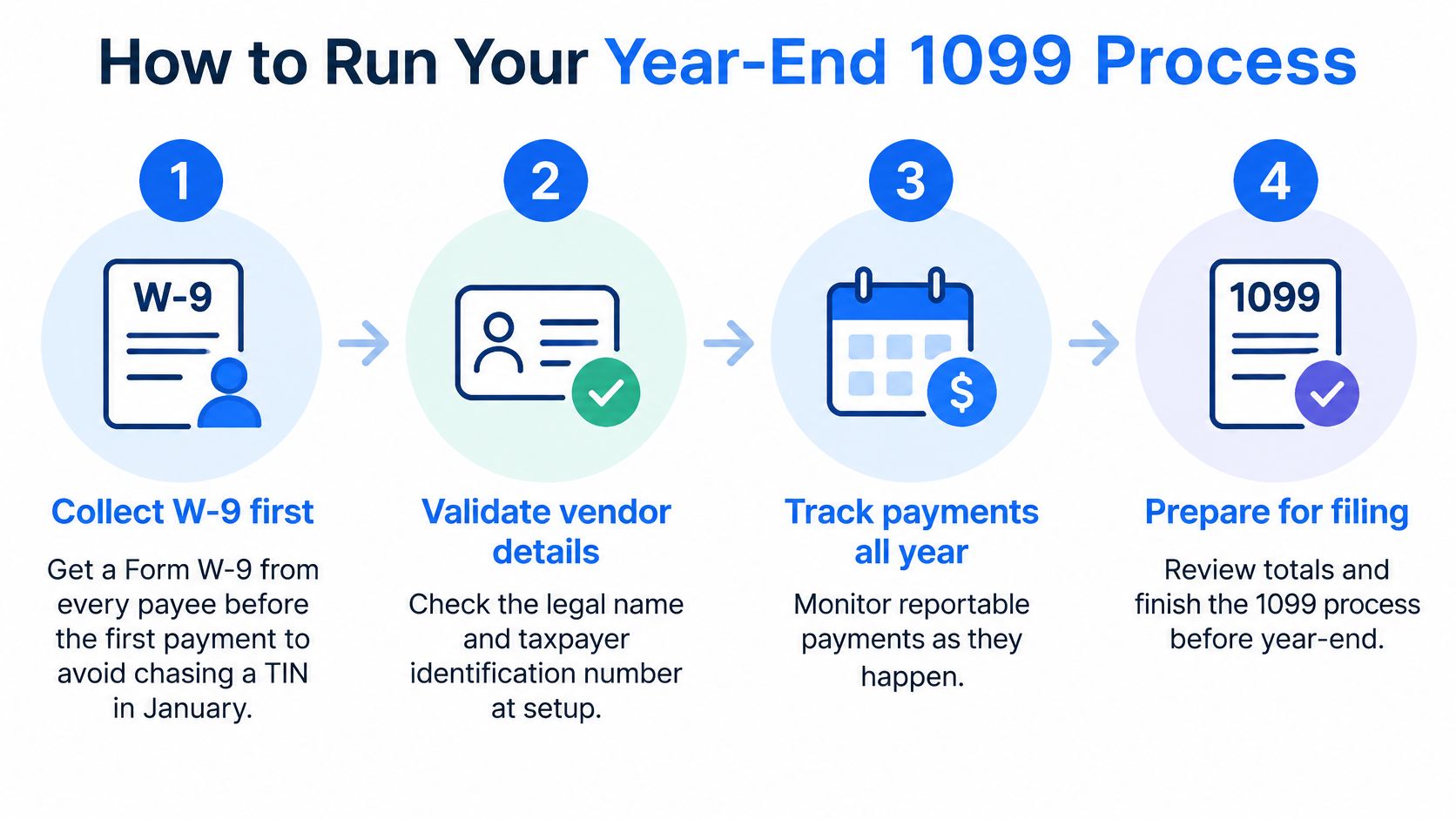
I would run this as a twelve-month process with a January output. The steps below are sequential for a reason. Skip an early one and you'll pay for it later, usually when there's no time left.
Build the record before you pay
- Collect Form W-9 before the first payment. A Form W-9 gathered at onboarding takes minutes. The same request in January can take weeks, and some payees never respond.
- Validate legal name and TIN at setup. Don't store a trade name where the legal name belongs. Check the TIN format and confirm the name matches the W-9 exactly. Eligible payers can use the IRS TIN Matching program to check name and TIN combinations before filing.
- Tag tax classification at vendor setup. Record whether the vendor is reportable and why. A disciplined vendor onboarding process makes this a setup field, not a year-end judgment call.
- Tag the 1099 category at approval. The person approving the spend knows what it was for. Months later, AP is guessing from a short invoice description.
Track totals while the year is open
- Track calendar-year totals per payee and per entity as payments post. Don't rebuild totals from bank activity. Your ledger should carry payee, category, entity, and amount on every transaction.
- Record backup withholding on the transaction. If you withhold federal income tax, store the withheld amount and the reason with the payment. A separate spreadsheet will drift from the ledger.
- Run exception reports before close. Look for missing or invalid TINs, duplicate vendors, payments in the wrong category, and vendors with reportable-looking spend but no 1099 flag. Review these monthly if vendor volume is high, quarterly at minimum in smaller environments.
Controller's test: If you can't produce a clean reportable-payments list in October, January won't be cleaner. It'll just be faster and more stressful.
Reconcile, file, and retain proof
- Reconcile 1099 totals to the general ledger. Tie reportable totals by category and entity back to the accounts where those payments posted. Investigate differences in the source records, not with a plug.
- Count all information returns together. Add every covered type before deciding how you'll file. If the aggregate reaches the electronic threshold, file electronically and test access early.
- Furnish recipient copies and file by the due date. Keep filing acknowledgments, transmission confirmations, and recipient delivery records together in one retained package.
- Log every correction. Record the date, reason, and approver for each corrected form. Corrections without a log turn into unanswerable questions during an audit or a payee dispute.
Notice what's missing: heroics. A calm January comes from boring discipline in March, July, and October. The filing step should be the least interesting part of the cycle.
Mistakes That Create 1099 Errors and How to Prevent Them
Automation doesn't remove Form 1099 risk. It can repeat a bad vendor record or a misclassified payment across every transaction for that payee, at scale, with complete confidence. The IRS Instructions for Forms 1099-MISC and 1099-NEC frame the operational point clearly: an ERP workflow should preserve vendor tax classification, TIN, payment category, calendar-year totals, and withholding status at the transaction level.
That design prevents two common failures. It stops teams from netting unrelated payments together, and it stops them from treating every vendor as if one universal threshold applies. Both shortcuts look efficient until the totals are wrong.
Common 1099 errors, causes and fixes
| Symptom | Likely Cause | Prevention Control |
|---|---|---|
| Missing or invalid TIN at filing | W-9 collected late or never | Block payment until a W-9 is on file and TIN is validated |
| Contractor reported on the wrong form or not at all | Payment coded to general expense instead of a 1099 category | Tag tax classification at vendor setup and category at approval |
| Totals do not match the general ledger | Payments netted, split or reconstructed at year-end | Keep calendar-year totals per payee and entity as payments post |
| Same payee appears twice | Vendor created under name variants | Duplicate check on TIN when a vendor is created |
| Intercompany payments reported in error | Shared-person payments between entities treated as outside spend | Settle the intercompany rule before configuration |
| Late filing despite few forms | Forms counted by type, not in aggregate | Count all information returns together against the 10-return rule |
Where the table points you
Most rows trace back to the vendor master. Name variants create duplicate vendors. Duplicates split annual totals. Split totals miss thresholds and produce incomplete forms. Strong vendor master data management isn't administrative tidiness here. It's the control that decides whether your payee total is real.
Intercompany payments need a decision, not a default. We advise clients to settle the intercompany rule before configuration, with whoever owns the tax position in the room. If related entities share people or services, decide how those payments are treated first, then configure entity and category rules to match. Reversing that order produces reports nobody trusts.
Nonprofit organizations don't get a pass either. The IRS information-return guidance for tax-exempt organizations explains why exempt-purpose status alone doesn't eliminate vendor-reporting controls.
Pick five recent vendor payments and trace each one from setup to category to ledger to draft form. If any attribute had to be reconstructed along the way, you've found your filing risk.
That five-payment test is fast and honest. It shows whether your process preserves evidence or depends on memory. I would run it well before December, while fixes are still cheap.
Decide Whether Your System Can Carry 1099 Compliance Alone
You'll usually know basic tools have been outgrown before anyone says it out loud. We advise that the signals are usually multiple entities, mixed billing methods, or project margin that only exists in a spreadsheet. Add one more for this topic: vendor and Form 1099 data that lives outside the accounting system.
When that's true, the question isn't whether software can print a form. Almost anything can. The question is whether your setup preserves the attributes that make the form right.
Software alone versus design plus implementation
Software alone can store fields and run reports. A modern accounting or ERP system should let you carry legal name, TIN, tax classification, payment category, entity, and withholding status at the transaction level, then produce exception reports and an audit trail. A well-designed accounts payable workflow can also route approvals so category decisions happen while the business context is fresh.
What software won't decide for you is the design. Someone still has to define the vendor master standards, the duplicate check, the intercompany rule, the approval workflow, and the category mapping from chart of accounts to form. Skip that work and you've automated your current habits, including the bad ones.
Partner-led implementation covers that design work. The useful version includes a dry run against last year's payments, so you can see which vendors would've been flagged, missed, or split across duplicates. It also includes training the people who'll own the vendor master after go-live, because controls decay quickly when ownership is vague.
Choosing the right system is a separate decision from 1099 design, but it should be made with the same controls in view. That's why choosing the right system means evaluating options against your entity structure, payment mix, and reporting needs, not against a feature checklist. Lucentive works as an independent advisor in that evaluation, testing fit against the controls you need and recommending what fits, without crowning a single product in advance.
If 1099 season exposes vendor data you don't trust, don't start with a software purchase. Start with the control design. Then choose technology that can carry it.
If you'd like a second set of eyes, schedule a 30-minute working session with our team to walk through your vendor master, exception reports, and the points where your entities meet. Bring last year's filing package. We'll help you see whether the gap is process, configuration, or system fit.
Summary
Form 1099 is a family of information returns. Most businesses issue 1099-NEC and 1099-MISC, while sellers receive 1099-K for gross card and platform receipts that can differ from taxable profit. The general threshold was $600 before 2026 and is $2,000 for 2026 payments in certain categories. Form 1099-NEC is due January 31, electronic filing applies at 10 or more returns counted together, and penalties rise with lateness. The work is year-round: collect the W-9, tag categories, reconcile, run exceptions, and settle the intercompany rule before configuration.
Frequently Asked Questions
Which Form 1099 do most businesses issue
Most operating businesses issue Form 1099-NEC for nonemployee compensation paid for services, such as independent contractors and consultants. They issue Form 1099-MISC for rents, prizes, awards, and other reportable payments not covered by another form. Other forms, including 1099-INT, 1099-DIV, 1099-R, and 1099-G, usually come from banks, corporations, plan administrators, or government agencies. List what you issue versus what you receive, then assign an owner to each type.
Did the threshold change for 2026
Yes. For payments made before 2026, the general reporting threshold is $600. Beginning with payments made in 2026, the general threshold increases to $2,000 for certain Form 1099 categories, and later amounts may be adjusted for inflation. Each form and payment category has its own rules and exceptions, so don't apply one threshold to every vendor. Check the category, aggregate the payee's calendar-year total, and keep records even when no form is required.
Can I skip a form for a contractor paid under the threshold
Generally, amount alone may mean no form is required below the applicable threshold, but there's an important exception. Backup withholding requires the applicable Form 1099 regardless of payment amount when federal income tax is withheld. A below-threshold payment can also matter under another reporting rule or for your income-tax records. Don't delete the vendor record or stop tracking totals. Keep the W-9, category, and annual total so the decision is documented and reversible if payments grow.
Do nonprofits need to file 1099s
Yes, they can. Nonprofit organizations are treated as engaged in a trade or business for these reporting rules, so exempt-purpose status alone doesn't eliminate vendor-reporting controls. A nonprofit paying contractors, landlords, or other reportable payees needs the same discipline as a commercial business: collect a W-9 before payment, validate the legal name and TIN, tag the payment category, and track calendar-year totals by payee and entity.
When is Form 1099-NEC due
Form 1099-NEC nonemployee compensation is generally reported to both the recipient and the IRS by January 31. Work backward from that date with separate milestones for the vendor data freeze, reconciliation to the general ledger, and filing. Also count all information returns together before the season starts. If you submit 10 or more in aggregate, you must generally file electronically, so confirm access and acknowledgment storage early.
Does 1099-K apply to my card receipts
Payment-card transactions have no minimum reporting amount, so even $0.01 of payment-card receipts can generate a Form 1099-K. For third-party settlement organizations, the federal threshold requires more than $20,000 in gross reportable payments and more than 200 transactions; both conditions apply. The IRS instructions for Form 1099-K distinguish these two reporting rules. Remember that 1099-K reports gross amounts. Refunds, fees, chargebacks, cost of goods, and expenses can make taxable profit lower than the gross figure on the form.
If your vendor records wouldn't survive a five-payment trace from setup to form, Lucentive can help you redesign the process and evaluate whether your current system can carry those controls. Visit Lucentive to schedule a short working session and map the fixes before the next filing deadline forces them.