A controller discovers that the general ledger looks clean, but the lease file doesn't. Copier agreements sit with procurement, vehicle contracts live in department folders, facility renewals are buried in legal correspondence, and an interlocal service agreement includes equipment nobody classified as a lease. The next close becomes a reconstruction exercise, with finance recalculating liabilities and right-to-use assets in disconnected workbooks while the audit team asks how management knows the population is complete.
That situation is why a GASB 87 implementation guide must go beyond the accounting model. GASB 87 is an ongoing data-governance discipline. The standard was issued in June 2017, its original effective date was postponed, and it became effective for fiscal years beginning after June 15, 2021. Many governments with June 30 year-ends first applied it in FY 2022, turning adoption into a multiyear effort involving transition entries, comparative reporting, and repeatable close procedures. GASB Statement No. 87 provides the authoritative foundation.
For finance leaders, the practical question is no longer just, “What is GASB 87?” It's “Who owns the lease data, how do we prove the inventory is complete, and how do we keep every renewal, modification, and termination synchronized with the books?”
Table of Contents
- The Lease Problem Finance Teams Are Still Solving
- How GASB 87 Changes Lease Accounting
- Building a Complete Lease Inventory
- Measuring the Liability and Right-to-Use Asset
- Journal Entries Across the Lease Lifecycle
- Disclosures and Ongoing Lease Data Governance
- Putting It All Together for a Clean Year-End
- Summary
- Frequently Asked Questions
- What does GASB 87 require lessees to recognize?
- How is a short-term lease treated under GASB 87?
- Why are renewal options so important?
- What should be included in a lease inventory?
- Which discount rate should a government use?
- What happens when a lease is modified?
- Why isn't a spreadsheet enough for ongoing compliance?
- What should finance leaders do before the next audit?
The Lease Problem Finance Teams Are Still Solving
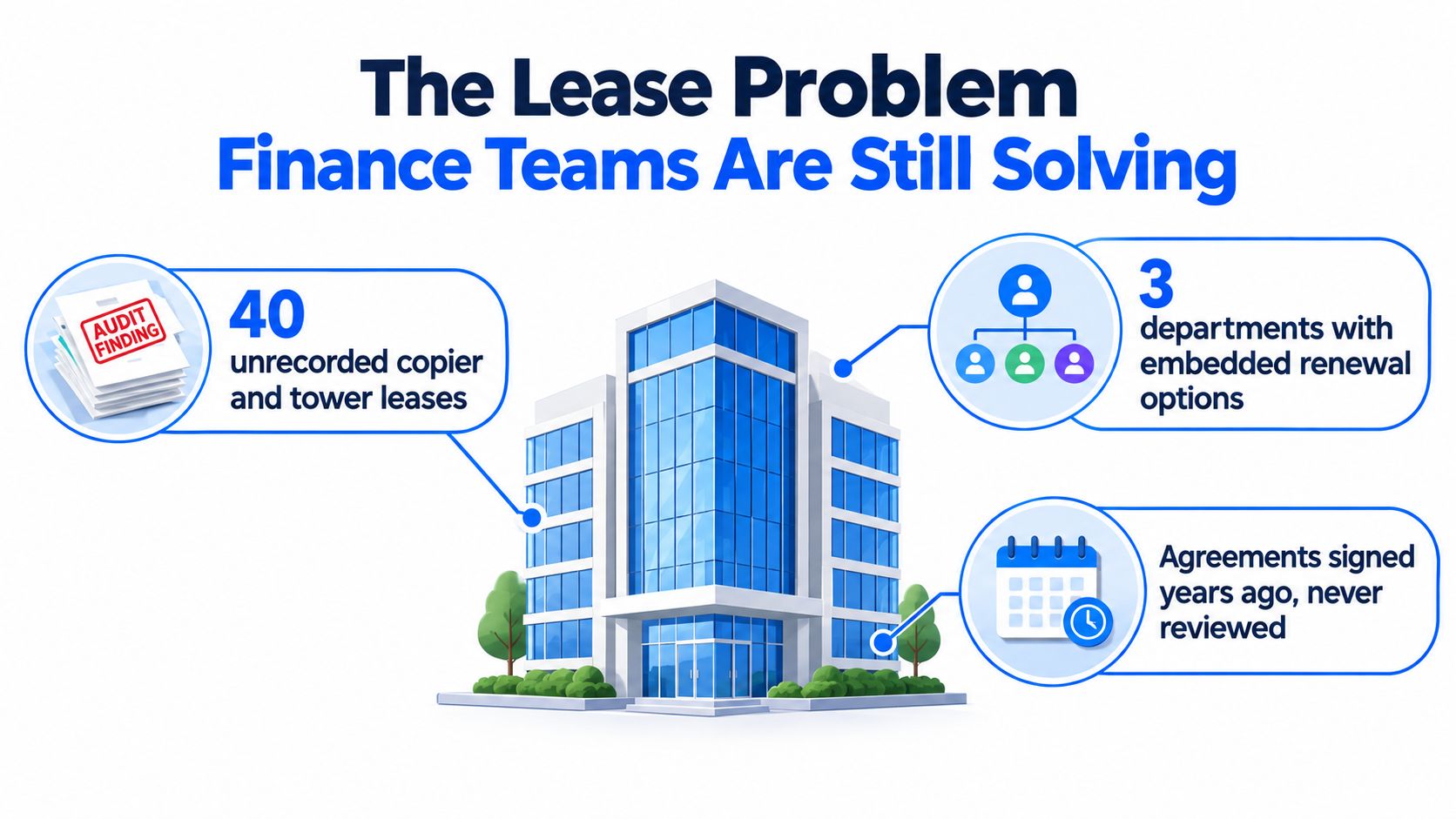
An audit finding can begin with a simple question: “Show us every agreement that gives the government control of an asset.” A controller may then find 40 unrecorded copier and tower leases, three departments with facility agreements containing embedded renewal options, and contracts signed years ago that no one has reviewed since commencement. Finance has to determine whether those arrangements create lease liabilities, reconstruct payment schedules, identify the correct term, and explain why the omissions weren't detected earlier.
The burden usually falls on the same people responsible for the close. They search email archives, procurement systems, shared drives, and department folders. One workbook calculates the liability, another tracks payments, and a third contains renewal assumptions. Staff turnover makes the process harder because the logic exists in individual knowledge rather than in an approved workflow.
Why adoption doesn't end at implementation
Government and nonprofit entities keep signing, extending, amending, and terminating contracts. A new vehicle lease can change the population. A seasonal facility rental can require a fresh term assessment. A shared-service arrangement can contain an embedded right to use equipment even though the agreement's title never includes the word “lease.”
That constant activity makes GASB 87 a control problem as much as an accounting problem. Auditors need to see a defensible method that survives personnel changes, system migrations, and future changes in guidance. A one-time spreadsheet prepared for adoption won't provide that assurance.
Practical rule: Treat every contract change as a potential accounting event, not an administrative update.
The GASB 87 implementation process should therefore assign ownership across purchasing, legal, operations, and accounting. Finance can own the accounting conclusion, but departments must provide timely notice of new agreements and changes. Without that shared responsibility, the ledger will always trail the contracts.
How GASB 87 Changes Lease Accounting
GASB 87 replaced the former government distinction between capital and operating leases with a single lessee model for most leases. When a contract conveys control of the right to use an identifiable nonfinancial asset for a period of time in an exchange or exchange-like transaction, the lessee generally recognizes a lease liability and an intangible right-to-use asset. GASB's implementation guidance addresses the detailed application and transition mechanics.
The balance-sheet effect is the major operational change. A contract that previously appeared mainly as an operating expense and a footnote disclosure may now require present-value measurement, a liability schedule, an asset schedule, and recurring journal entries. The accounting team must support the opening balance with contract evidence, payment terms, commencement information, and documented assumptions.
Exceptions require careful reading
A short-term lease is one whose maximum possible term at commencement, including extension options, is 12 months or less. The option doesn't depend on whether management expects to exercise it. Lessees expense payments for these leases rather than recording a lease liability and right-to-use asset, and short-term leases have no disclosure requirements under the cited state guidance. North Carolina's GASB 87 lease resource summarizes that treatment.
Small-dollar contracts may also be grouped under an entity's documented policy when the applicable guidance permits it. The key is consistency. A threshold that exists only in an accountant's spreadsheet won't defend itself during audit fieldwork.
Renewal and termination options deserve attention at commencement. The relevant question isn't whether a department casually expects to renew. The standard uses a high reasonably certain threshold, and the conclusion should reflect enforceable rights, operational dependence, replacement costs, budget decisions, and termination consequences. Lessee decision guidance explains that the lease term includes periods covered by options reasonably certain to be exercised.
The income statement still requires systematic recognition rather than a simple payment-only view. Principal and interest affect the liability, while the right-to-use asset is amortized. Cash flow presentation also separates principal and interest, so readers may interpret operating results and financial flexibility differently than they did under the prior model.
Building a Complete Lease Inventory
The inventory is the foundation. If the population is incomplete, accurate measurement of the identified contracts won't produce complete financial statements. Government implementation guidance recommends beginning with a complete enterprise-wide lease inventory and extracting the contract terms needed for classification and measurement. Additional public sector implementation resources from the GFOA, Cherry Bekaert, and RSM can help teams benchmark their approach.
Start with policy, then search everywhere
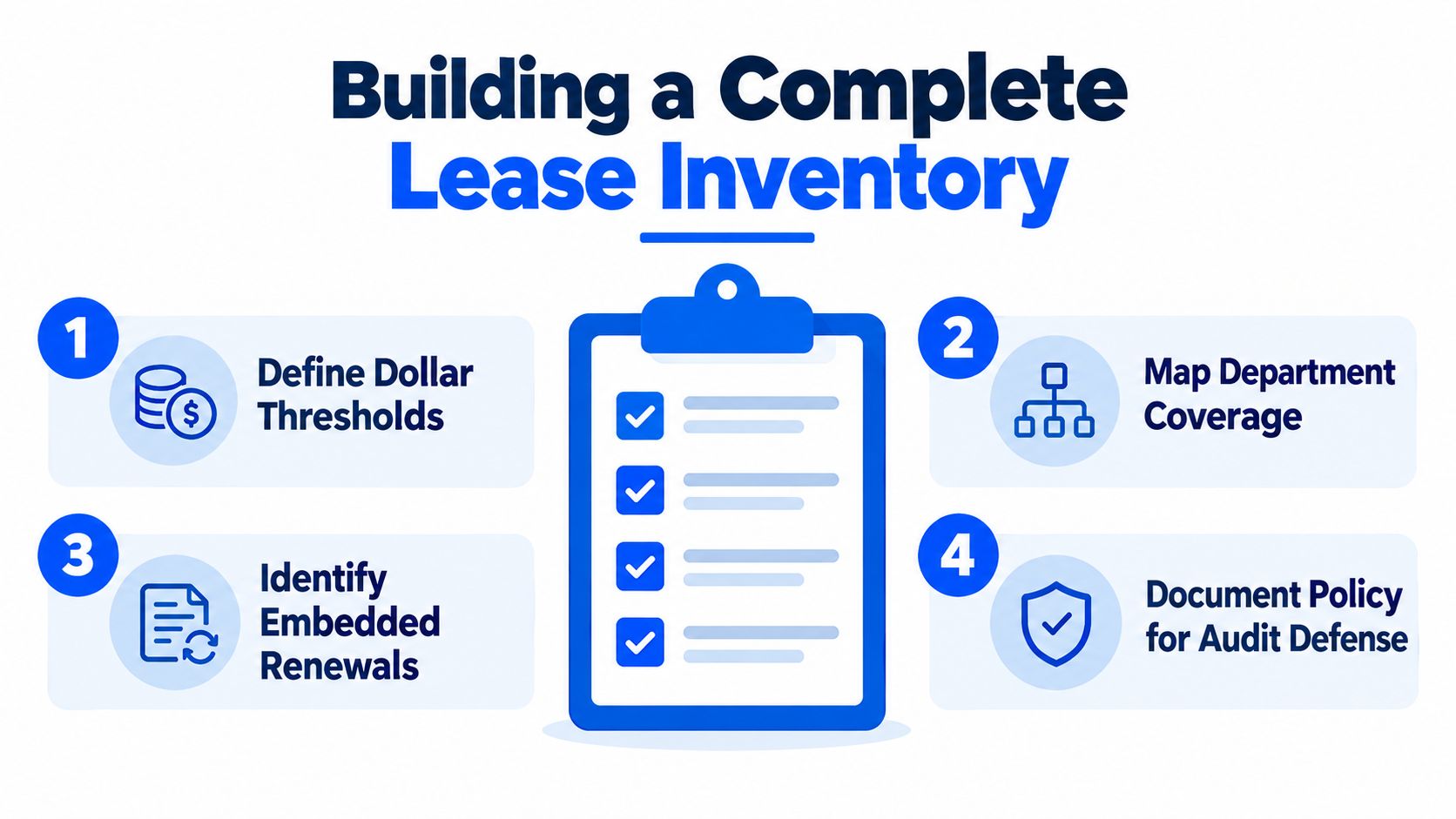
Document the scope before asking departments for contracts. The policy should define the dollar thresholds, entity and department coverage, contract types, approval responsibilities, and treatment of amendments. This gives reviewers a consistent basis for deciding why an arrangement was included or excluded.
Search by asset and rights, not just by contract title. Commonly missed arrangements include:
- Office equipment: Copiers, printers, postal meters, and similar equipment may appear in service or maintenance agreements.
- Transportation and facilities: Fleet vehicles, modular buildings, land easements, and antenna arrangements can sit outside the central contract repository.
- Shared services: Interlocal agreements may include control over specified equipment or space.
- Technology arrangements: Subscription-based hosting arrangements require careful assessment when the customer controls the use of an identified asset.
Master service agreements create a particular risk. A vendor may provide maintenance, supplies, and equipment under one contract, with no heading that says “lease.” The accounting review must determine whether the government controls the use of an identified asset and receives its service capacity for the agreed period.
Make departments part of the control
A complete search combines central data with departmental certification. Procurement can provide vendor and contract records. Legal can identify renewal clauses and amendments. Facilities can locate property arrangements. Fleet and information technology can identify assets managed outside finance.
Use a single intake channel for new, renewed, modified, and terminated contracts. Each submission should capture the vendor, contract number, asset type, commencement and termination dates, payment schedule, renewal and termination options, and the person accountable for the arrangement. Maine's FY26 lease survey instructions illustrate the level of detail agencies may need to maintain over time.
A centralized lease subledger connected to the general ledger is more durable than a collection of personal workbooks. If your finance architecture also needs stronger entity, department, grant, or program reporting, Sage Intacct dimensions can provide a structured way to preserve the coding context around lease activity. The software won't discover an omitted contract by itself. The value comes from combining a controlled intake process with a system that retains history, approvals, schedules, and posting support.
Measuring the Liability and Right-to-Use Asset
Measurement starts with the payment stream and ends with a documented present-value calculation. The lease liability generally reflects fixed and in-substance fixed payments over the lease term, discounted to the commencement date. Variable payments tied to usage or performance require separate analysis rather than automatic inclusion in the fixed schedule.
Establish the term before selecting the rate
The lease term includes the noncancelable period and option periods that are reasonably certain to be exercised. Purchase options, termination penalties, operational dependence, and the cost of replacing the asset can influence the conclusion. Management's informal expectation is not enough. The file should state the facts, identify the decision-maker, and explain why the option meets or fails the threshold.
The discount rate comes next. If the lease's implicit rate is readily determinable, use it. If not, the lessee uses its incremental borrowing rate, meaning the rate the government would pay to borrow the lease payment amounts over the lease term. A government should document the source, date, term, security assumptions, and adjustments used to derive that rate.
| Step | Source | When Applied | Documentation Needed |
|---|---|---|---|
| 1 | Implicit rate in the lease | When the rate is readily determinable | Contract terms and calculation support |
| 2 | Incremental borrowing rate | When the implicit rate isn't readily determinable | Borrowing evidence, term, assumptions, and approval |
| 3 | Approved methodology for the incremental rate | When comparable borrowing information must be developed | Methodology, source records, and reviewer sign-off |
The measurement file should also support the opening date. During transition, an entity may need to reconstruct the liability using the remaining lease term and discount rate as of the beginning of the earliest period restated. GASB's implementation guide makes historical contract capture essential for that reason.
Build the right-to-use asset from the liability
The initial right-to-use asset starts with the lease liability and is adjusted for items such as payments made before commencement, lease incentives, and qualifying initial direct costs. The asset is an intangible right to use the underlying asset, not ownership of the underlying property or equipment. An arrangement that transfers ownership under the applicable conditions is treated as a financed purchase rather than a lease.
At each reporting date, the liability follows the effective interest method. The right-to-use asset is amortized systematically, while the team updates the schedules for approved modifications and reassessments. A strong general ledger structure keeps the accounting conclusion, subledger schedule, and posted activity tied to the same contract identifier.
Journal Entries Across the Lease Lifecycle
A lease schedule is only useful when it produces entries that reconcile to the general ledger. At commencement, the controller records the right-to-use asset and lease liability based on the calculated present value. The supporting entry should identify the contract, commencement date, payment stream, term conclusion, and discount-rate source.
Annual activity then follows the schedule. The liability decreases for the principal portion of payments and accretes for interest using the effective interest method. The right-to-use asset is amortized systematically. The exact fund presentation depends on the reporting context, so government-wide statements and governmental fund statements shouldn't be forced into one identical entry pattern.
The recurring entry logic
A practical posting sequence looks like this:
- Commencement: Debit the right-to-use asset and credit the lease liability at the measured present value.
- Interest recognition: Debit interest expense and credit the lease liability for the period's effective interest.
- Payment allocation: Debit the lease liability for principal and credit cash for the payment, with interest handled according to the entity's established posting design.
- Asset amortization: Debit amortization expense and credit accumulated amortization or the applicable right-to-use asset account.
- Modification or reassessment: Adjust the liability and asset when an approved change alters the term, payments, or other measurement inputs.
- Termination: Remove the remaining balances and recognize the resulting adjustment under the applicable guidance.
Keep fund reporting aligned with the schedules
Governmental funds may use a modified approach for current financial resources, while the government-wide statements recognize the long-term lease liability and right-to-use asset. Transfers between funds and business-type activities require deliberate coding and reconciliation rather than a generic intercompany clearing entry.
Modifications deserve a formal trigger. An extension, reduction in space, change in payment terms, or change in the underlying asset can require reassessment. The accounting team should receive notice through contract administration, not discover the change when cash disbursements no longer match the schedule.
For organizations that need controlled data exchange between a lease process and other systems, the Sage Intacct API can be evaluated as part of the broader architecture. Integration doesn't replace accounting judgment, but it can reduce rekeying when the contract record, subledger, and general ledger need to stay synchronized.
Disclosures and Ongoing Lease Data Governance
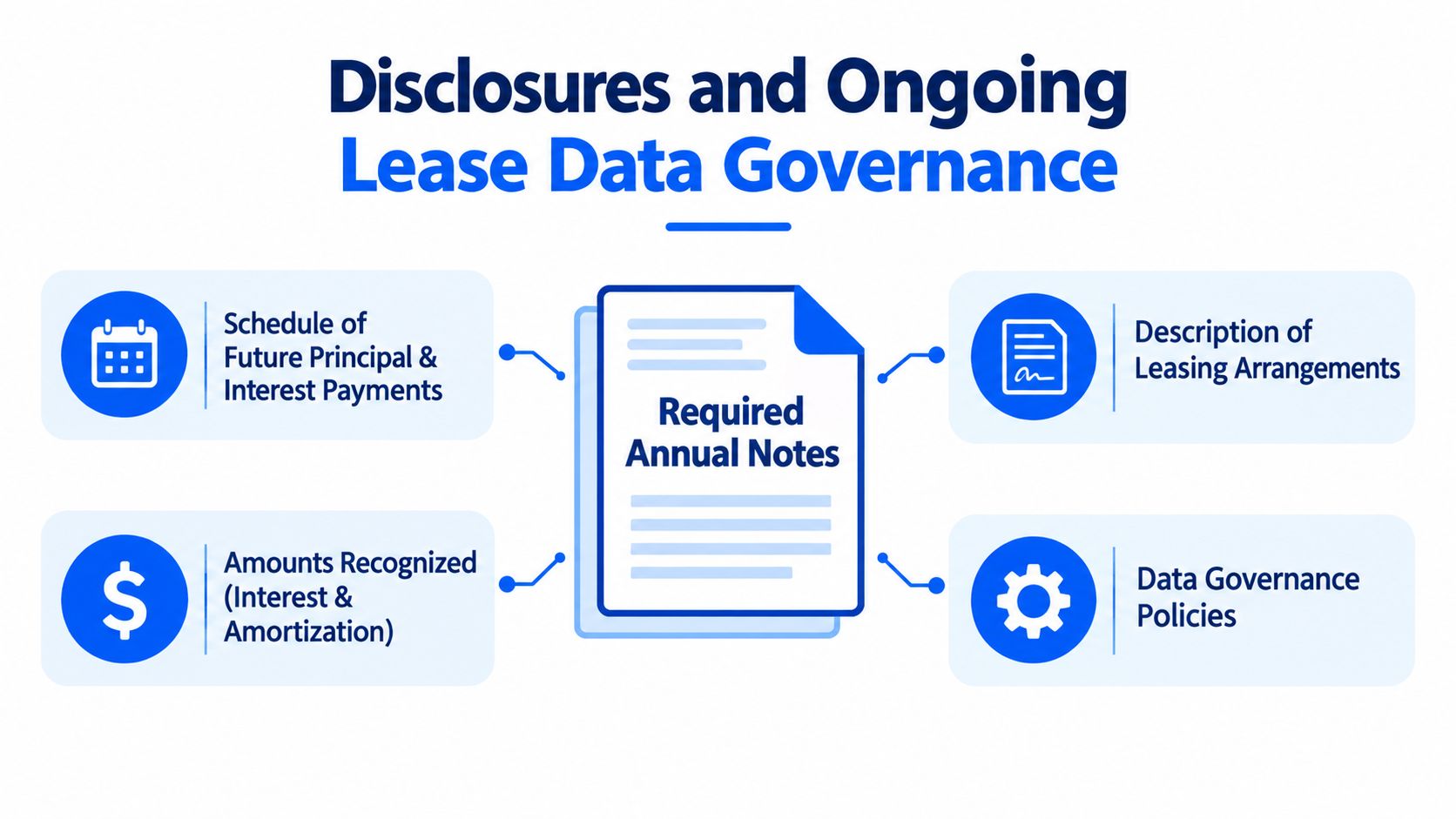
Year-end disclosure preparation should begin with the lease subledger, not with a blank note template. The annual notes generally need a description of the leasing arrangements, amounts recognized in the financial statements, a schedule of future principal and interest payments, and information about restrictions or commitments arising from lease contracts. The numbers in the note must agree with the liability schedule and the general ledger.
Turn the survey into a recurring control
An annual lease survey should ask every covered department to certify new contracts, renewals, terminations, modifications, and arrangements that were previously omitted. The questions should mirror the fields used in the subledger, including vendor, asset, commencement date, contract number, payment terms, and option periods.
A useful governance cycle includes:
- Department certification: The operational owner confirms that the contract population is complete.
- Accounting review: Finance assesses whether each new or changed arrangement meets the lease definition.
- Approval segregation: One person enters contract data while another reviews the conclusion and approves the measurement.
- Schedule reconciliation: The subledger is reconciled to cash activity and the general ledger.
- Audit retention: Contract versions, calculations, rate support, approvals, and modification decisions remain together.
A spreadsheet can work during discovery, but it becomes fragile when multiple people maintain formulas, files, and assumptions. An ERP-integrated lease subledger gives the team a controlled place to retain schedules and posting history. Data quality assurance practices are especially relevant when finance depends on information originating in decentralized departments.
Document the assumptions auditors will challenge
Renewal conclusions, discount rates, short-term treatment, embedded leases, and modification dates deserve explicit documentation. A reviewer should be able to understand the source contract, the facts considered, the accounting conclusion, and the person who approved it without relying on an informal conversation.
The most effective controls are ordinary and repeatable. Use version control. Require change notifications. Recalculate schedules after approved modifications. Reconcile balances before disclosures are drafted. Treat the process as part of the close calendar rather than as an annual scramble.
Putting It All Together for a Clean Year-End
A workable implementation roadmap sequences the decisions instead of asking finance to solve everything at once:
- Month one: Complete the enterprise-wide inventory, document scope, and assign ownership.
- Month two: Lock down lease terms, renewal conclusions, payment schedules, and discount-rate assumptions.
- Month three: Post opening entries and confirm the transition approach, including any permitted practical expedient.
- Month four: Run depreciation and interest schedules in parallel with the general ledger and investigate differences.
- Month five: Reconcile the balances to the required disclosures and preserve the audit support.
The recurring failure points are predictable. Teams omit copiers and vehicles, assume every renewal will be exercised, use stale incremental borrowing rates, or fail to record a modification when a lease is extended. Each issue points to a control weakness, not merely a calculation error.
GASB 87 doesn't end on implementation day. It becomes a repeatable close-cycle discipline that connects purchasing, legal, operations, accounting, and reporting. Finance leaders should map the current data sources, identify ownership gaps, and create a remediation plan before the next audit cycle begins.
Lucentive helps finance teams evaluate Sage Intacct and related implementation needs around controlled data, reporting, and audit-ready workflows. Schedule a 30-minute working session or Sage Intacct demo through Lucentive to map your lease data sources and determine whether the platform and implementation approach fit your organization.
Summary
GASB 87 replaces the former government lease classification model with a single lessee approach for most qualifying leases. The practical work depends on finding every contract, evaluating embedded leases and renewal options, documenting discount-rate decisions, measuring the liability and right-to-use asset, and posting entries throughout the lease lifecycle. Annual surveys, controlled approvals, reconciliations, and retained calculation support turn adoption into a sustainable governance process. A centralized workflow and integrated subledger can reduce dependence on fragmented workbooks and help finance teams prepare defensible year-end disclosures.
Frequently Asked Questions
What does GASB 87 require lessees to recognize?
For most leases longer than 12 months, GASB 87 requires a lessee to recognize a lease liability and an intangible right-to-use asset. The former capital-versus-operating distinction no longer drives the basic lessee model. The accounting team must support recognition with contract terms, payment schedules, lease-term conclusions, and discount-rate documentation.
How is a short-term lease treated under GASB 87?
A short-term lease has a maximum possible term of 12 months or less at commencement, including options to extend. The assessment doesn't depend on whether management expects to exercise an option. Short-term lease payments are expensed rather than recorded as a lease liability and right-to-use asset, and the cited state guidance says short-term leases don't require disclosures.
Why are renewal options so important?
Renewal options affect the lease term when exercise is reasonably certain. That conclusion influences the present value of the liability, the right-to-use asset, amortization, and future disclosures. Finance should document the operational facts, contractual rights, termination penalties, and other evidence supporting the decision instead of relying on an informal expectation.
What should be included in a lease inventory?
The inventory should cover contracts that may convey control of an identified asset, including copier and printer arrangements, vehicles, modular buildings, land easements, antenna agreements, interlocal service contracts, and relevant technology arrangements. It should capture vendors, contract numbers, asset types, payment schedules, commencement and termination dates, renewal options, and discount-rate inputs.
Which discount rate should a government use?
The lessee should use the implicit rate when it's readily determinable. If it isn't, the lessee uses its incremental borrowing rate, which reflects the rate the government would pay to borrow the lease payment amounts over the lease term. The file should retain the methodology, source information, assumptions, calculation, and approval.
What happens when a lease is modified?
A modification or reassessment may require changes to the lease liability and right-to-use asset. Extensions, reductions, payment changes, and other contract amendments should be routed to accounting through a formal intake process. The team should preserve the revised contract, updated assumptions, recalculation, approval, and resulting journal entry.
Why isn't a spreadsheet enough for ongoing compliance?
A spreadsheet can support initial discovery, but it becomes difficult to control when departments, reviewers, and reporting requirements expand. An integrated lease subledger can retain schedules, approvals, calculation history, and posting support in a controlled process. It still depends on complete departmental reporting and sound accounting judgments.
What should finance leaders do before the next audit?
Start by mapping every current lease data source across procurement, legal, operations, and accounting. Identify contracts without owners, renewals without tracking, and schedules that don't reconcile to the general ledger. Then create a remediation plan that assigns responsibility, sets review points, and connects the inventory to the recurring close and disclosure process.