You're on day eight of the close, three entity ledgers still don't tie, and the auditor wants a transaction trail nobody can pull without a spreadsheet hunt. QuickBooks carried the company this far. It will not carry a multi-site clinic, a nonprofit with restricted funds, or a services firm that needs project margin it can defend.
Most write-ups of risks in ERP implementation projects stop at go-live. That's the wrong finish line. A system can launch, invoices can post, and finance can still be reconciling by hand because nobody owns the chart of accounts once the consultants leave. The software is rarely what breaks. Scope, process design, data, integrations, adoption, and staffing are.
Table of Contents
- Six Risk Categories and What Each One Costs
- Root Causes Behind Each Risk
- How to Score ERP Risks Before You Sign
- Controls to Put in Place Phase by Phase
- Data Migration and Integration Failures to Prevent
- Industry Risk Profiles and Your Next Step
- Summary
- Frequently Asked Questions
Six Risk Categories and What Each One Costs
Failed implementations rarely surprise anyone who was watching closely. The same six categories account for most of the damage, and each one carries an early warning sign a finance team can spot months before the invoice arrives.
A risk is a cause plus a consequence. The impact column is what belongs in front of the steering committee, because a CFO signs off on close days, audit exposure, and a business case. Configuration screens are the consultant's problem.
| Risk category | What goes wrong | Business impact | Early warning sign |
|---|---|---|---|
| Scope and objectives | Scope expands and customizations accumulate without an owner | Cost overruns, delayed go-live, business case unmet | Change requests approved by email with no budget impact review |
| Process design | Configuration starts before future-state processes and entity structure are agreed | Rework, wrong reporting hierarchy, rebuilt approval flows | Team says we will decide the entity structure later |
| Data migration | Duplicate vendors, incomplete customer balances, inconsistent dimensions | Opening balances nobody trusts, reports that do not tie | Mock conversion totals differ from the legacy general ledger |
| Integration | Interfaces duplicate, drop, or transform transactions | Close delays, unexplained variances, control gaps | Manual file uploads reappear in the first cycles |
| Adoption and training | Users keep spreadsheet workarounds and bypass standard steps | Controls are bypassed and visibility never materializes | Staff keep asking for the old reports or export to Excel first |
| Budget and staffing | Subject-matter expert time is underestimated and testing is squeezed | Overruns, rushed testing, unplanned tool purchases | Key accounting staff are double-booked between daily close and project work |
Launch is not the business case
Gartner has reported that more than 70% of recently implemented ERP initiatives fail to fully meet their original use-case goals, while as many as 25% fail catastrophically. A system can go live on time and still miss the close-time, reporting, control, or multi-entity visibility you used to justify the spend. The same review names scope expansion, technical problems, organizational issues, underestimated staffing, and unplanned technology purchases as the leading causes of cost overruns.
Lateness is common enough that the early-warning column matters as much as the go-live date. Industry surveys repeatedly find that a large share of ERP and SaaS implementations finish late, over budget, or both. In a 2024 Boston Consulting Group survey of global C-suite executives across 25 industries, nearly half reported that more than 30% of their organization's technology-development projects were both late and over budget.
Define success before configuration: a shorter monthly close, no spreadsheet consolidations, an audit-ready transaction history, and standard approval workflows.
Software selection alone does not deliver that list. Tie every design decision to those outcomes and name an owner for every open process decision. Then hold that ownership past go-live: the chart of accounts and dimensions still need someone accountable after the consultants leave, or the reporting you paid for degrades one workaround at a time. That is the row this table underweights, and it is where a launched system turns into a reporting failure. The line items that surface after signature are what a serious ERP total cost of ownership review is meant to catch.
Root Causes Behind Each Risk
Think of a house built on a foundation nobody surveyed. The walls go up on schedule. The cracks show when the furniture arrives, which is your first real close.
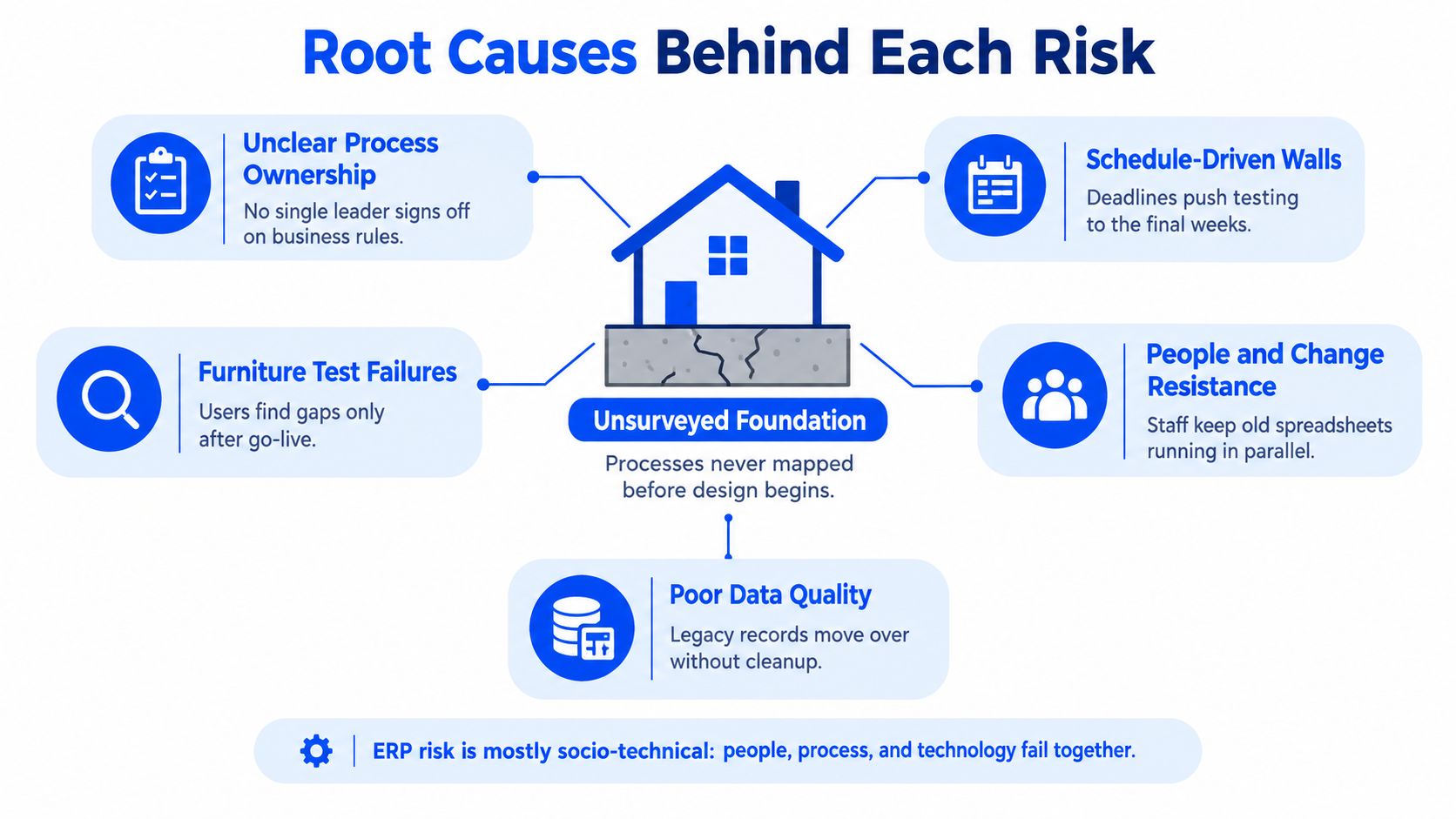
ERP risk is primarily socio-technical, not a software defect. A review of empirical research traces a clear chain. Ambiguous requirements produce incorrect process and data designs. Weak user participation leaves operational exceptions undiscovered. Insufficient training reduces adoption and increases workarounds. Those workarounds then undermine data standardization and control. The same review cites a survey of 34 organizations in which outcomes depended substantially on organizational fit and implementation variables, not on software capability alone.
Where projects actually stall
We see four places where implementations stall, and all four are design decisions postponed:
- Entity structure too late: Leadership agrees the legal and reporting structure after configuration has already started, so hierarchies get rebuilt.
- Master data treated as a cleanup chore: Duplicate vendors and blank dimensions are handed to IT instead of designed as accounting rules.
- No internal owner after the consultants leave: Nobody on your payroll owns the chart of accounts and dimensions once the partner steps back.
- Fund administration left fuzzy: Restricted-fund and grant boundaries stay undefined until testing, when every exception becomes a defect.
Resistance, weak communication, and thin leadership involvement sit on that same chain. Change management is a workstream with an owner, milestones, and acceptance criteria. It is not a go-live email.
Practical rule: Add a root-cause column to the risk register this week, and put a named person on every unresolved design decision.
Executive governance should track open design decisions, adoption readiness, training completion, and defect severity, not only budget and schedule. For a healthcare provider, nonprofit, or multi-site business, define measurable future-state processes before configuration, assign process owners, and require representative users to approve requirements and test scripts. Pilot with real transactions, including grants, restricted funds, intercompany activity, project accounting, or EMR-related integrations, so exceptions surface before enterprise rollout.
How to Score ERP Risks Before You Sign
Most business cases price the subscription and park everything else in contingency. That is how an affordable ERP becomes an expensive one. Lucentive advises that the planning effort for an ERP implementation deserves realistic estimation before anyone approves a number.
Score the register before you sign, then keep scoring it. Include the risks that only surface after the partner steps back, when the chart of accounts and dimensions still need a permanent owner and the close has to run without consulting support.
- List every risk from the six categories, each with a named owner.
- Score likelihood from 1 to 5 using evidence you already have: past close problems, staff capacity, and the count of open design decisions.
- Score impact from 1 to 5 in days added to the close, dollars at risk, audit exposure, and reporting gaps.
- Multiply the two scores.
- Assign a response and an escalation path. No orphan risks.
- Re-score monthly at steering. A risk that moved is news. A risk nobody re-scored is a blind spot.
| Score (likelihood x impact) | Rating | Required response | Escalation |
|---|---|---|---|
| 1 to 4 | Low | Monitor at monthly steering review | Owner reports only by exception |
| 5 to 9 | Medium | Named owner and mitigation plan within two weeks | Reviewed at steering each month |
| 10 to 14 | High | Funded mitigation with a date before the next phase gate | Escalated to the executive sponsor |
| 15 to 25 | Critical | Stop-or-proceed decision before the next phase gate | Escalated to CEO and executive sponsor |
Why staffing and scope score higher than teams expect
In a survey summarized by NetSuite, 38% of organizations that experienced ERP budget overruns attributed them to underestimated project staffing, nearly 35% cited expansion of the initial scope, and about 34% cited technical issues. Each one maps to a different control, so a single contingency line covers none of them.
Name the internal subject-matter experts from accounting, operations, payroll, reporting, and compliance, and count the days they leave daily work. Split mandatory launch requirements from later enhancements so a request cannot become scope by email. Test integration and conversion assumptions early instead of pricing them as a vague pad. The same build-versus-buy judgment applies here: if standard configuration covers the close, do not fund a custom build. Finance teams already make that call when weighing custom AI workflows versus off-the-shelf tools, and the ERP version of the question is identical.
A realistic case includes implementation labor, data cleansing, testing, training, temporary productivity loss, integrations, and post-go-live stabilization, all on top of software fees. A short ERP readiness assessment will show whether those owners and hours exist before you commit.
Controls to Put in Place Phase by Phase
A license gives you configuration tools. A partner-led implementation ties scope, design, and testing to the month-end close. Buying software and running an implementation are different jobs.
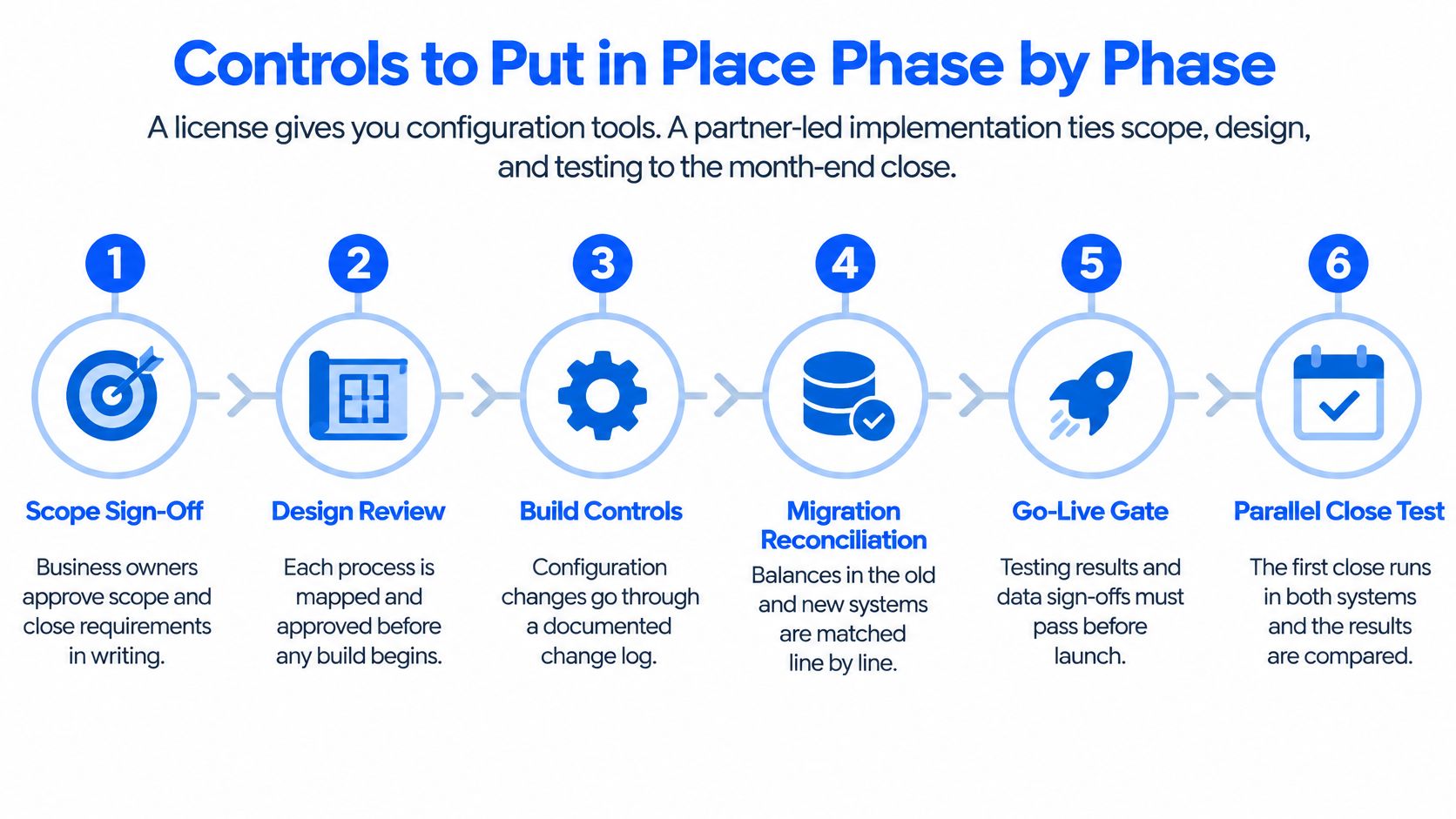
Lock four design pieces before build starts. The chart of accounts and dimensions should match how you report. Custom work happens only where no standard configuration fits. Integrations attach to systems you already run. Scope stays fixed and written down. Then prove the books with a parallel close before go-live.
| Phase | Control | Owner | Done when |
|---|---|---|---|
| Scope and design | Fixed scope and requirements built from the actual close | CFO with Controller | Scope signed and change requests logged with cost impact |
| Process and entity design | Entity structure and approval paths agreed before configuration | Controller and operational leaders | Entity map and approval matrix signed off |
| Data preparation | Named data owners and a cross-entity data dictionary | Controller with data owners | Dictionary approved and cleansing tracked by owner |
| Integration | Interfaces specified with error handling and reconciliation | Systems lead with IT | Interface test log cleared of open defects |
| Testing and parallel close | One full close run in legacy and new systems and tied out | Controller | Variances explained and documented for every line |
| Training and adoption | Role-based training and super-users in first cycles | Department heads | Training completion and readiness scores met |
| Go-live and first close | Daily exception log reviewed during the first close | CFO and project sponsor | First close completed with an approved exception list |
What a gate actually requires
Each gate needs evidence, not a status color. Scope is done when the close calendar drove the requirements and every change has a cost. Entity design is done when the map and approval matrix are signed, not when someone says they'll decide later. Data is done when owners and the dictionary exist. Interfaces are done when the defect log is clear, including failures, not only happy-path posts. Microsoft's go-live guidance calls for completed and signed-off integration, user-acceptance, and performance testing, so a green status should have test results behind it.
Microsoft recommends planning training at project initiation, then delivering it by role near go-live, with super-users in the room for the first reporting cycles. The first close is a controlled event: the exception log is reviewed daily until the CFO and sponsor accept the list. Microsoft's cutover guidance also recommends rehearsing the cutover in a test environment, with verification and sign-off defined before production. Adoption fails without warning when people are told about software instead of told what changes in approvals, close steps, and reports. Treat that as ERP change management with acceptance criteria, not a newsletter.
Data Migration and Integration Failures to Prevent
The failure that surprises finance is a successful launch. Reports arrive faster. Then the first close produces numbers nobody can defend.

Inconsistent customer, vendor, account, fund, location, or project identifiers block reliable matching. Incomplete historical mapping opens balance gaps. Poorly specified interfaces duplicate, omit, or transform transactions. Research on ERP implementation problems puts poor data quality, legacy integration difficulty, hidden costs, weak integration, unstable systems, and missing functionality on the common-problem list, and it counts more than 42 recurring problems. Weak project management, thin departmental cooperation, unclear objectives, and inadequate top-management support rank among the prominent risks. Data work is cross-functional governance owned by finance. It matters most where you need fund or grant reporting, multi-entity consolidation, project billing, or links to clinical, payroll, banking, and practice-management systems.
A conversion you can sign
- Profile source data for duplicates, blanks, and invalid dimension combinations.
- Write field-level transformation rules and name an owner for each field.
- Run at least one full mock conversion at production-like volumes. Oracle's data conversion guidance recommends multiple full-volume mock runs before cutover.
- Reconcile record counts and monetary totals by entity, period, account, fund, and transaction type.
- Tie converted balances to the legacy general ledger before cutover.
- Test interfaces for retries, duplicate messages, out-of-order events, failed authentication, and downtime recovery.
Document how every exception is treated. A file that loaded cleanly once proves little. Microsoft recommends multiple migration dry runs to check for duplication, corruption, performance problems, and cutover timing before production. When files move between the legacy ledger and the new system, follow best practices for secure data transfers so the control totals you reconciled aren't exposed or altered in transit.
Items that usually need human review are open receivables and payables, fixed assets, attachments, and grant or restricted-fund balances. That cleanup is a design task: an account that can post to the wrong fund or project in the new system was mapped wrong on paper first. Teams leaving QuickBooks should treat that cleanup as accounting design, and Lucentive's QuickBooks data migration service can support that work.
After cutover, the exposure moves from migration to the operating model. Name who owns the chart of accounts, dimension definitions, and the reconciliation cadence once the implementation partner steps back, and give that owner authority to reject new values. A clean conversion does not settle ongoing ambiguity over definitions and stewardship. Microsoft's go-live checklist calls for production monitoring and a planned handoff from the implementation team to operational support. PwC's 2026 survey found that many organizations still lack a common chart of accounts and a unified ERP environment, and about one-third operate mainly in Excel without automation. Finance can adopt a modern system and still reconcile inconsistent data by hand.
Industry Risk Profiles and Your Next Step
The same six categories land differently depending on how you bill, fund, and consolidate.
Healthcare providers and multi-site clinics. An EMR or practice-system interface error lands in receivables the same day it happens. Location-level reporting fails when the location dimension was an afterthought in the design. Run the interface at realistic clinical volumes before cutover, because a quiet test day hides what a full week of claims will expose. If that pattern matches your clinics, look at how ERP in healthcare treats those interfaces as close controls.
Nonprofit and faith-based organizations. Fund accounting, restricted-fund rules, and grant reporting break when the fund-administration boundary is still undefined at testing. Write that boundary, and who can release a restriction, before a single script runs.
Dental practices and DSOs. Multi-location roll-ups and intercompany activity between practice entities are expensive to unwind after configuration. Sign the entity map first. A wrong parent-child structure does not get a quick patch in month two.
Professional services firms. Project profitability breaks in five places: timesheet latency, uncoded non-billable time, professional services expenses landing in overhead, revenue and cost on different cadences, and change orders handled by email. Make the project field required on expense and payables transactions so margin is not overstated by costs that never hit the job.
QuickBooks migrants. Informal workarounds hide business logic that never made it into a policy. Write that logic down before design. Otherwise the new system faithfully repeats a rule nobody can explain to an auditor.
Every profile above is a design decision that outlives the launch. Someone inside your organization has to own the fund boundary, the entity map, the project field, and the dimension definitions after the implementation partner steps back. When that ownership is left unassigned, a clean go-live still degrades into reporting nobody trusts.
Lucentive is a Sage Intacct Value Added Reseller and Premier Implementation Partner serving healthcare, nonprofit, and general business organizations. ERP Advisory starts at a $5,000 fixed fee and takes 2 to 4 weeks, including requirements built from your actual close, a side-by-side platform comparison, and an honest fit assessment that may recommend staying where you are. The advisory fee is credited against implementation if you proceed. To rank your top three risks against your close calendar, schedule a 30-minute working session with our team.
Summary
Six risks decide the outcome: scope, process design, data, integration, adoption, and staffing. Missing owners after go-live turn a launch into a reporting failure. Score each risk, hold phase gates, and reconcile a mock conversion before cutover. Budget for people and stabilization, not only the license. Healthcare, nonprofits, dental groups, professional services, and QuickBooks migrants each have a specific fix. Book a 30-minute working session to rank your top three risks before you choose a partner or buy software alone.
Frequently Asked Questions
What are the most common risks in ERP implementation projects?
Six categories cover nearly every troubled project. Scope expands without an owner. Process design starts before the future-state entity structure is agreed. Data migration leaves balances that don't tie. Integrations duplicate or drop transactions. Users keep spreadsheet workarounds. Staffing is underestimated, so testing gets squeezed. Each one has a business impact a CFO signs off on, from a longer close to a business case that a live system still misses. Watch the early signals, such as email change approvals, mock totals that don't match the legacy ledger, and accountants double-booked on the daily close.
What causes ERP implementations to struggle?
The chain is socio-technical. Ambiguous requirements produce bad process and data designs. Weak user participation hides exceptions. Thin training creates workarounds, and workarounds erode controls. Projects stall in four concrete spots: entity structure agreed after configuration, master data treated as a cleanup task, no internal owner for the chart of accounts and dimensions after consultants leave, and the fund-administration boundary undefined until testing. Software capability is rarely the deciding variable. Organizational fit and how you run the implementation are.
How much should a budget include beyond the software subscription?
Overruns cluster around underestimated project staffing, scope that expands after the plan is set, and technical issues that were priced as a vague contingency. A defensible budget names internal experts and the time they leave daily work, separates launch requirements from later enhancements, and tests integration and conversion assumptions early. Beyond the license, include implementation labor, data cleansing, testing, training, temporary productivity loss, integrations, and post-go-live stabilization. If those lines are missing, the subscription price is not the project cost.
How do I check data before go-live?
Profile source data, assign an owner to every transformation rule, and run at least one full mock conversion at production-like volumes. Reconcile record counts and monetary totals by entity, period, account, fund, and transaction type, then tie converted balances to the legacy general ledger before cutover. Test interfaces for retries, duplicates, out-of-order events, failed authentication, and downtime recovery. Separately, run one full close in both systems and explain every variance. Open receivables, open payables, fixed assets, attachments, and restricted-fund balances usually need a manual review.
If you are choosing a partner or considering Sage Intacct on your own, talk through the risks against your close calendar first. Lucentive helps CEOs and CFOs see whether a cloud ERP, and the operating model around it, will shorten the close and defend the numbers. Schedule a 30-minute working session with our team at Lucentive.