The bank balance on Monday morning says the company has plenty of cash. By Wednesday, payroll is approaching, a large vendor payment is pending, and no one can say with confidence which entity has funds available. The forecast lives in a spreadsheet, account details are scattered across bank portals, and the approval trail is buried in email.
That's not a dashboard problem. It's a connectivity, process, and control problem. Treasury management software systems can bring bank activity, payments, forecasting, and reconciliation into a governed workflow, but only when the systems and processes behind them are set up to work together.

Table of Contents
- The Cash-Visibility Problem That Sends CFOs Looking for Treasury Software
- Core Modules Inside a Treasury Management Software System
- Bank Connectivity and the Standards That Matter in Practice
- Fraud, Controls, and Why Treasury Software Is an Internal-Control Decision
- Choosing Software Alone Versus the Right Implementation Partner
- Selection Criteria by Company Size and Sector
- Putting It Together and What to Do Next
- Summary
- Frequently Asked Questions
The Cash-Visibility Problem That Sends CFOs Looking for Treasury Software
A growing company often outgrows its cash process before it outgrows its accounting software. The CFO needs a consolidated view across entities, but the Controller is still checking bank portals and reconciling exports. The forecast can't reliably answer whether payroll clears next Friday because the inputs arrive late or require manual cleanup.
A treasury management system (TMS) is a software layer that gathers bank and finance data, supports cash positioning and forecasts, and governs payment workflows. It complements an ERP. The ERP remains the accounting system of record for transactions, reporting, and financial structure; the TMS helps treasury teams manage cash, bank connectivity, payments, and liquidity across accounts and entities. For a baseline definition, the Association for Financial Professionals overview of treasury management is a useful external reference.
Diagnose the missing layer
Start with the work that keeps breaking, not with a vendor feature list. If the core issue is a slow close, examine the ERP, transaction coding, and reconciliation process. If the problem is uncertainty about available cash across multiple bank accounts, delayed bank data, or payment approvals handled outside the accounting record, treasury capabilities may be missing.
A useful cash forecast also depends on reliable inputs and ownership. Teams evaluating forecasting processes can review rolling cash flow forecast practices alongside the bank and ERP data they already maintain. For broader context on how different tools approach forecasting and cash visibility, this guide to cash flow management tools can help frame the buying conversation. Finance teams that want a general forecasting benchmark can also review the CFI guide to cash flow forecasting.
Practical rule: A cash dashboard is only as trustworthy as the bank data, ERP records, and approval workflow feeding it.
The broader shift from paper payments to electronic finance helps explain why these systems matter. A U.S. law enacted in 1996 required most federal payments, except tax refunds, to be issued electronically beginning January 2, 1999. In fiscal year 1998, the Treasury's Financial Management Service issued more than 860 million payments for non-defense agencies, with 68% sent electronically, compared with 55% in fiscal year 1995. Vendor payments made electronically rose from 10% to 50% over that period, while Treasury-disbursed check volume fell by 110 million checks. These milestones are documented in the U.S. Treasury's account of electronic payment requirements.
For a mid-market buyer, the practical definition is straightforward: a TMS connects cash events to the people, approvals, and accounting records needed to manage them. It shouldn't be purchased just to add another screen. It should reduce manual handoffs and make the company's cash position easier to verify.
Core Modules Inside a Treasury Management Software System
Feature lists make treasury products look interchangeable. They aren't. The useful question is which jobs the system must support and who owns each outcome.
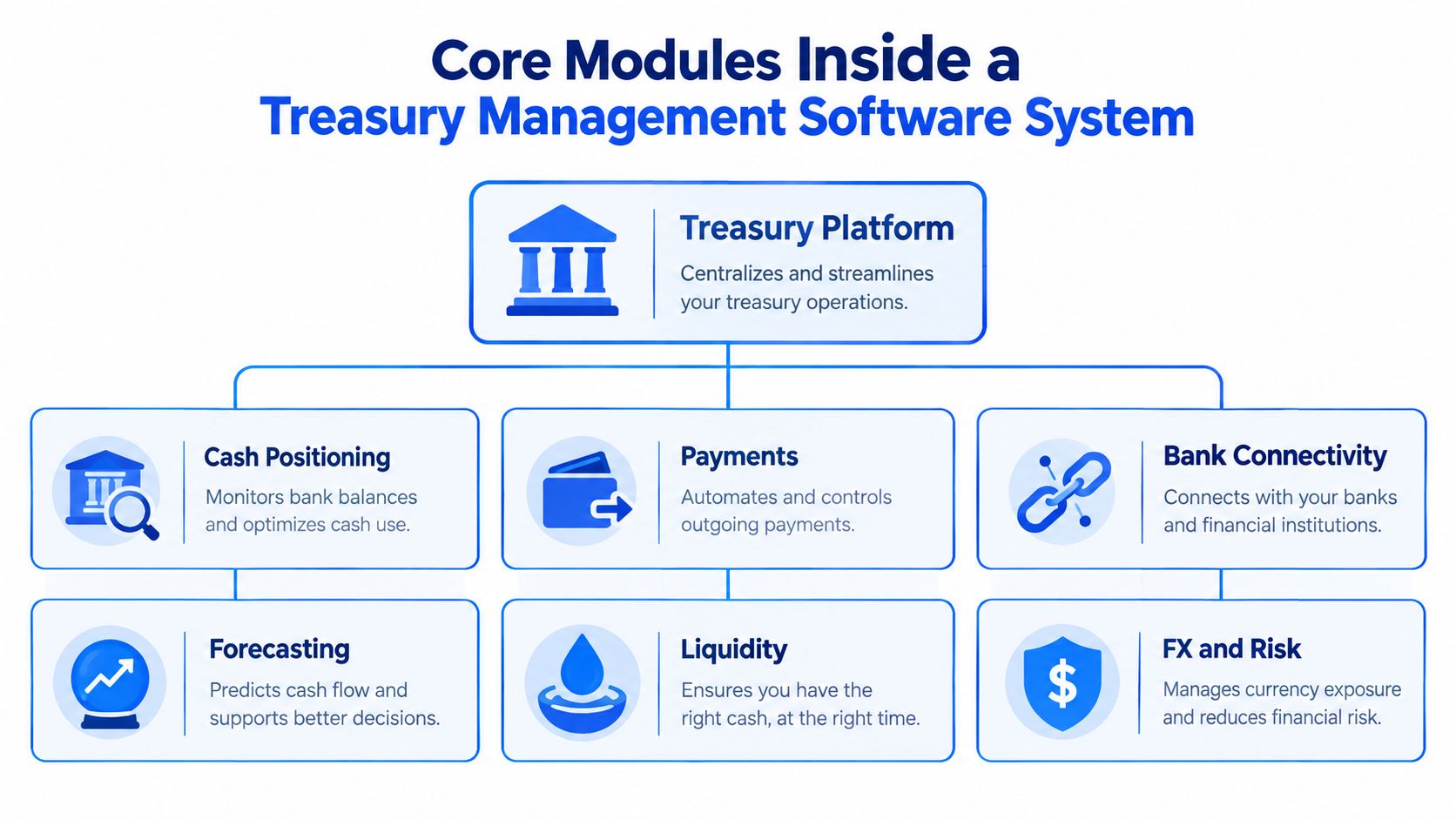
Cash positioning is the foundation: it consolidates balances and transactions so finance can see where cash sits. Bank connectivity supplies the data. Payments manage requests, approvals, transmission, and confirmation. Forecasting uses bank, ERP, and operational inputs to project inflows and outflows. Reconciliation connects bank activity to accounting records. Liquidity, debt, investment, FX, and other risk workflows become more important as the company's structure and exposures grow. For another outside view of common treasury functions, this Kyriba treasury management primer provides additional context.
| Treasury Module | Primary Job | Owning Role | Common Mid-Market Gap |
|---|---|---|---|
| Cash positioning | Consolidate balances and transactions across accounts | Treasurer or Controller | Bank balances reviewed separately in portals |
| Payments | Govern preparation, approval, release, and confirmation | Controller or AP lead | Approval history split between email and bank |
| Bank connectivity | Move bank and payment data between systems | Treasury lead and IT | Manual statement downloads and inconsistent formats |
| Forecasting | Project cash inflows and outflows | CFO or FP&A lead | Spreadsheet inputs arrive late or don't reconcile |
| Liquidity | Monitor available cash and funding needs | CFO or treasurer | Entity-level cash isn't easy to compare |
| FX and risk | Track exposures and related treasury activity | CFO or treasury lead | Exposure data sits outside regular reporting |
Keep the ERP and TMS boundaries clear
The ERP should remain the financial backbone: general ledger, accounts payable and receivable, entity accounting, and reporting. The TMS should coordinate treasury-specific work, particularly bank connectivity, cash positioning, payments, and liquidity. If both systems attempt to own the same approval or accounting step without a clear handoff, finance inherits another reconciliation problem.
A mid-market company may not need every enterprise treasury module. A multi-entity services firm may prioritize consolidated cash visibility, bank feeds, and payment controls. A business with material foreign exchange activity may need more explicit exposure tracking. The right shortlist follows operating complexity, not the length of a product menu.
For an additional perspective on how treasury systems are discussed across markets, buyers can consult this overview of treasury management systems in South Africa. Use it as context, then test each vendor against your own bank footprint, ERP setup, entities, and approval rules.
Bank Connectivity and the Standards That Matter in Practice
Bank connectivity is where a treasury project either becomes useful or creates more manual work. A vendor may show a polished cash screen, but the important questions are how data gets there, how quickly it arrives, and what happens when a bank rejects a file or returns an unexpected format.
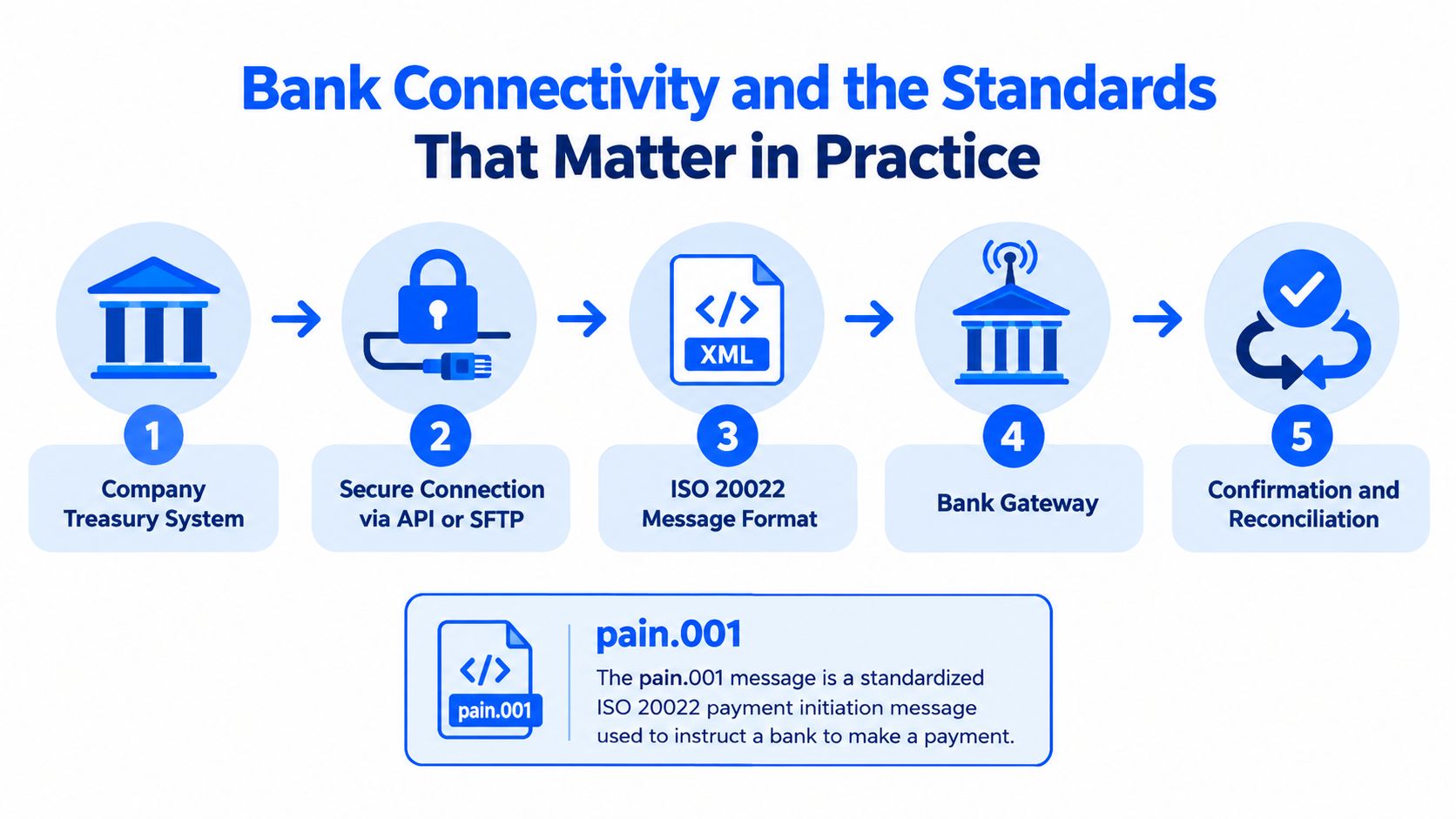
ISO 20022 is a structured messaging standard used across payment initiation, bank reporting, and settlement. A pain.001 message can initiate a payment. Cash-reporting messages such as camt.052, camt.053, and camt.054 carry account and transaction information. Because these messages use structured fields, a TMS can map bank transactions to ERP, receivables, payables, and reconciliation records more reliably than when it must interpret institution-specific free text. Readers who want a standards-level explanation can review the official ISO 20022 overview.
Structure helps, but it doesn't eliminate setup work. SWIFT notes that corporate ISO 20022 deployment remains inconsistent, so companies still need to accommodate different provider specifications. Its corporate ISO 20022 FAQs provide useful context for the standard and its corporate adoption.
Design the connection, not just the format
Periodic host-to-host, electronic-banking, or SWIFT exchanges provide data on a schedule. API-based connections can exchange account data, transactions, and payment status dynamically. Shorter data latency means a cash event can appear in the forecast sooner, and status updates can help finance identify pending, rejected, or failed payments earlier.
Build a layered design: the ERP owns accounting records, the TMS manages treasury workflow and controls, and bank connectivity moves data through APIs or secure file channels. Keep a fallback for legacy formats such as BAI. Ask each bank about supported message versions, mandatory fields, cut-off times, and remittance conventions before implementation. For teams comparing connectivity models, this J.P. Morgan explanation of API and treasury connectivity adds useful practical detail.
Automation is only a control improvement when the team can see failed deliveries, investigate exceptions, and prove who approved each payment.
Require configurable bank-format mapping, validation rules, exception queues, audit trails, and monitoring of file or API delivery. A cash management overview for Sage Intacct can help clarify the ERP-side discussion, but buyers should still verify which treasury functions require a separate system and how each connection will be maintained.
Fraud, Controls, and Why Treasury Software Is an Internal-Control Decision
Treasury controls are not a finishing touch. They determine whether an electronic payment process is auditable and whether finance can establish who requested, approved, and released money.
The Association for Financial Professionals' 2025 Payments Fraud and Control Survey collected responses from 521 corporate treasury practitioners. It found that 79% of organizations experienced attempted or actual payments fraud in 2024, while 63% reported business email compromise and 63% said checks were the payment method most frequently targeted. Only 22% recovered at least 75% of funds lost to payments fraud, down from 41% in 2023, according to the AFP survey results.
Those figures make the buying test clear. Don't ask only whether a product can export an ACH file. Ask whether it governs the entire payment path, from request and vendor validation through approval, bank transmission, confirmation, and general-ledger posting. For a broader external resource on business payment risk controls, the FBI guidance on business email compromise is also worth reviewing.
Test controls in the workflow
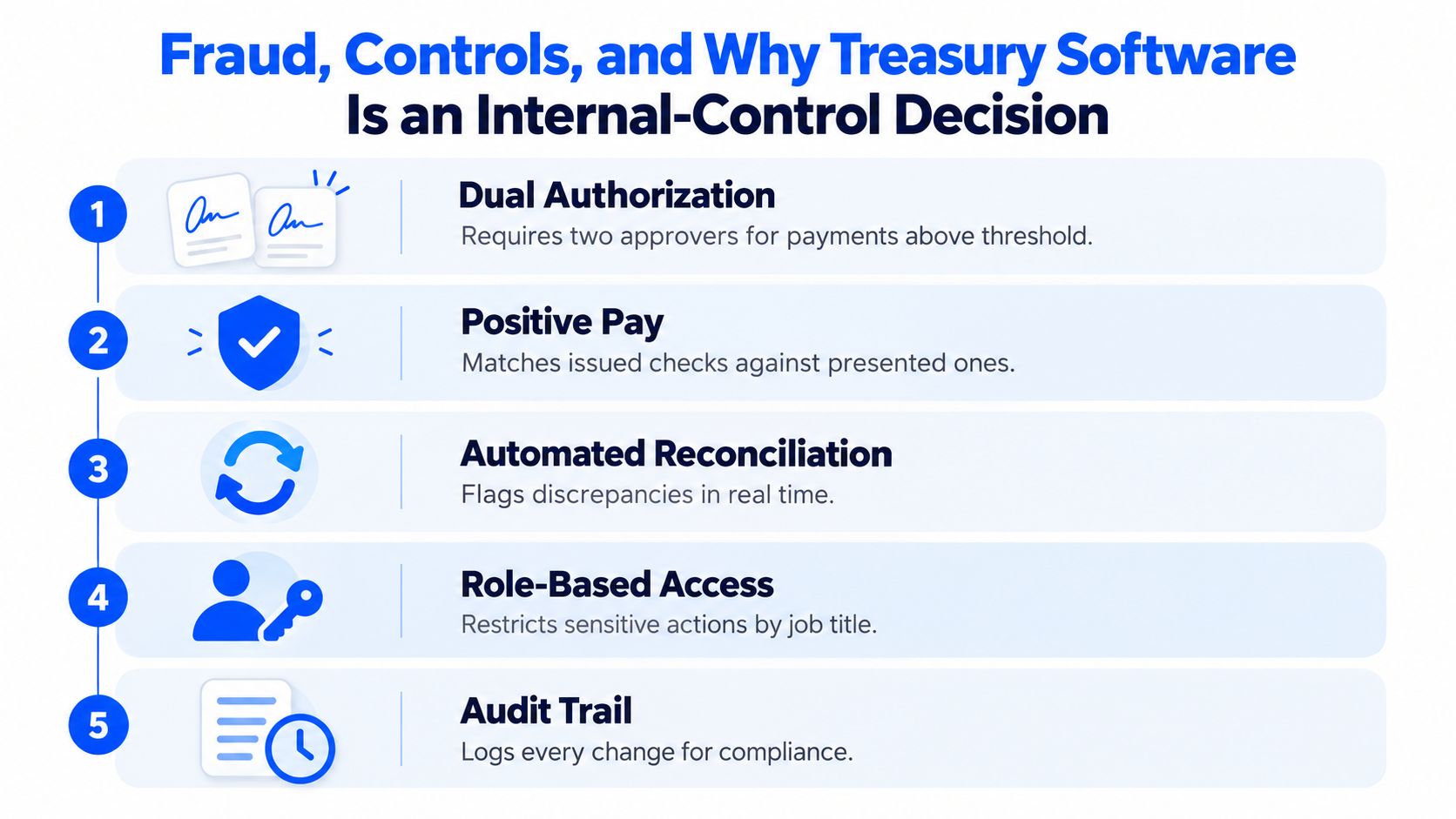
A practical demonstration should show how the system handles:
- Dual approval: Separate payment preparation from authorization, with thresholds that reflect company policy.
- Role-based permissions: Restrict sensitive actions, including vendor changes and payment release, to authorized users.
- Vendor validation: Make changes to payment details reviewable before a payment is sent.
- Payment limits: Apply approval rules consistently to batches and individual transactions.
- Audit history and exceptions: Retain an activity record and flag payments or reconciliations that need review.
Checks still matter during a transition to digital payments. AFP data cited by Nacha found that 91% of surveyed organizations used checks in 2024, up from 75% in 2023, and 63% reported attempted or actual check fraud. The same report says ACH debits were used by 88% of respondents. These figures appear in Nacha's coverage of the AFP survey.
Moving payments online changes the control model, not the need for controls. A system that sends a file while leaving vendor changes, approvals, bank acceptance, and reconciliation in spreadsheets and email has moved risk around rather than governing it. For a related view of how approval workflows intersect with finance processes, see this guide to spend management software.
Choosing Software Alone Versus the Right Implementation Partner
Buying software directly can seem simpler. The vendor supplies the system, the finance team follows the setup process, and the company connects its banks and ERP. That path can work when requirements are simple and internal owners have time to map workflows, validate data, and configure controls. It becomes less straightforward when the company has multiple entities, different signing authorities, inconsistent bank formats, or a finance team already stretched by daily operations.
The partner's job isn't to sell a product tour. It's to translate how the company operates into a workable design: which entity owns a payment, who can prepare and approve it, how bank data reaches the accounting record, and how exceptions reach the right person. A strong implementation plan should also clarify what belongs in the ERP, what belongs in a treasury system, and what should remain a policy decision. Independent guidance on software implementation risk, such as the Gartner overview of ERP implementation challenges, can help frame that conversation.
| Buying software alone | Working with an implementation partner |
|---|---|
| The finance team interprets requirements and workflows | The partner helps map processes and decision rights |
| Bank and ERP setup may be treated as technical tasks | Data flows and system ownership are designed together |
| Configuration can follow generic defaults | Controls and entities can reflect the company's actual structure |
| Internal staff carry the coordination burden | Project responsibilities and handoffs are made explicit |
Lucentive is a Sage Intacct National Premier Partner and works with healthcare organizations, nonprofits and faith-based organizations, dental practices and DSOs, finance and accounting leaders at small to mid-sized businesses, and professional services firms. That sector mix is relevant because these organizations often need to coordinate finance across locations, entities, and operating teams. Lucentive's Sage Intacct consulting services are one way to bring ERP advisory and implementation planning into the software decision.
No partner can remove the need for client decisions or guarantee a particular outcome. But buyers should evaluate the implementation team alongside the software: ask how it will document current workflows, configure entities and permissions, test bank connections, train users, and handle exceptions at launch. The partner decision deserves the same diligence as the product decision.
Selection Criteria by Company Size and Sector
A treasury setup that suits a single-entity professional services firm may be wrong for a multi-site healthcare group. Start with operational complexity, then add the sector requirements that affect data, reporting, and cash control. Company revenue alone won't tell you which workflows need to be connected.
For a growing company moving beyond QuickBooks, the first questions are often basic: Can finance see balances across accounts? Can it match payments to bank confirmations? Can the ERP close process absorb the data cleanly? A larger or more complex organization may also need entity-level permissions, intercompany visibility, and more deliberate liquidity or risk workflows. Teams evaluating system maturity may also find the AICPA resources on internal control and financial reporting helpful when shaping requirements.
Build the scorecard around how the organization runs
- Healthcare: Test how the finance environment handles EMR-related data flows, patient-revenue activity, and reconciliation needs created by high transaction volumes. Confirm which records remain in the ERP and which bank or operational data must feed the forecast.
- Nonprofits and faith-based organizations: Prioritize fund accounting, grant tracking, and restricted-cash reporting. Treasury visibility should help finance distinguish available cash from balances subject to restrictions.
- Dental practices and DSOs: Evaluate multi-practice cash visibility, intercompany accounting, and approval workflows that reflect how the organization manages locations and central finance.
- Professional services: Look for alignment between project accounting, cash forecasting, and reporting on utilization. Finance should be able to connect operational activity to cash expectations without building another disconnected spreadsheet.
The scorecard should name the business owner for each need. If the Controller owns payment controls, define which approvals they need to enforce. If the CFO owns consolidated forecasting, specify which bank and ERP inputs the forecast must use. This turns a broad feature request into a test the vendor can demonstrate.
For a sector-focused starting point, Lucentive's financial services and industry context can help frame ERP requirements. Treat any discussion as a fit assessment, then verify the actual data flows and responsibilities in your own organization. A useful shortlist is the one that reflects the company's entities, banks, operating systems, and control policies, not the one with the longest checklist.
Putting It Together and What to Do Next
The useful question isn't whether your company needs another dashboard. It's whether finance can trust the cash position, trace a payment from request to bank confirmation, and connect treasury activity to accounting records without relying on fragile manual handoffs.
Evaluate treasury management software systems as an integration and control layer. Test bank connectivity and ISO 20022 support against each provider's actual formats and requirements. Treat payment approvals, permissions, audit history, and reconciliation exceptions as baseline controls. Give partner selection the same attention as product selection, and filter the shortlist through the needs of your sector, entities, and finance team.
For CFOs and Controllers considering Sage Intacct as part of a broader finance-system decision, a short working session can clarify what belongs in the ERP, where treasury workflows need additional support, and how implementation would fit the company's operations. Schedule a 30-minute working session with Lucentive to walk through your cash, payments, and forecast reality. The point is to test fit, not to commit to a product before the requirements are clear.
Summary
Treasury management software systems are most useful when they connect bank activity, payments, forecasts, and reconciliation in a controlled workflow. Buyers should evaluate connectivity, structured bank messages, payment approvals, audit history, and exception handling, not just the cash dashboard. ERP responsibilities and treasury responsibilities need clear boundaries, and sector requirements matter for healthcare, nonprofits, DSOs, and professional services firms. Partner selection deserves equal scrutiny because implementation must reflect real entities, workflows, and approval authority. A short working session can help determine whether Sage Intacct and an experienced implementation partner fit the company's needs.
Frequently Asked Questions
What do treasury management software systems do?
They connect bank and finance data to support cash positioning, forecasting, payments, liquidity, and reconciliation. The ERP remains the accounting system of record, while the TMS coordinates treasury-specific workflows. The buyer should focus on the company's actual gaps, such as delayed bank information, disconnected approvals, or cash visibility across entities, rather than purchasing features without a defined operating need.
How should a mid-market company think about treasury software?
Start with the work finance can't manage reliably today. Identify which accounts, entities, payments, and forecast inputs require manual collection or review, then define who owns each workflow. A company outgrowing QuickBooks may need stronger ERP accounting and reporting first, while a business with fragmented bank data or payment controls should evaluate treasury functionality and how it connects to the ERP.
Why does ISO 20022 matter if adoption is inconsistent?
ISO 20022 provides structured payment and cash-reporting messages that can support clearer mapping between bank transactions and finance records. But providers may differ in specifications, supported versions, required fields, and remittance conventions. Buyers should confirm each bank's implementation details and test mapping, validation, and exception handling instead of assuming that a standards-based connection will work without configuration.
How should fraud concerns change the software requirements?
Require a demonstration of the full payment workflow, including vendor validation, preparation, approval, bank transmission, confirmation, and accounting. Check that the system supports role-based permissions, approval rules, payment limits, an activity history, and reconciliation exceptions. A file export alone doesn't establish that the company can show who initiated, reviewed, and released a payment.
How should we evaluate a Sage Intacct implementation partner?
Ask the partner to explain how it will map your entities, signing authorities, bank connections, approval workflows, and ERP responsibilities. Confirm who owns configuration, testing, user training, and exception handling. Sector experience can be relevant when your organization has multi-site or multi-entity workflows, but the partner should demonstrate how its approach fits your specific operations.
Lucentive helps finance leaders assess ERP needs and plan Sage Intacct implementations, including how treasury workflows should connect to accounting and bank data. Schedule a no-pressure working session or custom demo to discuss your company's requirements with Lucentive.