Day 11 of the close, and your team is still stitching together spreadsheets for intercompany eliminations. The board wants a refreshed forecast, but finance can't produce one until the 18th. Meanwhile, the organization is paying for an ERP program that seems to generate status reports faster than it generates usable financial control.
That isn't primarily a software problem. It's a delivery and governance problem. A disciplined agile methodology ERP implementation gives finance working workflows early, exposes bad assumptions before they become expensive, and keeps the CFO involved in the decisions that determine scope, risk, and adoption. For mid-market companies moving beyond QuickBooks, or replacing disconnected systems across healthcare, nonprofit, dental, or professional services operations, Sage Intacct with the right implementation partner can turn the ERP from a delayed promise into a sequence of visible business improvements.
Table of Contents
- The CFO's Case for Running ERP on Agile Terms
- Setting Up the Program Before the First Sprint
- Sprint Cadence, Roles, and Backlog Discipline
- Testing, Data Migration, and a Controlled Cutover
- Why Change Management Beats Methodology Every Time
- Hybrid Delivery Across Healthcare, Nonprofit, DSO, and QuickBooks Migrations
- KPIs, Risk Triggers, and the Right Next Move
- Frequently Asked Questions
- How long does an agile ERP implementation take for a mid-market company?
- Can agile and waterfall coexist in ERP?
- Who should serve as product owner?
- What is the biggest risk in agile ERP delivery?
- How does QuickBooks migration fit into an agile ERP program?
- What does the right implementation partner contribute beyond software?
The CFO's Case for Running ERP on Agile Terms
Waterfall ERP programs usually begin with an understandable promise: agree on the scope, set the date, approve the budget, and work toward one major go-live. The trouble starts when finance discovers that the chart of accounts doesn't support the reporting structure, an integration has an undocumented dependency, or controllers disagree about the approval workflow. By then, the program has invested heavily in decisions that users haven't validated.
Agile changes the timing of that discovery. Teams work through short delivery loops, often using two-to-three-week cycles, cross-functional teams, product owners, and continuous feedback, an approach adapted to ERP after the Agile Manifesto was introduced in 2001. Finance users can review a working workflow, test a report, and challenge an assumption before the issue reaches the end of the program. The underlying delivery logic also aligns with the original Manifesto for Agile Software Development and broader project guidance from the Project Management Institute.
CFO principle: Agile doesn't eliminate scope decisions. It moves those decisions closer to the evidence.
That distinction matters. A CFO can reprioritize a backlog item when a sprint review reveals greater value elsewhere. In a rigid plan, the same change may require a formal change request, budget debate, and schedule reset. Agile gives leadership more control, provided the team protects the full business scope and uses clear acceptance criteria. That is also consistent with ERP advisory perspectives from Gartner and implementation research from Panorama Consulting.
The CFO's influence sits in three places: governance, scope discipline, and adoption. Executive sponsorship must resolve cross-functional conflicts. The product owner must reject low-value customization. Users must learn and accept the new process before go-live. Lucentive's guidance on the CFO's role in digital transformation reflects the practical point: finance leadership can't delegate the business decisions and expect the implementation team to manufacture alignment.
Setting Up the Program Before the First Sprint
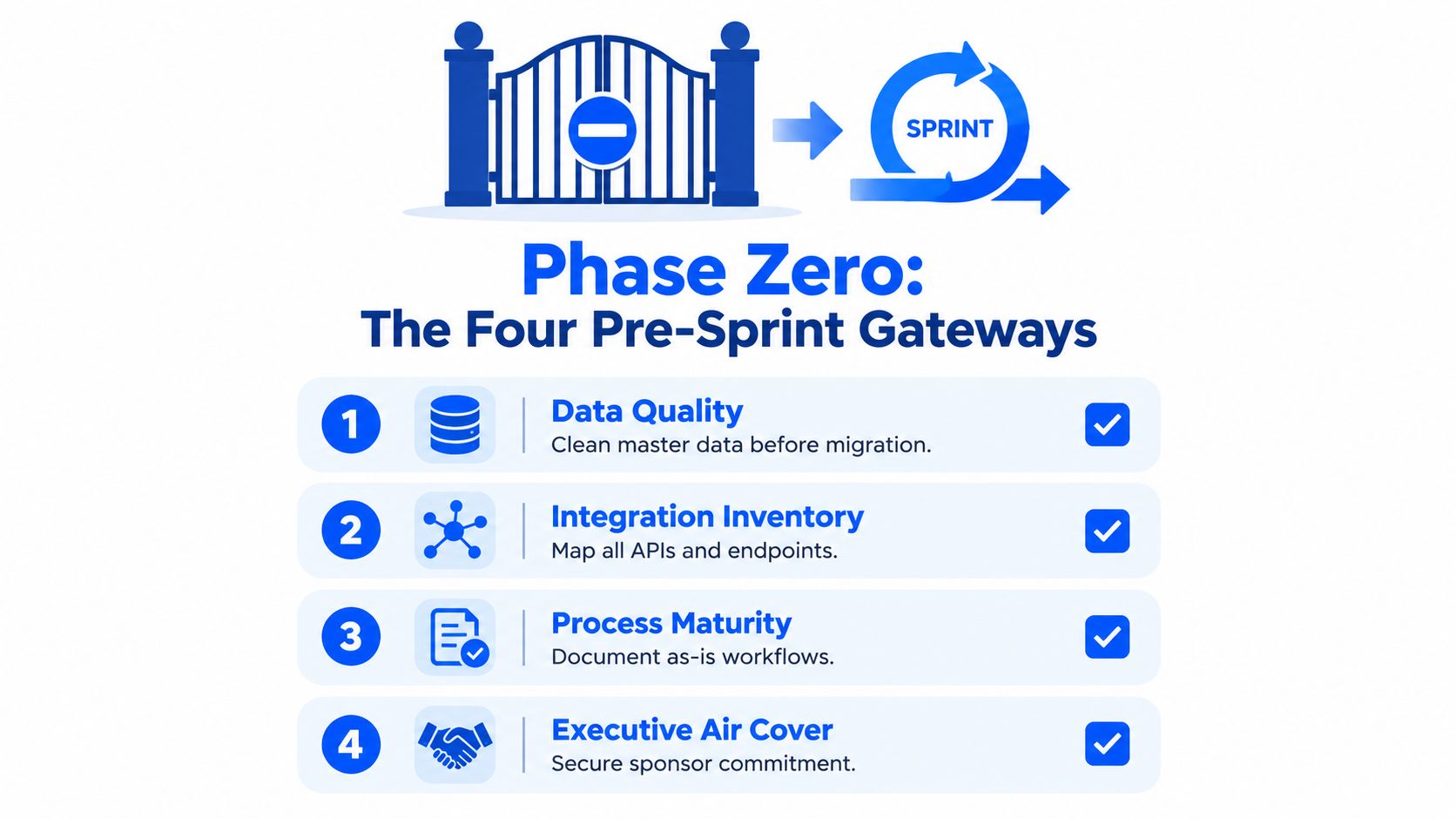
A sprint can't compensate for an undefined program. Before configuration starts, establish four gateways that determine whether the organization can operate an agile cadence without confusing flexibility with drift.
Start with readiness, not enthusiasm
The readiness assessment should examine data quality, integrations, process documentation, and executive air cover. Identify duplicate vendors, inconsistent customer records, undocumented interfaces, and processes that exist only in one employee's spreadsheet. If the team doesn't know which systems feed payroll, billing, banking, or clinical operations, it doesn't have an agile backlog. It has hidden risk.
Put authority in the room
The executive sponsor needs enough authority to make decisions across finance, IT, and operations. A siloed finance champion can define accounting preferences, but can't resolve an integration dependency or enforce a process standard across locations. The sponsor should also chair a governance rhythm where risks, scope changes, and unresolved decisions receive an explicit disposition.
Give finance a real product owner
Assign a controller or senior finance leader who can rank backlog items by business value and say no to attractive but nonessential features. This person should own business acceptance, not merely attend demonstrations. The product owner also needs protected time, because delayed decisions create idle consultants, rework, and pressure to accept unfinished work.
Define the whole scope, then sequence it
Agile doesn't mean ambiguous scope. Document the target chart of accounts, multi-entity structure, dimensional model, integrations, reporting, compliance needs, data history, and deployment boundaries before sprint planning. Then sequence that scope into releases.
A software purchase may fit a company with strong internal ERP expertise and available project capacity. Most mid-market finance teams underestimate the work around process design, data preparation, testing, training, and decision management. A partner-led approach adds implementation leadership and methodology support, while the company retains ownership of business decisions. Lucentive's ERP planning guidance is useful because staffing and internal time belong in the business case, not in the footnotes.
Week one should produce four tangible artifacts:
- A prioritized backlog: Business, technical, integration, data, and adoption work in one view.
- A release plan: The intended sequence of modules, entities, and deployment waves.
- A risk register: Owners, response actions, and escalation dates.
- A governance cadence: Steering meetings, sprint reviews, decision deadlines, and reporting standards.
Sprint Cadence, Roles, and Backlog Discipline
A finance-friendly sprint is short enough to create urgency and long enough to complete meaningful work. In a two-to-three-week cycle, the team selects a small set of outcomes, configures or builds them, tests them, and demonstrates them to users. The review should show a working approval path, report, integration, or close task, not a slide describing future progress.
The product owner ranks the work. The scrum master protects the cadence and removes blockers. Functional leads translate finance and operational requirements into configurations and test cases. The integration architect owns dependencies that cross system boundaries. The executive steering committee resolves decisions the delivery team can't make.
Make every backlog item testable
Each item needs an owner, business-value assessment, acceptance criteria, and a definition of done. For finance, “done” must include reconciliation impact. A report isn't complete because it renders correctly. It must tie to an agreed source, support the intended dimensions, and produce an output the Controller can review.
Reserve capacity for integration and migration in every sprint. ERP-specific research identifies legacy integration and large-volume historical migration as difficult constraints, so ETL design, interface testing, cleansing, and conversion rehearsals can't sit at the bottom of the backlog. Treating them as optional technical tasks is how a visually impressive configuration reaches a nonfunctional cutover.
Use ceremonies to make decisions visible
Sprint planning sets the outcome and confirms dependencies. Daily standups surface blockers. Backlog refinement prepares the next work. The sprint review brings finance users into validation. The retrospective asks what the team should change in its own operating model, then feeds that improvement into the next cycle.
| Ceremony | Frequency | Owner | Output |
|---|---|---|---|
| Sprint planning | At the start of each sprint | Product owner and scrum master | Committed sprint backlog |
| Daily standup | Each working day | Scrum master | Blocker and dependency log |
| Backlog refinement | During each sprint | Product owner | Ready, prioritized next items |
| Sprint review | At sprint end | Product owner | User feedback and acceptance decisions |
| Retrospective | At sprint end | Scrum master | Process improvements and owners |
A phased release plan can string eight to twelve sprints into go-lives by entity or module. That sequence gives the CFO repeated evidence about configuration quality and user readiness instead of one late demonstration when course correction is expensive. The role boundaries and accountability should be explicit, which is why ERP project manager responsibilities need to be documented before the cadence begins.
Testing, Data Migration, and a Controlled Cutover
A controlled go-live is built through repetition. Each sprint should finish with unit testing, integration scripts against representative sandbox data, and a short regression run before users review the increment. The team should record failures, assign owners, and bring unresolved defects into the next planning session instead of hiding them in a separate testing spreadsheet.
User acceptance testing needs the same discipline. At the end of each functional epic, run a two-week UAT cycle with business users and require sign-off from the product owner. Consultants can facilitate the scenarios, but the business must decide whether the process works. That distinction protects the CFO from a familiar trap, where a technically complete system is treated as operationally ready.
Keep migration inside the sprint
Reserve 20–30% of sprint capacity for cleansing, mock conversions, migration validation, and reconciliation reports. Source records need owners. Historical treatment needs a decision. Opening balances need a tie-out. The final cutover should be the last rehearsal, not the first time the team discovers that legacy data doesn't map cleanly.
Cutover itself deserves a dedicated backlog. Freeze cutover items one week before launch, run parallel ledger processes through the first two weeks, and staff a triage rotation through the first close. The steering committee should review a cutover dashboard, variance reconciliation, and daily risk log. Those artifacts give finance leadership evidence about readiness instead of status theatre.
A green project status is not a green financial close. Reconciliation is the test that matters.
The result is a softer landing. Users see the process before launch, data problems surface while the team can still respond, and leadership has a record of the decisions behind the cutover.
Why Change Management Beats Methodology Every Time
A technically green implementation can still fail in the finance department. Controllers return to spreadsheets, accounts receivable staff keep parallel files, and executives cannot find the reports they were promised. Agile ceremonies do not correct that failure. Users must understand why processes changed, what their daily work now requires, and who owns each decision.
The evidence supports a direct conclusion. Broader ERP guidance connects poor change management and inadequate training to roughly half of failures, while one sample found 53% of organizations achieved less than 50% of expected post-implementation benefit (PMI guidance). The issue is adoption, not the choice of agile itself. A CFO should fund and govern both delivery mechanics and behavior change.
Put OCM in the backlog
Every sprint should include adoption work with acceptance criteria. Use our ERP change management guide to structure the work, then assign owners for:
- Refresh the stakeholder map: Identify affected roles, decision-makers, skeptics, and local champions.
- Build role-based training: Show each group the transactions, approvals, reports, and exceptions it will handle.
- Create desk-level job aids: Give users concise instructions for tasks performed under pressure.
- Maintain a resistance log: Record recurring objections in retrospectives and assign responses.
Track training recordings, communication plans, attendance, scenario completion, and unresolved resistance beside defects and integrations. The steering committee should review adoption evidence with the same discipline as scope and budget. If nobody owns the work, it will be postponed until the week before go-live, when users have the least capacity to absorb change.
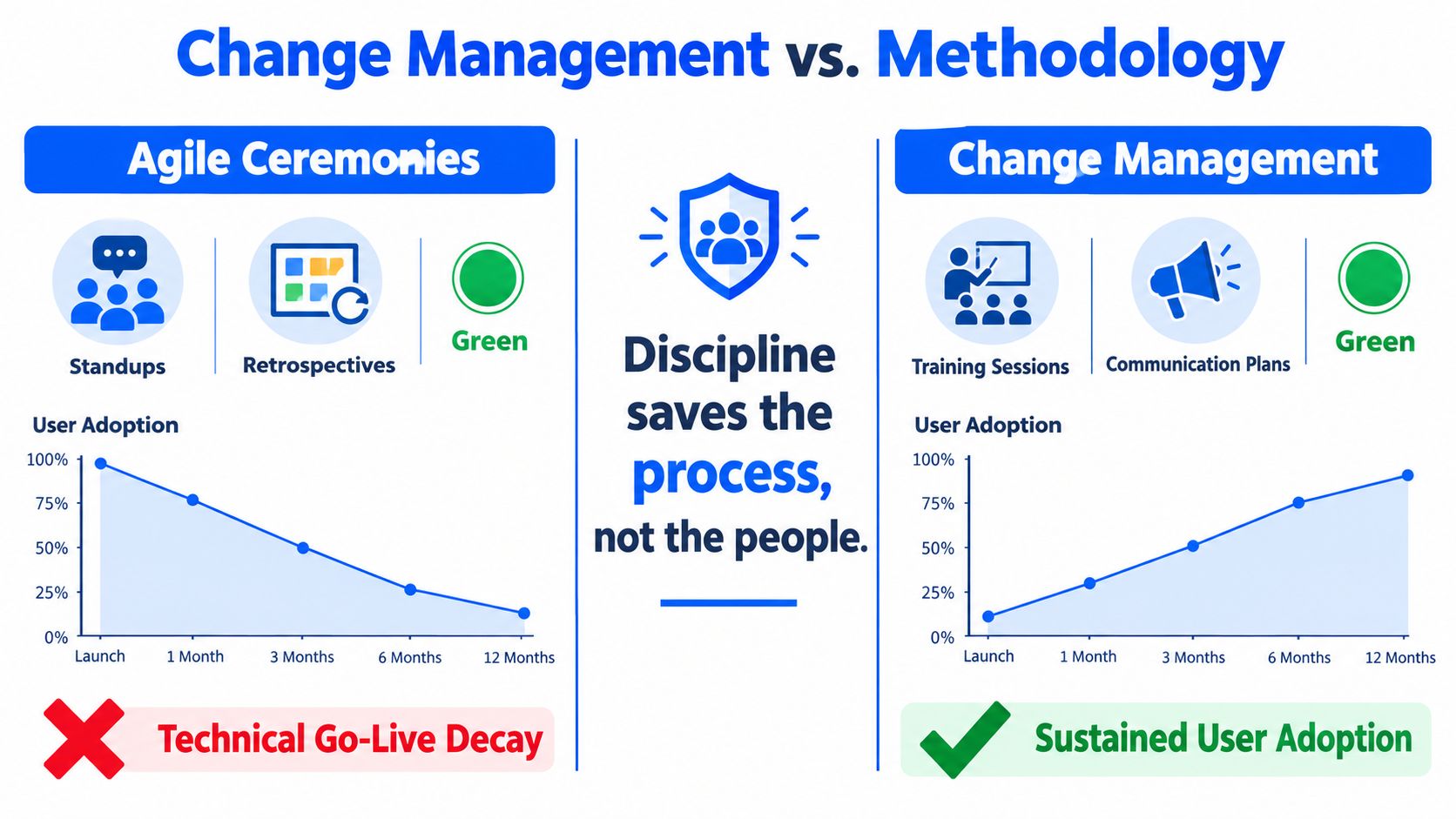
A recent ERP report from Panorama Consulting identifies organizational change management as a stronger response to failed or stalled ERP projects than methodology alone. The CFO must therefore protect scope, budget, and adoption together. Methodology governs delivery. Change management determines whether the organization uses what it bought.
Hybrid Delivery Across Healthcare, Nonprofit, DSO, and QuickBooks Migrations
A healthcare CFO cannot let compliance requirements change inside a sprint. A nonprofit CFO cannot let audit outputs depend on unfinished configuration. A dental service organization needs consistent financial controls across locations, while a company leaving QuickBooks needs clean data before it can benefit from iterative design. These conditions make a hybrid model the practical choice for many ERP programs.
A hybrid model assigns each workstream the delivery method its risk requires. Predictive planning governs regulatory design, data conversion, financial controls, and cutover. Agile sprints support reporting, interfaces, workflows, and user feedback. The CFO should approve that boundary before the implementation partner starts configuration.
A 2025 review reported 82% implementation success for hybrid delivery, compared with 58% for waterfall-only and 65% for agile-only. It also reported budget adherence of 85% for hybrid, compared with 70% for waterfall-only and 61% for agile-only, plus user satisfaction scores of 8.2, 5.8, and 7.3, respectively (2025 hybrid delivery review). The figures support selective agility, not a universal template.
| Industry Scenario | Waterfall Spine | Agile Sprint Layer | CFO Decision |
|---|---|---|---|
| Healthcare provider or multi-site clinic | Regulatory controls, HIPAA-related requirements, 835 remit posting, grant tracking, and core compliance design | EMR interfaces, operational reporting, and release waves | Freeze compliance requirements, then sequence interfaces and reporting |
| Nonprofit or faith-based organization | Fund accounting core, GASB reporting, audit deliverables, and grant structure | Constituent CRM integration, program dashboards, and QuickBooks migration work | Protect audit integrity while iterating on visibility and stakeholder workflows |
| Dental service organization | Multi-location consolidation, payer tables, and core entity controls | Patient-flow analytics and acquisition onboarding playbooks | Standardize the financial spine, then adapt acquired-location processes |
| Company outgrowing QuickBooks | Discovery, historical data cleansing, conversion rules, and reconciliation | Configuration, reporting, workflow, and user feedback cycles | Control cutover tightly while improving finance workflows through sprints |
Healthcare teams should phase-gate compliance design, access rules, and required financial treatment. They can still iterate on interface validation and operational reporting. That separation protects regulatory obligations without freezing useful improvements.
Nonprofits need the same discipline. Fund accounting and audit outputs require stable decisions, while dashboards and constituent integrations can improve through repeated feedback. DSOs should standardize consolidation and payer structures, then test an onboarding playbook against each acquired location.
For a QuickBooks migration, discovery, cleansing, conversion rules, and reconciliation belong on the controlled path. Configuration, reporting, and workflow refinement can run through sprints. The governance committee should define that split before signing the partner contract, with the CFO retaining authority over scope, risk, and cutover.
KPIs, Risk Triggers, and the Right Next Move
A CFO should be able to open the ERP dashboard, spot a warning, understand its financial consequence, and assign the next action before another month of drift consumes budget. Sprint activity is not the objective. The measures must show whether the program is creating usable finance capability, protecting data quality, and preparing employees to adopt new processes.
Use a focused KPI set:
- Velocity variance: Compare planned work with completed work. Repeated misses require root-cause analysis, not pressure to inflate estimates.
- Backlog aging: Flag requirements that remain unresolved because no accountable owner has made the decision.
- Defect escape rate: Track issues found after sprint review or during UAT, with special attention to close, billing, consolidation, and control failures.
- Migration reconciliation: Confirm that converted balances and records tie to approved source data.
- UAT sign-off coverage: Measure completed business scenarios across roles, entities, and functional epics.
- Change-readiness score: Combine training completion, communications, stakeholder feedback, and outstanding resistance actions.
- Milestones without scope change: Separate genuine progress from schedule movement achieved by reducing or shifting the target.
Set warning bands that require a response. A yellow signal means the product owner and delivery lead inspect the cause, pause low-value scope, and assign a corrective owner. A red signal requires steering committee escalation, possible release resequencing, and a documented budget or timeline decision. A dashboard that merely records old problems is not governance. It is delayed reporting.
| KPI | Yellow Trigger | Red Trigger | Response | Owner |
|---|---|---|---|---|
| Velocity variance | Repeated gap between planned and completed work | Delivery capacity no longer supports the release plan | Re-estimate, remove low-value scope, or re-baseline | Scrum master and product owner |
| Backlog aging | Decision items remain open across planning cycles | Critical dependency has no accountable decision-maker | Escalate to steering committee | Product owner |
| Defect escape rate | Defects reach review or UAT repeatedly | Finance-critical defects threaten a release | Pause affected scope and intensify testing | Functional lead |
| Migration reconciliation | Exceptions remain unresolved after mock conversion | Opening balances or key records do not tie out | Stop cutover work and assign data owners | Data lead and Controller |
| UAT sign-off coverage | Important roles or scenarios remain untested | Product owner cannot approve a functional epic | Extend UAT and adjust release sequence | Product owner |
| Change-readiness score | Training or resistance actions lag the release | Users lack confidence in critical daily processes | Add adoption work and reconsider deployment | OCM lead and sponsor |
| Milestones without scope change | Dates slip as assumptions are revised | Timeline no longer matches approved scope | Re-baseline transparently | Steering committee |
Budget control depends on early intervention. Independent project-management guidance reports that 56% of ERP implementations went over budget and 54% ran over schedule, with an average cost overrun above US$2 million (McKinsey's ERP delivery analysis). The practical conclusion belongs with the CFO: scope governance is a finance responsibility, not an administrative preference.
Data quality needs a separate control point. Definitions, reconciled source records, and named ownership make migration decisions more dependable. Apply a data quality assurance approach before conversion and keep those controls active throughout the sprints. The data lead and controller should own exceptions, document their resolution, and refuse cutover approval when key records do not tie out.
Five operating decisions keep the program under control:
- Stand up executive sponsorship before the first sprint.
- Reserve integration and data capacity inside the backlog.
- Treat OCM as a sprint deliverable, not a late workstream.
- Choose hybrid cadence deliberately according to industry obligations and delivery risk.
- Govern with KPIs that trigger defined actions.
A 2023 quantitative study reported 80% continuous user involvement, 75% iterative development, 72% of projects meeting timelines, and 75% reporting budget adherence among respondents practicing agile ERP approaches (ERP Agile study). The same source describes a comparative study reporting an 85% success rate and six-month average completion time for agile projects, compared with 60% and twelve months for traditional projects. It also identifies cultural resistance as the most common adoption barrier at 42%. Use these findings to support disciplined involvement and iteration, not to promise a result for every company. Your own readiness evidence, decision speed, data quality, and governance performance remain the better basis for a release decision.
Summary
Agile ERP implementation gives CFOs earlier evidence, while scope control, executive authority, data ownership, and user adoption still determine the result. A hybrid model usually fits best, with predictive governance around regulated requirements, migration, and integrations, and iterative delivery for configurable workflows and reporting. The product owner, protected data capacity, continuous UAT, and sprint-level change management must stay tied to measurable business value.
Sage Intacct can support a clearer finance operating model. Whether that value reaches the close, audit, and board pack depends heavily on partner governance and implementation discipline. The right next move is to review the KPI thresholds with the steering committee, assign an owner to every red trigger, and make the release decision from evidence rather than optimism.
Frequently Asked Questions
How long does an agile ERP implementation take for a mid-market company?
Most Sage Intacct rollouts run four to nine months across six to twelve sprints, with healthcare and DSO multi-entity builds closer to the upper end. The actual schedule depends on scope, data quality, integration complexity, decision speed, testing capacity, and user readiness. Agile helps the team expose delays earlier, but it can't rescue an undefined program or make migration and compliance work disappear.
Can agile and waterfall coexist in ERP?
Yes. A hybrid model uses waterfall for requirements that need controlled sequencing, such as clinical reporting, compliance design, fund accounting, audit deliverables, and core multi-entity structures. Agile can handle configurable finance workflows, operational reporting, interface validation, dashboards, and acquisition onboarding. The governance committee should decide where the boundary sits before contracting, then monitor whether each workstream is following the appropriate delivery discipline.
Who should serve as product owner?
A controller or senior finance lead should serve as product owner when that person can prioritize backlog items, make business decisions, and sign off on UAT. The role requires authority across affected finance processes, not just attendance at demonstrations. The product owner should also be able to reject low-value customization and escalate unresolved decisions to an executive sponsor.
What is the biggest risk in agile ERP delivery?
Scope creep caused by unclear epic definition is a major risk. Agile makes it easy to add requests unless the team defines the full business scope, prioritizes work by value, and gives one product owner authority to say no. Executive backing, acceptance criteria, a release plan, and visible escalation rules keep iterative delivery from becoming open-ended customization.
How does QuickBooks migration fit into an agile ERP program?
Treat the QuickBooks migration as one governed epic with three controlled sprints covering historical cleansing, parallel close, and decommission. Discovery, conversion rules, and reconciliation require predictive discipline. Configuration and reporting can improve through user feedback. The final cutover should follow rehearsals, verified balances, clear ownership, and a triage plan for the first close.
What does the right implementation partner contribute beyond software?
Software provides the platform. A partner contributes program structure, process design, project management, integration coordination, data-migration planning, testing discipline, training, and change-management support. Lucentive is a Sage Intacct National Premier Partner with mid-market, healthcare, and nonprofit experience, and its role is to help manage the path from selection through launch rather than leave the finance team to coordinate every workstream alone.
Schedule a 30-minute working session with Lucentive to map your scope, data, integrations, and change risks against a practical Sage Intacct delivery model. Visit Lucentive for a no-pressure discovery conversation or customized demo focused on your company's close, reporting, and multi-entity priorities.