A slow close rarely starts in the consolidation workbook. It starts earlier, when one entity records an internal charge without a consistent code, another books the corresponding payable in a different period, and the group finance team has to reconstruct both sides from separate ledgers. By the time the CFO asks whether consolidated revenue and liabilities are complete, the answer depends on spreadsheet tabs, email trails, and someone's memory of last month's workaround.
That problem becomes acute when a growing company outgrows QuickBooks. Multiple legal entities, shared services, loans, management fees, foreign currencies, and acquisitions create a close process that basic accounting software can't coordinate well. Intercompany transactions elimination is not just a journal-entry exercise. It's a controlled operating process that determines whether leadership sees external performance or a distorted picture of the group.
I've seen this pattern across more than 100 Sage Intacct migrations. Software can provide the mechanics, but the outcome depends on how finance leaders design entity structures, account mappings, transaction coding, reconciliation ownership, and exception review. The right implementation can turn a recurring consolidation crisis into a documented close step with better visibility and a cleaner audit trail.
Table of Contents
- Why Intercompany Transactions Elimination Slows Your Close
- Identifying the Core Elimination Entries
- Navigating Timing and Currency Challenges
- How Sage Intacct Automates the Elimination Workflow
- Manual Reconciliation vs. Integrated Elimination
- The Month-End Elimination Checklist
- Securing Partnership and Implementation Support
- Summary
- Frequently Asked Questions
- What is intercompany transactions elimination?
- Are reconciliation and elimination the same process?
- Why do timing differences create elimination problems?
- How should foreign currency differences be handled?
- Can Sage Intacct automate intercompany eliminations?
- What should a month-end elimination checklist include?
- Why is an implementation partner important?
Why Intercompany Transactions Elimination Slows Your Close
The finance team starts the month-end close with a reasonable plan. Each entity exports its trial balance, the group accountant imports the files into a master workbook, and formulas match due-from balances to due-to balances. Then the exceptions appear. One subsidiary has recorded a shared-services invoice, but the other entity hasn't posted the expense. A receivable is in one ledger while the payable is coded to a different account in another. A UK entity is closing on a different timetable from its US parent.
The workbook doesn't know which difference is a timing issue, a mapping error, a missing transaction, or a genuine disagreement between entities. Someone has to investigate each item manually, often while preparing management reporting and responding to audit requests. That is why intercompany elimination becomes a close bottleneck even when the underlying transactions are routine.

Why spreadsheets fail at the point of control
Spreadsheets are flexible, which is useful during an unusual transaction. They're much less reliable as the primary control for recurring consolidation. Version conflicts, overwritten formulas, inconsistent account mappings, and manual journal uploads make it difficult to prove who changed what and why.
The bigger issue is timing. If Entity A records a transaction before the group cutoff and Entity B records its side afterward, the balances won't match in the current period. The spreadsheet can highlight the difference, but it can't establish ownership or automatically move the item into an exception workflow.
Practical rule: Don't use an elimination entry to conceal an unresolved posting error. Fix the source transaction when possible, then eliminate the agreed internal activity at the consolidation level.
The cost of a late answer
A late elimination affects more than the close calendar. Unremoved internal revenue can make operating performance appear stronger, while uneliminated receivables and payables can inflate the group balance sheet. If the team can't explain the difference, the issue becomes an audit support problem and a credibility problem for the controller.
A documented record-to-report process flow helps assign responsibility before close pressure builds. It should identify who records the transaction, who reconciles the counterparty, who approves exceptions, and who posts or reviews the consolidation entry. Teams refining this area often also review broader close-control guidance such as month-end close best practices. Without that design, a new ERP may only make the same weak process faster.
Identifying the Core Elimination Entries
The accounting principle is straightforward. Under both IFRS 10 and U.S. GAAP consolidation guidance, intra-group balances and transactions are eliminated so the group is reported as a single economic entity. The rule covers open-account balances, sales and purchases, dividends, interest, and similar internal items, as described in this IFRS and U.S. GAAP intercompany guidance.
Each entity still records its own transaction correctly. Consolidation asks a different question: did the group transact with an outside party, or did one group company transact with another? If a parent sells goods to a subsidiary, the parent's revenue isn't external group revenue. The related receivable and payable also don't belong in the consolidated balance sheet.
Start with the transaction families
Build the elimination model around the types of activity your group performs. Common categories include:
- Intercompany sales and purchases: Remove internal revenue and the corresponding internal cost or purchase effect.
- Due-to and due-from balances: Offset receivables and payables between entities after both sides have been reconciled.
- Management fees and shared services: Eliminate internal charges for finance, HR, technology, or corporate support.
- Loans and interest: Remove the internal principal balance, interest income, and related interest expense.
- Dividends: Eliminate internal dividend income and the corresponding distribution within the group.
- Royalties and licensing: Remove internal income and expense where the rights remain inside the consolidated group.
- Unrealized profit: Defer profit remaining in inventory or fixed assets when the group hasn't completed an external sale.
The right entry depends on the transaction. For an internal inventory sale, the consolidation layer may reverse the seller's internal revenue and the buyer's corresponding internal cost, then offset the intercompany receivable and payable. If inventory remains inside the group, the team must also consider profit embedded in that inventory. A matching balance alone doesn't prove the elimination is complete.
Separate reconciliation from elimination
Reconciliation confirms that both entities recorded the same underlying activity. Elimination removes that agreed activity from the consolidated view. Those are related controls, but they aren't interchangeable.
A useful review sequence is:
- Identify the entity pair and transaction type.
- Confirm the source documents and posting period.
- Match the balance sheet and income statement sides.
- Resolve differences before posting the elimination.
- Document the entry, support, preparer, and reviewer.
The aging trial balance resources can support the balance investigation, but they don't replace a group-level policy. Finance leaders should define which accounts and transaction types are eligible for elimination, how exceptions are handled, and when unresolved items escalate to the controller.
Navigating Timing and Currency Challenges
A transaction can be economically matched but still fail to eliminate in the period under review. Suppose one entity records a December management charge and its counterparty posts the invoice in January. During the December close, one side exists and the other doesn't. A controller who forces an entry to make the workbook balance may create a second problem by moving activity into the wrong entity or period.
Different fiscal calendars and close cutoffs create the same friction. An overseas subsidiary may finish its local close after the parent has started consolidation. Acquired entities may follow different accounting calendars or approval routines. The result is a residual balance that looks like an accounting error until the team traces the posting dates.
Timing requires a policy, not a monthly debate
A workable policy sets cutoffs, late-posting rules, and ownership for unmatched items. It also distinguishes between a transaction that belongs in the current period and a transaction that should remain open until the counterparty posts its side.
Monthly settlement can help prevent old balances from accumulating, especially for recurring charges. But settlement doesn't fix inconsistent source data. If Entity A calls a charge “corporate allocation” and Entity B codes it as “management fee,” the cash movement may clear while the reporting still requires manual mapping.
Timing differences should be visible exceptions, not silent spreadsheet adjustments.
Currency differences need consistent treatment
Foreign exchange creates a separate layer of complexity. Two entities may record the same economic transaction in different currencies, then remeasure or translate it using different rates or at different points in the close. The resulting residual may represent a rate difference rather than a missing transaction, but the group still needs a defined treatment.
Finance should document:
- Transaction currency: Which currency is used for the original intercompany record?
- Functional currency: Which currency does each entity use for its own reporting?
- Remeasurement timing: When are open foreign currency balances revalued?
- Translation treatment: Where do consolidated currency differences appear?
- Exception ownership: Who investigates a residual that doesn't net?
Many teams also align this policy with broader foreign currency accounting guidance. For organizations operating across currencies, Sage Intacct financial services guidance is relevant to the broader design conversation because the elimination workflow must sit alongside multi-entity reporting and currency controls. The system can support the process, but finance leadership still has to define the policy.
How Sage Intacct Automates the Elimination Workflow
Moving from QuickBooks to Sage Intacct should not mean uploading the same spreadsheets into a newer interface. The value comes from designing a shared transaction model across entities, then configuring the system to identify intercompany activity consistently.
That design starts with entity relationships, due-to and due-from accounts, intercompany dimensions, recurring allocations, approval rules, and consolidation settings. When those elements are aligned, the finance team can move away from manually rebuilding every elimination journal and toward reviewing unmatched or unusual items.
Automation works only after the model is sound
A system can't reliably eliminate what it can't identify. If users select ordinary revenue accounts for internal charges, omit the counterparty entity, or post directly to a general ledger account without the required intercompany attributes, automation has no dependable basis for matching.
The implementation should therefore define:
- The approved intercompany transaction types.
- The entity or counterparty field required on each transaction.
- Standard account mappings across the chart of accounts.
- Rules for recurring allocations and shared services.
- Treatment of timing differences and foreign exchange.
- Review steps for unmatched and exceptional activity.
Sage Intacct can then support a controlled consolidation workflow in which elimination logic is applied based on the configured structure. The finance team's job changes from keying every adjustment to validating the rules and resolving exceptions.
What the operational workflow should show
Oracle's NetSuite documentation illustrates the broader operational standard for modern multi-entity systems. Its intercompany elimination report and journal workflow tracks source transactions and generated elimination entries for a period. That shows why elimination isn't merely a theoretical consolidation concept. It belongs in the month-end close process, with traceability from source activity to the resulting journal.
The controller should be able to answer several questions without reconstructing a workbook:
- Which entities created the internal transaction?
- Which source documents support both sides?
- What amount was eliminated?
- Which accounts changed?
- Did debits and credits balance?
- What remains unresolved?
- Who reviewed the exception?
The Sage Intacct general ledger is part of that control environment, not a substitute for it. The goal isn't to eliminate human judgment. It's to reserve judgment for exceptions that deserve investigation.
Manual Reconciliation vs. Integrated Elimination
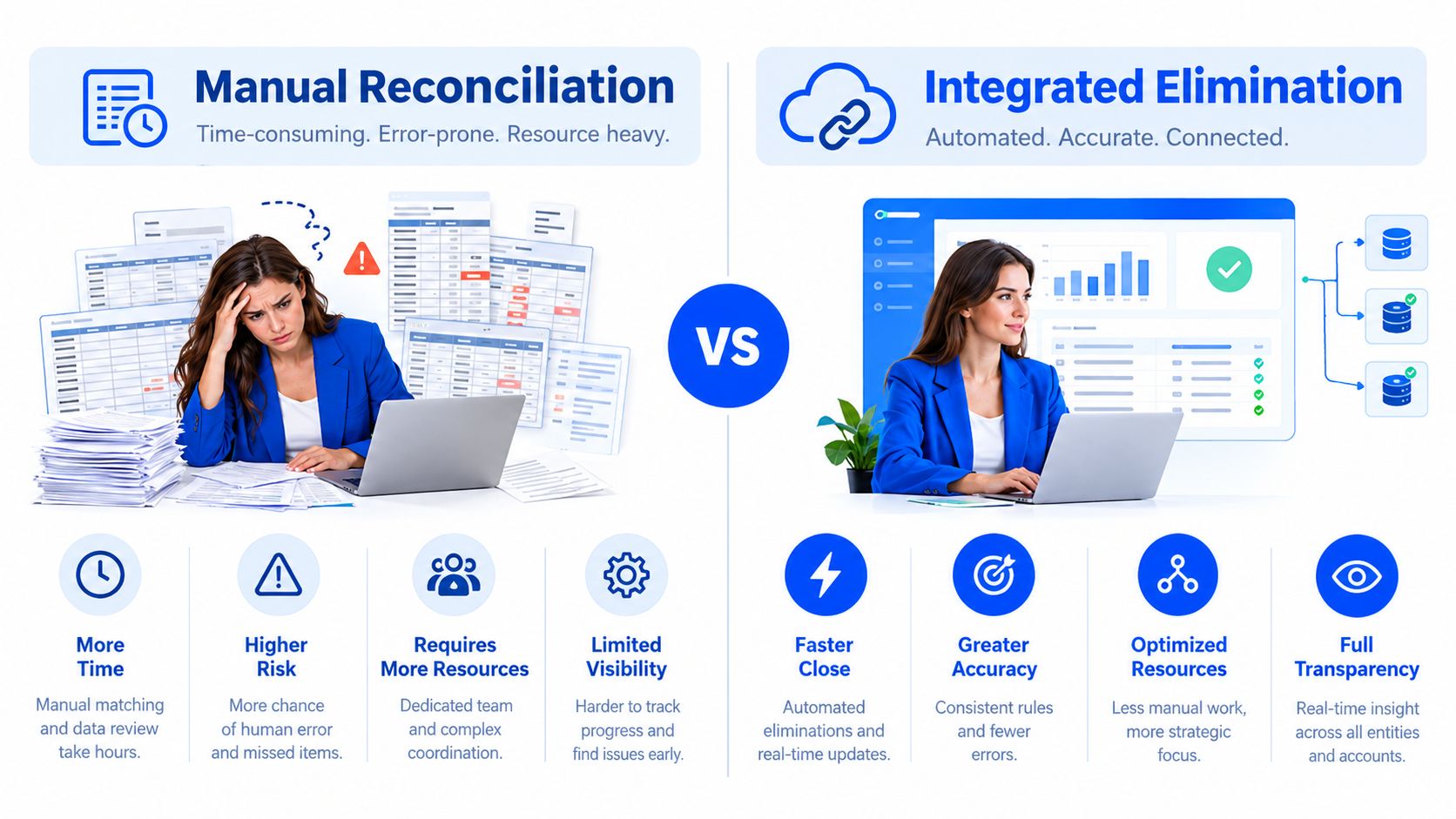
Manual reconciliation has a real advantage: it can accommodate almost anything. A skilled accountant can combine exports from different ERPs, map unrelated charts of accounts, adjust for different periods, and create a consolidation entry. That flexibility is useful during a transition or for an exceptionally unusual transaction.
The weakness is repeatability. Each month depends on the person who knows the workbook, the mapping tabs, and the unexplained adjustments carried forward from prior periods. As the group adds entities, acquisitions, currencies, and internal service arrangements, the process becomes harder to review and harder to hand over.
The real comparison
| Manual spreadsheet process | Integrated elimination process |
|---|---|
| Data arrives from disconnected ledgers | Entities use a shared reporting structure |
| Account mapping happens during close | Mappings are defined before close |
| Matching depends on exported balances | Transactions carry consistent intercompany attributes |
| Exceptions sit in notes or email | Exceptions can be reviewed as part of the close |
| Journal support may be assembled manually | Source activity and elimination entries can be traced |
| Knowledge concentrates in a few people | The workflow can be documented and assigned |
The multi-entity finance software analysis from Rand Group identifies the practical problem finance leaders face when entities use disconnected ERPs, different charts of accounts, and different timing conventions. That problem isn't limited to large transaction volumes. Even modest activity can block the close if the data standards don't align.
What doesn't work
A common mistake is to buy an ERP and leave the old process intact. The team continues exporting entity ledgers, maintaining shadow mappings, and posting top-side adjustments outside the system. The company has paid for a controlled platform but still relies on the same fragile operating model.
Another weak approach is to standardize accounts without standardizing ownership. If nobody is responsible for confirming that both entities have posted an internal charge, the account mapping only makes the error easier to classify. Integration must include policies, cutoffs, review responsibilities, and documented exception handling. That same lesson shows up in many financial close automation projects, where tooling helps most after ownership and process rules are clear.
Software reduces repetitive work. It doesn't decide whether a recurring mismatch is a timing issue, a bad account mapping, or a broken source process.
The Month-End Elimination Checklist
A reliable close treats elimination as a sequence of controls, not a final plug. Start by identifying all intra-group activity expected for the period. That includes open balances, internal sales, purchases, management charges, loans, interest, dividends, royalties, and transfers of inventory or fixed assets.
Then match the counterparties before posting anything. The elimination should reflect reconciled source activity, not an estimate designed to make the consolidated trial balance look tidy.
Before posting
Use a checklist that finance can assign and evidence:
- Confirm entity scope: Verify which legal entities and ownership relationships belong in the consolidation.
- Identify internal activity: Pull transactions using the approved intercompany codes, dimensions, and account mappings.
- Match balance sheet sides: Compare each due-from balance with the corresponding due-to balance.
- Match income statement sides: Pair internal revenue with the related cost, expense, interest, or dividend entry.
- Investigate differences: Classify each mismatch as a missing posting, timing difference, account mapping issue, currency difference, or source error.
- Review inventory and assets: Check whether internal profit remains in inventory or fixed assets held within the group.
The control principle is clear. A multi-entity reconciliation workflow should identify and match internal transactions before entries are posted. The elimination must net to zero, with debits equaling credits. Where ownership-based proportionalization applies below full common control, only the lower proportionalized amount is eliminated because that is the amount controlled in common.
Before releasing consolidated reports
Review the generated entries and the remaining exceptions. Confirm that the elimination accounts behave as expected, that the journal includes both the balance sheet and income statement effects, and that the support links back to source records.
Pay special attention to recurring differences. If the same entity pair fails to match every period, don't just add a standing adjustment. Investigate the source workflow, coding rule, approval timing, or currency treatment causing the problem.
The close file should retain the transaction population, reconciliation evidence, journal detail, exception explanations, and review sign-off. That documentation gives the controller a defensible audit trail and gives the next close a starting point that doesn't depend on personal memory.
Securing Partnership and Implementation Support
Sage Intacct can provide the mechanics for multi-entity consolidation, but software configuration does not define the operating model. That distinction becomes clear when a company has outgrown QuickBooks. The system may support entities, dimensions, intercompany accounts, and automated entries, yet the finance team still needs agreed rules for how entities transact, how shared costs are allocated, when counterparties post, and who resolves exceptions.
Those decisions affect more than elimination journals. They shape dashboards, board reporting, audit support, budgeting, cash visibility, and management reporting. A chart of accounts that appears manageable within each entity may not support group reporting. A recurring allocation that works in a spreadsheet can become difficult to control once it crosses entities, currencies, reporting dimensions, and approval responsibilities.
Implementation should begin with the close
A partner-led design should work backward from the consolidated financial statements. Begin with the reports the CFO and Controller require. Then define the entity relationships, source transactions, account mappings, approval points, and elimination rules needed to produce those reports.
Ask practical questions before configuration begins:
- Which internal flows occur every period?
- Which entity initiates each charge, and which entity receives it?
- Which balances must clear through due-to and due-from accounts?
- Which transactions create internal income and expense?
- Which assets or inventory may retain unrealized profit?
- Which entities use different currencies or close calendars?
- Which exceptions require local finance approval?
- What evidence should an auditor see for each recurring entry?
This design work prevents a common mid-market failure: configuring generic elimination accounts and expecting entity teams to adapt later. Across more than 100 Sage Intacct migrations, the implementation reality is consistent. Teams make better configuration decisions when they resolve workflow questions while mapping data, rather than during the first close under deadline pressure.
Why the partner matters
Lucentive is a Sage Intacct National Premier Partner serving mid-market, healthcare, and nonprofit organizations. Its work can include process discovery, chart-of-accounts design, multi-entity configuration, reporting, training, and transition support. Organizations evaluating a Sage Intacct consultant should assess how the partner handles those decisions, not just how quickly it can demonstrate the software.
Software supplies fields and workflows. It does not interview entity controllers, challenge inconsistent posting practices, document the close calendar, or decide whether a recurring difference requires a policy change. Those responsibilities remain with people who understand the organization's transactions and reporting obligations.
The partner should also identify where Sage Intacct does not provide the complete answer. Some organizations require connections to an EMR, practice-management system, donor platform, payroll tool, or specialized operational application. The implementation must define what crosses each system boundary, how it is validated, and who owns exceptions. Otherwise, the organization may replace one uncontrolled spreadsheet with several disconnected workarounds.
Measure the decision by risk and usability
Evaluate the design against practical finance outcomes:
- Give leadership a consistent view of external performance.
- Reduce dependence on a single spreadsheet owner.
- Make intercompany exceptions visible earlier.
- Improve audit and management-review support.
- Clarify ownership between local and group finance.
- Scale as the company adds entities or reporting requirements.
- Give finance more time for analysis instead of reconstruction.
A disciplined implementation will not remove every exception. It should make each exception understandable, assigned to an owner, and supported by evidence. That standard is more useful than promising a close with no judgment calls.
The objective is a close process where finance knows what the system posted, why it posted it, and which items still require professional judgment.
For a company that has outgrown QuickBooks, the difference is practical. Buying cloud accounting software addresses system mechanics. Building a dependable finance function also requires partner-led workflow design, clear ownership, and rules that entity teams can follow. Sage Intacct can support the integrated model, while the implementation partner translates the organization's real transactions into workable system and close procedures.
Schedule a 30-minute working session with the Lucentive team to review your entity structure, current elimination process, and Sage Intacct fit. The discussion can clarify where automation helps, where workflow design remains necessary, and what implementation would involve.
Summary
Intercompany transactions elimination keeps consolidated financial statements focused on external activity rather than internal trading between group entities. The work becomes difficult when companies rely on spreadsheets, disconnected ERPs, inconsistent account mappings, different close periods, or foreign currency treatments. A controlled process identifies internal activity, reconciles both sides, applies documented elimination rules, and reviews exceptions. Sage Intacct can support an integrated workflow, but implementation design remains essential. A partner-led approach helps finance leaders connect system configuration with close ownership, reporting needs, audit support, and future growth.
For teams refining close controls, related perspectives on month-end close process design, intercompany accounting workflows, and financial consolidation best practices can add useful context alongside the system and policy guidance covered here.
Frequently Asked Questions
What is intercompany transactions elimination?
Intercompany transactions elimination removes internal balances, revenue, expenses, income, and other activity from consolidated financial statements. The purpose is to present the group as a single economic entity. Common examples include intercompany receivables and payables, sales and purchases, management fees, loans, interest, dividends, royalties, and profit remaining in inventory or fixed assets held within the group.
Are reconciliation and elimination the same process?
No. Reconciliation confirms that both entities recorded the same underlying transaction and that the amounts, accounts, and periods agree. Elimination then removes the agreed internal activity from the consolidated financial statements. If the team posts an elimination before resolving a mismatch, the journal can hide a source error instead of correcting it.
Why do timing differences create elimination problems?
Timing differences occur when one entity records an internal transaction before its counterparty records the other side, or when entities follow different close calendars and cutoffs. The transaction may be economically valid but absent from one ledger during the period under review. Finance needs a policy for late postings, ownership of unmatched items, and whether the difference belongs in the current consolidation period.
How should foreign currency differences be handled?
Finance should document the transaction currency, each entity's functional currency, remeasurement timing, translation treatment, and exception ownership. Two entities can record the same economic activity in different currencies and produce a residual after remeasurement or translation. That residual should be classified and reviewed rather than treated as an unexplained plug.
Can Sage Intacct automate intercompany eliminations?
Sage Intacct can support an integrated elimination workflow when the entity structure, account mappings, intercompany attributes, recurring allocations, and review rules are configured consistently. Automation is most useful for recurring activity and exception identification. Finance still needs to validate the design, investigate unmatched items, and review unusual transactions.
What should a month-end elimination checklist include?
The checklist should confirm entity scope, identify all internal activity, match due-from and due-to balances, pair internal revenue with related costs or expenses, resolve discrepancies, review currency differences, and check for unrealized profit in inventory or fixed assets. The final elimination should net to zero, with supporting documentation and review sign-off retained.
Why is an implementation partner important?
A partner helps translate the organization's actual close process into system configuration, policies, ownership, and reporting. Software alone won't resolve inconsistent posting practices, different entity calendars, missing counterparty data, or unclear exception responsibilities. Partner support is especially useful when a company is moving from QuickBooks, combining entities, or coordinating healthcare, nonprofit, or multi-site operations.