Your lender wants audited financial statements, the board meeting is approaching, and your Controller is still chasing approval emails for transactions posted months ago. The balances may be right, but proving them means reopening spreadsheets, searching inboxes, and asking people to reconstruct decisions.
That's an audit-readiness problem, not just an auditor-request problem. For a growing company that's outgrown QuickBooks or relies on disconnected systems, the practical objective is to make evidence part of the normal close. A well-configured cloud ERP can support that outcome, but only when the implementation matches how people approve, record, and review transactions.
Table of Contents
- What an Audit Is and Why It Matters
- Audit Types and Who Performs Each One
- How an Audit Runs From Planning to Opinion
- A Worked Example With Round Numbers
- Preparing Your Records and Avoiding Common Mistakes
- Decide Whether Your Financial System Supports Audit Readiness
- Summary
- Frequently Asked Questions
What an Audit Is and Why It Matters
Say a lender pauses its review because an audit finding raises questions about revenue support. Finance now has two jobs: explain the financial statements and demonstrate that the process behind them is reliable. That can disrupt a financing or transaction timetable even when management believes the underlying business is sound.
An audit is an independent examination of financial records and relevant controls that provides reasonable confidence that the financial statements are fairly presented under the applicable accounting framework. Management prepares the statements and remains responsible for them. The auditor evaluates the evidence supporting an opinion.
Management keeps the scorecard. The auditor checks the plays against the rules, but no referee watches every pass.
That distinction matters. Auditors use risk assessment, testing, and professional judgment rather than examining every transaction. As the AICPA explains in its overview of audit and assurance, reasonable assurance isn't absolute assurance, and a clean opinion isn't a certification that nothing went wrong.
Who relies on the result
Lenders and investors use audited statements to assess financial performance and position. Boards need independent assurance, while regulators and grantors may impose their own reporting requirements. For a useful UK-oriented introduction, Stewart Accounting Services explains financial audits and their role in business accountability.
The principal output is an auditor's opinion on the financial statements. Auditors may also communicate control deficiencies through a management letter or other required communications; those findings serve a different purpose from the opinion itself.
A material weakness isn't merely an untidy file: the SEC's definition describes a control deficiency, or combination of deficiencies, creating a reasonable possibility that a material financial-statement misstatement won't be prevented, or detected and corrected, promptly.
That makes a documented purchase requisition and approval process more than administrative housekeeping. The audit outcome depends heavily on how the books operate throughout the year, not how quickly finance assembles a folder during audit week.
Audit Types and Who Performs Each One
Companies with lender, investor, or board requirements often need an annual external financial statement audit. Internal, compliance, operational, fraud-focused, and tax audits answer different questions, so commissioning one doesn't automatically satisfy another.
Start with the obligation or decision you need to address. A grantor's expenditure review isn't a substitute for an opinion on the company's financial statements, and an operational review won't necessarily satisfy a loan covenant.
Audit types, who performs them and what they deliver
| Audit type | Performed by | Core question | Typical output |
|---|---|---|---|
| External financial statement audit | Independent CPA firm | Do the financial statements fairly present results and position? | Auditor's opinion and management letter |
| Internal audit | Internal team or outsourced firm reporting to the audit committee | Are controls and processes operating as designed? | Findings and remediation plan |
| Compliance audit | Internal reviewer or external assessor | Are we meeting the specific rules, contract or grant terms? | Compliance report to funder or regulator |
| Operational audit | Internal audit or outside consultant | Are processes efficient and effective? | Recommendations with owners and deadlines |
| Fraud-focused audit | Internal audit or forensic specialist | Did misconduct occur, where, and how was it hidden? | Investigation findings and control changes |
| Tax audit | Tax authority reviewer | Are filed tax returns accurate and supported? | Assessment or closure letter |
Independence changes the assignment
External auditors must be independent of management. They communicate with owners or those charged with governance, commonly the board or audit committee, rather than acting as management's accounting department.
Internal auditors evaluate the organization from within, even when the work is outsourced. They support management while maintaining an appropriate reporting relationship with the audit committee. The IIA's Global Internal Audit Standards explain how independent positioning and objectivity support that work. Their remit can extend beyond financial reporting into purchasing, cybersecurity, service delivery, or other operational risks.
For nonprofits and healthcare organizations, compliance work may focus on grant restrictions, allowable costs, reimbursement conditions, or payer-contract terms. The reviewer needs evidence tied to those specific obligations, not just a reconciled general ledger. For an Australian perspective on preparing for a tax-authority examination, the guide to tax audits with Nanak Accountants and Associates provides relevant context.
Fraud needs complementary coverage
An annual financial statement audit shouldn't be your only fraud control. In its study of 1,921 occupational-fraud cases across 138 countries and territories, the ACFE's 2024 Report to the Nations found that surprise audits, financial-statement audits, hotlines, and proactive data analysis were each associated with at least a 50% reduction in both fraud loss and duration.
Those are associations, not guarantees. The practical lesson is to combine independent financial reporting assurance with ways to surface suspicious behavior and transactions between audits.
Assign someone to review hotline reports, investigate duplicate-payment exceptions, and preserve supporting evidence. Then check your loan covenants, grant agreements, payer contracts, and board charter to establish which audits apply.
How an Audit Runs From Planning to Opinion
Much of the preparation, and often substantial audit work, happens before year-end. Waiting until the books are closed leaves less time to resolve accounting questions, repair missing documentation, or explain a process change.
The auditor's schedule should fit into your record-to-report process, which connects transaction recording, reconciliation, consolidation, and financial reporting. Treat auditor requests as planned deliverables with owners, not interruptions assigned to whoever answers first.
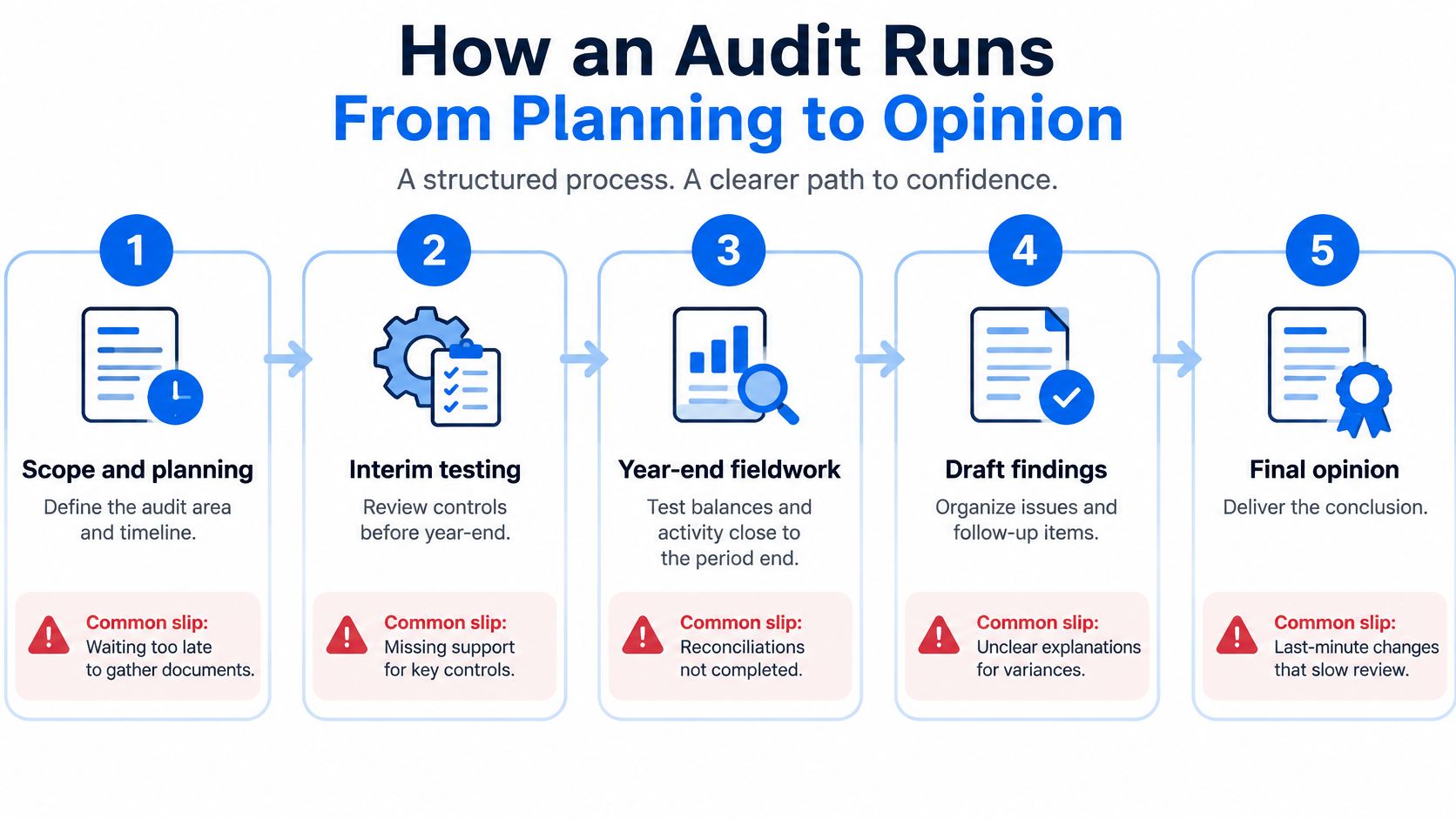
The phases and the evidence each needs
Scope and engagement letter. Management and the auditor establish the reporting framework, period, responsibilities, and expected timetable. Agree how requested documents will be listed, submitted, and tracked. A vague request such as revenue support creates avoidable follow-up; a request identifying the transaction, required evidence, and due date is actionable.
Planning and risk assessment. The auditor sets materiality and identifies areas requiring particular attention, such as revenue recognition, estimates, or unusual transactions. Materiality concerns errors that could influence a financial-statement user's decisions. Finance should understand the flagged accounts early enough to prepare accounting memos and supporting schedules.
Interim work. The auditor walks through processes and may test whether controls operated before year-end. A walkthrough follows a transaction through the process and checks who did what. If an approval workflow changed during the year, retain both versions and their effective dates rather than presenting the current process as though it always existed.
Year-end fieldwork. Auditors test balances and transactions, often using samples from ledger populations. They may inspect invoices, confirm balances with third parties, examine subsequent payments, and test whether activity belongs in the correct period. Scattered sample support and unfinished reconciliations slow this phase.
Completion and reporting. Management evaluates proposed adjustments, resolves outstanding questions, and signs a representation letter confirming specified responsibilities and representations. The auditor completes review procedures and issues the opinion. Control findings and management's responses should become tracked remediation items, not a document filed away until next year.
Evidence quality matters on both sides
Audit quality depends on more than whether management delivers a spreadsheet. The PCAOB's update on 2025 inspections reported that aggregate Part I.A deficiency rates across inspected firms fell to 23% in 2025 from 38% in 2024, involving significant shortcomings in audit evidence or compliance with relevant standards.
Inspections examine selected portions of engagements. Those figures don't mean that roughly a quarter of all audits are defective, or that the underlying financial statements were necessarily wrong.
Practical rule: A schedule is ready when someone other than its preparer can understand its source, calculation, reconciliation, and review.
Map your close calendar against these phases. Identify when each schedule becomes final, who approves it, and how subsequent changes will be communicated. Otherwise, the auditor may test one version while finance continues editing another.
A Worked Example With Round Numbers
Consider Northwind Services, a hypothetical company. Every figure below is illustrative, including the sampling choices and planning thresholds; none represents a mandatory audit rule or a customer result.
Northwind reports $2,000,000 in pre-tax income. Assume its auditor selects 5% of pre-tax income as the starting point for overall materiality.
Establishing the planning amounts
| Illustrative planning item | Calculation | Amount |
|---|---|---|
| Overall materiality | $2,000,000 × 5% | $100,000 |
| Performance materiality | $100,000 × 75% | $75,000 |
| Clearly trivial threshold | Assumed for this example | $5,000 |
Performance materiality is set below overall materiality to reduce the risk that undetected and uncorrected errors collectively exceed overall materiality. It helps determine the nature and extent of testing; it isn't a rule that auditors ignore transactions below that amount.
The clearly trivial threshold identifies amounts that ordinarily don't need to be accumulated for evaluation. As ISA 450 explains, clearly trivial isn't another name for immaterial, and the nature of an item can still require attention.
For this example, the auditor tests 25 vendor invoices from a population of 400 to assess errors in that population. Two errors appear, and the auditor extends testing. In practice, the response considers how the sample was selected, why the errors occurred, and whether they suggest a broader problem.
The combined error changes the conclusion
Testing identifies $60,000 of unrecorded accrued professional fees. The company received the services before year-end but hadn't recorded the expense and liability because the invoice arrived later.
The auditor also identifies a $50,000 revenue cut-off error. Cut-off means recording a transaction in the correct reporting period; Northwind recognized revenue before the relevant service was delivered.
Neither finding individually exceeds the assumed $100,000 materiality amount. Together, however, they total $110,000.
Don't assess each proposed adjustment in isolation. Several individually smaller errors can change the financial statements materially.
Management records the adjustments and updates the affected schedules. If management refuses and the remaining misstatement is material, the auditor may issue a qualified opinion; a more pervasive misstatement can require a different conclusion.
The Controller should investigate the underlying causes, not just post the entries. Review subsequent invoices for missing accruals, inspect service-completion evidence around year-end, and reconcile customer balances using an aging trial balance.
The 5% and 75% assumptions are illustrative planning choices, not fixed rules. The lesson is that auditors aren't hunting every dollar, but finance should identify and evaluate its own errors before audit testing does.
Preparing Your Records and Avoiding Common Mistakes
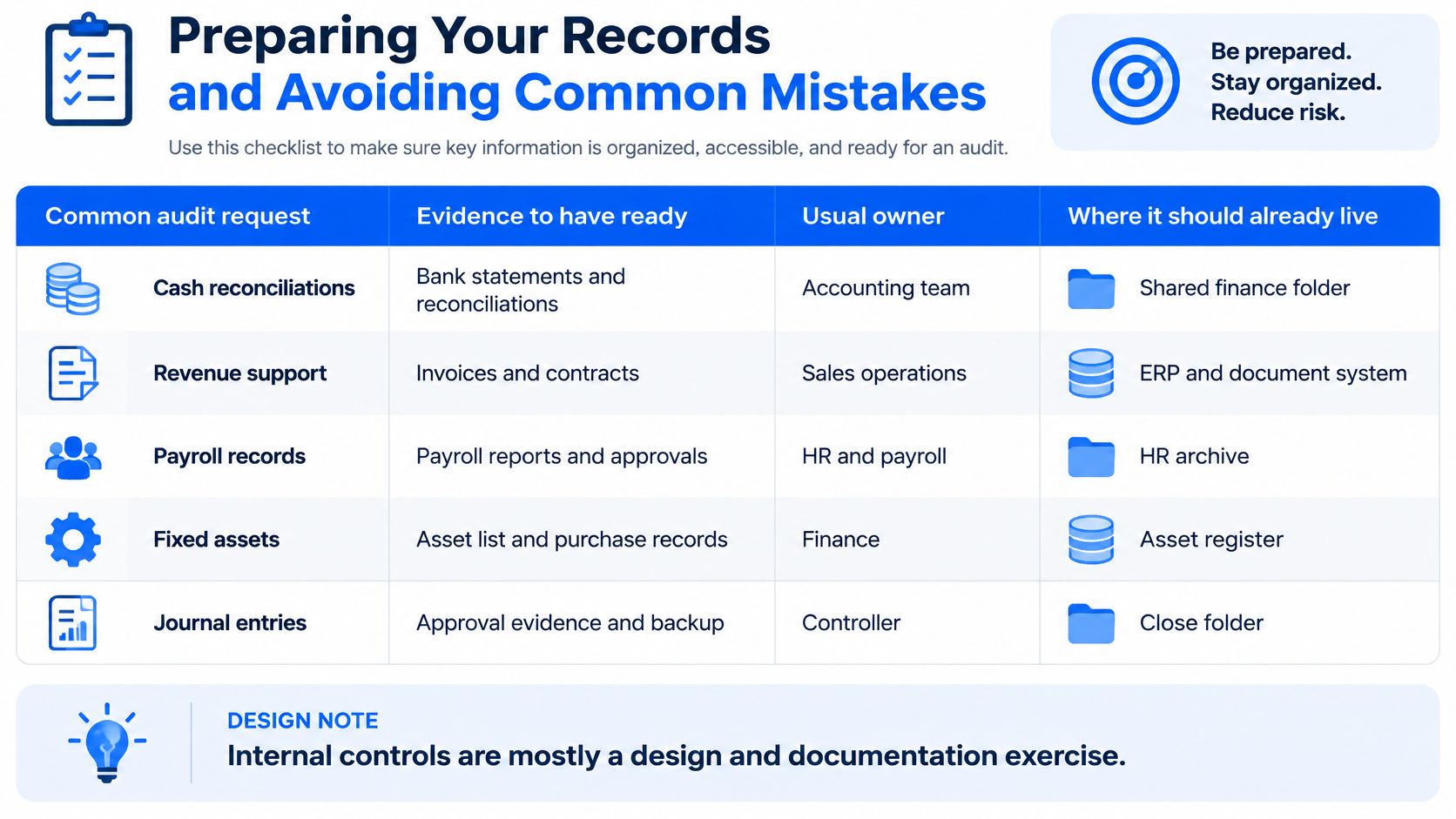
| Audit request | Evidence to have ready | Usual owner | Where it lives |
|---|---|---|---|
| Bank reconciliation | Signed reconciliation, bank statement and aged reconciling items | Accounting lead or Controller | General ledger and bank feed |
| Revenue sample | Contract, invoice, cash receipt and delivery or service proof | Accounts receivable lead | Billing system and customer records |
| Vendor payment sample | Invoice, purchase order, approval and payment record | Accounts payable manager | Accounts payable subledger |
| Journal entry testing | Entry, preparer, approver, support and posting date | Controller | General ledger audit log |
| Fixed asset additions | Invoice, capitalization memo and approval | Accounting manager | Fixed asset register |
| Period close | Close checklist with sign-offs and dates | CFO or Controller | Close calendar and task records |
Use this as a working checklist, not a reason to duplicate every record into another folder. Where attachments sit outside the accounting system, retain stable references and access permissions so a reviewer can retrieve the exact document supporting the transaction.
A bank feed alone doesn't prove a reconciliation was reviewed. Likewise, an invoice attachment doesn't prove the approver had authority or that the service was received.
Design the responsibility before configuring the workflow
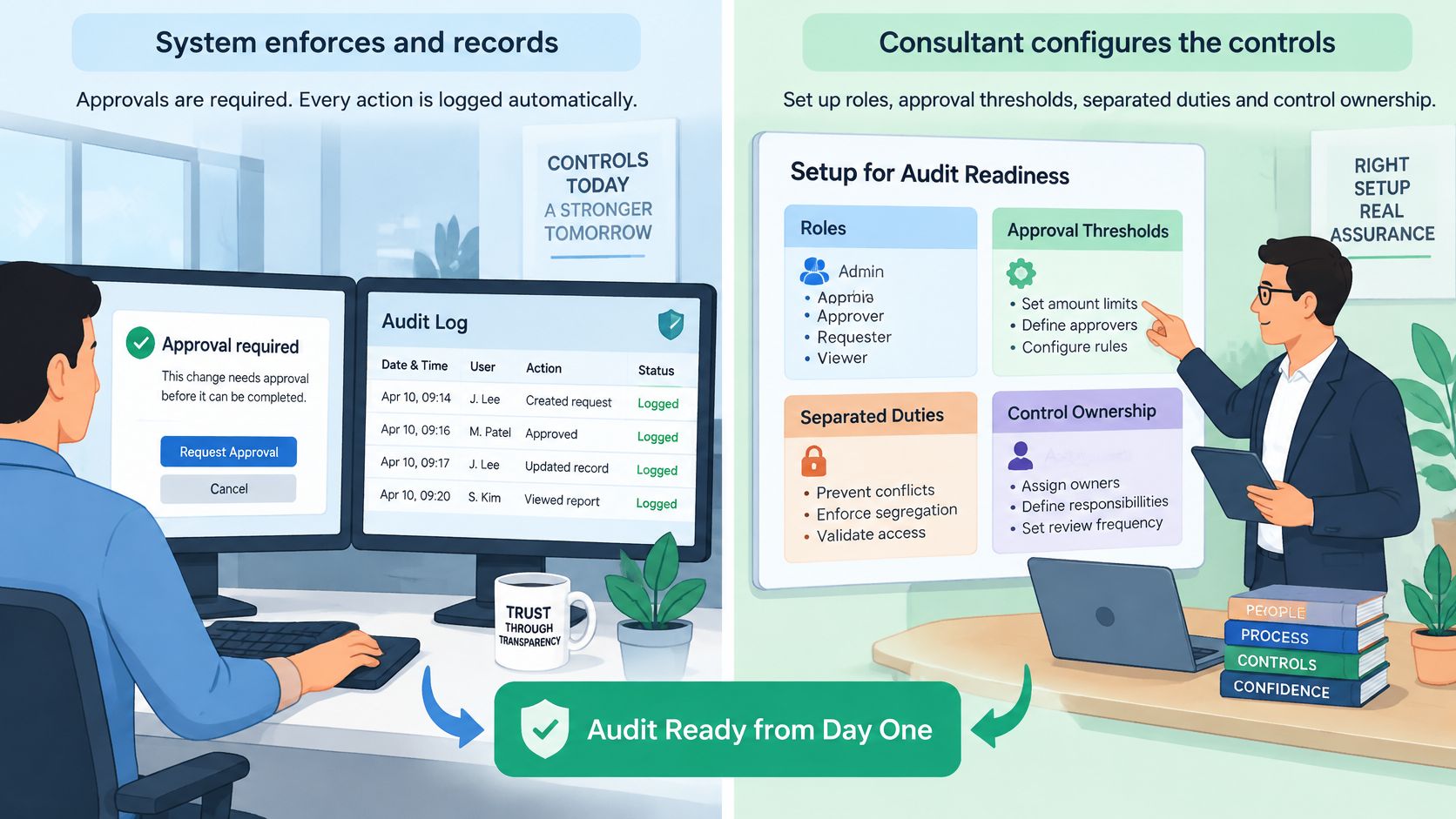
At Lucentive, we treat internal controls primarily as a design exercise about people, rather than software. Before configuration, establish who approves invoices, when a second approver is required, who can post to a closed period, and who can create a vendor.
The vendor onboarding process deserves particular attention because supplier creation and payment authorization shouldn't become an unchecked path for the same person. Document the control owner, backup reviewer, and escalation route when an exception occurs.
Historical reporting on audit deficiencies, including the comment letter hosted by the SEC, reinforces the importance of retaining evidence connecting accounting records and control activity. The useful operating response is a traceable chain from source transaction to entry, approval, reconciliation, and reported balance.
Mistakes that turn testing into reconstruction
Unexplained spreadsheet allocations. A workbook without a visible allocation basis forces the reviewer to reverse-engineer the result. Our recommendation is to configure defensible ledger allocation rules that run consistently and show their working. Retain the approved basis and review changes.
Email approvals without transaction context. An approval is weak evidence if nobody can establish which invoice version or amount the person approved. Preserve the decision with the transaction it authorized.
Manual adjustments after close without sign-off. Require support and approval for reopening a period or posting a late entry. Identify which reports need to be regenerated.
Access rights that don't reflect current roles. Review permissions when employees change responsibilities, leave, or gain access to additional entities. A new title doesn't automatically remove old privileges.
Assuming last year's controls still fit. Growth can introduce new locations, revenue arrangements, or grant restrictions. Reassess whether the existing reviewer has the information and capacity to perform the control.
Collecting evidence in the final week. Assemble reconciliation support and review sign-offs during each close. Retrospective explanations aren't equivalent to evidence that a control operated when intended.
Run a one-hour test: select three transactions and follow each from its source document to the reported balance. Treat missing approval, unresolved reconciliation differences, and inaccessible support as process defects to fix now.
Decide Whether Your Financial System Supports Audit Readiness
Software can enforce a configured approval and retain an activity log. It can't decide whether your delegation of authority makes sense, whether a reviewer is independent, or whether someone owns an unresolved exception.
That's the difference between buying software and implementing a control environment. The right implementation partner translates operating responsibilities into permissions, workflows, reporting, and testable evidence. A poor implementation can reproduce the old spreadsheet process inside a more expensive platform.
Require a demonstration, not a feature checklist
When choosing the right system, test realistic scenarios using your organization's structure. A demonstration should show the reviewer's work, not just the preparer's transaction-entry screen.
- Authority alignment. Confirm that approval routing follows the actual delegation of authority across entities and departments, including substitutes and escalations.
- Separated duties. Demonstrate that the person raising a transaction can't also release it where your control design prohibits that combination.
- Traceability. Follow a consolidated figure through entity balances to the underlying transaction and source document.
- Repeatable processing. Verify that recurring allocation rules produce inspectable calculations and retain controlled changes.
- Visible ownership. Show which close tasks are complete, which require review, and who is responsible for outstanding items.
- Controlled access. Test whether reviewers can inspect the necessary evidence without receiving unnecessary posting or administrative rights.
Our approach at Lucentive is to configure the authority, permission, and document relationships around the business's real operating model. The demonstration is only the start; acceptance testing should establish that those relationships still work with exceptions, corrections, and multiple entities.
Evaluate assurance and implementation effort
Ask any vendor for its current SOC report, an independent report concerning specified service-organization controls. Check its scope, covered period, exceptions, and the responsibilities it assigns to your organization with your auditor. Don't assume that a report exists at the level your auditor expects; our advice applies to Sage as well as any other vendor.
The commercial decision also needs a realistic implementation assessment. Consider data cleanup, integration responsibilities, staff availability, and the timing of go-live relative to close and audit commitments. These determine how quickly the team can use the system reliably, not when licenses become active.
An independent ERP selection discussion should distinguish problems your current system can solve through better configuration from limitations that justify replacement. The return should be framed around less evidence reconstruction, clearer control ownership, and a more manageable close, without assuming software alone will deliver those outcomes.
Summary
An audit provides independent, reasonable assurance about financial statements. External and internal audits serve different purposes, alongside compliance, operational, fraud-focused, and tax work. The process moves from scope and risk assessment through interim testing, year-end fieldwork, and reporting. Northwind's example shows why individually smaller errors must be evaluated together. Readiness depends on evidence retained during normal operations, clear responsibilities, and timely review. A modern ERP can support those practices, but a complete audit trail and the right partner-led implementation matter more than a list of software features.
Frequently Asked Questions
What's the difference between an internal audit and an external audit?
An external financial statement audit is performed by an independent firm that evaluates whether the statements are fairly presented. The auditor communicates with owners or those charged with governance, commonly the board or audit committee.
Internal audit examines whether controls and processes work as intended. An internal team or outsourced firm performs the work, supporting management while maintaining an appropriate reporting relationship with the audit committee. Its scope can include operational risks beyond financial reporting.
What does material mean in an audit?
A misstatement is material when it could influence a financial-statement user's decisions. Auditors establish overall materiality and use a lower performance-materiality amount to help plan testing and address the risk of errors accumulating.
Northwind's hypothetical example illustrates why separate findings must be evaluated together: the combined errors exceeded overall materiality even though neither did individually. The percentages used in that example are planning assumptions, not mandatory formulas or permission to ignore smaller errors.
Why do auditors ask for an audit trail?
An audit trail connects a reported amount to the transactions, documents, approvals, and reconciliations supporting it. Auditors need that connection to evaluate what happened, whether it belongs in the reporting period, and how management reviewed it.
For finance, the benefit is less reconstruction. When the evidence already sits with the transaction or has a stable reference, the team doesn't have to search old inboxes or ask employees to remember why they approved an item.
Does a clean audit opinion mean there's no fraud?
No. An audit provides reasonable assurance, not absolute assurance, and auditors don't examine every transaction. A clean financial statement opinion isn't a guarantee that misconduct hasn't occurred.
Fraud coverage needs complementary controls. Surprise procedures can make concealment harder, hotlines can surface behavioral concerns, and analytics can flag suspicious transactions between audits. Someone still needs to review exceptions, investigate concerns, and retain evidence; installing those mechanisms without assigning responsibility leaves an important gap.
Can accounting software alone make us audit-ready?
No. Software can route approvals and record activity, but people must establish authority, separated duties, control ownership, and exception handling. Implementation determines whether those decisions operate effectively in the system.
Evaluate the software through realistic transaction and review scenarios rather than a feature checklist. Also obtain the vendor's current SOC report and review its scope and relevant customer responsibilities with your auditor. A vendor's assurance report doesn't replace your own operating controls.
Lucentive helps finance leaders assess whether their systems and implementation approach support clear approvals, reliable reporting, and accessible audit evidence. Visit Lucentive to schedule a 30-minute working session focused on your close, approval map, and audit calendar, with a practical discussion of whether better configuration or a new ERP is the right next step.