Statutory accounting principles are the NAIC-based rules U.S. insurers use to report to state regulators and measure their ability to pay policyholder claims, while most other companies report under GAAP.
Your close may already be slow, with separate entity workbooks and adjustments nobody wants to touch. Add an insurance subsidiary, and a familiar question becomes harder: why does the regulator's capital number differ from the equity on the group's financial statements?
That difference can be correct. The finance team's job is to explain it through controlled reconciliations, not force the numbers to match. A properly designed cloud ERP implementation can support that work with entity-level books, documented adjustments, and a traceable reporting process, while specialist insurance systems handle calculations that don't belong in the general ledger.
Table of Contents
- What Statutory Accounting Principles Are and Who Uses Them
- Statutory Accounting Versus GAAP at a Glance
- How Admissibility Shapes Statutory Surplus
- Reporting Chain From Ledger to Regulator
- Common Mistakes That Create Statutory Errors
- Tracking SSAP Changes as a Moving Rulebook
- Confirm Which Rules Apply Before You Choose a Partner
- Summary
- Frequently Asked Questions
- Do I need statutory accounting principles if I run a manufacturing company?
- Is statutory surplus the same as GAAP equity?
- Why are some assets nonadmitted?
- How does the hierarchy decide which rule applies?
- How do statutory rules connect to risk-based capital?
- How do you keep up with SSAP revisions?
- Does an accounting system handle statutory reporting on its own?
What Statutory Accounting Principles Are and Who Uses Them
Few finance teams outside insurance will ever file a statutory statement. SAP applies to a defined group: insurers reporting to their state regulators, the holding companies that consolidate them, and the auditors and examiners who read the output.
The framework exists because the earlier approach did not hold together. The NAIC began its formal codification project in 1991 to pull scattered, incomplete statutory guidance into a consistent framework, according to NOLHGA's account of SAP codification. Codification gave regulators a basis for comparing insurers across states rather than interpreting disconnected practices company by company.
The working references are the Statements of Statutory Accounting Principles, or SSAPs, and the Accounting Practices and Procedures Manual. NAIC publications maintain that nationwide baseline, though individual states can prescribe practices that depart from it, so the SSAPs are the starting point rather than the last word.
GAAP works like a photograph of economic performance for investors; SAP works like a stress test of the balance sheet for the regulator. The comparison describes their priorities, and formal solvency testing goes further than any analogy.
SAP matters to:
- Insurers preparing annual and quarterly statutory statements.
- Holding companies consolidating insurance subsidiaries alongside GAAP reporting.
- Auditors, examiners, and other recipients who interpret statutory statements.
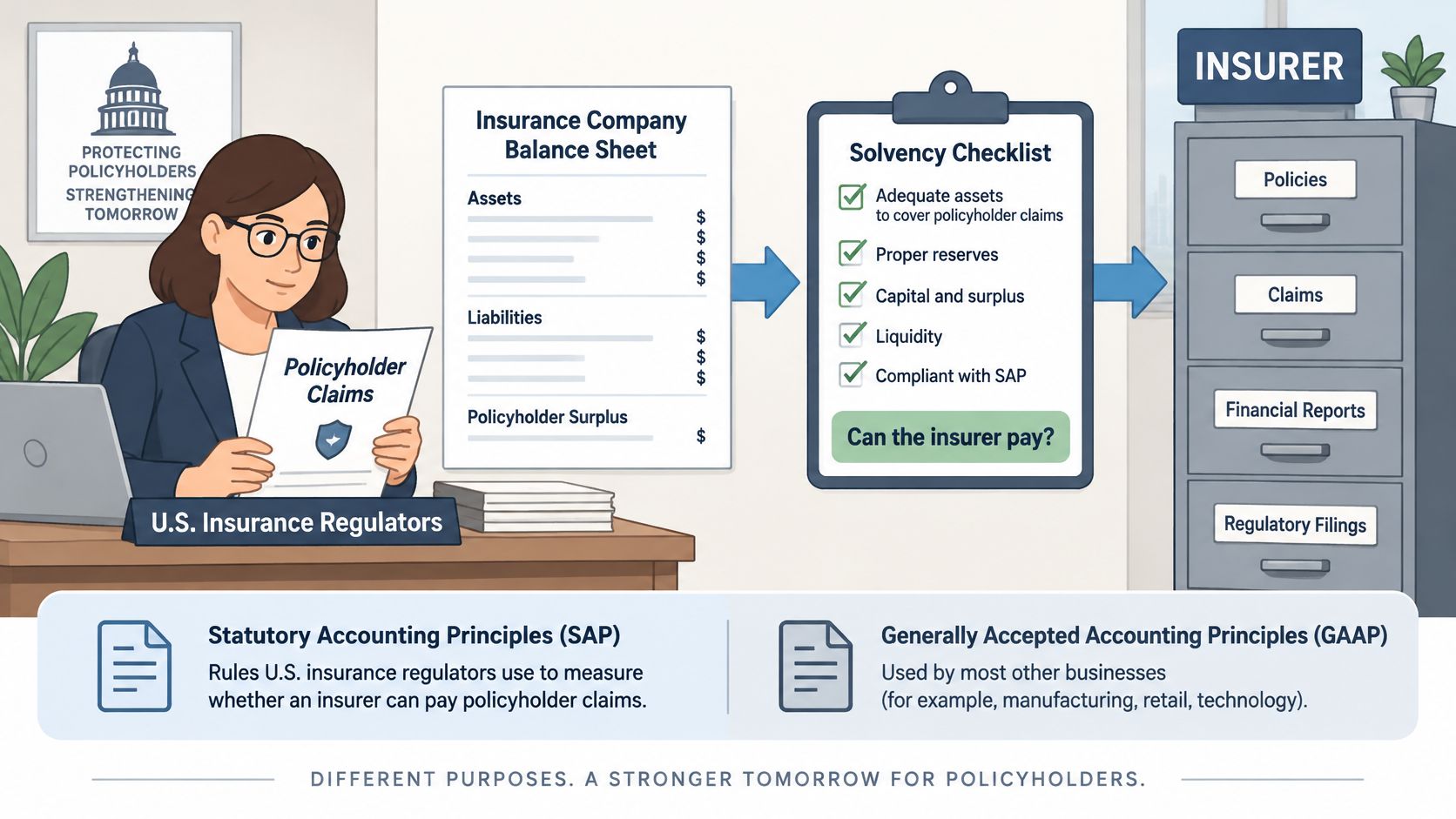
One group can owe both sets of statements at once: GAAP for consolidated reporting, SAP for the insurance subsidiary. Teams building the reporting side can find delivery case material under financial sector projects with Ekipa, and Lucentive's financial services accounting software covers the multi-entity ledger context those reports draw on.
The quick self-check: if none of your entities write insurance, SAP is generally context for your work, not a filing obligation.
Statutory Accounting Versus GAAP at a Glance
| Topic | Statutory accounting principles (SAP) | GAAP |
|---|---|---|
| Governing body | NAIC SSAPs and Accounting Practices and Procedures Manual, adopted by states | FASB Accounting Standards Codification |
| Primary purpose | Measure solvency and ability to pay policyholder claims | Show economic performance and financial position for investors |
| Main users | State regulators, examiners, auditors | Investors, lenders, analysts, other outside users |
| Asset treatment | Admitted only if available to satisfy policyholder claims; others nonadmitted | Recognized when recognition criteria are met; no equivalent claim-paying availability test |
| Policy acquisition costs | Generally expensed as incurred | Generally deferred and amortized for qualifying costs |
| Headline capital measure | Statutory surplus | Shareholders' equity |
| Reporting output | Annual and quarterly statutory statements in NAIC formats | GAAP financial statements |
| Change management | Revisions treated as accounting changes under SSAP No. 3 | Applicable accounting standards updates |
Reading rule: the same transaction can produce different equity figures under the different frameworks. That gap is intentional, not automatic evidence of a posting error.
For example, an insurer can incur costs to acquire a policy whose benefits extend into future periods. GAAP may recognize qualifying deferred acquisition costs and amortize them, while SAP generally recognizes the acquisition expense sooner. The timing difference changes the reported result without changing the underlying cash payment.
Different questions produce different measurements
The CFO wants to understand the business's economic performance. The regulator wants to know whether the insurer has resources available to meet policyholder obligations. Neither question disappears because the other has been answered.
That distinction matters when management reviews capital. A healthy GAAP balance sheet doesn't establish that every asset counts toward statutory surplus. Likewise, a statutory adjustment doesn't necessarily mean an asset has no economic value.
Practical rule: don't describe statutory surplus as GAAP equity with a more conservative label. Build and maintain the reconciliation between them.
Accounting frameworks also matter when interpreting documents outside insurance. Lighthouse Consultants' discussion of comparing accounting standards for financial disputes offers context for why the applicable framework matters, although it addresses IFRS and UK GAAP rather than U.S. insurance SAP.
Keep the scope narrow
This comparison concerns U.S. insurance statutory accounting. It doesn't mean an ordinary manufacturer, healthcare practice, or nonprofit should replace its existing reporting framework with SAP.
GAAP remains the usual framework for the companies in that group that prepare GAAP financial statements. Other reporting bases may also apply depending on their circumstances, so confirm the actual obligation rather than assume every business must produce the same statements.
SAP isn't a simpler or cheaper alternative to GAAP. For an insurance group, statutory reporting can sit alongside GAAP reporting, which means the accounting design must preserve differences rather than erase them during consolidation.
How Admissibility Shapes Statutory Surplus
A household budget might distinguish cash available tonight from the value of a house that could take months to sell. SAP applies a related discipline: is this asset available to satisfy policyholder claims?
Under SSAP No. 4, assets unavailable because of encumbrances, third-party interests, or limited liquidity are generally nonadmitted, as explained in the NAIC's statutory accounting principles guidance. Nonadmitted amounts receive limited or no statutory balance-sheet value and reduce surplus unless a specific exception applies.
A hypothetical balance-sheet reconciliation
The following example uses $ millions and assumes no liability differences or other GAAP-to-SAP adjustments. Its nonadmission amounts are illustrative assumptions, not blanket rules for every asset in those categories.
Illustrative balance sheet under GAAP and SAP ($ millions, hypothetical)
| Balance sheet item | GAAP carrying value | Admitted under SAP | Difference |
|---|---|---|---|
| Cash and investments | 80 | 80 | 0 |
| Premiums receivable | 10 | 9 | 1 |
| Furniture and equipment | 2 | 0 | 2 |
| Deferred acquisition costs | 3 | 0 | 3 |
| Other assets | 5 | 5 | 0 |
| Total assets | 100 | 94 | 6 |
| Liabilities | 70 | 70 | 0 |
| Equity (GAAP) or statutory surplus (SAP) | 30 | 24 | 6 |
Start with 100 of GAAP assets. In this scenario, the preparer determines that 1 of premiums receivable, 2 of furniture and equipment, and 3 of deferred acquisition costs don't qualify for statutory recognition.
Subtract those assumed exclusions, totaling 6, and admitted assets become 94. Subtract the unchanged liabilities of 70, and statutory surplus is 24, compared with GAAP equity of 30.
The receivable assumption illustrates why a balance needs review below the account-total level. Some receivables may qualify while others don't; the category name alone doesn't establish admissibility.
Furniture can support daily operations without providing readily available claim-paying resources. Deferred acquisition costs can represent future economic benefits without representing assets available to settle claims. Restricted investments may present a different issue: an otherwise valuable asset can be unavailable because another party has rights over it.
The reconciliation finance owns
An asset-by-asset admissibility reconciliation should contain:
- Ledger reference: the entity, account, supporting balance, and source record.
- Applicable guidance: the relevant SSAP and any state-specific treatment.
- Availability assessment: liquidity, restrictions, encumbrances, and third-party interests.
- Conclusion and adjustment: admitted amount, nonadmitted amount, rationale, preparer, and approval.
Pay particular attention to deferred acquisition costs, certain receivables, unconsolidated investments, and furniture and equipment. Don't assume all investments qualify or all receivables fail.
Good data quality assurance makes this repeatable: reconcile supporting records to the ledger, identify missing attributes, and resolve unexplained differences before preparing the filing.
An asset can be economically useful and still fail the statutory availability test.
Run this calculation on your own trial balance before the first statutory filing. A late discovery isn't just a reporting inconvenience; management may have been making capital decisions using the wrong starting point.
Reporting Chain From Ledger to Regulator
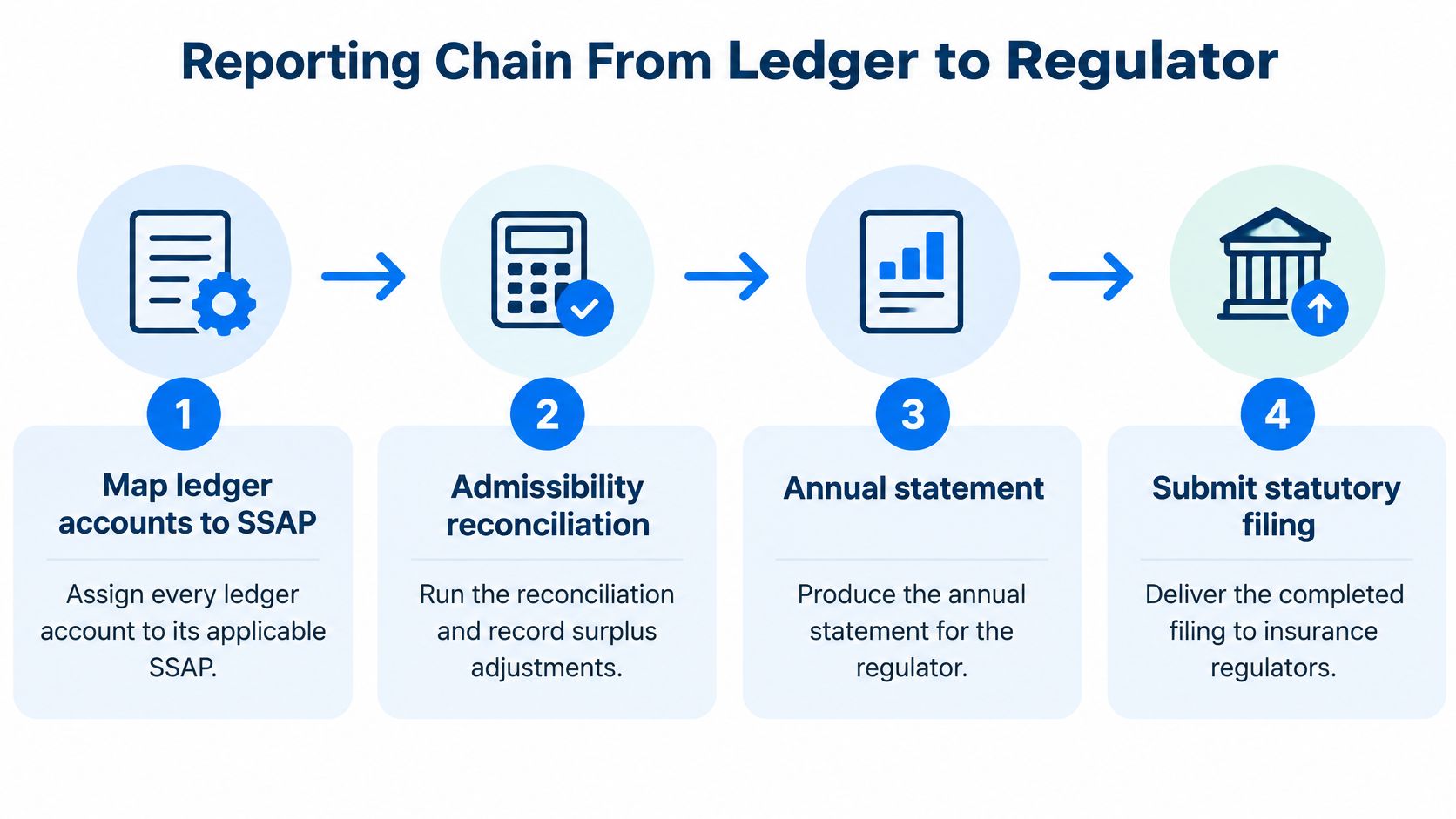
A regulatory number should have a traceable route from its source record through the statutory statement. Organize that route around clear responsibilities rather than a workbook that only its creator understands.
- Map ledger accounts to SSAPs. Identify the applicable treatment and retain supporting conclusions where an account contains different transaction types.
- Perform the admissibility reconciliation. Record approved statutory adjustments and reconcile the resulting surplus.
- Prepare statutory statements. Populate annual and quarterly statements in the applicable NAIC formats, supported by reconciled schedules.
- Use statutory values in RBC calculations. Reconcile the capital-reporting inputs and complete the applicable regulatory submission process.
Why the capital calculation depends on accounting
The NAIC defines risk-based capital, or RBC, as a statutory minimum capital requirement determined by an insurer's size and the inherent risk of its financial assets and operations. RBC calculations use statutory annual-statement amounts and, where practical, align with statutory accounting and reserving practices.
That creates a direct connection between accounting decisions and capital oversight. A reduction in admitted assets or surplus can increase RBC pressure even when GAAP equity appears stable.
Accurate classification matters on the risk side too. Investment categories, reserves, underwriting exposures, and off-balance-sheet risks need consistent treatment so management receives a reliable solvency signal.
The Controller should therefore reconcile statement inputs to both the general ledger and actuarial reserving schedules. The risk team shouldn't have to reconstruct the accounting team's adjustments after close.
What belongs in the accounting system
A cloud ledger such as Sage Intacct maintains separate financials per entity while automating consolidation, including currency conversion, inter-entity transactions, and local tax reporting. A sound implementation should also preserve the mapping, adjustment, and approval history needed to support reporting.
That doesn't make a general ledger an actuarial platform. Reserve calculations and other specialist insurance functions typically remain in dedicated tools, with controlled interfaces carrying approved results into accounting.
When evaluating ERP for financial services firms, define the system boundary before configuration. The ledger, investment records, actuarial schedules, and filing process each need named owners and agreed reconciliation points.
For architecture context, Cleffex Digital ltd.’s financial data platform development guide is a separate resource for discussing platform design. Pair technical architecture discussions with a documented record-to-report process flow so teams agree on who prepares, reviews, and releases each output.
Before close, test the effects of investment impairments, reserve changes, catastrophe exposure, and premium growth. Review both the accounting adjustment and its capital-reporting consequences, rather than treating the statutory statement as the end of the process.
Common Mistakes That Create Statutory Errors
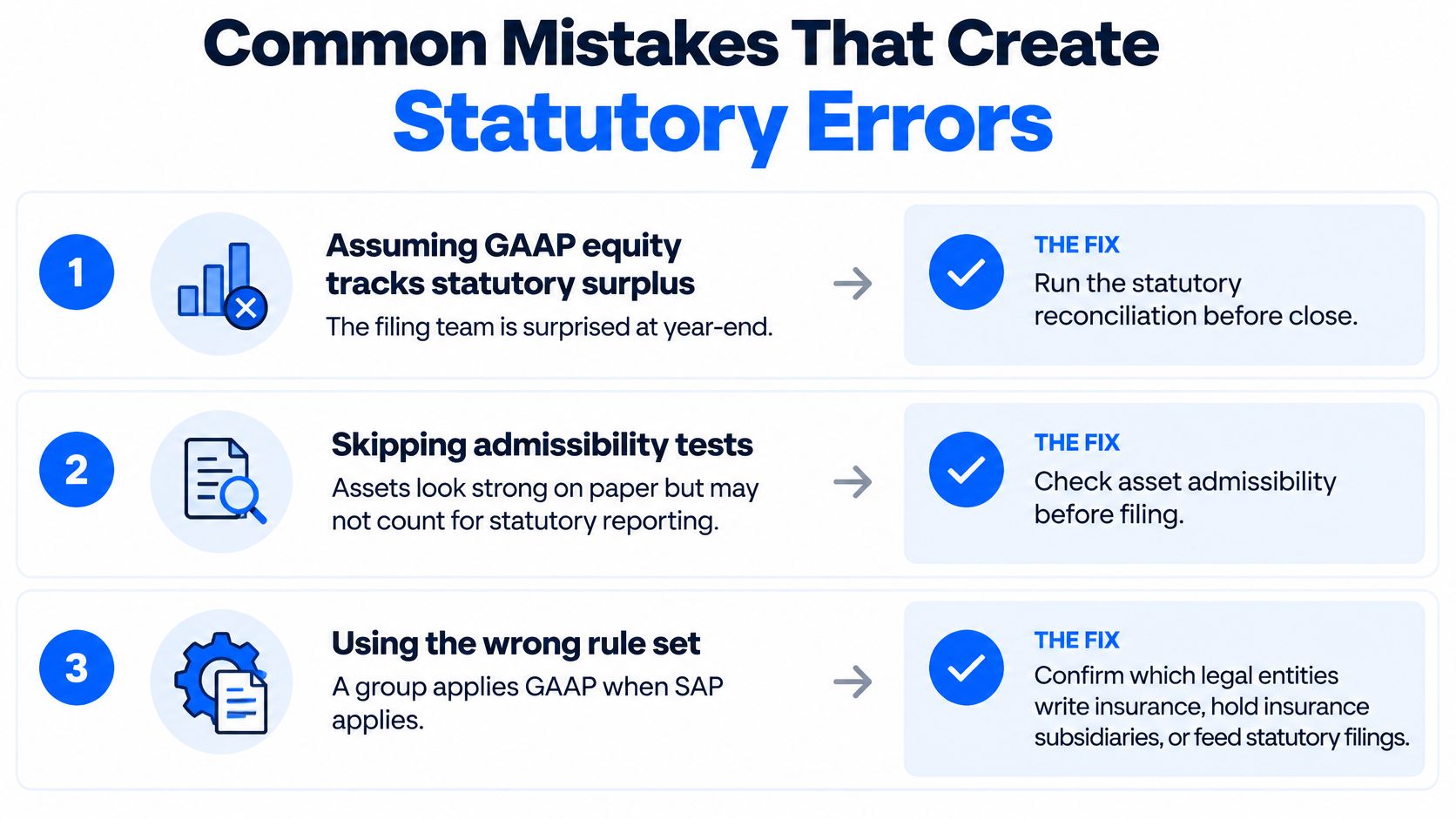
A costly mistake is discovering near filing that management's capital expectations were based on GAAP balances alone. Use this checklist to find weak controls before the reporting deadline.
Assuming GAAP equity tracks statutory surplus. Run the admissibility bridge monthly so the filing team isn't explaining an unexpected gap at year-end. Assign an owner to unresolved differences and carry forward the supporting explanation, not just the adjustment total.
Copying deferred acquisition costs into statutory reporting. Review the balance for the applicable expensing or nonadmission treatment before loading it into a statutory reporting package. A successful import only proves that the software transferred the number, not that the number belongs there.
Make the accounting conclusion traceable
The NAIC Accounting Practices and Procedures Manual places SSAPs at the highest level of authoritative statutory guidance, gives precedence to higher-level sources when guidance conflicts, and addresses revisions as accounting changes under SSAP No. 3. Internal policies should implement that hierarchy, not replace it.
Keeping judgments in unversioned spreadsheets. Retain dated guidance references, approvals, and effective periods alongside account mappings. A reviewer should be able to distinguish the current conclusion from a superseded one without asking the preparer.
Treating silence as a free policy choice. Check the statutory hierarchy and document the applicable reasoning when an SSAP doesn't directly address a transaction. Don't assume a familiar GAAP treatment automatically controls.
Ignoring state-prescribed differences. Include the relevant state requirements in the entity's accounting policy and filing checklist. A national template still needs a jurisdiction-specific review.
Lucentive advises that allocation rules configured in the ledger are defensible because they run consistently and show their working, unlike an uncontrolled spreadsheet. That principle supports financial reporting automation, but automation doesn't make an incorrect rule correct.
- Waiting for an SSAP revision's effective date. Use the change register described below to assess reporting and system impacts before implementation.
Audit-readiness test: if you can't trace a filed figure to its source entry and the rule governing it, the process isn't yet audit-ready.
Tracking SSAP Changes as a Moving Rulebook
An SSAP revision works like a software release. It has a version, an effective date, and a list of things that stop working the old way. The master copy is the Accounting Practices and Procedures Manual, where adopted SSAPs are maintained. Read each adopted update as a potential change to your regulatory data model: what the ledger must capture, which balances remain admissible, and how surplus is calculated.
The NAIC's 2026 working-group summary describes adopted revisions addressing securities-lending restricted assets, including collateral received with a liability for its return, and an extension of guidance on net-negative interest maintenance reserves through December 31, 2027. Topics like these reach past accounting conclusions into the data behind them. A restricted-asset revision can change which balances qualify, and an interest maintenance reserve extension can change what your investment systems must feed the statutory schedules.
A single adopted sentence can force new fields.
Maintain a controlled change register
- Log the revision. Record its adoption, effective date, affected SSAP, and responsible reviewer.
- Map the blast radius. Trace the affected legal entities, ledger accounts, disclosure schedules, and RBC inputs. Include upstream investment or operational records, not only the final report.
- Document the accounting conclusion. Assess treatment under SSAP No. 3 and retain the rationale and approvals.
- Size the implementation. Decide whether the revision needs new ERP fields, mappings, interfaces, or reports, or whether a governance update covers it.
- Run a parallel close before the effective date. Compare outputs, investigate differences, and validate the first live filing afterward.
The output should be a one-page change register owned by the Controller and reviewed with the CFO before each filing. Supporting analysis sits behind it.
The register also keeps the running reconciliation between statutory surplus and GAAP equity honest, because each revision can move admissibility, valuation, or both. The decision point is practical. If the revised rule requires information your source systems don't capture, you have systems work. If the information already exists and the treatment is unchanged, the work stays with documentation, review, and disclosure controls. Hold off on a system change until the accounting team has identified the actual gap.
Confirm Which Rules Apply Before You Choose a Partner
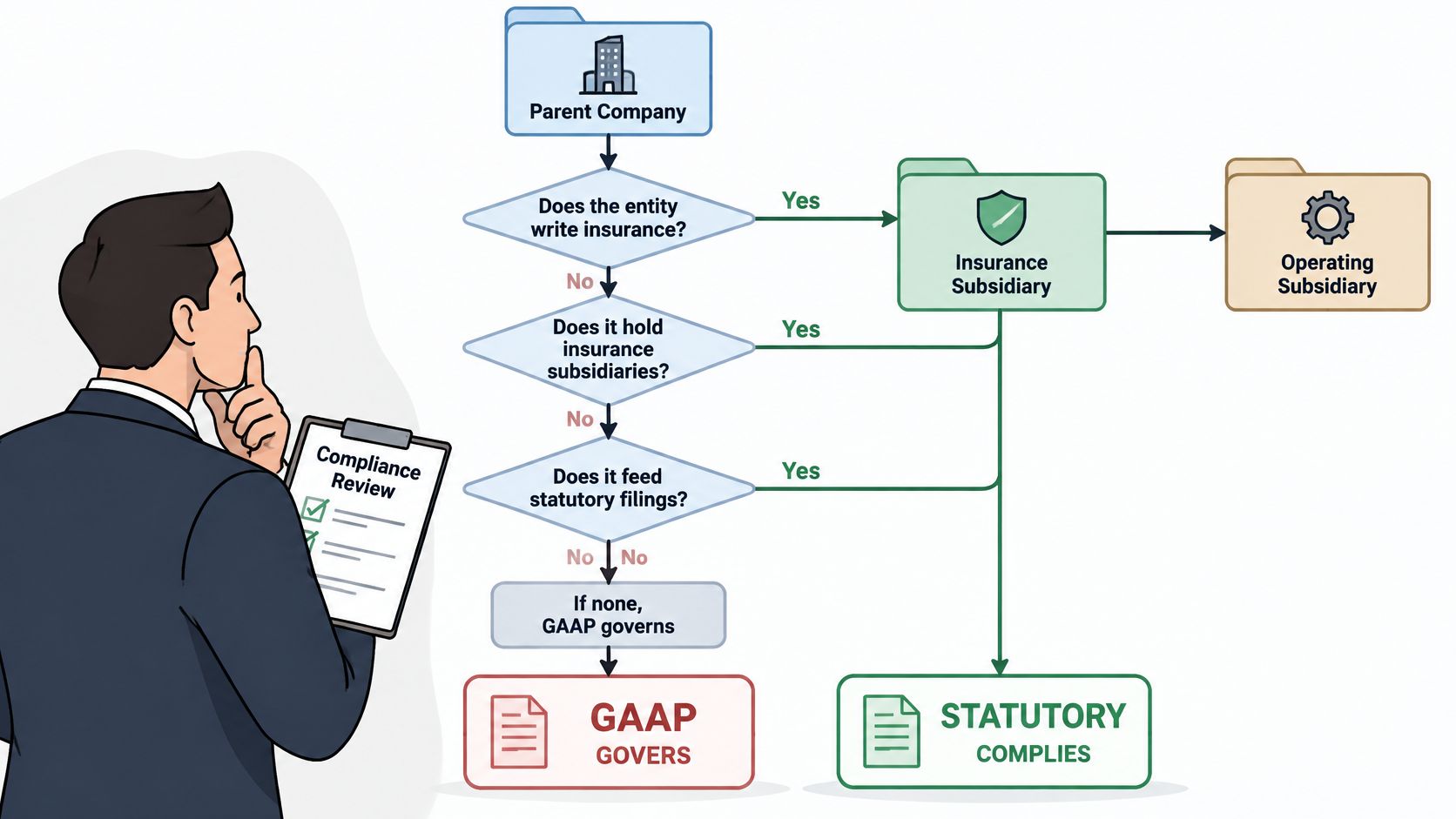
A group can run five legal entities and owe statutory filings for only one. Start by listing every entity and marking which ones write insurance, hold insurance subsidiaries, or feed statutory filings. If none do, plan around your applicable general-purpose reporting framework, usually GAAP, instead of building an SAP process no regulator will read.
If one does, settle the boundary before you compare vendors. The general ledger runs the entities it owns, while premium, reserve, and actuarial calculations stay in the specialist platforms built for them. Agree on which figures cross that boundary, in which direction, and at what grain, because the answer shapes the chart of accounts, the consolidation logic, and every reconciliation standing behind the surplus figure.
Bring evidence to the selection discussion
- Accountability: a named owner for SSAP changes and named source-data owners.
- Accounting design: an account-to-SSAP map and documented judgments for transactions the codification leaves unaddressed.
- Testing: a parallel-run plan completed before applicable effective dates.
Lucentive's financial services accounting software can supply numbers for regulatory filings, but it doesn't file returns itself or replace fund administration. We decide early which entities belong in the ledger and which stay in specialist systems.
Lucentive, a Sage Intacct Value Added Reseller and Premier Implementation Partner, starts ERP software selection consulting with those same boundaries, and the assessment may conclude that a different setup fits better. Software alone won't settle an unclear reporting obligation or an unowned reconciliation.
Summary
Statutory accounting principles are the NAIC-based rules U.S. insurers use to assess claim-paying ability, while most companies report under GAAP. The frameworks differ in authority, purpose, asset admissibility, acquisition-cost treatment, and capital measurement. In the hypothetical example, GAAP equity of 30 becomes statutory surplus of 24 because 6 of assets are nonadmitted. Finance teams need a controlled chain from ledger mapping through statutory statements to RBC inputs. Unversioned spreadsheets, copied GAAP balances, and unmanaged SSAP revisions weaken that chain. Confirm entity obligations and specialist-system boundaries before choosing accounting software or an implementation partner.
Frequently Asked Questions
Do I need statutory accounting principles if I run a manufacturing company?
Usually not. SAP is the U.S. insurance regulatory reporting framework, while most manufacturers prepare general-purpose financial statements under GAAP. The deciding factor is legal-entity structure. A group that writes insurance or holds an insurance subsidiary owes statutory reporting for that insurer, while its operating entities continue under GAAP.
Is statutory surplus the same as GAAP equity?
No. The gap is deliberate regulatory design. In the hypothetical example, one balance sheet produces GAAP equity of 30 million and statutory surplus of 24 million, because 6 million of assets are nonadmitted while liabilities stay unchanged. Regulators want surplus to measure resources available for policyholders, so assets that cannot be converted quickly are excluded. Other accounting differences can widen or narrow the gap in an actual insurer's reconciliation.
Why are some assets nonadmitted?
Admissibility asks whether an asset can realistically satisfy policyholder claims. Limited liquidity, encumbrances, or third-party interests can disqualify it. Deferred acquisition costs and furniture and equipment show that economic usefulness does not establish statutory admissibility. The practical work finance teams own is an asset-by-asset reconciliation: assess each balance under its applicable guidance, document the conclusion, and avoid assuming every item inside a broad ledger category receives identical treatment.
How does the hierarchy decide which rule applies?
SSAPs rank highest within the statutory accounting hierarchy. When no SSAP directly addresses a transaction, preparers consider other established statutory guidance, and when sources conflict, the higher-level source takes precedence. Retain a dated conclusion identifying the guidance, reasoning, and approval. Silence in the rulebook is a research question that deserves a documented answer.
How do statutory rules connect to risk-based capital?
RBC calculations draw amounts from statutory annual statements and reflect an insurer's size plus the risks of its assets and operations. Conservative SAP treatment can reduce admitted assets or surplus and increase capital pressure even when GAAP equity appears stable. Accurate classifications and reconciled inputs let finance and risk teams evaluate the solvency signal rather than debate inconsistent source numbers.
How do you keep up with SSAP revisions?
Treat the rulebook as a moving data model. An SSAP revision can change how a balance is classified, admitted, or measured, so a mapping that was correct last year can produce a different statutory result this year. Keep a versioned log of which guidance governs each account, and update ledger mappings when the NAIC adopts a revision, before the next reporting period closes.
Does an accounting system handle statutory reporting on its own?
Not usually. A general ledger can maintain entity-level books, support consolidation, and preserve mappings and approval history when properly configured, while actuarial reserving typically belongs in a specialist platform. Define during implementation where calculations occur, how approved values enter accounting, who reconciles them, and who completes the filing. The ledger supplies reconciled inputs to the submission and serves as one component of the reporting chain.
Lucentive offers independent ERP selection and implementation advice grounded in your entity structure and reporting responsibilities. Visit Lucentive to schedule a working session with our team to map your reporting chain, separate ledger requirements from specialist insurance work, and decide which setup fits before you commit to software.