It's the second week of the month and your Controller is still reconciling a workbook that pulls from three systems and a shared drive. The ledger is closed, in theory. The numbers your CEO wants aren't. That gap, between recorded transactions and decision-ready reporting, is where accounting software either helps you run the business or slows it down. Judge it by its reporting architecture and close readiness, not by its feature list.
Table of Contents
- Where Accounting Software Stops Being a Bookkeeping Tool
- The Four Layers Every Accounting Platform Needs
- How Needs Differ Across Organization Types
- What to Evaluate Before You Shortlist Systems
- Software Alone Versus a Partner-Led Selection
- Summary
- Frequently Asked Questions
Where Accounting Software Stops Being a Bookkeeping Tool
Bookkeeping often fails without obvious signs. Invoices still post, bills still get paid, bank accounts still reconcile, and yet the Controller spends days nine through thirteen exporting entity reports, rekeying intercompany entries, and checking whether this month's spreadsheet formula matches last month's version. Leadership gets its pack late, and the forecast discussion runs on figures nobody fully trusts.
That pattern is common. A comparison of Sage Intacct and QuickBooks notes that finance teams on QuickBooks often spent much of the month-end close working in spreadsheets.
What the System Actually Has to Be
Accounting software is the system of record for the general ledger, subledgers, approvals, the close and reporting. Transaction entry is the smallest part of that job. The gap usually appears at the second entity, currency, grant or project: the ledger keeps recording while reporting falls back to workbooks, so management numbers arrive late and forecasts run on stale data.
For a CFO, the cost is concrete. Skilled finance hours go to assembling data instead of analyzing it, and executives discount consolidated figures they cannot trace back to a source. Teams evaluating QuickBooks Online against a larger platform should measure that delay before they compare license fees.
The difference between financial services and general accounting software shows up in the second month, when the consolidated close either runs or turns back into a workbook.
If your close already depends on work outside the ledger, start with choosing the right system before you compare product demos.
The Four Layers Every Accounting Platform Needs
Think of a platform as four stacked layers. If any layer is weak, your team rebuilds it in spreadsheets.
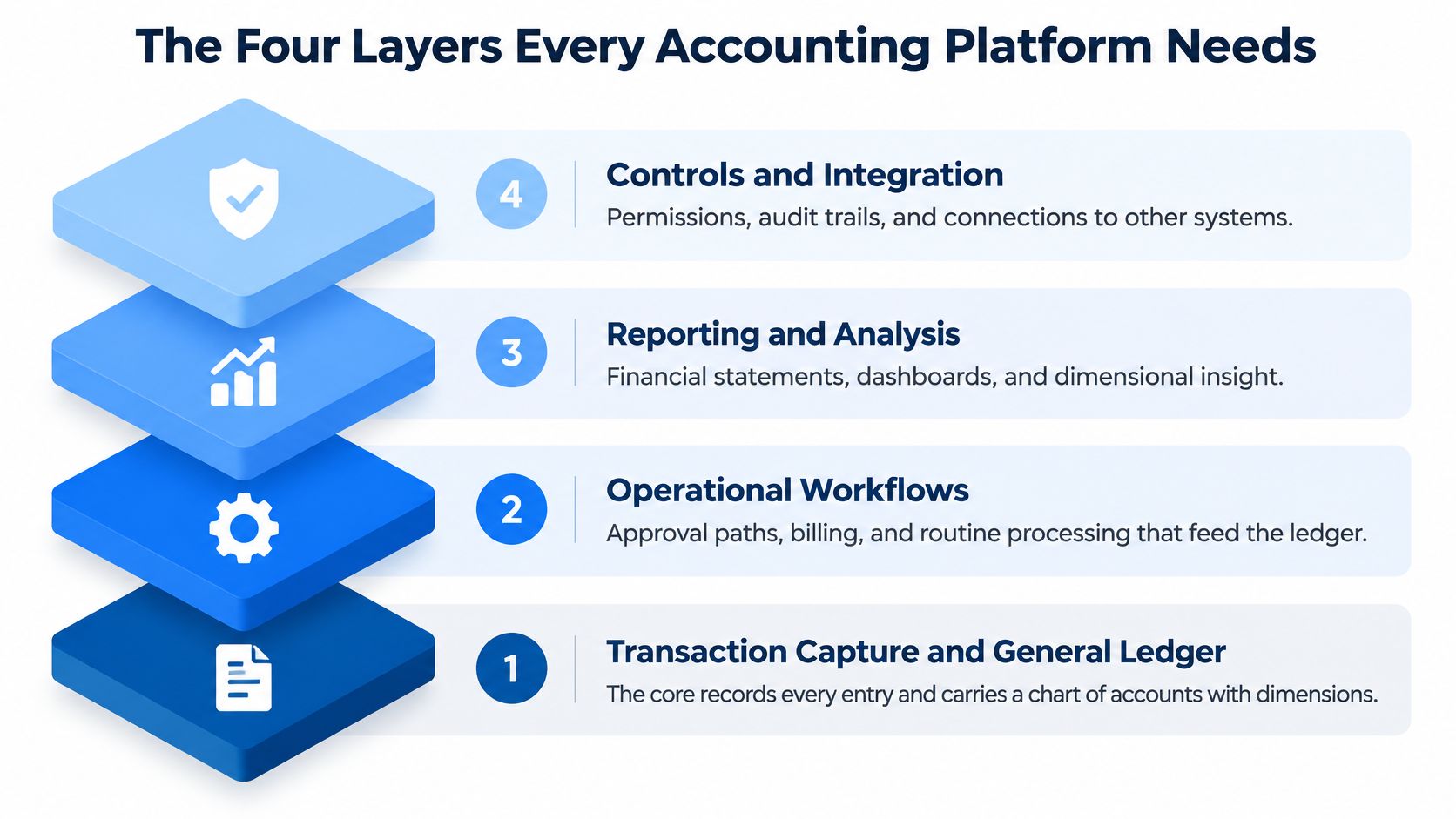
Layer one is transaction capture and the general ledger. Your chart of accounts must carry dimensions such as entity, department and location without forcing a new account for every combination. For example, one rent account tagged by location beats twelve rent accounts that nobody codes consistently.
Layer two is the subledgers. Payables, receivables, fixed assets, payroll journals and bank reconciliation feed the ledger directly. If open items live elsewhere, the close can't finish inside the system. This layer also has to handle cases such as multi-currency accounting cleanly when you transact across borders.
Controls, Then Reporting
Layer three is controls and workflow. Approval routing should follow your real delegation of authority. Role based permissions, segregation of duties and an audit trail recording who changed what and when protect both cash and credibility. NIST guidance on access control and auditability provides a useful reference when you test permissions and logs.
Automation belongs here, not as unattended posting. Route high confidence classifications straight through, send low confidence or unusual items to a reviewer, and use correction rates to tune thresholds. That keeps judgment where error costs most.
Layer four is consolidation, close management and reporting. Multi-entity statements, intercompany eliminations, budget versus actual and dashboards should read the same live ledger as statutory reports. The FASB's consolidation guidance offers useful context when evaluating how a system handles entities and eliminations; its standards resource is a starting point for checking applicable U.S. GAAP requirements. A platform can list every feature and still fail at close if these layers aren't configured together.
| Capability | Verdict | Why it matters |
|---|---|---|
| General ledger with entity and department dimensions | Must have | Every later report depends on it |
| AP, AR and bank reconciliation subledgers | Must have | The close cannot finish with open items outside the ledger |
| Approval routing and audit trail | Must have | Shows who changed what and when |
| Multi-entity consolidation with intercompany eliminations | Must have once a second entity exists | Manual roll-ups create labor and control risk |
| Close management and sign-off tracking | Must have | Keeps the close inside one system |
| Budget versus actual dashboards | Must have for growth-stage reporting | Reads the same live ledger as statutory reports |
| Confidence-based automation of classification | Can wait | Adopt once review thresholds can be measured |
| Advanced forecasting or planning add-ons | Can wait | Build after the close is reliable |
Treat each row as a question to put to any vendor during a demo.
How Needs Differ Across Organization Types
Organizations differ less by headcount than by what the system must represent. Entities, locations, funds, projects and payer streams each stress a different part of the design. Find your row below, then use the right hand column as the first test to run in a demo.
| Organization type | Core need | What breaks first on a basic system |
|---|---|---|
| Multi-entity mid-market company | Consolidation with intercompany eliminations | Manual spreadsheet roll-ups and separate entity files |
| Healthcare provider or multi-site clinic group | Location and payer dimensions, EMR integration | Location-level margin not visible, practice system data reconciled by hand |
| Nonprofit or faith-based organization | Fund accounting and grant tracking, including reporting net assets with and without donor restrictions | Restricted funds tracked off the ledger |
| Professional services firm | Project accounting, time and expense capture, mixed billing | Project margin known only after the project closes |
| Dental practice or dental service organization | Location reporting and consolidated view across sites | Site-by-site comparison built manually each month |
| Franchisor | Percentage-based billing across a franchisee network | Royalty calculations maintained in spreadsheets |
Where the Burden Shows Up First
The multi-entity row carries the highest stakes. Forvis Mazars guidance on outgrowing QuickBooks identifies multi-entity consolidation as a common sign an organization has outgrown QuickBooks, noting each entity requires a separate instance and subscription, data must be exported and manipulated outside QuickBooks or through a third party solution, and intercompany transactions require manual entry.
That work compounds. Your team maintains separate records, verifies mappings, and confirms eliminations before group results can go out. It's labor capacity and control risk, not just inconvenience. Evaluating multi-entity accounting software means testing whether that roll up happens inside one ledger.
Dimensions answer these questions directly. They're tags carried by every transaction, such as entity, location, department, fund, strategy, vehicle or adviser, so reports by those categories come from the same ledger.
One edge case deserves honesty. A two entity company with one currency and no intercompany activity may not need full consolidation on day one. It should still confirm the system can add it later without a rebuild.
What to Evaluate Before You Shortlist Systems
Don't score vendors on scripted demos. Score them on your data, your entities and your close.
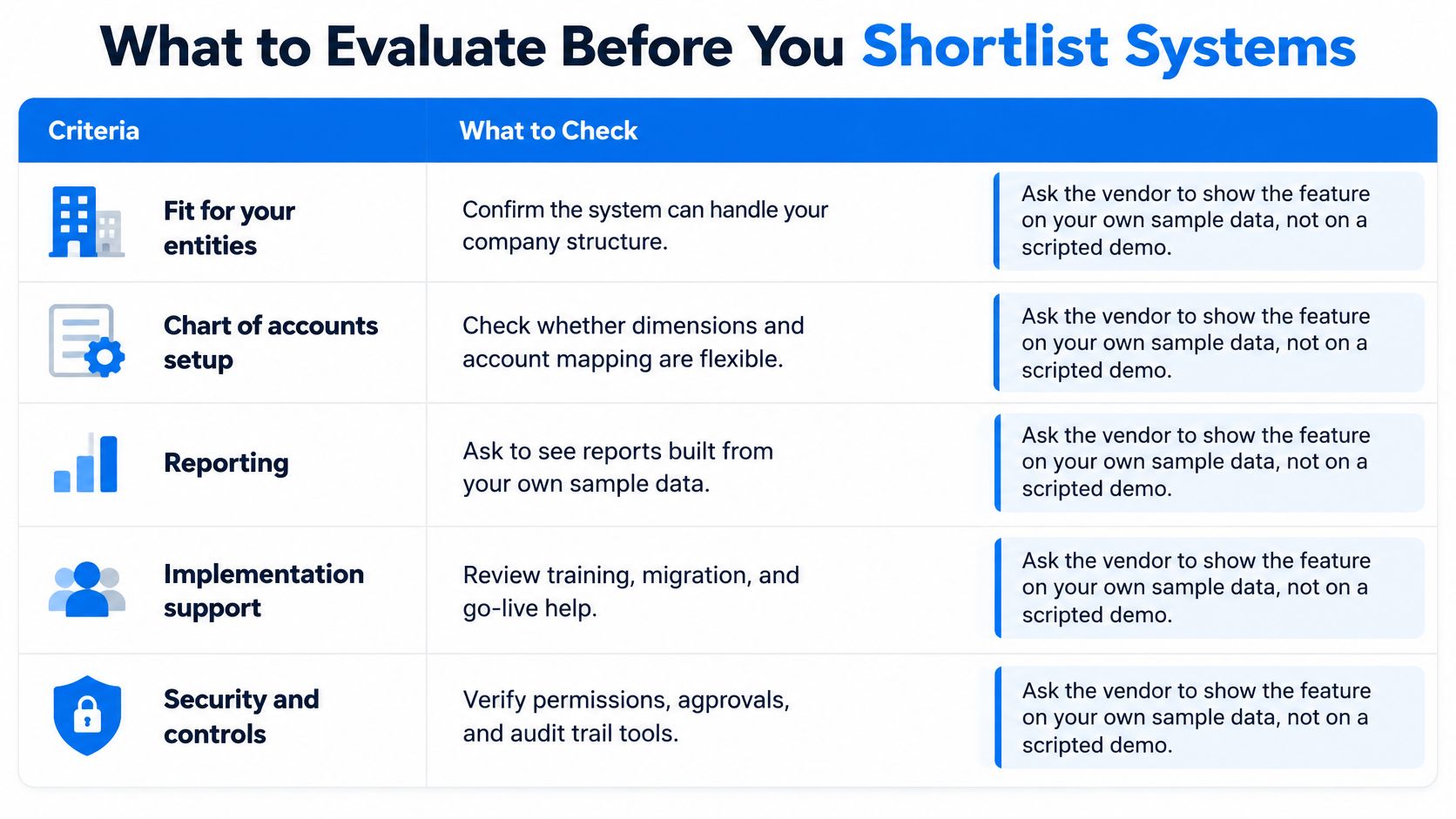
| Criterion | What to verify | Red flag in a demo |
|---|---|---|
| Multi-entity structure | Parent-child entities, intercompany entries and eliminations run inside one ledger | Consolidation built from exported spreadsheets |
| Reporting dimensions | Entity, location, department, fund or project tagged on every transaction | Reports only by account, no custom dimensions |
| Close workflow | Reconciliations, accruals and sign-off tracked in the system | Close checklist kept in a separate spreadsheet |
| Approvals and audit trail | Approval rules match real delegation of authority; every change logged with user and time | Approvals by email, edits with no log |
| Automation controls | Confidence-based routing, review queues, reversal and sampling of auto-posted entries | Unattended posting with no review path |
| Integrations | Named owner and field-level mapping for EMR, payroll, billing or CRM systems | Vague claim of native integration with no field list |
| Data migration | Opening balances, history and mapping tested before go-live | Migration treated as a one-weekend import |
| AI governance | Written policy on what data may go into AI tools and who reviews outputs | No policy, AI features switched on by default |
Run Three Tests, Not Thirty Questions
Run a sample close. Use two entities and one intercompany transaction. Eliminations, approvals and the audit trail should all appear in the same run, on your sample data. Our approach supports audit readiness through approval workflows matching your real delegation of authority, separated duties, and an unbroken path from a consolidated figure back to its source document.
Test automation as a control. Ask to see a confidence based review queue, a reversal of an auto-posted error, and reporting on sampling of auto-posted entries. If the vendor can't show the correction path, you don't have a control. You have a shortcut.
Governance test: ask for a written policy on which data may go into AI tools, including payroll and bank data, and name who approves AI generated reconciliations before they post. The NIST AI Risk Management Framework provides a useful structure for assigning responsibility and managing AI risks.
Assign integration and migration ownership. Confirm who owns field level mapping for EMR, payroll or billing systems after go-live. Test opening balances, history and chart of accounts mapping before cutover, not on the final weekend. An ERP readiness assessment checklist helps sequence that work, and a reference check with a buyer of similar size and structure tells you whether it held up.
Software Alone Versus a Partner-Led Selection
Say a four entity group buys a capable platform, keeps the vendor's default chart of accounts, and migrates two years of history from separate QuickBooks files. In the first close, intercompany balances don't tie. The software was sound. The design decisions on dimensions, opening balances and the close calendar went to an internal team that was already stretched thin.
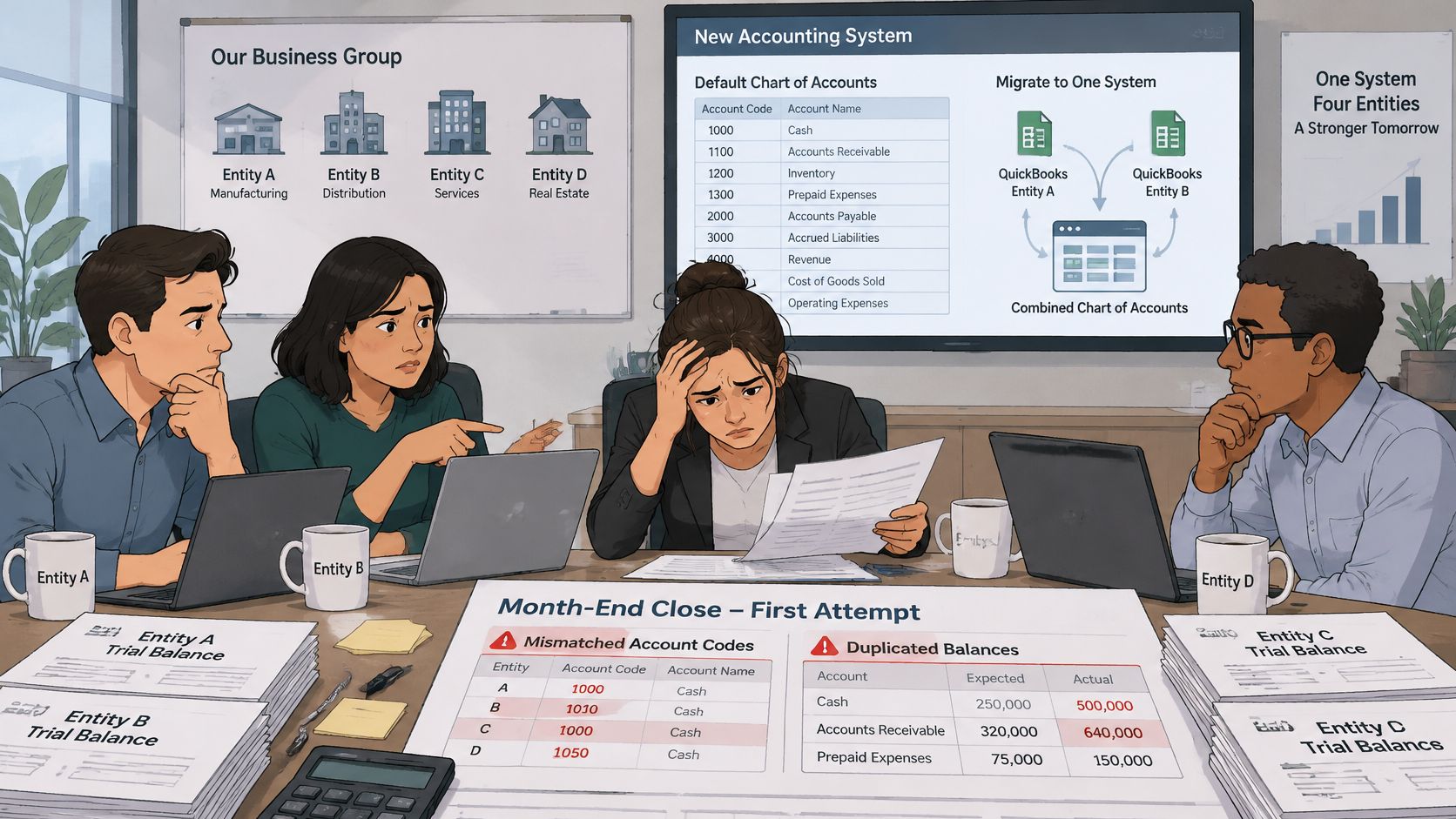
An implementation led path looks different. Requirements come from your actual close. Dimensions are designed before migration, opening balances are reconciled and tested, and a parallel close runs before go-live. Governance then covers new entities, reporting changes and training, so month two doesn't undo month one.
A Practical Decision Test
A partner conversation is worth having before purchase if any of these sound familiar.
- Several entities or locations: consolidation and eliminations are part of every close, not a year end exercise.
- Reporting by fund, location or project: dimensional design will decide whether reports are trustworthy.
- Migration from fragmented files: opening balances and history need testing, not just importing.
- No spare internal capacity: your team can't design, test and close at the same time.
Software alone may suffice when requirements are documented, your team has run implementations before, and scope is one entity with standard reporting. Don't buy advisory help you don't need.
Lucentive works as a Sage Intacct National Premier Partner with deep mid-market, healthcare and nonprofit experience, and we tailor the approach when no standard setup fits. An honest assessment should be willing to recommend staying where you are. If you proceed with us, the advisory fee is credited against implementation.
Frame the decision in close days and reporting delay rather than feature counts. Working with an ERP software selection consultant only pays if it shortens time to a close you can defend.
If you'd like an independent view before you shortlist, here's the next step for choosing the right system. Schedule a 30-minute working session with our team to review your close, entity structure and the criteria above, and decide whether a platform comparison makes sense for your company.
Summary
A long close built on spreadsheets signals that accounting software has become a constraint, not just an inconvenience. The right platform works as the system of record across four layers, from the dimensional general ledger through subledgers, controls and consolidated reporting. Needs vary by entity, fund, location and project structure, so evaluate consolidation, dimensions, close workflow, approvals, automation controls, integrations, migration and AI governance on your own data. Software alone leaves critical design decisions with your team. Test those decisions before you buy, and get independent help when capacity or complexity demands it.
Frequently Asked Questions
What Does Accounting Software Do Beyond Bookkeeping
It serves as the system of record for the general ledger, subledgers, approvals, the close and reporting. Bookkeeping records transactions. A complete platform also routes approvals under your delegation of authority, maintains an audit trail, manages reconciliations and sign off, consolidates entities with eliminations, and produces budget versus actual reporting from the same live ledger. Those four layers working together are what turn recorded data into numbers executives can act on during the month, not after it.
When Does a Business Outgrow QuickBooks
The clearest signs are a slow close and reporting that lives in spreadsheets. A Sage survey reported that many finance executives using QuickBooks took up to 14 days to complete the month-end close. Multi-entity growth sharpens the problem, because each entity needs a separate instance and subscription, consolidation happens outside the system, and intercompany activity is entered by hand. When your team spends its time assembling data instead of analyzing it, the tool has become the constraint.
Which Features Matter Most for a Multi-Entity Company
Start with dimensions tagged on every transaction, parent child entity structure inside one ledger, intercompany entries with automated eliminations, and consolidated reporting that doesn't depend on exports. Add approval routing matched to your real delegation of authority and a complete audit trail, so any consolidated figure traces back to its source document. Test all of it in one sample close using two entities and one intercompany transaction on your own data before you shortlist any vendor.
Should We Buy Accounting Software Alone or Work With a Partner
Buy alone when requirements are documented, scope is a single entity with standard reporting, and your team has implementation experience and time. Involve a partner before purchase when you have several entities, fund, location or project reporting, a migration from fragmented files, or no capacity to design and test the close. A good advisor may recommend staying where you are. A 30-minute working session on your close and entity structure is a reasonable, low pressure next step.
If your close still depends on spreadsheets, Lucentive can help you assess your reporting architecture, compare platforms fairly, and design an implementation your team can run. Schedule a 30-minute working session with our team to review your entity structure and close process, and leave with a clear view of fit before you commit to any system.